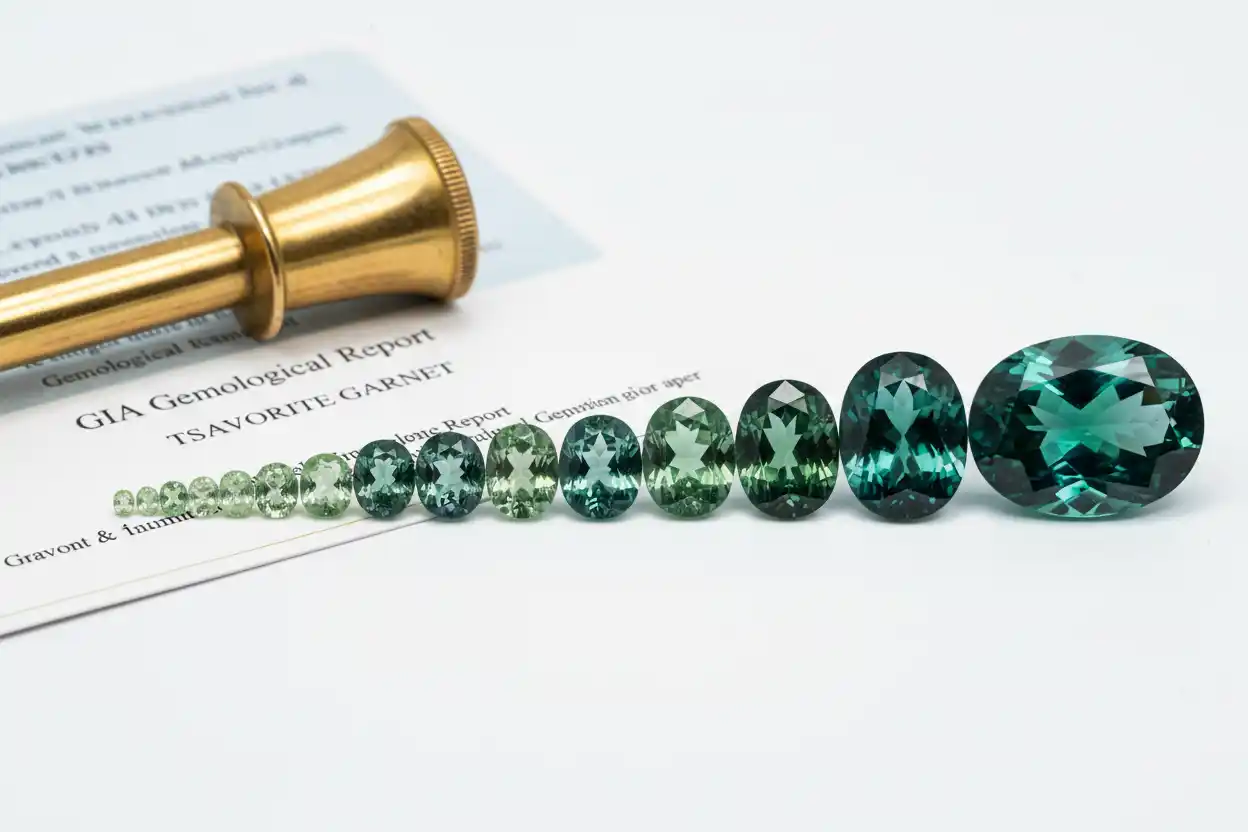
Tsavorite Price Guide: Value and Cost in 2026
Tsavorite prices in 2026 commonly range from approximately $200 to $5,000 per carat. Small pale or included stones may cost below $500 per carat, while fine vivid-green gems between one and three carats commonly reach $1,000 to $4,000 per carat.
Exceptional stones above three or five carats can exceed $5,000 per carat. Rare top-color, eye-clean gems with strong cutting and credible East African provenance may reach $8,000 to $15,000 per carat.
Tsavorite Price per Carat in 2026
| Tsavorite quality | Typical characteristics | Approximate 2026 retail price |
|---|---|---|
| Entry commercial | Pale yellow-green, dark, included, windowed or very small | $100–$400 per carat |
| Good commercial | Attractive green, visible inclusions and competent cutting | $400–$1,200 per carat |
| Fine | Vivid grass-green or slightly blue-green, good transparency and cut | $1,000–$3,000 per carat |
| Premium | Strong saturation, eye-clean appearance and rare two- to five-carat size | $2,500–$6,000 per carat |
| Exceptional collector quality | Top color, rare clean size above five carats and important provenance | $5,000–$15,000+ per carat |
Current July 2026 valuation examples commonly place attractive one- to three-carat Tsavorites around $1,000 to $2,500 per carat. The highest tiers apply to much rarer combinations of large size, vivid color and transparency.
The broader relationship among color, size and rarity appears in How Gemstone Prices Are Determined.
What Is Tsavorite?
Tsavorite is the green variety of Grossular Garnet.
Vanadium creates much of its green color, while chromium may also contribute.
The stone ranges from light spring green and yellowish green to vivid grass green, blue-green and dark forest green.
Tsavorite was discovered in East Africa and named after the Tsavo region of Kenya.
The completed Tsavorite guide owns its mineralogy, discovery history, geology and traditional symbolism.
This page focuses on its 2026 market without duplicating the family-wide Garnet Price Guide.
Color Is Tsavorite’s Main Value Factor
Fine Tsavorite should show vivid green color without becoming overly dark, yellow or gray.
Medium to medium-dark tone generally provides the strongest balance between saturation and brilliance.
A slight blue component can be highly desirable, creating a rich emerald-like green. However, the stone should remain recognizably Tsavorite rather than appearing dark teal or nearly black.
Pale yellow-green stones occupy the lower market. Dark forest-green gems can also lose value when extinction hides their brilliance.
Color must be judged under ordinary indoor light as well as daylight-equivalent illumination. Dark backgrounds and concentrated spotlights can make an average stone appear richer than it looks when worn.
The tracker’s Garnet Quality and Grading Guide owns the family-wide grading framework.
Vivid Green vs Dark Green Tsavorite
Vivid green receives the strongest broad demand.
The ideal stone should remain open and luminous through the center. Dark edges are acceptable in deep stones, but large black areas reduce value.
A dark five-carat Tsavorite can cost less per carat than a vivid two-carat gem.
Yellow secondary color also affects the price. Spring-green stones may be bright and attractive, though the strongest premiums usually belong to more saturated neutral-to-blue green.
A seller’s labels such as emerald green, forest green or neon green are not standardized grades.
Videos should show rotation because one still frame may hide extinction, zoning or a pale central window.
Clarity and Inclusions
Tsavorite commonly contains natural inclusions.
Possible features include crystals, needles, fingerprints, healed fissures, tubes and reflective particles.
The market accepts moderate inclusions because vivid transparent rough is scarce. However, fine stones should remain visually lively.
Eye-clean Tsavorite receives a strong premium, particularly above one or two carats.
Open fissures and fractures near the girdle create greater concerns than small enclosed crystals. They may affect setting durability and increase the risk of chipping.
Dense inclusions can produce a sleepy or cloudy appearance. Such material belongs to a lower tier even when the body color is strong.
Tsavorite Is Normally Untreated
Routine heat treatment is not established as a standard part of the Tsavorite market.
Its natural green color generally reaches the market without heating, irradiation or oiling.
This untreated norm distinguishes Tsavorite from Emerald, where clarity enhancement is widespread.
A seller should still disclose any known filling, coating or unusual treatment. Untreated should not be used as though it were an exceptional premium claim because it is expected for most natural Tsavorite.
Misidentification presents a greater concern than enhancement. Green glass, synthetic Garnet, Chrome Diopside, Tourmaline and other stones can imitate its appearance.
Cut Quality
Tsavorite has high brilliance and can look exceptionally lively when properly cut.
Ovals, cushions, rounds and pears are common. Emerald cuts are less frequent because they can show inclusions and sacrifice brilliance.
A shallow pavilion produces a transparent window. Excessive depth can make the stone dark and face up small for its weight.
Fine cutting should distribute green reflections across most of the face.
Rounds may command a premium because they require more rough loss. Cushions and ovals often provide better weight retention.
The complete stone-selection process belongs to the Tsavorite Buying Guide.
Tsavorite Prices by Carat Weight
| Carat weight | Commercial quality | Fine quality | Exceptional quality |
|---|---|---|---|
| Under 0.50 ct | $100–$600 per carat | $500–$1,500 per carat | $1,000–$2,500 per carat |
| 0.50–1.00 ct | $250–$900 per carat | $750–$2,000 per carat | $1,500–$3,500 per carat |
| 1–2 ct | $400–$1,200 per carat | $1,000–$3,000 per carat | $2,000–$5,000 per carat |
| 2–3 ct | $600–$1,800 per carat | $1,500–$4,000 per carat | $3,000–$7,000 per carat |
| 3–5 ct | $800–$2,500 per carat | $2,500–$6,000 per carat | $5,000–$10,000 per carat |
| Above 5 ct | Individually evaluated | Rare collector market | $7,500–$15,000+ per carat |
Tsavorite becomes much rarer above two and three carats. Fine stones above five carats belong to a small collector market.
Why Large Tsavorite Is Rare
Tsavorite forms under geological conditions that often produce fractured and heavily included crystals.
Many pieces of rough are too small or structurally unsuitable for faceting.
Cutting removes additional weight, especially when the cutter must avoid dark areas or inclusions.
As a result, small stones are available for accent jewelry, while clean multi-carat centers become difficult to replace.
This scarcity creates a steeper size curve than ordinary red Garnet.
The family-wide Garnet Price Per Carat Guide owns broader calculations across Garnet varieties.
Kenyan Tsavorite Prices
Kenya is the locality most closely associated with the Tsavorite name.
Deposits around the Tsavo region have produced vivid green material, including fine transparent stones.
Commercial Kenyan gems may cost several hundred dollars per carat. Fine one- to three-carat stones commonly reach $1,000 to $4,000 per carat.
Rare large and clean stones can enter substantially higher tiers.
Kenyan origin supports provenance but does not guarantee quality. Pale, overly dark and fractured material also occurs.
A premium should follow visible color, cut and clarity rather than the country name alone.
Tanzanian Tsavorite Prices
Tanzania is historically important because green Grossular was first identified there before commercial promotion of the Tsavorite name.
The Merelani, Lemshuko and related East African regions have produced vivid green crystals.
Fine Tanzanian Tsavorite competes directly with Kenyan material.
Commercial-to-fine stones commonly range from several hundred to several thousand dollars per carat.
Exceptional stones with strong saturation, rare size and traceable provenance can reach the premium market.
Visual quality usually outweighs the Kenya-versus-Tanzania distinction for ordinary retail buyers.
Madagascar and Other Sources
Madagascar produces some green Grossular Garnet, though Kenya and Tanzania dominate Tsavorite’s market identity.
Small occurrences have also been reported elsewhere.
A non-East-African origin should not be rejected automatically if the mineral identity and color are correct.
However, exotic or unusual origin claims require credible documentation when they increase the price.
The Tsavorite trade name is applied based primarily on green vanadium- or chromium-bearing Grossular appearance rather than one exclusive country.
Tsavorite vs Emerald Prices
Tsavorite and Emerald can overlap in vivid green color.
Emerald is green beryl and normally contains visible inclusions. Fine Emerald can cost thousands or tens of thousands of dollars per carat.
Tsavorite commonly offers greater brilliance, less routine treatment and stronger toughness at a lower price.
The complete identification boundary belongs to Tsavorite vs Emerald.
Current Emerald pricing appears in the Emerald Price Guide, while the completed Emerald guide owns its mineral identity.
Exceptional Tsavorite can cost more than low-quality or heavily treated Emerald, although top Emerald occupies the higher market.
Tsavorite vs Demantoid
Tsavorite is green Grossular, while Demantoid is green Andradite Garnet.
Demantoid has stronger dispersion and can show distinctive horsetail inclusions.
Tsavorite often provides richer green body color and greater availability in clean stones around one carat.
Fine Russian Demantoid can cost substantially more because of provenance, dispersion and scarcity.
Current market tiers appear in the Demantoid Garnet Price Guide.
The comparison should account for variety rather than treating all green Garnets as one price category.
Tsavorite vs Other Garnets
Ordinary Almandine, Pyrope and many red Garnets cost far less than Tsavorite.
Rhodolite offers pink-red and purple-red color at a lower price. Its market appears in the Rhodolite Garnet Price Guide.
Spessartite occupies the orange Garnet market, with current pricing in the Spessartite Garnet Price Guide.
Tsavorite’s premium comes from vivid green color, scarcity and strong brilliance rather than the Garnet family name alone.
Tsavorite Jewelry Prices in 2026
| Jewelry type | Broad U.S. retail range |
|---|---|
| Silver jewelry with small commercial Tsavorite | $100–$600 |
| Gold earrings or pendant | $600–$5,000 |
| One-carat Tsavorite ring | $1,500–$8,000 |
| Two- to three-carat fine ring | $5,000–$25,000 |
| Five-carat premium Tsavorite jewel | $25,000–$100,000+ |
| Signed high-jewelry piece | Individually evaluated |
Matched earrings can command premiums because both stones must align in hue, saturation, size, clarity and cut.
Style-specific selection belongs to the Tsavorite Ring Guide, Tsavorite Earrings Guide, Tsavorite Necklace Guide and Tsavorite Bracelet Guide.
Fine Tsavorite also appears among practical options in Green Gemstones for Engagement Rings and the broader Green Gemstones guide.
Durability and Care
Tsavorite has a Mohs hardness of approximately 7 to 7.5 and generally good toughness.
It is suitable for rings, although exposed corners, thin girdles and existing fractures remain vulnerable.
Warm water, mild soap and a soft brush provide a safe cleaning method.
Steam and ultrasonic cleaning should be avoided when fractures or filling are present.
Complete maintenance instructions belong to How to Clean Tsavorite Jewelry Safely.
Certification and Appraisal
Most small commercial Tsavorite does not require an expensive report.
Documentation becomes more useful when:
- The stone exceeds two or three carats
- Exceptional vivid color creates a premium
- Geographic provenance matters
- Natural versus synthetic identity is uncertain
- Filling or unusual treatment is suspected
- The jewel requires insurance documentation
A laboratory can identify natural Grossular Garnet and record its gemological properties.
The Gemstone Certification Labs comparison explains report scope.
Does Tsavorite Hold Its Value?
Fine Tsavorite has an established collector and high-jewelry market.
The strongest resale prospects belong to vivid, eye-clean stones above two or three carats.
Small commercial stones and heavily marked-up retail jewelry may resell below the original purchase price.
Tsavorite remains less liquid than Emerald because fewer buyers recognize the variety.
Nevertheless, rare large stones with strong reports and provenance can attract international collectors.
The general secondary-market framework appears in Do Gemstones Hold Their Value?.
Online buyers should verify dimensions, treatment statements and return terms through How to Buy Gemstones Online Without Getting Scammed.
The Buying & Value hub connects Tsavorite pricing with Garnet, Emerald, certification and resale content.
Frequently Asked Questions
1. How much is Tsavorite worth per carat in 2026?
Most Tsavorite costs approximately $200 to $5,000 per carat. Exceptional stones above five carats may reach $8,000 to $15,000 per carat.
2. What Tsavorite color is most valuable?
Vivid medium-to-medium-dark green with minimal yellow or gray generally receives the strongest price.
3. How much is a one-carat Tsavorite?
A one-carat stone commonly costs approximately $750 to $3,500, depending on color, clarity and cut.
4. How much is a two-carat Tsavorite?
A two-carat stone may cost approximately $2,000 to $10,000 in total. Exceptional quality can cost more.
5. How much is a five-carat Tsavorite?
A fine five-carat gem may cost $15,000 to $50,000 or more because clean stones of that size are rare.
6. Why is large Tsavorite expensive?
Most crystals are small, fractured or included, so clean faceted gems above two, three and five carats become increasingly scarce.
7. Is Kenyan Tsavorite more valuable than Tanzanian Tsavorite?
Not automatically. Both countries produce fine material, and visible color, clarity and cutting usually matter more.
8. Is Tsavorite normally treated?
Most Tsavorite reaches the market without routine treatment. Known filling or other enhancement should still be disclosed.
9. Is Tsavorite more durable than Emerald?
It generally has better toughness and does not have Emerald’s common oiling concerns, although it can still chip.
10. Is Tsavorite more valuable than Demantoid?
Top Russian Demantoid can cost more, while fine Tsavorite may offer larger vivid-green stones and broader jewelry use.
11. Does Tsavorite need a laboratory report?
Small commercial stones often do not. A report is advisable for rare size, exceptional color and expensive purchases.
12. Is Tsavorite a good investment?
Fine large stones can retain collector demand, but Tsavorite remains a specialized and relatively illiquid market.
Tsavorite Value Rises Sharply Beyond Ordinary Sizes
Tsavorite combines vivid natural green color, strong brilliance and little routine treatment. Its commercial market remains accessible in small stones, while fine multi-carat gems become increasingly difficult to replace.
In 2026, good one- to three-carat Tsavorite commonly falls between $1,000 and $4,000 per carat. Prices above that range should correspond to exceptional saturation, eye-clean clarity, rare size and superior cutting—not the green Garnet name alone.