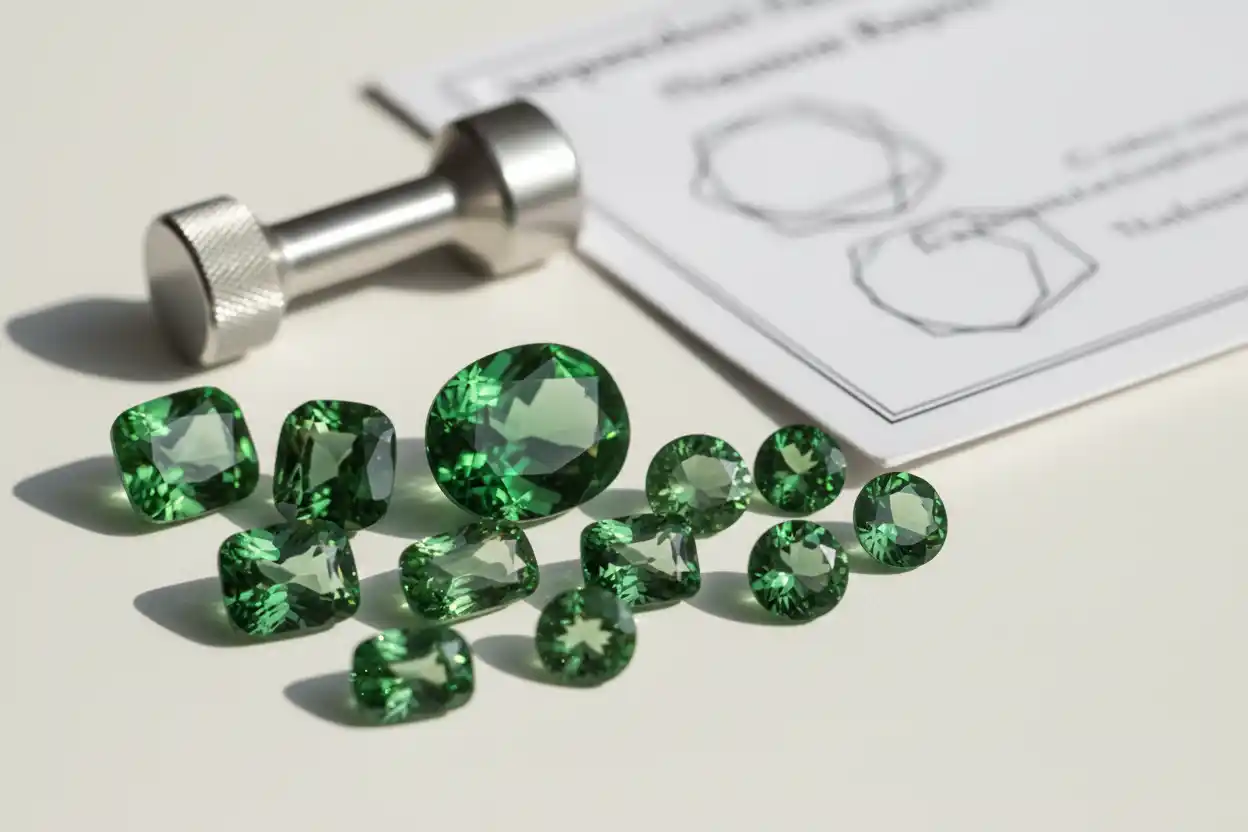
Buy Tsavorite: Smart Buying Tips & Red Flags
When you buy tsavorite, color should capture your attention, but the smartest purchase begins by confirming that the stone is actually green grossular garnet and then judging whether its color, transparency, cut, size, and condition justify the premium. Fine tsavorite can deliver an exceptionally vivid green appearance with strong brilliance, relatively limited routine treatment, no cleavage, and practical jewelry durability, which is why it frequently attracts buyers who like emerald-like color but want a different combination of optical and physical properties.
The difficulty is that not every green grossular deserves the strongest tsavorite pricing, and not every intense green stone offered as tsavorite is necessarily grossular garnet. Pale mint grossular, dark green stones with poor light return, demantoid, green tourmaline, chrome diopside, emerald, synthetic materials, and glass can all complicate visual comparisons. A seller-created AAAA label does not resolve those questions.
A strong way to buy tsavorite is to establish identity first, evaluate hue, tone, and saturation second, then assess transparency, inclusions, cutting, face-up dimensions, structural condition, treatment disclosure, provenance, documentation, photography, return rights, and intended jewelry use. Carat weight matters strongly in fine material, but only after quality has survived into the larger size.
The underlying gem is the vivid green variety of grossular garnet, with vanadium usually playing an important role in the color and chromium contributing in some stones. Its mineralogical background, formation, physical properties, and symbolic traditions are covered separately in tsavorite meaning. For purchasing, the central question is simpler: does the exact gemstone offer enough verified quality to justify what you are being asked to pay?
What Should You Judge First When You Buy Tsavorite?
When you buy tsavorite, use a hierarchy specific to this variety rather than a generic green-gem checklist. Identity comes first because an attractive green stone should not receive a tsavorite premium until it has been established as grossular garnet. Color comes next because vivid green is the primary visible driver of desirability, followed by transparency, clarity, cut, size, treatment, condition, provenance, and documentation.
The relationship to the parent mineral is important. Grossular occurs in several colors, and not every green grossular is marketed as fine tsavorite. The broader species is explained in grossular garnet meaning, while the position of tsavorite among other garnets is covered in types of garnet.
| Priority | What to evaluate | Stronger choice | Main red flag |
|---|---|---|---|
| 1 | Identity | Natural green grossular garnet established appropriately | Green color used as the only proof |
| 2 | Hue | Balanced green to slightly bluish green | Strong yellow, brown, or gray modifier |
| 3 | Tone | Medium to medium-dark while remaining bright | Stone looks almost black indoors |
| 4 | Saturation | Strong, vivid green | Weak or muddy color sold as premium |
| 5 | Transparency | Open transparent faceting quality | Cloudiness priced like fine transparent material |
| 6 | Clarity | Eye-clean or minimally distracting inclusions | Large white or surface-reaching fractures |
| 7 | Cut | Strong brilliance and useful face-up spread | Windowing, extinction, unnecessary depth |
| 8 | Size | Fine color and clarity maintained as weight rises | Large weight used to distract from poor quality |
| 9 | Treatment | Clear disclosure of filling or unusual enhancement | “Normally untreated” used instead of examining the stone |
| 10 | Documentation | Evidence appropriate to value and claims | Generic seller certificate presented as conclusive proof |
This order makes it much easier to buy tsavorite according to measurable and visible quality rather than rarity language.
Fine Tsavorite Color Is About Balance, Not Maximum Darkness
Color usually has the greatest influence once you know the stone is genuine. When you buy tsavorite, look for green that remains clearly visible under ordinary lighting rather than a stone that appears richly saturated only beneath intense display lamps.
Fine material commonly ranges from lively yellowish green through balanced vivid green to slightly bluish green. The strongest market preference often favors medium to medium-dark stones with strong saturation and relatively little gray or brown, although personal preference should still matter.
A slightly yellowish green tsavorite can be beautiful if it remains bright. A somewhat bluish green stone can approach the visual territory that attracts emerald buyers. Neither modifier automatically creates or destroys quality.
The problem arises when tone becomes so dark that the stone stops looking green.
Do Not Confuse Dark Green With Fine Saturation
One of the easiest mistakes when you buy tsavorite is assuming that the darkest gemstone must contain the richest color.
Tone and saturation are different.
A gemstone can be highly saturated yet still remain bright enough for the green body color to show across most of the face. Another stone can simply be dark, allowing only small green flashes while large regions appear nearly black.
Rotate the gemstone under ordinary indoor illumination. If the green disappears whenever the stone leaves direct light, darkness is dominating the appearance.
A slightly lighter vivid gem often provides the better buy tsavorite result because more of its color remains visible during normal wear.
Medium Tone Often Gives the Best Balance
For many buyers, the practical sweet spot is a medium to medium-dark green with strong saturation.
When you buy tsavorite in this range, the stone can maintain rich color while still returning enough light to look lively. This balance becomes particularly attractive because garnet can produce strong brilliance when the pavilion is cut effectively.
Pale stones can look bright but may lack enough saturation to justify a top premium. Extremely dark stones can look rich in photographs while becoming closed and nearly black away from concentrated lighting.
The strongest candidate usually lets you see both color and brilliance simultaneously.
Yellowish Green Can Still Be Attractive
Not every worthwhile tsavorite must imitate emerald.
When you buy tsavorite with a yellowish-green component, assess whether the hue looks fresh and lively rather than muddy or olive-brown. Bright grassy greens can create beautiful jewelry and may offer better value than stones chasing a more expensive bluish-green appearance.
The commercial distinction also matters because pale mint and yellow-green grossular can fall outside what some sellers consider classic saturated tsavorite.
Do not pay an elite color premium simply because the stone belongs chemically to green grossular. Judge the face-up green first.
Slightly Bluish Green Can Command Strong Demand
A clean slightly bluish-green tsavorite can be especially appealing to buyers who want a vivid emerald-like appearance combined with garnet brilliance and a different treatment profile.
When you buy tsavorite in this color range, make sure the blue modifier is actually visible under neutral lighting rather than created by camera white balance.
Cool lighting can push ordinary green toward blue-green very easily.
Ask for a neutral background and continuous rotating video. If the gemstone remains balanced green to slightly bluish green while surrounding white objects stay neutral, the presentation is much more useful.
Color Should Be Evaluated in More Than One Lighting Environment
Green gems can change substantially between bright directional illumination and softer indoor lighting.
When you buy tsavorite online, ask to see the exact gemstone under neutral diffuse illumination as well as a stronger directional light. The first reveals body color, transparency, and excessive darkness; the second helps reveal brilliance.
Do not let one staged photograph define the stone.
A strong tsavorite should remain attractive when the sparkle decreases.
Camera White Balance Can Make Tsavorite Look Better Than It Is
Digital photography can move yellow-green toward a cooler emerald-like green or make gray-green material appear more saturated.
When you buy tsavorite remotely, examine the background, tweezers, fingers, and jewelry metal for color casts.
If a white surface looks blue or green, the gemstone is probably being shifted too.
Requesting more than one unedited-looking video is particularly useful for expensive stones because subtle color differences can have meaningful value consequences.
Transparency Is a Major Quality Factor
Tsavorite is valued primarily as a transparent faceted gemstone, so useful transparency deserves strong weight when you buy tsavorite.
Fine material should allow light to travel through the stone without dense clouds blocking the body color. That does not mean every stone must be perfectly clean under magnification.
Natural crystals can contain graphite, apatite, quartz, calcite, mica, zircon, sulfide minerals, fluid inclusions, fingerprints, healed fissures, and other internal features.
The question is whether those features interfere with transparency, brilliance, or durability.
Tsavorite Can Be Cleaner Than Emerald, but Not Always Flawless
Buyers often compare tsavorite with emerald because both can occupy a vivid green range.
When you buy tsavorite, it is reasonable to expect relatively good transparency, especially in smaller faceted stones, but demanding diamond-like perfection is unnecessary.
Fine larger crystals become scarce, so a modest inclusion may be an acceptable compromise when color and size are exceptional.
The most useful question is not whether an inclusion exists. Ask whether you notice the inclusion before you notice the green color and brilliance.
If the stone’s beauty dominates normal viewing, the inclusion may be commercially acceptable.
Eye-Clean Is Desirable
All else being similar, an eye-clean gemstone normally deserves a premium.
When you buy tsavorite, begin clarity evaluation without magnification. View the gem at an ordinary distance and determine whether dark crystals, reflective fissures, or white inclusions interrupt the face.
Then use close-up photography or magnification to understand the nature and position of those features.
A tiny internal inclusion near the pavilion can matter far less than a bright fissure beneath the table.
The broader variety-specific approach is covered in garnet quality and grading.
Larger Tsavorite Deserves More Inclusion Tolerance
As finished size increases, clean vivid rough becomes much more difficult to obtain.
When you buy tsavorite in larger sizes, some additional inclusion tolerance can therefore make sense. The trade-off is worthwhile when the stone retains good transparency and the inclusions do not create major structural concerns.
Do not confuse tolerance with ignoring quality.
A large gem dominated by fractures and dark inclusions belongs to a different category from a slightly included but transparent fine stone.
Size amplifies quality only when the underlying quality remains.
Black Inclusions Need Context
Graphite and other dark inclusions can occur in tsavorite.
When you buy tsavorite with a black crystal or plate, inspect its size, location, and visual effect. A tiny dark inclusion near the girdle may disappear in normal viewing and have little impact on beauty.
A large central black inclusion beneath the table can become the first thing you see.
The inclusion may be completely natural in either case.
Natural does not automatically mean desirable.
White Reflective Fractures Can Be More Distracting
A bright fissure can reflect light strongly enough to look white or silvery, sometimes becoming more visible than a small dark crystal.
When you buy tsavorite, rotate the stone and observe whether the fracture flashes across a large part of the face.
A fissure that becomes highly reflective from several angles can reduce both visual quality and value even when the stone remains structurally stable.
If the fracture reaches the surface, treatment and durability questions become more important.
Surface-Reaching Fractures Need Separate Inspection
A completely enclosed inclusion and an open fissure should not receive the same evaluation.
When you buy tsavorite, inspect cracks intersecting the crown, girdle, pavilion, corners, and potential prong positions. Surface-reaching fractures can collect dirt, extend after impact, and potentially contain filler.
They can also create a setting risk.
A vivid green stone may still be worth purchasing with a modest fracture, but the price should account for the condition.
Tsavorite Versus Emerald Is More Than a Color Comparison
Tsavorite and emerald can overlap strongly in attractive green color, but they are very different materials.
Tsavorite is grossular garnet. Emerald is beryl.
The dedicated tsavorite vs emerald comparison separates their optical properties, treatment patterns, inclusions, durability, and value more completely.
When you buy tsavorite instead of emerald, you are generally choosing a gemstone with no cleavage, strong brilliance, good jewelry durability, and much less routine clarity enhancement.
Emerald is harder in terms of scratch resistance but frequently contains more fractures and commonly receives oil or resin treatment.
Neither gemstone is universally superior. The better choice depends on the individual stone and your priorities.
Tsavorite Often Offers Stronger Brilliance Than Emerald
Garnet’s optical character can give well-cut tsavorite a bright, lively face-up appearance.
When you buy tsavorite, this brilliance is worth evaluating independently from saturation. A richly colored stone that returns light across most of its face can look exceptionally vivid.
Emerald often presents a softer internal appearance because of its inclusions and different refractive behavior.
That distinction is part of why buyers should compare actual stones rather than only green color swatches.
Tsavorite Versus Demantoid Requires Species-Level Understanding
Both tsavorite and demantoid are green garnets, but they belong to different species.
Tsavorite is green grossular.
Demantoid is green andradite.
Demantoid generally has higher refractive index and much stronger dispersion, producing greater spectral fire. Tsavorite commonly offers a saturated green appearance with somewhat greater resistance to scratching.
When you buy tsavorite, do not pay a tsavorite premium for a green garnet whose species has not been established when the transaction is significant.
Both gems can be valuable. They simply belong to different markets.
Horsetail Inclusions Do Not Belong to Tsavorite Grading
Demantoid is famous for horsetail-type inclusions, particularly in certain material.
When you buy tsavorite, a seller should not describe random needles or fibrous inclusions as proof of elite tsavorite quality by borrowing terminology from demantoid.
Tsavorite inclusions have their own mineralogical context.
An inclusion pattern should be interpreted according to the host gemstone rather than whichever marketing story sounds most valuable.
Green Tourmaline Can Be an Effective Lookalike
Green tourmaline can overlap strongly with tsavorite in photographs, particularly when both gems have medium-to-dark green color.
Tourmaline is doubly refractive and strongly pleochroic, while grossular garnet is cubic and fundamentally singly refractive.
Their refractive indices, density, spectroscopy, and inclusion characteristics also differ.
When you buy tsavorite at meaningful value, a seller should not rely on green color or hardness alone to establish identity.
Chrome Diopside Can Resemble Tsavorite
Chrome diopside is another vivid green gemstone that can look remarkably similar in photographs.
It commonly displays strong green color at comparatively accessible prices, but it is softer and belongs to a different mineral family.
When you buy tsavorite, unusually low price combined with vivid green color should prompt identification questions rather than immediate excitement.
A chrome diopside is not a fake gemstone. It simply should not be sold as tsavorite.
Peridot Can Overlap With Yellow-Green Tsavorite
Yellowish-green tsavorite can resemble peridot, particularly when the garnet is lighter in tone.
Peridot is gem-quality olivine and is doubly refractive, whereas tsavorite is singly refractive.
Their refractive behavior, density, chemistry, and inclusion patterns differ.
When you buy tsavorite with a strong yellow-green color, professional identification prevents a color-based assumption from becoming an expensive mistake.
Green Glass Can Be Convincing
Glass can reproduce virtually any green hue, including vivid emerald-like colors.
When you buy tsavorite, round bubbles, curved flow features, comparatively soft facet wear, or mold-related structures can suggest glass, but those clues are not universal.
Natural gemstones can contain fluid inclusions, while good glass may be extremely clean.
The family-wide authentication framework is covered in real vs fake garnet.
For a high-value stone, objective gemological measurements are much stronger evidence than one inclusion shortcut.
Synthetic Spinel and Synthetic Corundum Can Imitate Green Gems
Laboratory-produced spinel and corundum can be colored to resemble natural green gemstones.
When you buy tsavorite, the fact that a stone is hard, transparent, and clean does not prove it is grossular garnet.
Synthetic materials can also be exceptionally clean.
Professional examination distinguishes them through optical properties, spectroscopy, density, inclusions, and other evidence.
YAG and GGG Are Garnet-Structure Materials, Not Natural Tsavorite
Synthetic yttrium aluminum garnet and gadolinium gallium garnet have garnet-type crystal structures and have historically been used as gemstone materials.
They are not synthetic versions of natural tsavorite in the ordinary commercial sense because their chemistry differs from natural grossular.
When you buy tsavorite, a product should not be called synthetic tsavorite simply because the manufactured material also belongs to a garnet structural family.
Correct material naming matters.
Routine Color Treatment Is Not a Defining Part of the Tsavorite Market
One of tsavorite’s strongest commercial characteristics is that most transparent gem material reaches buyers without the routine color or clarity enhancement associated with several other high-value gems.
When you buy tsavorite, this treatment profile can be attractive because the face-up color is generally valued as a natural property of the stone.
However, “usually untreated” should not become “treatment is impossible.”
Fracture filling, coatings, dyeing, assembly, or other modifications remain technically possible, particularly in lower-quality or misrepresented material.
Treatment questions should focus on the exact stone.
Heating Is Not a Routine Improvement Strategy
Unlike sapphire or tanzanite, tsavorite is not commonly heated as a standard commercial color-enhancement process.
When you buy tsavorite, a seller should not charge an enormous premium merely because the stone is described as unheated. Lack of routine heat is normal for the category.
The gemstone still needs fine color, transparency, clarity, cutting, and condition.
An ordinary unheated stone is still ordinary.
Be Careful With Diffusion Claims
Reports and claims involving diffusion treatment of tsavorite have appeared in gem-treatment discussions, but diffusion has not become an established routine tsavorite trade practice.
When you buy tsavorite, do not panic simply because an article mentions experimental or unsubstantiated treatment reports.
Instead, apply a proportionate standard.
For an ordinary commercial stone, identity and basic disclosure may be enough. For an exceptional vivid-green gem carrying a major premium, a recognized laboratory can provide greater confidence about the material and detectable enhancement.
Fracture Filling Is the More Practical Treatment Concern
Surface-reaching fractures can potentially be filled with resin, polymer, glass-like material, or another substance to reduce their visibility.
When you buy tsavorite with a fracture network, ask specifically whether filling has been detected or disclosed.
Filled material can still be genuine natural grossular.
The concern is that filling can improve apparent clarity, affect value, and create additional care limitations.
A filled fissure does not restore the structural condition of an originally intact gemstone.
Coatings Can Make a Pale Stone Look Greener
A surface coating can alter the visible color of garnet, glass, or another gemstone.
When you buy tsavorite with unusually intense or unnaturally uniform green concentrated near the surface, inspect facet junctions, chips, scratches, and girdle areas for irregularities.
Do not scrape or scratch the gemstone.
A suspicious surface should be evaluated professionally.
Synthetic Tsavorite Is Not a Major Commercial Jewelry Category
Laboratory work can produce grossular-related and garnet-structure materials, but synthetic tsavorite is not a mainstream jewelry product comparable with synthetic ruby, sapphire, emerald, or diamond.
When you buy tsavorite, common misrepresentation risks are more likely to involve natural lookalikes, glass, synthetic spinel, synthetic corundum, CZ, YAG, GGG, or other substitutes.
That distinction matters because “synthetic tsavorite is uncommon” does not prove the offered gemstone is natural tsavorite.
Authentication is still necessary when the financial stakes are high.
Cut Quality Has an Outsized Effect on Tsavorite
Fine tsavorite rough is valuable and often fractured, so cutters have strong incentives to retain weight. This can lead to irregular outlines, thick girdles, deep pavilions, or non-standard proportions.
When you buy tsavorite, some compromise can be perfectly rational.
The question is what the compromise achieved.
If extra depth preserves exceptional color or saves a clean section of rare rough, it may be worthwhile. If the same depth creates severe extinction and a small face-up appearance, it becomes much less attractive.
Windowing Weakens Color
A window is a pale or transparent region where light passes through the pavilion instead of returning efficiently.
When you buy tsavorite, place the gemstone over a neutral background and inspect the center.
If you can see the background clearly through a broad stationary area, the pavilion may be too shallow.
Windowing reduces apparent saturation and brilliance.
This weakness is particularly noticeable in lighter green stones because there is less body color to disguise the transparent center.
Extinction Makes Dark Tsavorite Look Almost Black
Extinction occurs when sections of the gem return very little useful light.
When you buy tsavorite in medium-dark or deep green, rotate it slowly and observe whether the black-looking facets change position.
Some contrast gives a faceted stone depth.
A large region that remains black across ordinary movement suggests that tone or cutting is suppressing the green.
A lighter stone with better proportions can often provide much stronger face-up beauty.
Bow Ties Can Appear in Elongated Shapes
Oval, pear, marquise, and elongated cushion tsavorites can show a dark bow-tie region through the center.
When you buy tsavorite in one of these shapes, request continuous video.
A mild bow tie can provide useful contrast.
A broad black band that remains obvious through normal movement should lower the price.
One carefully selected still photograph can make the effect appear much smaller than it really is.
Rounds Can Carry a Cutting Premium
Round brilliant-style cutting generally requires greater rough loss than many weight-saving ovals or cushions.
When you buy tsavorite, a fine round can therefore command a premium because the cutter sacrificed valuable rough to create the shape.
That premium makes sense only when the finished stone actually performs well.
Poorly proportioned rounds should not receive automatic extra value simply because they are round.
Ovals and Cushions Often Preserve Rough Efficiently
Tsavorite rough frequently lends itself to oval and cushion forms, allowing cutters to preserve more weight while maintaining attractive brilliance.
When you buy tsavorite in these shapes, inspect symmetry and pavilion depth rather than assuming weight retention is automatically a problem.
A well-designed cushion can preserve valuable material and still face up beautifully.
Efficiency becomes a weakness only when it visibly compromises performance.
Emerald-Style Cuts Expose Clarity and Windowing
Step-cut tsavorite can look elegant, particularly in transparent vivid material.
When you buy tsavorite in an emerald or octagonal step cut, clarity becomes more obvious because broad facets reveal the interior directly.
Windowing is also easier to see.
A strong step-cut stone should combine an open transparent interior with enough pavilion structure to prevent the center from looking empty.
Fancy and Precision Cuts Can Add Real Value
Custom cutting can turn excellent rough into an unusually lively gemstone.
When you buy tsavorite with a recognized precision or artistic cut, a premium may be justified for craftsmanship.
Evaluate:
- Polish.
- Symmetry.
- Facet alignment.
- Light return.
- Face-up spread.
- Color distribution.
- Design originality.
In rare material, exceptional lapidary work can become an important part of the finished value.
Compare Millimeter Dimensions With Carat Weight
A carat tells you how much the gemstone weighs, not how large it appears once mounted.
When you buy tsavorite, always obtain length, width, and depth.
Fine rough can encourage deep cutting, and two stones of similar weight may differ dramatically in face-up area.
If a three-carat gemstone appears little larger than a well-cut two-carat alternative, determine whether the extra depth produces better color or simply preserves hidden mass.
Visible size matters every time you look at the gem.
Fine Tsavorite Becomes Much Scarcer as Size Increases
Tsavorite deposits frequently yield relatively small and fractured crystals, so clean vivid faceting material becomes increasingly difficult to replace as size rises.
When you buy tsavorite above ordinary sizes, this scarcity can produce a substantial per-carat premium.
The value hierarchy is explained in tsavorite price, but the central principle is more useful than any fixed price number: larger weight deserves a strong premium only when color, transparency, clarity, and cut remain correspondingly strong.
A large dark or heavily fractured stone should not borrow the rarity premium of a large fine gem.
One Excellent Carat Can Beat Several Mediocre Carats
Suppose your budget allows either a smaller vivid eye-clean stone or a much larger gem that is dark, windowed, and visibly included.
When you buy tsavorite for jewelry, the smaller stone can easily provide more beauty and stronger quality.
A larger gemstone is not inherently more prestigious if its size came from retaining poor material.
Quality first, size second.
Origin Matters, but Usually Less Than Visible Quality
The most important tsavorite sources are in East Africa, particularly Kenya and Tanzania, with additional material from Madagascar and other occurrences.
When you buy tsavorite for ordinary jewelry, country of origin generally matters less than color, clarity, cutting, and size.
A superb Tanzanian gemstone can be more desirable than a mediocre Kenyan one, and vice versa.
Origin should add context to quality rather than replace it.
Kenya Is Historically Central to the Tsavorite Name
The commercial name is connected with the Tsavo region of Kenya, and Kenyan deposits remain deeply associated with the gemstone.
When you buy tsavorite represented as Kenyan, that provenance can add collector interest, especially for fine material accompanied by credible source history.
However, a country name does not create a uniform quality grade.
Kenya produces a range of colors, sizes, and clarity levels.
The exact stone still controls value.
Tanzania Produces Exceptional Material Too
Northern Tanzania is another major source of fine tsavorite, including vivid saturated gemstones and important larger crystals.
When you buy tsavorite represented as Tanzanian, evaluate it under the same quality hierarchy as Kenyan material.
Color and transparency should remain central.
A Tanzania label should not automatically create either a discount or premium without a specific reason.
Madagascar Material Can Be Legitimate Tsavorite
Madagascar produces green grossular, including material that can meet commercial tsavorite color expectations.
When you buy tsavorite represented as Madagascan, do not reject it merely because it comes from outside the best-known East African sources.
Instead, confirm identity and evaluate color.
A vivid green grossular can still be a legitimate and attractive gemstone.
Origin becomes relevant only when the market attaches a separate premium to it.
Exact Mine Claims Need Better Provenance
A seller may attach a specific district or mine name to make the stone sound more exclusive.
When you buy tsavorite with a mine-level premium, ask what actually links the gemstone to that location.
Useful evidence can include:
- Mine-to-market records.
- Original parcel information.
- Dealer provenance.
- Rough photographs.
- Prior collection labels.
- Traceable invoices.
Color alone cannot establish one mine.
Laboratory Origin Opinions May Have Limitations
A laboratory can identify natural grossular garnet and characterize its composition, but geographic-origin determination is not equally available or conclusive for every tsavorite.
When you buy tsavorite with an expensive origin claim, check what the laboratory actually offers rather than assuming any identification report automatically confirms the country.
An inconclusive origin result does not make the stone fake.
It simply means mineral identity is more secure than geographic attribution.
Seller-Created AAA Grades Are Not Standardized
AAA, AAAA, premium, investment, royal green, museum grade, and similar labels are not universal tsavorite grading systems.
When you buy tsavorite with one of these descriptions, ask what the grade measures.
Does it require a particular hue?
Is tone specified?
Must the gemstone be eye-clean?
Does cutting matter?
Is treatment included?
Are dimensions considered?
Without defined criteria, the letters provide little comparison value.
Garnet does not have one standardized AAA scale across the trade.
“Emerald Green” Is a Visual Description, Not an Identity
A seller may describe a tsavorite as emerald green.
That can be useful as a color comparison, but when you buy tsavorite, remember that the phrase does not make the stone emerald, prove a particular chromium concentration, or establish top quality.
Evaluate the green color directly.
A vivid medium stone may deserve the description. A nearly black gem should not receive a stronger premium merely because the product title says emerald green.
When Does a Laboratory Report Make Sense?
Small commercial stones with straightforward seller disclosure may not justify individual laboratory costs.
A report becomes much more useful when you buy tsavorite that is:
- Expensive.
- Unusually large.
- Exceptionally clean.
- Exceptionally saturated.
- Sold with an important origin claim.
- Suspected of filling or coating.
- Difficult to distinguish from another green gem.
- Intended for a significant jewelry purchase.
The correct threshold follows the financial consequence of being wrong.
A Report Should Confirm the Material Clearly
For an important purchase, a useful report should identify the stone as natural grossular garnet, with appropriate variety description where the laboratory provides it.
When you buy tsavorite, vague documentation stating only “natural green stone” or “natural garnet” provides much less commercial information.
The exact report service and terminology matter.
A Laboratory Report Is Not an Appraisal
A gemological report identifies material and records supported characteristics.
An appraisal estimates monetary value.
When you buy tsavorite, a high insurance value does not prove that the stone is fine-quality tsavorite, Kenyan, untreated, or even correctly represented if the underlying identification work was inadequate.
Likewise, a laboratory report does not establish that the retailer’s asking price is fair.
Authentication and valuation are separate jobs.
Match the Report to the Exact Gemstone
Before you buy tsavorite with documentation, compare the report with the actual stone.
Check:
- Carat weight.
- Length.
- Width.
- Depth.
- Shape.
- Cutting style.
- Color description.
- Report number.
- Photograph where available.
A report for another green garnet from the same parcel does not authenticate yours.
Verify Reports Independently When Possible
For an expensive stone, use the issuing laboratory’s own report-verification system when one is available.
When you buy tsavorite, do not rely solely on a screenshot of a laboratory report supplied by the seller.
A genuine report number can be copied into a false listing.
Confirm the document and then match it to the gemstone.
Seller Certificates Are Not the Same as Independent Reports
A jeweler or dealer can create a certificate that accurately describes the product, but it remains the seller’s own documentation unless independent testing was performed.
When you buy tsavorite at meaningful value, ask who actually identified the stone.
A glossy certificate containing the words natural, premium, AAAA, East African, or untreated is not equivalent to independent gemological evidence.
Actual-Stone Photography Is Essential
No two tsavorites have identical color, inclusions, cut, and dimensions.
When you buy tsavorite online, request photographs of the exact stone rather than a representative gem.
A useful image set should include:
- Face-up view.
- Side profile.
- Pavilion view.
- Neutral background.
- Close-up of visible inclusions.
- Girdle and corner detail.
- Continuous rotating video.
This is especially important when the stone is individually priced.
Neutral Backgrounds Expose Windowing
When you buy tsavorite, ask for at least one image over neutral white or gray.
A broad window becomes easier to see because the background may remain visible through the center.
A dark green background can disguise windowing and make saturation look stronger.
The same stone should also be shown away from reflective colored surfaces that can influence its apparent hue.
Side Views Reveal Hidden Weight
A face-up image tells you very little about pavilion depth.
When you buy tsavorite, request the side profile and compare it with the stated measurements.
A deep pavilion can be a rational consequence of valuable rough. It can also create a high weight without useful visual size.
Understanding the geometry helps you decide whether the carat premium is justified.
Pavilion Views Reveal Condition
The back of a loose stone can expose:
- Chips.
- Poor polish.
- Open fissures.
- Cleavage-like-looking fractures even though garnet has no cleavage.
- Hidden dark inclusions.
- Thick girdle areas.
- Excessive depth.
When you buy tsavorite at significant value, there is little reason to accept a listing that shows only the crown.
Return Terms Are Part of the Buying Method
When you buy tsavorite remotely, a usable return policy reduces the risk created by screens and lighting differences.
Check whether you can inspect the stone under your own lighting and, for higher-value material, obtain independent examination.
Confirm:
- Whether laboratory testing is permitted.
- Whether tags must remain attached.
- Whether setting the stone ends return rights.
- Who pays insured return shipping.
- Whether restocking fees apply.
- How misidentification is handled.
A high-value final sale with little opportunity for verification deserves extra caution.
Put Important Claims in Writing
When you buy tsavorite, the invoice should identify the gemstone clearly.
For a meaningful transaction, preserve:
- Natural tsavorite or green grossular garnet description.
- Carat weight.
- Millimeter dimensions.
- Known treatment.
- Laboratory report number.
- Geographic origin when represented.
- Setting details.
- Return conditions.
If the seller charges a premium for Kenyan origin or exceptional untreated status, that claim should not disappear from the written paperwork after payment.
Tsavorite Has Good Jewelry Durability
Tsavorite ranks toward the harder end of the garnet range, approximately Mohs 7–7.5, and garnets possess no cleavage.
That combination makes sound material suitable for rings, earrings, pendants, and other jewelry when reasonable care is used.
GIA’s garnet guidance describes garnets as having fair-to-good toughness and notes that tsavorite sits among the harder garnet varieties.
When you buy tsavorite for frequent wear, however, remember that the stone is still brittle and can chip after a hard impact.
No cleavage does not mean no breakage.
Tsavorite Can Be a Practical Green Ring Stone
For buyers who want saturated green in a frequently worn ring, tsavorite offers an attractive balance between color, brilliance, limited routine treatment, and practical durability.
The specific setting choices are covered in tsavorite rings, while green gemstones for engagement rings places it beside sapphire, spinel, emerald, tourmaline, and other alternatives.
When you buy tsavorite for a ring, choose a stone without dangerous girdle fractures and place it in a setting that reduces unnecessary direct impact.
Protective Settings Still Matter
A halo, partial bezel, well-designed bezel, or substantial prong arrangement can shield exposed edges.
When you buy tsavorite, avoid assuming that the hardest-looking setting is automatically best.
A bezel requires pressure during installation, so the jeweler must inspect the stone for fractures before tightening metal around it.
Prongs should also avoid pressing directly over vulnerable fissures.
Setting craftsmanship matters as much as setting style.
Pointed Shapes Need Additional Protection
Pear, marquise, trillion, and other pointed cuts concentrate stress at corners.
When you buy tsavorite in one of these shapes, inspect each point closely for chips or fractures.
Protective V-prongs or equivalent structural features can reduce direct impact.
A rare fine gemstone should not be mounted with an exposed tip simply because the open design looks elegant in photographs.
Earrings and Pendants Reduce Impact Exposure
If you buy tsavorite primarily for vivid green color and larger visual presence, earrings and pendants generally expose the gemstone to less impact than rings or bracelets.
That can make them excellent choices for larger stones or specimens with minor inclusions.
Lower mechanical exposure does not make quality irrelevant, but it can allow a beautiful gemstone to be enjoyed with less risk.
Cleaning Is Usually Straightforward
Sound untreated tsavorite is comparatively easy to maintain.
The dedicated how to clean tsavorite jewelry guide covers the complete process, but the conservative household method is simple: use lukewarm water, mild soap, and a soft brush or cloth.
Rinse carefully and dry thoroughly.
Ultrasonic Cleaning Depends on Condition
Sound garnet can sometimes tolerate ultrasonic cleaning, but that does not mean every tsavorite should automatically be placed in a machine.
When you buy tsavorite with fractures, filling, glue, antique metalwork, or vulnerable companion stones, manual cleaning is the safer choice.
Mechanical cleaning equipment should never be used as an authenticity test.
Steam Is Better Avoided
Steam adds heat and rapid thermal change without providing a necessary benefit.
When you buy tsavorite, plan for gentle hand cleaning instead.
This is especially important when the stone’s filling status or fracture condition is uncertain.
Value Trade-Off: Color Versus Clarity
Suppose one stone has exceptional vivid green color with a modest inclusion while another is completely eye-clean but noticeably paler and more yellow.
When you buy tsavorite, the stronger-color gemstone can be the better choice if the inclusion is not structurally dangerous or visually dominant.
Color usually carries more weight than small clarity differences.
The trade-off changes when the inclusion is a major white fissure through the center.
Value Trade-Off: Medium Green Versus Very Dark Green
A dark green stone can look luxurious beneath strong lighting, but a medium vivid green gem may remain much livelier throughout ordinary wear.
When you buy tsavorite, compare both away from the display spotlight.
If the darker stone turns almost black while the medium stone continues to glow green, the latter may provide much greater visual value.
Value Trade-Off: Smaller Fine Stone Versus Larger Commercial Stone
Fine size is genuinely scarce in tsavorite, but not every large stone deserves fine-gem pricing.
When you buy tsavorite on a fixed budget, a smaller gem with superior color, transparency, and cutting can be a stronger purchase than a larger dark or fractured stone.
A larger gemstone should command more because good qualities survived into size—not simply because more grossular was retained.
Value Trade-Off: Better Cut Versus Extra Carat Weight
A deeply cut gem may retain more expensive rough but face up smaller and darker.
When you buy tsavorite, compare dimensions and rotating video.
A lighter stone with better proportions may appear larger, brighter, and more saturated.
Hidden pavilion weight has limited practical value if the face-up gemstone performs poorly.
Value Trade-Off: Kenyan Origin Versus Better Quality
A documented Kenyan gemstone can have historical and collector appeal, but ordinary jewelry buyers should still prioritize the visible stone.
When you buy tsavorite, a superior Tanzanian gem with better color and cutting can be more satisfying than an inferior Kenyan stone carrying a provenance premium.
Collectors focused on source may make the opposite choice.
The important step is knowing why you are paying the premium.
Value Trade-Off: Report Versus More Weight
For a modest stone, an expensive report may contribute little relative to improving the gemstone itself.
For an unusually large or expensive tsavorite, documentation can be more useful than adding a fraction of a carat.
When you buy tsavorite, consider the financial consequence of being wrong.
If misidentification would destroy much of the value, independent evidence deserves part of the budget.
Value Trade-Off: Tsavorite Versus Emerald
If you value classic prestige, distinctive emerald texture, and beryl identity, emerald may remain your preferred green gemstone.
If you want strong brilliance, less routine clarity treatment, no cleavage, and a vivid natural green in a comparatively practical ring stone, you may prefer to buy tsavorite.
The correct choice depends on what characteristics matter to you, not on which gemstone is universally declared superior.
Resale Expectations Should Stay Conservative
Fine tsavorite can attract serious collector and jewelry demand, particularly when strong color, clean transparency, meaningful size, good cutting, and credible documentation occur together.
That does not make the market perfectly liquid.
When you buy tsavorite at retail, your price may include dealer margin, cutting labor, laboratory costs, jewelry fabrication, precious metal, side stones, and branding.
A secondary buyer may not reimburse every component.
Large fine stones may be desirable, but resale and appreciation are never guaranteed.
Do Not Buy Tsavorite From an “Investment Grade” Promise Alone
The term investment grade is not a universal laboratory classification.
When you buy tsavorite because a seller predicts guaranteed appreciation, separate the gemstone’s actual qualities from the financial claim.
Ask:
Is the stone genuinely fine color?
Is it transparent?
Is the cut strong?
Is the size genuinely scarce at this quality?
Is the identity supported?
Would another knowledgeable buyer recognize the same value factors?
Those questions are more useful than an investment label.
Practical Buy Tsavorite Decision Matrix
| Factor | Strong candidate | Reasonable compromise | Serious concern |
|---|---|---|---|
| Identity | Natural grossular garnet established appropriately | Modest commercial stone with strong return rights | Green appearance treated as proof |
| Color | Vivid medium to medium-dark green | Slight yellow or blue modifier that remains attractive | Gray, brown, weak, or nearly black |
| Transparency | Clear transparent faceting quality | Minor inclusions with excellent color | Heavy cloudiness |
| Clarity | Eye-clean or modest unobtrusive inclusions | Larger stone with acceptable natural features | Large central or surface-reaching fracture |
| Cut | Bright and well spread | Minor asymmetry preserving fine rough | Broad window, severe extinction |
| Dimensions | Good visible size for weight | Some additional depth helping color | Major hidden pavilion mass |
| Treatment | Normally untreated with specific disclosure | Minor disclosed filling at adjusted price | Filler or coating concealed |
| Origin | Credible provenance when premium matters | Kenya/Tanzania unspecified | Exact mine assigned from color |
| Report | Independent documentation where justified | No report for modest low-risk stone | Seller certificate used as sole proof |
| Photos | Exact gem in neutral and ordinary lighting | Clear actual-stone images | Stock photography or heavy editing |
| Condition | Sound girdle and crisp facets | Minor wear reflected in price | Chips or unstable fissures |
| Jewelry use | Secure setting matched to stone | Careful frequent wear | Exposed fractured stone |
| Returns | Meaningful inspection opportunity | Reasonable limitations | Expensive final sale with no verification path |
| Resale claim | Specialist-market uncertainty acknowledged | No financial promises | Guaranteed appreciation |
Use the matrix as a decision framework rather than another seller grade.
Stone-Specific Red Flags When You Buy Tsavorite
One of the strongest red flags is a gemstone that appears almost black through most of its face but receives a top premium because the seller calls it deeply saturated. Fine color should remain visibly green.
Another warning is pale mint or ordinary light-green grossular priced as though every green grossular automatically belongs to the finest tsavorite category.
Be cautious with an unusually large clean stone sold cheaply without meaningful identification. Large fine tsavorite becomes significantly harder to replace, so rarity and documentation should become more consistent as size and quality increase.
Other important red flags include:
- Green glass or synthetic material represented from color alone.
- Chrome diopside or green tourmaline mislabeled as tsavorite.
- A seller-created AAAA grade with no criteria.
- Kenyan origin inferred from color.
- A famous mine name without provenance.
- A broad central window concealed against a green or dark background.
- Severe extinction described as exceptional saturation.
- Large carat weight without dimensions.
- Surface-reaching fractures with no filling discussion.
- A report that identifies only “green gemstone.”
- An appraisal presented as authenticity evidence.
- A report that does not match the exact weight and measurements.
- High-value final-sale conditions that prevent meaningful verification.
A Better Way to Buy Tsavorite
Start your buy tsavorite comparison with several gemstones in a similar budget and approximate size range.
First, eliminate stones whose identity is uncertain if the price depends materially on being tsavorite.
Next, compare color under similar neutral lighting. Remove candidates that look muddy, heavily yellow-brown, gray, or almost black.
Then judge transparency and inclusions. A small visible inclusion can be acceptable, especially in larger material, while a large surface-reaching fissure should receive far more weight.
After that, compare cutting. Look for strong brilliance, limited windowing, manageable extinction, sensible symmetry, and face-up dimensions appropriate to the weight.
Only after visible quality is established should you investigate provenance, retailer grades, and rarity stories.
For significant stones, match the laboratory report to the exact gemstone and preserve important claims in writing.
Finally, consider setting and wear. Tsavorite is practical enough for many jewelry formats, but it remains a natural brittle gemstone rather than an indestructible object.
The broader Buying & Value section follows the same evidence-first purchasing approach across other gemstones, but the most important rule when you buy tsavorite is to prioritize balanced vivid green, useful transparency, clean brilliance, and sensible cutting before allowing size or provenance to dominate the decision.
Frequently Asked Questions
What should I check first when I buy tsavorite?
When you buy tsavorite, establish that the gemstone is natural green grossular garnet, then evaluate color, transparency, clarity, cut, size, treatment, condition, provenance, and documentation.
What color tsavorite is best?
Fine stones commonly show vivid medium to medium-dark green, sometimes with a slight bluish modifier. When you buy tsavorite, avoid assuming that the darkest stone is automatically the finest.
Is yellow-green tsavorite valuable?
It can be attractive, particularly when bright and saturated. Stronger yellow modification may reduce demand compared with balanced or slightly bluish green, but overall beauty matters.
Is bluish-green tsavorite more valuable?
Slightly bluish-green material can attract strong demand, but the stone still needs appropriate saturation, tone, clarity, and cutting. A blue modifier alone does not create fine quality.
Should tsavorite look dark?
Fine tsavorite can have medium-dark tone, but it should still appear visibly green. A stone that looks nearly black through most of the face may be too dark or poorly cut.
Is tsavorite a type of garnet?
Yes. Tsavorite is the vivid green gem variety of grossular garnet.
What gives tsavorite its green color?
Vanadium is an important coloring element in many tsavorites, with chromium contributing in some stones.
Is every green grossular tsavorite?
No. Pale mint, weakly saturated, yellowish, translucent, or opaque green grossular may be sold under broader green grossular terminology rather than fine tsavorite.
Is tsavorite rarer than emerald?
Fine large tsavorite is exceptionally scarce, but simple rarity rankings depend on size, quality, and market category. When you buy tsavorite, evaluate the specific stone instead of relying on a broad rarity slogan.
Is tsavorite more durable than emerald?
Tsavorite has no cleavage and usually fewer fracture-treatment concerns, while emerald is harder but commonly more fractured. Tsavorite can be a practical green ring gemstone with reasonable care.
Is tsavorite harder than emerald?
No. Emerald generally has a higher Mohs hardness. Durability is broader than hardness alone, however, and tsavorite’s lack of cleavage and typical treatment profile can make it easier to wear in some situations.
Is tsavorite the same as demantoid?
No. Tsavorite is green grossular garnet, while demantoid is green andradite garnet.
Which has more fire, tsavorite or demantoid?
Demantoid generally has greater dispersion and can show stronger spectral fire. Tsavorite is often prized more for saturated green body color and strong brilliance.
Can green tourmaline look like tsavorite?
Yes. Their colors can overlap strongly. Professional testing can distinguish them through optical and physical properties.
Can chrome diopside look like tsavorite?
Yes. Vivid chrome diopside can resemble tsavorite in photographs but is a different mineral with different durability and value.
Can peridot be mistaken for tsavorite?
Yellow-green stones can overlap visually, although peridot and grossular garnet have different optical, chemical, and physical properties.
Can glass imitate tsavorite?
Yes. Green glass can reproduce a convincing color. When you buy tsavorite at significant value, objective gemological identification is preferable to visual assumptions.
Is synthetic tsavorite common?
No. Laboratory-grown material directly equivalent to commercial tsavorite is not a mainstream jewelry category. Simulants such as glass, synthetic spinel, synthetic corundum, CZ, YAG, and GGG are more practical concerns.
What is YAG?
YAG is synthetic yttrium aluminum garnet. It has a garnet-type structure but different chemistry from natural grossular and should not be represented as natural or synthetic tsavorite.
Should tsavorite be eye-clean?
Eye-clean material is desirable, particularly in smaller stones. When you buy tsavorite in larger sizes, modest inclusions can be acceptable because clean large rough becomes increasingly scarce.
What inclusions occur in tsavorite?
Natural tsavorite can contain graphite, apatite, quartz, calcite, mica, zircon, sulfides, fluid inclusions, healed fissures, fingerprints, and other mineral inclusions.
Are black inclusions proof that tsavorite is natural?
No. Natural inclusions can support interpretation, but one black crystal does not establish the complete gemstone identity.
Are inclusions always bad in tsavorite?
No. Small unobtrusive inclusions can be acceptable, especially in larger fine-color gems. Surface-reaching fractures and highly reflective central fissures deserve much more concern.
Is tsavorite normally treated?
Routine color and clarity treatment is uncommon. When you buy tsavorite, still ask about fracture filling, coating, dye, assembly, and any laboratory-detected treatment.
Is tsavorite heated?
Heat is not a routine commercial enhancement for tsavorite. An unheated claim should therefore not receive a huge premium by itself.
Can tsavorite be fracture filled?
Yes, a surface-reaching fracture can potentially contain filler even though filling is uncommon. When you buy tsavorite with visible fissures, ask specifically about clarity enhancement.
Can tsavorite be coated?
A coating can potentially strengthen apparent green color on garnet or an imitation. Suspected coatings should be examined professionally rather than tested destructively.
Does tsavorite have cleavage?
No. Garnet does not have the prominent cleavage found in gemstones such as topaz or tanzanite.
How hard is tsavorite?
Tsavorite is approximately Mohs 7–7.5, placing it toward the harder side of the garnet family.
Is tsavorite suitable for rings?
Yes. When you buy tsavorite for a ring, choose a structurally sound gemstone and a setting that protects exposed edges and corners from hard impact.
Is tsavorite suitable for an engagement ring?
Yes. Its vivid green color, lack of cleavage, good brilliance, and practical durability make it a strong green engagement-ring option when reasonable care is accepted.
What is windowing in tsavorite?
Windowing is a pale transparent face-up region caused by inefficient pavilion light return. When you buy tsavorite, a large window should generally reduce the price.
What is extinction in tsavorite?
Extinction creates dark or black-looking areas where little useful light returns. Excessive extinction can make a saturated green gemstone appear almost black.
Should I buy tsavorite based on carat weight?
No. When you buy tsavorite, compare the weight with color, transparency, clarity, cutting, and millimeter dimensions. Large weight deserves a premium only when fine quality survives.
Why are large tsavorites expensive?
Clean vivid crystals are commonly small or fractured, so larger faceted stones with fine color and transparency become increasingly difficult to replace.
Is Kenyan tsavorite better than Tanzanian tsavorite?
Not automatically. Both countries produce exceptional material. When you buy tsavorite, visible quality usually deserves more weight than the country name.
Does Madagascar produce tsavorite?
Yes. Madagascar has produced green grossular that can fall within the tsavorite commercial category.
Can a laboratory determine tsavorite origin?
A laboratory can identify grossular garnet, but geographic-origin opinions are not equally available or definitive for every stone. Check the exact service and report conclusion.
Do I need a laboratory report when I buy tsavorite?
Small modest-value stones do not always require one. A report becomes more useful for high-value, unusually large, exceptionally clean, rare-color, treatment-sensitive, or provenance-dependent stones.
Is an appraisal proof that a stone is tsavorite?
No. An appraisal estimates monetary value. Gemological identity should be established through appropriate examination.
Does AAAA mean top-quality tsavorite?
Not universally. AAA and AAAA are seller-created grades unless specific criteria are defined. When you buy tsavorite, compare observable quality instead.
What photos should I request before I buy tsavorite online?
Ask for exact-stone face-up photographs, neutral-light images, rotating video, side and pavilion views, close-ups of inclusions, and clear millimeter measurements.
How should tsavorite be cleaned?
For most sound stones, lukewarm water, mild soap, and gentle brushing are appropriate. Fractured or filled material should receive more conservative care.
Can tsavorite go in an ultrasonic cleaner?
Some sound garnets can tolerate ultrasound, but it should not be the default for fractured, filled, glued, antique, or uncertain-condition pieces.
Can tsavorite be steam cleaned?
Gentle hand cleaning is preferable, particularly when treatment or fracture status is uncertain.
Does tsavorite hold its value?
Fine large stones can attract strong specialist demand, but resale is never guaranteed. When you buy tsavorite, quality, documentation, condition, and market access matter more than investment terminology.
What is the biggest red flag when I buy tsavorite?
A major warning is a high premium based on one unsupported claim—such as deep green being called automatically finest, every green grossular being called tsavorite, Kenyan origin inferred from color, or a large supposedly exceptional gemstone being offered without adequate identity evidence.
Final Buy Tsavorite Checklist
Before you buy tsavorite, establish that the gemstone is natural green grossular garnet rather than relying on vivid green color alone. Emerald, demantoid, green tourmaline, chrome diopside, peridot, glass, synthetic spinel, synthetic corundum, CZ, YAG, GGG, and other materials can overlap with parts of its appearance.
Judge color next. Fine tsavorite should display an attractive green with enough saturation to look vivid and enough brightness to avoid blacking out. Medium to medium-dark tone often creates an effective balance, while slight yellow or blue modifiers should be judged according to the overall face-up result.
Then evaluate transparency and clarity. Eye-clean stones are desirable, but modest natural inclusions can be acceptable, particularly as size rises. Large reflective fissures and surface-reaching fractures should receive much greater scrutiny because they affect beauty, durability, and possible filling.
Study the cut through movement. When you buy tsavorite, look for strong brilliance, limited windowing, manageable extinction, useful face-up dimensions, good polish, and sensible weight retention. Rare rough may justify unconventional proportions, but extra carat weight should create a real benefit.
Compare millimeter dimensions with the stated weight. A deep pavilion may preserve valuable rough, yet a stone that carries substantial hidden weight should not be valued as though every carat contributes equally to visible size.
Ask about treatment specifically. Routine enhancement is uncommon, but filling, coatings, dye, assembly, or other modifications remain possible. The general statement that tsavorite is normally untreated should never replace evaluation of the exact gemstone.
Treat provenance as an additional factor rather than a universal quality grade. Kenya and Tanzania remain the central sources, while Madagascar also produces material. A famous origin should receive a premium only when it matters to you and when the evidence supports the claim.
For substantial purchases, obtain documentation appropriate to the risk. Match any laboratory report to the exact weight, dimensions, shape, color, and report number, and understand that a gemological identification report performs a different function from an appraisal.
When you buy tsavorite online, insist on actual-stone photography, neutral-light video, ordinary indoor video, side and pavilion views, inclusion close-ups, dimensions, written treatment disclosure, and return terms that allow meaningful inspection.
Finally, match the gemstone to its intended jewelry use. Tsavorite’s approximately Mohs 7–7.5 hardness, absence of cleavage, strong brilliance, and fair-to-good toughness make sound material a practical green jewelry choice, but hard impact can still chip a brittle gemstone.
The strongest way to buy tsavorite is to pay first for correctly represented grossular identity, compelling green color, useful transparency, appropriate clarity, lively cutting, sensible face-up dimensions, sound structural condition, and clear disclosure. Large carat weight, Kenyan or Tanzanian provenance, seller-created grades, rarity claims, and investment language should increase the price only after the exact gemstone has demonstrated that it genuinely deserves the premium.