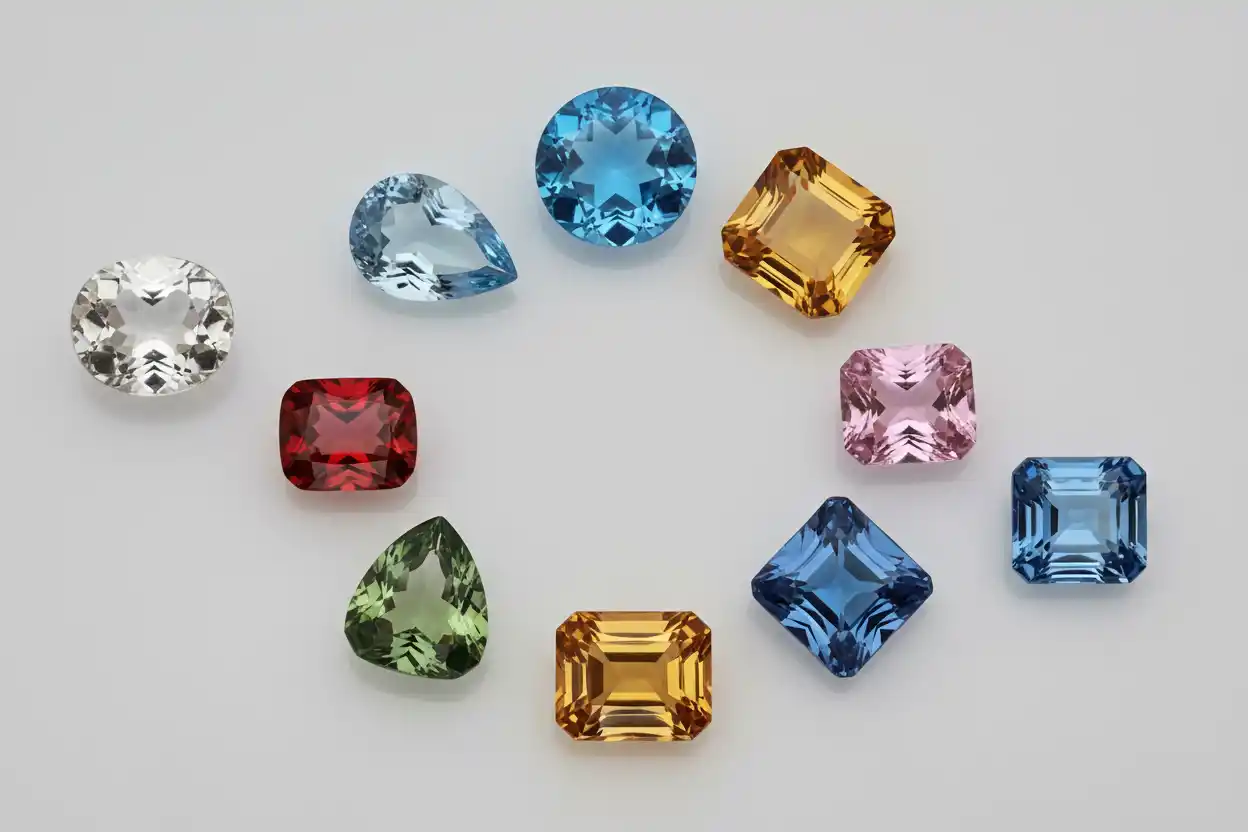
Types of Topaz: Colors and Varieties Explained
Topaz is an aluminum fluorosilicate gemstone whose natural color range includes colorless, yellow, orange, brown, pink, red, blue, green, violet, and multicolored material. However, most strongly blue topaz and nearly all rainbow-coated mystic topaz receive treatment after mining.
The principal types of topaz are classified by color, trace defects, fluorine-to-hydroxyl chemistry, origin, treatment, coating, and trade name. A pale colorless crystal, mass-market London blue gem, rare natural pink stone, and orange-red imperial topaz share the same mineral species but occupy very different rarity and value categories. The parent topaz meaning and properties guide covers the mineral broadly, while this page owns its color and variety classification.
Topaz at a Glance
| Property | Topaz |
|---|---|
| Composition | Aluminum fluorosilicate, Al₂SiO₄(F,OH)₂ |
| Mineral group | Topaz |
| Main colors | Colorless, white, blue, yellow, gold, orange, pink, red, purple, brown, green, and multicolored |
| Crystal system | Orthorhombic |
| Typical habit | Prismatic crystals with longitudinal striations, terminated crystals, water-worn pebbles, massive rough, and faceted gems |
| Luster | Vitreous |
| Transparency | Transparent to translucent |
| Mohs hardness | 8 |
| Cleavage | Perfect basal cleavage |
| Tenacity | Brittle |
| Common uses | Faceted rings, earrings, pendants, bracelets, collector crystals, carvings, and decorative objects |
| Main care concern | Perfect cleavage, heat and thermal shock, irradiation disclosure, coating wear, fractures, and misleading names such as smoky topaz |
What Controls Topaz Color?
Pure topaz can be colorless. Natural color develops through trace elements, atomic defects, radiation-related color centers, and interactions involving fluorine and hydroxyl within the crystal structure.
Iron and defects contribute to yellow, orange, brown, blue, and related colors. Chromium can create pink, red, and violet shades.
Natural radiation may create pale blue or brown color. Artificial irradiation and heat treatment can produce stronger blue on a commercial scale.
The exact mechanism can be complex, so visual color does not reveal whether a topaz is natural, treated, or synthetic.
Colorless or White Topaz
White topaz is transparent colorless topaz.
It occurs in large clean crystals and is widely faceted as a diamond alternative, accent stone, or starting material for blue and coated topaz treatments.
Colorless topaz has greater brilliance than ordinary glass but less fire and refractive index than diamond, moissanite, and zircon. Its high density also means it weighs more than some visually similar gems of the same dimensions.
Eye-clean white topaz is common and affordable. Value depends mostly on cut, size, polish, and whether the stone has been coated or assembled.
Natural Blue Topaz
Natural blue topaz exists but is usually pale.
Colors include faint sky blue, gray-blue, greenish blue, and light steel blue. Strong naturally saturated blue is rare.
Because treated blue topaz dominates the market, an expensive natural-color claim requires laboratory evidence. A pale unheated blue stone with documented origin can be more collectible than a much darker commercial treated gem.
Sky Blue Topaz
Sky blue topaz is the palest of the principal commercial blue categories.
It usually begins as colorless topaz that receives irradiation followed by controlled heating. The resulting color resembles pale aquamarine or a clear blue sky.
Sky blue stones are widely available in calibrated sizes and large clean cuts. Their per-carat price remains modest because treatment and rough supply are abundant.
The dedicated aquamarine versus blue topaz guide explains why density, refractive properties, pleochroism, and treatment differ.
Swiss Blue Topaz
Swiss blue topaz has a brighter and more saturated electric or tropical blue than sky blue.
Its color is also normally produced through irradiation and heating. Some stones show a slight green or turquoise modifier.
Swiss blue remains inexpensive compared with naturally rare blue gems. Its appeal comes from vivid color, large clean sizes, and consistent availability rather than geological scarcity.
London Blue Topaz
London blue topaz is the darkest mainstream blue treatment category.
It commonly appears deep blue, gray-blue, greenish blue, or ink blue. Some stones resemble dark teal or steel.
London blue is generally produced through irradiation and heating. The exact treatment sequence may differ among processors.
Deep color can hide extinction and make a stone appear nearly black in poor lighting. Fine cutting should preserve visible blue reflections through the center.
Yellow Topaz
Yellow topaz ranges from pale lemon and straw to golden yellow and yellow-brown.
Natural yellow material exists, although irradiation and heat can modify some stones. The most attractive gems combine warm color with strong transparency and minimal brown or gray.
The name yellow topaz should not be applied to citrine or yellow quartz. Their direct differences are covered in citrine versus yellow topaz.
Golden Topaz
Golden topaz is a richer yellow-to-orange category.
Colors may include honey, amber, sherry, orange-yellow, and golden brown. Some sellers use golden and precious topaz interchangeably, although terminology varies.
Fine golden topaz is more valuable than mass-market blue or colorless material, particularly when its color is natural and well saturated.
Imperial Topaz
Imperial topaz is the most prestigious topaz trade category.
Its accepted color range is not identical across every laboratory or market. It generally includes warm yellow-orange, orange, pinkish orange, orangy pink, salmon, peach, and reddish orange material.
Some dealers reserve imperial for pinkish-orange and orange-red stones from the Ouro Preto region of Brazil. Others include selected golden yellow material.
Fine imperial topaz should have attractive saturation, high transparency, strong cut, and minimal brown. Pink or red modifiers generally increase value.
A seller’s unsupported imperial label should not replace color description, treatment disclosure, origin, and independent testing.
Precious Topaz
Precious topaz is an older trade term for natural yellow, golden, orange, pink, or reddish topaz.
The term helped distinguish genuine topaz from quartz historically sold as Spanish topaz, Madeira topaz, or smoky topaz.
Modern descriptions should state the actual color rather than relying on precious alone. The word does not represent one standardized quality grade.
Pink Topaz
Natural pink topaz is rare and valuable.
Colors range from pale rose and salmon to vivid pink, purplish pink, and reddish pink. Chromium commonly contributes to the color.
Some pink topaz is produced by heating suitable orange, yellow, or brown material. Coatings can also create pink surfaces on colorless stones.
A valuable natural untreated pink claim requires laboratory support because treated and coated products are far more available.
Red Topaz
Natural red topaz is among the rarest topaz colors.
Fine stones may appear red, pinkish red, orange-red, or purplish red. Even small transparent gems can command substantial premiums.
Brown or orange material should not be promoted as red solely through warm photography. Neutral-light examination and laboratory wording are important.
Orange and Peach Topaz
Orange topaz ranges from apricot and tangerine to reddish orange and pumpkin tones.
Peach material occupies the transition between pale orange, pinkish orange, and warm yellow. These colors may fall within imperial terminology when their quality and origin meet market expectations.
Strongly brownish or dull orange stones generally sell below lively pink-orange material.
Brown and Sherry Topaz
Brown topaz can appear champagne, cinnamon, sherry, cognac, chocolate, or reddish brown.
Some brown colors are naturally radiation related and may fade with prolonged heat or strong light. Other stones are treated.
Sherry is a descriptive trade term rather than a standardized variety. Its boundary with imperial, golden, and brown topaz varies among sellers.
Green Topaz
Natural green topaz is rare and generally pale.
Colors may include yellow-green, blue-green, olive, and gray-green. Some green material derives from irradiation or coating.
Strong emerald-green topaz is unusual and should be investigated for treatment or misidentification.
Green topaz can resemble tourmaline, prasiolite, beryl, glass, and coated quartz.
Purple and Violet Topaz
Natural violet or purple topaz is rare.
Some material receives color from chromium-related processes, irradiation, heating, or coatings. Pale lavender shades can be subtle, while vivid uniform purple commonly deserves treatment scrutiny.
Purple topaz should not be confused with amethyst, which is quartz and significantly less dense.
Bicolor and Multicolor Topaz
Topaz crystals can contain distinct zones of blue, colorless, yellow, brown, pink, or other colors.
Natural zoning may form parallel layers, sectors, or gradual transitions. Cutters can orient the rough to display a bicolor face-up pattern.
Coating can also create artificial multicolor effects. Therefore, the color should be examined through the side and pavilion to determine whether it extends through the stone.
Mystic Topaz
Mystic topaz is usually colorless topaz coated with a thin metallic-oxide film.
The coating creates iridescent green, purple, blue, pink, gold, and rainbow colors. It sits near the surface rather than extending through the entire crystal.
Mystic topaz is genuine topaz with an applied treatment, but its appearance and durability depend on that film.
Facet edges, girdles, and pavilion surfaces can show coating wear. Repolishing may remove or alter the effect.
Azotic and Other Coated Topaz
Azotic topaz is another trade category for coated colorless topaz displaying vivid rainbow or multicolored effects.
Manufacturing processes and brand terminology vary. Some coatings emphasize pink and gold, while others produce blue-green or full-spectrum color.
All significant surface coatings should be disclosed because they require gentler care than untreated topaz.
Rutilated and Included Topaz
Topaz can contain needles, channels, iron oxides, mica, fluorite, quartz, feldspar, fluid inclusions, and other minerals.
Some commercial “rutilated topaz” contains limonite or iron-oxide staining in channels rather than true rutile needles. The inclusion should be identified before a premium name is applied.
Attractive natural inclusions can make one-of-a-kind collector gems, although surface-reaching channels and fractures affect durability.
Cat’s-Eye Topaz
Rare topaz can display chatoyancy when aligned tubes, needles, or inclusions reflect one band of light.
The rough must be cut as a cabochon across the inclusion direction. Fine examples show a centered moving eye.
Cat’s-eye topaz is uncommon and lacks a large standardized market. Identification matters because cat’s-eye quartz, apatite, scapolite, glass, and synthetic materials can look similar.
Natural Topaz Versus Trade Misnomers
Several materials have historically been sold with topaz names despite being quartz.
Smoky topaz usually means smoky quartz. Madeira topaz and Spanish topaz commonly refer to heated or naturally colored quartz and citrine.
Oriental topaz was historically used for yellow sapphire. Topazolite is a yellow-andradite garnet rather than topaz.
Modern sellers should use the correct mineral name instead of preserving misleading historical labels.
Topaz Formation
Topaz commonly forms in fluorine-rich granitic pegmatites, rhyolites, hydrothermal veins, greisens, and cavities associated with evolved igneous rocks.
Fluorine helps stabilize topaz during late-stage magma and fluid evolution. The mineral commonly occurs with quartz, feldspar, mica, tourmaline, fluorite, cassiterite, beryl, and related minerals.
Large open cavities can produce transparent prismatic crystals. Erosion later releases durable topaz into alluvial gravels.
Major Localities
Brazil is the defining commercial source of imperial, yellow, orange, pink, colorless, and blue-treatment rough. Ouro Preto and surrounding Minas Gerais districts are especially important for imperial material.
Pakistan produces fine colorless, pink, golden, and collector crystals. Russia, Ukraine, Nigeria, Namibia, Sri Lanka, Madagascar, Myanmar, Mexico, Afghanistan, China, and the United States also produce topaz.
Texas and Utah are notable United States localities. Some Texas colorless topaz naturally becomes pale blue or brown through radiation-related defects.
Geographic origin cannot be determined from color alone.
Topaz Inclusions
Topaz may contain two-phase or three-phase fluid inclusions, mineral crystals, healed fractures, growth tubes, veils, cleavage feathers, and color zoning.
Fine colorless and blue topaz is often eye-clean. Rare pink, red, and imperial material may retain visible inclusions without losing high value because color scarcity is more important.
Cleavage fractures parallel to the basal plane create particular risk during cutting and setting.
How Topaz Is Identified
Topaz has hardness 8, high density, orthorhombic optical character, moderate birefringence, and perfect basal cleavage.
It feels unusually heavy for its size compared with quartz and beryl. However, heft alone is not a reliable test in mounted jewelry.
The real versus fake topaz guide owns consumer-level identification. The broader aquamarine versus topaz guide separates pale blue beryl and topaz.
Refractive index, specific gravity, pleochroism, microscopy, spectroscopy, and treatment analysis provide stronger confirmation than scratch testing.
Irradiated Blue Topaz
Most strong blue topaz begins as colorless rough.
Irradiation creates or modifies color centers, while subsequent heating adjusts and stabilizes the blue. Different treatment conditions produce sky, Swiss, and London-style shades.
Regulated irradiation facilities must hold stones until residual radioactivity falls within legal release standards. Finished commercially released blue topaz should comply with applicable regulations.
Because treatment is routine, blue topaz should generally be assumed irradiated and heated unless respected evidence establishes otherwise.
Heated Topaz
Heating can lighten brown color, stabilize irradiation-created blue, or convert suitable orange-brown material toward pink.
The outcome depends on the original color centers and trace chemistry. Not every brown stone becomes valuable pink topaz.
Heat treatment should be disclosed when detected or known, especially when it changes the market category substantially.
Coated and Diffused Topaz
Thin films create mystic, Azotic, pink, green, blue, and rainbow effects.
Some surface-related color treatments may penetrate only a shallow depth. Recutting, repolishing, and abrasion can change them.
The dedicated treated topaz guide owns the full treatment-detection intent, while gemstone treatments explained provides broader terminology.
Synthetic Topaz and Imitations
Laboratory-grown topaz has been produced for research and limited applications, but synthetic gem topaz is not common in ordinary retail jewelry.
Imitations are more practical concerns. Glass, synthetic spinel, cubic zirconia, quartz, citrine, beryl, sapphire, and doublets can resemble different topaz colors.
A low price does not prove imitation because commercial blue and colorless topaz are genuinely inexpensive. Identification must rely on material properties.
Cutting Behavior
Topaz can occur in very large transparent crystals, allowing substantial faceted gems.
However, perfect cleavage requires careful orientation during sawing, preforming, polishing, and setting. A sharp blow or excessive dop pressure can split the stone.
Elongated ovals, emerald cuts, cushions, pears, and long rectangles preserve weight from prismatic rough. Rounds require greater loss.
Dark London blue and brown stones may need shallower proportions to prevent extinction. Pale material can be cut more deeply, although excessive depth reduces face-up size.
Durability and Jewelry Suitability
Topaz has Mohs hardness 8 and resists ordinary scratches well. The gemstone hardness chart places it above quartz and feldspar.
Its toughness is only fair to poor because of perfect cleavage. The gemstone cleavage guide explains why hardness does not protect a stone from splitting.
Earrings and pendants are safer than exposed rings and bracelets. A topaz ring should protect pointed corners and avoid prong pressure over cleavage feathers.
Topaz earrings and a topaz necklace can accommodate larger gems, while a topaz bracelet receives more frequent impact.
Topaz Prices in 2026
Colorless topaz commonly sells for approximately $1–$10 per carat. Precision cutting or unusual size can raise the price, but raw colorless material remains abundant.
Commercial sky, Swiss, and London blue topaz commonly ranges from $5–$30 per carat. Large stones do not gain value per carat rapidly because treated blue supply is plentiful.
Natural yellow, golden, brown, and attractive bicolor topaz commonly ranges from approximately $20–$150 per carat, depending on color, treatment, origin, and cutting.
Fine imperial topaz often ranges from $200–$1,500 per carat. Strong pink-orange, reddish orange, or premium larger stones may reach $1,500–$3,500-plus per carat.
Natural pink and red topaz can cost several hundred to several thousand dollars per carat. Exceptional untreated red or vivid pink gems may exceed ordinary imperial ranges.
Mystic and other coated topaz generally remain inexpensive, with value coming mainly from cutting, jewelry design, and brand rather than rarity.
Detailed future pricing belongs in the topaz price guide.
Buying Guidance
Identify the exact color and treatment category before comparing prices.
A dark London blue stone and a pale natural blue stone may look similar in a photograph but have very different rarity. Likewise, coated pink topaz should not be valued like natural chromium-bearing pink material.
Request treatment disclosure, exact dimensions, weight, cut, clarity, and return terms. Significant imperial, pink, red, or natural-blue claims may justify a laboratory report.
The full transaction checklist belongs in the topaz buying guide. The role of independent laboratories appears in gemstone certification.
Topaz also shares November birthstone status with citrine, as explained in the November birthstone guide.
Cleaning and Storage
Clean topaz with lukewarm water, mild soap, and a soft brush.
Avoid steam, ultrasonic machines, sudden temperature changes, and strong heat. Cleavage fractures can expand, while coatings may wear or discolor.
The complete care process belongs in how to clean topaz jewelry.
Store topaz separately from sapphire, moissanite, and diamond. It can also scratch quartz, feldspar, and softer stones.
Coated mystic material should be wrapped individually and kept away from abrasive cloths and polishing compounds.
Meaning and Symbolism
Topaz has been associated with clarity, confidence, friendship, prosperity, affection, and personal strength in different historical and spiritual traditions.
Blue topaz is often linked with communication, yellow with optimism, imperial with confidence, pink with affection, and white with clarity.
The detailed symbolic comparison belongs in the topaz color meaning guide.
These meanings reflect history, cultural practice, and personal belief. They are not scientifically demonstrated effects of fluorosilicate chemistry or color treatment.
Frequently Asked Questions
1. What are the main types of topaz?
Major types include colorless, natural blue, sky blue, Swiss blue, London blue, yellow, golden, imperial, pink, red, orange, brown, green, purple, bicolor, mystic, and cat’s-eye topaz.
2. Is blue topaz naturally blue?
Pale natural blue topaz exists, but most strongly blue commercial stones are irradiated and heated.
3. What is imperial topaz?
Imperial topaz is a prestigious warm-color category commonly covering fine yellow-orange, orange, pinkish-orange, orangy-pink, salmon, and reddish-orange stones.
4. Is London blue topaz natural?
Its dark blue color is generally produced by irradiation and heating of colorless topaz.
5. What is Swiss blue topaz?
Swiss blue is a bright, strongly saturated treated-blue category lighter and more vivid than London blue.
6. Is mystic topaz natural?
The underlying topaz is usually natural colorless material, but its rainbow appearance comes from an artificial surface coating.
7. Is white topaz a diamond?
No. White topaz is colorless aluminum fluorosilicate with lower brilliance, dispersion, and hardness than diamond.
8. Is smoky topaz genuine topaz?
Usually not. Smoky topaz is an outdated or misleading name commonly applied to smoky quartz.
9. Is pink topaz always treated?
No. Natural pink topaz exists and is rare, but heating and surface coatings also produce pink material.
10. Why does topaz chip despite hardness 8?
It has perfect basal cleavage, so impact in a vulnerable direction can split the stone even when its surface resists scratching.
11. Is irradiated blue topaz safe to wear?
Commercially released irradiated gems must meet applicable regulatory safety standards before sale.
12. Which topaz type is most valuable?
Fine untreated natural red, vivid pink, and premium imperial topaz—especially in larger clean sizes—generally occupy the highest market tier.
Topaz types demonstrate why color names alone cannot establish rarity. A colorless crystal, mass-market irradiated sky-blue gem, deep London blue stone, coated mystic topaz, Brazilian imperial gem, and rare natural red crystal share one mineral structure, yet treatment and natural scarcity place them in entirely different markets. Related entries appear in the crystals that start with T directory and the gemstones that start with T guide.