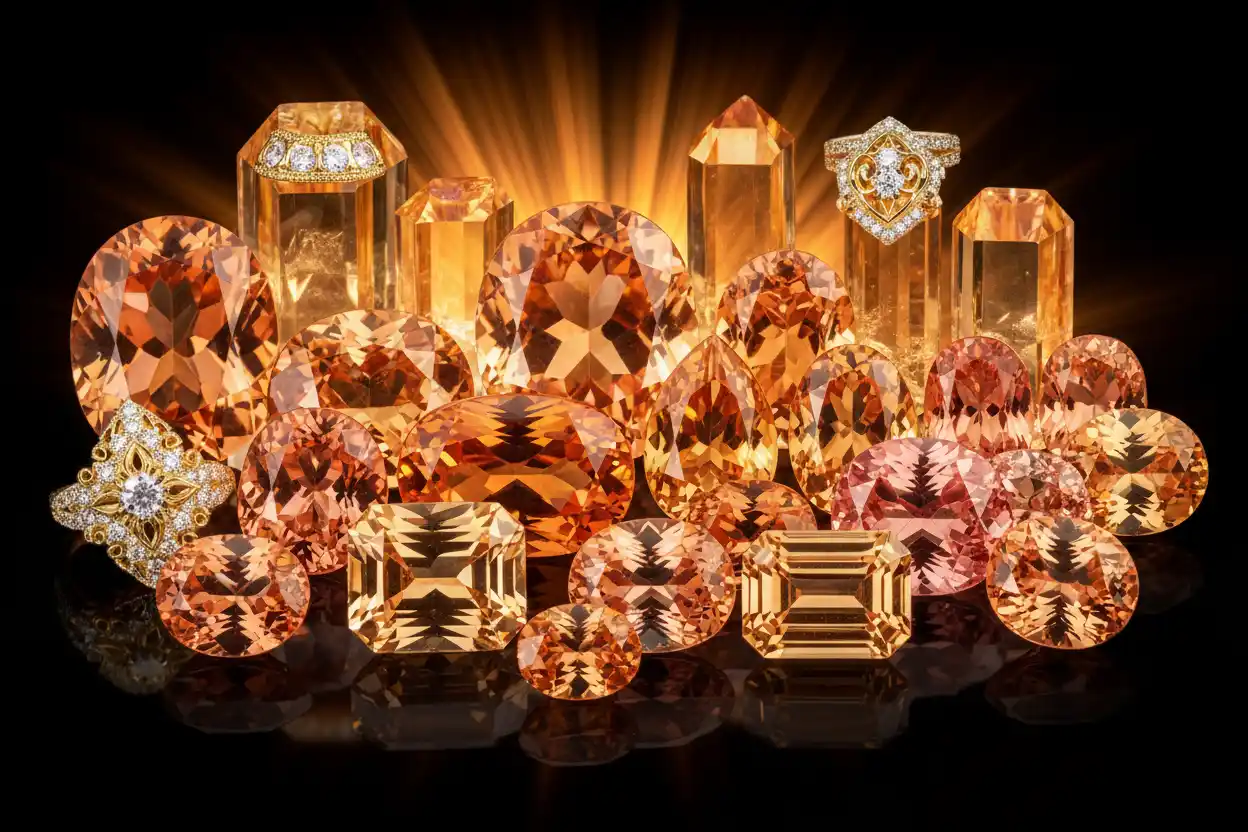
Imperial Topaz Meaning: Properties, Uses & Symbolism
Imperial topaz meaning begins with topaz, an aluminum fluorosilicate represented as Al₂(SiO₄)(F,OH)₂. Topaz is generally orthorhombic, has Mohs hardness 8, specific gravity commonly around 3.4–3.6, vitreous luster, strong basal cleavage, and gemological refractive indices broadly in the low 1.62 range. GIA gives an RI range of approximately 1.619–1.627, specific gravity near 3.53, birefringence around 0.008–0.010, and Mohs hardness 8 for gem topaz.
The word imperial adds a trade and historical layer rather than creating a different mineral species. There is no universally accepted gemological standard that defines exactly where ordinary yellow, orange, pink, or red topaz becomes imperial topaz. GIA explicitly notes that some dealers apply the term to colors spanning orange through pink, red, and purple, while others reserve it for narrower saturated ranges. GIA’s descriptive material commonly presents classic imperial color around medium reddish orange to orange-red.
That terminology issue is one of the most important parts of imperial topaz meaning. A gemstone does not become chemically different because a seller applies the imperial label, and a pale golden topaz should not automatically acquire the same rarity implications as a vivid reddish-orange stone. The responsible approach is to identify topaz first, describe the actual color second, investigate treatment where relevant, and then evaluate whether the imperial trade name is appropriate within the convention being used.
Imperial topaz also has a particularly strong connection with the Ouro Preto mining district of Minas Gerais, Brazil. GIA’s historical and geological literature describes the district as the classic source of highly prized orange-yellow, reddish-orange, pinkish-orange, and related topaz and documents long-standing production from mines around Ouro Preto.
Modern symbolism comes after those material facts. Imperial topaz is commonly associated with confidence, creativity, purposeful action, warmth, generosity, ambition, leadership, optimism, or personal renewal. Those themes can be meaningful as cultural or personal interpretations, but they are not demonstrated physiological effects of fluorine, aluminum, chromium, crystal defects, or orange color centers.
Readers exploring the broader material-first collection can browse Gemstone Guides. This page defines imperial topaz itself, explains why its name and color require careful interpretation, outlines formation and diagnostic evidence, documents the historical record, and keeps symbolic meaning clearly separated from unsupported medical or supernatural claims.
Imperial Topaz Meaning at a Glance
| Property or question | Evidence-aware summary |
|---|---|
| Mineral species | Topaz |
| Formula | Al₂(SiO₄)(F,OH)₂ |
| Status of “imperial topaz” | Trade/color designation rather than separate mineral species |
| Official universal imperial color standard | None |
| Classic trade color | Commonly reddish orange to orange-red, with broader trade usage extending through orange, pink and red |
| Crystal system | Generally orthorhombic |
| Mohs hardness | 8 |
| Specific gravity | About 3.4–3.6 |
| Typical gem RI | Approximately 1.619–1.627 in GIA’s general gem data |
| Birefringence | Approximately 0.008–0.010 |
| Optical character | Biaxial |
| Pleochroism | Present and potentially important for color appearance |
| Cleavage | Perfect basal cleavage |
| Transparency | Transparent to translucent |
| Luster | Vitreous |
| Classic locality | Ouro Preto district, Minas Gerais, Brazil |
| Important color factor | Chromium contributes pink-to-violet components; defect/color-center processes can modify appearance toward imperial orange |
| Treatment consideration | Heating can modify some yellowish-pink material toward purplish pink; other topaz treatments exist |
| Main identification issue | The imperial name is not itself proof of a particular color origin, treatment status, or geographic origin |
| Modern symbolism | Confidence, creativity, warmth, purposeful action, generosity, leadership |
| Scientific status of symbolism | Interpretive rather than demonstrated medical or supernatural effect |
| Main ownership issue | High hardness does not prevent breakage along perfect cleavage |
The properties belong fundamentally to topaz. Imperial topaz does not gain greater hardness, density, or toughness simply because its color is rarer.
What Is Imperial Topaz?
Imperial topaz is topaz occupying a particularly prized warm-color range.
GIA describes topaz generally as occurring in yellow, orange, brown, pink, red, purple-red, blue, green, and colorless material. Most natural topaz is colorless, while reddish, pink, and strongly orange colors are much less abundant.
The imperial designation is applied within that warmer part of the spectrum.
That does not create a separate formula.
A reddish-orange imperial stone remains Al₂(SiO₄)(F,OH)₂ topaz.
A colorless topaz remains the same mineral species.
What changes is the combination of trace constituents, defects, color centers, geological history, and—in some stones—treatment.
This distinction protects readers from a common misunderstanding: “imperial” is a gem-trade description of particularly desirable topaz, not a formal mineral species recognized because of a different crystal structure.
Imperial Topaz Identity Table
| Characteristic | Imperial topaz |
|---|---|
| Mineral | Topaz |
| Idealized formula | Al₂(SiO₄)(F,OH)₂ |
| Mineral type | Aluminum fluorosilicate |
| Crystal system | Orthorhombic in ordinary natural gem topaz |
| Typical crystal habit | Long to short prismatic crystals, often vertically striated |
| Traditional imperial colors | Golden-orange, pinkish orange, reddish orange, orange-red, pink-to-red in broader usage |
| Hardness | 8 |
| Measured SG range for topaz | Roughly 3.4–3.6 |
| General GIA gem SG | About 3.53 |
| Typical RI | Around 1.619–1.627 in GIA’s general gem reference |
| Birefringence | Approximately 0.008–0.010 |
| Optical behavior | Biaxial |
| Pleochroism | Can alter apparent color with viewing direction |
| Cleavage | Perfect on the basal plane |
| Fracture | Uneven to subconchoidal outside cleavage |
| Tenacity | Brittle |
| Luster | Vitreous |
| Main identification principle | Confirm topaz before interpreting the imperial trade name |
| Main naming caution | No universal official imperial color boundary |
Mindat gives topaz hardness 8, density approximately 3.4–3.6, perfect basal cleavage, and refractive indices that vary somewhat with F/OH composition.
Why “Imperial” Is Not a Precise Scientific Variety Boundary
Gem names can operate at several levels.
Some identify mineral species.
Some identify chemically meaningful varieties.
Some identify color varieties.
Others are historical or commercial categories.
Imperial topaz belongs primarily to the last two categories.
GIA states directly that there is no official standard for determining whether a particular topaz is imperial. Some dealers use the word broadly from orange into pink, red, and purple, while other dealers require a more saturated reddish-orange appearance.
That means two reputable sellers can inspect the same pinkish-orange stone and legitimately use different trade terminology.
The disagreement does not necessarily mean either seller has misidentified the mineral.
It means the commercial boundary is not standardized.
Original Information Gain: Imperial Topaz Naming Decision Table
| Stone description | Material-first description | Is “imperial” automatically justified? |
|---|---|---|
| Medium reddish-orange natural topaz | Topaz with classic imperial-range color | Strong case |
| Orange-red transparent topaz | Topaz in classic desirable warm range | Strong case |
| Pinkish-orange topaz | Commonly included in imperial usage | Often, depending on convention |
| Saturated pink topaz | Some dealers include it | Not universal |
| Purple-red topaz | Included in some broad trade definitions | Not universal |
| Golden-yellow topaz without red modifier | Yellow/golden topaz | Usually weaker imperial case |
| Brownish-yellow topaz | Sherry/precious-topaz territory in many trade descriptions | Do not assume imperial |
| Colorless topaz | Colorless topaz | No |
| Irradiated blue topaz | Treated blue topaz | No |
| Coated vivid orange topaz | Treated/coated topaz | Do not infer imperial rarity from appearance |
| Heated pink topaz | Treated topaz with modified color | May be sold in imperial-range color, but treatment must be disclosed |
| Seller label “Brazilian imperial topaz” | Trade plus origin claim | Requires topaz identity and credible provenance |
| Seller label “Ouro Preto imperial topaz” | Specific locality claim | Requires provenance or appropriate origin evidence |
| “Royal topaz” | Marketing wording | No mineralogical meaning by itself |
| “Precious topaz” | Historical/trade term used for warm natural colors | Not identical to imperial in every source |
The central lesson is straightforward: color terminology can be subjective even when mineral identification is objective.
What Color Is Imperial Topaz?
Classic imperial topaz is generally described around reddish-orange, orange-red, pinkish-orange, or related warm tones.
GIA’s topaz description uses medium reddish orange to orange-red as a characteristic imperial range, while its buyer guidance acknowledges broader trade usage that extends through orange, pink, red, and purple.
This variation makes hue modifiers important.
“Orange” is not enough.
A useful description should record:
the dominant hue,
secondary hue,
tone,
saturation,
color zoning,
pleochroism,
and lighting conditions.
A strongly reddish-orange stone and a pale yellow-orange stone can both be topaz yet occupy very different visual and trade categories.
What Causes Imperial Topaz Color?
Topaz color is controlled by a combination of trace impurities and structural defects rather than one universal pigment.
GIA’s research on topaz color identifies Cr³⁺ substituting for Al³⁺ as an important chromophore in pink-to-violet topaz. The same research describes imperial-orange coloration as involving interactions between chromium-related pink components, oxygen-related charge-transfer behavior, and radiation-induced color centers.
This is more precise than the simplified claim that “chromium makes imperial topaz orange.”
Chromium is important in many pinkish and reddish stones.
Defect chemistry modifies the final appearance.
Different stones can contain different proportions of these effects.
The detailed absorption spectra, pleochroism, zoning, defect centers, chromophore chemistry, and lighting behavior belong in Imperial Topaz Optical Properties and Color Behavior.
Chromium Does Not Explain Every Warm Topaz
Warm-colored topaz spans yellow, brown, orange, pink, and red.
Some color is associated strongly with chromium.
Other color involves defect centers.
Still other appearance may combine several mechanisms.
Therefore, a stone being orange does not prove chromium content.
Likewise, a stone containing detectable chromium does not automatically fall within the most desirable imperial color range.
Gem color results from how the complete crystal absorbs and transmits visible wavelengths.
Elemental analysis and visible color answer related but different questions.
Pleochroism Changes What Imperial Topaz Looks Like
Topaz is pleochroic, meaning its apparent color can change with crystallographic viewing direction.
GIA notes that topaz can display different colors in different crystal directions.
In warm-colored material, that may mean one direction appears more orange, another more pinkish, reddish, yellowish, or subdued.
This is important for both photography and cutting.
A gem photographed from one favorable orientation can look substantially richer than it does from another.
Likewise, a cutter must orient rough to balance color appearance against cleavage risk and weight retention.
Pleochroism is an optical property.
It is not evidence that the stone “changes energy” as it turns.
Color Zoning
Natural topaz crystals can show unevenly distributed color.
GIA’s topaz research documents distinct color zones in rough crystals and emphasizes how crystal orientation and internal color distribution can influence the finished gem.
A crystal may contain richer orange or pink areas alongside paler regions.
Cutting can concentrate desirable color into the face-up view by orienting a stronger-colored zone where it contributes most effectively.
This does not mean every patchy stone has been treated.
Growth zoning is a normal geological possibility.
Treatment questions should be investigated separately.
Heat Treatment and Imperial-Range Colors
Topaz treatment deserves careful but limited discussion here because treatment status affects how color should be interpreted.
GIA documents heating of yellowish-pink topaz to remove part of the yellow component and intensify purplish-pink color. GIA also illustrates an imperial topaz crystal divided before treatment, with one portion becoming purplish pink after heating.
Treatment does not change the mineral from topaz into another species.
It changes the appearance.
A seller should therefore disclose treatment when known and when it materially affects the representation of color.
This meaning page does not attempt to reproduce a full treatment-identification guide.
Its boundary is simpler: warm color is not, by itself, proof of untreated imperial topaz.
Is Imperial Topaz Usually Treated?
No universal statement should be applied to every stone.
Much desirable warm-colored topaz enters the trade with natural color, while some material can be heat treated to modify pink/orange relationships. Coatings and other surface treatments can also alter topaz appearance in the broader market.
The correct question is specimen-specific:
What treatment has been disclosed?
What treatment is detectable?
What does the laboratory report actually say?
An untreated declaration should not be inferred merely from price, locality claim, or rich color.
How Imperial Topaz Forms
Topaz generally forms in fluorine-rich, highly evolved geological systems.
GIA’s geological research describes topaz crystallizing from fluorine- and lithium-rich, aluminum-rich, highly fractionated silicic melts or gases associated with rhyolites, pegmatites, hydrothermal greisens, and related systems. Topaz in pegmatites commonly occurs with quartz, feldspar, muscovite, tourmaline, fluorite, and other late-stage minerals.
Mindat likewise records topaz from pegmatites, high-temperature quartz veins, granite cavities, and rhyolitic environments.
Imperial topaz from the classic Brazilian district represents a more specific geological problem.
The Ouro Preto occurrences are not adequately explained by saying simply “all imperial topaz forms in pegmatites.”
The dedicated geology belongs in Imperial Topaz Formation and Deposit Geology.
The Ouro Preto Geological Setting
The classic imperial topaz district lies around Ouro Preto in Minas Gerais, Brazil.
GIA’s historical literature describes topaz mining from a restricted district west and southwest of the city, including major workings such as Capão.
GIA’s historical research compilation describes imperial topaz occurring in weathered, clay-rich material filling fractures and faults, with components including kaolinite, hematite, muscovite, and quartz reported from the mineralized zones.
The precise genesis of these deposits has been debated by geologists through time.
That makes a cautious wording preferable:
Imperial topaz at Ouro Preto occurs within a distinctive altered and fracture-controlled geological environment whose formation reflects interaction among topaz-bearing fluids, host rocks, structural pathways, and later weathering.
A single simplified “magma cooled into orange crystals” explanation would erase too much of that geological complexity.
Formation Is Not the Same as Weathering
A crystal can form during one stage and be exposed or concentrated during a much later stage.
At Ouro Preto, deeply weathered material can make topaz recoverable from soft altered zones even though the topaz itself formed earlier.
This distinction matters because many gem deposits are described by the material miners dig today rather than by the conditions under which the gem originally crystallized.
Clay around a topaz crystal does not necessarily mean the topaz crystallized from clay.
Weathering can transform the host after mineral formation.
Diagnostic Characteristics of Imperial Topaz
The first diagnostic task is identifying topaz.
Only after that should the imperial color term be evaluated.
| Observation or test | Topaz-compatible result | What it establishes |
|---|---|---|
| Hardness | Mohs 8 | Strong supporting property |
| SG | Roughly 3.4–3.6 | Distinguishes topaz from many look-alikes |
| RI | Around low 1.62 range | Strong gemological evidence |
| Birefringence | Approximately 0.008–0.010 | Supports topaz |
| Optical character | Biaxial | Useful |
| Pleochroism | Present | Supports orientation/color evaluation |
| Cleavage | Perfect basal | Important structural clue |
| Crystal habit | Prismatic, commonly elongated | Supporting morphology |
| Color | Orange/pink/red | Supports imperial trade classification only after host identification |
| Spectroscopy | Can characterize color centers/chromophores | Strong color-mechanism evidence |
| Chemical analysis | Can detect Cr and other trace elements | Does not alone establish trade quality |
A reddish-orange stone with the wrong RI and density is not imperial topaz merely because the color matches.
Imperial Topaz Versus Citrine
Citrine is quartz.
Imperial topaz is topaz.
The distinction is straightforward gemologically even when golden-orange stones overlap visually.
Topaz has higher density, higher refractive index, greater hardness, biaxial optical behavior, and perfect basal cleavage.
Quartz has lower density, lower RI, Mohs hardness 7, uniaxial behavior, and no equivalent topaz cleavage.
GIA specifically notes that warm yellow-brown topaz can be confused in trade with citrine and smoky quartz, which historically contributed to the use of terms such as precious topaz for true topaz.
Color is therefore the weakest part of the comparison.
Imperial Topaz Versus Indicolite
Indicolite Meaning concerns blue tourmaline.
Both tourmaline and topaz can form elongated prismatic crystals and both can be strongly pleochroic, so rough crystal photographs do not always make species identification obvious to a non-specialist.
Their chemistry, density, optical constants, cleavage behavior, and crystal structures differ substantially.
Imperial topaz belongs to a fluorine-bearing aluminum silicate system.
Indicolite belongs to the chemically complex tourmaline group.
A trade color name should never override the host species.
Imperial Topaz Versus Ilmenite
Ilmenite Meaning concerns opaque FeTiO₃.
The comparison could hardly be more different visually: imperial topaz is transparent and valued for transmitted warm color, while ilmenite is normally black and opaque with metallic to submetallic luster.
Both can contain iron in some form, but the role of iron and crystal structure differ completely.
An element name shared across minerals does not imply similar color, symbolism, durability, or biological behavior.
Imperial Topaz Versus Indigo Gabbro
Indigo Gabbro Meaning concerns an ornamental rock rather than a single transparent gem species.
Imperial topaz is a mineral that can be characterized by one crystalline structure and compositional framework.
An ornamental gabbro is a multi-mineral rock whose appearance results from the proportions and textures of several phases.
This is a useful classification contrast:
gemstone trade names may refer either to one mineral variety or to an entire rock.
Determining which is which should come before symbolism.
Imperial Topaz Versus Iceland Spar
Iceland Spar Meaning concerns exceptionally transparent calcite.
Both can be water-clear when color is weak, but their physical properties differ strongly.
Calcite is Mohs 3 and shows extraordinary double refraction and rhombohedral cleavage. Topaz is Mohs 8, has much lower birefringence, higher density, and perfect basal cleavage.
A transparent crystal’s beauty cannot identify the species.
Measurement can.
Inclusions in Imperial Topaz
Fine topaz used in jewelry is commonly expected to be highly transparent and often eye-clean. GIA notes that topaz used in jewelry is typically eye-clean.
That does not mean natural imperial topaz lacks inclusions.
Crystals can contain fluid inclusions, healed fractures, mineral inclusions, growth features, zoning, cleavage-related damage, and other internal structures.
Some inclusions may help establish natural formation or geological context.
Others may reduce transparency or create durability concerns.
No single inclusion proves Ouro Preto origin.
The detailed inclusion morphology and specimen-scale evidence belong in the Imperial Topaz Microscope Inclusion Notebook.
Original Specimen and Photo Checklist
| Observation | Photograph can often support | Photograph cannot reliably prove |
|---|---|---|
| Reddish-orange body color | Hue, saturation and zoning | Imperial status under every trade definition |
| Pinkish-orange modifier | Visible color balance | Chromium concentration |
| Pleochroic variation | Directional color differences | Exact crystallographic orientation without testing |
| Transparent prismatic habit | Topaz-compatible morphology | Topaz conclusively |
| Vertical surface striations | Growth morphology clue | Geographic provenance |
| Existing basal cleavage | Structural clue | Treatment history |
| Color zoning | Natural-looking distribution | Whether color was modified by heating |
| Fluid inclusions | Natural internal structures | Exact fluid chemistry |
| Mineral inclusions | Shape and distribution | Inclusion species without analysis |
| Weathered matrix | Geological context | Ouro Preto origin |
| Seller “Brazil” label | Country claim | Mine-level provenance |
| Seller “Ouro Preto” label | Specific locality claim | Independent geographic proof |
| Seller “untreated” label | Disclosure claim | Laboratory confirmation |
| “Imperial” label | Trade classification | One standardized color grade |
| “Healing energy” | Nothing objectively measurable | Physiological or supernatural effect |
A strong documentary photo set should include neutral daylight, warm indoor light, and at least two crystal orientations.
That matters because warm lighting can artificially intensify orange and red, while pleochroism can change color with direction.
Do not evaluate imperial color from one highly saturated seller photograph.
Original Imperial Topaz Evidence Hierarchy
| Evidence level | Defensible conclusion |
|---|---|
| Warm orange/pink color | Imperial topaz is one possibility |
| Prismatic topaz-like rough | Topaz becomes plausible |
| RI and SG compatible with topaz | Strong species support |
| Biaxial behavior and birefringence | Further support |
| Basal cleavage/habit | Strong supporting evidence |
| Spectroscopy | Color centers/chromophores can be investigated |
| Chemical analysis | Trace constituents such as chromium can be measured |
| Treatment analysis | Color history becomes better constrained |
| Provenance records | Locality claim gains credibility |
| Several independent methods agreeing | Strongest basis for material and origin claims |
The imperial label sits near the end of the process, not the beginning.
Documented History of Imperial Topaz
Topaz has a much longer cultural history than the imperial trade name.
GIA records ancient and later traditions in which topaz was associated with strength, protection from magic, anger reduction, beauty, intelligence, and long life. These beliefs belong to cultural history rather than modern medical evidence.
The imperial name has its own disputed history.
One GIA historical account traces the term to imperial Russia, where prized pink topaz from the Ural Mountains became associated with the royal family. Another GIA historical summary notes a competing Brazilian tradition linking the name with a visit by Emperor Pedro II to Ouro Preto and the presentation of reddish topaz.
Because reputable gemological sources record more than one explanation, the safest statement is not that one story is unquestionably proven.
The origin of the imperial name is historically associated with royal imagery, with Russian and Brazilian explanations both appearing in gemological literature.
Ouro Preto and the Imperial Topaz Tradition
Whatever the exact origin of the name, Ouro Preto became the locality most strongly associated with imperial topaz in the modern gem trade.
GIA’s classic deposit study describes a restricted mining district near Ouro Preto as the historic major source of this prized topaz.
The Smithsonian likewise describes highly prized imperial material as intense golden to reddish orange and identifies Ouro Preto as its principal classic source.
This locality relationship is important.
It should not be converted into the reverse assumption that every orange topaz comes from Ouro Preto.
Provenance requires evidence.
The Topaz Name Has Its Own Historical Complication
Even the word topaz has changed meaning historically.
GIA notes that the name is often connected with the ancient Greek name Topazios for an island in the Red Sea, although that island is associated with peridot rather than modern topaz. Another proposed derivation connects the word with Sanskrit terminology for fire.
This historical ambiguity is a useful reminder that gemstone names can migrate across materials before mineralogy becomes precise.
A modern mineral identification should follow chemistry and structure.
Historical terminology should be preserved as history.
Modern Imperial Topaz Meaning
Modern imperial topaz meaning commonly centers on confidence, leadership, creativity, warmth, generosity, optimism, personal authority, ambition, and constructive action.
These associations are understandable.
The saturated orange-red appearance can evoke sunlight, fire, warmth, autumn, ceremony, and precious metals.
The imperial trade name naturally invites ideas of authority or leadership.
Its rarity compared with ordinary colorless and treated blue topaz can inspire symbolism around selectivity or intentionality.
All of these are human interpretations.
None is a measured physiological property of topaz.
Imperial Topaz and Confidence
Confidence is one of the most natural modern symbolic themes.
A grounded practice might connect the stone with preparation rather than passive expectation.
Before a presentation, interview, negotiation, or difficult conversation, use the gem as a reminder to identify the goal, review the evidence, anticipate difficult questions, and decide what outcome is acceptable.
That preparation can influence confidence.
The gemstone does not biologically produce it.
Imperial Topaz and Leadership
The word imperial makes leadership symbolism almost inevitable.
Responsible leadership symbolism should focus on accountability rather than dominance.
A practical reflective prompt could ask:
What decision is actually mine to make?
Who will be affected?
What evidence am I missing?
What responsibility remains with me after the decision?
The stone does not confer authority.
It can remind the owner to use authority carefully.
Imperial Topaz and Creativity
Imperial topaz can symbolize creativity through its unusual warm color and the way cutters use orientation, pleochroism, zoning, and facet geometry to reveal a compelling face-up appearance.
That is also a genuine creative application.
Lapidaries must make choices about cleavage, weight retention, color concentration, and visual balance.
The detailed workmanship belongs in Imperial Topaz Cutting, Orientation and Polish.
A person may use the finished gem as a creative cue.
There is no established evidence that topaz chemistry increases creative brain function.
Imperial Topaz and Purposeful Action
Orange and red stones are often assigned action-oriented symbolism.
A responsible interpretation can turn that symbolism into a measurable process:
choose one goal,
define the next action,
set a completion condition,
and review the result.
The stone becomes an object associated with follow-through.
It does not guarantee productivity, business success, promotion, artistic achievement, or favorable external outcomes.
Imperial Topaz and Optimism
Warm transparent topaz can appear bright and luminous, making optimism an intuitive modern association.
Optimism does not need to mean assuming that difficulties will disappear.
A more useful interpretation is recognizing uncertainty while continuing to search for workable options.
The gemstone can symbolize that attitude.
It cannot alter probability.
Imperial Topaz and Prosperity
The imperial name and prized reddish colors often lead to wealth or prosperity symbolism.
There is no scientific evidence that imperial topaz attracts money, raises investment returns, increases sales, causes promotions, changes lottery outcomes, or brings financial opportunities to its owner.
A grounded prosperity practice could connect the stone to budgeting, saving, completing paid work, developing expertise, or following up on opportunities.
Those behaviors have mechanisms.
The gemstone has symbolism.
Imperial Topaz and Protection
Historical topaz lore includes protective beliefs, including older European traditions involving magic and anger. GIA records these as historical beliefs rather than modern physical properties.
Modern users may continue to interpret topaz as protective.
A responsible version turns protection into real action: verify information, use appropriate safety equipment, maintain boundaries, secure accounts, insure valuable jewelry where appropriate, and leave unsafe circumstances.
Imperial topaz does not create a supernatural shield.
Imperial Topaz Healing Claims
There is no established scientific evidence that imperial topaz treats anxiety, depression, cardiovascular disease, neurological conditions, hormonal disorders, immune dysfunction, infertility, chronic pain, digestive disorders, sleep problems, or other medical conditions.
Topaz contains aluminum, silicon, fluorine, oxygen, and variable hydroxyl.
Those elements are part of a crystalline mineral structure.
They are not automatically available as nutrients, medicine, or transdermal therapy.
The broader evidence boundary around gemstone wellness claims is stated in the Gems Lore Disclaimer.
Fluorine in Topaz Is Not Dental Treatment
Topaz can contain substantial fluorine.
That does not make a gemstone equivalent to fluoride used in dental products.
Chemical form, concentration, route of administration, bioavailability, formulation, and dosage all matter.
Fluorine bound within topaz’s crystal lattice is not delivered therapeutically to teeth merely because the stone is worn against skin.
Mineral composition should not be transformed into healthcare advice.
Aluminum in Topaz Is Not a Wellness Mechanism
The same reasoning applies to aluminum.
Its presence in Al₂(SiO₄)(F,OH)₂ defines topaz chemistry.
It does not demonstrate either a health benefit or a health hazard from ordinary intact gemstone contact.
Claims about biological exposure require actual exposure pathways and dose information.
Reading the formula alone cannot supply those answers.
Safe Ownership: Hardness 8 Does Not Mean Unbreakable
Topaz is a Mohs hardness reference mineral at 8, so it resists scratching far better than quartz, calcite, fluorite, and many other common materials.
But hardness measures resistance to scratching.
It does not measure resistance to cleavage.
Topaz has perfect basal cleavage and is brittle. GIA specifically cautions that strong pressure or sudden temperature change can cause topaz to break.
That distinction is particularly important for imperial material because visually valuable stones can be damaged by a blow despite having high hardness.
Why Cleavage Matters in Jewelry
A gem cutter can orient topaz to reduce the likelihood that vulnerable cleavage lies in an unfavorable position.
GIA’s topaz research describes cutters avoiding table orientation directly along the cleavage plane and balancing structural weakness against color orientation.
A jeweler faces a related problem.
Strong prong pressure near a vulnerable direction can chip or split a stone.
Exposed corners and points increase impact risk.
Large gems can receive greater leverage during knocks.
The detailed engineering of settings, girdles, prongs, bezels, impact exposure, and long-term wear belongs in Imperial Topaz Setting and Wear Engineering.
Cleaning and Temperature
GIA recommends warm soapy water as a safe routine method for topaz and warns that sudden temperature changes can damage the stone.
This meaning page does not attempt to reproduce a complete care guide.
The key ownership principle is enough:
avoid unnecessary heat,
avoid strong thermal shock,
avoid hard blows,
and consider treatment status before applying aggressive cleaning.
A coated or otherwise treated stone may require additional restrictions.
Intact Topaz Versus Processing Dust
Ordinary handling of intact imperial topaz is different from cutting, sawing, grinding, sanding, or drilling rough material.
Lapidary processing generates fine mineral particles and may also expose dust from matrix minerals and polishing compounds.
Appropriate workshop controls include wet methods where suitable, local dust management, eye protection, safe machinery, and correctly selected respiratory protection when required.
Do not deliberately grind topaz into powder for spiritual use.
Its symbolic meaning does not require destroying the specimen.
Do Not Ingest Imperial Topaz
Imperial topaz should not be powdered, swallowed, added to supplements, or deliberately placed into drinking water to create gemstone elixirs.
A natural gem can contain inclusions, fractures, polishing residues, treatment materials, surface contamination, or associated minerals not represented by the ideal formula.
Mineral chemistry is not dosage guidance.
Symbolic use does not require ingestion.
Specimen Conservation
Natural imperial topaz crystals can preserve crystal faces, striations, color zoning, growth history, fractures, inclusions, matrix relationships, locality information, mine labels, historic collection records, and treatment evidence.
A complete crystal from a classic locality can have scientific or collector importance separate from its potential value as faceting rough.
Before cutting an important specimen, photograph all sides and record dimensions, weight where useful, color zones, termination quality, existing cleavage damage, associated minerals, locality wording, acquisition history, old labels, and analytical information.
The Imperial Topaz Specimen Conservation Record provides the dedicated framework for preserving that information.
Should Every Transparent Crystal Be Faceted?
No.
A complete terminated crystal may preserve geological information that disappears once it is sawn.
A damaged fragment or crystal already recovered specifically as gem rough may be an appropriate cutting candidate.
The choice should consider:
crystal completeness,
rarity,
locality documentation,
color zoning,
inclusions,
cleavage,
historical provenance,
and likely finished yield.
A large transparent crystal is not automatically more valuable after faceting.
Specimen and gemstone markets can value different features.
What Photographs Should Be Preserved Before Cutting?
For a potentially important imperial topaz crystal, record:
the complete crystal in neutral daylight;
both ends and termination geometry;
all natural crystal faces;
color zoning from multiple directions;
existing cleavage and fractures;
matrix attachments;
labels beside the specimen;
and a transmitted-light image where practical.
Those photographs create a record of the natural object even if cutting later removes much of its morphology.
About Provenance
Brazilian origin is plausible for a large amount of imperial material because the Ouro Preto district is historically central to the trade.
That does not make origin visually obvious.
Color alone cannot establish Brazil, Minas Gerais, Ouro Preto, or a particular mine.
Strong locality claims should be supported by chain of custody, credible supplier records, documented collection history, or appropriate analytical provenance work where available.
The site’s broader evidence and sourcing approach is described on About Gems Lore.
Original Source-Comparison Framework
| Source type | Best question it answers | Main limitation |
|---|---|---|
| GIA Gem Encyclopedia | Standard topaz properties and trade terminology | Does not authenticate one stone |
| GIA imperial FAQ | How standardized is the imperial label? | Does not create a fixed grading system |
| GIA spectroscopy/research | What mechanisms contribute to topaz color? | Findings may require specimen-specific analysis |
| GIA deposit studies | What is documented about Ouro Preto geology? | Does not prove origin of another gem |
| Smithsonian collection | What documented imperial material exists in a major museum? | Individual museum specimen does not define all trade material |
| Refractometer/SG testing | Is the material compatible with topaz? | Does not determine origin or treatment alone |
| Spectroscopy/chemistry | What color centers or trace elements are present? | Does not automatically assign market quality |
| Laboratory treatment analysis | Has detectable treatment occurred? | Some treatments may be difficult to determine |
| Seller photograph | What color and cut are being represented? | Lighting and editing can distort appearance |
| Metaphysical source | What symbolism is practiced? | Cannot establish mineralogy or medical effect |
This framework prevents a recurring category error: historical lore is appropriate evidence for historical beliefs, while gemological properties require mineralogical or laboratory evidence.
Evidence and Technical Limits
This article does not claim first-hand mining in Ouro Preto, private chromium analysis, unpublished spectroscopy, laboratory treatment testing of every imperial stone, or direct authentication of a reader’s gem.
Exact color cause, treatment history, inclusion identity, geographic provenance, and difficult variety-name decisions may require refractometry, spectroscopy, microscopy, trace-element analysis, or specialist gemological review.
The absence of a universal imperial-color standard also means that two experts can reasonably use the trade term somewhat differently while agreeing completely on the mineral species and measured color.
Readers with documented analytical corrections, historical records, locality data, or stronger technical evidence can submit them through Contact Gems Lore. Information submitted through site channels is handled according to the Privacy Policy.
Frequently Asked Questions About Imperial Topaz Meaning
What is imperial topaz meaning?
Imperial topaz meaning combines its identity as prized warm-colored topaz with modern symbolic themes such as confidence, creativity, purposeful action, generosity, leadership, optimism, and discernment. Those symbolic meanings are interpretations rather than demonstrated medical effects.
What is imperial topaz?
Imperial topaz is a trade designation for especially valued warm-colored topaz, commonly reddish orange, orange-red, pinkish orange, and related tones. It is still the mineral topaz rather than a separate species.
Is there an official definition of imperial topaz?
No universal official standard exists. GIA notes that dealers use the term differently, with some covering orange through pink, red, and purple and others applying stricter color criteria.
What is imperial topaz made of?
The mineral is topaz with formula Al₂(SiO₄)(F,OH)₂.
How hard is imperial topaz?
Topaz has Mohs hardness 8.
Is imperial topaz durable?
It has excellent scratch resistance but perfect basal cleavage. A sharp blow or unfavorable pressure can split topaz despite its high hardness.
What is imperial topaz’s refractive index?
GIA gives a general topaz RI range of approximately 1.619–1.627.
What is imperial topaz’s specific gravity?
GIA gives about 3.53 for gem topaz, while mineral references provide a broader natural range of approximately 3.4–3.6.
What causes imperial topaz color?
Chromium contributes to pink-to-violet topaz, while imperial-orange appearance can involve chromium-related color together with oxygen/metal charge-transfer and radiation-related defect centers.
Is every orange topaz imperial topaz?
No. Imperial is a trade term without one official boundary. Hue, saturation, tone, red or pink modifiers, treatment, and seller convention all affect usage.
Is golden topaz the same as imperial topaz?
Not automatically. GIA distinguishes more abundant golden or yellow topaz from rarer imperial material carrying prized reddish or pinkish modifiers.
Can imperial topaz be treated?
Yes. GIA documents heating certain yellowish-pink topaz to remove yellow components and intensify purplish-pink color.
Is all imperial topaz heated?
No. Treatment status is specimen-specific and should be disclosed or tested rather than assumed.
Where does imperial topaz come from?
The Ouro Preto district in Minas Gerais, Brazil, is the classic and historically most important source associated with imperial topaz.
Does imperial topaz occur only in Brazil?
The imperial trade term is fundamentally color-based rather than an official geographic species definition. Brazilian Ouro Preto material has exceptional historical importance, but a stone’s origin should be established independently rather than inferred solely from its warm color.
Why is it called imperial topaz?
Gemological sources record competing royal-origin traditions. One associates the name with Russian royal ownership of prized pink Ural topaz, while another Brazilian tradition links it with Emperor Pedro II and Ouro Preto.
Is imperial topaz the same as citrine?
No. Citrine is quartz, while imperial topaz is topaz. Their hardness, density, refractive indices, cleavage, and optical behavior differ.
Does imperial topaz have healing properties?
There is no established scientific evidence that carrying or wearing imperial topaz treats disease or produces specific physiological healing effects.
Does imperial topaz improve confidence?
Someone may use the stone as a symbolic reminder to prepare, communicate, or act deliberately, but topaz has not been demonstrated to biologically increase confidence.
Does imperial topaz attract money?
There is no scientific evidence that imperial topaz changes financial probabilities, business outcomes, investment returns, employment decisions, or wealth.
Can imperial topaz go in drinking water?
Imperial topaz should not be powdered, ingested, or deliberately used to prepare gemstone drinking-water elixirs. Mineral specimens and jewelry are not nutritional or pharmaceutical products.
Final Perspective
Imperial topaz meaning becomes clearer once three separate questions are kept apart: What mineral is it? What does the imperial name mean? What meaning do people assign to it?
The first question has a strong scientific answer. Imperial topaz is topaz, Al₂(SiO₄)(F,OH)₂, with Mohs hardness 8, substantial density, vitreous luster, pleochroism, relatively low birefringence, and an important perfect basal cleavage.
The second question is less rigid. Imperial is not a universally standardized mineralogical variety boundary. Classic usage centers on reddish-orange to orange-red material, while broader trade usage can extend toward pink, red, and purple. GIA explicitly advises that color itself matters more than assuming the word imperial represents a formal grade.
The color also has a genuine scientific story. Chromium contributes importantly to pink and violet components, while defect and charge-transfer processes help create the warm orange appearance associated with imperial material. That is more informative than reducing the stone to the claim that one trace element simply “makes it orange.”
Its geology adds another distinctive layer. The Ouro Preto district became the classic source of imperial topaz and preserves a complicated history of mineralization, structural fractures, altered host material, mining, and weathering rather than one simplistic formation story.
Modern associations with confidence, leadership, creativity, optimism, generosity, prosperity, protection, and purposeful action can still form a responsible imperial topaz meaning. The boundaries are straightforward: symbolism can inspire behavior, but it does not establish medical treatment, guaranteed wealth, supernatural protection, or biological transfer of fluorine or other mineral components.
A material-first interpretation therefore makes imperial topaz more interesting rather than less meaningful. Confirm topaz identity first. Describe the actual color instead of relying only on the imperial label. Treat origin and treatment as evidence questions. Respect perfect cleavage despite Mohs 8 hardness. Preserve important natural crystals and provenance. Keep historical lore distinct from modern symbolism. Then allow the warm color and remarkable history to carry whatever personal meaning remains.