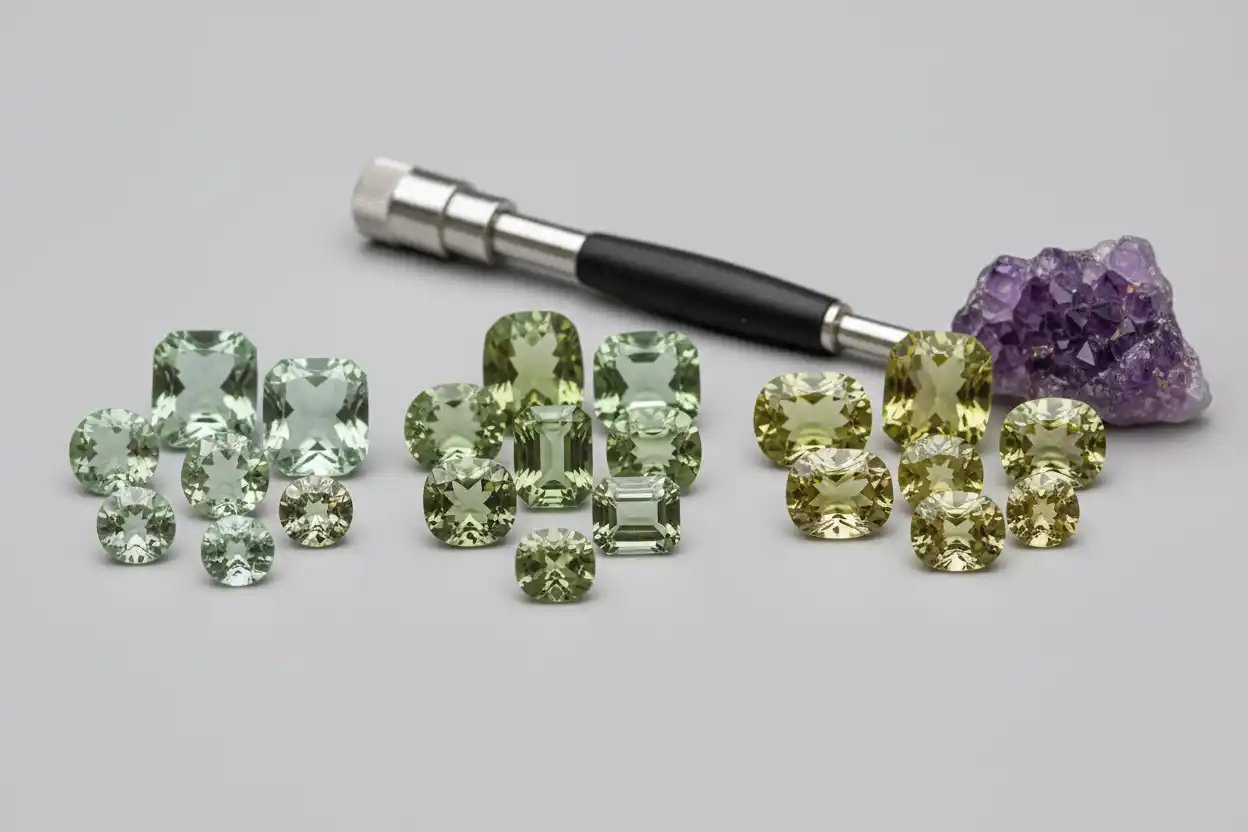
Prasiolite Price: What Influences Value, Quality, Treatments & Availability
Prasiolite price is usually governed by attractive green color, transparency, cutting, visible size, treatment disclosure, natural-versus-synthetic identity, provenance, and finished-jewelry craftsmanship rather than by geological scarcity alone. Prasiolite is transparent green macrocrystalline quartz, and Mindat notes that most material in the commercial market is created by heating certain amethyst or by irradiating colorless quartz, even though genuine naturally green occurrences are documented. This supply structure is fundamental to valuation because an ordinary ten- or twenty-carat faceted prasiolite can be visually impressive without being remotely comparable in rarity to an equivalently sized emerald, alexandrite, Paraíba tourmaline, or other genuinely scarce green gemstone.
A useful prasiolite price comparison must therefore identify which market is being discussed. Heat-produced green quartz, irradiated green quartz, naturally green quartz with credible locality provenance, hydrothermal synthetic quartz, and green-glass imitation can all resemble one another sufficiently in photographs to confuse inexperienced buyers, yet their origin stories and collector value differ significantly. GIA confirms that synthetic gem-quality quartz is widely available through hydrothermal growth, meaning large clean quartz cannot be assumed natural merely because its color and clarity look convincing. The strongest commercial value consequently belongs to a stone whose identity, color origin, cut, clarity, size, and price are transparent rather than to one marketed through vague claims of “rare green amethyst.”
Prasiolite Price At a Glance
| Value Factor | What Usually Raises Prasiolite Price | What Can Lower Prasiolite Price |
|---|---|---|
| Material Identity | Confirmed quartz sold accurately as prasiolite | Glass or another green gem represented as prasiolite |
| Color Origin | Credibly documented natural green provenance | Ordinary treatment-created material priced as rare natural color |
| Hue | Attractive mint, leek-green, or balanced green | Muddy, brownish, grayish, or nearly colorless appearance |
| Saturation | Clearly visible green without excessive darkness | Weak washed-out color |
| Transparency | Clean transparent material | Heavy cloudiness or fractures |
| Cut | Bright, symmetrical, well proportioned | Windowing, extinction, poor polish |
| Face-Up Size | Efficient dimensions for weight | Excess pavilion depth inflating carats |
| Carat Weight | Larger stone with quality maintained | Large common quartz without better visible quality |
| Treatment Disclosure | Heating or irradiation stated honestly | Treatment hidden behind “natural green amethyst” language |
| Natural Provenance | Credible locality and collector documentation | Unsupported claims of rare natural origin |
| Synthetic Origin | Clearly disclosed laboratory-grown quartz | Synthetic quartz represented as natural |
| Condition | Sharp facet junctions and intact surface | Scratches, chips, abrasions |
| Color Stability | Appropriate care and known treatment history | Fading or altered color from unsuitable exposure |
| Seller Grade | Observable quality characteristics | Undefined AAA/AAAA labels |
| Finished Jewelry | Fine metalwork and design | Setting markup mistaken for loose-gem rarity |
Most Commercial Prasiolite Is Not Naturally Green
Mindat describes prasiolite as a green transparent variety of macrocrystalline quartz but states that most material is artificially produced by heating amethyst or irradiating colorless quartz. This fact has a direct effect on prasiolite price because the ordinary jewelry supply is not constrained by the limited number of natural green quartz deposits. When suitable amethyst or colorless quartz rough can be converted into attractive green material, commercial availability expands and the scarcity premium remains modest.
Treatment-created color does not make the gemstone fake. The underlying stone remains quartz, and a beautifully cut treated prasiolite can provide excellent jewelry value. The problem appears only when sellers use the rarity of naturally green quartz to justify a premium on treatment-created material without making the distinction clear.
Natural Green Prasiolite Belongs to a Different Collector Category
Genuine natural prasiolite exists, and Mindat documents reported natural occurrences including Thunder Bay in Ontario as well as several locations in Poland and other regions. Naturally green material can therefore deserve additional mineralogical interest when the locality, collection history, and untreated color are supported convincingly.
That premium should not be assumed merely because a seller writes “natural prasiolite” in a listing. Commercial treatment-created material is much more common, and distinguishing natural geological green from deliberately produced green can be difficult enough that provenance becomes important. A rough crystal with an old locality label and traceable collecting history belongs to a stronger evidence category than an anonymous faceted stone advertised online as “100% naturally green.”
Color Is the Leading Visual Price Factor
Most prasiolite falls within pale mint-green, leek-green, yellowish-green, or slightly grayish-green tones rather than deep emerald green. Mindat records green color and transparent-to-translucent character as defining physical properties. Within the jewelry market, stronger yet attractive green normally receives more demand because extremely pale material can look almost colorless once mounted, especially under cool indoor lighting.
The highest saturation is not automatically the best. An unusually dark or intense green stone deserves careful identification because typical prasiolite is relatively light. Attractive valuation depends on a balanced green that remains visible face-up without becoming dull, brownish, or artificial-looking.
Pale Color Makes Cutting Especially Important
A pale gem loses visual impact quickly when light escapes through a large window in the center. This is why well-cut prasiolite often appears more valuable than a heavier stone with inferior proportions. Broad step cuts can showcase transparency elegantly, while brilliant and mixed cuts can create stronger scintillation that helps delicate green color remain noticeable.
When comparing stones of similar weight, examine face-up dimensions and pavilion depth. A deep ten-carat stone can appear smaller than an eight-carat gem with efficient proportions, meaning the buyer may be paying for hidden quartz beneath the girdle rather than greater visible presence.
Clarity Should Generally Be High
Quartz is abundant, and commercial prasiolite is usually available in clean transparent material. Large obvious fractures, dense clouds, distracting mineral inclusions, or severe surface-reaching fissures therefore weaken value more readily than they would in naturally inclusion-rich gems such as emerald.
Microscopic perfection is unnecessary once the stone looks clean at normal viewing distance. Color and cut provide more visible improvement than paying a large premium to move from one internally clean prasiolite to another whose difference is apparent only under magnification.
Large Size Does Not Create Extreme Rarity
Quartz can grow in substantial crystals, and synthetic quartz is also widely produced commercially. GIA notes that hydrothermal synthetic quartz became extensively available because quartz has major technological as well as gemological applications. Consequently, a large clean prasiolite can be impressive but should not receive the kind of exponential size premium associated with gemstones whose fine rough becomes extremely rare above a few carats.
A larger stone can still cost more in total because it uses more rough and offers greater visual presence, but the price-per-carat increase should remain grounded in actual color and workmanship. Large size is a design advantage more often than a scarcity event.
Heat-Treated Prasiolite Should Be Priced as Treated Quartz
Heating certain amethyst material can create green quartz, and this route accounts for an important portion of commercial prasiolite supply. The Gems Lore buy amethyst guide and amethyst price guide provide useful context because amethyst and prasiolite share the same quartz framework even though their visible colors differ.
A treated prasiolite should not be discounted simply for being treated when the seller has represented it correctly. The fair comparison is with other similarly treated green quartz of comparable hue, saturation, clarity, cut, size, and condition rather than with genuinely rare natural green specimens.
Irradiated Green Quartz Needs Accurate Disclosure
Mindat also identifies irradiation of colorless quartz as a route used to create prasiolite. GIA’s broader gemstone-treatment guidance explains that irradiation can alter color in gem materials and that treatment disclosure becomes important when the resulting appearance affects value.
A gemstone whose green is treatment-produced can remain visually beautiful and durable enough for jewelry. Disclosure matters because the color origin changes the scarcity story and can influence care, collector interest, and resale expectations.
Synthetic Quartz Establishes Another Price Category
Laboratory-grown quartz has essentially the same fundamental crystal chemistry as natural quartz but is produced artificially through hydrothermal growth. GIA describes synthetic quartz as widely available, reflecting decades of industrial production. Synthetic prasiolite-like material therefore should not be priced as though its size and clarity resulted from unusual geological conditions.
A synthetic stone can be an excellent low-cost jewelry option when disclosed honestly. Its value comes from cutting, color, design, and craftsmanship rather than natural formation.
Natural Provenance Can Matter More Than Faceted Size
A documented natural-green quartz specimen from a recognized locality may command collector interest even when the stone is not especially large or clean enough for fine jewelry. This illustrates a key distinction between mineral collecting and the commercial faceted-gem market.
A naturally green crystal retaining original form, locality information, associated minerals, and historical collection labels can be more collectible than a larger anonymous faceted gem. Conversely, a jewelry buyer may prefer the larger cleaner treated stone because its appearance is more important than geological provenance.
“Green Amethyst” Should Not Create a Premium
Prasiolite is often marketed as green amethyst, but the term can obscure what the buyer is actually purchasing. Once the visible quartz is green, it is clearer to describe the material as prasiolite or green quartz and state whether the color results from treatment.
A retailer who uses “rare green amethyst” to imply that an ordinary heat-treated stone is a naturally scarce amethyst subtype is creating an artificial scarcity narrative. The Gems Lore buy prasiolite guide explains why accurate terminology and treatment disclosure should precede any discussion of value.
Color Stability Affects Long-Term Ownership
Treatment-created colors in quartz can respond differently to strong light or heat depending on their underlying color centers. This does not mean normal prasiolite jewelry must be kept in darkness, but prolonged intense sunlight or unnecessary high heat offers no benefit and may create avoidable risk.
Long-term value depends partly on condition, so a gemstone that has faded noticeably or been heat damaged during repair may be worth less than a comparable stone retaining its original appearance. Sellers of valuable natural-color specimens should also avoid using color-stability claims they cannot support.
Quartz Durability Supports Everyday Jewelry
As quartz, prasiolite has Mohs hardness around 7, making it harder than household dust and many ornamental stones but softer than sapphire, ruby, or diamond. This balance makes it suitable for pendants, earrings, bracelets, and rings when normal care is used.
Surface scratches and chipped facet junctions can still accumulate in frequently worn rings, especially if the gem is stored loose beside harder stones. Secondhand valuation should therefore inspect polish and facet edges rather than assuming quartz remains pristine indefinitely.
Setting Quality Can Dominate Finished Jewelry Price
A large prasiolite mounted in substantial gold, platinum, or designer jewelry can carry a retail price many times higher than the loose gemstone itself. Side diamonds, hand engraving, custom fabrication, and brand reputation may contribute more value than the center quartz.
Consumers comparing prasiolite price should therefore separate the loose gem from the setting wherever possible. An expensive finished ring does not automatically mean the prasiolite is rare.
Prasiolite Price Versus Amethyst Price
Prasiolite and amethyst belong to the same macrocrystalline quartz family, and much commercial prasiolite begins as amethyst suitable for heat conversion. This shared supply structure explains why both gems can offer substantial clean sizes without extraordinary prices.
Fine amethyst receives premiums for saturated purple, favorable zoning, clarity, and source reputation, while prasiolite depends on attractive green, treatment disclosure, and cutting. Neither should be priced by copying the scarcity model of emerald or alexandrite.
Prasiolite Price Versus Citrine Price
The Gems Lore buy citrine guide and citrine price guide cover another quartz market in which commercial supply includes treatment-created color. This makes citrine a useful economic comparison because buyers also need to distinguish attractive commercial material from rarer natural-color provenance.
Both categories illustrate why transparent treatment disclosure supports fair pricing without making the treated gemstone undesirable.
Prasiolite Price Versus Emerald Price
Emerald is green beryl with a dramatically different scarcity structure, inclusion pattern, treatment market, and global demand. Gems Lore’s emerald price guide should therefore never be used as a direct benchmark for prasiolite merely because both gems are green.
Prasiolite’s appeal lies partly in providing large transparent pastel-green stones at accessible cost. It does not need emerald-style rarity to be worthwhile.
Retail Price and Resale Value Can Differ Sharply
Commercial treated quartz is widely available, which means secondhand buyers can compare a used prasiolite with abundant new stones. Dealer resale offers therefore may be substantially lower than original retail price, particularly when the setting rather than the gem accounted for much of the initial purchase.
Naturally green documented collector specimens can follow a different market because provenance and mineralogical rarity may attract specialized buyers, but that niche can also be less liquid.
AAA and AAAA Labels Do Not Standardize Prasiolite Price
There is no universal prasiolite quality ladder that makes one seller’s AAAA directly comparable with another retailer’s AAA. Color, clarity, cutting, dimensions, treatment, natural-versus-synthetic origin, and condition provide much stronger evidence.
A buyer should translate every proprietary grade into visible and documented characteristics before comparing prices.
What Usually Raises Prasiolite Price?
Prasiolite price generally rises with attractive clearly visible green color, clean transparency, excellent polish, skilled cutting, efficient face-up dimensions, larger size when quality remains strong, credible natural-green provenance, independent identification when natural origin is important, and fine jewelry craftsmanship. Documented natural occurrences can add collector value that ordinary treated commercial stones do not share.
What Usually Lowers Prasiolite Price?
Nearly colorless appearance, muddy gray or brown modifiers, weak cutting, large windows, excessive pavilion depth, visible fractures, poor polish, synthetic material represented as natural, ordinary heat-treated material marketed as exceptionally rare natural color, treatment hidden behind “green amethyst” language, unsupported locality claims, and undefined seller grades can all weaken value.
How to Compare Prasiolite Prices Fairly
Compare stones by quartz identity, color origin, hue, saturation, tone, transparency, visible inclusions, cut, dimensions, carat weight, treatment route, natural-versus-synthetic origin, provenance, condition, jewelry setting, and transaction type. A documented naturally green Thunder Bay specimen, heat-produced faceted prasiolite, irradiated green quartz, hydrothermal synthetic quartz, and green-glass imitation belong to fundamentally different value categories even when photographs show similar mint-green color.
Conclusion
Prasiolite price is best understood as the value of attractive green quartz rather than as the price of an inherently ultra-rare gemstone. Mindat confirms that prasiolite is green macrocrystalline quartz and that most commercial material is produced by heating amethyst or irradiating colorless quartz, while true natural occurrences are documented but uncommon.
That supply structure means ordinary treated stones should be judged primarily by color, transparency, cutting, visible size, condition, and jewelry craftsmanship. Natural provenance can add a separate collector premium, while hydrothermal synthetic quartz occupies another clearly distinct manufactured category. GIA’s confirmation that synthetic quartz is widely available reinforces why large size and perfect clarity alone cannot establish natural rarity.
A defensible prasiolite price therefore depends on accurate disclosure. Buyers should pay for the beauty and documentation actually present rather than for vague claims that every green quartz is rare natural “green amethyst.”
Frequently Asked Questions
How much is prasiolite worth per carat?
There is no universal prasiolite price per carat because natural green provenance, treatment-created color, synthetic origin, saturation, clarity, cut, dimensions, and setting quality vary. Ordinary treated commercial quartz generally follows a much more accessible market than documented natural-green collector material.
Is natural prasiolite more valuable?
Credibly documented naturally green prasiolite can receive a collector premium because natural occurrences are uncommon compared with treatment-created supply. Mindat nevertheless confirms that natural occurrences do exist.
Is most prasiolite heat treated?
A large portion of commercial prasiolite is produced by heating suitable amethyst, while irradiation of colorless quartz is another recognized route.
Does heat treatment make prasiolite fake?
No. The underlying gemstone remains quartz. Treatment changes the color origin and therefore the appropriate disclosure and rarity category, but it does not turn natural quartz into glass.
Is large prasiolite rare?
Large clean quartz is readily available, and synthetic quartz is also widely manufactured, so size alone does not create extreme rarity. Large stones become more desirable when color and cutting are especially attractive.
Does darker green prasiolite cost more?
Not automatically. Typical prasiolite is comparatively light, and very dark material deserves careful identification and treatment evaluation. A balanced visible green with good brightness is usually more important than maximum darkness.
Is prasiolite the same as green amethyst?
The two phrases are commonly used for the same commercial green quartz material, but prasiolite or green quartz is clearer because the finished gemstone is green rather than purple amethyst.
Can prasiolite be synthetic?
Yes. Synthetic quartz is widely produced through hydrothermal growth and can enter jewelry markets in multiple colors. Synthetic origin should be disclosed when relevant.
Why is prasiolite relatively affordable?
Quartz is abundant, commercial green color can be created through treatment, and large clean material is readily obtainable. This prevents the extreme scarcity premiums seen in fine emerald, alexandrite, or Paraíba tourmaline.
Does cutting affect prasiolite price?
Yes. Pale green quartz benefits significantly from precise cutting because windowing or excessive depth can make the stone appear weaker and smaller face-up.
Can natural provenance matter?
Yes. A documented naturally green specimen from a recognized locality can have mineralogical collector value beyond an ordinary treatment-created faceted stone.
Does AAAA prasiolite have an official meaning?
No universal laboratory AAAA system applies. Buyers should compare actual color, clarity, cut, dimensions, treatment, origin, and condition.
Does prasiolite hold retail value?
There is no guaranteed retention rate. Widely available treated material can have modest secondhand value, while well-documented natural specimens may appeal to a narrower collector market.
Is prasiolite a guaranteed investment?
No. Natural provenance can create collector interest, but ordinary commercial prasiolite is readily available and future appreciation is not guaranteed.