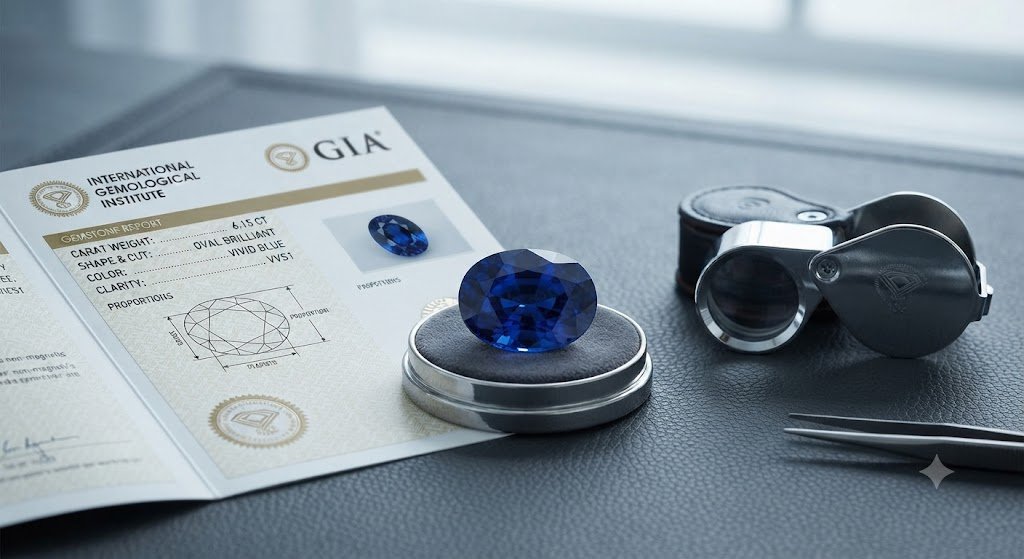
Gemstone Certification: 7 Essential Report Checks & Costly Verification Gaps
Gemstone certification can protect a buyer from expensive mistakes, but the word certification is often used loosely. Respected gemological laboratories generally issue grading, identification, or origin reports that record the results of testing. Those reports can establish whether a gem is natural or laboratory-grown, identify its species and variety, disclose detectable treatments, document measurements and weight, and sometimes provide an opinion on geographic origin. They do not automatically tell you what the gemstone is worth.
The strongest buying approach is therefore to read the actual report rather than assuming that any certificate guarantees quality, rarity, authenticity, origin, or price. A professional-looking document from an unknown seller-created laboratory can provide far less protection than an independently verifiable report from a respected gemological institution.
1. Gemstone Identification: Confirm Natural, Laboratory-Grown, Synthetic, or Imitation Status
The first job of a gemstone report is identification. A buyer should be able to determine exactly what the submitted stone is rather than relying on its color, trade name, or seller description.
This matters because visually similar stones can have completely different values. Natural ruby can resemble laboratory-grown ruby, red spinel, garnet, glass, and other red gems. Sapphire can be confused with synthetic corundum and several natural blue stones. Emerald can resemble green beryl, tourmaline, garnet, glass, and laboratory-grown emerald.
A proper report should identify the species and, where appropriate, the gem variety. For example, ruby and sapphire belong to corundum, while emerald belongs to beryl. That scientific identification creates a stronger foundation than marketing language.
The ruby quality grading process should begin only after identity is established. Describing a red stone as vivid, eye-clean, or premium has limited meaning if testing has not confirmed that it is natural ruby.
Laboratory-grown gems deserve the same clarity. A laboratory-grown sapphire can have essentially the same chemical composition and crystal structure as natural sapphire, but geological origin changes scarcity and market value. A report should make that distinction explicit.
Imitations are different again. Glass, cubic zirconia, assembled stones, and other lookalikes can imitate expensive gems without sharing their composition. Proper identification prevents appearance from being mistaken for rarity.
2. Treatment Disclosure: Read the Exact Wording Instead of Assuming Untreated
Treatment can be one of the largest value differences between two visually similar gemstones. Heat, fracture filling, diffusion, irradiation, dyeing, impregnation, coating, oiling, and other processes can improve appearance, and their acceptance varies by gem type.
Ruby illustrates the importance of exact wording. Heat treatment is common and widely accepted, while extensive fracture filling creates a different commercial category. A buyer who assumes all treated rubies are equivalent can overpay significantly.
Sapphire also requires treatment awareness. Traditional heating is common, while lattice diffusion can alter color near the surface or penetrate the stone to varying degrees. Untreated sapphire with exceptional color can command a strong premium when testing supports the claim.
Emerald is frequently clarity enhanced with oil or resin because natural fractures are common. The emerald quality grading evaluation becomes more meaningful when the amount and nature of enhancement are understood.
A laboratory report should be read line by line. Statements such as indications of heating, no indications of heating, clarity enhancement, impregnation, coating, or other detected processes can carry substantial commercial significance.
No indications of treatment does not mean that every imaginable treatment has been ruled out forever. It means the laboratory did not detect treatment using the applicable testing methods during the examination.
3. Geographic Origin Reports: Country Claims Need the Correct Type of Testing
Not every gemstone report includes geographic origin. Identification and origin determination are separate services, and some gemstones qualify for origin opinions more readily than others because laboratories need extensive reference collections and distinctive analytical evidence.
Origin analysis can involve inclusions, trace-element chemistry, spectroscopy, growth features, and comparison against known-source samples. Even with advanced testing, a laboratory may conclude that the evidence overlaps too strongly between deposits to provide a confident origin.
This is important for valuable ruby, sapphire, emerald, Paraiba-type tourmaline, alexandrite, red spinel, and other gems where country of origin can influence price. An ordinary identification report should not be interpreted as proof of a country merely because the seller supplies a separate origin story.
The sapphire quality grading decision can change substantially when a fine untreated stone also carries an important supported provenance. The report must actually state that origin rather than leaving the buyer to infer it.
Paraiba tourmaline creates another good example. Copper-bearing chemistry establishes the distinctive category, but Brazil, Mozambique, and Nigeria can all produce copper-bearing tourmaline. The Paraiba tourmaline quality grading assessment should therefore distinguish the gem’s chemistry and visible color from a separate geographic-origin claim.
When origin contributes significantly to the asking price, check whether the laboratory is recognized for that specific analysis and whether the report wording says definite origin, probable origin, or inconclusive.
4. Gemstone Report Numbers: Verify That the Document Matches the Stone
A convincing report is useful only when it belongs to the gemstone being sold. Report numbers, dimensions, carat weight, shape, color description, photographs, inscriptions, and other recorded details help connect the document to the physical stone.
Start by checking the report number through the issuing laboratory’s official verification system when available. The database entry should match the report presented by the seller. A photograph or PDF can be altered, while direct database verification provides a stronger check.
Next compare the stone’s measurements. A report describing a 9.10 x 7.02 x 4.25 mm oval should not accompany a visibly different cushion or a stone whose measurements differ significantly. Weight should also correspond when the gem is loose and can be weighed accurately.
Photographs can help, but they should not be the only identifier. Lighting, orientation, and image quality can change a gem’s appearance, while multiple stones from the same parcel may look similar.
Laser inscriptions are particularly useful on diamonds and certain gems when offered by the laboratory, but an inscription should still be checked against the report database. A number etched on a girdle does not replace independent verification.
If a gemstone has been significantly recut, repolished, damaged, or altered after examination, the original dimensions or weight may no longer match. A fresh report can resolve that uncertainty.
5. Gemstone Grading Reports and Identification Reports Are Not the Same
Diamond grading and colored-gem identification are often discussed as though they follow the same system, but they do not.
Diamond reports commonly record carat weight, color grade, clarity grade, cut information, proportions, polish, symmetry, fluorescence, and other standardized characteristics. The diamond quality grading process therefore provides a relatively structured comparison between stones.
Colored gemstones are much less standardized. A laboratory may identify a natural sapphire, describe its color, disclose heating, and provide origin when determinable without assigning a universal overall quality grade such as AAA.
This distinction matters because seller-created colored-gem grades can sound more authoritative than they are. AAA, AAAA, investment quality, royal grade, museum grade, and similar labels may reflect a dealer’s internal system rather than an international grading standard.
The same issue applies to many niche stones. A fine alexandrite report can establish natural identity, treatment status, and possibly origin, while the alexandrite quality grading still requires evaluating the strength of color change, hue, clarity, cut, and size.
A laboratory report supplies facts. Market quality interpretation still requires understanding how those facts affect desirability.
6. Gemstone Certification Is Not an Appraisal or Guaranteed Selling Price
A laboratory report and an appraisal serve different purposes. The laboratory examines the gemstone and records its gemological characteristics. An appraiser estimates monetary value for a stated purpose, such as insurance, estate division, resale analysis, or another valuation need.
This distinction prevents a common buying mistake. A report showing natural sapphire, no indications of heating, and a desirable origin can explain why a stone has valuable characteristics, but the laboratory report itself does not state what the buyer should pay.
An insurance appraisal also should not be mistaken for a guaranteed resale figure. Insurance valuations often focus on replacement needs, while resale depends on the market, the selling channel, condition, buyer demand, and the amount another party is willing to pay.
The question do gemstones hold value therefore cannot be answered from the report alone. Documentation makes a gem easier to evaluate, but purchase price, rarity, demand, condition, and liquidity still determine financial performance.
Be cautious when a seller presents a laboratory report beside an inflated appraisal and implies that both figures come from the laboratory. Check who issued each document and what service that organization actually performed.
7. Laboratory Reputation and Scope Matter More Than a Professional-Looking Certificate
A gemstone certificate is only as useful as the laboratory, testing, and wording behind it. Professional printing, seals, holograms, photographs, and technical terminology can make any document look impressive, but appearance does not establish laboratory independence or expertise.
For high-value gems, look for laboratories with recognized gemological research, trained specialists, advanced analytical instruments, extensive reference collections, and report-verification systems. The laboratory should be independent enough that its conclusion is not simply a seller’s marketing statement.
Different laboratories can occasionally reach different conclusions, particularly in difficult treatment and geographic-origin cases. This does not automatically prove that one report is fraudulent. Gem science involves interpretation of inclusions, chemistry, spectroscopy, and evolving reference databases, and some stones genuinely fall into overlapping ranges.
Read qualifiers carefully. Inconclusive origin, indications of heating, minor clarity enhancement, evidence of diffusion, and similar wording should never be replaced in the seller’s description by simpler claims that sound more favorable.
The most expensive gemstones deserve the most disciplined documentation. When a small wording difference can change market value substantially, the report should be read as carefully as the gemstone itself.
What a Strong Gemstone Report Should Let You Confirm
A useful report should allow you to establish the identity of the gem, whether it is natural or laboratory-grown, the species and variety, relevant detectable treatments, physical description, dimensions, weight when applicable, and the report number needed for verification. If geographic origin is part of the service and can be determined, the report should state that opinion clearly.
It should not require the buyer to guess whether an origin was tested or whether treatment wording means untreated. The report’s limitations are just as important as its conclusions.
For colored gemstones, quality still requires visual judgment. The report can tell you that an emerald is natural and disclose enhancement, but it cannot replace your evaluation of color, transparency, cut, size, and beauty. The same principle applies to ruby, sapphire, alexandrite, tourmaline, garnet, and other stones.
Conclusion
Gemstone certification is most useful when it reduces uncertainty about facts that cannot be established safely from appearance alone. Check natural versus laboratory-grown origin, species and variety, treatments, geographic origin when applicable, report number, dimensions, weight, and the issuing laboratory before judging the price. A laboratory report supports a buying decision, while quality assessment and valuation remain separate steps.
FAQs
What does gemstone certification prove?
A respected laboratory report can establish gem identity, natural or laboratory-grown origin, detectable treatments, measurements, weight, and other characteristics. Certain report types can also provide geographic-origin opinions.
Is a gemstone certificate the same as an appraisal?
No. A gemological report documents characteristics, while an appraisal assigns a monetary value for a specific purpose.
Does a gemstone report guarantee value?
No. The report helps establish characteristics that influence value, but it does not guarantee a purchase price, resale price, or future value.
Can a laboratory tell whether a gemstone was treated?
Major gemological laboratories can detect many important treatments using microscopy, spectroscopy, chemistry, and other analytical techniques. Some treatments can be difficult to detect in certain circumstances.
Does every gemstone report show country of origin?
No. Geographic origin is a separate determination and is available only for qualifying gems and cases where sufficient evidence allows an opinion.
Should I verify the report number online?
Yes. When the laboratory provides an official report-verification database, confirm that the number and recorded details match the gemstone and document you received.
Are AAA and AAAA gemstone grades official?
Not generally for colored gemstones. These labels are frequently seller-created quality descriptions rather than universal laboratory grades.
Do inexpensive gemstones need laboratory reports?
Often not. Laboratory fees may make little sense for a low-cost stone unless identity or treatment is unusually important. Reports become more valuable as financial risk and uncertainty increase.
Can two laboratories disagree about a gemstone?
Yes, especially in difficult treatment or geographic-origin cases. Laboratories can use different reference collections, equipment, terminology, and interpretation standards.
Should a high-value ruby, sapphire, or emerald have a report?
Independent laboratory documentation is highly useful when natural identity, treatment status, geographic origin, or another difficult-to-verify characteristic contributes significantly to the price.