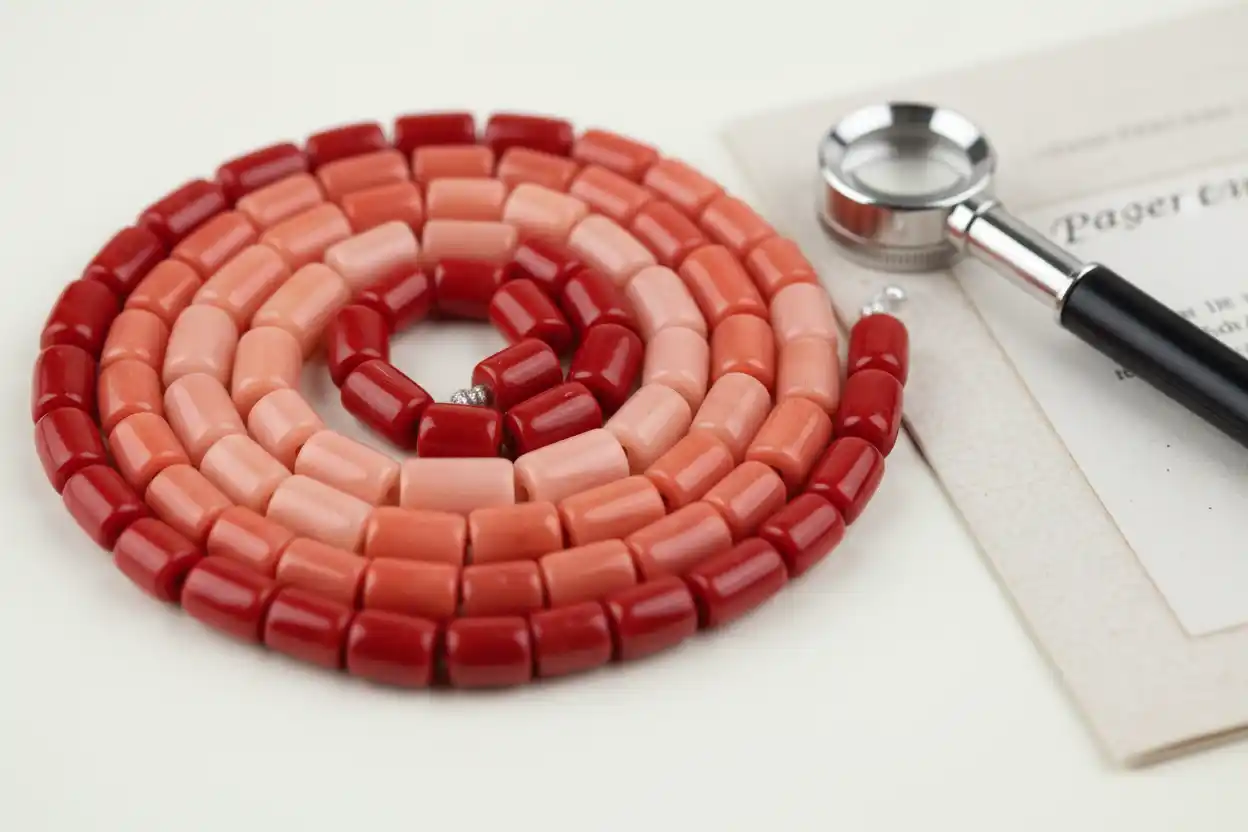
Buy Coral: What to Inspect, Quality Signals & Common Pitfalls
To buy coral intelligently, begin by identifying exactly what the seller means by “coral.” The jewellery trade uses several materials that may share a coral name while differing substantially in biological origin, composition, treatment, regulation, rarity, durability, and market value. CIBJO limits the term precious coral in jewellery to particular members of the Corallidae family, principally the genera Corallium, Pleurocorallium, and Hemicorallium, whose polished skeletons occur in red, pink, orangey, and white varieties. CIBJO also distinguishes these materials from reef corals and numerous “common corals” that do not belong to the precious-coral category.
That distinction should come before color, size, or price because dyed common coral, reconstructed material, glass, plastic, bone, limestone, and other substances can be sold in coral-like colors. GIA documents dyeing, bleaching, wax impregnation, polymer stabilization, reconstructed coral, and multiple imitations in the jewellery market. A buyer comparing a fine natural-color precious-coral necklace with an inexpensive dyed coral strand is therefore not comparing two grades of the same commercial product. Anyone interested primarily in rarity or collectible value should also understand the broader distinction between scarcity and price discussed in Gems Lore’s rarest gemstones in the world guide and the difference between exceptional market records and normal retail material in most expensive gemstones.
Buy Coral At a Glance
| Buying Factor | What to Inspect | Why It Matters |
|---|---|---|
| Material Identity | Precious coral, common coral, composite, imitation, or another organic material | Similar appearance does not establish the same material or value |
| Species/Trade Description | Scientific or accepted trade name where available | Different coral groups have different properties, rarity, regulation, and market recognition |
| Color | Hue, saturation, natural-looking distribution, zoning | Color is a major value factor and may also reveal treatment |
| Color Origin | Natural color versus dyed, bleached, coated, or otherwise modified | Treatment can materially affect value and care requirements |
| Luster | Porcelain-like, smooth surface reflection | Strong attractive luster is one of CIBJO’s stated value criteria |
| Surface Quality | Pits, cavities, fractures, polish, growth structure | Cleaner surfaces generally support stronger quality, while some features aid identification |
| Size | Bead diameter, cabochon dimensions, carving size | Larger fine material can be harder to obtain, but size must be judged with quality |
| Symmetry | Shape consistency and workmanship | Important for individual beads and especially matched strands |
| Matching | Color, size, shape, luster across multi-piece jewelry | Well-matched strands can require extensive sorting |
| Treatment | Dye, bleaching, wax, resin/polymer impregnation, reconstruction | Disclosure is essential for fair comparison |
| Condition | Scratches, chips, dulling, cracking, worn drill holes | Coral is comparatively soft and can show wear |
| Trade Documentation | Invoice description, treatment disclosure, provenance, permits where applicable | Important for value, resale, and legal cross-border movement |
| Seller Terms | Return rights, inspection period, accurate photographs | Reduces risk when buying an organic material with many imitations |
Precious Coral Is Not the Same as Reef Coral
The word coral covers thousands of marine colonial organisms, but only a small subset enters the jewellery trade as precious coral. CIBJO’s current industry guidance restricts precious coral to selected Corallidae species used for jewellery and decoration and separates these deep-water materials from reef-building and other common corals. This distinction matters because buyers sometimes assume that every red or pink coral jewel is made from threatened shallow-water reef coral, while other buyers make the opposite error and assume that all products called coral are interchangeable and unrestricted.
Precious coral is an organic gem material in the sense that its skeleton is produced biologically by colonial marine organisms. It should not be described as a mineral species in the way ruby, aquamarine, or quartz would be. CIBJO describes precious coral as a biomineralized material with a polished porcelain-like luster, and GIA describes jewellery coral as calcium-carbonate skeletal material secreted by coral colonies. Understanding that identity makes it easier to evaluate treatments, durability, surface structure, and species-related terminology without applying inappropriate grading ideas borrowed from crystalline gemstones.
Ask Exactly Which Type of Coral the Seller Is Offering
A professional seller should be able to provide a meaningful material description rather than simply “genuine coral.” CIBJO recognizes accepted trade names associated with different precious-coral species and color varieties, including Mediterranean coral, oxblood or aka coral, angel’s-skin material, momo, and several other commercial terms. Those names can be useful, but the seller should use them consistently with accepted nomenclature rather than attaching prestigious coral names to unrelated dyed material.
Terms such as bamboo coral, sponge coral, lace coral, blue coral, and black coral refer to materially different groups and should not be treated as synonyms for precious red coral. CIBJO’s guide notes, for example, that bamboo coral can be bleached and dyed pink or red to imitate precious coral, while some sponge coral is filled with polymer and may also be dyed. The correct buying question is consequently not merely “Is this real coral?” but “What coral material is this, what species or group does the seller claim, and what treatment or reconstruction has been used?”
Color Is a Major Quality Factor, but the Preferred Color Depends on the Coral
CIBJO identifies color as one of the principal precious-coral value criteria and emphasizes that the most desirable hue differs among species and commercial varieties. Mediterranean Corallium rubrum commonly attracts demand for red tones, dark saturated red is particularly appreciated in oxblood-type Corallium japonicum, while the light flesh-pink appearance associated with angel’s-skin coral has its own established market. This means that a universal rule such as “darkest red is always best” would be inaccurate across all precious coral.
Color distribution matters as much as the headline hue. CIBJO notes that greater uniformity generally supports higher value, although natural diagnostic features and typical color structures differ among varieties. Contrasting streaks, spots, veins, cores, or zoning can alter desirability depending on the coral type. A buyer should therefore compare like with like: a pale angel’s-skin coral should be judged according to the normal appearance of that material rather than penalized because it does not resemble dark oxblood coral.
Natural Color and Dyed Color Need to Be Separated
Pink-to-red coral has been extensively treated to improve or imitate desirable colors. GIA’s research on more than a thousand natural- and treated-color samples documented the widespread use of dyeing and noted that bleaching may be performed before dyeing to improve penetration and uniformity. Polymer impregnation may also be used, sometimes together with colorants, to alter appearance and surface quality. GIA has additionally documented coated “soft coral” in which coloring material concentrated in surface pores and cavities.
Visual inspection can sometimes reveal treatment clues, such as color concentrated inside pits, cracks, drill holes, or porous areas, but a clean-looking surface does not prove natural color. GIA research shows that advanced techniques such as Raman spectroscopy may be necessary to establish color origin conclusively in some pink-to-red coral. For an inexpensive fashion item, seller disclosure may be sufficient for the buyer’s purpose, but a substantial premium for natural-color precious coral should be supported by evidence appropriate to the value of the purchase.
Dyeing Does Not Make Coral “Fake,” but It Changes the Product
A dyed natural coral skeleton is still coral material, yet it is not equivalent to untreated natural-color precious coral. The most useful terminology separates identity from treatment. A seller should describe both what the underlying material is and what has been done to it. CIBJO’s responsible-sourcing guidance emphasizes that gem materials and products should be accurately represented and that treatments and enhancements should be disclosed according to recognized nomenclature.
This distinction protects buyers from two opposite mistakes. One is dismissing every treated coral as worthless or artificial; the other is paying untreated-coral prices for common material whose appearance has been created mainly by dye, coating, or impregnation. Treated coral can make attractive jewellery when the treatment is stable, disclosed, and reflected appropriately in the price.
Watch for Reconstructed and Composite Coral
GIA describes reconstructed coral as material made from coral fragments that are bonded together and commonly dyed to create a more uniform appearance. CIBJO separately defines composite coral products as artificial constructions made from two or more previously separate parts or layers, with at least one coral component. Both categories can be legitimate products when disclosed clearly, but neither should be represented as a single naturally formed piece of untreated precious coral.
The practical challenge is that polished reconstructed material can look convincing in photographs. Magnification may reveal unusual boundaries, concentrations of adhesive, artificial uniformity, porosity patterns, or disrupted natural growth structure, but buyers should not rely on amateur identification when substantial money is involved. Written seller disclosure and laboratory examination provide a stronger basis for a high-value purchase.
Coral Imitations Can Be Surprisingly Convincing
GIA lists glass, plastics, dyed limestone, ceramics, bone, marble, and reconstructed products among materials used to imitate coral. Its laboratory publications have also documented dyed bone submitted as red coral, demonstrating that color and polished appearance alone are insufficient for reliable identification.
Some imitations can be separated with magnification because they lack coral’s characteristic structural features, while others may require more advanced testing. Buyers should avoid destructive home tests such as scratching, burning, or applying acids to valuable jewellery because these methods can damage both genuine and imitation materials. A professional gemologist can use microscopy and appropriate analytical techniques without sacrificing the piece.
Luster Is an Important Quality Signal
CIBJO includes luster among the principal value criteria for precious coral and describes coral’s polished surface as generally porcelain-like, with a variable glassy component. Fine polish can make well-colored coral appear rich and visually smooth, while a dull, chalky, heavily porous, or poorly finished surface can reduce commercial appeal.
Luster should not be evaluated without asking how it was achieved. Wax, resin, polymer impregnation, or other surface treatments can improve apparent smoothness or sheen. GIA specifically advises buyers to ask whether coral has been treated and identifies wax and plastic stabilization among known enhancements. A highly glossy surface is therefore a visual quality, not proof that the underlying material is naturally fine or untreated.
Surface Quality Can Affect Both Beauty and Identification
Coral grows biologically rather than crystallizing as a single mineral crystal, so natural growth structures and small features are expected. Fine precious coral nevertheless commands stronger demand when its polished surface is attractive, well finished, and free from excessive pits, cracks, cavities, or blemishes that disrupt the design. CIBJO specifically lists surface quality as a value factor alongside color, luster, size, and symmetry.
Some structural characteristics are diagnostically useful rather than simply negative. GIA publications describe typical fibrous, striated, or growth-related structures that can help gemologists distinguish coral from imitations. The buyer’s goal is therefore not to demand a featureless plastic-like surface but to distinguish normal biological structure from damage, poor treatment, or inferior workmanship.
Size Matters, Especially When Quality Remains High
Large branches capable of yielding substantial beads, cabochons, or carvings are naturally more limited than tiny pieces, and CIBJO includes size among the recognized value criteria for precious coral. A large bead with rich natural color, high luster, minimal blemishing, and good symmetry can therefore command much more than a smaller bead from the same material.
Size should still be measured rather than described vaguely. For strands, bead diameter in millimeters is usually more informative than total necklace weight alone. A graduated necklace may combine many different bead sizes, while a carved piece may contain significant material without offering the same rarity as a perfectly matched suite of large spherical beads. Buyers should compare dimensions, workmanship, color, and treatment together rather than assuming that heavier automatically means finer.
Symmetry and Matching Matter Strongly in Beads and Strands
CIBJO includes symmetry among its precious-coral value criteria. This becomes particularly important for round beads, matched earrings, and necklaces where repeated elements must resemble one another closely. Producing a well-matched strand requires enough coral material to sort for diameter, hue, saturation, luster, surface quality, and shape, which can add substantial labor and scarcity beyond the value of one isolated bead.
A graduated strand should change size deliberately and smoothly rather than appearing randomly assorted. Examine whether neighboring beads differ sharply in color, whether drill holes are centered, whether surfaces are equally polished, and whether repairs or replacements interrupt the matching. In antique jewellery, minor variation may reflect age and hand workmanship, but material differences should still be disclosed when they affect authenticity or value.
Origin Claims Need Evidence, Not Just a Famous Name
Precious coral is harvested from several geographically distinct marine regions, and trade names sometimes imply Mediterranean, Japanese, Pacific, or other origins. CIBJO defines place of origin as the geographical area from which coral was harvested and provides standardized terminology for multiple precious-coral types. The market may attach different preferences to particular species, colors, or local traditions, but origin should not be accepted merely because a seller repeats a prestigious locality.
Scientific identification of coral species and origin can be complex. CIBJO warns that conclusive species identification may require advanced techniques such as trace-element analysis or DNA methods. A retail invoice can document the seller’s representation and provenance history, but buyers should distinguish that statement from an independent scientific determination.
Verify Legal and Trade Documentation Before Cross-Border Purchases
International coral trade is not governed by one blanket rule applying to every species. CITES maintains different protections for various coral taxa, and international trade controls depend on the scientific identity of the material and its listing status. The CITES species checklist is the appropriate current reference for determining whether a taxon appears in Appendix I, II, or III. GIA research also illustrates why species-level distinction matters: Stylasteridae corals are CITES-listed and can resemble pink-to-red jewellery coral from other groups.
Because listings, domestic legislation, and import requirements can change, buyers should not rely on a generic statement that “coral is legal” or “coral is illegal.” For a cross-border purchase, especially valuable vintage or species-specific material, request the scientific or accepted trade identification available to the seller, provenance records, invoices, and any required permits. Legal compliance is separate from gem quality but can materially affect whether an item can be imported, exported, resold, or transported without difficulty.
Ethical Sourcing Should Be Treated as a Documentation Question
Responsible purchasing requires more than a vague “sustainable” label. CIBJO maintains dedicated coral standards and responsible-sourcing guidance intended to promote accurate representation, lawful sourcing, and responsible trade practices. A serious seller should be willing to explain where material entered the supply chain, whether it is contemporary or vintage stock, what species or trade category is represented, and which documentation supports those statements.
Vintage coral introduces a different sourcing context because an older object may predate current trade rules or modern harvest controls, yet age itself does not automatically prove legality or origin. Documentation still matters, particularly when crossing borders. Buyers who care strongly about environmental provenance can also consider well-documented antique jewellery, disclosed imitation materials, or other gems whose sourcing profile better matches their priorities.
Coral Is Soft Enough That Condition Matters Greatly
GIA describes coral as a comparatively soft gem material, around 3 to 4 on the Mohs scale, while CIBJO’s precious-coral guidance places it around 3½. Hardness measures resistance to scratching, not general strength, and polished coral can lose surface quality through contact with harder jewellery materials, abrasive dust, cosmetics, chemicals, or careless storage.
Examine used coral for scratches, dull patches, chips around drill holes, cracks, flattened bead surfaces, and evidence of aggressive repolishing. GIA recommends avoiding heat, chemicals, ultrasonic cleaning, and steam cleaning and notes that porous coral can be affected by cosmetics, perfumes, chlorinated water, and prolonged sunlight in dyed material. Condition can therefore have a substantial effect on both appearance and resale value.
Antique Coral Needs Separate Evaluation From New Material
Antique coral jewellery may carry value from age, provenance, maker, workmanship, design period, precious metal, and historical importance in addition to the coral itself. A Victorian or Art Deco jewel should not be reduced to bead diameter or coral weight alone, particularly when the setting is signed or historically significant.
Age also creates potential complications. Old restringing, replacement beads, repaired carvings, later-added clasps, repolishing, or mixed coral types can change authenticity and value. A seller describing an item as antique should distinguish the age of the finished jewel from assumptions about when the coral itself was harvested, because those are not necessarily the same claim.
Coral Does Not Have One Universal AAA Grading System
CIBJO’s Precious Coral Guide explicitly states that precious coral does not have an internationally accepted grading system covering its individual value factors or an overall holistic grade. Retail terms such as AAA, AAAA, top grade, museum quality, collector grade, or investment coral should therefore be treated as seller-specific descriptions unless the seller clearly defines the system being used.
A more reliable comparison replaces the label with actual observations: species or material category, natural versus treated color, hue and uniformity, luster, surface quality, dimensions, symmetry, matching, condition, provenance, and legal documentation. A seller who provides those details allows the buyer to compare quality meaningfully even without an impressive grade name.
Laboratory Identification and Appraisal Are Different Services
A gemological laboratory can help establish material identity, detect certain treatments, and sometimes provide more specialized information depending on the service and material. GIA research shows that coral identification and color-origin determination can require spectroscopy and other analytical techniques when routine visual evidence is insufficient.
An appraisal addresses monetary value for a stated purpose, such as insurance replacement, estate valuation, fair market value, or liquidation. One document should not be substituted for the other. A laboratory conclusion that a bead is natural-color precious coral does not state what a collector should pay, while an appraisal does not replace scientific testing when material identity is uncertain.
Compare Coral Listings by Material Before Comparing Price
The most common pricing mistake is to compare pieces that only share a similar color. A natural-color Mediterranean coral cabochon, dyed bamboo-coral bead, reconstructed coral bracelet, and red glass imitation might all photograph as red, yet their material identities and commercial categories are entirely different. GIA and CIBJO both document the range of treatments, substitutes, and non-precious coral products encountered in the market.
A sensible comparison therefore begins with identity and treatment, then proceeds to color, luster, surface, size, symmetry, condition, matching, provenance, and workmanship. This evidence-first approach is similar to the method used when evaluating other organic or visually complex gem materials such as buy ammolite and buy black opal, even though their geology and value factors are completely different.
Common Red Flags When You Buy Coral
Several warning signs deserve additional scrutiny:
A seller uses “precious coral,” “oxblood,” or “angel skin” but cannot explain the underlying material.
Strong red or pink color concentrates inside cracks, pits, drill holes, or porous areas.
A strand is perfectly uniform but the seller provides no treatment disclosure.
“Natural” is used without clarifying whether it refers to material identity, natural color, or untreated status.
The listing relies on AAA or museum-grade terminology without measurable criteria.
A prestigious geographic origin is asserted without provenance.
The seller refuses side, back, or drill-hole photographs.
An expensive piece has no meaningful return or independent inspection option.
Cross-border documentation is dismissed despite uncertainty about species or current trade controls.
Guaranteed investment appreciation is used to justify the asking price.
None of these points alone proves misrepresentation, but several together should prompt stronger verification before purchase.
Conclusion
To buy coral well, identify the material before judging its beauty or price. Precious coral is a narrowly defined jewellery category rather than a generic name for every marine skeleton, and CIBJO distinguishes it clearly from reef coral, common coral, composite products, and artificial substitutes. Natural color, treatment, luster, surface quality, size, symmetry, matching, condition, provenance, and legal documentation then determine whether the individual piece justifies its market position.
The strongest purchase does not depend on an undefined AAA label or a dramatic origin story. It rests on accurate nomenclature, disclosed treatment, convincing material identity, attractive workmanship, responsible provenance, appropriate trade paperwork, and a price that reflects the product actually being sold. For significant purchases, independent gemological examination and a seller willing to document their claims provide far more protection than color photographs alone.
Frequently Asked Questions
What does precious coral mean in jewellery?
CIBJO restricts precious coral to selected species in the Corallidae family, principally Corallium, Pleurocorallium, and Hemicorallium, used for jewellery and decorative objects in red, pink, orangey, and white varieties. It is different from the thousands of other coral species collectively found in marine environments, including most reef-building corals.
Is all red coral naturally red?
No. GIA has extensively documented dyeing of pale and white coral to create desirable pink and red appearances, often after bleaching, and polymer impregnation can also be combined with color enhancement. Natural-color red coral exists, but an attractive red appearance alone does not prove that the color is untreated.
Is dyed coral fake?
Not necessarily. Dyed natural coral remains coral material, but treatment changes how the product should be represented and compared. A dyed common coral or dyed precious coral should not be sold as untreated natural-color precious coral. Proper disclosure allows buyers to decide whether the material suits their budget and preferences.
What are common coral imitations?
GIA lists glass, plastic, dyed limestone, ceramics, bone, marble, and reconstructed coral among materials encountered as coral imitations or substitutes. Because some can look convincing after polishing and dyeing, valuable pieces may justify professional gemological examination.
Is oxblood coral an official laboratory grade?
No. Oxblood is a recognized commercial name associated with dark saturated red Corallium japonicum, but it is not a universal laboratory quality grade such as a standardized letter scale. CIBJO also states that precious coral has no internationally accepted overall grading system.
Is coral jewellery illegal to buy?
There is no single rule covering every coral species and every country. Different taxa have different CITES statuses, and domestic import, export, possession, or trade requirements can also vary. The current CITES checklist should be consulted for the exact species involved in an international transaction.
Does larger coral always cost more?
Larger fine material can command premiums, but size is only one value factor. CIBJO identifies color, color distribution, luster, surface quality, size, and symmetry as important criteria. A smaller natural-color piece with superior luster and surface quality can be more desirable than a larger treated or damaged example.
How hard is precious coral?
Precious coral is comparatively soft, around 3 to 4 on the Mohs scale depending on the material and reference. It should be protected from harder jewellery, harsh chemicals, heat, steam, ultrasonic cleaning, and abrasive storage conditions.
Does coral have an official AAA or AAAA grade?
No internationally accepted holistic coral grading system exists. CIBJO explicitly notes the absence of such a standardized system. AAA and similar labels are therefore seller-defined unless the retailer explains a particular methodology.
Is vintage coral automatically ethically sourced?
No. Age may change the sourcing context and can make an item attractive as existing material rather than newly harvested coral, but “vintage” does not by itself prove species, legal provenance, or original harvest conditions. Documentation remains important, especially for international movement or high-value transactions.