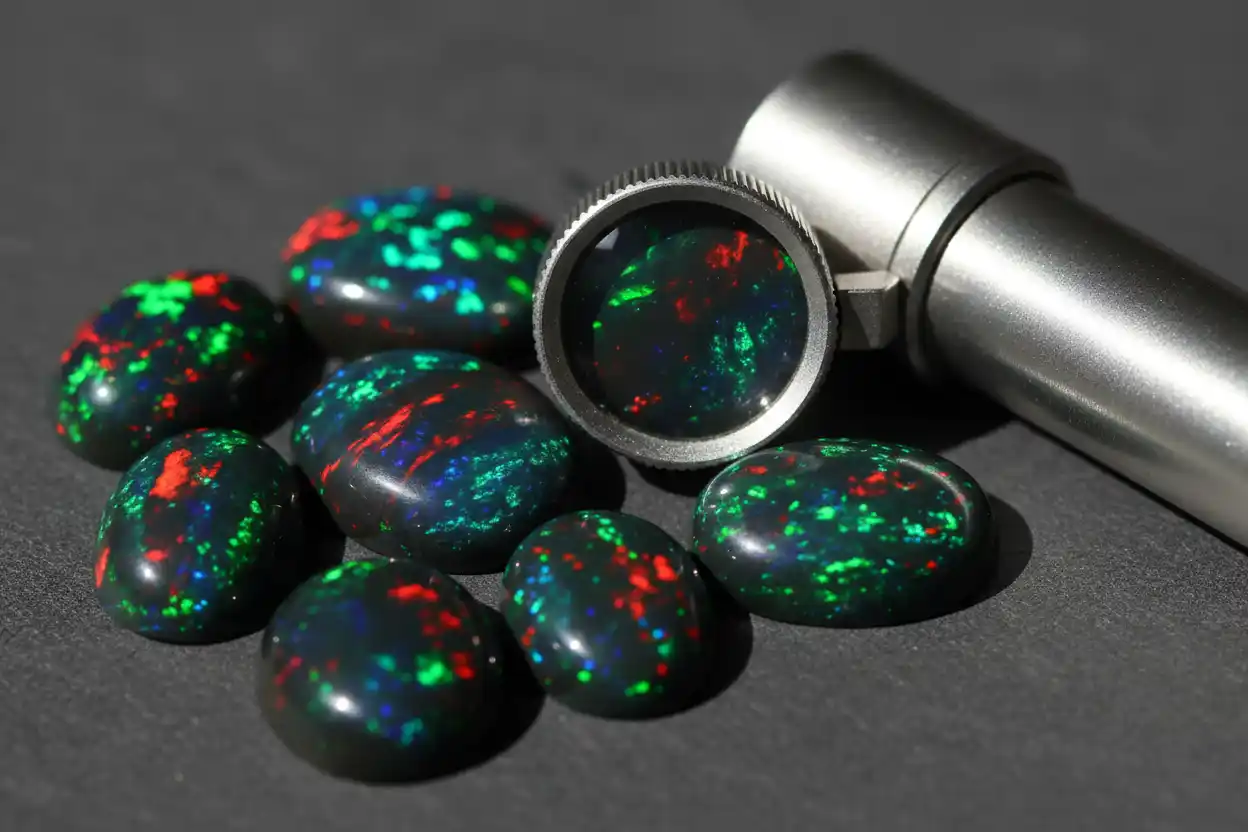
Buy Black Opal: Buying Criteria, Color, Clarity & Value
To buy black opal intelligently, begin by confirming what the stone actually is and then judge the individual gem by its background color, play-of-color, brightness, pattern, transparency, inclusions, cut, stability, treatment status, construction, condition, and documentation. Black opal is precious opal with a dark bodycolor when viewed face-up; the dark background can make flashes of spectral color appear especially vivid. GIA identifies color, pattern, and clarity as the three principal aspects of opal quality and describes play-of-color as the most important quality factor.
Black opal deserves particularly careful comparison because no two stones display exactly the same combination of color, pattern, orientation, and body tone. A smaller opal with exceptionally bright, broad play-of-color across most of its face can be more desirable than a larger stone with weak flashes, extensive dead areas, poor stability, or questionable treatment. Buyers should therefore avoid reducing black opal to a carat-weight calculation. The Gems Lore guides to the rarest gemstones in the world and most expensive gemstones provide useful context for the broader distinction between rarity, quality, market demand, and monetary value.
Buy Black Opal At a Glance
| Buying Factor | What to Examine | Why It Matters |
|---|---|---|
| Identity | Natural opal, synthetic opal, imitation, doublet, triplet, or solid stone | Different materials and constructions have different markets and values |
| Bodycolor | Dark gray to black face-up background | Dark background can increase contrast with play-of-color |
| Play-of-Color | Brightness, range of colors, coverage, viewing angles | The strongest driver of visual appeal and value |
| Pattern | Arrangement and scale of color flashes | Broad, vivid, balanced patterns can attract stronger demand |
| Clarity | Transparency, inclusions, pits, cracks, matrix | Opal clarity is type-specific; “more transparent” is not always better for black opal |
| Cut | Dome, thickness, symmetry, polish, orientation | Good cutting presents color effectively while retaining useful opal thickness |
| Stability | Crazing, fractures, prior drying problems | Cracked or unstable opal carries greater durability risk |
| Treatment | Smoke, sugar, dye, oil, wax, resin or other enhancement | Treatments can alter bodycolor, apparent clarity, durability and market value |
| Construction | Solid opal versus doublet or triplet | Assembled opals contain bonded components and should be disclosed clearly |
| Origin | Documented locality versus seller claim | Lightning Ridge is famous, but quality matters more than a mine name alone |
| Condition | Chips, scratches, abrasion, setting damage | Existing wear can reduce desirability and future durability |
| Documentation | Laboratory report, invoice and return terms | Independent evidence reduces uncertainty on significant purchases |
Understand What “Black Opal” Means Before Buying
Black opal is classified by its dark background or bodycolor rather than by the presence of black play-of-color. GIA’s Australian field research describes black opal as opal with a dark bodycolor viewed from above and notes that examples can range from almost transparent to opaque while displaying many possible play-of-color combinations. The dark background is important because it creates contrast, allowing spectral flashes to stand out more strongly than they often do against a light background.
That definition also explains why photographs require careful interpretation. A seller can place an ordinary light opal against a black surface, photograph it from a favorable angle, or adjust exposure so that the stone looks darker than it does under normal viewing conditions. The background visible through or behind the stone should not be confused with the stone’s own bodycolor. Request face-up and side-view images under neutral lighting, preferably against more than one background, so that you can judge whether the darkness belongs to the opal itself.
The distinction between black opal and boulder opal matters as well. Boulder opal naturally retains part of its ironstone host rock, whereas a solid black opal is valued as opal material rather than as a deliberately retained host-rock composite. GIA describes Queensland boulder opal as opal attached to its natural ironstone host and notes that this structure is integral to the material.
Play-of-Color Should Dominate the Quality Evaluation
GIA identifies play-of-color as the most important quality factor in opal. The effect results from diffraction of light through an ordered structure of microscopic silica spheres, producing shifting spectral colors as the stone, observer, or light source moves. For a buyer, the scientific explanation matters because genuine play-of-color should behave dynamically rather than looking like a static painted patch or metallic foil effect.
Evaluate brightness first. A fine black opal should produce color that remains conspicuous under ordinary viewing rather than appearing impressive only under a pinpoint spotlight. Then examine coverage: some stones show play-of-color over nearly the entire face, while others contain large inactive areas. Directionality matters too. A stone whose strongest color appears only from a narrow viewing angle may be less satisfying in jewelry than one that remains lively across a broader range of movement.
Color range also influences desirability. GIA notes that black opal’s dark background makes play-of-color particularly dramatic and that full-spectrum displays are especially prized. Red is comparatively uncommon in play-of-color and can add substantial visual appeal when it appears brightly alongside other hues. This does not mean a blue-green black opal cannot be exceptional. Brightness, pattern, coverage, balance, size, and personal preference remain part of the complete evaluation.
Pattern Changes How the Same Colors Are Perceived
Pattern describes the arrangement of play-of-color across the opal. GIA recognizes descriptive trade terms including pinfire, mosaic or harlequin, flame, and peacock-style patterns, while emphasizing that the important commercial issue is not the romantic name but the quality, brightness, distribution, and attractiveness of the color.
Large, clearly defined flashes can create a stronger visual impact than tiny scattered points, particularly when the pattern moves coherently across the surface. Some collectors place premiums on distinctive broad patterns, but there is no universal rule that one named pattern must always be more valuable than every other. An unusual arrangement can be extraordinary in one stone and mediocre in another if the brightness is weak.
Watch for dead areas where little or no play-of-color appears. A small inactive section near an edge may have little effect on overall beauty, while large central patches can substantially reduce visual impact. Rotate the stone slowly rather than judging one still image, because opal is fundamentally a movement-dependent gemstone.
Clarity in Black Opal Does Not Mean “The Clearest Stone Wins”
Opal clarity refers to transparency and the presence of inclusions, fractures, pits, matrix, or other internal and surface features. Unlike diamond, black opal does not improve automatically as it becomes more transparent. GIA specifically notes that experts expect different clarity characteristics from different types of opal and that an opaque dark background can be desirable in black opal because it enhances play-of-color.
The more important question is whether inclusions or structural features interfere with beauty or durability. Sand, clay, potch, pits, fractures, and irregular matrix can reduce value when they dominate the face of an otherwise fine black opal. A minor natural feature away from the main color display may matter much less, particularly in a rare stone with exceptional play-of-color.
Cracks demand separate attention because they can affect durability rather than merely appearance. Fine networks of fractures known as crazing can develop in unstable opal, and GIA notes that crazed material has reduced durability and commercial value. Examine the stone under magnification and ask the seller specifically whether any visible lines are surface scratches, internal features, healed fractures, or active cracks.
Body Tone Should Be Judged Independently From Play-of-Color
A darker body tone can make play-of-color look stronger because of increased contrast, which is one reason black opal commands such attention. GIA describes black opal as the rarest and generally most valuable principal opal type when other quality factors are comparable. The phrase “when other factors are comparable” is crucial. A dark stone with weak color is not automatically more desirable than a lighter opal with exceptionally vivid play-of-color.
Body tone can also be manipulated by treatment. Some hydrophane opals have been smoke-treated, dyed, or subjected to other processes to create darker appearances, and GIA has documented treatments that alter opal color significantly. Buyers should therefore avoid assuming that every dark opal is naturally black-bodied simply because it looks convincing in photographs.
When a seller charges a substantial premium for natural dark bodycolor, treatment disclosure and independent examination become increasingly valuable.
Lightning Ridge Origin Is Important, but Quality Still Comes First
Lightning Ridge in New South Wales is internationally associated with fine black opal. GIA’s field research calls the locality synonymous with top-quality black opal and describes it as the traditional source of fine black material. The locality has genuine historical, geological, and commercial importance, so credible Lightning Ridge provenance can add buyer confidence and collector interest.
Origin should not override the actual gemstone, however. GIA’s buyer guidance explicitly states that opal value is based on quality rather than locality alone and that fine opal can come from more than one source. A weak stone does not become fine simply because a seller calls it Lightning Ridge material.
Distinguish a dealer’s locality statement from laboratory-supported geographic origin. GIA currently offers geographic-origin reporting for qualifying natural opal through its Colored Stone Identification & Origin service. When origin meaningfully affects the asking price, read the laboratory wording itself instead of relying on the seller’s paraphrase.
Solid Black Opal Is Not the Same as a Doublet or Triplet
This distinction is critical when you buy black opal. GIA defines an opal doublet as a thin layer of opal bonded to a backing and a triplet as a thin opal layer sandwiched between a dark backing and a transparent protective cap. These assembled products can be attractive and legitimate when disclosed, but GIA notes that they generally sell for only a fraction of the price of comparable natural boulder opal or substantial solid material.
A dark backing can make a thin opal layer look more like black opal from above, so inspect the side of the stone whenever possible. Look for a straight bonding plane, different materials in distinct layers, glue lines, or a clear domed cap. Mounted jewelry can hide these clues, which makes seller disclosure and documentation more important.
An assembled opal is not automatically “fake.” It contains natural opal and can be a sensible choice for a buyer who wants dramatic appearance at a lower budget. The problem arises when a doublet or triplet is represented or priced as a solid black opal.
Synthetic and Imitation Opal Must Also Be Distinguished
Synthetic opal is laboratory-grown material designed to reproduce the essential structural and optical characteristics of natural opal. An imitation merely resembles opal while having a different composition or structure. GIA notes that opal has synthetic counterparts and can also be imitated by other materials.
These categories can look convincing to an untrained buyer, particularly in online listings where close examination is impossible. Uniform repeating patterns, unnatural columnar structures, obvious layering, or unusually consistent appearance may raise questions, but visual clues alone should not be treated as definitive identification.
For a higher-value black opal, independent gemological testing can provide more confidence than seller photographs or home tests. A professional report can address natural versus laboratory-grown status and detectable treatments within the laboratory’s service scope.
Treatment Disclosure Is Essential When Buying Black Opal
GIA lists oil, wax, plastic impregnation, sugar treatment, and smoke treatment among known opal enhancements. Hydrophane opal can be particularly receptive to absorbed substances because of its porous structure, and GIA research has documented dyeing, smoke treatment, resin or oil impregnation, and other modifications in such material.
Smoke treatment is particularly relevant to black-opal shopping because it can create or deepen a dark body appearance. The visual result can make play-of-color stand out more strongly, but treated dark opal should not be priced or represented as though the bodycolor were naturally equivalent to untreated fine black opal.
Request treatment information in writing. “Natural opal” does not necessarily mean “untreated opal,” because geological origin and treatment status are separate questions. If a seller states “no treatment,” determine whether that is simply the seller’s representation or whether an independent laboratory has examined the stone.
Cut Quality Matters More Than Standard Shape
Opals are commonly cut as cabochons because a rounded polished surface can display play-of-color effectively while preserving valuable material. GIA notes that fine opals are often cut in irregular shapes to retain as much desirable color as possible. A freeform black opal should therefore not be considered inferior merely because it lacks the symmetry of a calibrated oval.
Evaluate whether the cutter oriented the strongest color toward the face, preserved adequate thickness, created a smooth polish, and avoided unnecessary inactive material. A very thin stone may face up beautifully but offer less physical substance than a thicker gem, while an excessively high dome can add weight without improving appearance.
Inspect the back as well. The rear surface can reveal potch, sand, natural opal structure, repair, assembly, or treatment clues that are hidden in a face-up photograph.
Carat Weight Is Only One Part of Value
Opal’s density is relatively low compared with many common gemstones, so a visually large opal can weigh less than a similarly sized sapphire or zircon. GIA specifically notes this lower density when discussing opal size and wearability. Buyers should therefore compare dimensions and face-up visual impact alongside carat weight.
A heavier black opal may contain additional thickness, potch, or inactive material that contributes little to the visible color display. A lighter stone can sometimes offer a superior face-up appearance because the cutter retained the area with the best color and removed less attractive material.
Price-per-carat calculations become meaningful only after color, pattern, brightness, stability, construction, condition, treatment and overall quality have been compared. The Gems Lore benitoite price guide illustrates the same broader principle: weight becomes useful for valuation only when the gemstones being compared are genuinely similar in quality.
Inspect Stability and Durability Before Paying a Premium
Opal ranges around 5 to 6.5 on the Mohs hardness scale, while GIA characterizes its toughness as very poor to fair depending on the material. Hardness measures resistance to scratching, whereas toughness relates more closely to resistance to breaking and chipping. A black opal can therefore be suitable for jewelry while still requiring more protective wear than sapphire or diamond.
High heat and sudden temperature changes can cause fractures, and intense heat or dryness can contribute to crazing in susceptible opal. Ask whether the stone has shown any instability during storage, cutting, or previous ownership, especially when purchasing recently mined or unfamiliar material.
For rings, consider a protective design that shields exposed edges. Pendants and earrings usually receive fewer impacts, but every setting should avoid placing excessive pressure on the stone.
Compare Black Opal Listings With the Same Discipline Used for Other Rare Gems
A compelling listing should provide enough information to make a real comparison rather than relying on adjectives. The Gems Lore guide to buy benitoite emphasizes documentation and identity for a rare collector gem, while buy ammolite provides another useful comparison for a material valued heavily for dynamic color effects. Black opal requires the same evidence-first mindset, even though its gemological properties and market are different.
Before paying a substantial premium, compare:
Natural, synthetic, imitation or assembled status.
Body tone under neutral lighting.
Brightness and coverage of play-of-color.
Dominant colors and range of visible hues.
Pattern size, organization and inactive areas.
Transparency, inclusions, potch, pits and fractures.
Carat weight plus millimeter dimensions.
Dome, thickness, polish and orientation.
Treatment disclosure.
Geographic-origin evidence if the seller charges for provenance.
Existing chips, scratches or crazing.
Return rights and independent inspection options.
A seller who willingly supplies this information gives the buyer much more to evaluate than one who depends on terms such as “museum grade,” “AAA,” or “investment opal.”
Retail Grades Like AAA Are Not Universal Laboratory Grades
Black opal does not have a universally standardized AAA, AAAA, premium, museum-grade, or investment-grade system that makes one seller’s labels directly comparable with another’s. GIA evaluates opal but explicitly states that it does not grade opal. Its Colored Stone Identification Report records identifying characteristics, natural or laboratory-grown status where applicable, and detectable treatments rather than assigning a universal commercial quality grade.
That makes descriptive evidence more useful than letter labels. A dealer may legitimately create internal categories for inventory management, but the buyer should ask how those categories relate to brightness, body tone, color coverage, pattern, clarity, cut, stability and treatment.
If the seller cannot define the grade, do not pay a premium simply because the label sounds impressive.
Laboratory Report, Appraisal and Selling Price Are Different
A gemological identification report addresses what the stone is and what detectable treatments the laboratory finds within the scope of its service. An appraisal addresses monetary value for a stated purpose. A retail price is what a merchant asks the consumer to pay, while a resale offer is what another buyer is willing to pay after considering risk, margin, testing, marketing and holding costs.
These numbers can differ significantly without contradiction. A laboratory report does not guarantee that an asking price is fair, and a high insurance appraisal does not guarantee the same amount in a future cash sale.
This distinction becomes especially important with black opal because visual individuality makes truly comparable stones difficult to find. Documentation reduces uncertainty, but the market still has to decide what a particular combination of color, pattern and quality is worth.
Conclusion
To buy black opal confidently, evaluate the stone as a unique optical object rather than as a generic commodity. Begin with identity and construction, then compare body tone, brightness, play-of-color coverage, color range, pattern, clarity, cut, stability, treatment, condition, provenance and documentation. GIA’s guidance consistently places play-of-color at the center of opal quality while recognizing that bodycolor, pattern and clarity must be considered together.
The most important safeguards are equally practical: do not mistake a doublet or triplet for a solid stone, do not assume dark bodycolor is untreated, do not treat Lightning Ridge provenance as a substitute for quality, and do not rely on retailer grade labels as universal standards. Fine black opal can justify a significant premium, but that premium should be supported by what the stone actually displays and by evidence that reduces uncertainty about identity and treatment.
Frequently Asked Questions
What should I look for first when I buy black opal?
Start with identity, construction and play-of-color. Determine whether the stone is natural solid opal, an assembled doublet or triplet, synthetic opal, or an imitation. Then judge brightness, color coverage, pattern, dark body tone, stability, treatment and condition. GIA identifies play-of-color as opal’s most important quality factor, so an impressive display should carry more weight than a marketing grade or carat number alone.
Is darker black opal always more valuable?
No. A darker body tone can increase contrast and make play-of-color stand out, but body darkness alone does not create fine quality. A very dark stone with weak, narrow or dull play-of-color can be less desirable than a slightly lighter stone with vivid broad flashes and strong coverage. Quality must be judged as a combination of bodycolor, play-of-color, pattern, clarity, cut, stability and overall beauty.
Is Lightning Ridge black opal automatically more valuable?
No. Lightning Ridge is one of the world’s most important black-opal localities and is strongly associated with fine material, but GIA states that opal value depends on quality rather than locality alone. A documented Lightning Ridge stone can attract collector interest, yet weak color, poor stability or damage can still reduce value.
What is the difference between black opal and an opal doublet?
A solid black opal consists of opal material with its own dark bodycolor, whereas an opal doublet contains a thin layer of natural opal bonded to a separate backing. A triplet adds a transparent top layer as well. GIA recognizes doublets and triplets as assembled opals and notes that they occupy a different market from substantial natural material.
Can black opal be treated to look darker?
Yes. GIA documents smoke treatment, sugar treatment, dyeing and impregnation among known opal enhancements, and smoke or dye can significantly darken porous opal. This is why treatment disclosure matters when a dark bodycolor contributes substantially to price.
Does GIA grade black opal?
No. GIA evaluates and identifies opal but states that it does not assign an overall opal grade. Its reports can document characteristics and identify natural or laboratory-grown material and detectable treatments within the service scope.
Is transparent black opal better than opaque black opal?
Not automatically. Opal clarity expectations depend on the opal type, and GIA notes that an opaque dark background can be desirable in black opal because it provides strong contrast for play-of-color. Transparency should therefore be judged together with brightness, body tone, pattern and inclusions rather than treated as a universal quality scale.
Is black opal durable enough for a ring?
Black opal can be worn in rings, but it requires more care than harder and tougher gems. Opal has a Mohs hardness of roughly 5 to 6.5 and variable toughness, while high heat or sudden temperature changes can cause damage. A protective setting and sensible wear habits are particularly valuable for a high-quality stone.
Is black opal a guaranteed investment?
No. Fine black opal can be rare, valuable and collectible, but future appreciation depends on market demand, quality, condition, liquidity, documentation and transaction costs. Neither rarity nor a retailer’s “investment grade” description guarantees a future profit.