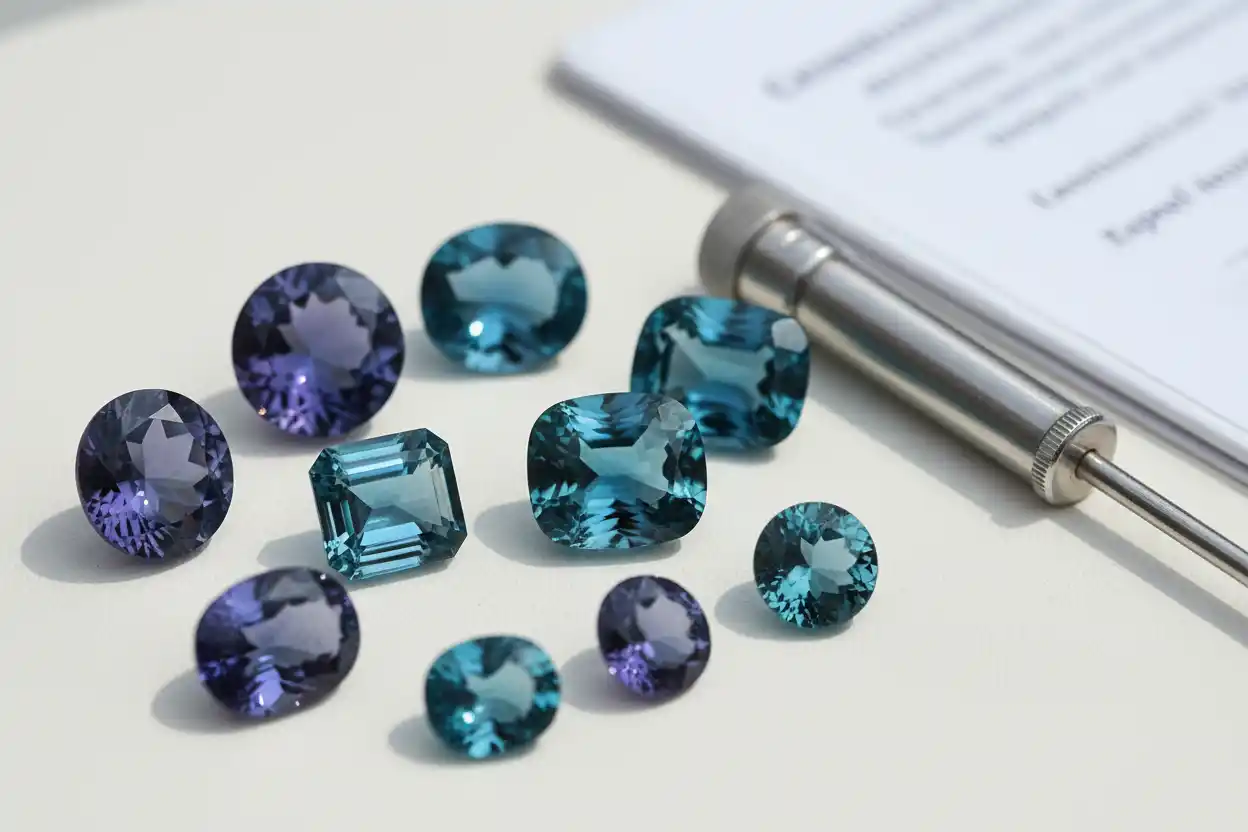
Buy Indicolite: How to Compare Listings, Origin, Quality & Red Flags
To buy indicolite confidently, begin by separating ordinary blue tourmaline from copper-bearing Paraíba tourmaline and from other blue gemstones that can look similar in photographs. Indicolite is the trade name commonly used for blue tourmaline, generally associated with iron-related blue coloration. GIA’s research on blue tourmaline specifically contrasts iron-colored indicolite with copper-bearing Paraíba material, whose vivid electric blue-to-green colors arise principally from copper and manganese and occupy a distinct premium market.
Within ordinary indicolite, value depends primarily on hue, tone, saturation, transparency, clarity, cut, pleochroic orientation, size, treatment, condition, and seller documentation. GIA identifies color as tourmaline’s most important quality factor and notes that fine blue tourmaline can range from relatively light through dark tones, often with green as a modifying hue. Strongly saturated stones without large black extinction areas are generally the most desirable.
Buy Indicolite At a Glance
| Buying Factor | What to Examine | Why It Matters |
|---|---|---|
| Identity | Natural blue tourmaline consistent with indicolite | Blue appearance alone does not prove tourmaline |
| Copper Status | Ordinary iron-colored indicolite versus copper-bearing Paraíba-type tourmaline | These belong to very different market categories |
| Color | Blue, slightly greenish blue, greenish blue, or related tones | Color is tourmaline’s leading value factor |
| Tone | Medium-light through dark, without excessive black extinction | Overly dark stones can lose brilliance |
| Saturation | Strong vivid color without grayness | Saturation strongly affects desirability |
| Clarity | Eye-visible inclusions, tubes, fractures, clouds | Blue tourmaline is generally expected to be relatively clean |
| Pleochroism | Directional color differences | Orientation can make a stone look bright blue or nearly black |
| Cut | Brightness, symmetry, windowing, orientation, polish | Good cutting can transform the face-up color |
| Size | Weight together with millimeter dimensions | Fine larger tourmalines can rise meaningfully in per-carat value |
| Treatment | Heating, irradiation, or other color modification | Treatment can influence appearance, stability, and disclosure |
| Condition | Chips, scratches, facet wear, fractures | Important for pre-owned stones |
| Origin | Seller provenance versus laboratory-supported origin | Ordinary indicolite does not have the same GIA origin-report framework as Paraíba tourmaline |
| Documentation | Independent identification and treatment testing | Useful when color or price creates substantial risk |
Indicolite Is Blue Tourmaline
Tourmaline is a chemically complex mineral group with a remarkable color range. GIA’s Gübelin Gem Project identifies indicolite as blue elbaite tourmaline and distinguishes it from verdelite, the green variety, and rubellite, the red variety.
Because tourmaline color exists on a continuum, the border between blue indicolite and blue-green or green tourmaline can be subjective in marketplace language. A stone may be described as blue, slightly greenish blue, greenish blue, or blue-green depending on lighting, viewing direction, and the seller’s terminology.
Buy the appearance you actually prefer rather than paying extra for the word indicolite when the stone looks predominantly green to your eye.
Iron-Colored Indicolite Is Not the Same as Paraíba Tourmaline
GIA’s research on Paraíba tourmaline explains that iron can produce blue coloration in tourmaline commonly called indicolite, while the famous neon blue-to-green Paraíba colors are associated primarily with copper and manganese.
This chemical distinction matters enormously in pricing. A vivid copper-bearing tourmaline that qualifies for the Paraíba designation belongs to one of the most expensive tourmaline categories, while ordinary iron-colored indicolite occupies a different supply and demand structure.
A seller should never imply that a stone is Paraíba merely because it is bright blue. Copper-bearing status requires analytical evidence, and the accepted Paraíba category involves both color and chemical composition.
Color Is the Leading Indicolite Quality Factor
GIA identifies color as tourmaline’s most important quality factor. Bright pure blue, blue-green, and green tones generally attract strong demand, while grayish, weakly saturated, or excessively dark stones are less desirable.
Blue tourmaline can range from light to dark, and green can modify the hue in varying amounts. GIA describes desirable examples with medium-light tone and strongly saturated slightly greenish-blue color, illustrating that a small green modifier does not automatically reduce quality.
The best color for a particular buyer is therefore not necessarily the purest possible blue. Some collectors prefer oceanic greenish blue, while others want cooler inky blue or brighter cyan-leaning material.
Excessive Darkness Can Reduce Value
Tourmaline is strongly pleochroic and can absorb significantly more light along one crystal direction than another. GIA notes that tourmalines that appear pale across the crystal can become extremely dark—sometimes almost black—when viewed down the crystal length.
This effect makes tone one of the most important buying checks in indicolite. A saturated blue stone can look impressive in a bright photography setup yet become nearly black indoors if the tone is too deep or the cutter oriented the rough poorly.
Request video in moderate neutral lighting rather than only strong backlighting. A fine indicolite should remain visibly blue and lively in the conditions where it will actually be worn.
Pleochroism Makes Cutting Orientation Critical
Tourmaline’s strong pleochroism means that cutters must decide which crystal direction will dominate face-up. GIA explains that cutters may orient pale rough to make it appear darker or orient dark rough differently to avoid an overly black face-up appearance.
This is why two tourmalines from similar rough can look dramatically different after cutting. One can show bright attractive blue across the face, while another retains more weight but presents a dark, extinguished center.
A good indicolite cut should manage directional color as carefully as it manages symmetry and weight.
Cut Quality Can Matter as Much as Carat Weight
GIA advises buyers not to compromise on tourmaline cut because poor cutting reduces brilliance and marketability. Tourmaline crystals are often elongated, so rectangular and emerald-style shapes are common because they preserve rough efficiently.
Efficient rough retention is not automatically good cutting. Inspect the stone for central windowing, large black extinction areas, uneven outline, excessive pavilion depth, poorly meeting facet junctions, and weak polish.
A smaller precision-cut indicolite can look larger, brighter, and more saturated than a heavier stone with inefficient proportions.
Blue Tourmaline Is Generally Expected to Have Good Clarity
GIA notes that pink and red tourmalines commonly show more inclusions, whereas green-to-blue varieties are generally expected to be cleaner. Visible inclusions in a blue tourmaline can therefore affect value more strongly than similar inclusions in certain red tourmalines.
Typical tourmaline inclusions include thread-like liquid-filled cavities, growth tubes, and other internal features.
A small natural inclusion may be acceptable in a richly colored rare stone, but prominent white inclusions, surface-reaching fractures, or clouds that interfere with transparency can reduce marketability substantially.
Surface-Reaching Inclusions Deserve Extra Attention
GIA notes that inclusions reaching the surface can interfere with polish and luster and make tourmalines harder to sell.
For an indicolite intended for a ring, a fracture reaching the girdle near a prong deserves careful inspection because it can also influence durability during setting and wear.
Request side and pavilion photographs when buying online. Face-up beauty alone does not reveal every structural weakness.
Carat Weight Can Increase Price Significantly in Fine Material
GIA notes that larger fashioned tourmalines can rise considerably in per-carat price, with the size effect varying according to variety and quality.
The premium is strongest when a larger indicolite retains attractive saturation, good transparency, strong cutting, and useful face-up dimensions. Extra weight does little to help a stone that becomes too dark or heavily included as size increases.
A large fine blue tourmaline can therefore be impressive and valuable, but the carat number should never be evaluated without tone and cut.
Millimeter Dimensions Help Reveal Hidden Weight
Long tourmaline crystals encourage elongated cuts, and some cutters preserve considerable depth to maximize yield.
Compare length, width, and depth as well as weight. A deep eight-carat indicolite may look smaller than a well-proportioned six-carat stone with a broader face-up spread.
This becomes financially important as fine blue tourmaline moves into higher per-carat price levels.
Heating Is an Important Tourmaline Treatment
GIA identifies heating as one of the two major tourmaline treatments. Heat can alter color, and tourmaline containing abundant liquid inclusions may be unable to tolerate heating safely.
The commercial effect of treatment depends on the original and final color and on whether the treatment can be detected conclusively. A treated indicolite can still be attractive, but a seller should not imply untreated status without evidence.
Treatment should be understood as a separate question from whether the stone is natural tourmaline.
Irradiation Can Also Modify Tourmaline Color
GIA identifies irradiation as another important tourmaline treatment and warns that irradiation-related color can fade with heat or bright light.
This does not mean every blue indicolite has been irradiated. Natural iron-colored blue tourmaline is well documented.
It does mean that unusually colored stones and strong treatment claims should be supported by appropriate disclosure or laboratory testing rather than assumption.
Paraíba Treatment Rules Should Not Be Applied Automatically to Ordinary Indicolite
Copper-bearing Paraíba tourmaline has a specialized market in which heat treatment is common and some treatment effects can be difficult to detect. GIA’s origin research explains that heat can remove pink and purple components from certain cuprian tourmalines, leaving blue-to-green colors associated with the Paraíba market.
Ordinary iron-colored indicolite is chemically and commercially different. A seller should not use Paraíba terminology, treatment expectations, or price benchmarks unless copper-bearing status has actually been established.
Geographic Origin Usually Matters Less Than Color and Quality in Ordinary Indicolite
Tourmaline occurs in many gem-producing regions, and blue material can come from several countries. A seller may cite Brazil, Namibia, Nigeria, Mozambique, Afghanistan, Pakistan, Madagascar, Russia, or another locality.
For ordinary indicolite, attractive color, clarity, cut, size, and condition generally matter more than a famous country name unless the provenance has special collector significance.
GIA’s general buyer guidance likewise warns that a famous mine does not automatically make a tourmaline high quality.
Ordinary Indicolite Does Not Receive the Same GIA Origin Service as Paraíba Tourmaline
GIA’s current Colored Stone Identification & Origin Report includes Paraíba tourmaline among eligible gemstone categories but does not list ordinary indicolite as a separate material for geographic-origin reporting.
A GIA Colored Stone Identification Report can still identify an indicolite as tourmaline, describe color and measurements, determine natural or laboratory-grown status where applicable, and list detectable treatments.
A dealer’s ordinary indicolite origin statement should therefore be understood as provenance information unless supported by another appropriate form of documentation.
GIA Does Not Give Tourmaline an Overall Quality Grade
GIA explicitly states that it evaluates tourmaline but does not grade it.
Retail labels such as AAA indicolite, AAAA blue tourmaline, top blue, collector grade, and investment grade are therefore seller-defined rather than standardized international grades.
A more reliable comparison looks directly at hue, tone, saturation, clarity, cut, weight, dimensions, treatment, and condition.
Indicolite Versus Paraíba Tourmaline
The most important distinction is chromophore. Indicolite’s blue is commonly iron-related, while Paraíba-type electric blue to green tourmaline is defined by copper and manganese chemistry.
Fine Paraíba can command extraordinary premiums because the neon copper-bearing color and supply structure are different. A normal indicolite should not be considered inferior simply because it lacks copper; it belongs to another category with its own aesthetic strengths.
Buyers should choose indicolite for attractive natural blue tourmaline rather than for an attempt to acquire a discounted Paraíba substitute.
Indicolite Versus Aquamarine
Indicolite and aquamarine can both appear blue to greenish blue, but indicolite is tourmaline while aquamarine is beryl.
Gems Lore’s buy aquamarine guide and aquamarine price guide explain the beryl framework. Tourmaline generally has stronger pleochroism and can show darker directional color, making cutting orientation especially important.
A side-by-side comparison should therefore consider mineral identity, color, brilliance, durability, treatment, and market demand rather than color alone.
Indicolite Versus Grandidierite
Certain grandidierites can overlap with indicolite in bluish-green appearance. The Gems Lore buy grandidierite guide explains that transparent grandidierite is exceptionally scarce and belongs to a different mineral species.
Laboratory identification becomes particularly important when a rare name is responsible for much of the price.
The safest buying principle is to identify first and compare prices second.
Tourmaline Has Useful Jewelry Durability
GIA gives tourmaline a Mohs hardness of approximately 7 to 7.5 and describes its toughness as fair. It is generally stable to light and chemicals, though high heat and thermal shock can damage the stone.
Indicolite can therefore be worn in rings, pendants, earrings, and other jewelry with sensible care.
A valuable daily-wear ring should protect exposed corners and avoid severe impact, especially when the stone contains fractures or prominent liquid inclusions.
Warm Soapy Water Is the Safest Cleaning Method
GIA recommends warm soapy water for tourmaline and advises against ultrasonic and steam cleaning because inclusions and thermal stress can create risk.
This becomes particularly important if the indicolite contains liquid inclusions, fractures, or has undergone treatment.
A jeweler should know that the stone is tourmaline before performing high-heat repair work nearby.
Condition Can Affect Pre-Owned Indicolite Value
Check secondhand stones for chipped girdles, worn facet junctions, scratched tables, damaged corners, fractures near prongs, and signs of repolishing.
A strongly saturated stone can hide wear in photographs, especially if images are dark or highly contrasted.
Repolishing can improve luster but may remove weight and alter original proportions, so condition should be assessed before the stone is compared with fresh newly cut material.
Common Red Flags When You Buy Indicolite
Be cautious when:
Every blue tourmaline is marketed as Paraíba.
The seller implies copper-bearing chemistry based only on vivid blue color.
A dark stone appears bright only under strong backlighting.
AAA or investment grade is presented as an official laboratory category.
Eye-visible fractures are hidden by saturated photography.
A large stone is priced by weight without dimensions.
Treatment questions receive only the answer “natural.”
Ordinary indicolite is presented with a GIA geographic-origin claim intended for Paraíba tourmaline.
A lab identification report is described as an appraisal.
A seller guarantees appreciation because blue tourmaline is “rare.”
Greenish-blue material is heavily edited to appear neon cyan.
Strong documentation becomes more important as color, rarity claims, and price increase.
How to Compare Indicolite Listings Fairly
Compare:
Natural tourmaline identity.
Iron-colored indicolite versus copper-bearing Paraíba-type status.
Blue hue and green modifiers.
Tone.
Saturation.
Grayness or brownness.
Face-up extinction.
Eye-visible clarity.
Surface-reaching fractures.
Pleochroic orientation.
Cut quality.
Carat weight.
Millimeter dimensions.
Treatment disclosure.
Condition.
Seller provenance.
Independent laboratory report.
Return and inspection rights.
Only after those points align does the price become meaningfully comparable.
Conclusion
To buy indicolite well, judge the stone first as blue tourmaline and only then evaluate commercial labels. GIA identifies color as tourmaline’s most important quality factor, with fine blue material valued for attractive saturation and tone while excessive darkness and poor cutting can reduce brilliance significantly.
The most important authenticity distinction is between ordinary iron-colored indicolite and copper-bearing Paraíba tourmaline. GIA research makes clear that iron can produce indicolite’s blue color, whereas Paraíba-type neon blues and greens are associated primarily with copper and manganese.
A strong indicolite purchase therefore combines attractive blue color, controlled tone, useful transparency, good clarity, skilled pleochroic orientation, efficient cutting, sensible size, clear treatment disclosure, sound condition, and documentation appropriate to the price. Undefined AAA labels and unsupported Paraíba or origin claims should never carry more weight than the stone’s actual gemological characteristics.
Frequently Asked Questions
What is indicolite?
Indicolite is the trade name commonly used for blue tourmaline, particularly blue elbaite. GIA identifies indicolite among the colored varieties of elbaite tourmaline.
What causes indicolite’s blue color?
GIA research notes that iron can produce blue coloration in tourmaline commonly termed indicolite.
Is indicolite the same as Paraíba tourmaline?
No. Ordinary indicolite is generally iron-colored blue tourmaline, while Paraíba tourmaline is a copper- and manganese-bearing category known for exceptionally vivid blue-to-green colors.
What color indicolite is most valuable?
Strongly saturated blue or attractive slightly greenish-blue material with controlled tone and minimal extinction can command strong demand. GIA identifies bright pure blue and related saturated tourmaline colors as particularly desirable.
Should indicolite be eye-clean?
Blue-to-green tourmalines are generally expected to be relatively clean compared with pink and red tourmalines, so obvious inclusions can have a stronger negative effect on value.
Why do some indicolites look almost black?
Tourmaline is strongly pleochroic and can absorb much more light along one crystal direction. Poor orientation or excessively dark tone can therefore produce strong extinction.
Can indicolite be heated?
Heating is one of the important treatments used on tourmaline. GIA notes that heat can alter color and that stones with abundant liquid inclusions may not tolerate the treatment safely.
Can indicolite be irradiated?
Irradiation is also used on some tourmalines, and irradiation-related color can fade under bright light or heat.
Does GIA grade indicolite AAA?
No. GIA evaluates tourmaline but does not assign an overall quality grade.
Can GIA identify indicolite?
Yes. GIA’s Colored Stone Identification Report can identify tourmaline, record descriptive characteristics, and list detectable treatments.
Can GIA confirm country of origin for ordinary indicolite?
GIA’s standard Colored Stone Identification & Origin Report currently includes Paraíba tourmaline, not ordinary indicolite as a separate eligible category.
Is indicolite durable enough for a ring?
Tourmaline is about 7 to 7.5 on the Mohs scale with fair toughness. It can work well in rings with sensible care, though hard blows, high heat, and thermal shock should be avoided.
Is indicolite a guaranteed investment?
No. Fine blue tourmaline can be desirable and collectible, but future resale depends on color, clarity, cut, size, treatment, condition, documentation, demand, and liquidity.