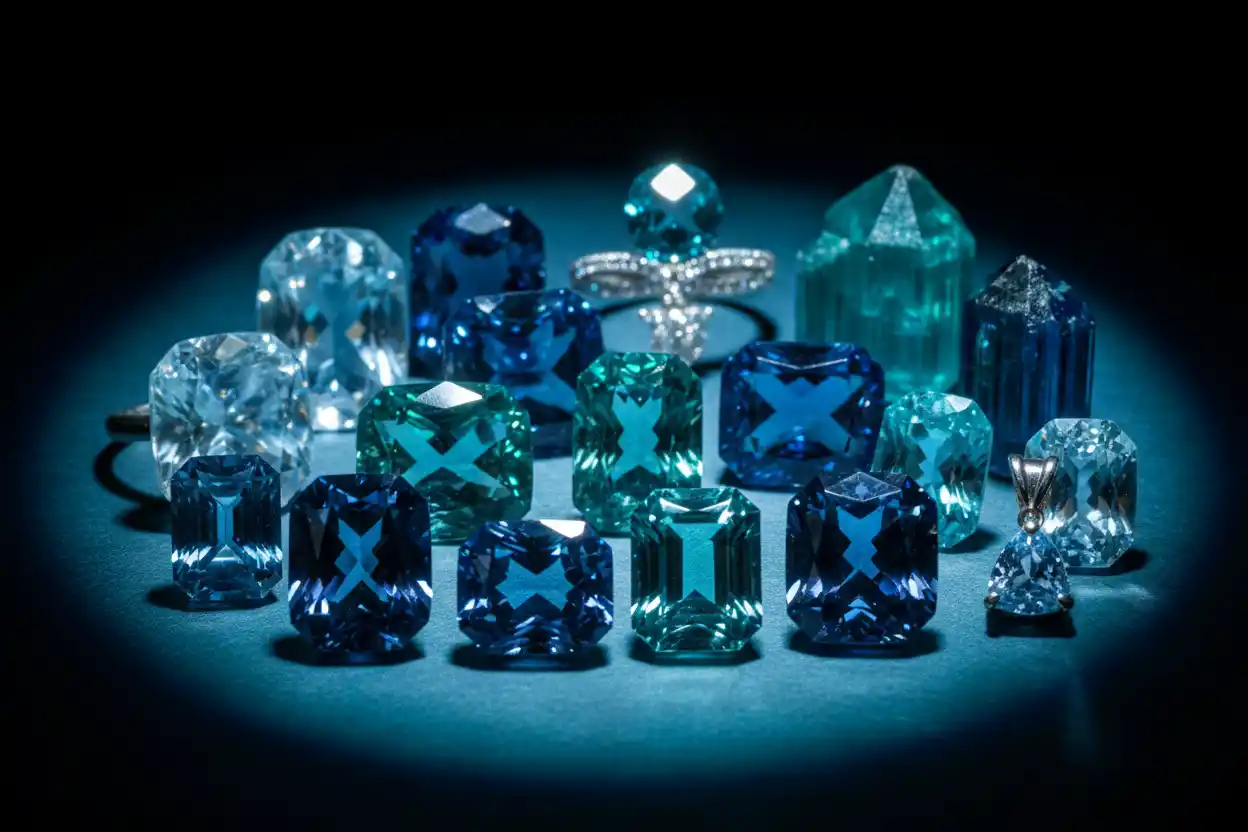
Indicolite Meaning: Properties, Uses & Symbolism
Indicolite meaning begins with blue tourmaline rather than with a separate mineral species called indicolite. In modern gemological usage, indicolite describes dark violetish-blue, blue, or greenish-blue tourmaline. Most gem-quality material carrying the name belongs to elbaite or closely related fluor-elbaite, although Mindat cautions that blue tourmaline called indicolite is usually—but not invariably—one of those species. This distinction matters because tourmaline is a mineral group containing multiple chemically distinct species that share a related crystal structure.
Elbaite, the species behind much gem indicolite, is a complex sodium-lithium-aluminum borosilicate. GIA represents its composition as Na(Li₁.₅,Al₁.₅)Al₆Si₆O₁₈(BO₃)₃(OH)₄, while emphasizing that tourmaline chemistry can vary substantially through substitutions involving sodium, lithium, calcium, magnesium, manganese, iron, chromium, vanadium, fluorine, copper, and other constituents. GIA gives general gem-tourmaline properties of Mohs 7–7.5, refractive index approximately 1.624–1.644, birefringence roughly 0.018–0.040, and specific gravity near 3.06 with meaningful compositional variation.
The blue itself also requires careful interpretation. Ordinary indicolite is typically associated principally with iron-related absorption, whereas the intensely vivid blue-to-green material sold under the Paraíba designation is defined gemologically by copper and manganese chemistry. GIA specifically contrasts iron-dominant blue tourmaline—commonly termed indicolite—with copper-dominant Paraíba tourmaline, and modern spectroscopy can separate their dominant color mechanisms even when the colors overlap visually.
Those mineralogical facts should remain distinct from symbolism. Contemporary indicolite meaning commonly emphasizes communication, thoughtful expression, reflection, calm focus, honesty, creativity, perspective, or emotional restraint. These can work as personal or cultural interpretations. They do not establish that iron-bearing tourmaline alters neurological function, treats anxiety, controls the throat, regulates hormones, or produces a measurable spiritual field.
Readers exploring other material-first references can browse Gemstone Guides. This page defines indicolite as a material first, then examines formation, color, identification, history, symbolism, and safe ownership without duplicating the dedicated buying, value, treatment, cutting, jewelry, or care resources mapped to the same gemstone.
Indicolite Meaning at a Glance
| Property or question | Evidence-aware summary |
|---|---|
| Material | Blue tourmaline |
| Variety status | Color variety/trade term rather than separate mineral species |
| Most common species | Usually elbaite or fluor-elbaite |
| Representative elbaite formula | Na(Li₁.₅,Al₁.₅)Al₆Si₆O₁₈(BO₃)₃(OH)₄ |
| Mineral group | Tourmaline |
| Crystal system | Trigonal |
| Indicolite color | Violetish blue, blue, greenish blue |
| Main ordinary blue-color mechanism | Commonly iron-related absorption |
| Important distinction | Copper-bearing Paraíba tourmaline is not simply another name for ordinary indicolite |
| General tourmaline hardness | Mohs 7–7.5 |
| General gem-tourmaline RI | Approximately 1.624–1.644 |
| General birefringence | Approximately 0.018–0.040 |
| General SG | Around 3.06, composition dependent |
| Pleochroism | Often conspicuous |
| Typical crystal habit | Elongated trigonal prisms with longitudinal striations |
| Common gem formation | Lithium-rich granitic pegmatites for most elbaite gems |
| Common inclusions | Growth tubes, fluid inclusions, mineral inclusions, fractures |
| Main visual confusion | Paraíba-type copper-bearing tourmaline, blue-green tourmaline of other compositions, blue glass and other gems |
| Modern symbolism | Communication, reflection, clarity, honesty, calm focus, creativity |
| Scientific status of symbolism | Interpretive, not demonstrated physiological action |
| Main ownership concern | Good hardness but only fair toughness; heat and thermal shock can damage tourmaline |
The table deliberately calls the physical values general tourmaline properties. Because indicolite is a color term spanning compositionally variable tourmaline, assigning one exact RI, density, or formula to every blue stone would imply more chemical uniformity than the name actually provides.
What Is Indicolite?
Indicolite is blue tourmaline.
GIA describes indicolite as dark violetish blue, blue, or greenish-blue tourmaline. Mindat uses the broader description “blue gemmy variety of tourmaline” and notes that the material is usually, though not always, elbaite or fluor-elbaite.
This creates an important nomenclatural hierarchy:
Tourmaline is the mineral group.
Elbaite is one mineral species within that group.
Indicolite is a blue color-variety name usually applied to gemmy tourmaline, especially blue elbaite.
A gemstone can therefore be accurately called both elbaite and indicolite when its chemistry and color support those descriptions.
The two words do not operate at the same classification level.
Indicolite Identity Table
| Characteristic | Indicolite |
|---|---|
| Classification | Blue gem tourmaline |
| Common host species | Elbaite / fluor-elbaite |
| Representative chemistry | Complex Na-Li-Al borosilicate |
| Crystal system | Trigonal |
| Typical crystal habit | Long prismatic crystals, commonly vertically striated |
| Typical hue range | Violetish blue, blue, greenish blue |
| Transparency | Transparent to translucent |
| Luster | Vitreous |
| Hardness | About 7–7.5 for gem tourmaline |
| Typical SG | Around 3.0–3.2, composition dependent |
| General tourmaline RI | Approximately 1.624–1.644 |
| General birefringence | Approximately 0.018–0.040 |
| Optical character | Uniaxial in tourmaline |
| Pleochroism | Often strong |
| Cleavage | Poor/indistinct rather than prominent |
| Fracture | Uneven to conchoidal |
| Toughness | Fair |
| Main ordinary blue chromophore system | Iron-related absorption |
| Important alternative blue system | Copper-bearing Paraíba-type tourmaline |
| Typical geological setting for elbaite | Highly evolved granitic pegmatites |
| Identification priority | Establish tourmaline/species before interpreting the color-variety name |
GIA emphasizes that tourmaline is not one chemically uniform mineral. Species classification depends on composition, and most gem tourmalines are elbaite, while dravite, uvite, liddicoatite, schorl, and other species occupy different chemical parts of the group.
Is Indicolite Always Elbaite?
No.
It is safest to say usually elbaite or fluor-elbaite, not always.
Mindat explicitly makes that distinction in its indicolite definition. GIA’s Gübelin Gem Project places indicolite among familiar elbaite varieties, which accurately reflects the majority of important gem material.
The broader tourmaline group, however, is chemically diverse.
A blue tourmaline may require chemistry to establish its actual species.
This becomes particularly important for scientifically cataloged specimens, unusual localities, research material, or gemstones being sold with a species-specific rarity claim.
Color is a variety clue.
Species is a chemical classification.
Why Is Indicolite Blue?
Iron is the central answer for ordinary indicolite.
GIA states generally that iron, and possibly titanium in some combinations, contributes blue and green colors in tourmaline. More detailed spectroscopic work shows that Fe²⁺ and Fe²⁺–Fe³⁺ interactions can create characteristic absorption in blue tourmaline.
In one GIA-reported comparison of blue and green tourmaline, blue color was associated with Fe²⁺ together with a limited amount of Fe³⁺ interaction, while green involved a different relationship including Fe²⁺ and Ti⁴⁺.
That does not mean every indicolite is produced by one identical concentration of iron.
Tourmaline chemistry is exceptionally variable.
The exact blue can depend on iron concentration, oxidation state, site occupancy, titanium, other trace elements, crystal orientation, thickness, and additional absorption features.
The strongest general statement is therefore:
Ordinary indicolite blue is typically iron-dominant, but specimen-specific color mechanisms can be more complex than “iron equals blue.”
The specialized spectroscopy and directional color behavior belong in Indicolite Optical Properties and Color Behavior.
Indicolite Versus Paraíba Tourmaline
This distinction is one of the most commercially important boundaries in blue tourmaline.
Paraíba tourmaline is defined in the gem trade by intense blue, greenish blue, bluish green, or related color principally associated with copper and manganese rather than merely by being blue tourmaline. GIA cites the widely accepted LMHC definition and contrasts this copper-bearing material with iron-colored blue indicolite.
Modern UV-Vis-NIR spectroscopy makes the distinction analytically useful.
GIA reports copper-dominant Paraíba tourmaline showing characteristic Cu²⁺ absorptions near approximately 697 and 900 nm, while iron-dominant tourmaline shows a principal Fe²⁺ absorption around 715 nm in the discussed spectral region.
This means a visually attractive neon-looking blue stone cannot responsibly be promoted as Paraíba merely because it resembles one in a photograph.
Copper chemistry matters.
Conversely, a beautiful iron-colored indicolite does not become inferior mineralogically because it is not Paraíba.
It is a different color system within an exceptionally diverse gemstone group.
Can Indicolite Contain Copper?
Trace copper can occur in tourmaline without automatically making the stone Paraíba.
GIA notes that low concentrations of copper occur in many gem tourmalines, whereas the Paraíba definition depends on color being principally caused by meaningful Cu and Mn chemistry.
Therefore, a laboratory result showing a few traces of copper should not be converted immediately into a Paraíba label.
The relevant questions include concentration, absorption mechanism, manganese relationship, actual color, and accepted gemological nomenclature.
“Copper detected” and “copper-dominant Paraíba tourmaline” are different conclusions.
Why Some Indicolite Looks Greenish Blue
Tourmaline absorption is strongly directional.
Iron-related absorption, crystal orientation, thickness, pleochroism, and other chemical contributions can shift an indicolite from pure blue toward greenish blue, teal, or violetish blue.
GIA’s general description explicitly includes greenish blue within indicolite terminology.
A cutter can alter the face-up balance significantly through orientation.
A darker crystal viewed along one crystallographic direction may appear more open or greener from another.
This makes hue evaluation inherently three-dimensional.
A single photograph cannot represent the entire crystal.
Pleochroism in Indicolite
Pleochroism is one of tourmaline’s defining gemological characteristics.
GIA notes that tourmaline can change apparent color when rotated, and its Gübelin collection specifically highlights pleochroism among tourmaline’s optical effects.
In indicolite, one direction may look deeper blue while another appears greener, lighter, darker, or more grayish.
Strong pleochroism affects cutting because an orientation that preserves the greatest carat weight might produce an overly dark face-up stone.
The cutter therefore balances color direction, transparency, shape, inclusions, and yield.
Pleochroism is measurable directional absorption.
It is not evidence that the stone changes emotional or spiritual properties when rotated.
Why Some Indicolite Looks Almost Black
Blue tourmaline can become so dark that little light returns through a faceted stone.
This may result from high iron-related absorption, unfavorable cutting orientation, excessive depth, large stone thickness, or combinations of those factors.
A dark rough crystal can show attractive blue only at thinner edges.
A faceted gem cut too deep may appear black in ordinary room light even though transmitted light reveals strong blue.
The issue is optical performance, not merely whether the stone contains “more blue.”
Darker does not automatically mean better.
Indicolite Is Not Defined by Neon Color
The spectacular vivid blues associated with copper-bearing Paraíba tourmaline have influenced consumer expectations for all blue tourmaline.
Ordinary indicolite often looks deeper, darker, steelier, greener, or more subdued.
That is normal.
GIA specifically explains that Fe-related indicolite blues are generally less intensely neon than Cu-bearing Paraíba colors.
A seller should therefore describe the actual stone rather than digitally increasing saturation until traditional indicolite resembles Paraíba material.
How Indicolite Forms
Most gem elbaite forms in highly evolved granitic pegmatites.
GIA explains that most gem tourmalines are elbaites and that elbaite forms in granite-related pegmatites enriched in unusual elements. Such pegmatites can produce very large crystals and individual pockets containing dramatically different tourmaline colors.
Pegmatites represent the late, highly fractionated portions of granitic magmatic systems. During progressive crystallization, elements that do not fit easily into early-forming minerals can become concentrated in the residual melt and fluid. Boron, lithium, fluorine, manganese, and other constituents important to gem tourmaline can become strongly enriched.
When suitable open pockets form, tourmaline crystals can grow into cavities rather than being completely enclosed by surrounding rock.
That is why exceptional elbaite specimens can develop large, sharp prismatic crystals with dramatic color zoning.
The deposit-specific fluid evolution, elemental fractionation, host rocks, pocket development, and blue-tourmaline localities belong in Indicolite Formation and Deposit Geology.
Why Pegmatite Pockets Produce Different Colors
One pegmatite does not necessarily have one uniform tourmaline chemistry.
GIA notes that separate pockets within the same pegmatite can contain crystals of strikingly different colors.
That happens because the residual melt and fluids evolve as crystallization proceeds.
Elements become concentrated or depleted.
Minerals precipitate and remove components.
Existing minerals may dissolve and regrow.
Temperature and fluid composition change.
One tourmaline crystal can even record several of these stages through color and chemical zoning.
Blue indicolite therefore represents part of a dynamic chemical history rather than a uniformly colored object created in one instantaneous event.
Color Zoning
Tourmaline is famous for color zoning.
A single crystal can change from blue to green, blue-green to colorless, or from one saturation level to another along or across the growth direction.
These zones can reflect changing concentrations and oxidation states of color-producing elements as the crystal grew.
The presence of a green end on a blue tourmaline does not necessarily mean the specimen contains two mineral species.
It may represent changing trace chemistry within one tourmaline crystal.
Species and color zone should be evaluated separately.
Growth Tubes and Fluid Inclusions
Tourmaline frequently traps evidence of its growth environment.
GIA’s tourmaline inclusion reference describes thread-like or hollow growth tubes running approximately parallel to crystal length, along with abundant fluid inclusions and, in some stones, three-phase inclusions containing liquid, gas, and solid components.
These structures can be especially visible in lighter indicolite.
They can also affect durability when large fluid inclusions or fractures intersect the surface.
Their presence may support natural geological growth, but no one tube establishes geographic origin or treatment history.
The detailed interpretation belongs in the Indicolite Microscope Inclusion Notebook.
Solid Mineral Inclusions
Pegmatitic elbaite can contain other pegmatite minerals.
GIA documents inclusions such as lepidolite, feldspar, zircon, and pyrochlore in elbaite from pegmatitic environments.
The exact inclusion population varies by deposit.
A small pale plate should not automatically be called mica.
A transparent colorless inclusion should not automatically be quartz.
Mineral identification should follow microscopy and spectroscopy when the inclusion matters scientifically.
A beautiful inclusion can preserve geological information.
It is not automatically a defect.
Diagnostic Characteristics of Indicolite
The first task is to establish tourmaline.
Only then should the blue indicolite label be applied.
| Evidence | Tourmaline-compatible result | What it tells you |
|---|---|---|
| Crystal habit | Elongated trigonal prism, often strongly striated | Strong rough-specimen clue |
| Cross section | Commonly triangular or rounded triangular | Useful clue |
| Hardness | About 7–7.5 | Supports tourmaline |
| RI | Roughly 1.624–1.644 in general gem material | Strong gemological evidence |
| Birefringence | Roughly 0.018–0.040 | Useful |
| SG | Near 3.06 with compositional variation | Useful |
| Pleochroism | Often strong | Characteristic |
| Blue hue | Indicolite-compatible | Color-variety evidence only |
| UV-Vis-NIR | Can distinguish Fe- and Cu-dominant absorption | Strong color-mechanism evidence |
| Chemistry | Establishes tourmaline species and trace elements | Strongest compositional evidence |
GIA’s general tourmaline data support the hardness, refractive-index, birefringence, and SG ranges above.
No single blue color establishes indicolite conclusively if the underlying material has not first been shown to be tourmaline.
Indicolite Versus Blue Glass
Blue glass can imitate almost any transparent blue gemstone visually.
The absence of natural crystal morphology in a faceted stone makes physical testing especially important.
Glass typically lacks tourmaline’s strong pleochroism and has different optical properties. Gas bubbles, flow structures, mold-related surfaces, or other manufacturing evidence may appear under magnification.
However, a bubble alone should not be treated as absolute proof of glass because natural gems can also contain fluid inclusions with gas phases.
A proper identification combines optical, microscopic, and physical evidence.
Indicolite Versus Blue Sapphire
Sapphire is corundum, Al₂O₃.
Indicolite is tourmaline.
Sapphire is harder at Mohs 9 and has different refractive indices, density, optical character, inclusion populations, and crystal morphology.
Dark blue tourmaline can superficially resemble sapphire when faceted.
Pleochroism also occurs in both materials.
That is why color alone remains weak evidence.
A refractometer can separate the two rapidly in many loose polished stones.
Indicolite Versus Aquamarine
Aquamarine is blue-to-greenish-blue beryl.
Its lighter colors can overlap significantly with pale indicolite.
Tourmaline usually has stronger birefringence and commonly stronger pleochroism than aquamarine, while density and RI also differ.
Natural rough morphology provides additional clues: tourmaline commonly shows strongly striated prisms and characteristic trigonal cross-sectional forms.
A pale blue gem should not be called indicolite simply because it is darker than ordinary aquamarine.
Indicolite Versus Paraíba
The most important distinction is chemical rather than purely visual.
Ordinary indicolite is typically iron-dominant blue tourmaline.
Paraíba is copper-bearing tourmaline whose characteristic colors are principally related to Cu and Mn chemistry.
Some colors overlap enough that spectroscopy and trace-element analysis are needed.
Therefore, a vivid blue-green gem cannot be upgraded from indicolite to Paraíba based solely on photography.
Indicolite Versus Imperial Topaz
Imperial Topaz Meaning concerns warm orange-to-reddish topaz rather than tourmaline.
Topaz is harder, denser, has prominent basal cleavage, and belongs to a different silicate structure.
Both gems can show directional color differences and occur in pegmatite-related geological systems, but those similarities do not make them chemically related.
The comparison highlights an important rule: geological association and optical behavior do not replace mineral identification.
Indicolite Versus Indigo Gabbro
Indigo Gabbro Meaning concerns a multi-mineral ornamental rock rather than a single blue gem species.
Indicolite is a color variety of tourmaline and can be identified through a coherent set of crystal-chemical and optical properties.
Indigo gabbro is classified through rock texture and mineral assemblage.
The word indigo in both names describes visual association.
It does not imply mineralogical relationship.
Original Information Gain: Indicolite Name and Claim Audit
| Name or claim | Evidence-aware interpretation | What should not automatically be assumed | Stronger evidence when needed |
|---|---|---|---|
| Indicolite | Blue gem tourmaline | Separate mineral species | Determine tourmaline species |
| Blue tourmaline | Direct color/group description | Elbaite automatically | Chemical classification |
| Elbaite indicolite | Appropriate when blue gem is confirmed elbaite | Every indicolite is elbaite | Species analysis |
| Fluor-elbaite indicolite | Possible blue fluor-elbaite | Fluor-elbaite from appearance | Chemistry |
| Paraíba tourmaline | Cu/Mn-related gemological designation | Any vivid blue tourmaline | Trace chemistry + accepted color criteria |
| “Paraíba-like” | Visual comparison | Actual Paraíba | Laboratory evidence |
| Neon indicolite | Commercial appearance wording | Copper-bearing chemistry | Spectroscopy/chemistry |
| Greenish-blue indicolite | Accepted indicolite color range | Paraíba automatically | Color mechanism |
| “Brazilian sapphire” | Obsolete/commercial name used for some blue tourmaline | Corundum sapphire | Identify tourmaline |
| “Blue elbaite” | Mineral/color description | Commercial indicolite grade | Trade convention |
| “Iron-colored indicolite” | Generally plausible for ordinary blue tourmaline | Exact Fe oxidation state from appearance | Spectroscopy |
| “Copper detected” | Analytical observation | Paraíba automatically | Quantitative chemistry + spectroscopy |
| “Communication stone” | Modern symbolism | Biological alteration of speech or nerves | Remains symbolic |
| “Throat healing stone” | Metaphysical/wellness wording | Treatment of throat disease | Clinical evidence required |
| “Calming tourmaline” | Personal symbolic use | Anxiety treatment | Clinical evidence required |
| “EMF balancing crystal” | Unsupported wellness claim | Meaningful electromagnetic shielding | Instrumental evidence required |
The strongest information gain is the hierarchy between blue appearance, indicolite trade identity, tourmaline species, and color mechanism. Those are four related but separate questions.
Original Specimen and Photo Checklist
| Observation | Photograph can often support | Photograph cannot reliably prove |
|---|---|---|
| Blue body color | Hue, tone and saturation | Indicolite identity alone |
| Greenish-blue modifier | Visible color balance | Copper versus iron |
| Violetish-blue modifier | Directional appearance | Exact chromophore |
| Long prismatic crystal | Tourmaline-compatible morphology | Elbaite species |
| Vertical striations | Strong tourmaline clue | Geographic origin |
| Triangular cross section | Tourmaline-compatible morphology | Treatment |
| Color zoning | Growth variation | Exact trace chemistry |
| Pleochroic shift | Directional color change | Complete optical constants |
| Growth tubes | Natural internal structure | Locality |
| Fluid inclusions | Geological growth evidence | Treatment history alone |
| Matrix feldspar/quartz/mica | Pegmatite-compatible association | Specific mine |
| Seller “indicolite” label | Trade claim | Species chemistry |
| Seller “Paraíba” label | High-value variety claim | Copper dominance or origin |
| Seller “untreated” label | Disclosure claim | Independent treatment verification |
| “Healing energy” | Nothing objectively measurable | Medical effect |
For rough indicolite, photographs should include the crystal from the side and down the length of the prism where practical. Tourmaline can change dramatically with direction.
For faceted stones, photograph face-up first, then at controlled tilts under the same neutral light.
That provides a much more useful pleochroism record than one dramatically saturated marketing image.
Original Source-Comparison Framework
| Source type | Best question it answers | Main limitation |
|---|---|---|
| GIA tourmaline reference | General gemological properties and accepted trade color terminology | Not specimen-specific |
| Mineralogical database | Indicolite variety status and likely host species | Does not authenticate a loose stone |
| UV-Vis-NIR spectroscopy | Is blue absorption Fe- or Cu-dominant? | Requires appropriate equipment and interpretation |
| Trace-element analysis | What Cu, Fe, Mn, Ti and other elements are present? | Presence alone does not establish every color contribution |
| Microscopy | What inclusions, growth tubes and fractures are present? | Cannot always identify exact chemistry |
| Pegmatite geology | How did gem elbaite crystallize? | Does not prove locality from appearance |
| Seller description | How the stone is marketed | Not independent mineralogical evidence |
| Photograph | Color, cut, morphology, visible inclusions | Strongly affected by lighting and editing |
| Metaphysical source | What modern symbolism is practiced? | Cannot establish physiology or gem chemistry |
This framework prevents a seller’s term “neon” from being treated as spectroscopy and prevents iron chemistry from being stretched into a health claim.
Documented History of the Indicolite Name
Mindat traces indicolite to roots associated with indigo or blue and stone: Latin indicum and Greek lithos. The name therefore describes blue appearance.
That etymology is much simpler than many modern spiritual explanations.
Indicolite does not historically mean truth, communication, intuition, tranquility, or throat healing.
Those are later symbolic associations.
The broader history of tourmaline is equally revealing. GIA explains that tourmaline’s enormous color diversity led people to confuse it with emerald, ruby, sapphire, and other gems for centuries before modern mineralogy established the group more clearly. The tourmaline name itself derives from the Sinhalese toramalli, historically applied to mixed-colored gem pebbles.
Indicolite therefore belongs to a gemstone family whose history repeatedly demonstrates the danger of identifying minerals by color alone.
Blue Tourmaline and Historical Misidentification
Blue gems historically entered trade systems without modern spectroscopy, refractometry, trace chemistry, or standardized laboratory terminology.
A sufficiently blue transparent stone might be treated as sapphire or another familiar gem based largely on appearance.
Modern gemology changed that.
Tourmaline has characteristic optical properties, crystal morphology, pleochroism, chemistry, and inclusions that make it distinguishable from corundum, beryl, glass, and other blue materials.
This is a stronger historical lesson than attributing ancient powers specifically to indicolite when the mineral may not even have been differentiated consistently under that name.
Treatment Boundary
Tourmaline can be heated or irradiated to alter color.
GIA states that heating and irradiation are the two most important tourmaline color treatments. Heat-related changes are generally stable, while irradiation-related changes can sometimes fade under heat or bright light.
GIA’s inclusion research also notes that many blue and green tourmalines undergo relatively low-temperature heating to lighten or improve color, and such treatment may be difficult or impossible to detect in many stones.
That creates an important disclosure boundary.
A beautiful blue color does not prove untreated origin.
Likewise, the possibility of treatment does not justify calling every indicolite heated.
The evidence must remain specimen-specific.
Modern Indicolite Meaning
Modern indicolite meaning commonly centers on communication, calm expression, honesty, perspective, reflection, creativity, emotional restraint, and thoughtful decision-making.
The blue color provides an obvious cultural basis for several of these associations.
Blue is widely linked visually with sky, water, distance, coolness, quiet, and clarity.
Tourmaline adds its own material metaphors: strong directional color, chemically complex growth, and crystals that may contain several distinct zones.
These can support symbolic interpretations without requiring claims of invisible force.
Indicolite and Communication
Communication is probably the most widespread modern indicolite association.
A grounded use turns that idea into behavior.
Before a difficult conversation, use the stone as a reminder to identify three things:
What do I know?
What am I assuming?
What do I actually need to communicate?
That process may improve a conversation because it changes preparation.
The mineral does not alter vocal cords, language centers, or another person’s willingness to listen.
Indicolite and Honest Expression
Blue tourmaline is sometimes described as encouraging truth.
No gemstone can determine whether a statement is true or force someone to speak honestly.
A more defensible symbolic interpretation is to connect the stone with accuracy.
State what you observed.
Separate it from what you inferred.
Acknowledge what remains unknown.
Correct yourself when stronger evidence appears.
That approach fits indicolite particularly well because correctly identifying blue tourmaline itself requires exactly this separation between appearance and evidence.
Indicolite and Calm
Deep blue color can be visually calming to some people.
A polished stone may therefore function well as an object used during a quiet reflective routine.
That subjective experience is valid as personal experience.
It is different from proving that indicolite lowers cortisol, treats anxiety disorders, changes neurotransmitter concentrations, regulates heart rate, or creates a sedative biochemical effect.
The stone can cue a calming routine.
It is not an anxiolytic medication.
Indicolite and Reflection
Pleochroism makes reflection an especially suitable metaphor.
One crystal can appear differently depending on viewing direction.
A personal exercise might therefore ask:
What does this situation look like from my current position?
What would it look like from another person’s position?
What facts remain unchanged regardless of perspective?
Changing perspective does not mean every interpretation is equally correct.
The purpose is to reveal missing information.
Indicolite and Creativity
Tourmaline crystals can combine blue, green, colorless, pink, or other zones within one specimen, creating obvious visual inspiration for lapidaries, designers, photographers, and collectors.
That is a real creative use.
A cutter can work with pleochroism and zoning.
A jeweler can design around an elongated crystal.
A photographer can reveal several colors by rotating one specimen.
There is no need to claim that indicolite chemically increases creativity in the brain.
Indicolite and Intuition
Some modern descriptions associate indicolite with intuition or spiritual perception.
A responsible interpretation can define intuition as a preliminary impression rather than as supernatural certainty.
Use the impression to generate a hypothesis.
Then investigate.
This mirrors gemological identification: a trained observer may initially suspect indicolite from color and morphology, but proper testing establishes whether the impression is correct.
Intuition can begin inquiry.
It should not end it.
Indicolite and “Throat Chakra” Symbolism
Blue stones are frequently assigned to throat-chakra symbolism in contemporary crystal systems.
That association can function as a spiritual framework for communication, honesty, boundaries, or self-expression.
It is not an anatomical property of tourmaline.
There is no established evidence that wearing indicolite changes thyroid function, treats throat infections, improves vocal-cord disease, alters nerve conduction, or regulates hormones through a chakra mechanism.
The spiritual category and medical category should remain separate.
The broader evidence boundary is stated in the Gems Lore Disclaimer.
Indicolite Healing Claims
There is no established scientific evidence that carrying or wearing indicolite treats anxiety, depression, neurological disease, cardiovascular conditions, hormonal disorders, thyroid disease, chronic pain, infertility, immune dysfunction, sleep disorders, or other medical conditions.
Tourmaline contains elements including boron, aluminum, silicon, sodium, lithium, iron, and potentially many others depending on species and composition.
Those elements are part of a crystal lattice.
They are not automatically available as medicine, nutrients, or transdermal supplements.
Lithium in Elbaite Is Not Psychiatric Medication
Many indicolites are lithium-bearing elbaite.
This fact is sometimes turned into the claim that the gemstone should have calming effects because lithium compounds have recognized medical applications.
That inference is invalid.
Lithium chemically bound inside a tourmaline structure is not equivalent to a carefully formulated prescription lithium compound given at controlled dosage.
Ordinary skin contact with indicolite is not a demonstrated medication-delivery pathway.
Mineral chemistry and pharmacology are different disciplines.
Iron in Indicolite Is Not an Iron Supplement
The iron responsible for much ordinary indicolite blue does not turn the gemstone into nutritional iron.
Wearing a blue tourmaline does not deliver a controlled iron dose to the bloodstream.
Likewise, stronger blue color should not be interpreted as stronger nutritional or medical action.
Color intensity is gemology.
Iron deficiency treatment is medicine.
Tourmaline’s Electrical Properties Do Not Prove “Energy Healing”
Tourmaline is genuinely pyroelectric and piezoelectric.
GIA notes that tourmaline can develop electrical charge when heated and is also piezoelectric under mechanical stress.
Those are real physical properties.
They do not demonstrate that an indicolite pendant emits a therapeutic field, balances human energy, removes electromagnetic pollution, or changes emotional states through ordinary wear.
A measurable electrical phenomenon under defined physical conditions cannot be generalized automatically into a biological healing mechanism.
Safe Ownership
Tourmaline is reasonably durable for jewelry because its hardness is about 7–7.5.
However, GIA rates its toughness only as fair and warns that high heat and sudden temperature change can damage it.
This means indicolite can resist routine scratching much better than calcite or fluorite while still being vulnerable to fractures, especially if substantial liquid inclusions or existing cracks are present.
Hardness does not equal indestructibility.
Heat and Thermal Shock
Heat deserves particular care because tourmaline frequently contains fluid inclusions.
GIA notes that stones with abundant liquid inclusions can fracture under heating, while sudden temperature changes can cause thermal-shock damage.
This matters during jewelry repair.
A jeweler should know that a blue tourmaline is present before applying a torch near the setting.
Treatment history can create another reason to avoid unnecessary heat because irradiated color in some tourmaline can fade.
Cleaning Indicolite
This meaning page does not duplicate the full cleaning procedure because that belongs in How to Clean Indicolite Jewelry.
The essential safety boundary is that GIA recommends warm soapy water for tourmaline and advises against routine ultrasonic and steam cleaning.
A heavily included stone, repaired gem, fracture-filled piece, or mounted item may require even more conservative handling.
The gemstone’s individual condition should govern cleaning.
Cutting and Orientation
Indicolite is especially sensitive to cutting direction because of strong pleochroism and the possibility of excessive darkness.
A cutter may need to orient a crystal away from maximum weight yield to produce a more attractive face-up blue.
Growth tubes, fractures, color zones, rough shape, and intended design all affect the decision.
The specialized lapidary methodology belongs in Indicolite Cutting, Orientation and Polish.
The important principle here is that an apparently dark piece of rough can become a much brighter gem if the optical orientation is understood correctly.
Jewelry Wear
Tourmaline’s hardness makes indicolite suitable for many forms of jewelry, but setting design still matters.
Large stones, sharp corners, exposed points, surface-reaching inclusions, and existing fractures can increase impact risk.
Rings generally experience more knocks than pendants or earrings.
A beautiful blue stone should therefore be evaluated for actual mechanical condition rather than assuming Mohs 7–7.5 guarantees unlimited wear.
The detailed setting choices belong in Indicolite Setting and Wear Engineering.
Buying and Price Are Separate Questions
This page intentionally does not turn indicolite meaning into a shopping guide.
Seller evaluation, documentation, return policies, laboratory reports, treatment disclosure, and transaction-level questions belong in Buy Indicolite.
Likewise, color quality, saturation, tone, clarity, cut, size, treatment, copper-versus-iron chemistry, and market context belong in Indicolite Price.
Keeping those topics separate prevents the symbolic meaning page from repeating commercial advice and allows value claims to be supported by their own market evidence.
Do Not Ingest Indicolite
Indicolite should not be powdered, swallowed, added to supplements, or deliberately used to prepare gemstone drinking-water elixirs.
A natural tourmaline can contain fluid inclusions, other mineral inclusions, surface contamination, polishing compounds, treatment residues, fracture fillers, or matrix phases.
Lithium, iron, boron, and other elements in a tourmaline formula do not constitute dosage guidance.
Symbolic use does not require ingestion.
Intact Gem Versus Cutting Dust
Handling an intact polished indicolite is different from cutting, grinding, drilling, sanding, or crushing tourmaline rough.
Mechanical processing generates mineral particles and can expose dust from tourmaline and associated pegmatite minerals such as quartz or feldspar.
Lapidary work should use suitable wet methods where appropriate, local dust control, safe equipment practice, eye protection, and properly selected respiratory protection when required.
There is no benefit in generating tourmaline powder for metaphysical use.
Specimen Conservation
A natural indicolite crystal can preserve much more information than its blue color.
Crystal terminations, longitudinal striations, color zoning, growth tubes, fluid inclusions, matrix, pocket relationships, fractures, surface etching, old locality labels, collection history, and analytical records may all be significant.
Before cutting an important natural crystal, photograph it from several orientations and record dimensions, weight, color zones, matrix, visible damage, reported locality, labels, and any test results.
The Indicolite Specimen Conservation Record provides the dedicated framework for preserving those details.
A complete crystal with strong provenance can have scientific or collector significance that disappears permanently after faceting.
Evidence and Technical Limits
This article does not claim first-hand mine visits, unpublished spectroscopy, private chemical analyses, laboratory determination of every blue tourmaline species, or direct examination of a reader’s gemstone. The broader evidence approach used by Gems Lore is described on About Gems Lore.
Exact tourmaline species can require quantitative chemistry. Distinguishing iron-dominant indicolite from copper-dominant Paraíba-type material can require UV-Vis-NIR spectroscopy and trace-element analysis. Treatment may sometimes remain difficult to detect. Geographic origin requires evidence beyond color alone.
Readers with documented analytical corrections, locality records, treatment findings, or stronger technical evidence can submit them through Contact Gems Lore.
Frequently Asked Questions About Indicolite Meaning
What is indicolite meaning?
Indicolite meaning combines the material identity of blue tourmaline with modern symbolic themes such as communication, reflection, honesty, calm focus, creativity, perspective, and thoughtful expression. Those themes are interpretations rather than demonstrated medical effects.
What is indicolite?
Indicolite is the name used for dark violetish-blue, blue, or greenish-blue gem tourmaline.
Is indicolite a separate mineral species?
No. It is a blue color variety/trade designation within the tourmaline group.
Is indicolite always elbaite?
No. It is usually elbaite or fluor-elbaite, but mineralogical references caution that the name is not absolutely restricted to those species.
What is indicolite made of?
Most gem indicolite is elbaite, a complex sodium-lithium-aluminum borosilicate. Tourmaline chemistry is highly variable, so one simplified formula should not be applied blindly to every blue specimen.
Why is indicolite blue?
Ordinary indicolite blue is generally iron-related. Fe²⁺ and Fe²⁺–Fe³⁺ interactions can create characteristic absorption responsible for blue tourmaline.
Is indicolite the same as Paraíba tourmaline?
No. Indicolite is typically iron-dominant blue tourmaline, while Paraíba is principally colored by copper and manganese under accepted gemological definitions.
Can indicolite contain copper?
It can contain trace copper, but copper detection alone does not automatically justify a Paraíba designation. The dominant color mechanism and accepted chemical/color criteria matter.
How can a laboratory distinguish ordinary blue indicolite from Paraíba?
UV-Vis-NIR spectroscopy can distinguish characteristic Fe-dominant and Cu-dominant absorption, while trace-element analysis provides complementary chemical evidence.
Does indicolite show pleochroism?
Yes. Tourmaline can show strong directional color differences, and rotating an indicolite may reveal changes among blue, greenish-blue, darker, or lighter appearances.
How hard is indicolite?
Gem tourmaline is approximately Mohs 7–7.5.
What is indicolite’s refractive index?
GIA gives a general gem-tourmaline RI range of approximately 1.624–1.644. Exact values depend on species and composition.
What is indicolite’s specific gravity?
GIA gives approximately 3.06 as a general gem-tourmaline value, with meaningful compositional variation.
Where does indicolite form?
Most gem indicolite associated with elbaite forms in chemically evolved granitic pegmatites enriched in boron, lithium, and other unusual elements.
What inclusions occur in indicolite?
Tourmaline commonly contains growth tubes, fluid inclusions, fractures, and mineral inclusions. Pegmatitic elbaite can contain minerals such as feldspar, lepidolite, zircon, and pyrochlore.
Can indicolite be heat treated?
Blue and green tourmalines can be heated to modify or lighten color, and some heat treatments may be difficult to detect.
Is indicolite durable for jewelry?
Generally yes, with qualifications. Tourmaline is Mohs 7–7.5, but GIA rates its toughness as fair and warns about high heat and thermal shock.
Does indicolite have healing properties?
There is no established scientific evidence that carrying or wearing indicolite treats disease or creates specific physiological healing effects.
Does indicolite help communication?
It can be used symbolically as a reminder to prepare, speak accurately, listen, and distinguish facts from assumptions. The gemstone has not been shown to biologically alter communication ability.
Does indicolite reduce anxiety?
A person may find its color or a reflective ritual calming, but indicolite is not an established treatment for anxiety disorders.
Can indicolite go in drinking water?
Indicolite should not be powdered, ingested, or deliberately used to prepare gemstone drinking-water elixirs. Natural gems and mineral specimens are not food, supplements, or medicines.
Final Perspective
Indicolite meaning becomes more precise once the blue color is separated from the mineral hierarchy beneath it. Indicolite is blue tourmaline—commonly elbaite or fluor-elbaite rather than a separate mineral species. Tourmaline itself is a chemically complex group, and its physical properties and exact chemistry vary according to species and composition.
Its color provides the next important layer. Ordinary indicolite is typically an iron-dominant blue tourmaline, with Fe²⁺ and related iron interactions producing characteristic absorption. Copper-bearing Paraíba material occupies a different gemological category because its exceptionally vivid blue-to-green color is principally associated with copper and manganese chemistry. Modern spectroscopy can distinguish the dominant absorption systems even when photographs cannot.
Its geology adds further depth. Much gem indicolite forms as elbaite in evolved granitic pegmatites, where residual magmatic and fluid systems concentrate boron, lithium, fluorine, iron, manganese, and other elements. Individual pockets—and even individual crystals—can record changing chemistry through zoning, inclusions, and directional color.
Modern associations with communication, honesty, calm focus, reflection, perspective, creativity, and discernment can still form a responsible indicolite meaning. The stone’s actual properties offer unusually useful metaphors: one crystal can look different from different directions, one blue appearance can arise from more than one chemical mechanism, and a visually convincing Paraíba-like color can still require spectroscopy before the label is justified.
The evidence-aware approach is therefore straightforward. Identify tourmaline first. Establish species when technical precision matters. Treat indicolite as a blue variety term rather than a standalone mineral species. Distinguish iron-dominant blue from copper-dominant Paraíba through evidence rather than saturation alone. Preserve zoning and inclusions instead of dismissing them automatically as flaws. Respect tourmaline’s fair toughness and heat sensitivity. Avoid ingestion and element-based health claims. Then allow the blue color and complex crystal history to support personal symbolism without turning symbolism into mineralogy or medicine.