Buy Labradorite: What to Inspect, Treatments, Grading & Cost
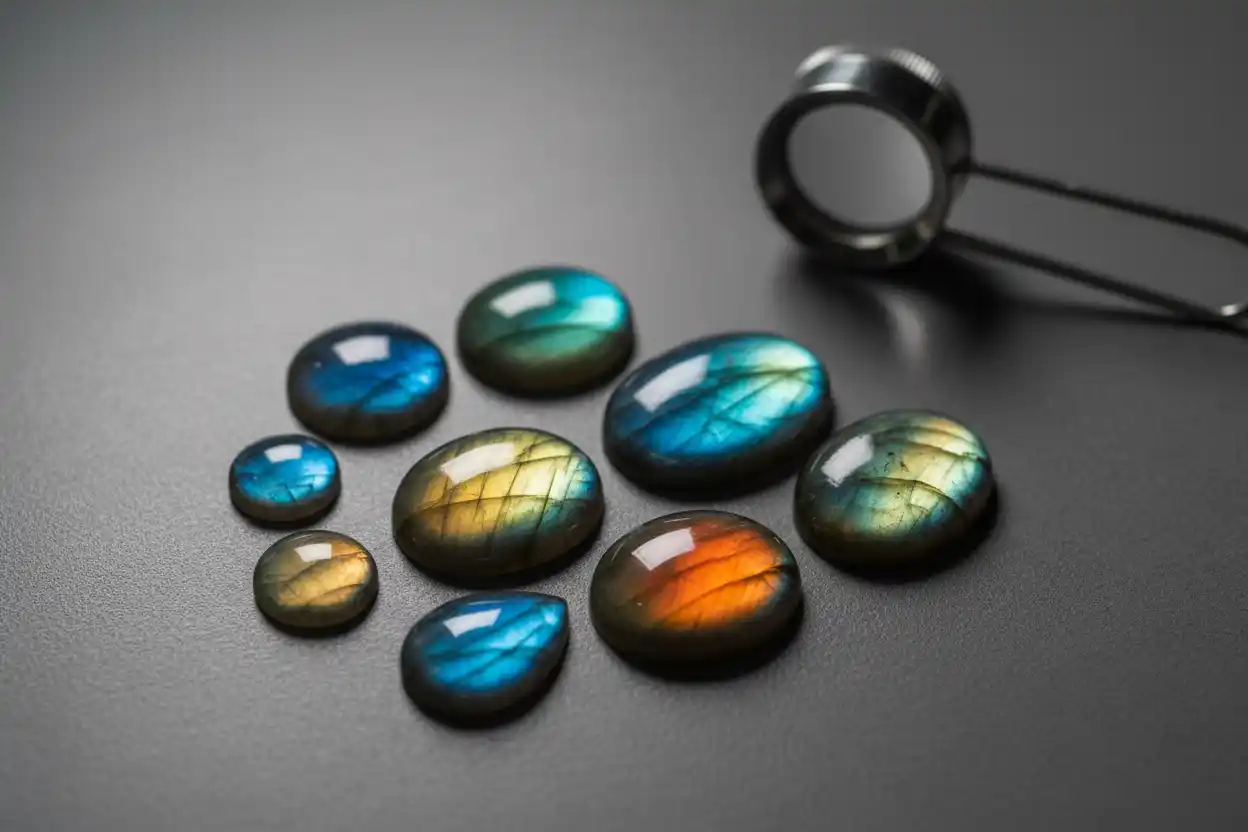
If you want to buy labradorite, judge the strength, color, coverage, and viewing angle of its labradorescence before focusing on size or seller grades. Good labradorite should produce a strong moving flash when the stone is tilted under light, while weaker pieces may show only small patches of blue or green from a narrow angle. Cut orientation is especially important because the optical effect depends on how the internal layers meet the polished surface.
Labradorite is usually affordable. Current specialist retail listings for loose stones commonly work out to roughly $1 to $2.50 per carat, while general market guidance places ordinary multicolor labradorite around approximately $0.50 to $4 per carat. Exceptional flash, full-color coverage, uncommon red or orange components, Finnish spectrolite, precision cutting, or finished jewelry can cost more. Buyers should therefore judge visible quality before assuming that a large stone or an AAA label deserves a premium.
What Makes Labradorite Different
Labradorite is a plagioclase feldspar best known for labradorescence, the broad flashes of spectral color that appear as the stone moves. Blue and green are common, while gold, orange, violet, and multicolor displays can also occur. GIA explains that this optical effect comes from interference involving extremely thin internal layers created as the feldspar forms and cools.
The flash is directional. A stone can look spectacular from one angle and almost gray from another. That characteristic is not automatically a defect. It is a normal part of the gem’s optical behavior. The question is how easily the flash appears during ordinary movement and how much of the face it covers.
This is why online photographs need careful interpretation. A seller may rotate the stone until the strongest possible flash fills the photograph. That image can be accurate while still failing to show what the labradorite looks like from less favorable angles. Video is therefore especially useful when buying online.
Current Labradorite Price Examples
Current specialist listings show that ordinary loose labradorite remains inexpensive even at substantial carat weights. The following examples provide realistic retail reference points rather than fixed values.
| Current loose labradorite example | Weight | Asking price | Approx. price per carat |
|---|---|---|---|
| Multicolor round, translucent | 2.47 ct | $2.68 | $1.09 |
| Multicolor baguette, transparent | 1.79 ct | $3.93 | $2.20 |
| Multicolor pear, translucent | 3.66 ct | $8.10 | $2.21 |
| Multicolor round pair | 4.97 ct total | $12.08 | $2.43 |
| Multicolor marquise | 9.70 ct | $21.45 | $2.21 |
| Multicolor round | 30.85 ct | $40.22 | $1.30 |
| Multicolor pear | 40.89 ct | $44.80 | $1.10 |
| Multicolor round pair | 64.36 ct total | $118.59 | $1.84 |
These examples fit within the current general labradorite price range seen for standard dark-background stones with visible color flash. Individual sellers can ask substantially more for exceptional specimens, custom cuts, rare color combinations, or jewelry.
The labradorite price per carat also does not automatically rise with size. A 30-carat piece may cost less per carat than a carefully selected 4-carat stone if the smaller gem has stronger flash, better polish, and more attractive orientation.
Flash Coverage Matters More Than Carat Weight
A large labradorite with weak flash can be less desirable than a much smaller stone that lights up across most of its face. When comparing stones, move them through several angles and watch how quickly the color appears.
Full-face coverage generally attracts more attention than an isolated strip or small patch. A strong blue flash is popular and widely available, while combinations involving blue, green, gold, orange, violet, and red can command higher asking prices when the colors are bright and well distributed.
The best stone does not need to remain colorful from every possible direction. Labradorite is inherently directional. What matters is whether its strongest display appears naturally when the gem is viewed or worn rather than requiring an awkward, extremely precise angle.
Cut Orientation Can Make or Break the Stone
Labradorite must be oriented carefully during cutting because labradorescence is linked to its internal structure. A cutter who understands the phenomenon can position the polished face to reveal the strongest color. Poor orientation may leave a stone that contains attractive internal layers but shows little visible flash.
Cabochons are especially common because their smooth surface works well with the broad optical effect. Freeform shapes, ovals, pears, rounds, and rectangles are also widely available. Transparent or translucent labradorite may sometimes be faceted, although the classic dark-background stones are usually purchased for their iridescent display rather than conventional brilliance.
The labradorite quality grading should therefore consider flash strength, coverage, color range, viewing angle, cut orientation, surface polish, transparency, condition, and overall appeal together. A seller’s AAA or AAAA label has little meaning unless the actual stone supports it.
Check the Base Color When the Flash Disappears
A strong photograph can make buyers forget that labradorite also has a body appearance when the flash is not visible. Many stones show gray, dark gray, brownish, or nearly black backgrounds. Others may be lighter or more transparent.
Look at both states. A labradorite that appears attractive only in one carefully staged photograph may be less satisfying in daily wear than a stone with a pleasing base appearance and easily visible color movement.
Dark backgrounds often provide strong contrast for vivid blue and green flash. Lighter transparent labradorite can create a different visual style. Neither is automatically superior. The important point is that the seller shows enough views for you to understand what you are buying.
Spectrolite Can Deserve a Premium
Spectrolite is a trade name associated with highly colorful labradorite from Finland. GIA describes Finnish spectrolite as a vivid form capable of displaying strong multicolor labradorescence, often with several spectral colors appearing across the same stone.
Not every labradorite showing several colors should automatically be called Finnish spectrolite. Provenance should be supported if the seller is using locality to justify a premium. A beautiful Madagascar labradorite can still show excellent blue, green, gold, or multicolor flash without being Finnish.
Pay for the stone you can evaluate. Origin can add collector interest, but strong labradorescence, careful cutting, and attractive condition remain essential.
Treatments Are Uncommon in Ordinary Labradorite, but They Exist
Standard gray labradorite with classic labradorescence is commonly sold without treatment beyond cutting and polishing. That does not mean every feldspar sold under related trade descriptions should automatically be assumed untreated.
GIA has documented that labradorite and related feldspars can respond to copper diffusion, which can alter body color substantially. Research has examined copper-diffused red labradorite and ways advanced laboratory testing may help identify such treatment.
Dyed products also appear in general online markets. Bright pink, intense artificial red, or unusually uniform colors deserve questions about treatment. A seller should disclose dye, diffusion, coating, fracture filling, or other alteration when relevant.
For an inexpensive ordinary blue-flash cabochon, extensive laboratory testing may not be economical. For a costly red, green, transparent, or origin-specific feldspar sold with unusual claims, professional identification can become more worthwhile.
Do Not Confuse Labradorite With Similar Feldspar Names
Feldspar naming can be confusing because several gems display optical effects and sellers sometimes use trade terms loosely. Labradorite, moonstone, rainbow moonstone, sunstone, and spectrolite can overlap in retail descriptions even though they are not interchangeable names.
Recent GIA research emphasizes that labradorescence is specifically tied to labradorite’s structure. Spectrolite refers to particularly vivid Finnish labradorite, while many stones sold as rainbow moonstone are actually transparent labradorite.
This does not necessarily make a retail listing deceptive, but it means buyers should understand what species they are purchasing. If exact identity matters, ask the seller rather than relying only on a trade name.
Surface Condition Deserves Close Inspection
Labradorite is not as hard as sapphire or diamond. Common jewelry references place it around 6 to 6.5 on the Mohs scale, so scratches and abrasion are realistic concerns, particularly in rings and bracelets.
Look for chips around edges, scratches across the polished face, pits, open fractures, and dull areas. Natural internal fractures can occur, but damage reaching the surface may weaken a thin cabochon or create future problems in a setting.
Good polish matters because a dull surface reduces the crispness of the flash. Examine close photographs from several angles rather than judging only the strongest color image.
Choose the Right Labradorite for Jewelry
Pendants and earrings are relatively forgiving because they receive fewer hard knocks. Rings and bracelets need more protection, especially if the labradorite has exposed edges or natural fractures.
A bezel setting can provide good edge protection for cabochons, while raised prong settings may leave more of the stone exposed. Large statement stones can work particularly well in pendants because they have enough surface area to display the moving optical effect without enduring constant impact.
If you plan to wear the stone frequently, choose one with sound structure and a clean surface rather than selecting only for maximum color.
Seller Grades Are Not Standardized
Terms such as AAA, AAA+, AAAA, premium, super flash, top grade, and collector grade appear frequently in labradorite listings. They may help a seller organize inventory, but they are not universal gemological grades.
Current marketplace listings demonstrate the problem clearly. Similar-looking cabochons can all be advertised as AAA or AAAA while selling anywhere from below $1 to more than $20 depending on size, seller, photography, and claimed quality.
Use visible criteria instead. Flash brightness, color coverage, attractive color combinations, useful viewing angles, cutting, polish, condition, dimensions, and verified origin provide more information than a letter grade.
Large Discounts Need Context
Labradorite is commonly sold with dramatic sale percentages online. A stone may be advertised as 50, 70, or even 75 percent off. The discount can be genuine within that seller’s pricing history, but it does not prove that the original crossed-out price represented normal market value.
Compare actual selling prices from several retailers. Current specialist inventory shows many ordinary stones around approximately $1 to $2.50 per carat, while general guidance for standard multicolor labradorite places many pieces around $0.50 to $4 per carat.
Exceptional specimens can exceed that range, but a large discount percentage should never replace direct quality comparison.
Ask for Video Before Buying an Expensive Stone
Video is especially important for labradorite because a still photograph captures only one orientation. Ask for a short clip showing the stone moving under neutral light from several directions if the listing does not already provide one.
Watch how much of the surface lights up, whether the color disappears immediately, and whether unattractive fractures or dead areas become visible when the angle changes. Also check whether the seller appears to be using extremely intense directional lighting that creates a stronger effect than you are likely to see indoors.
A trustworthy seller should be comfortable showing the stone beyond its single best angle.
Keep Personal Beliefs Separate From Buying Quality
The labradorite benefits discussed in crystal traditions may include personal associations with reflection, focus, creativity, or protection. These beliefs do not establish commercial grade or market price.
Likewise, claims about labradorite healing properties belong to belief-based wellness traditions rather than established medical treatment. When buying a gemstone, judge value through physical identity, optical performance, cutting, condition, treatment disclosure, provenance, and current market comparison.
FAQs
How much does good labradorite cost?
Standard loose labradorite commonly falls around $0.50 to $4 per carat in current retail guidance. Current specialist examples reviewed here cluster around roughly $1 to $2.50 per carat, although exceptional stones can cost more.
What color flash is most valuable in labradorite?
Bright, extensive flash usually matters more than one particular hue. Blue is highly popular, while strong multicolor displays and vivid orange, red, or full-spectrum combinations can command premiums.
Is blue-flash labradorite rare?
Blue labradorescence is common enough to be widely available. Exceptional brightness, full-face coverage, attractive cutting, and multiple vivid colors can make an individual stone more desirable.
Is spectrolite the same as labradorite?
Spectrolite is a trade name associated with vivid labradorite from Finland. Genuine Finnish provenance can add interest, especially when the stone shows strong multicolor flash.
Is labradorite normally treated?
Ordinary iridescent labradorite is commonly sold without treatment beyond cutting and polishing. However, dye and diffusion are possible in feldspar, so unusual colors deserve disclosure.
What does AAA labradorite mean?
There is no universal AAA grading system for labradorite. Sellers define these labels themselves, so inspect the actual flash, coverage, cut, polish, condition, and dimensions.
Why does my labradorite look gray sometimes?
Labradorescence is directional. The colorful flash appears when the stone and light reach favorable angles, while other viewing positions can reveal mostly the gray or dark body appearance.
Should labradorite have cracks?
Internal fractures can occur naturally, but large surface-reaching cracks may reduce durability. Inspect the edges and polished face carefully before buying.
Is labradorite suitable for a ring?
It can be used in rings, but it requires more care than harder gems. Protective settings and sensible wear reduce the risk of scratches and chips.
Does large labradorite cost much more?
Not necessarily. Large crystals and cabochons are widely available, so flash quality and cutting often affect price more than weight alone.
Conclusion
To buy labradorite successfully, focus first on labradorescence rather than carat weight or seller-created grades. Strong flash, wide color coverage, good orientation, attractive cutting, smooth polish, sound condition, and honest treatment disclosure are the main buying priorities. Current ordinary loose prices are generally modest, so there is little reason to accept weak quality simply because a stone is large or heavily discounted. Compare the actual optical effect from several angles, ask for video when needed, and pay premiums only when the individual stone clearly earns them.