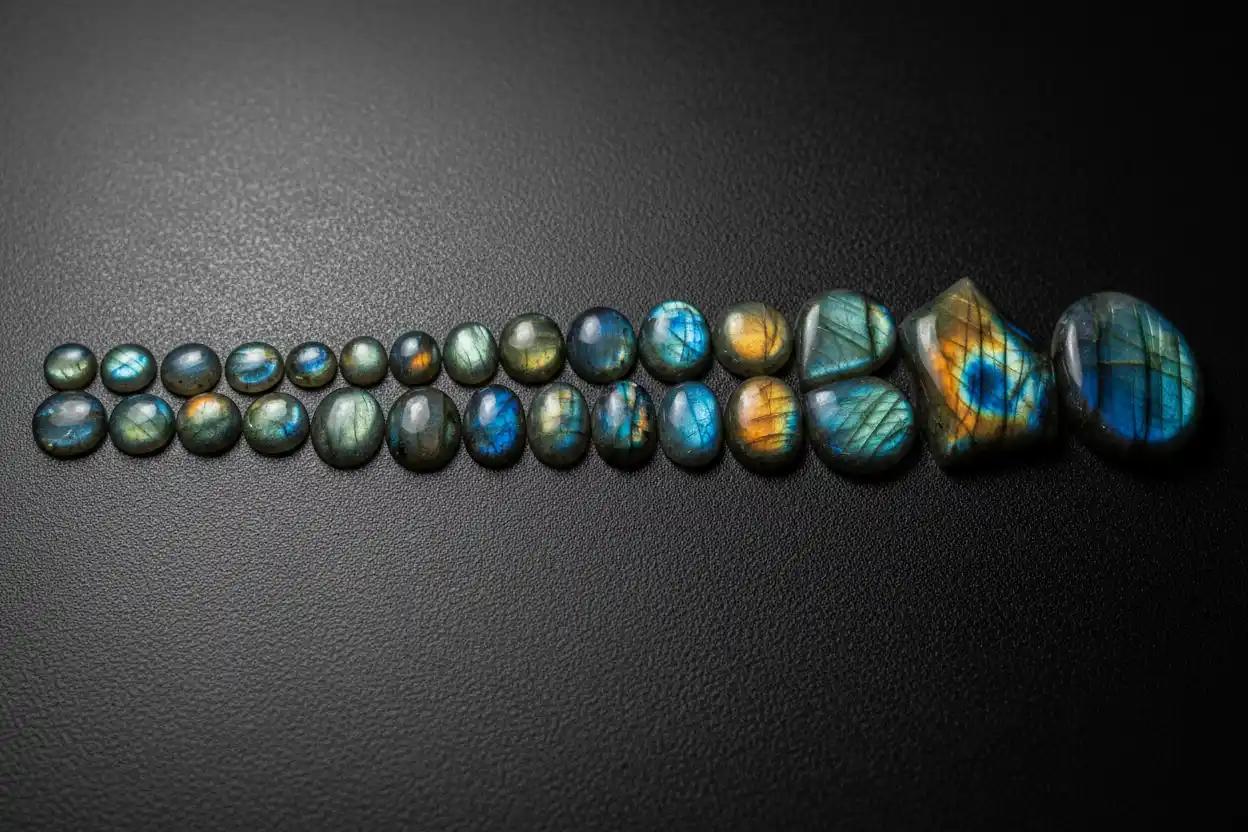
Labradorite Price: Market Value, Authenticity, Rarity & Size
Labradorite price is driven far more by the quality of its optical phenomenon than by carat weight alone. Labradorite is a plagioclase feldspar capable of displaying labradorescence, a broad directional flash created when light interacts with microscopic compositional layers inside the crystal. The phenomenon can appear blue, green, yellow, orange, violet, or multicolored, and the flash can range from a tiny localized patch visible only at one precise angle to an intense sheet of color that seems to sweep across nearly the entire polished face as the stone moves. GIA identifies this internal structural effect as the defining reason phenomenal labradorite can look dramatically different from ordinary gray feldspar.
Because the phenomenon is directional, market value cannot be judged reliably from a single perfectly angled seller photograph. A smaller stone with bright full-face blue or multicolor flash can command stronger demand than a much larger cabochon that remains dull gray through most viewing positions. Bodycolor, flash coverage, brightness, color range, orientation, pattern, cut, polish, fractures, treatment, provenance, and whether the stone qualifies credibly as Finnish spectrolite all refine the final labradorite price. Buyers should first understand these quality checks through the Gems Lore buy labradorite guide before comparing asking prices.
Labradorite Price At a Glance
| Value Factor | What Usually Raises Labradorite Price | What Can Lower Labradorite Price |
|---|---|---|
| Labradorescence | Bright, vivid, clearly visible flash | Weak, dull, difficult-to-find flash |
| Flash Coverage | Broad or near-full-face phenomenon | Small isolated patch |
| Color Range | Vivid blue, green, gold, orange, violet, or attractive multicolor | Muddy, weak, grayish effect |
| Viewing Angle | Flash appears through a useful range of movement | Color appears only at one very narrow angle |
| Bodycolor | Attractive contrast supporting the phenomenon | Bodycolor that overwhelms or dulls the effect |
| Orientation | Cut positioned accurately on the optical plane | Poor orientation that hides strong rough |
| Pattern | Distinctive sweeping, feathered, geometric, or multicolor structure | Disorganized or unattractive distribution |
| Polish | Smooth, crisp reflective surface | Scratches, pits, orange peel, dull polish |
| Fractures | Structurally sound cabochon or carving | Deep cleavage cracks or unstable fractures |
| Size | Larger stone retaining exceptional phenomenon | Added size without stronger flash |
| Spectrolite Provenance | Documented Finnish origin and exceptional effect | Generic multicolor material mislabeled spectrolite |
| Treatment | Natural phenomenon and clear treatment disclosure | Undisclosed diffusion, coating, paint, or other modification |
| Craftsmanship | Precision orientation, custom carving, fine jewelry setting | Mass cutting that ignores optical direction |
| Market Form | Fine gem, matched pair, artist cut, collector specimen | Ordinary decorative material |
| Documentation | Appropriate laboratory identification for unusual high-value material | Unsupported seller grade or locality claim |
Labradorescence Is the Primary Value Driver
A conventional transparent gemstone is often valued by color, clarity, cut, and carat weight, but labradorite requires a different hierarchy because the phenomenon itself is central to desirability. GIA describes labradorescence as a broad flash generated by the stone’s internal layered structure, and modern structural research shows that the darkness of the body can influence where and how that iridescence appears to the observer.
A stone with intense electric-blue flash across most of its surface will usually have stronger jewelry demand than one of equal size showing only a faint patch. The same is true for multicolor examples when their colors remain bright, coordinated, and visible during normal movement.
This is why labradorite price should be compared by phenomenon quality before weight. Two fifty-carat cabochons can belong to completely different value categories when one provides continuous full-face color and the other requires the viewer to search for a small flash.
Flash Coverage Can Matter More Than the Number of Colors
Multicolor labradorite receives considerable attention online, but the mere presence of several colors does not automatically make a stone superior. A tiny isolated rainbow patch on a mostly inactive gray surface can be less desirable than a brilliant blue-green flash that covers the entire face.
Coverage describes how much of the polished surface participates in the optical effect when properly oriented. The strongest examples can appear illuminated across nearly the whole cabochon, while lower-quality material may show only one corner or narrow strip.
A practical buyer should therefore compare brightness, coverage, and movement before counting colors. The phenomenon needs to remain visually compelling as the gem tilts rather than appearing spectacular in one frozen photograph only.
Blue Flash Has Strong Demand but Is Not Automatically the Highest Grade
Blue is perhaps the most familiar labradorite flash because it contrasts dramatically with dark gray bodycolor. Electric blue, turquoise-blue, blue-green, and deep cobalt-like flashes can all attract strong demand when brightness and coverage are excellent.
Gold, orange, green, violet, and broader spectral combinations can also be highly desirable. Fine Finnish spectrolite is particularly associated with broad vivid color displays and strong contrast. GIA identifies spectrolite specifically as a trade name for Finnish labradorite rather than a generic term for every multicolored stone.
The best value decision therefore depends on visual quality rather than a rigid hierarchy stating that one flash color must always cost more than another.
Spectrolite Can Carry a Provenance Premium
Spectrolite is a recognized trade name associated with labradorite from Finland. Fine Finnish material is celebrated for intense spectral flashes against comparatively dark bodycolor, which can make the iridescence appear unusually sharp and surface-oriented. GIA’s modern research contrasts the nearly black bodycolor of Finnish spectrolite with pale transparent rainbow-moonstone-type labradorite, where the iridescence appears deeper inside the stone.
A credible spectrolite premium therefore rests on two separate attributes: strong phenomenon and legitimate Finnish provenance.
A Madagascar or Canadian labradorite can be exceptional and may outperform mediocre Finnish material visually, but it should not be priced using the spectrolite name unless the source claim is supportable.
“Spectrolite Quality” Is Not the Same as Spectrolite Origin
Some sellers use expressions such as spectrolite grade or spectrolite quality for any dark labradorite with many colors. These expressions can describe an aesthetic resemblance, but they should not be confused with actual Finnish provenance.
If the seller charges a meaningful source premium, ask what documentation supports the locality. Mine or dealer records can be useful, while ordinary visual appearance alone cannot prove geographic origin.
The buyer should pay for the quality visible in the stone even when provenance remains uncertain, but source-specific terminology deserves accurate disclosure.
Bodycolor Changes the Appearance of Labradorescence
Bodycolor is not merely background. Modern GIA research shows that dark bodycolor can make the reflected color appear closer to the surface and more strongly contrasted, whereas pale transparent labradorite can produce softer iridescence that seems to float deeper within the material.
This is why dark Finnish spectrolite and transparent rainbow moonstone can both be labradorite yet look dramatically different.
Neither appearance is universally better. Dark material may appeal to buyers who want high-contrast electric flashes, while pale transparent material can suit jewelry designed around softer luminous effects.
Rainbow Moonstone Belongs to the Labradorite Family
The trade term rainbow moonstone can create confusion because the material is generally transparent labradorite rather than traditional moonstone in the strict mineralogical sense. GIA specifically identifies rainbow moonstone as labradorite.
This means transparent pale labradorite showing blue or multicolor internal sheen should not be valued according to the same appearance expectations as dark gray cabochon labradorite.
The two materials share feldspar relationships but target different aesthetic markets. A high-quality rainbow-moonstone-type labradorite can command a strong price because of transparency, blue sheen, clarity, cutting, and jewelry demand even when it lacks the dramatic black-background appearance of spectrolite.
Viewing Angle Is a Major Commercial Quality Factor
A labradorite that displays spectacular color only when tilted forty degrees away from its normal face-up position may be less satisfying in jewelry than one whose flash appears readily while the pendant or ring moves naturally.
This does not make narrow-angle labradorite defective. Labradorescence is inherently directional.
The difference is usability. A broad viewing angle increases the amount of time the wearer and observer actually see the phenomenon, making the gem more visually rewarding and potentially more marketable.
Video should therefore show the stone slowly rotating through multiple axes rather than quickly rocking across the single angle that produces maximum flash.
Cut Orientation Can Create or Destroy Value
Labradorite rough must be oriented relative to the internal lamellae that create the phenomenon. A cutter who locates that plane correctly can produce a cabochon with strong face-up flash, while cutting the same rough from an unfavorable direction may leave the stone visually inactive.
This makes cutting expertise a genuine labradorite price factor. The cutter is not merely shaping the outside of the stone but deciding how its internal optical structure will interact with the viewer.
A non-standard freeform outline may therefore represent excellent cutting when the shape preserves a rare broad flash that would have been lost by forcing the rough into a calibrated oval.
Precision Cutting Can Add a Craftsmanship Premium
Commercial labradorite is abundant enough that inexpensive calibrated cabochons are widely available, but artisan cutting can create a very different product. Precision lapidaries may sacrifice large portions of the rough to center the strongest optical plane, remove fractures, preserve an unusual pattern, create a matched pair, or integrate the flash into a carving.
The finished price can consequently exceed what the raw stone alone would suggest.
This premium should be understood as craftsmanship value rather than mineral rarity.
Pattern Can Create One-of-a-Kind Appeal
Labradorescence can appear as broad sheets, segmented blocks, feathers, waves, flames, arcs, or irregular mosaics depending on the internal structure and the way the stone was oriented.
Pattern has no universal laboratory grading scale, so market demand becomes subjective. A memorable flash resembling an eye, landscape, bird wing, or abstract geometric design can command more from one collector than a technically broader but less distinctive phenomenon.
For unique designer jewelry, the relationship between pattern and setting design can become as important as carat weight.
Size Alone Is a Weak Labradorite Price Indicator
Labradorite can occur in very large masses, so size does not create rarity in the same way it can for transparent emerald, ruby, or alexandrite. Large cabochons, palm stones, slabs, carvings, spheres, and decorative pieces are all common market forms.
A hundred-carat stone with poor flash can therefore be inexpensive, while a twenty-carat cabochon with exceptional full-face color may command more.
Size becomes commercially meaningful when the larger piece retains strong phenomenon, attractive patterning, low fracture content, fine polish, and useful orientation across the full surface.
Large Full-Face Flash Is More Selective Than Large Rough
A large block of ordinary labradorite is not rare, but a large uninterrupted area with exceptionally bright and well-oriented labradorescence is more selective.
The cutter must find rough with consistent internal lamellae across a broad area and then orient it correctly without major fractures interrupting the effect.
This is why large high-quality statement cabochons can carry disproportionately stronger prices than ordinary large decorative material even though labradorite itself is not exceptionally scarce.
Fractures Can Reduce Price Quickly
Feldspar is not as tough as corundum, and cleavage makes it vulnerable to hard impacts. Related GIA care guidance for feldspar moonstone places hardness around 6 to 6.5 and specifically warns that cleavage can allow a sharp blow to break the material.
Labradorite jewelry should therefore be inspected from the side and back as carefully as from the flashing front. Deep cracks, unstable cleavage fractures, chips along the girdle, and fractured drill holes can reduce practical value even when the face-up optical effect remains attractive.
Natural internal lines that are structurally stable should not be confused automatically with dangerous fractures, but significant cracks deserve a discount.
Surface Polish Influences Market Value
A strong optical effect can distract the buyer from a mediocre polish. Rotate the stone until the flash disappears and inspect the surface under reflected light.
Scratches, pits, flat spots, polishing haze, chipped edges, and undercut grains become much easier to see when the dramatic color is not masking them.
Premium cabochons should combine an excellent optical plane with an equally competent surface finish.
Treatment Matters Most in Unusual Transparent Colored Feldspar
Ordinary gray labradorite is valued primarily for naturally occurring labradorescence, but feldspar treatment research shows that some labradorite can be altered substantially. GIA has experimentally applied copper diffusion to nearly colorless or pale labradorite, producing red coloration and demonstrating that the material can accept significant copper through high-temperature treatment.
GIA’s broader treatment guidance also identifies labradorite and andesine as feldspars receptive to copper diffusion and notes that detecting the process can be difficult enough to require qualified laboratories.
This issue is particularly relevant to unusual transparent red, green, or copper-colored feldspar rather than ordinary dark blue-flash cabochons.
Copper Diffusion Should Not Be Assumed in Every Labradorite
The existence of an experimentally demonstrated treatment does not mean that every labradorite on the market is treated. GIA’s 2022 research specifically noted that the researchers were not aware of copper-diffused red labradorite being routinely encountered in the market at the time of the study, even though the experiment proved the treatment feasible.
The appropriate buying response is therefore targeted caution rather than blanket suspicion.
Ordinary gray iridescent labradorite should be evaluated primarily for natural optical quality, while unusually colored transparent feldspar carrying a substantial premium deserves stronger treatment verification.
Paint, Coating, or Backing Should Be Disclosed
Natural labradorescence originates inside the feldspar structure. An added surface pigment, metallic backing, colored resin, foil, or coating creates a different product even if the visual result is attractive.
Artistically modified stones can have legitimate decorative value when sold transparently.
The issue is not whether enhancement is aesthetically acceptable but whether the final appearance is represented accurately.
Labradorite Price Versus Ammolite Price
Labradorite and ammolite can both show dramatic moving spectral colors, but their structures, rarity, durability, treatment, and markets differ substantially. Gems Lore’s buy ammolite guide and ammolite price guide explain why ammolite’s thin iridescent shell layers and stabilization requirements create a separate valuation system.
Labradorite should never receive an ammolite premium merely because both gems display vivid colors.
The comparison is useful aesthetically, not as a direct dollars-per-carat benchmark.
Labradorite Price Versus Black Opal Price
Black opal’s play-of-color arises through ordered silica structures, while labradorescence comes from feldspar lamellae. The Gems Lore buy black opal guide and black opal price guide cover a market where body tone, play-of-color, pattern, brightness, treatment, origin, and rarity can create much higher values.
Labradorite can produce spectacular visual drama without occupying the same geological scarcity market.
A buyer should therefore appreciate phenomenal appearance without assuming similar color automatically means similar financial value.
Retail Jewelry Price Can Be Much Higher Than Loose-Stone Value
Labradorite is widely used by artisan jewelers because every stone can show a unique pattern. A handcrafted sterling-silver, gold, or high-design setting can cost many times more than the loose cabochon.
That price can be entirely reasonable if the craftsmanship, design, metal, finishing, and maker reputation justify it.
Do not calculate the loose labradorite price simply by dividing the completed jewelry price by carat weight.
Resale Value Depends Heavily on Design and Buyer Demand
Ordinary commercial labradorite is widely available, so resale liquidity for loose common-quality stones can be limited.
Fine spectrolite, exceptional full-flash pieces, important artist cuts, matched pairs, documented provenance, or signed jewelry can attract more specialized demand.
Even then, rarity of appearance does not guarantee rapid resale at the original retail price because phenomenal gemstones remain niche products relative to mainstream precious stones.
What Usually Raises Labradorite Price?
Labradorite price generally rises when a stone combines intense labradorescence, broad flash coverage, a useful viewing angle, attractive multicolor or vivid blue-green display, skilled orientation, smooth polish, limited fractures, memorable patterning, larger size with phenomenon maintained, documented Finnish spectrolite provenance where claimed, fine craftsmanship, or distinctive artist cutting.
The strongest pieces are visually compelling through normal movement rather than only when perfectly positioned for photography.
What Usually Lowers Labradorite Price?
Weak or dull flash, extremely narrow viewing angle, patchy coverage, excessive fractures, poor orientation, heavy scratches, weak polish, hidden treatment, unsupported spectrolite claims, painted or coated surfaces represented as natural, or large size without exceptional optical quality can all reduce value.
A low-priced labradorite can still be an excellent purchase when the appearance is attractive and the limitations are honestly represented.
How to Compare Labradorite Prices Fairly
Compare labradorite by phenomenon type, flash brightness, coverage, color range, viewing angle, pattern, bodycolor, cut orientation, size, dimensions, polish, structural condition, treatment, provenance, loose-versus-mounted status, and craftsmanship. A Finnish spectrolite cabochon, transparent rainbow-moonstone-type labradorite, common blue-flash Madagascar cabochon, and unusual transparent red feldspar should not be averaged together as though one universal labradorite price applies.
Conclusion
Labradorite price is primarily a price for optical quality rather than simple mineral weight. GIA shows that labradorescence results from internal feldspar structures that selectively return broad flashes of color, while bodycolor and lamellar structure influence whether those colors appear sharp at the surface or softer from deeper within the gem.
The most valuable conventional material combines strong brightness, broad coverage, attractive color, skilled orientation, useful viewing angle, fine polish, and limited structural damage. Finnish spectrolite can receive a provenance premium when the source is documented, but not every multicolored labradorite qualifies for that trade name. Treatment concerns should also remain proportional: ordinary iridescent cabochons are valued for natural structural color, while unusual transparent colored feldspar may warrant testing because copper diffusion of labradorite is technically possible and has been demonstrated experimentally.
The strongest valuation therefore ignores simplistic size charts and asks how often the stone flashes, how much of its surface participates, how bright the colors are, how well the cutter oriented the rough, and whether treatment or provenance claims are adequately supported.
Frequently Asked Questions
How much is labradorite worth per carat?
There is no universal labradorite price per carat because flash brightness, coverage, viewing angle, pattern, color range, polish, fractures, provenance, craftsmanship, and stone form vary dramatically. Carat weight becomes useful only after those qualities are reasonably comparable.
What makes expensive labradorite different from cheap labradorite?
Premium material generally shows stronger labradorescence, wider coverage, a more useful viewing angle, attractive color or pattern, better polish, fewer damaging fractures, and more skillful orientation. Ordinary large pieces can remain inexpensive when the flash is weak.
Is blue labradorite more valuable than multicolor labradorite?
Not automatically. Vivid full-face blue can be highly desirable, while strong multicolor material can also command a premium. Brightness, coverage, pattern, and viewing angle matter more than simply counting colors.
What is spectrolite?
Spectrolite is the trade name for Finnish labradorite, especially material known for vivid broad spectral flashes and dark contrasting bodycolor.
Is all rainbow labradorite spectrolite?
No. Labradorite from several countries can display multiple colors. Spectrolite properly refers to Finnish material.
Does large labradorite automatically cost more?
No. Labradorite can occur in large masses. Size creates a stronger premium only when excellent phenomenon, pattern, polish, and structural quality continue across the larger piece.
Is rainbow moonstone actually labradorite?
Yes. GIA identifies commercial rainbow moonstone as transparent labradorite rather than traditional moonstone in the strict mineralogical sense.
Can labradorite be treated?
Yes. GIA has demonstrated copper diffusion in labradorite feldspar, which can change pale material to red and related colors. Treatment concerns are especially relevant to unusual transparent colored feldspar.
Is natural blue flash caused by a coating?
No. Natural labradorescence comes from light interacting with microscopic internal feldspar layers.
Is labradorite good for everyday rings?
It can be worn in rings, but feldspar has cleavage and lower hardness than sapphire or diamond. Protective settings and sensible wear are advisable, while pendants and earrings generally expose the stone to less impact.
Does AAA labradorite have an official meaning?
No universal laboratory AAA scale exists for labradorite. The actual flash brightness, coverage, viewing angle, polish, fractures, treatment, size, and provenance are more useful.
Is labradorite a guaranteed investment?
No. Exceptional spectrolite, artist-cut material, or unusually fine full-flash stones can attract collectors, but future value depends on quality, fashion, condition, provenance, treatment, craftsmanship, and market liquidity.