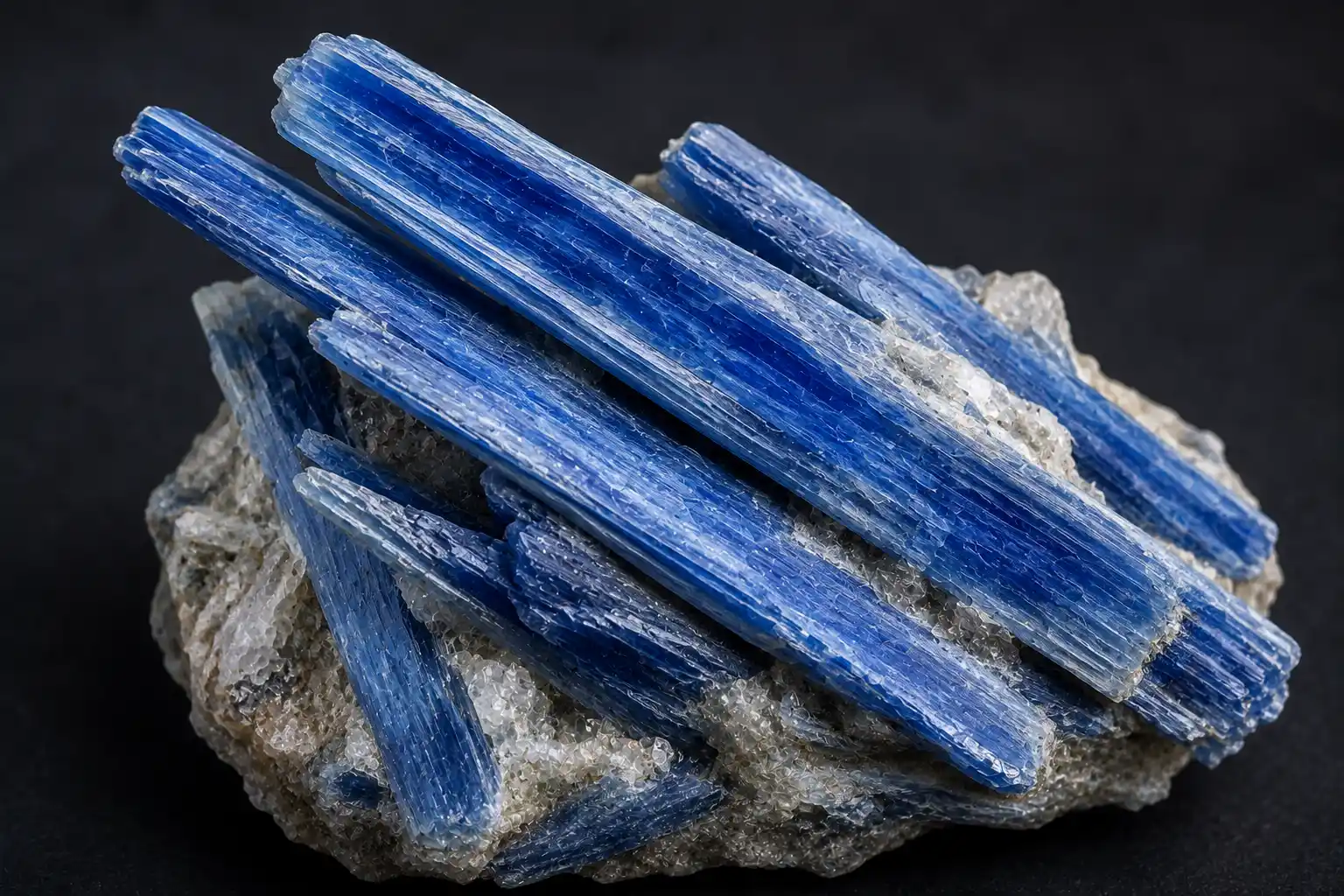
Kyanite Meaning: Formation, Recognizable Traits & Recorded Lore
Kyanite meaning begins with a mineralogical fact that makes the material unusually easy to misunderstand: kyanite is the triclinic aluminum silicate Al₂SiO₅, one of three major polymorphs sharing that chemistry with andalusite and sillimanite. The three minerals have the same overall chemical formula but different crystal structures, so their stability, density, habit, optical properties, and geological significance differ. USGS describes kyanite, andalusite, and sillimanite as anhydrous aluminosilicates with identical chemistry but different structures and physical properties, while Mindat identifies kyanite specifically as the triclinic polymorph.
Kyanite is especially recognizable because its hardness is strongly directional. Reference data place it near Mohs 5.5 when tested parallel to its long crystallographic direction and around Mohs 7 in another principal direction. That means one crystal can resist scratching very differently depending on which way the test is performed—a far more unusual behavior than the small directional hardness differences found in most minerals. Mindat also records perfect cleavage on one plane, good cleavage on another, brittle tenacity, and measured density of approximately 3.53–3.67.
Blue is the color most strongly associated with the species, but kyanite is not defined by blue alone. White, gray, green, yellow, orange, and pink material is documented. Iron-related electronic interactions are central to much blue kyanite, while modern analytical work also shows contributions from titanium and chromium in some material; orange kyanite has been associated with manganese.
Modern crystal literature often adds another layer, describing kyanite as a stone of alignment, calmness, communication, balance, or mental clarity. Those ideas belong to contemporary symbolism. They should not be confused with the measurable effects of aluminum-silicate crystal structure, metamorphic pressure, iron-related color, cleavage, or directional hardness. This page keeps those evidence categories separate within the broader Healing Crystal collection.
Kyanite at a Glance
| Feature | Evidence-based description |
|---|---|
| Mineral | Kyanite |
| Formula | Al₂SiO₅ |
| Mineral class | Aluminosilicate |
| Crystal system | Triclinic |
| Polymorphs | Andalusite and sillimanite |
| Typical habit | Bladed, tabular, elongated, sometimes bent or radiating |
| Most familiar color | Blue |
| Other documented colors | White, gray, green, yellow, orange, pink |
| Luster | Vitreous to sub-vitreous; cleavage faces may appear pearly |
| Transparency | Transparent to translucent |
| Hardness | Strongly directional, approximately 5.5 to 7 |
| Cleavage | Perfect on one major plane; good on another |
| Tenacity | Brittle |
| Specific gravity | Approximately 3.53–3.67 |
| Gem optical character | Biaxial negative |
| Typical blue-gem RI | Common gem material falls around the low 1.71–1.73 range, with compositional variation |
| Important geological setting | Aluminum-rich metamorphic rocks, especially relatively high-pressure assemblages |
| Geological significance | Useful metamorphic indicator mineral |
| Industrial significance | Source mineral for high-alumina refractory products |
| Proven healing effect | None established |
| Main ownership concern | Cleavage, brittleness, directional hardness, and specimen-specific fractures |
What Kyanite Actually Is
Kyanite is a defined mineral species, not a rock, trade-name mixture, or blue variety of another silicate. Its Al₂SiO₅ composition is shared with andalusite and sillimanite, making the three minerals a classic example of polymorphism: identical bulk chemistry arranged into different crystal structures.
That distinction makes kyanite geologically important. Different Al₂SiO₅ structures become stable under different combinations of pressure and temperature, so identifying kyanite in a metamorphic rock can help geologists reconstruct the conditions the rock experienced. In simplified terms, kyanite is characteristically associated with higher-pressure metamorphic conditions than andalusite, while sillimanite becomes important at higher temperatures. The actual stability boundaries are quantitative phase equilibria rather than a three-word rule, and experimental studies have refined those boundaries considerably.
A crystal therefore carries two identities at once: as an attractive blue mineral specimen or occasional gemstone, and as a record of metamorphic conditions inside Earth’s crust.
That is a more defensible foundation for kyanite meaning than describing it first as an “energy stone.”
Kyanite Identity Table
| Observation or claim | Evidence-based interpretation | Diagnostic value |
|---|---|---|
| Al₂SiO₅ chemistry | Required species chemistry | Strong |
| Triclinic structure | Characteristic of kyanite | Strong |
| Bladed habit | Very common | Useful |
| Blue color | Very common | Weak by itself |
| Directional hardness | Highly characteristic | Strong when correctly observed |
| Perfect cleavage | Characteristic | Strong supporting clue |
| SG around 3.5–3.7 | Compatible | Useful |
| RI around 1.71–1.73 in many faceted stones | Compatible | Strong gemological evidence |
| Biaxial negative behavior | Characteristic | Strong |
| Blue/colorless pleochroism | Documented in gem material | Useful |
| Parallel growth tubes | Documented in some stones | Supporting, not universal |
| Metamorphic host rock | Highly consistent | Strong geological context |
| “Every blue blade is kyanite” | Incorrect | Other blue minerals can resemble it |
| “Hardness is 7 everywhere” | Incorrect | Kyanite is strongly anisotropic |
| “Kyanite never needs care because it is hard” | Incorrect | Cleavage and brittleness remain important |
| “Blue kyanite scientifically creates calm” | Unsupported | Symbolic claim rather than measured property |
The Unusual Hardness of Kyanite
Kyanite’s directional hardness is one of the most useful facts for understanding the mineral. Mindat records approximately Mohs 5.5 parallel to [001] and about 7 parallel to [100]. Educational mineral-testing references describe the same pronounced anisotropy and identify kyanite as one of the best-known minerals for demonstrating that hardness is not necessarily identical in every crystal direction.
The reason lies in crystal bonding. Scratch resistance depends partly on how strongly atomic bonds resist disruption along the tested direction. Because kyanite’s triclinic structure is strongly anisotropic, those bonding relationships are not mechanically equivalent in every direction.
This does not mean a valuable crystal should be scratched lengthwise and crosswise to prove authenticity. Hardness testing is destructive. On a collectible specimen or faceted gem, refractive index, density, optical examination, microscopy, and Raman spectroscopy can provide stronger evidence without intentionally leaving scars.
The directional hardness also complicates polishing. A surface can respond differently when the polishing direction changes relative to the crystal structure, which is one reason detailed lapidary issues belong in Kyanite cutting, orientation, and polish rather than being reduced to one Mohs number.
How Kyanite Forms
Kyanite is principally a metamorphic mineral. It develops in aluminum-rich rocks that undergo sufficient pressure and temperature for new metamorphic mineral assemblages to become stable. USGS descriptions of kyanite deposits document the mineral in micaceous schists and gneisses, quartz-rich metamorphic rocks, quartz veins, pegmatitic bodies associated with metamorphic terrains, and secondary placer concentrations produced after erosion.
Many kyanite-bearing schists and gneisses began as aluminum-rich sedimentary material. During burial, deformation, and metamorphism, clay-rich components recrystallized into assemblages containing mica, garnet, staurolite, kyanite, quartz, and other minerals depending on bulk chemistry and metamorphic grade. USGS work on major southeastern deposits specifically interprets much kyanite and sillimanite in schists and gneisses as products of metamorphism of aluminous sedimentary rocks.
Because the Al₂SiO₅ polymorphs respond strongly to pressure-temperature conditions, their presence and textural relationships can help metamorphic petrologists reconstruct geological histories. A rock containing kyanite that is partly replaced by sillimanite, for example, may record a different metamorphic path from one containing andalusite replacing kyanite.
The precise stability fields, reaction textures, metamorphic facies, quartz-vein relationships, and deposit-scale processes belong in Kyanite formation and deposit geology.
Why Kyanite Is Usually Blue
Kyanite’s familiar blue is related to trace-element and electronic processes rather than to the Al₂SiO₅ formula alone. Pure major-element chemistry does not require strong blue coloration; this is demonstrated directly by white and colorless kyanite.
Mindat summarizes blue coloration as iron-related charge transfer and also reports more recent analytical evidence showing that Fe²⁺, Fe³⁺, and Ti⁴⁺ influence blue kyanite color, with iron having a particularly important effect on hue and chroma. Chromium can contribute in some material as well.
This means the statement “iron makes kyanite blue” is useful as a first approximation but incomplete as a universal explanation. Actual body color can depend on oxidation state, trace-element combinations, concentrations, crystal orientation, zoning, thickness, and optical path length.
The dedicated Kyanite color meaning page separates physical color causes from the symbolic interpretations people attach to blue, green, orange, black, and other varieties, while Kyanite optical properties and color behavior owns the detailed discussion of pleochroism, refractive behavior, absorption, and viewing direction.
Kyanite Can Be More Than Blue
Color variation matters because commercial naming sometimes treats non-blue material as though it were an unrelated stone. Mindat records white, light gray, green, yellow, orange, and pink in addition to blue. Orange coloration has been associated with Mn³⁺, while chromium and iron-related processes can influence other hues.
Green kyanite may overlap visually with several other silicates, while orange material can be striking enough that a buyer unfamiliar with the species may not recognize it as kyanite at all.
Color should therefore be treated as one observation rather than a species definition.
Pleochroism and Directional Appearance
Transparent blue kyanite commonly displays pleochroism, often shifting between blue and paler, grayish, or near-colorless appearances as the crystal or gemstone is rotated. A documented GIA specimen from Zimbabwe showed colorless-to-blue pleochroism, RI values around 1.710 and 1.723, birefringence of 0.013, and specific gravity of 3.81 for that particular sample. A Nepal specimen recorded by the same collection showed gray-to-blue pleochroism with RI around 1.718–1.730.
These are specimen-level measurements rather than one fixed number for every kyanite. Natural chemical variation, orientation, and measurement conditions produce ranges.
Pleochroism also explains why a single blue stone may look richer in one photograph than another even when neither image has been edited. A buyer comparing stones online should therefore prefer several orientations under one controlled light source rather than treating one saturated still photograph as the complete color record.
Original Claim Audit: Repeated Kyanite Statements Tested
| Common claim | Evidence status | More defensible interpretation |
|---|---|---|
| “Kyanite is a blue mineral.” | Usually true but incomplete | Blue is common, but several other colors occur |
| “Kyanite has one hardness of 7.” | Incorrect | Hardness varies strongly with direction |
| “Kyanite and sillimanite are chemically different.” | Incorrect | They share Al₂SiO₅ chemistry but have different structures |
| “Kyanite is high-pressure metamorphic.” | Broadly supported | Exact stability depends on pressure, temperature, and assemblage |
| “Every blade-shaped blue crystal is kyanite.” | Incorrect | Habit and color require confirmation |
| “Kyanite never breaks because one direction reaches Mohs 7.” | Incorrect | It is brittle and cleaves readily |
| “Blue color proves one specific locality.” | Incorrect | Blue material occurs worldwide |
| “All blue color comes from one iron ion.” | Oversimplified | Multiple iron states plus Ti and sometimes Cr contribute |
| “Orange kyanite is dyed blue kyanite altered by treatment.” | Unsupported as a general statement | Natural orange material is documented |
| “A quartz matrix proves natural kyanite.” | Incorrect | Matrix context helps but does not replace identification |
| “Kyanite permanently aligns the body.” | Unsupported medical/metaphysical claim | Alignment is modern symbolism |
| “Kyanite never needs cleansing because it stores no negative energy.” | Metaphysical claim | No mineralogical test measures stored emotional energy |
| “Kyanite treats anxiety or neurological problems.” | Unsupported medical claim | No established clinical mechanism |
| “High-pressure formation means stronger energy.” | Unsupported | Metamorphic pressure is geological, not therapeutic evidence |
| “All traditions historically used kyanite for communication.” | Unsupported generalization | Modern symbolism should not be projected backward without evidence |
The claim audit is important because kyanite’s unusual physical behavior often becomes mixed with symbolic language. Directional hardness, cleavage, and polymorphism are measurable. Emotional “alignment” is not another gemological property.
Original Specimen and Photo Checklist
A useful kyanite record should capture material evidence before assigning quality, locality, or symbolism.
| Observation | What to record | Why it matters |
|---|---|---|
| Overall color | Blue, gray-blue, green, white, orange, other | Avoids assuming all kyanite is blue |
| Color zoning | Uniform, streaky, patchy, edge-concentrated | Commonly affects appearance |
| Crystal habit | Blade, tabular crystal, radiating group, massive aggregate | Strong visual evidence |
| Dimensions | Length, width, thickness | Kyanite blades can appear much larger in macro photos |
| Transparency | Transparent, translucent, opaque zones | Useful gem/specimen distinction |
| Luster | Vitreous, pearly on cleavage, dull/weathered | Helps characterize surfaces |
| Cleavage | Existing flat breaks or stepped surfaces | Strong mineral clue and condition issue |
| Cross-fractures | Present/absent | Important for durability |
| Bend/twist | Present/absent | Some natural blades are mechanically distorted |
| Matrix | Quartz, mica schist, gneiss, other | Adds geological context |
| Associated minerals | Record rather than infer | Garnet, mica, quartz and others may be informative |
| Pleochroism | Colors visible upon rotation | Strong supporting clue in transparent material |
| RI | Exact measured values | Strong gemological evidence |
| SG | Measurement and method | Helps distinguish look-alikes |
| Hardness | Use only existing data; avoid destructive testing of valuable pieces | Kyanite’s anisotropy is useful but scratch tests cause damage |
| Inclusions | Growth tubes, crystals, fractures, fluid features | Preserve observations without over-identifying them |
| Locality | Documented, inherited label, seller-stated, unknown | Appearance cannot prove origin |
| Photograph conditions | Light source, white balance, orientation | Necessary for accurate blue-color comparison |
The checklist deliberately avoids a points-based authenticity score. Ten weak visual similarities do not equal one reliable refractive-index or Raman result.
Recognizable Diagnostic Traits
The combination of bladed habit, high density, strong anisotropy, cleavage, biaxial optical behavior, and characteristic refractive indices can make kyanite fairly distinctive when enough observations are available.
Mindat records measured SG of roughly 3.53–3.67. GIA’s faceted reference stones illustrate RI values clustered around the low 1.71 to low 1.73 range, while documented stones can vary somewhat with composition.
Microscopy can show parallel growth tubes, healed fractures, mineral inclusions, cleavage-related structures, and color zoning. The Nepal specimen documented by GIA, for example, contained parallel growth tubes extending across the stone.
Those features should not be converted into a rule such as “growth tubes prove kyanite.” The detailed microscopy workflow belongs in the Kyanite microscope inclusion notebook.
Kyanite Versus Its Al₂SiO₅ Polymorphs
Kyanite, andalusite, and sillimanite demonstrate why chemical formula alone cannot define a mineral. All three have Al₂SiO₅ bulk chemistry, yet kyanite is triclinic, andalusite is orthorhombic, and sillimanite is orthorhombic with a different structural arrangement. Their densities, habits, cleavage, optical properties, and geological stability differ.
A laboratory analysis reporting only aluminum, silicon, and oxygen would therefore not be enough to distinguish them. Crystal structure matters.
That same material-versus-origin principle appears in Lab Ruby Meaning: mineral identity and growth origin are separate questions. A laboratory-grown material can share a mineral structure with its natural counterpart, while two naturally occurring materials can share chemistry yet remain distinct species because their structures differ.
Kyanite as a Geological Pressure-Temperature Indicator
Kyanite’s importance extends far beyond jewelry. Because the Al₂SiO₅ polymorphs respond to metamorphic conditions, their coexistence, replacement textures, and relationships with minerals such as garnet, staurolite, mica, quartz, and sillimanite can help reconstruct a rock’s metamorphic evolution.
Older geological summaries often phrase the distinction as high-pressure kyanite, low-pressure andalusite, and higher-temperature sillimanite. This is directionally useful but simplified. Experimental studies define real boundaries between the phases, and those equilibria shift with pressure and temperature rather than behaving as arbitrary labels.
Kyanite can also remain preserved after conditions change, meaning the presence of a crystal does not necessarily prove that the rock is currently at the conditions where that crystal originally grew. Textural interpretation matters.
Documented Naming History
The name kyanite derives from the Greek word associated with blue, reflecting the characteristic color that made the species recognizable to early mineralogists. Mindat records Abraham Gottlob Werner as establishing the name in the late eighteenth century and notes that the spelling “cyanite” remained common in French and older mineralogical literature for a long period afterward.
Old mineral labels reading “cyanite” should therefore not automatically be treated as misidentified specimens. They may preserve an earlier spelling for the same species.
The naming history is documented mineralogy. It is much stronger evidence than claims that every culture historically understood kyanite as a universal stone of communication, energetic alignment, or psychic development.
Kyanite’s Documented Practical Uses
Not all kyanite is collected for beauty. Industrial kyanite is valuable because heating converts Al₂SiO₅ material toward mullite plus silica. Mullite is highly refractory, meaning it remains useful under high-temperature conditions. USGS identifies kyanite-group minerals as raw materials for refractory products used in furnaces, kilns, metallurgical systems, glass manufacture, cement production, and other high-temperature industrial settings.
That industrial use does not mean a gem crystal should be heated experimentally. Industrial calcination uses controlled processing of mineral concentrates at temperatures completely unrelated to normal gemstone ownership.
Gem-quality transparent kyanite represents a much smaller subset of the overall mineral resource.
Kyanite Meaning in Modern Symbolism
Contemporary crystal traditions commonly associate blue kyanite with calm communication, mental organization, honesty, meditation, personal alignment, or clarity. Some systems extend those interpretations to different colors, assigning green material themes of emotional balance, black material themes of grounding, or orange material themes of creativity.
Such associations can function as personal symbolism. A person may use a blade-shaped crystal as a reminder to communicate directly, organize a difficult conversation, or align actions with stated priorities. Those are human uses of an object as a cue or symbol.
They are not measurable properties of Al₂SiO₅.
There is no established evidence that kyanite opens anatomical energy centers, repairs the nervous system, corrects spinal alignment, treats anxiety, improves thyroid function, changes hormone levels, eliminates electromagnetic exposure, or medically balances the body.
Readers comparing contemporary crystal symbolism with historically codified gemstone traditions should keep the distinction clear when consulting the Jyotish Gemstones Guide: cultural or religious gemstone systems deserve accurate description as traditions, not conversion into laboratory-established mineral effects.
The Symbolism Boundary
A geological statement can say kyanite formed during metamorphism of aluminum-rich material and is favored under particular pressure-temperature conditions.
A mineralogical statement can say it is triclinic Al₂SiO₅, has strongly directional hardness, high density, cleavage, and blue coloration influenced by trace elements.
A historical statement can document its mineral name and industrial use.
A symbolic statement can say modern users associate it with alignment, communication, or calmness.
Those categories can coexist without one proving another.
Directional hardness does not mean kyanite “balances opposing energies.” High-pressure formation does not mean it enables people to withstand psychological pressure. Blue color does not establish a sedative effect on the nervous system.
A metaphor may be meaningful precisely because a person consciously chooses it; it does not become stronger by being mislabeled as mineral science.
“Healing Properties” Versus Evidence
The phrase “healing properties” is widespread in crystal commerce, but it should be interpreted carefully. No credible mineralogical measurement demonstrates that wearing or holding kyanite treats a disease, accelerates tissue healing, corrects neurological dysfunction, alters psychiatric illness, or substitutes for evidence-based medical care.
Kyanite’s chemistry also does not make it a nutritional source of aluminum or silicon. An element existing within a stable crystal lattice is not equivalent to a controlled dietary or pharmaceutical dose.
The site’s Disclaimer sets the broader limits around educational mineral and health information.
Safe Ownership
Ordinary handling of a stable intact kyanite specimen is very different from cutting, grinding, drilling, or crushing it. For most collectors, the primary practical concern is mechanical damage rather than chemical exposure.
Kyanite is brittle and cleaves readily. Long thin blades can snap, cleavage faces can separate, and pre-existing fractures can propagate under pressure. A hard knock to a crystal should therefore not be dismissed because one direction reaches Mohs 7.
For jewelry, a protected design is more forgiving than an exposed high-set stone. The engineering consequences of cleavage orientation, prongs, bezel coverage, girdle exposure, and impact frequency belong in Kyanite setting and wear engineering.
For mineral collections, original locality labels, matrix relationships, old collection numbers, repairs, and historic “cyanite” labels can carry scientific value. Storage and documentation are addressed in the Kyanite specimen conservation record.
Cutting and Dust
Kyanite is not usually considered dangerous to handle intact, but lapidary processing creates a different situation. Sawing, grinding, or sanding a specimen can also generate dust from associated quartz or other silicate matrix minerals, so controlled wet methods, ventilation, eye protection, and appropriate workshop hygiene are preferable to uncontrolled dry processing.
Do not intentionally grind kyanite into powder for consumption or place powdered material into drinks for supposed therapeutic effects. Mineral composition does not establish safe ingestion.
Buying Kyanite Without Buying a Story
A buyer should first establish what is being sold: rough mineral specimen, faceting rough, transparent cut kyanite, bead material, matrix specimen, or another blue mineral carrying a kyanite label.
Color photographs should be taken under neutral lighting and ideally from more than one direction because pleochroism can change appearance. For faceted material, RI and SG measurements are much stronger evidence than a seller’s statement that the stone has the “correct kyanite blue.”
Locality should be documented separately. A rich blue color does not prove Nepal, Brazil, Tanzania, or another origin.
Seller selection, provenance questions, return terms, and marketplace screening belong in where to buy Kyanite rather than being folded into this meaning reference.
What a Photograph Can Establish
A photograph can show bladed habit, color zoning, cleavage surfaces, matrix relationships, obvious fractures, transparency, bends, and apparent luster. Multiple orientations can also document pleochroic change.
A photograph cannot measure crystal structure, refractive index, density, or directional hardness. It also cannot determine exact trace-element chemistry or prove locality.
A blue blade in quartz may be consistent with kyanite, but the visual hypothesis should remain provisional when the material is valuable or scientifically significant.
GIA’s documented identification of kyanite inclusions inside quartz illustrates this principle well: morphology suggested possibilities, but Raman spectroscopy established the identity of the blue blades.
When Laboratory Testing Is Appropriate
Routine gemological testing can often identify transparent kyanite through refractive index, optic character, birefringence, density, pleochroism, and microscopy.
Raman spectroscopy can provide species-level structural confirmation when a small inclusion, unusual color, or ambiguous specimen makes visual identification uncertain. The GIA kyanite-in-quartz example demonstrates exactly why spectroscopy is useful when a blue included mineral initially resembles another species.
Mineral chemistry becomes useful when a question concerns color mechanisms or unusual trace-element composition. X-ray diffraction or crystallographic methods can separate Al₂SiO₅ polymorphs directly when necessary.
This page does not claim private laboratory testing, mine visits, unpublished chemical analyses, or first-hand authentication of individual specimens.
Evidence Limits and Site Context
The material-first editorial scope used for mineral references is described on About. General site communication is available through Contact, while the Privacy Policy addresses website data practices; neither replaces specimen-specific mineralogical testing.
Common Kyanite Misunderstandings
The first misconception is that kyanite is simply “a blue crystal.” It is a distinct triclinic Al₂SiO₅ mineral with identifiable physical and geological characteristics.
A second is that kyanite has a single Mohs hardness. Its strong directional hardness is one of the mineral’s defining practical features.
A third misconception is that hardness around 7 means it cannot break. Cleavage and brittleness are separate properties.
A fourth is that blue coloration establishes one mine or country. Blue kyanite occurs across many geological regions.
A fifth assumes all blue color has one simplistic chemical cause. Iron is central, but titanium, chromium, oxidation states, concentration, zoning, and optical orientation can all influence appearance.
A sixth treats kyanite, andalusite, and sillimanite as chemically unrelated. Their chemistry is essentially the same; crystal structure differentiates them.
A seventh turns metamorphic pressure into metaphysical power. Geological pressure records formation conditions, not a therapeutic mechanism.
An eighth converts modern symbolism into ancient universal history. The documented mineral name and recorded geological literature should be separated from recently developed crystal interpretations.
A Practical Evidence Hierarchy for Kyanite
The weakest evidence is a product title saying “natural blue kyanite.”
A scaled neutral-light photograph adds color, habit, matrix, and condition information. A reliable locality label strengthens geological context.
Pleochroism, density, and refractive-index measurements provide much stronger routine gemological evidence.
Microscopy can document growth tubes, fractures, inclusions, cleavage, and zoning.
Raman spectroscopy or diffraction can establish species-level structural identity when uncertainty remains.
Trace-element analysis can then investigate unusual color or composition.
A symbolic statement belongs outside that identification ladder. No amount of repetition of the words “alignment stone” makes alignment a mineralogical test.
Frequently Asked Questions
What is kyanite?
Kyanite is a triclinic aluminum silicate mineral with the formula Al₂SiO₅. It is polymorphous with andalusite and sillimanite, meaning all three share the same overall chemistry but have different crystal structures.
Why is kyanite usually blue?
Iron-related electronic processes are central to blue coloration. Analytical data also show contributions from titanium and, in some material, chromium.
Is kyanite always blue?
No. White, gray, green, yellow, orange, and pink material is also documented.
Why does kyanite have two hardness values?
Its crystal structure is strongly anisotropic, so scratch resistance varies by direction. Reference data give about Mohs 5.5 along one principal direction and around 7 along another.
Is kyanite hard or soft?
Both descriptions can be misleading without direction. It is substantially softer in one crystallographic direction than another and is also brittle with strong cleavage.
What is kyanite’s specific gravity?
Mindat records measured values around 3.53–3.67, although individual gem measurements can vary with composition and testing conditions.
What is the refractive index of kyanite?
Faceted GIA reference examples commonly fall around the low 1.71 to low 1.73 range, with specimen variation. One Zimbabwe specimen measured 1.710–1.723, while one Nepal specimen measured approximately 1.718–1.730.
Does kyanite show pleochroism?
Yes. Blue gem material can show blue, gray, pale, or near-colorless directional appearances. GIA’s documented stones include blue/colorless and blue/gray pleochroism.
Where does kyanite form?
It forms mainly in aluminum-rich metamorphic rocks and is especially associated with relatively high-pressure regional metamorphism. Kyanite also occurs in quartz-rich metamorphic bodies and related veins.
Is kyanite the same as sillimanite?
No. They have the same Al₂SiO₅ composition but different crystal structures and physical properties.
Is kyanite the same as andalusite?
No. Andalusite is another Al₂SiO₅ polymorph with a different structure and stability field.
Why is kyanite important to geologists?
Its stability relative to andalusite and sillimanite helps constrain metamorphic pressure-temperature conditions and reconstruct metamorphic histories.
What does kyanite symbolize?
Modern crystal traditions commonly associate kyanite with alignment, communication, clarity, calmness, or reflection. These are contemporary symbolic interpretations rather than measured physical properties.
Does kyanite have scientifically proven healing properties?
No established scientific evidence shows that holding or wearing kyanite treats disease, alters neurological function, physically aligns the body, or replaces medical care.
Does kyanite need cleansing because of “stored energy”?
There is no mineralogical measurement for accumulated emotional or spiritual energy. Ritual cleansing belongs to personal or cultural practice rather than mineral science.
Is kyanite safe to wear?
It can be used in jewelry, but its cleavage, brittleness, and directional hardness make impact protection important. Lower-impact or protective settings are generally more forgiving.
Can kyanite be scratched easily?
Along its softer direction, yes, compared with the harder cross-direction. Deliberate scratch testing should still be avoided on valuable specimens or gemstones.
Can I identify kyanite by its blue color?
No. Blue is only a preliminary clue. Crystal habit, density, refractive index, pleochroism, cleavage, spectroscopy, and geological context provide stronger evidence.
Is orange kyanite natural?
Natural orange kyanite is documented, and manganese has been associated with its coloration.
What is kyanite used for besides jewelry?
Industrial kyanite is used as a source material for mullite-containing refractory products designed for high-temperature applications such as furnaces and kilns.
Can a photograph prove a specimen is kyanite?
No. A photograph can show compatible habit, color, cleavage, and matrix, but species-level certainty may require gemological measurements or analytical methods such as Raman spectroscopy.