Where to Buy Real Kyanite and Avoid Dyed or Glass Fakes
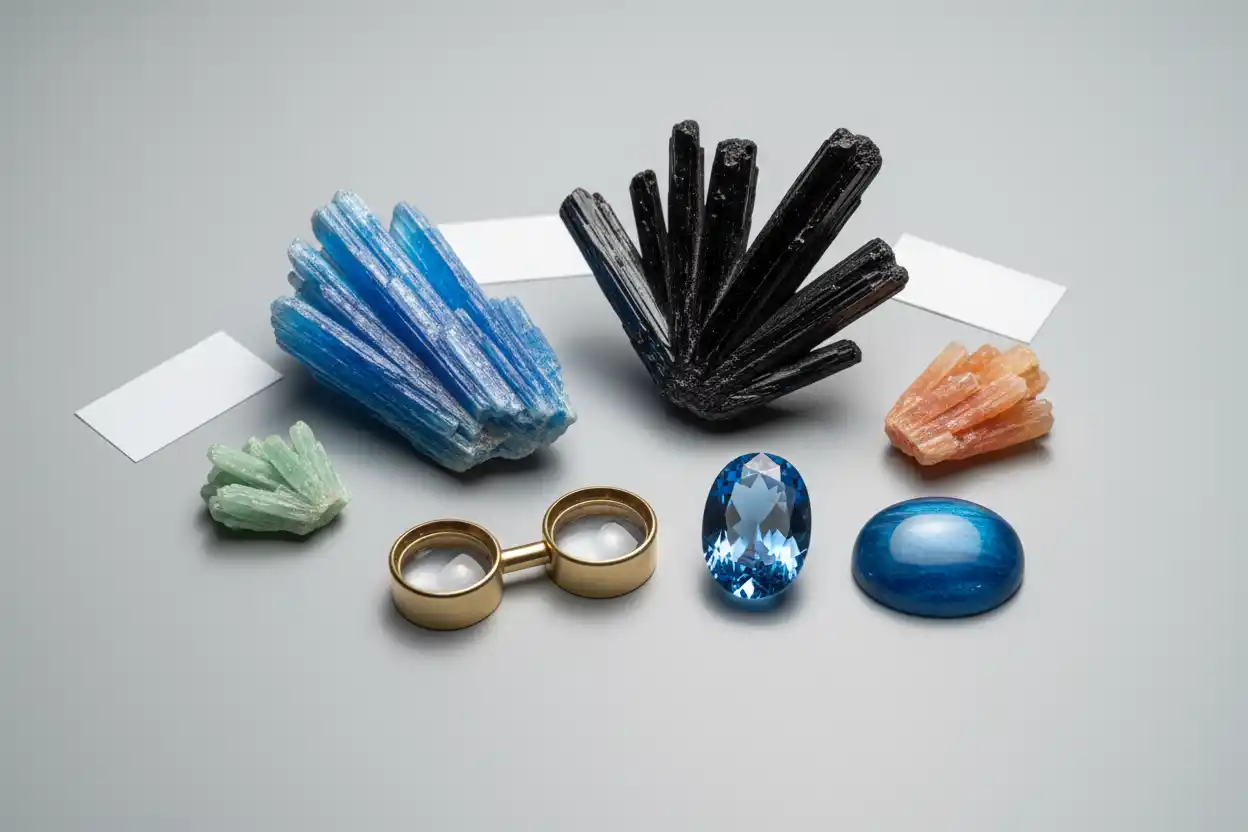
Real Kyanite is an aluminum silicate mineral best known for blue bladed crystals, but it can also appear black, green, orange, gray, white and nearly colorless. It occurs as collector specimens, blade clusters, faceted gems, cabochons, beads and decorative pieces.
The family market is unusually varied. A black fan-shaped cluster should not be evaluated like a transparent blue faceted gem, while an orange crystal may have different color and locality considerations from either one.
Kyanite also has directional hardness and perfect cleavage. These properties make it difficult to cut, drill and set. A stone can resist scratching in one direction yet split or abrade much more readily in another.
The Kyanite meaning and properties guide covers mineral identity and traditional symbolism. This general buying guide focuses on family-wide sellers, construction, treatment and durability while leaving the narrower Black and Blue Kyanite markets to their dedicated guides.
What Kyanite Is
Kyanite has the chemical formula Al2SiO5. It shares that formula with Andalusite and Sillimanite, but the three minerals have different crystal structures and form under different pressure-temperature conditions.
Kyanite is particularly associated with relatively high-pressure metamorphic rocks. It commonly occurs in schist, gneiss, quartz-rich veins, eclogite and related metamorphic environments.
Crystals are often bladed, elongated or tabular. Blue material may show visible color zoning, with darker blue concentrated along the center or selected growth areas.
The types of Kyanite guide explains the major colors and crystal forms. The Kyanite color guide keeps color symbolism separate from identification and buying criteria.
Kyanite Has Directional Hardness
Kyanite was historically called Disthene, a name referring to its two strengths.
Its Mohs hardness varies according to direction. Along the length of a crystal blade, it may test around 4.5 to 5, while across the blade it may approach roughly 6.5 to 7.
This anisotropy complicates polishing. One facet or surface can polish well while an adjacent direction abrades differently.
Hardness does not protect Kyanite from impact. The mineral also has perfect cleavage and brittle tenacity.
The gemstone hardness chart, gemstone cleavage guide and gemstone toughness-versus-hardness guide explain why these three properties must be considered separately.
Choose the Product Form First
| Kyanite product | Best source | Main buying concern |
|---|---|---|
| Blue crystal specimen | Specialist mineral dealer | Color zoning, cleavage, repair and locality |
| Black fan or blade cluster | Mineral dealer | Glued blades, coating and matrix stability |
| Green or orange crystal | Rare-mineral dealer | Correct color identity, treatment and source |
| Faceting rough | Specialist rough dealer | Directional hardness, cleavage and dark zoning |
| Faceted gemstone | Collector-gem dealer | Windowing, chips, orientation and identity |
| Cabochon | Independent cutter | Filler, backing, color zoning and fractures |
| Bead strand | Established supplier | Dye, glass, resin and drill-hole breakage |
| Pendant or earrings | Jeweler familiar with Kyanite | Protective setting and adhesive |
| Ring | Requires specialist setting | Cleavage, abrasion and daily-wear limitations |
| Decorative blade bundle | Mineral retailer | Natural growth versus glued assembly |
A collector should prioritize natural crystal form and condition. A jewelry buyer needs accurate identification, cutting quality and conservative durability advice.
Where to Buy Genuine Kyanite
Specialist mineral dealers
A mineral dealer is the strongest source for natural blades, matrix specimens, fans and unusual colors.
Listings should include dimensions, locality, crystal condition, associated minerals and repair history.
Request photographs of the reverse, blade bases and all terminations. A front view can hide reattached crystals or a reconstructed base.
The dealer should distinguish natural growth from a decorative bundle assembled with glue.
Rare-gem dealers
Transparent faceted Kyanite should come from a seller familiar with cleavable collector gems.
The listing should state weight, dimensions, color, clarity, treatment and geographic origin when known.
Ask for daylight and indoor-light videos. Blue zoning and pleochroism can make the stone look very different according to orientation.
Macro images should show the girdle and facet junctions because small cleavage chips may be difficult to see face-up.
Gem and mineral shows
Shows let you compare Kyanite with Sapphire, Iolite, Tourmaline, glass and dyed quartz.
Rotate a transparent stone beneath neutral light. Blue Kyanite may show directional color and uneven zoning rather than one perfectly uniform body.
Use a loupe to inspect cleavage, blade texture, resin and coatings. Do not scratch the mineral; directional hardness makes a scratch test both damaging and difficult to interpret.
The crystal identification guide explains why habit, optical properties and instrumental testing should support one another.
Lapidary suppliers
Rough sellers should understand Kyanite’s cleavage and anisotropic hardness.
Request videos from several directions. A transparent window may conceal internal cleavage elsewhere.
Ask whether test stones were cut from the same parcel and whether stabilization was necessary.
A heavy piece of rough may produce a much smaller finished gem because cutters must orient around cleavage, color zoning and variable hardness.
Established online stores
The online gemstone buying guide provides general checks for seller identity, payments and returns.
For specimens, request exact-item images and a complete rotation. For faceted gems, ask for neutral-light video and close-ups.
Digital saturation can transform gray-blue Kyanite into Sapphire-like royal blue. Ask whether hue or contrast was edited.
Blue Kyanite
Blue Kyanite is the best-known color and the most important faceted-gem variety.
Natural blue may be pale, denim, cornflower, violet-blue, teal-blue or deep royal blue. Zoning is common, with darker color concentrated along a crystal’s center or in streaks.
The completed guide to buying real Blue Kyanite owns blue-specific Sapphire comparisons, dye concerns, faceted quality and locality issues.
This family page should not duplicate that detailed process. Instead, it establishes that blue color alone is not sufficient; crystal structure, cleavage, directional optical behavior and treatment disclosure also matter.
Black Kyanite
Black Kyanite commonly forms radiating, fan-like or bladed aggregates.
The material may be opaque black, dark gray or brownish black. Individual blades can be thin and fragile, especially near the edges.
The completed guide to buying genuine Black Kyanite covers glued fans, coated blades, Tourmaline confusion and specimen stability.
In the general market, inspect every blade base. A visually dramatic fan may consist of natural blades arranged artificially in resin.
Green Kyanite
Green Kyanite ranges from pale mint and gray-green to richer blue-green or grass-green shades.
Transparent green material is less common than ordinary blue Kyanite and may receive a premium.
A seller should not identify every green bladed mineral as Kyanite. Green Tourmaline, Actinolite, Diopside and other silicates can have similar forms or colors.
Natural color may be uneven and pleochroic. An exceptionally uniform emerald-green stone requires careful identification and treatment disclosure.
Orange Kyanite
Orange Kyanite entered the gem market as an unusual color associated especially with material from Tanzania.
Its color is generally linked to manganese-related structural chemistry rather than the iron-related mechanism responsible for common blue Kyanite.
Orange rough may be included, fractured and strongly zoned. Cut stones are therefore often small.
Bright orange color deserves verification because glass, dyed quartz and other orange gems can imitate its appearance.
White, Gray and Colorless Kyanite
Pale Kyanite can appear white, silvery gray or nearly colorless. Some crystals contain blue concentrated only in narrow zones.
Colorless faceted material is uncommon in mainstream jewelry and can be confused with quartz, Topaz or glass.
Crystal habit, cleavage and optical properties provide better evidence than color.
A seller should not add a rare-color premium merely because a pale stone lacks the familiar blue.
Kyanite Versus Sapphire
Sapphire is corundum with Mohs hardness 9 and no easy cleavage. Kyanite is softer, strongly anisotropic and perfectly cleavable.
Both can show attractive blue color and zoning. A well-cut blue Kyanite may resemble Sapphire in a photograph.
The completed Kyanite-versus-Sapphire guide owns the complete comparison.
A Sapphire-like appearance should not justify Sapphire pricing or durability claims. Refractive index, optic character, specific gravity and spectroscopy separate them readily.
Kyanite Versus Iolite
Iolite can appear violet-blue, gray-blue or deep blue and is strongly pleochroic.
Kyanite and Iolite differ in crystal structure, refractive properties, cleavage and typical inclusion patterns.
A faceted gem may require professional testing because both can show directional blue-gray color.
Iolite generally belongs in a more conventional jewelry market, though it also has cleavage and orientation concerns.
Kyanite Versus Blue Tourmaline
Blue Tourmaline can form elongated prismatic crystals and transparent faceted gems.
Tourmaline commonly has pronounced longitudinal striations and a triangular or rounded triangular cross section. Kyanite often forms flatter blades.
The minerals differ in refractive properties, pleochroism and cleavage.
A seller should not use “Kyanite Tourmaline” unless describing two separate minerals or a verified association.
Kyanite Versus Blue Topaz and Dyed Quartz
Blue Topaz and blue quartz products can imitate transparent Kyanite in faceted form.
Topaz has higher hardness and different cleavage, while quartz lacks Kyanite’s perfect cleavage and directional hardness.
Dyed quartz or glass may show color concentrated in fractures. Kyanite’s natural zoning more commonly follows growth and crystal orientation.
Professional gemological testing avoids destructive confusion.
Glass and Resin Imitations
Blue, green or orange glass can be cut into elongated gems or molded into blade-like decorative forms.
Round bubbles, flow lines, mold seams and abraded facet edges support glass. However, bubble-free glass remains possible.
Resin can imitate black fans, colored blades and tumbled stones. Mold lines, soft scratches and identical repeated shapes suggest polymer.
The fake-crystal buyer’s guide provides broader checks for glass, resin and molded products.
Dyed and Coated Kyanite
No single routine treatment dominates the entire Kyanite market, but individual stones can still be dyed, coated, oiled, filled or backed.
Dye may concentrate along cleavage and fractures, particularly in pale rough or beads.
Coatings can intensify blue, green, black or metallic appearance. Inspect edges and scratched areas for color loss.
Oil or resin can reduce the visibility of cracks and improve the appearance of weak material.
The gemstone treatments guide explains why a natural mineral can still have altered color or clarity.
Glued Blade Clusters
Thin Kyanite blades can be arranged into decorative fans or attached to matrix with glue.
The individual crystals may be genuine even though the current cluster did not grow naturally.
Inspect blade bases for glossy adhesive, smooth resin and repeated spacing. A natural aggregate generally shows intergrowth and matrix relationships rather than every blade entering one uniform polymer socket.
Repaired natural specimens are different from fabricated clusters, but both require disclosure.
How to Evaluate a Crystal Specimen
Crystal habit
Look for credible bladed, tabular or elongated crystals with natural variation.
Color zoning
Blue or green color may vary along the crystal. Zoning can add interest but should match the description.
Cleavage
Inspect flat internal reflections, edge chips and fresh breaks. A crack parallel to cleavage can extend during shipping.
Terminations
Complete natural terminations increase value. Contacted ends are common but should not be presented as damage-free.
Matrix
Quartz, mica, Garnet and other metamorphic minerals may accompany Kyanite. The association should appear geologically coherent.
Repair
Request close-ups of every crystal base and matrix seam.
Locality
Origin affects collector interest but cannot normally be established by appearance alone.
How to Evaluate Faceting Rough
Transparent rough should have enough clean material between cleavage planes to support cutting.
Request dimensions as well as weight. Long thin blades may contain little usable depth.
Strong blue zoning should be positioned so that the finished face shows balanced color. An incorrectly oriented cut can appear pale at one end and dark at the other.
The cutter must manage cleavage, color, pleochroism and different polishing hardnesses simultaneously. Large weight loss is normal.
How to Judge a Faceted Kyanite
Fine faceted stones should show attractive color without excessive darkness, grayness or a large colorless window.
Inspect facet junctions. Abrasion and chips can develop more quickly along softer directions.
A shallow stone may window, while an overly deep gem can become nearly black.
Color zoning can be acceptable when it creates a lively face-up appearance. However, uneven dark bands should affect price.
Buying Cabochons and Beads
Cabochons can use translucent, included or fibrous Kyanite. Ask whether resin or backing supports the stone.
A quality cabochon should have a stable girdle and polish that remains consistent despite directional hardness.
Beads are particularly vulnerable around drill holes. Inspect for radial cracks, dye and filler.
Natural strands may vary in color and blade texture. Perfectly identical beads can indicate glass, resin or extensive treatment.
Buying Kyanite Jewelry
Pendants, earrings and brooches are safer than exposed rings and bracelets.
A protective bezel supports cabochon edges, though setting pressure must remain controlled to avoid cleavage.
Faceted stones should sit low enough to reduce impact. Avoid tension settings and designs that place strong pressure across the girdle.
Daily-wear rings are possible only with careful construction and realistic expectations. Kyanite should not be treated like Sapphire.
Locality and Provenance
Important Kyanite comes from Brazil, Nepal, Tanzania, Kenya, India, Pakistan, the United States and other metamorphic regions.
Nepal is known for notable blue gem material, while Tanzania is associated with orange Kyanite. Brazil supplies a wide range of crystal and lapidary material.
However, country cannot be proven reliably from color alone. A locality premium requires supplier records, mine information or collection labels.
The ethical gemstone sourcing guide provides practical questions about mining, cutting labor and traceability.
Price and Value
Common opaque blades and small specimens are affordable. Transparent, strongly colored faceted material can cost considerably more.
Value factors include:
- Color and saturation
- Transparency
- Pleochroic orientation
- Evenness of zoning
- Crystal form
- Size and cutting yield
- Cleavage and condition
- Cut quality
- Treatment
- Locality and provenance
A large dark blade is not automatically more valuable than a small transparent gem.
Black fan specimens gain value from symmetry and condition, while blue faceted stones are judged more heavily by color, transparency and cutting.
The gemstone pricing guide explains how rarity, yield, treatment and workmanship interact.
Questions to Ask the Seller
Ask which Kyanite color and product form is being sold.
Request the locality and the basis for that information. Confirm dye, coating, oil, resin, fracture filling, backing and glue.
For specimens, ask whether the cluster grew naturally or was assembled. Request front, reverse and crystal-base photographs.
For faceted stones, request neutral-light video, girdle close-ups and gemological identification.
For beads, request drill-hole images. Finally, obtain a return policy that permits magnified examination.
Professional Identification
A gemologist can use refractive index, birefringence, pleochroism, specific gravity and microscopy to identify transparent Kyanite.
Raman spectroscopy and X-ray diffraction confirm crystals and opaque material.
Microscopy may reveal dye-filled cleavage, coatings, resin and glued clusters. Chemical analysis can assist with unusual color mechanisms.
Testing should address the complete seller claim. Confirming Al2SiO5 does not prove a specific country or natural color origin.
Cleaning and Storage
Clean sound untreated Kyanite with a soft dry cloth or a barely damp cloth followed by immediate drying.
Avoid prolonged soaking, steam and ultrasonic cleaning. Vibration and heat can extend cleavage or affect glue and filler.
Store blades and faceted stones separately so their edges cannot strike harder gems.
Remove Kyanite jewelry before exercise, household work or sudden temperature exposure.
The K crystal directory, K gemstone directory, blue gemstones guide and visual gemstone guide provide broader comparisons.
Frequently Asked Questions
1. Is Kyanite always blue?
No. Kyanite also occurs in black, green, orange, gray, white and nearly colorless forms.
2. Why does Kyanite have two hardness values?
Its hardness is directional. It is softer along the length of the crystal blade and harder across it.
3. Is Kyanite the same mineral as Sapphire?
No. Kyanite is Al2SiO5, while Sapphire is corundum, Al2O3. Sapphire is much harder and lacks Kyanite’s easy cleavage.
4. Is Black Kyanite natural?
Yes. Natural Black Kyanite commonly forms bladed or fan-like aggregates, though decorative clusters can be glued together.
5. Can Kyanite be dyed?
Yes. Dye can enter fractures or cleavage in pale or porous material, especially beads and low-grade rough.
6. Can Kyanite contain resin?
Yes. Fractures can be filled, and weak cabochons or carvings may be stabilized.
7. Is orange Kyanite genuine?
Natural orange Kyanite exists and is especially associated with Tanzania. Its unusual color still deserves proper identification.
8. Can glass imitate Kyanite?
Yes. Colored glass can imitate faceted gems, beads and decorative blades.
9. Is Kyanite suitable for everyday rings?
It is risky for daily exposed wear because of cleavage, brittleness and directional abrasion. Protected occasional-wear designs are more realistic.
10. Are all Kyanite fans natural clusters?
No. Some are natural aggregates, while others consist of genuine blades assembled with adhesive.
11. Do ordinary specimens need laboratory reports?
Usually not. Testing is more useful for expensive faceted gems, unusual colors, disputed treatments or high-value locality claims.
12. What is the biggest warning sign in a listing?
Be cautious when a perfectly uniform Sapphire-blue stone or symmetrical black fan has no cleavage, treatment, reverse-view or assembly information.
Buy the Correct Kyanite Form for Its Intended Use
Kyanite is not one uniform blue product. Its family includes fragile black fans, zoned blue blades, rare-colored crystals and difficult-to-cut collector gems.
Choose a seller who understands directional hardness, discloses every repair and keeps the general Kyanite market separate from the completed Black and Blue Kyanite buying pages.
Safety note: Kyanite and associated metamorphic rocks are silicate materials. Cutting, drilling, sanding or grinding may create hazardous mineral dust. Use professional wet methods, effective extraction and appropriate eye and respiratory protection.