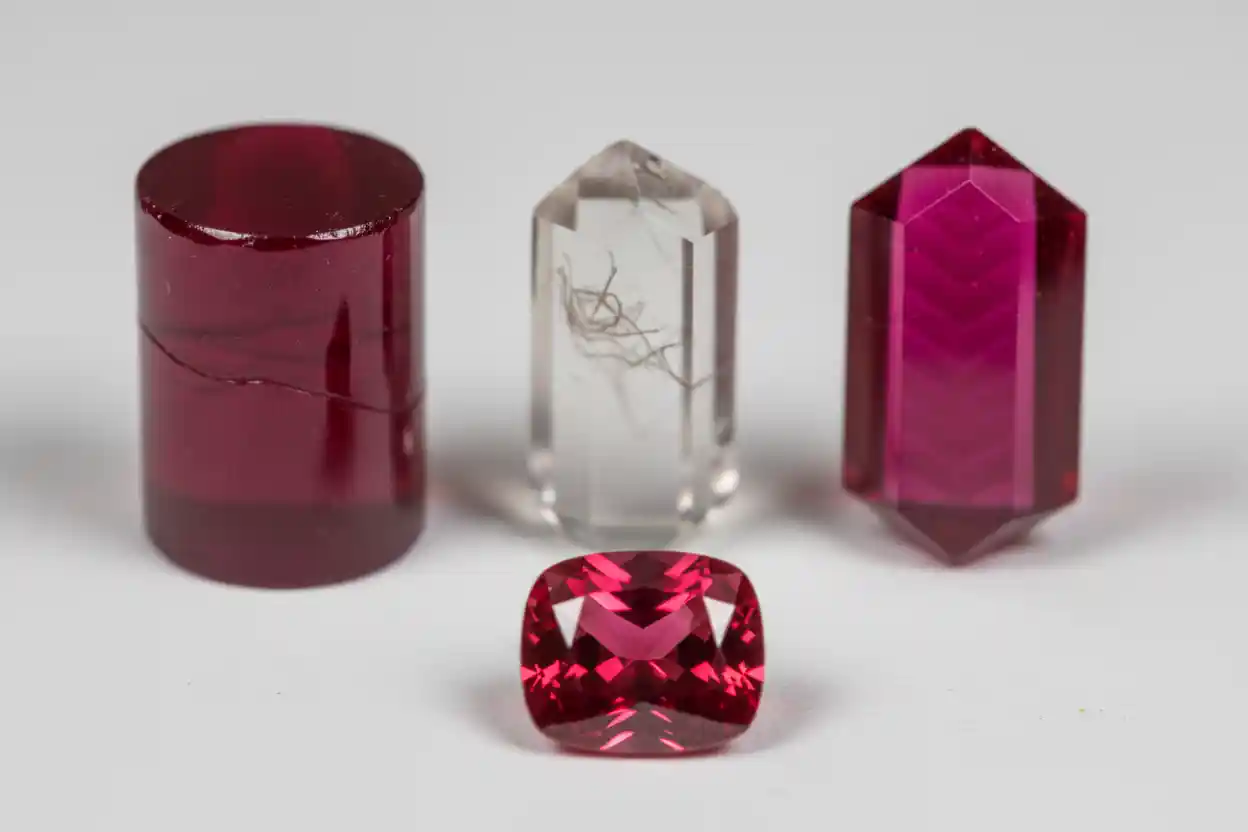
Lab Ruby Meaning: Properties, Uses & Symbolism
Lab ruby meaning begins with material identity rather than metaphysical interpretation. A correctly identified laboratory-grown ruby is ruby material produced through controlled crystal growth instead of geological formation. Ruby is the red variety of corundum, an aluminum oxide mineral with the composition Al₂O₃. GIA records ruby at a refractive index of approximately 1.762–1.770, birefringence of 0.008–0.010, specific gravity near 4.00, and Mohs hardness 9. Chromium incorporated into corundum is responsible for the characteristic red color and can also produce strong red fluorescence.
Laboratory growth changes the stone’s origin but does not turn it into glass, plastic, or an unrelated ruby imitation. Gemological usage distinguishes a synthetic ruby from a simulant: a synthetic ruby possesses essentially the same optical, physical, and chemical properties as ruby, whereas an imitation merely resembles ruby while being made from another substance. FTC guidance likewise requires laboratory-created ruby to be clearly disclosed as laboratory-grown, laboratory-created, synthetic, or equivalent wording and reserves that terminology for products with essentially the same relevant properties as the corresponding mined gemstone.
The distinction matters because laboratory-grown ruby can look convincing enough that appearance alone may not establish origin. Flame-fusion, flux, and hydrothermal methods produce different internal growth evidence, while sophisticated synthetic products may deliberately contain inclusions resembling structures familiar from natural stones. Modern gemological identification therefore combines microscopy, growth patterns, fluorescence, spectroscopy, and trace-element chemistry when routine evidence is insufficient.
Symbolism sits in a separate category. Ruby has a long cultural history associated with ideas such as vitality, status, love, courage, and protection, but laboratory-grown ruby itself is a modern technological product. Contemporary owners may extend older ruby symbolism to laboratory-created material or develop newer associations with intentional creation, engineering, accessibility, or choosing meaning independently from geological rarity. These interpretations can be personally significant without implying that chromium-bearing corundum produces medically measurable emotional or physical effects. This evidence-first distinction guides the wider Healing Crystal collection.
Lab Ruby at a Glance
| Feature | Evidence-based description |
|---|---|
| Material | Ruby |
| Mineral species | Corundum |
| Formula | Al₂O₃ |
| Gem variety requirement | Red corundum |
| Crystal system | Trigonal |
| Origin | Laboratory-grown rather than naturally geological |
| Major synthetic methods | Flame fusion, flux growth, hydrothermal growth; other technical crystal-growth methods also exist |
| Principal color cause | Chromium |
| Typical color | Orangy red through red to purplish red |
| Refractive index | Approximately 1.762–1.770 |
| Birefringence | Approximately 0.008–0.010 |
| Specific gravity | About 4.00 |
| Mohs hardness | 9 |
| Cleavage | None |
| Toughness | Excellent for normal jewelry use when treatment does not introduce weaknesses |
| Optical character | Uniaxial negative |
| Pleochroism | Commonly red/purplish-red directional differences |
| Fluorescence | Often strong red in low-iron synthetic material, but fluorescence alone does not prove laboratory origin |
| Common flame-fusion clues | Curved striae, curved color banding, occasional gas bubbles |
| Common flux clues | Wispy flux residues, fingerprint-like flux structures, growth features |
| Common hydrothermal clues | Chevron-shaped graining, seed-related or hydrothermal growth structures |
| Proven healing effects | None established |
What a Lab Ruby Actually Is
Ruby and sapphire are color varieties of corundum. Pure corundum is colorless; chromium substituting into the crystal structure produces the red required for ruby. GIA notes that greater chromium content can strengthen red coloration and that chromium also contributes to ruby’s characteristic red fluorescence.
A laboratory-grown ruby recreates that corundum structure under engineered conditions. The process can change the shape of the rough, distribution of impurities, zoning, inclusion population, and growth defects without changing the underlying species from corundum to something else.
That creates three useful categories:
Natural ruby: red corundum formed geologically.
Laboratory-grown ruby: red corundum formed through controlled synthesis.
Ruby imitation: another material selected or manufactured to resemble ruby.
The second category is why “fake ruby” is usually an inaccurate description of a properly disclosed synthetic ruby. “Not natural” and “not ruby material” are different statements.
Lab Ruby Identity Table
| Observation or claim | Evidence-based interpretation | Identification value |
|---|---|---|
| Al₂O₃ composition | Corundum chemistry | Fundamental |
| Red color | Required for ruby variety classification | Necessary but not sufficient |
| Chromium spectrum | Supports ruby coloration | Strong material evidence |
| RI around 1.762–1.770 | Compatible with corundum | Strong |
| SG around 4.00 | Compatible with corundum | Strong |
| Mohs 9 | Corundum property | Useful, but destructive testing is unnecessary |
| No cleavage | Characteristic corundum behavior | Supporting |
| Strong red fluorescence | Common in many low-iron rubies | Supporting only |
| Curved striae | Classic flame-fusion evidence | Strong synthetic clue |
| Spherical gas bubbles with curved striae | Strong flame-fusion combination | Strong |
| Wispy flux fingerprints | Supports flux growth | Strong in context |
| Chevron-shaped growth | Characteristic of hydrothermal synthetic ruby | Strong supporting evidence |
| Perfect clarity | Does not prove synthetic origin | Weak |
| Visible inclusions | Do not prove natural origin | Weak |
| Chromium present | Does not establish natural origin | Weak for origin |
| Seller calls it “created ruby” | Commercial claim | Requires disclosure/documentation |
How Flame-Fusion Ruby Grows
Flame fusion, often associated with the Verneuil process, became one of the foundational techniques for producing synthetic corundum. Finely prepared aluminum-oxide feed material containing the required color-causing components is melted in a high-temperature flame. Droplets fall onto a support where the material crystallizes into a characteristic elongated boule.
The process can generate curved growth lines and curved color banding because the crystallization surface develops a rounded geometry during boule growth. Gas bubbles may also become trapped. GIA documents curved striae together with spherical gas bubbles as classic evidence used to identify flame-fusion synthetic ruby.
Those curved structures contrast with many natural corundum growth patterns, which commonly follow straighter or angular crystallographic geometry. The distinction can become particularly obvious under controlled lighting or ultraviolet examination.
Flame-fusion material should not be dismissed as merely an inexpensive imitation. It is synthetic corundum and has played an important technological role because the process can produce useful ruby crystal efficiently and repeatedly.
The detailed mechanics of laboratory synthesis versus geological ruby formation belong in Lab Ruby formation and deposit geology.
Flux-Grown Lab Ruby
Flux growth uses a molten solvent in which the components required for ruby can dissolve and then crystallize gradually under controlled conditions. Growth is typically much slower than flame fusion and can generate crystals whose external appearance and internal structures differ substantially from a Verneuil boule.
Flux-grown ruby is especially important to gemologists because the growth medium can become trapped inside the crystal. Wispy, fingerprint-like, veil-like, granular, or irregular flux residues may therefore occur. GIA has documented synthetic ruby specimens containing clear flux fingerprints as well as more complicated products produced by growing flux synthetic ruby over flame-fusion seed material.
Flux features can sometimes look deceptively similar to healed fractures in natural gemstones. Historical and modern experiments have even produced synthetic ruby with induced fingerprint patterns intended to create a more natural-looking internal scene. This is why one vaguely “natural-looking fingerprint” should not be treated as proof of geological origin.
Hydrothermal Lab Ruby
Hydrothermal synthesis grows crystals from hot aqueous solutions under elevated pressure. The method recreates some broad physical principles found in natural fluid-assisted crystal growth while using engineered equipment, controlled chemistry, and seed material.
Hydrothermal synthetic ruby can display distinctive internal architecture. GIA’s ruby inclusion references identify chevron-shaped graining as diagnostic of the hydrothermal growth method in documented synthetic material.
Seed relationships, angular-to-chevron zoning, tube-like structures, growth layers, and manufacturer-specific chemistry can provide additional evidence.
Hydrothermal ruby illustrates why “synthetic ruby” is not one visually uniform product. A flame-fusion boule, a flux-grown crystal, and a hydrothermal crystal can all be laboratory-grown corundum while preserving very different growth records.
Why Lab Ruby Is Red
Corundum itself does not need to be red. Pure Al₂O₃ is colorless. Ruby color develops primarily because chromium substitutes for a small proportion of aluminum within the lattice. Chromium changes visible-light absorption so the transmitted and reflected appearance shifts into the red range.
Laboratory growers can deliberately introduce chromium into the feedstock or growth environment. Consequently, the presence of chromium does not distinguish natural from synthetic ruby.
Color can range from orangy red through pure red toward purplish red according to chromium concentration, other trace elements, growth chemistry, optical path length, orientation, and treatment. GIA identifies vibrant red to slightly purplish red as the most prized natural-ruby color range, but the same descriptive color space can be produced in laboratory corundum.
The detailed relationship between chromium absorption, iron suppression, pleochroism, fluorescence, spectra, and directional color belongs in Lab Ruby optical properties and color behavior.
Why Lab Ruby Can Fluoresce So Strongly
Chromium can cause ruby to fluoresce red under ultraviolet excitation. Low iron content allows that fluorescence to appear especially strong because iron can suppress or quench the effect.
Laboratory-grown ruby frequently contains relatively little iron unless the growth chemistry intentionally includes it, so strong red fluorescence is common. GIA notes that synthetic rubies often fluoresce more strongly than natural rubies for exactly this reason.
Yet fluorescence cannot prove laboratory origin. Natural low-iron marble-hosted ruby can also fluoresce intensely. GIA specifically warns that some natural rubies can respond strongly enough to overlap synthetic material.
The correct interpretation is:
Strong fluorescence = useful evidence.
Strong fluorescence = not automatic proof of synthesis.
Growth structure, inclusions, spectroscopy, and chemistry need to agree.
Lab Ruby and Lab Sapphire Are Closely Related Materials
Laboratory-grown ruby and laboratory-grown sapphire share the same corundum structure. Their distinction is principally one of color variety and chromophore chemistry rather than an entirely different mineral species.
Ruby requires red corundum, primarily colored by chromium. Sapphire encompasses non-red gem corundum and can involve iron, titanium, chromium, vanadium, or other color-producing mechanisms depending on hue.
This makes Lab Sapphire color meaning a useful adjacent reference for understanding why corundum can display dramatically different colors without ceasing to be the same mineral species.
Diagnostic Traits
Standard gemological testing can establish that an unknown red stone is consistent with corundum. GIA lists ruby’s expected RI at 1.762–1.770, birefringence around 0.008–0.010, SG about 4.00, and Mohs hardness 9.
Those measurements can separate ruby from many red imitations, but they generally do not establish natural versus laboratory origin because synthetic ruby was specifically grown to possess corundum’s properties.
Origin determination moves to another evidence level:
- growth zoning;
- inclusion morphology;
- fluorescence pattern;
- spectroscopy;
- trace-element chemistry;
- seed evidence;
- manufacturer-specific growth features.
Microscopy is therefore particularly valuable. GIA’s synthetic-ruby documentation includes curved flame-fusion striae, flux fingerprint patterns, hydrothermal chevron growth, and complex synthetic products combining more than one artificial growth process.
Detailed inclusion morphology belongs in the Lab Ruby microscope inclusion notebook rather than being converted into a one-feature authenticity rule here.
Original Source-Comparison Table: Lab Ruby Claims Tested
| Common claim | Evidence status | More defensible interpretation |
|---|---|---|
| “Lab ruby is fake ruby.” | Misleading | Proper laboratory-grown ruby is synthetic corundum |
| “Lab ruby is glass.” | Incorrect | Glass is an imitation, not synthetic ruby |
| “Synthetic ruby has different hardness.” | Incorrect as a general rule | Corundum remains Mohs 9 |
| “Lab ruby has no inclusions.” | Incorrect | Synthetic growth can produce abundant diagnostic inclusions |
| “A flawless ruby must be synthetic.” | Incorrect | Natural ruby can occasionally be exceptionally clean |
| “Visible inclusions prove natural ruby.” | Incorrect | Flux and hydrothermal synthetics can be included |
| “Curved striae support flame-fusion growth.” | Supported | One of the classic synthetic-ruby clues |
| “Spherical bubbles plus curved growth support flame fusion.” | Strongly supported | Useful combination |
| “Flux fingerprints always prove natural ruby.” | Incorrect | Flux synthetic ruby can contain fingerprint-like patterns |
| “Chevron growth can indicate hydrothermal synthesis.” | Supported | Documented hydrothermal clue |
| “Strong fluorescence proves synthetic ruby.” | Incorrect | Low-iron natural ruby can fluoresce strongly too |
| “Chromium proves natural ruby.” | Incorrect | Chromium is deliberately introduced into synthetic ruby |
| “Laboratory ruby is always untreated after growth.” | Incorrect | Synthetic material can undergo additional processing |
| “All lab ruby is made by one method.” | Incorrect | Several growth technologies are established |
| “Lab ruby has no historical importance.” | Incorrect | Synthetic ruby became important in technology and gemology |
| “Lab ruby has ancient origin-specific spiritual traditions.” | Unsupported | Laboratory-grown ruby is a modern product category |
| “Ruby’s chromium heals the body through skin contact.” | Unsupported | Crystal chemistry does not establish therapeutic dosing |
| “Lab ruby guarantees passion or relationship success.” | Unsupported | Symbolism is not physical causation |
Original Specimen and Photo Checklist
A useful laboratory-ruby record should separate what is visible from what testing establishes.
| Observation | What to record | Why it matters |
|---|---|---|
| Body color | Orangy red, red, purplish red | Establishes actual hue |
| Tone | Light, medium, dark | Helps describe appearance without marketing language |
| Saturation | Weak, medium, vivid | Useful quality observation |
| Crystal form | Boule, rough crystal, seed-grown crystal, faceted gem | Can suggest manufacturing context |
| Curved striae | Present, absent, uncertain | Important flame-fusion clue |
| Gas bubbles | Shape, distribution, association with growth lines | Useful in flame-fusion material |
| Flux veils | Wispy, granular, fingerprint-like, honeycomb-like | Supports flux-related growth or processing |
| Chevron growth | Present, absent, uncertain | Important hydrothermal clue |
| Seed boundary | Visible, absent, removed, uncertain | Can support synthetic origin |
| Reaction zone | Present/absent | Relevant in overgrowth products |
| Color zoning | Curved, straight, angular, chevron, irregular | Growth geometry matters |
| Fluorescence | Long-wave and short-wave response | Supporting evidence |
| RI | Exact values | Confirms corundum properties |
| SG | Measurement and method | Confirms material identity |
| Pleochroism | Directional colors | Normal ruby optical behavior |
| Spectrum | Chromium-related absorption | Confirms red-corundum color context |
| Trace chemistry | Cr, Fe, Ti, Mo or others if tested | Can aid growth-method/origin analysis |
| Treatment evidence | Filling, diffusion, overgrowth, coating, other | Separate from synthesis |
| Report | Laboratory, report number, conclusion | Strong transaction evidence |
| Photography | Lighting, magnification, white balance | Prevents exaggerated red appearance |
The checklist does not assign an “authenticity percentage.” A curved line, bubble, or fluorescent response gains meaning only when the complete evidence supports the same conclusion.
Some Synthetic Rubies Are Intentionally Difficult to Identify
The history of synthetic ruby includes products designed not merely to grow corundum but to imitate the internal appearance of natural ruby.
GIA has documented flame-fusion synthetic ruby that was fractured and exposed to flux so that new flux-filled fingerprint patterns developed inside the material. Such features could be mistaken for natural healed fractures if the observer focused on the word “fingerprint” instead of examining growth context.
Even more complex material can combine a flame-fusion synthetic core with flux-grown synthetic ruby over it. One documented specimen showed both curved striae and flux fingerprints, together with a growth boundary between the two synthetic components.
Recent laboratory work has likewise documented flux-grown synthetic ruby containing cloudy areas visually reminiscent of heated natural ruby; microscopy combined with trace-element analysis was required to resolve the origin confidently.
The implication is clear: natural-looking inclusions are not the same as natural geological origin.
Documented History of Laboratory Ruby
Laboratory ruby occupies an important place in the history of synthetic gemstones. Earlier researchers demonstrated that ruby-like corundum could be crystallized artificially, but flame-fusion technology transformed synthesis by making large-scale production practical.
Synthetic ruby subsequently became important far beyond jewelry. Ruby’s chromium-related fluorescence made corundum an important material in early laser technology, demonstrating that the same optical property admired in gemstones can also have engineered applications. GIA highlights ruby’s role in the development of the first successful laser.
Flux and hydrothermal technologies later expanded the range of laboratory-grown ruby structures available to gemologists and manufacturers. Those methods also made synthetic identification progressively more sophisticated because some crystals resemble natural material much more closely than classic flame-fusion boules.
The documented history is therefore a history of materials science, spectroscopy, manufacturing, gemology, and technology.
It is not evidence of an ancient spiritual tradition specifically centered on laboratory-grown ruby.
Lab Ruby Meaning in Modern Symbolism
Ruby’s older symbolic traditions can still influence how modern users interpret laboratory-grown material. Across different cultural and historical contexts, natural ruby has been associated with status, vitality, love, courage, protection, prosperity, and power.
Someone choosing laboratory-grown ruby may adopt those themes because the stone is ruby material and visually participates in the same red-gem tradition.
Laboratory origin can add newer symbolism. A person may associate it with deliberate creation, human ingenuity, technological progress, accessible luxury, or making a conscious distinction between material beauty and geological rarity.
Another person may reject origin-based symbolism entirely and simply value the red color.
All of those positions are personal interpretations.
They are not laboratory-measurable properties of Al₂O₃.
A Clear Symbolism Boundary
A material statement can say lab ruby is chromium-bearing synthetic corundum.
A growth statement can identify flame-fusion, flux, or hydrothermal synthesis.
A historical statement can document the development of synthetic ruby technology.
A symbolic statement can describe ruby as representing passion, courage, commitment, vitality, or deliberate creation.
Those statements belong to different evidence categories.
Mohs hardness 9 does not create psychological resilience.
Strong red fluorescence does not increase romantic attraction.
Chromium does not transmit courage through skin contact.
Controlled laboratory growth does not guarantee more rational decision-making.
A metaphor does not need to be presented as science to have personal meaning.
“Healing Properties” and Evidence
Modern crystal descriptions sometimes attribute lab ruby or ruby generally with effects on circulation, energy, motivation, libido, confidence, the heart, blood, fertility, emotional trauma, or physical stamina.
There is no established scientific evidence that wearing or holding laboratory-grown ruby treats these conditions or produces those physiological effects.
Ruby’s chromium is incorporated into the corundum lattice. Its presence explains red coloration and fluorescence; it does not establish therapeutic chromium delivery through the skin.
The same evidence boundary applies when comparing lab ruby symbolism with unrelated minerals such as Kyanite meaning. Similar words such as alignment, courage, clarity, or energy appearing across chemically unrelated materials are products of human symbolic traditions rather than proof of a shared mineral mechanism.
The broader limitations around health and metaphysical claims are defined in the Disclaimer.
Lab Ruby Is Not a Chromium Supplement
Chromium in synthetic ruby exists as trace ions incorporated into a durable aluminum-oxide crystal lattice.
That does not make the gemstone an appropriate source of dietary chromium.
Ordinary wear does not establish meaningful therapeutic transfer.
Do not intentionally grind, powder, ingest, dissolve, or place ruby fragments into drinking water for supposed mineral supplementation.
The same caution applies to aluminum and oxygen within the crystal. A chemical formula describes composition, not a safe nutritional dose.
Durability: Lab Ruby Inherits Corundum’s Strength
Laboratory-grown ruby has one of the most practical jewelry profiles among colored gemstones because it is corundum.
GIA rates ruby Mohs 9, notes its excellent toughness, and records no cleavage. Untreated and conventional heat-treated corundum is also stable under ordinary wearing conditions.
Laboratory origin does not automatically make ruby softer.
Likewise, a synthetic crystal does not become unbreakable. Any gemstone can fracture under sufficient force, and a poorly cut stone, vulnerable corner, internal crack, or damaged mounting can create practical risk.
Setting geometry, edge protection, prong pressure, and high-impact wear are handled separately in Lab Ruby setting and wear engineering.
Safe Cleaning and Ownership
For sound ruby, warm soapy water is a conservative cleaning method. GIA also notes that untreated, heated, and many diffusion-treated corundums can tolerate ultrasonic and steam cleaning, while fracture-filled, cavity-filled, or dyed material needs much more cautious care because the treatment rather than the corundum itself becomes the vulnerable component.
That creates a useful rule:
Laboratory origin does not replace treatment assessment.
A lab-grown ruby can be structurally sound, but a finished stone may still have been coated, filled, diffused, repaired, or combined with another material after growth.
Detailed cleaning procedures belong on how to clean Lab Ruby jewelry rather than being duplicated here.
Cutting Lab Ruby
Synthetic ruby rough can look very different according to how it was grown. Flame-fusion material often arrives as boule sections, while flux and hydrothermal processes can create more conventionally crystal-like rough.
Cutters must consider:
- crystal orientation;
- pleochroism;
- color zoning;
- inclusion placement;
- fractures;
- boule curvature;
- seed boundaries;
- desired yield;
- facet orientation.
A faceted laboratory ruby can therefore be well or poorly cut just like a natural gemstone.
The detailed lapidary tradeoffs belong in Lab Ruby cutting, orientation, and polish.
Price Is a Different Question From Identity
A lab ruby can possess corundum’s ruby properties while occupying a dramatically different market from a rare natural ruby.
Natural ruby can receive premiums for geological scarcity, locality, untreated status, size, exceptional color, historical provenance, and collector demand. Laboratory growth makes comparable-looking red corundum more reproducible.
That market distinction does not mean one material is corundum and the other is not.
It means material identity and scarcity are different value concepts.
Current quality bands, asking-price comparisons, manufacturer context, size effects, and resale limits are handled on Lab Ruby price.
Buying Without Confusing Natural, Synthetic, and Composite Material
A seller should disclose laboratory-created ruby clearly rather than presenting it as a mined gem. FTC guidance also warns against labeling products made with gemstone material plus significant filler or binder as laboratory-grown ruby because such composites do not possess the same characteristics as ruby crystal.
A buyer should therefore ask:
- Is this natural or laboratory-grown?
- If laboratory-grown, is the growth method known?
- Is the stone corundum rather than glass or another imitation?
- Has it received post-growth treatment?
- Is the material composite?
- Is there an independent report where the price justifies one?
Purchase-specific seller checks and transaction decisions belong in buy Lab Ruby.
What a Photograph Can Establish
A photograph can document red color, apparent saturation, cut, crystal form, obvious zoning, visible bubbles, large flux veils, fractures, inclusions, and surface condition.
Macro imaging can sometimes reveal curved striae or other growth features.
A photograph cannot reliably establish:
- exact RI;
- SG;
- corundum chemistry;
- chromium concentration;
- every growth method;
- natural versus synthetic origin in difficult stones;
- treatment status in every case;
- whether a tiny inclusion is flux, glass, crystal, or fluid without further examination.
This is especially important because some synthetic rubies contain inclusions deliberately or accidentally resembling features familiar from natural stones.
When Fluorescence Helps—and When It Does Not
Strong red fluorescence can support the identification of chromium-bearing ruby, and exceptionally strong response may raise suspicion of low-iron synthetic material.
GIA nevertheless warns that natural marble-hosted rubies can also fluoresce strongly because their low iron content allows chromium fluorescence to remain intense.
Fluorescence therefore works best as part of a sequence:
- establish corundum;
- document UV response;
- examine growth features;
- inspect inclusions;
- use spectroscopy or chemistry when required.
It should not become a single yes/no origin test.
When Laboratory Analysis Matters
Many classic flame-fusion synthetic rubies can be recognized under a gemological microscope by experienced observers. Difficult flux and hydrothermal material can require more.
Trace-element chemistry is particularly useful where inclusions look ambiguous. GIA’s study of a natural-looking flux synthetic ruby required LA-ICP-MS chemical comparison in addition to microscopy before the unusual cloudy features could be interpreted confidently.
Spectroscopy can confirm chromium-related absorption and provide growth or treatment evidence.
Fluorescence imaging can reveal growth structures not obvious under ordinary illumination.
The strongest origin conclusions generally come from several compatible observations rather than a single test.
Evidence Limits
This page does not claim first-hand manufacture of laboratory ruby, private growth experiments, unpublished chemical analyses, mine visits, or personal authentication of individual stones.
Its material-first approach is described on About. For general questions about the website itself, Contact is available; an individual ruby’s origin still requires specimen-specific gemological evidence rather than a description sent without adequate testing.
Research and Collector Value
Not every laboratory-grown ruby needs to be evaluated purely as jewelry.
Historic flame-fusion boules, unusual flux crystals, early hydrothermal products, research specimens, synthetic overgrowths, experimentally modified ruby, and crystals displaying exceptional growth structures can be significant teaching or collector specimens.
A stone containing both a flame-fusion core and flux-grown overgrowth, for example, may be more educational intact than if it were cut merely to maximize jewelry yield. GIA’s documentation of such material demonstrates how one specimen can preserve more than one synthetic-growth history.
For research material, retain manufacturer information, growth-method records, laboratory reports, photographs, packaging, old labels, and treatment information.
Long-term documentation and preservation practices belong in the Lab Ruby specimen conservation record.
Common Lab Ruby Misunderstandings
One misconception is that laboratory ruby is red glass. Proper lab ruby is synthetic corundum.
A second is that laboratory origin makes ruby physically soft. Corundum remains Mohs 9.
A third is that a perfectly clean stone must be synthetic. Natural ruby can be very clean, while synthetic ruby can be heavily included.
A fourth is that bubbles automatically prove laboratory origin. Gas bubbles can be valuable evidence in the right flame-fusion growth context, but an isolated rounded feature should still be interpreted properly.
A fifth assumes fingerprints prove natural ruby. Flux-grown synthetics can contain fingerprint-like residues, and synthetic material has even been modified specifically to create natural-looking internal patterns.
A sixth is that strong fluorescence proves laboratory growth. Some natural low-iron rubies fluoresce intensely.
A seventh assumes chromium proves natural origin. Chromium is the intended chromophore in many synthetic rubies.
An eighth is that all lab ruby is flame-fusion material. Flux and hydrothermal growth are also well documented.
A ninth assumes laboratory-grown ruby cannot receive post-growth treatment. Synthesis and treatment are separate questions.
A tenth is that laboratory ruby has an ancient origin-specific metaphysical tradition. The cultural history of ruby is old; laboratory-grown ruby technology is modern.
A Practical Evidence Hierarchy for Lab Ruby
The weakest evidence is a seller photograph labeled “lab ruby” or “natural ruby.”
A controlled photograph can establish color, cut, and obvious growth features.
A refractometer, polariscope, spectrum, and density measurement can establish compatibility with corundum.
Microscopy can identify curved striae, bubbles, flux residues, seed boundaries, chevron growth, reaction zones, and inclusion assemblages.
Fluorescence can support the interpretation but should not stand alone.
Trace-element chemistry and spectroscopy can resolve difficult cases.
A reputable laboratory report provides the strongest transaction-level conclusion where natural-versus-synthetic origin materially affects price.
The point is not to use every test on every inexpensive stone. It is to match the strength of the evidence to the significance of the claim.
Frequently Asked Questions
What is a lab ruby?
A lab ruby is laboratory-grown red corundum. Its mineral composition is Al₂O₃, and chromium is responsible for ruby’s red coloration.
Is lab ruby real ruby?
It is ruby material with a laboratory growth origin. It is not a naturally mined ruby, but it is fundamentally different from glass or another ruby imitation.
Is lab ruby fake?
“Fake” is misleading when the material is properly identified synthetic ruby. Gemologically, synthetic ruby is laboratory-grown corundum with essentially the relevant properties of ruby.
Is lab ruby the same as glass ruby?
No. Red glass is an imitation. Laboratory-grown ruby is crystalline corundum.
What is lab ruby made of?
Its main composition is aluminum oxide, Al₂O₃, with chromium incorporated to produce the red ruby color.
How hard is lab ruby?
As corundum, it is approximately Mohs 9. GIA also describes ruby as having excellent toughness and no cleavage.
Does lab ruby have the same refractive index as natural ruby?
The ranges overlap because both materials are corundum. Ruby’s standard RI is approximately 1.762–1.770.
How is lab ruby made?
Important methods include flame fusion, flux growth, and hydrothermal synthesis. Each process can leave different growth structures and inclusions.
What is flame-fusion ruby?
It is synthetic corundum crystallized from molten feed material in a high-temperature flame. Curved striae and gas bubbles are classic identification features.
What is flux-grown ruby?
It is synthetic ruby crystallized from components dissolved in a molten flux. Wispy or fingerprint-like flux inclusions can remain within the crystal.
What is hydrothermal ruby?
It is laboratory ruby grown from hot pressurized aqueous solutions. Chevron-shaped growth structures are documented in some hydrothermal synthetic rubies.
Can lab ruby have inclusions?
Yes. Curved striae, bubbles, flux veils, reaction zones, seed-related features, chevron growth, and other inclusions can occur depending on growth method.
Does a flawless ruby prove it is lab grown?
No. Clarity alone cannot establish origin.
Do inclusions prove ruby is natural?
No. Synthetic ruby can contain extensive inclusions, including some that superficially resemble natural healed fractures.
Do curved lines mean a ruby is synthetic?
Curved striae are a classic flame-fusion synthetic-corundum clue, especially when supported by other evidence such as curved color zoning or gas bubbles.
Does strong red fluorescence mean a ruby is synthetic?
Not necessarily. Lab-grown ruby often fluoresces strongly because of low iron content, but natural low-iron ruby can also show intense red fluorescence.
Why does lab ruby glow red under UV?
Chromium in the corundum lattice can emit red fluorescence after ultraviolet excitation. Iron can suppress this effect when present at higher concentrations.
Can chromium prove a ruby is natural?
No. Chromium is also deliberately incorporated into laboratory-grown ruby to create red color.
Can a jeweler identify lab ruby with a loupe?
Classic flame-fusion material may be recognizable under magnification, but difficult flux and hydrothermal synthetics can require advanced gemological testing.
How do laboratories identify synthetic ruby?
They may use microscopy, growth structures, fluorescence, spectroscopy, refractive-index measurements, specific gravity, and trace-element chemistry.
Can lab ruby be treated after growth?
Yes. Laboratory growth and post-growth treatment are separate issues, so a synthetic ruby should not automatically be assumed untreated after synthesis.
Is lab ruby safe for everyday jewelry?
Sound laboratory-grown ruby is highly suitable for jewelry because corundum is Mohs 9, tough, and lacks cleavage. Setting quality and any post-growth treatment still matter.
How should lab ruby be cleaned?
Warm soapy water is a conservative method. More aggressive cleaning should consider whether the stone has filling, dye, coating, or another treatment.
What does lab ruby symbolize?
Modern symbolism may connect laboratory-grown ruby with passion, vitality, courage, commitment, intentional creation, or technological achievement. These are personal or cultural interpretations rather than measured mineral effects.
Does lab ruby have scientifically proven healing properties?
No established scientific evidence shows that wearing or holding laboratory-grown ruby treats physical or psychological illness.
Does the chromium in lab ruby benefit the body?
Chromium locked within corundum does not establish therapeutic chromium absorption through ordinary skin contact.
Is lab ruby cheaper than natural ruby?
Laboratory production generally removes much of the geological rarity premium, but actual price depends on growth method, color, size, cutting, manufacturer, provenance, documentation, and retail context.
Can a photograph prove that a ruby is laboratory grown?
No. Photography can reveal some compatible growth clues, but difficult natural-versus-synthetic origin decisions can require microscopic, spectroscopic, or chemical testing.