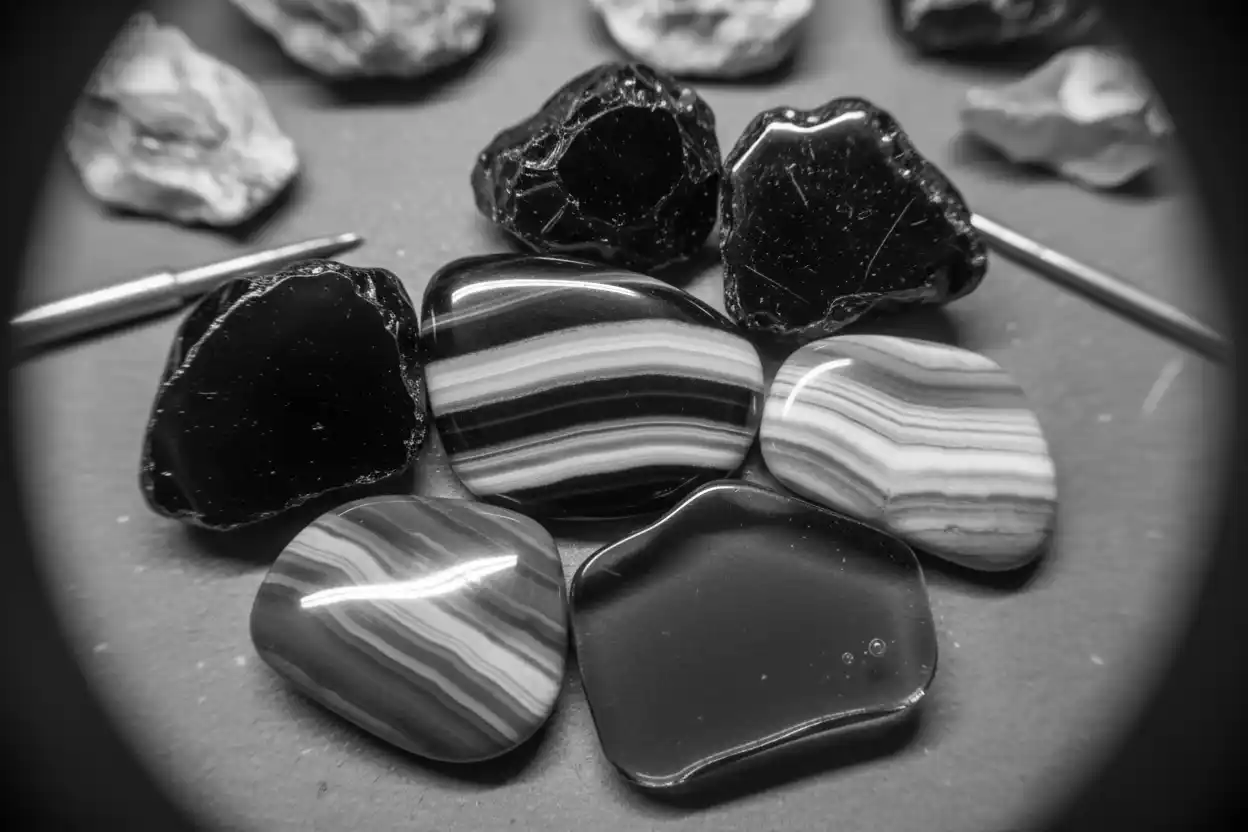
Real vs Fake Onyx: 7 Simple Tests to Identify Real Stones
Real vs fake onyx identification is more complicated than checking whether a stone is completely black. In strict gemological terminology, onyx is a variety of chalcedony characterized by straight, parallel bands of contrasting colors. Much of what the modern jewelry trade calls black onyx is actually chalcedony that has been dyed a deep uniform black, while some objects sold as onyx are glass, calcite, marble-like carbonate rock, plastic, or another black opaque gem altogether.
This distinction matters because dyed chalcedony is still genuine chalcedony. GIA explains that onyx belongs to the chalcedony family and is composed of straight parallel layers of different colors. GIA also notes that what is commonly sold as black onyx is usually dyed black chalcedony because naturally uniform black chalcedony is uncommon.
A useful real vs fake onyx assessment therefore needs to answer two questions separately. First, is the object actually chalcedony? Second, if it is black, does that black color occur naturally or result from treatment? A stone can be authentic chalcedony yet treated, while a glass imitation may be completely unrelated to onyx even if its appearance is convincing.
7 Real vs Fake Onyx Tests at a Glance
- Check whether any visible bands are straight and parallel.
- Inspect edges and drill holes for signs of dye concentration.
- Use magnification to look for glass bubbles or manufactured features.
- Compare hardness with normal chalcedony expectations.
- Measure refractive index when a suitable polished surface is available.
- Distinguish chalcedony onyx from calcite sold as onyx marble.
- Use professional testing when an opaque black stone remains uncertain.
What Genuine Onyx Actually Is
Onyx belongs to the cryptocrystalline quartz family. Like agate, it consists primarily of microscopic intergrowths of silica, but traditional nomenclature separates the two by band geometry. Agate normally shows curved, concentric, irregular, or fortification-style banding, while onyx displays straighter and more parallel layers. GIA’s gemological glossary has historically defined onyx as quartz arranged in alternate straight parallel layers of different colors.
This definition immediately explains one of the biggest problems in the retail market. A uniformly black polished cabochon can be sold as black onyx even though no contrasting banding is visible. In many cases, that product is dyed black chalcedony. GIA refers to treated black chalcedony as “black onyx” in commercial usage and has documented both genuine dyed chalcedony and black glass imitations sold under that name.
| Identification Feature | Chalcedony Onyx | Common Imitation or Mislabel |
|---|---|---|
| Main composition | Microcrystalline quartz | Glass, calcite, plastic, other black gems |
| Traditional structure | Straight parallel bands | Curved agate bands or no natural layering |
| Mohs hardness | About 6.5 to 7 | Glass often lower, calcite much lower |
| Typical RI | Around mid-1.53 to mid-1.54 range | Depends on substitute |
| Fracture | Conchoidal | Glass can also be conchoidal |
| Common treatment | Black dye in chalcedony | Entire object may be imitation |
| Natural uniform black | Uncommon | Commonly produced by dyeing |
| Important trade confusion | “Black onyx” often dyed chalcedony | “Onyx marble” may actually be calcite |
The distinction between gemological onyx and so-called onyx marble is especially important. Traditional onyx is chalcedony. Onyx marble is a commercial name historically used for banded calcite or similar carbonate rock. GIA’s older nomenclature explicitly separated the two, describing onyx marble as compact translucent calcite with parallel markings.
Straight Parallel Banding Is the First Structural Clue
When natural banding is visible, its geometry gives useful information.
True traditional onyx displays relatively straight, parallel layers. Sardonyx follows the same structural idea but combines sard, generally brownish red to brown-orange chalcedony, with white or dark onyx layers. GIA describes sardonyx as alternating bands of sard and onyx, reflecting the same parallel-banded chalcedony structure.
Agate, by comparison, commonly forms curved, concentric, or irregular bands.
This is why the previously discussed real vs fake agate identification principles overlap with onyx while still requiring a different structural emphasis. Both belong to the chalcedony family, but their traditional banding patterns are not identical.
Banding alone cannot settle every case.
A manufactured glass object can be layered.
A dyed chalcedony may be so black that original banding becomes almost impossible to see.
A natural onyx carving may also be cut at an angle that makes the bands appear less obviously parallel.
The key is to treat band geometry as one piece of evidence rather than an absolute visual rule.
Black Onyx Is Commonly Dyed Chalcedony
The most important fact for buyers is that black color does not automatically mean fake.
GIA states that natural black chalcedony is rare and that virtually all black chalcedony in the jewelry trade has been treated.
Dyeing chalcedony is an old and well-established gem treatment. GIA lists chalcedony among the gem substances commonly altered with dyes because its fine porous structure can accept coloring agents.
This creates three distinct commercial categories.
A naturally banded untreated onyx is genuine and untreated.
A dyed black chalcedony is genuine chalcedony but treated.
A black glass cabochon sold as onyx is an imitation.
These distinctions are more accurate than treating every dyed piece as fake.
A buyer should therefore ask not only, “Is this onyx?” but also, “Is the color natural, dyed, or otherwise treated?”
Dye Concentration Can Appear Around Edges and Open Features
Dyed chalcedony may reveal treatment where dye penetrates most easily.
Under strong transmitted light, some black onyx can appear dark brown rather than absolutely black and may reveal traces of original layering. GIA documented dyed black chalcedony whose intense apparent black coloration became brown under fiber-optic illumination, with indications of a layered chalcedony structure.
Drill holes, chipped corners, fractures, porous areas, and unpolished edges can therefore be useful places to examine.
If a bead is intensely black on the polished exterior but noticeably lighter within the drill channel, treatment may be present.
That does not mean the stone is an imitation.
It may confirm that the black appearance was produced through dyeing of genuine chalcedony.
Destructive solvent tests are unnecessary. A loupe, strong transmitted light, and ordinary gemological observations provide safer evidence.
Glass Imitations Can Be Surprisingly Convincing
Black glass can imitate dyed chalcedony so well that professional laboratories sometimes need multiple tests to separate them.
GIA documented black glass tablets that had been purchased as black onyx. Their appearance and drilled texture were convincing enough that standard visual examination alone did not settle the identity. Refractive index, specific gravity, hardness, and X-radiography ultimately confirmed glass rather than chalcedony.
This case is a useful warning against simplistic assumptions.
A black glass imitation may show conchoidal fracture, which chalcedony also displays.
It may be opaque enough that internal bubbles cannot be observed.
Its color can be perfectly uniform.
The strongest identification therefore comes from measured physical properties rather than appearance alone.
Refractive Index Provides Stronger Evidence Than Color
Chalcedony generally produces refractive-index readings in the mid-1.53 to mid-1.54 range.
In GIA’s examination of dyed black chalcedony, a vague mid-1.5 reading supported the identification before Raman spectroscopy confirmed chalcedony.
A refractometer can therefore help eliminate many substitutes when a suitable polished surface is available.
Glass can overlap partly depending on composition, so refractive index is not always decisive by itself.
Opaque black gems are especially challenging because limited transparency prevents some standard observations. GIA notes that black opaque stones may require combinations of microscopy, refractive index, specific gravity, spectroscopy, X-ray diffraction, or other advanced techniques.
This explains why professional testing becomes more valuable as the object becomes more expensive or historically important.
Hardness Can Support Chalcedony Identification, but Do Not Scratch Jewelry
Chalcedony generally ranks around 6.5 to 7 on the Mohs scale.
This makes genuine onyx reasonably durable for rings, beads, carvings, cameos, and signet jewelry.
Glass and calcite can be softer, but scratch testing finished jewelry is poor practice.
A knife or steel point may leave metal residue that looks like a scratch.
A genuine polished surface can also be permanently damaged.
The physical hardness is useful for professional identification under controlled conditions, but it should not become a destructive home experiment.
Surface wear on older jewelry can provide indirect clues. A very soft imitation may show unusually severe abrasion, while chalcedony often preserves a good polish. Still, wear depends heavily on how the jewelry was used.
Onyx Marble Is Not Chalcedony Onyx
One of the most persistent naming problems involves decorative carbonate rock sold as Mexican onyx, Pakistani onyx, onyx marble, or banded onyx.
These stones can be attractive and naturally banded, but mineralogically they are commonly calcite or aragonite-rich carbonate rock rather than chalcedony.
GIA’s traditional terminology explicitly distinguishes onyx marble from quartz onyx.
The difference can be substantial.
Calcite is much softer, with Mohs hardness around 3.
Chalcedony is around 6.5 to 7.
Their refractive properties, reaction to acids, crystal chemistry, and durability are different.
A large decorative bowl made from translucent cream, green, honey, or brown “onyx” may therefore be genuine natural stone while not being gemological onyx.
Accurate naming is more useful than calling such an object fake.
Onyx Can Be Confused With Obsidian, Spinel, Jet, and Other Black Stones
Many opaque black gems look similar after polishing.
Obsidian is volcanic glass.
Black spinel is a crystalline magnesium aluminum oxide.
Jet is an organic gem derived from lignitized wood.
Hematite, black jade, black tourmaline, pyroxenes, amphiboles, glass, and various rocks can also appear nearly black.
GIA emphasizes that identifying black opaque gems can be particularly difficult because visual appearance converges strongly across unrelated substances.
This is why the phrase “looks like onyx” has limited gemological value.
A polished black cabochon must be identified through measurable properties when certainty matters.
Spiritual Claims Cannot Authenticate Onyx
Modern crystal traditions associate onyx benefits with grounding, self-control, confidence, protection, emotional steadiness, and personal discipline.
The healing traditions discussed in onyx healing properties also contain symbolic and wellness claims.
None of these experiences can determine whether a black stone is chalcedony.
A piece of glass can feel cool.
Obsidian can be used during meditation.
Dyed chalcedony can carry personal meaning.
A genuine untreated onyx may produce no unusual sensation at all.
Authentication depends on mineral structure, optical properties, density, spectroscopy, and treatment evidence rather than perceived energy.
Buying Black Onyx Requires Accurate Terminology
Black onyx is commonly affordable because dyed chalcedony is readily available and widely used in jewelry.
That does not make it undesirable.
A well-cut black chalcedony cabochon can be durable, elegant, and suitable for everyday wear.
The important issue is disclosure.
A seller should not present dyed black chalcedony as extremely rare naturally black onyx when the color has been intentionally produced.
Likewise, black glass should not be sold as chalcedony.
A decorative calcite carving should not be described as quartz onyx if the distinction matters to the buyer.
Authenticity begins with an accurate name.
Professional Testing Is Best for Valuable Black Opaque Gems
Opaque black stones can be among the least cooperative gems for home identification.
They may not transmit enough light for ordinary internal examination.
A highly polished surface may conceal useful texture.
Some glasses can closely match the appearance and even approximate certain routine properties of chalcedony.
For a valuable antique cameo, signet stone, important carving, or expensive jewelry item, a gemologist may combine refractive index, microscopy, specific gravity, Raman spectroscopy, X-ray diffraction, or elemental analysis.
GIA’s published work on black opaque gems makes clear that advanced techniques are sometimes necessary even for trained laboratories.
Conclusion
Real vs fake onyx identification requires precise terminology. Traditional onyx is parallel-banded chalcedony, while much modern black onyx jewelry consists of genuine chalcedony dyed a uniform black. That treatment does not turn the stone into glass, but it should be disclosed accurately.
Straight parallel banding, strong-light examination, drill-hole inspection, hardness expectations, refractive testing, and professional gemological analysis can distinguish genuine chalcedony from glass, calcite, plastic, and unrelated black gems. The most important lesson is that natural, treated, and imitation are three different categories. A black stone should be identified by its physical properties rather than its color, trade name, or spiritual reputation.
FAQs
Is most black onyx naturally black?
No. GIA notes that natural black chalcedony is rare and that most black chalcedony sold as black onyx has been treated to produce or deepen the black color.
Does dyed black onyx count as real onyx?
The underlying stone can be genuine chalcedony even when its black color is produced by dyeing. Treatment should be disclosed, but dyed chalcedony is different from a glass or plastic imitation.
What does real onyx banding look like?
Traditional onyx shows straight, parallel layers of different colors. Curved and concentric banding is more typical of agate.
Can real onyx be completely black?
Commercial black onyx commonly appears uniformly black, but most such stones are treated chalcedony rather than naturally uniform black onyx. Strong transmitted light may sometimes reveal dark brown color or subtle underlying layers.
Can black glass look like onyx?
Yes. GIA has documented carefully made black glass sold as black onyx. Gemological measurements and advanced testing may be needed when visual clues are insufficient.
Is Mexican onyx real onyx?
Products sold as Mexican onyx or onyx marble are commonly banded calcite or related carbonate rock rather than chalcedony onyx. They may be genuine natural stone, but the mineral identity is different.
What is the safest way to authenticate expensive onyx?
A gemologist can combine refractive index, microscopy, density, and when necessary Raman spectroscopy or X-ray analysis. This is more reliable than scratching, heating, or judging color alone.
Disclaimer: Spiritual, grounding, protective, emotional, chakra, energetic, and healing interpretations associated with onyx reflect beliefs and personal practices rather than established medical or psychological effects. Such claims cannot authenticate onyx and should not replace professional gemological identification.