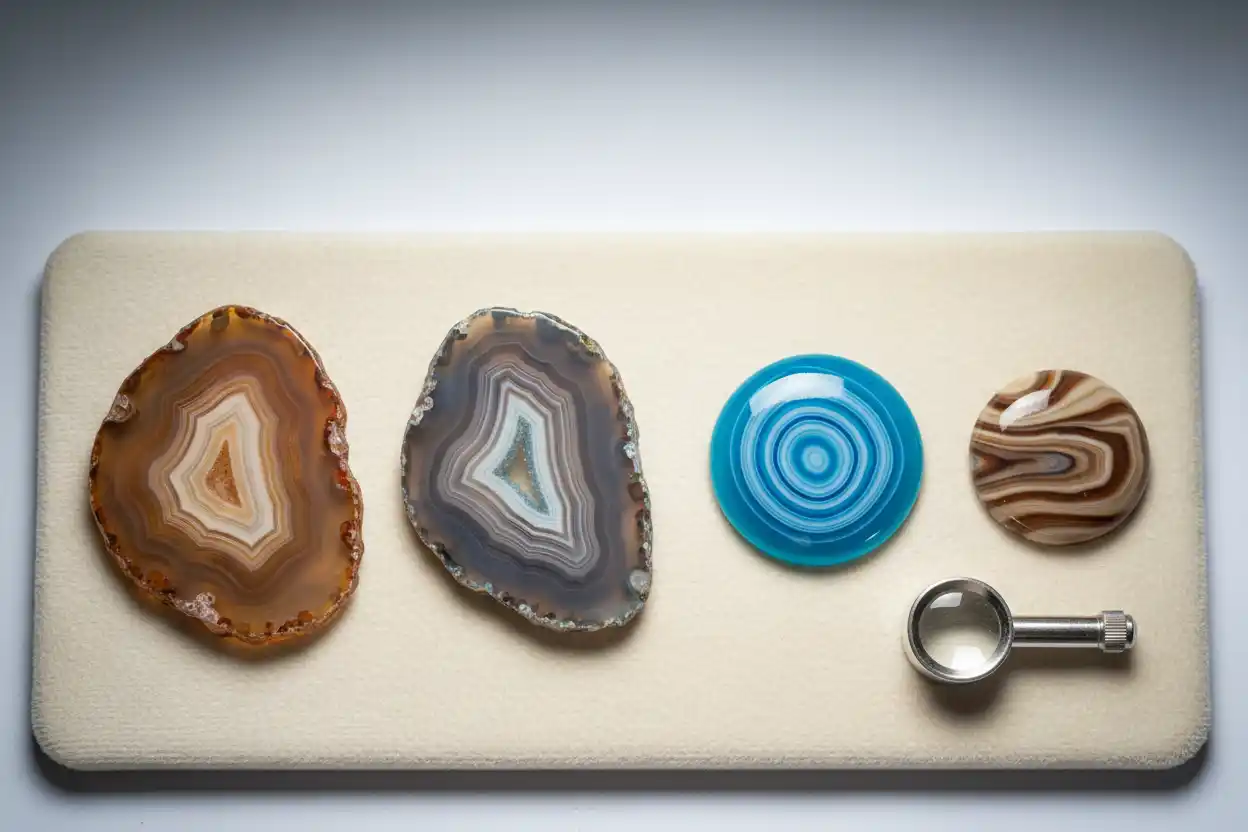
Real vs Fake Agate: Identification Tests and Warning Signs
Real agate is a compact silica material generally recognized by bands, layers, fortification patterns or other organized structures within chalcedony. Its colors may be natural, altered by heat or dye, or combined with both natural and treated zones. Therefore, identifying agate involves more than deciding whether the colors look believable.
A bright blue or black slice may still be genuine agate whose color was enhanced. Conversely, a brown-and-white object with convincing stripes may be molded glass, resin, printed ceramic or another stone sold under an agate trade name.
The first question is material identity: is the object actually chalcedony or an accepted agate variety? The second is treatment: are its colors, fractures or surface appearance natural? This page owns that direct identification workflow. The separate treated-agate guide retains the detailed chemistry, treatment processes and disclosure boundaries.
Real Agate vs Common Imitations
| Feature | Natural or treated agate | Glass imitation | Resin or plastic | Dyed howlite, magnesite or other stone |
|---|---|---|---|---|
| Material | Microcrystalline silica | Manufactured glass | Polymer material | Different natural mineral |
| Typical structure | Bands, plumes, moss, fortifications or aggregate texture | Homogeneous or molded patterns | Printed, poured or swirled pattern | Veining, pores or granular structure |
| Transparency | Translucent at thinner edges in many varieties | Often transparent or uniformly translucent | Variable, sometimes waxy | Usually opaque |
| Surface feel | Hard, cool and stone-like | Smooth and glassy | Lighter and often warmer | Chalky, porous or stone-like |
| Bubbles | Natural cavities possible, but not ordinary spherical glass bubbles | Round gas bubbles may occur | Air pockets may occur | Uncommon |
| Color concentration | Dye may collect in pores, bands and fractures | Color usually distributed through glass | Color may be uniform or pooled | Dye frequently follows pores and veins |
| Pattern repetition | Usually irregular and three-dimensional | Molded or repeated patterns possible | Repeated or printed patterns common | Natural host pattern may repeat by material type |
| Mohs hardness | Approximately 6.5–7 | Common glass around 5–6 | Much softer | Usually softer than chalcedony |
| Fracture | Conchoidal to uneven | Conchoidal and glass-like | Cuts, dents or melts rather than mineral fracture | Depends on substitute mineral |
| Best confirmation | Gemological testing | Optical and microscopic separation | Density, heat response and microscopy | Mineral identification |
A single feature is rarely sufficient. Natural agate varies widely, while manufacturers can copy banding, translucency and surface polish convincingly.
What Is Genuine Agate?
Agate belongs to the broader chalcedony family. Chalcedony consists principally of microscopic quartz and moganite structures intergrown so finely that individual crystals cannot normally be seen without specialized equipment.
Classic agate contains organized bands of chalcedony. The bands may follow a cavity wall, form nested fortifications, create horizontal waterlines or alternate between translucent and opaque layers.
Retail use of the name is broader. Moss agate, dendritic agate and tree agate may lack conventional rhythmic banding but remain accepted commercial names for chalcedony containing mineral inclusions or branch-like patterns.
The types-of-agate guide owns the full variety structure. Identification should account for the specific form rather than requiring every real piece to display identical concentric stripes.
Natural Agate Banding
Natural banding develops as silica-rich material fills cavities, fractures or spaces in host rock over repeated stages.
The layers commonly follow the outer shape of a cavity. In fortification agate, angular nested bands resemble the walls of a fortress. Waterline agate develops comparatively straight horizontal layers that record changing fill levels.
Individual bands vary in width, translucency, texture and color. They may curve, pinch out, merge or become interrupted by crystals, cavities and later fractures.
This complexity is difficult to reproduce perfectly. However, irregularity alone does not prove natural origin, since poured resin and artisan glass can also create non-repeating swirls.
Examine whether the pattern continues into the stone rather than sitting only on its surface. A three-dimensional natural band may remain visible from the edge and back, although cutting orientation can cause it to disappear in some directions.
Natural Agate Colors
Untreated agate occurs in white, gray, brown, red, orange, yellow, blackish, blue, green and combinations of these colors.
Iron oxides commonly create red, brown and yellow shades. Manganese compounds may contribute darker dendritic or plume structures. Fine blue-gray colors can occur in blue lace and other naturally subdued varieties.
The agate-color guide covers symbolic associations, while mineral identification should remain independent of those meanings.
Natural color does not need to be dull. Fire agate, iris agate and some plume agates can show vivid effects produced by internal structures rather than dye.
Nevertheless, uniformly neon pink, electric blue, bright violet or emerald green is often treatment-related. The conclusion should be “likely enhanced,” not automatically “not agate.”
Dyed Agate Is Still Agate
Dyeing changes color without necessarily changing the underlying material.
Commercial agate is well suited to dye because different layers vary in porosity and accept color unevenly. This selective absorption can emphasize banding dramatically.
A vivid slice may therefore be genuine chalcedony and dyed at the same time. Calling it “fake agate” without qualification is imprecise.
The correct description would be dyed natural agate, provided the base material has been identified. A seller who describes it simply as natural blue agate or natural pink agate with no treatment disclosure creates the consumer problem.
The full treatment workflow belongs in How to Spot Treated or Synthetic Agate.
Signs of Dyed Agate
Dye may appear stronger in cracks, drill holes, cavities, porous layers and near the surface.
Under magnification, look for unnatural color outlining a fracture or collecting around a bead hole. A pale interior visible at a chip can also suggest surface-concentrated treatment.
Color may become unusually uniform across layers that should differ in density. Alternatively, some layers may accept so much dye that the pattern looks sharply artificial.
These observations are useful but not conclusive. Natural minerals also concentrate along fractures, and some modern dyes penetrate deeply enough to avoid obvious surface evidence.
Solvent rubbing is not a reliable universal test. A stable dye may not transfer, while acetone or alcohol can damage adhesives, coatings, resin-filled areas, stringing material or metal finishes.
Heat-Treated Agate and Carnelian
Heat can alter iron-bearing compounds within agate and chalcedony, commonly strengthening red, orange or brown colors.
Some commercial carnelian begins as paler chalcedony whose color improves through heating. The resulting material remains chalcedony but should be represented according to accepted disclosure practices.
Heating may also make a stone more receptive to later dyeing by opening or modifying microscopic pathways.
Color alone usually cannot establish whether geological heat or human treatment produced a red agate. Laboratory testing may have limits, particularly when the final mineral chemistry resembles naturally heated material.
Black Agate and Black Onyx
Black agate is frequently produced by darkening suitable chalcedony. Deep black material with contrasting white bands may be sold as black onyx.
Mineralogically, traditional onyx is banded chalcedony with relatively parallel layers. Modern retail use often extends onyx to dyed black chalcedony without visible bands.
The planned real-versus-fake onyx guide owns the complete black-material comparison.
A black stone’s lack of visible banding does not prove it is glass. Strong dye may conceal internal structure until the piece is examined with transmitted light or magnification.
Glass Imitations
Glass can imitate translucent agate, especially in beads, decorative slices and cabochons.
Round gas bubbles are a useful clue when present. They may occur alone, in groups or with curved flow lines. Natural agate can contain cavities, but ordinary spherical bubbles suspended in a homogeneous glass body suggest manufacture.
Glass may also show molded seams, repeated swirl patterns, uniform transparency and rounded depressions created during production.
The surface can feel smoother and more glassy than chalcedony, although high-polish agate can also look glass-like.
A chipped glass edge may reveal a very smooth conchoidal fracture. Agate can also fracture conchoidally, so this feature does not separate them by itself.
Resin and Plastic Imitations
Resin can reproduce bands, mossy patterns, druzy cavities and even a polished stone-like surface.
It often feels lighter than expected and warms quickly in the hand. Those impressions are subjective and should remain preliminary clues.
Look for mold lines, repeated patterns, surface scratches, internal casting bubbles and color that appears poured rather than mineralized.
A hot-needle test should not be used. It damages the object, releases fumes and provides little benefit when safer methods are available.
Under magnification, resin may show flow textures, suspended glitter or boundaries around embedded pieces. Some products combine genuine agate chips with resin, creating a composite that requires accurate disclosure.
Dyed Howlite and Magnesite
Howlite and magnesite are porous light-colored minerals commonly dyed to imitate turquoise and other colorful stones. They may also be sold as blue, purple, red or green “agate.”
Howlite typically displays dark web-like veining. Magnesite may show a granular, chalky or irregularly veined texture.
Both are softer than agate. Nevertheless, scratch testing a finished bead is destructive and may damage genuine material.
Dye often concentrates in pores and veins, creating a pattern that looks painted into cracks rather than built from chalcedony bands.
A polished substitute remains a real mineral, but it is not agate and should be sold under its correct name.
Printed and Surface-Painted Patterns
Some inexpensive decorative products have bands printed, painted or transferred onto ceramic, resin, glass or low-grade stone.
Inspect the edge and back. A surface design may stop abruptly, lose definition at a curve or reveal a different base color where scratched accidentally.
Repeated identical slices are especially suspicious. Natural slabs cut sequentially from one agate can look related, but their internal details should change gradually rather than repeat exactly.
A clear coating may protect the printed design and create an unusually plastic-like shine.
Reconstituted and Composite Agate
Small chalcedony fragments can be bonded with resin, pigment or cement and polished into beads, slabs and decorative objects.
A composite may contain genuine agate while not being a solid natural piece.
Magnification can reveal boundaries between fragments, trapped bubbles, resin-filled gaps and color differences around the cement.
Composite construction is not inherently unacceptable. It becomes misleading when the seller describes the object as a solid, untreated agate.
The gemstone-treatments guide explains impregnation, filling, coating and reconstruction across gem materials.
Natural Agate Varieties and Their Patterns
Blue lace agate commonly displays delicate blue, white and gray lace-like bands. Strong royal-blue material may have been dyed.
Botswana agate is known for fine parallel or curved banding in gray, brown, pink and muted orange tones.
Crazy lace agate develops complex looping, eye and fortification patterns. Its visual complexity should remain three-dimensional rather than printed.
Moss agate contains moss-like mineral inclusions and may lack conventional bands. Tree agate usually has green dendritic or branching patterns against a white body.
Dendritic agate contains branch-like mineral growths, while flower agate shows plume or blossom-like inclusions.
Fire agate produces iridescent colors over layered iron oxides. Iris agate displays spectral diffraction through extremely fine bands under suitable transmitted light.
Each variety has different natural expectations. One universal “agate test” cannot evaluate them all.
Transmitted-Light Examination
A small flashlight can reveal whether color and structure continue through a translucent piece.
Place the clean stone against diffused white light rather than an intense laser or focused heat source. Rotate it slowly and observe band depth, internal clouds, fractures and any surface-only paint.
Dyed material may show strong color in porous bands and paler dense layers. Glass may reveal bubbles or uniform color. Resin may show casting swirls and suspended particles.
Opaque agate cannot be judged effectively through backlighting. A negative result is therefore not evidence of imitation.
Magnification
A 10× loupe is one of the most useful non-destructive tools.
Inspect drill holes, edges, fractures and transitions between colors. Look for dye concentration, bubbles, mold seams, resin boundaries, paint and repeated printed details.
Natural agate often displays fine granular, fibrous or layered texture beneath the polish. The exact appearance varies with cutting direction and variety.
Dirt, polishing compound and wax can resemble treatment residue. Clean the surface gently before drawing conclusions.
Hardness Testing
Agate’s hardness is approximately 6.5–7, making it harder than ordinary window glass, howlite, calcite and many plastics.
However, deliberately scratching a finished stone is poor practice. Quartz sand, steel particles and uneven pressure can produce confusing results.
Coatings and surface contamination may also respond differently from the underlying material.
Use hardness as a professional identification property rather than a destructive home challenge. The gemstone-hardness chart provides context across materials.
Temperature and Weight Tests
Real agate often feels cool initially because stone conducts heat away from the skin. Glass can feel similarly cool, while a large resin object may also remain cool in an air-conditioned room.
Weight by hand is equally unreliable. Glass and agate have overlapping subjective heft, and composites can be engineered to feel heavier.
These observations may help reject very light plastic, but they cannot authenticate valuable material.
Ultraviolet Light
Agate fluorescence varies with impurities, treatments and associated minerals.
Some dyed materials fluoresce, while others remain inert. Natural chalcedony may also show weak or localized reactions.
UV light can support a broader examination but cannot provide a universal real-versus-fake result.
Avoid looking directly into ultraviolet lamps and use appropriate eye and skin protection.
Gemological Identification
A gemologist may use refractive-index spot readings, specific gravity, magnification, spectroscopy, Raman analysis and other methods.
Chalcedony normally produces aggregate optical behavior rather than the clean readings expected from a single crystal. Glass, resin and substitute minerals show different combinations of density and optical properties.
Advanced testing may identify dye, polymer impregnation or an unexpected mineral species.
The gemstone-certification guide explains when formal documentation is proportionate to value. Use how to read a gem lab report to determine whether a report addresses material identity, treatment or only estimated price.
A Safe Home Inspection Sequence
Begin by cleaning the object gently with a soft cloth.
Examine the color under neutral daylight and warm indoor light. Note whether the pattern looks three-dimensional and whether it continues through the edges.
Use a loupe around drill holes, chips and fractures. Look for concentrated dye, bubbles, mold lines, paint and composite boundaries.
Compare the object with the expected pattern for its stated variety. A moss agate should not be rejected for lacking bands, and a fire agate should not be judged by blue-lace criteria.
Review the seller’s wording. “Natural stone” does not disclose dye, heat, filling or reconstruction.
Stop before scratch, acid, flame, hot-needle or solvent tests. If the value matters, seek professional identification.
Buying Real Agate
Use the where-to-buy-real-agate guide for seller and marketplace selection.
A listing should state the variety, treatment, dimensions and whether the piece is solid, composite or assembled.
Natural-looking photographs should show the exact item from several angles. Highly saturated studio images can conceal dye concentration and surface coating.
The online-gemstone buying guide provides return-window and documentation safeguards.
Frequently Asked Questions
1. How can I tell whether agate is real?
Look for three-dimensional natural structure, mineral texture and consistent chalcedony properties. Use magnification and professional testing rather than relying on color alone.
2. Does bright color mean agate is fake?
No. The base material may be genuine agate that has been dyed or heated. Bright color is primarily a treatment warning.
3. Is dyed agate considered real?
It is real agate if the underlying material is chalcedony, but the color is treated and should be disclosed.
4. Do all real agates have bands?
No. Moss, tree, dendritic and some plume materials use accepted agate trade names despite lacking classic rhythmic bands.
5. Are bubbles proof of fake agate?
Round gas bubbles within homogeneous material strongly suggest glass or resin, but natural agate can contain cavities. Interpret the full internal structure.
6. Can real agate scratch glass?
Agate is hard enough to scratch many ordinary glasses, but deliberate scratch testing can damage the stone and is not recommended.
7. Is black agate naturally black?
Natural dark chalcedony exists, but much uniformly black commercial agate has been dyed or otherwise darkened.
8. Can fake agate feel cold?
Yes. Glass and some composites can feel cool, so temperature is not a reliable authentication test.
9. Does acetone reveal dyed agate?
Sometimes color may transfer, but many dyes are stable and acetone can damage coatings, resin, adhesives and settings. It is not a dependable universal test.
10. Why does dye collect around bead holes?
Drilling exposes porous material and fractures that may absorb more dye than dense surrounding chalcedony.
11. Do I need a laboratory report for agate?
Most ordinary pieces do not justify one. Testing becomes useful for expensive carvings, rare-variety claims or disputed treatment and identity.
12. What is the safest way to buy real agate online?
Choose a seller who identifies the variety and treatment, shows the exact piece, provides dimensions and offers a meaningful return period.
Real agate can be naturally muted, naturally colorful or heavily enhanced. The correct conclusion is not based on whether the stone looks dramatic; it depends on whether the underlying material is chalcedony, whether the stated variety matches its structure and whether treatments or composite construction were disclosed. That distinction allows dyed agate to be sold honestly without being confused with glass, resin or another mineral.
Agate appears in Crystals That Start With A and Gemstones That Start With A.