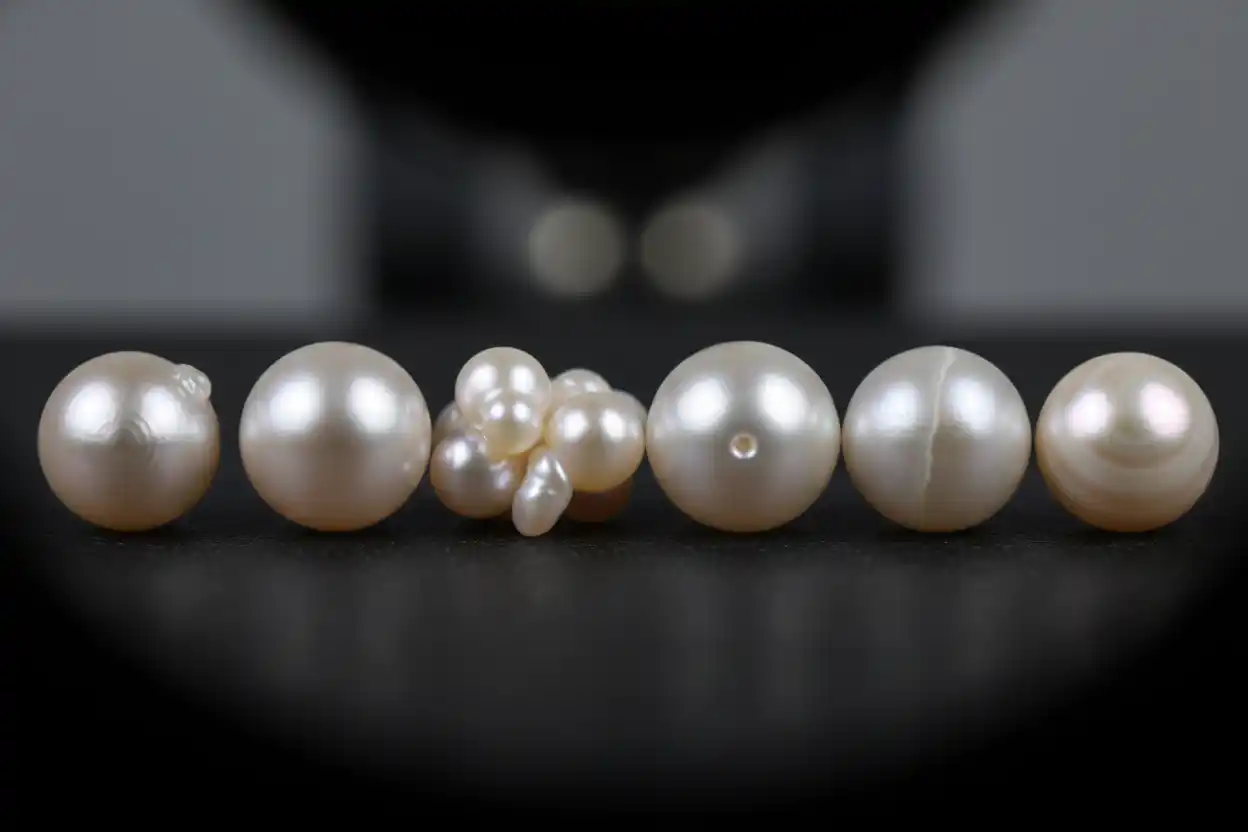
Real vs Fake Pearl: Natural, Cultured and Imitation Tests
A real pearl is a biological gem produced within a mollusk. It may have formed naturally without deliberate human intervention or through a cultured-pearl process in which a technician initiated pearl growth inside the animal. Both natural and cultured pearls are genuine pearls.
An imitation pearl is different. It typically consists of a glass, plastic, ceramic or shell bead covered with a pearly coating. The coating may contain fish-scale-derived essence, mineral pigments, synthetic nacre-like material or modern polymers that create convincing luster.
The most important distinction is therefore not simply real versus fake. A complete identification should determine whether the object is a pearl, whether it is natural or cultured, whether it formed in saltwater or freshwater, whether it is nacreous or non-nacreous and whether its color or surface has been treated.
Home observations can expose obvious plastic and coated-glass imitations. However, separating a valuable natural pearl from a cultured pearl normally requires X-ray imaging because their external surfaces may look nearly identical.
This page owns the direct authenticity workflow. The completed treated and synthetic pearl guide retains detailed dyeing, bleaching, irradiation, coating, filling and misleading synthetic-pearl terminology.
Natural, Cultured and Imitation Pearls Compared
| Feature | Natural pearl | Cultured pearl | Imitation pearl |
|---|---|---|---|
| Formation | Develops in a mollusk without deliberate culturing intervention | Pearl growth is initiated by people inside a living mollusk | Manufactured outside a mollusk |
| Outer material | Nacre or another natural shell-derived pearl structure | Nacre or another natural shell-derived pearl structure | Pearlescent coating, glass, plastic, ceramic or shell |
| Internal structure | Concentric growth around an organic or microscopic center | Bead nucleus with nacre, or non-bead cultured internal growth structures | Solid or hollow manufactured bead, coating or layered composite |
| Surface | Microscopic nacre platelets or porcelaneous non-nacreous structure | Similar biological surface | Coating may be smooth, granular, bubbled, peeling or artificially textured |
| Shape | Round, near-round, oval, button, drop, circled or baroque | Same broad shape range | Can be manufactured in nearly perfect matching shapes |
| Luster | Produced by biological layers and surface quality | Produced by biological layers and surface quality | Produced by coating, glass reflection or synthetic film |
| Drill hole | May reveal layered pearl structure | May reveal nacre over a bead or cultured interior | May reveal glass, plastic, shell bead or peeling coating |
| Natural vs cultured separation | Usually requires X-ray imaging | Usually requires X-ray imaging | Often separated through microscopy and material testing |
| Treatment risk | Dye, irradiation, bleaching, filling and coating | The same treatments may occur | Color and luster are normally manufactured |
| Correct description | Natural pearl | Cultured pearl with type stated | Imitation pearl with base material stated |
A cultured pearl should not be advertised as a natural pearl. Nevertheless, describing every cultured pearl as fake is equally incorrect.
What Is a Genuine Pearl?
A pearl forms when a mollusk deposits calcium-carbonate material and organic compounds around an internal stimulus.
Many familiar pearls are nacreous. Their surfaces consist of countless microscopic aragonite tablets held together by organic material. Light interacting with those thin layers creates luster, orient and subtle iridescence.
Other genuine pearls are non-nacreous. Conch, melo and some clam pearls have porcelaneous or flame-like surfaces rather than conventional nacre. They remain true pearls despite lacking the familiar layered appearance of an Akoya pearl.
The completed pearl meaning guide owns formation, symbolism and general gem properties. The completed types-of-pearl guide explains Akoya, South Sea, Tahitian, freshwater, conch, melo and other categories.
Natural Pearls
Natural pearls develop without deliberate implantation by a pearl farmer.
A parasite, tissue injury or another event may cause the mollusk to isolate an irritant with shell material. Contrary to a familiar simplified story, a grain of sand is not the universal cause of natural pearl formation.
Natural pearls are scarce because only a small proportion of wild mollusks produce useful pearls, and fewer still create attractive size, shape, color and surface quality.
Most natural pearls are not perfectly round. Baroque, button, oval and irregular forms are common.
A round shape alone does not prove cultivation, but a long strand of large, perfectly round, evenly matched pearls is far more likely to be cultured or imitation than an undocumented natural-pearl collection.
Cultured Pearls Are Real Pearls
Cultured pearls grow inside living mollusks through a human-assisted process.
In bead-cultured saltwater production, a technician commonly inserts a rounded shell bead and a small piece of donor mantle tissue. The mollusk then deposits nacre around the bead.
Many freshwater cultured pearls are non-bead cultured. Tissue is introduced without a large spherical nucleus, and the resulting internal structure can be irregular, linear or void-bearing.
Modern freshwater production also includes bead-cultured forms. Consequently, the old rule that saltwater pearls always contain beads while freshwater pearls never do is no longer reliable.
Cultured origin describes how growth began, not whether the outer pearl material is genuine.
Natural Versus Cultured Pearl
External appearance cannot reliably separate fine natural and cultured pearls.
Both can have excellent luster, orient, natural surface texture and genuine calcium-carbonate structure. Either can be round or baroque, white or colored, smooth or blemished.
X-ray radiography is the standard non-destructive method. Natural pearls commonly show concentric growth structures without a large manufactured nucleus. Bead-cultured pearls show a central bead surrounded by nacre. Non-bead cultured pearls may contain irregular cores, elongated structures or central voids.
Micro-computed tomography can reconstruct the interior in three dimensions when ordinary radiographs remain ambiguous.
A seller’s loupe inspection cannot replace X-ray evidence for a high-value natural-pearl claim.
Bead-Cultured Pearls
Akoya, many South Sea and many Tahitian cultured pearls grow around a bead nucleus.
The bead is often fashioned from freshwater mollusk shell. A layer of cultured nacre forms around it during the growth period.
Nacre thickness varies. Thin nacre may produce a chalkier appearance, reveal the bead beneath or wear more quickly around drill holes and high-contact areas.
Thick nacre can create deeper luster and greater durability, although value also depends on surface, orient, shape, size, color and matching.
A visible nucleus at a damaged drill hole supports bead-cultured construction but does not make the pearl an imitation.
Non-Bead-Cultured Freshwater Pearls
Many freshwater cultured pearls form primarily from mantle-tissue implantation without a spherical bead.
Their interiors may be mostly nacre, yet their growth was still intentionally initiated.
The absence of a bead does not make them natural pearls.
Modern freshwater pearls can be remarkably round and lustrous. Visual stereotypes based on older rice-shaped or heavily textured freshwater pearls no longer cover the full market.
When origin matters, internal imaging remains the dependable method.
Nacreous and Non-Nacreous Pearls
Nacreous pearls include most familiar Akoya, South Sea, Tahitian and freshwater cultured pearls.
Their layered aragonite structure produces the visual depth associated with classic pearl luster.
Non-nacreous pearls include conch and melo pearls. Rather than ordinary nacre, they can show a porcelaneous surface and flame-like structures.
A non-nacreous pearl should not fail an authenticity assessment merely because it does not feel or look like Akoya nacre.
Material-specific laboratory testing is necessary because polished shell and manufactured products may imitate both categories.
Pearl Versus Mother of Pearl
Mother of pearl is the nacreous lining cut from a mollusk shell.
A pearl develops as a rounded or irregular body within the mollusk. Mother of pearl remains part of the shell and is commonly fashioned into flat beads, inlay, carvings and watch dials.
A bead made entirely from shell is not a cultured pearl. It may be sold accurately as mother-of-pearl bead, shell bead or shell pearl imitation according to its construction.
The completed types-of-mother-of-pearl guide retains shell sources, colors and varieties.
Imitation Glass Pearls
Glass provides weight, smoothness and a stable round base for imitation pearls.
A glass bead may be solid or hollow and covered with several pearlescent layers. High-quality coatings can imitate nacre’s glow convincingly.
Under magnification, the coating may show peeling, chipped areas, bubbles, swirl marks or an orange-peel texture.
The drill hole can reveal the glass nucleus beneath the coating. A sharp edge may expose a smooth transparent, white or colored interior that does not consist of nacre layers.
Some imitation coatings are deliberately textured, so a slightly gritty surface cannot prove cultured origin.
Plastic and Resin Pearls
Plastic imitation pearls are generally lightweight and inexpensive.
They may warm quickly in the hand, but room temperature, bead size and hollow construction make touch tests subjective.
Mold seams, casting marks, soft scratches and peeling surface films provide stronger clues.
A strand can also feel suspiciously light compared with similarly sized cultured pearls. Nevertheless, dense polymers and weighted cores can defeat simple heft comparisons.
Do not use a hot needle or flame. These tests damage the bead and can release hazardous fumes.
“Shell Pearls”
The term shell pearl is used inconsistently.
It may describe a bead cut from mollusk shell and coated with a pearly substance. Other products combine shell powder, binders and surface coating.
A shell-based core does not turn the object into a cultured pearl because the rounded bead was manufactured rather than grown as a pearl in a mollusk.
The seller should state shell bead imitation, coated shell bead or the exact construction instead of allowing buyers to assume cultured origin.
A shell core can produce mineral-like weight and a slightly textured surface, making casual home tests less reliable.
Majorica and Branded Imitation Pearls
Majorica is associated with high-quality manufactured imitation pearls built around a bead core with multiple surface coatings.
Such products can have attractive luster, durable finishes and excellent matching. Their value lies in controlled manufacture and design rather than natural or cultured origin.
A branded imitation is not fraudulent when disclosed clearly.
The problem arises when a secondhand listing drops the word imitation and describes the product simply as genuine pearls.
Surface Examination
Use a clean 10× loupe under diffused light.
Genuine nacre may show fine overlapping platelet texture, subtle growth features, small pits and variations in orient.
Imitation coating can show bubbles, peeling, brush marks, swirl patterns, cracking or a uniformly granular finish.
Surface blemishes do not automatically prove a genuine pearl. Manufacturers can introduce irregularities deliberately, while high-quality cultured pearls may look extremely smooth.
Examine several areas rather than one flaw.
The Tooth Test
The tooth test involves rubbing a pearl lightly against the edge of a front tooth.
Nacre often feels finely gritty because of its microscopic surface structure. Glass or plastic coating may feel smoother.
However, the test is unhygienic, can abrade delicate surfaces and is not definitive. Some imitation coatings are engineered to feel gritty.
The method cannot distinguish natural from cultured pearls because both may have genuine nacre.
Magnification and laboratory testing provide better evidence without placing jewelry in the mouth.
Drill-Hole Examination
Drill holes are among the most useful places to inspect.
A cultured pearl may show nacre layers above a shell-bead nucleus. Thin nacre can reveal a sharp boundary between the outer layer and central bead.
An imitation may show peeling coating, glass, plastic, ceramic or a shell core beneath the surface.
Dye frequently concentrates inside drill holes or along damaged edges.
A hole lined with glue may indicate that the pearl was fixed to a post or that a coating has been repaired. Glue alone does not establish imitation, but it can hide useful material evidence.
Shape and Matching
Perfect roundness does not prove imitation. Cultured-pearl farming and sorting can produce highly round pearls.
A perfectly matched strand is possible because dealers sort thousands of cultured pearls by size, shape, color, luster and surface.
However, absolute uniformity at an unusually low price should prompt scrutiny. Plastic and glass manufacturing can reproduce diameter and color more precisely than biological growth.
Natural variations may appear in drill-hole position, surface blemishes, orient and overtone even within a well-matched cultured strand.
Luster and Orient
Luster describes the intensity and sharpness of reflections from the pearl surface.
Orient is the iridescent play of subtle colors visible within or over the surface of fine nacre.
A bright reflection alone does not establish genuine nacre. Coated glass can show strong mirror-like shine.
Natural nacre often has visual depth beneath the surface, while imitation coating can appear flatter or overly uniform. Nevertheless, premium manufactured pearls can reproduce depth convincingly.
Compare several beads under diffused daylight rather than relying on jewelry-store spotlights.
Rubbing Two Pearls Together
Some guides recommend rubbing two pearls gently against one another and feeling for powder or friction.
This risks scratching the nacre, weakening coatings and damaging matching surfaces.
Genuine pearls may produce a subtle gritty sensation, but imitation coatings can be engineered similarly.
The test also cannot separate natural and cultured pearls.
Avoid it on any strand worth preserving.
Weight and Temperature
Glass imitation pearls can feel heavier than plastic, while hollow glass can feel unexpectedly light.
Cultured pearls vary in weight according to size, nacre thickness, bead nucleus and mollusk type.
Temperature is equally unreliable. Glass, shell and pearl can all feel cool when first handled.
These observations may expose an extremely light plastic strand but cannot authenticate pearls by themselves.
Ultraviolet Examination
Ultraviolet response varies with mollusk type, freshwater or saltwater environment, treatment and coating.
Optical brighteners may produce strong fluorescence. Dye and polymer can also create unusual reactions.
Freshwater and saltwater pearls often differ in X-ray fluorescence because of trace-element composition, but the result requires controlled equipment and interpretation.
A household UV lamp can reveal inconsistent coating or glue, yet one glow color does not prove pearl identity.
Treatments
Pearls may be bleached to improve uniformity, dyed to create or intensify color, irradiated, optically brightened, coated, filled or polished.
Treatment does not necessarily change a cultured pearl into an imitation. The underlying biological pearl can remain genuine.
Disclosure matters because treatment affects rarity, stability, care and value.
The completed gemstone-treatments guide explains the difference between color enhancement, coating and composite construction.
Natural-Color Versus Dyed Pearls
Dye may concentrate around drill holes, pits, cracks and blemishes.
A strand can show unusually uniform black, blue, purple, pink or gold color that does not vary naturally among the beads.
Some dyes penetrate deeply and leave few obvious surface clues.
Laboratories use visible and near-infrared spectroscopy, Raman techniques, fluorescence and chemical analysis to investigate color origin.
A dark Tahitian cultured pearl should not automatically be considered dyed, while a brightly colored freshwater pearl should not automatically be considered natural color.
X-Ray Identification
X-ray radiography reveals structures hidden beneath the surface.
Natural pearls commonly show concentric growth rings without a large bead nucleus.
Bead-cultured pearls reveal the nucleus and surrounding nacre. Non-bead-cultured pearls show other characteristic internal structures, including irregular cores, voids and linear features.
Micro-CT provides a three-dimensional view that can resolve difficult cases.
X-ray testing does not judge beauty by itself. It establishes formation type and internal construction.
Laboratory Reports
An important pearl report can state whether the object is natural or cultured, freshwater or saltwater, nacreous or non-nacreous and treated or untreated where determinable.
The completed gemstone-certification guide explains the difference between identification and appraisal.
Use how to read a gem-lab report to check whether the report identifies one pearl, a strand or an entire jewelry item.
A retailer’s authenticity card without X-ray evidence should not support a high natural-pearl premium.
Buying Genuine Pearls
The completed pearl buying guide owns luster, surface, nacre, size, shape, color and matching criteria.
The pearl price guide retains value ranges for cultured and natural categories.
Ask whether pearls are natural or cultured, saltwater or freshwater and bead-cultured or non-bead-cultured where known.
The invoice should disclose imitation products clearly and identify treatments that affect value or care.
For remote purchases, follow how to buy gemstones online and preserve a return period long enough for examination.
Pearl Jewelry and Care
A pearl necklace exposes pearls to perfume, cosmetics, skin oils and string wear.
Pearl earrings are usually better protected, although adhesive and posts should be inspected periodically.
Use the completed pearl jewelry cleaning guide because acids, abrasives, ultrasonic cleaning and prolonged soaking can damage nacre, coating and string.
Belief-based practices belong in how to cleanse and charge pearl and should remain physically gentle.
Pearl’s calendar role appears in the June birthstone guide, while the separate June birthstone jewelry guide owns gift selection.
A Safe Home Inspection Sequence
Begin with magnification under diffused light. Look for nacre-like texture, coating bubbles, peeling, seams and repeated surface patterns.
Inspect every accessible drill hole. Determine whether the outer layer continues naturally or exposes glass, plastic, ceramic or a bead nucleus.
Compare weight, shape and luster across the strand without assuming that matching proves imitation.
Avoid tooth, rubbing, scraping, flame and hot-needle tests.
Review the invoice for natural, cultured or imitation terminology.
When natural origin materially affects value, obtain an independent pearl report based on X-ray imaging.
Frequently Asked Questions
1. Are cultured pearls real pearls?
Yes. Cultured pearls grow inside living mollusks and consist of genuine pearl material, although people initiated their formation.
2. What is the difference between natural and cultured pearls?
Natural pearls form without deliberate cultivation. Cultured pearls grow after tissue, a bead or another nucleus is introduced intentionally.
3. Can I distinguish natural from cultured pearls at home?
Not reliably. X-ray radiography or micro-CT is normally required to examine the internal growth structure.
4. Does a gritty tooth test prove a pearl is real?
No. Nacre often feels gritty, but some imitation coatings can copy that texture. The test is also unhygienic and potentially damaging.
5. Are shell pearls genuine cultured pearls?
Usually not. The term commonly describes manufactured shell-based beads with pearly coatings.
6. Do perfectly round pearls have to be fake?
No. High-quality cultured pearls can be very round. Perfect matching at an implausibly low price remains a warning sign.
7. Can imitation pearls feel heavy?
Yes. Glass-core imitations can feel as heavy as or heavier than some cultured pearls.
8. How do drill holes reveal imitation pearls?
Peeling coating, exposed glass or plastic and abrupt surface layers can become visible around a hole.
9. Are dyed pearls fake?
Not necessarily. A dyed pearl can be a genuine cultured pearl with treated color.
10. Is mother of pearl the same as pearl?
No. Mother of pearl is nacre cut from shell, while a pearl forms as a separate body within a mollusk.
11. Does ultraviolet fluorescence authenticate pearls?
No. Natural, cultured, treated and imitation pearls can show varied fluorescence.
12. When should pearls receive laboratory testing?
Testing is appropriate for natural-pearl claims, valuable strands, rare colors, significant treatments and disputed biological versus imitation identity.
Real pearl identification starts with accurate categories. Natural and cultured pearls are biological gems; coated glass, plastic and shell beads are imitations. A loupe can expose obvious coatings, but only internal imaging can resolve the natural-versus-cultured question confidently. The greater the premium attached to the claim, the more important an independent X-ray-based report becomes.
Pearl appears in Crystals That Start With P and Gemstones That Start With P.