Buy Pearl: Smart Buying Tips & Red Flags
When you buy pearl jewelry, the hardest part is rarely choosing between white, cream, pink, gray, black, or golden pearls. The real challenge is determining exactly what the seller is offering, because natural pearls, cultured pearls, treated cultured pearls, imitation pearls, and different cultured-pearl types can look deceptively similar in photographs while occupying very different positions in the market.
A strong buy pearl decision therefore begins with identity before beauty. Establish whether the pearls are natural or cultured, saltwater or freshwater, which commercial type they belong to, whether their color is natural or modified, and whether the asking price is consistent with those claims. Only then should you compare luster, nacre, surface condition, shape, color, size, and matching.
Pearls also need a different buying method from faceted gemstones. There is no table percentage, pavilion angle, window, extinction pattern, or hidden carat weight to evaluate. Instead, the surface itself creates most of the visual impression, which makes luster, nacre quality, blemish placement, matching, and treatment disclosure far more important than many first-time buyers expect.
What Should You Judge First When You Buy Pearl?
Before you buy pearl jewelry, judge the purchase in this order: identity, pearl type, luster, nacre quality, surface condition, color, shape, size, and matching. That sequence prevents a common mistake in which an attractive color or large diameter distracts from a weaker underlying product.
Identity comes first because the phrase “real pearl” is incomplete. A cultured pearl is a genuine biological pearl produced by a mollusk after human intervention, while a natural pearl forms without deliberate culturing. An imitation pearl is manufactured from materials such as glass, plastic, ceramic, shell, or resin and given a pearlescent surface.
That distinction matters enormously. If you want to buy pearl jewelry for ordinary wear, fine cultured pearls are usually the logical category. If someone is charging a substantial premium for a natural-pearl claim, however, visual appearance alone is not sufficient evidence. The difference between natural, cultured, and manufactured material is explored further in real vs fake pearl.
A Practical Pearl Buying Hierarchy
| Priority | What to establish | Why it matters |
|---|---|---|
| 1 | Natural, cultured, or imitation | Determines basic identity and market category |
| 2 | Pearl type | Sets realistic expectations for size, color, structure, and price |
| 3 | Luster | Has a major influence on face-up beauty |
| 4 | Nacre quality | Influences appearance and durability |
| 5 | Surface condition | Affects beauty, durability, and value |
| 6 | Color and treatment | Natural versus modified color can change desirability and price |
| 7 | Shape | Roundness can add value, but attractive baroque shapes can be excellent buys |
| 8 | Size | Larger is not automatically better if quality is weaker |
| 9 | Matching | Critical for earrings, strands, bracelets, and multi-pearl jewelry |
| 10 | Documentation and return terms | Protects you when claims carry a meaningful premium |
This hierarchy is more useful than treating every pearl with a single seller-created grade. A pearl described as “AAA,” “AAAA,” “premium,” or “heirloom grade” may be attractive, but those labels should never replace an explanation of the actual characteristics you can evaluate.
Buy Pearl by Type Before Comparing Price
You cannot compare pearl prices intelligently until you know the pearl type. Akoya, South Sea, Tahitian, and freshwater cultured pearls differ in typical size ranges, colors, mollusk species, nucleation methods, market supply, and visual character, so a large freshwater pearl and a large South Sea pearl should not be valued as though they were interchangeable products.
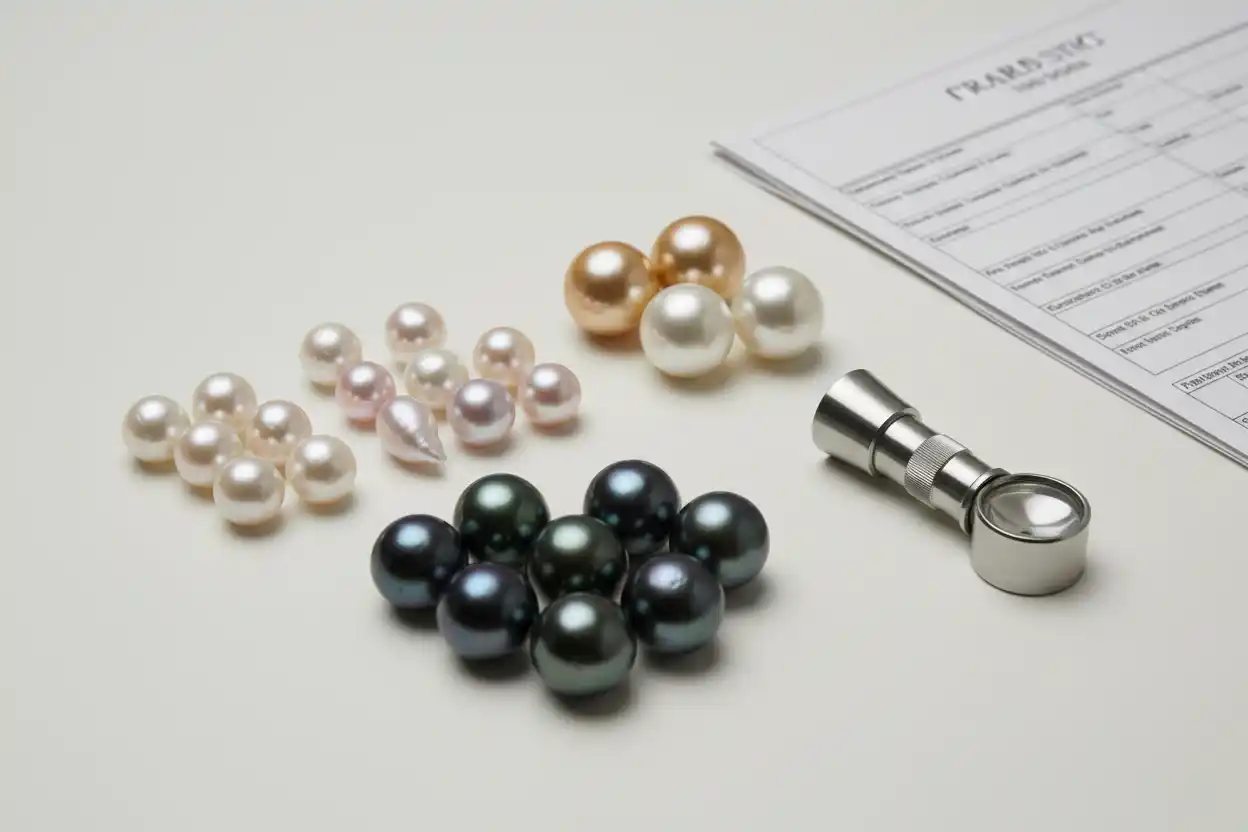
If you buy pearl jewelry primarily for a bright, classic white appearance, Akoya pearls are often associated with crisp reflections and traditional round strands. South Sea cultured pearls are typically sought for larger dimensions and white, silver, cream, or golden colors, while Tahitian cultured pearls are known for naturally dark body colors accompanied by green, gray, blue, bronze, aubergine, and peacock-like overtones.
Freshwater cultured pearls cover an especially broad spectrum of shapes, sizes, qualities, and natural colors. Modern high-quality freshwater pearls can be very round and highly lustrous, so the old assumption that freshwater automatically means irregular or inexpensive material is unreliable. The biological and commercial distinctions among these categories are explained in types of pearl.
When you buy pearl jewelry, compare like with like whenever possible. A seller claiming that one strand is a bargain because it costs less than a completely different pearl type may be creating a comparison that has little practical meaning.
Luster Should Usually Outrank Size
One of the most useful rules when you buy pearl jewelry is to prioritize luster before chasing the largest available diameter. A smaller pearl with crisp, bright reflections can look dramatically more refined than a larger pearl with dull, hazy, or chalky luster.
Look at the reflections on the pearl rather than merely asking whether the surface is shiny. Strong luster produces brighter, sharper reflections with noticeable contrast between light and dark areas. Weak luster makes reflections appear blurred, soft, flat, or milky.
Video is particularly useful here because the pearl should change dynamically as it moves relative to the light. When you buy pearl jewelry online, ask for a slow rotating video under neutral illumination if the existing images are heavily edited or insufficient. Strong luster should remain visible from multiple positions rather than appearing only in one carefully arranged photograph.
Do not assume that a mirror-like surface automatically proves high quality, either. Coatings and aggressive processing can alter surface appearance, so luster must be considered alongside nacre, treatment disclosure, and overall identity.
Nacre Quality Is More Than a Technical Detail
Nacre quality matters because it contributes both to the optical character of many familiar pearls and to their ability to withstand ordinary handling. In bead-nucleated cultured pearls, the nacre surrounds an internal bead, and excessively thin or poor-quality nacre can create a less convincing appearance or expose structural weakness around worn areas.
When you buy pearl jewelry, look for a surface that has depth rather than a thin, chalky, plasticky impression. Obvious visibility of the underlying bead, pronounced chalkiness, peeling, or severe wear around drill holes deserves closer attention.
Nacre should not be judged through one photograph alone. Lighting, contrast, sharpening, and exposure can dramatically change how depth and luster appear on a screen. Requesting both close and normal viewing distances makes it easier to separate actual surface character from photographic enhancement.
A seller may quote nacre thickness or use descriptive terms, but those numbers and labels are useful only when they correspond to a meaningful measurement or recognized evaluation method. If a major purchase depends on a specific nacre claim, documentation becomes more important than marketing language.
Surface Blemishes: Decide Which Ones Actually Matter
Almost no pearl needs to be completely flawless to be attractive. Spots, pits, wrinkles, ridges, abrasions, flattened areas, and growth features can occur naturally, and the importance of each feature depends on its size, location, number, visibility, and effect on durability.
When you buy pearl jewelry, distinguish between character and damage. A few minor natural features on the back of an earring or near a drill hole may have little effect on appearance, while a deep crack, peeling area, widespread abrasion, or heavily damaged surface can be much more consequential.
Large uninterrupted clean areas are desirable, but a cleaner surface should not automatically outrank luster. A nearly spotless pearl with weak reflections can appear lifeless, whereas a highly lustrous pearl with a few discreet features may look significantly better when worn.
For baroque pearls, irregular surface texture can be part of the design rather than a defect. The question is whether the surface looks coherent and healthy for that pearl type, not whether it resembles a perfectly round bead.
Round Pearls Are Not Automatically the Best Buy
Perfectly or nearly round pearls can command a premium because producing attractive round pearls consistently is difficult, particularly when strong luster, clean surfaces, desirable color, and good matching are required simultaneously. That premium does not mean round is objectively more beautiful for every buyer.
Drop, oval, button, circled, and baroque pearls can offer far more visual personality, and a finely lustrous baroque pearl can be a better buy pearl choice than a mediocre round pearl at the same budget. When shape matters mainly for traditional studs or a classic strand, roundness carries more practical weight. For pendants and artistic jewelry, attractive asymmetry may be an advantage.
Do not pay a large premium for roundness while accepting obviously inferior luster or nacre. Shape should refine a good pearl, not rescue a weak one.
Color: Separate Preference From Rarity Claims
Color should be judged in several layers. A pearl has a dominant body color, may show an overtone over that body color, and can display shifting iridescent effects that change with viewing angle. Warm indoor lighting, colored backgrounds, aggressive white balance, and digital saturation can make all three look more dramatic than they actually are.
Before you buy pearl jewelry online, ask to see the actual item against a neutral white or gray background as well as in normal wearable lighting. If a Tahitian pearl looks electric green in every photograph, or a golden pearl appears intensely saturated without any neutral reference, request additional images before accepting the color representation.
Natural color should also make biological sense for the pearl type. Dark freshwater cultured pearls, for example, should not automatically be treated as equivalent to naturally dark Tahitian cultured pearls. Golden appearance alone does not prove golden South Sea origin.
Color preferences are personal, so there is no universal best shade. What matters commercially is whether the color is attractive within that pearl category, whether it is natural or treated as represented, and whether any premium is justified by the actual material.
Treatments Can Change the Buying Equation
Pearls may undergo cleaning, bleaching, polishing, luster enhancement, pinking, dyeing, irradiation, coating, filling, impregnation, or other post-harvest processing. Some processing is common within parts of the pearl trade, whereas other treatments have much greater implications for color rarity, surface durability, or value.
When you buy pearl jewelry, disclosure matters more than attempting to identify every treatment yourself. Dye can concentrate around drill holes or surface features, and coatings may eventually reveal peeling or differential wear, but sophisticated treatment cannot always be identified confidently from photographs.
A vivid color that carries a premium deserves more scrutiny than a modestly priced fashion color. Likewise, a naturally colored Tahitian or golden South Sea claim should be treated differently from a clearly disclosed dyed freshwater product. Neither item is automatically bad; they simply belong to different value propositions.
The treatment possibilities and their limitations are covered in more detail under treated pearl. Use that distinction when a seller relies on vague phrases such as “enhanced naturally,” “premium processed,” or “permanent color” without explaining what was actually done.
“Synthetic Pearl” Is Usually the Wrong Question
Buyers sometimes ask whether they should buy pearl jewelry that is natural, cultured, or synthetic, but the terminology can be misleading. Cultured pearls are genuine biological pearls created within living mollusks after deliberate human intervention; they are not the pearl equivalent of a laboratory-grown crystalline gemstone.
Products sold loosely as synthetic pearls are more commonly imitation pearls made from coated glass, plastic, ceramic, shell, resin, or other manufactured materials. High-quality imitation pearls can be attractive jewelry products, but they should be represented and priced as imitation material rather than confused with cultured pearls.
When you buy pearl jewelry, insist on specific wording. “Cultured freshwater pearl,” “cultured Akoya pearl,” “Tahitian cultured pearl,” or “glass imitation pearl” tells you far more than “real pearl,” “shell pearl,” or “synthetic pearl.”
Seller Grades Are Not Universal Standards
A major red flag appears when a seller presents a proprietary letter grade as though it were universally standardized. Terms such as A, AA, AAA, AAAA, gem quality, top grade, investment grade, or museum grade can be defined differently by different companies.
This does not make every grading system useless. A consistent seller can use an internal scale to separate its own inventory, but buyers should be able to see what the grade means in measurable or observable terms.
Before you buy pearl jewelry based on a grade, ask how the seller evaluates luster, surface, shape, nacre, color, and matching. If “AAAA” is the entire explanation, you still do not know enough to compare the pearls with another seller’s product.
The photographs and return policy ultimately matter more than an impressive sequence of letters.
Matching Is a Major Quality Factor for Pearl Jewelry
Matching becomes crucial whenever the jewelry contains multiple pearls. Earrings, strands, bracelets, and multi-pearl pendants should be evaluated not only pearl by pearl but also as a complete composition.
When you buy pearl earrings, compare diameter, shape, luster, body color, overtone, and surface appearance between the pair. A technically excellent pearl can still make a poor pair if its partner is noticeably duller or differently colored. Pearl earrings deserve especially close attention because the two pearls are often seen together in symmetrical positions.
For a classic strand, move your eye from one end to the other. Matching should look intentional in size, luster, color, shape, and overall quality. Graduated strands are deliberately different in size, while multicolor designs may deliberately vary in hue, but uncontrolled shifts in luster or surface quality usually look accidental.
Matching can justify a premium because assembling many pearls with compatible characteristics requires more sorting than selecting one attractive loose pearl.
Size Should Be Compared Within the Same Pearl Type
Larger pearls can be more valuable when other factors are comparable, but “bigger is better” is one of the easiest ways to overpay. A large dull pearl with weak nacre or poor surface condition may be less desirable than a smaller, brighter example.
When you buy pearl jewelry, compare diameter within the appropriate pearl category and quality level. A size that is common for one cultured-pearl type may be unusual for another, so cross-type comparisons based only on millimeters are misleading.
Also check whether dimensions are stated as a range. Pearl strands may be described with a size interval because individual pearls vary slightly. If a seller advertises a strand using only its largest pearl without explaining the range, the specification can create an inflated impression.
When Is a Laboratory Report Worth Paying For?
Not every pair of modestly priced cultured pearl studs needs an independent laboratory report. Documentation becomes increasingly useful as the premium depends on claims that cannot be established reliably through ordinary visual inspection.
A laboratory report deserves serious consideration when you buy pearl material sold as natural rather than cultured, when a rare biological origin is important to the value, when a valuable dark or unusual color is represented as natural, when an important antique strand lacks clear documentation, or when treatment status materially affects the price.
Professional pearl analysis can evaluate issues such as natural versus cultured origin, saltwater versus freshwater environment, internal structure, biological characteristics when determinable, and detectable treatment. More extensive services may also classify cultured pearls according to recognized quality factors.
A report is evidence about the gem material. It is not a guarantee that you received a bargain.
Laboratory Report Versus Appraisal
A laboratory report and an appraisal answer different questions. The report concerns identity, characteristics, and potentially treatment or classification, while an appraisal estimates monetary value for a stated purpose.
When you buy pearl jewelry at a significant price, do not accept an appraisal as proof that an undocumented natural-pearl claim is correct. The appraiser may rely on information supplied by the owner or seller unless independent gemological testing was performed.
Likewise, a laboratory report does not necessarily tell you what the jewelry should sell for. Market value depends on quality, design, maker, condition, provenance, demand, and other commercial factors beyond basic identification.
For higher-value purchases, the strongest documentation separates these functions instead of pretending one document proves everything.
Match the Report to the Exact Pearls
A legitimate report has little value if it belongs to another strand. When documentation is part of your decision to buy pearl jewelry, verify that the identifying information corresponds to the exact item being offered.
Compare the number of pearls, dimensions, weight where stated, shape, color, photographs, identifying characteristics, and any report number or verification mechanism. For a loose pearl, confirm that measurements and appearance are consistent. For a strand, check the pearl count and length description if supplied.
Do not accept a photograph of an impressive report accompanied by a seller’s assurance that it represents “the same quality.” If the premium depends on laboratory findings, the documentation should relate to the exact item you are purchasing.
Actual-Pearl Photos Matter More Than Catalog Images
Stock photography is especially problematic when you buy pearl jewelry because luster, surface features, matching, orient, and color vary from pearl to pearl. A catalog image can show the general design while revealing almost nothing about the quality of the exact piece you will receive.
Request actual-item photographs for expensive purchases. Useful images include a full view, close surface view, side view, drill-hole area when accessible, clasp or setting, and neutral-background image. A slowly rotating video adds valuable information about luster and surface consistency.
The lighting should not be so diffuse that every blemish disappears, nor so harsh that reflections obscure the surface. Ideally, you want enough variation to judge both appearance and condition.
Watch for White-Balance and Background Manipulation
Pearl color is unusually vulnerable to photographic presentation. Warm light can make cream and golden tones richer, while cool light can make whites appear brighter and dark pearls appear more blue or green. Colored surroundings can also reflect directly onto the surface.
Before you buy pearl jewelry based on a specific overtone or body color, compare photographs against neutral surroundings. If every image uses dramatic black velvet, sunset-colored light, or highly saturated styling, request a plain reference image.
The goal is not to eliminate attractive photography. It is to understand what the pearls look like without presentation techniques doing most of the work.
Examine Drill Holes and Mounting Quality
Drill holes can reveal useful information about condition and workmanship. Chipping, peeling coating, excessive wear, dark discoloration, exposed nuclei, glue residue, or poorly centered drilling can affect both appearance and durability.
For a strand, inspect how the pearls sit on the thread. Knots between pearls can reduce rubbing and help prevent the loss of multiple pearls if the thread fails. The clasp should function securely and should not place abrasive metal directly against vulnerable surfaces.
For earrings and pendants, check whether caps, posts, bails, or cups are properly aligned and whether adhesive is visible. A beautiful pearl attached carelessly to poor-quality findings can still be a disappointing purchase.
Return Terms Are Part of Pearl Quality Control
When you buy pearl jewelry remotely, the return policy becomes part of your inspection process because photographs cannot fully communicate luster, color, surface texture, weight, or matching.
The policy should give you a reasonable opportunity to inspect the exact item without requiring you to remove tags or alter the jewelry first. Check whether custom stringing, drilled loose pearls, resized items, personalized pieces, or sale items are excluded.
Also read who pays return shipping, whether insurance is required, whether restocking charges apply, and what happens if the item differs materially from the seller’s description.
A seller who makes unusually strong natural-origin or untreated-color claims while making returns effectively impossible deserves additional scrutiny.
Put Important Claims on the Invoice
Before you buy pearl jewelry carrying a meaningful premium, make sure the invoice states the attributes you are actually paying for. A vague receipt saying “pearl necklace” is weak documentation if the sales presentation emphasized natural origin, Tahitian identity, natural color, exceptional matching, or a particular treatment status.
Useful wording can identify the pearls as cultured or natural, name the pearl type when known, describe important treatment disclosures, and reference an accompanying independent report where applicable.
Written descriptions reduce ambiguity after the sale and make it easier to resolve a dispute if the delivered material does not match the representation.
Understand the Value Trade-Offs Before You Buy Pearl
A limited budget does not require buying the lowest-quality version of every factor. It is usually more effective to decide which attributes create the greatest visible benefit for your intended jewelry.
For classic earrings, strong luster and close matching may deserve more of the budget than maximum diameter. For a statement pendant, an attractive baroque shape can allow you to buy pearl material with exceptional luster at a lower cost than a similarly impressive round pearl.
For strands, matching and overall visual continuity become more important because dozens of pearls are viewed together. For collectors, biological origin, unusual natural color, rarity, documentation, and provenance may deserve more weight than ordinary wearability.
The broader factors that influence market pricing are discussed in pearl price, but the correct purchase is the combination of quality and documentation that fits your own use rather than the highest nominal grade.
A Practical Buy Pearl Decision Matrix
Use this matrix to compare two or three candidates without allowing one impressive feature to dominate the entire decision.
| Factor | Strong choice | Acceptable trade-off | Red flag |
|---|---|---|---|
| Identity | Specific natural/cultured/type description | Broad cultured category at modest price | Vague “real pearl” claim with premium pricing |
| Luster | Bright, sharp reflections | Good brightness with slightly softer reflections | Dull, chalky, flat appearance |
| Nacre | Healthy-looking surface and convincing depth | Minor variation appropriate to type | Obvious thinness, peeling, nucleus exposure |
| Surface | Minor discreet features | Visible but non-structural marks at fair price | Deep cracks, widespread abrasion, major damage |
| Color | Attractive and accurately represented | Disclosed treatment at appropriate price | Rare natural-color claim without support |
| Shape | Attractive and appropriate for design | Intentional baroque or asymmetric form | Misrepresented roundness |
| Matching | Consistent or deliberately graduated | Small variations that are not distracting | One or more obviously mismatched pearls |
| Treatment | Clearly disclosed | Routine processing understood | Evasive wording or undisclosed coating/dye concerns |
| Documentation | Report where claims justify it | Detailed seller disclosure for ordinary cultured pearls | Expensive natural claim based only on verbal assurance |
| Images | Actual item, neutral light, multiple angles | Clear video plus adequate close-ups | Stock image only for expensive item |
| Returns | Inspection-friendly | Reasonable restrictions disclosed | No meaningful remedy for misrepresentation |
No single row should determine the purchase. If you buy pearl jewelry with exceptional luster but disclosed color treatment, that can still be an excellent value. A much more serious problem is paying a natural-color premium when the seller cannot substantiate the claim.
Pearl Resale Expectations
Pearl jewelry should normally be bought for beauty, use, design, collectability, or personal significance rather than an assumption of easy resale. Retail price includes margins, jewelry construction, branding, matching labor, presentation, and other costs that may not transfer fully to the secondary market.
Natural pearls, exceptional documented material, important signed jewelry, and historically significant pieces can behave differently from ordinary cultured jewelry, but that does not create a guaranteed investment outcome.
When you buy pearl jewelry, treat future resale as uncertain unless you understand the specific secondary market for the exact category. Documentation, condition, recognized maker, rarity, and provenance may help, but none guarantees appreciation.
Durability and Jewelry Suitability
Pearls are considerably more vulnerable to abrasion, acids, cosmetics, heat, harsh chemicals, and aggressive cleaning than many crystalline gemstones. Their relatively soft surface means that storage and wear habits matter.
If you buy pearl jewelry for frequent use, inspect how exposed the pearls are. Earrings and pendants often receive less abrasion than rings or bracelets, while strands can rub against skin, clothing, clasps, and neighboring jewelry.
Pearls should generally be put on after perfume, hairspray, cosmetics, and other personal products have been applied. Wiping them gently after wear can remove surface residue that would otherwise remain on the nacre.
Detailed physical maintenance is covered in how to clean pearl jewelry.
Red Flags When You Buy Pearl
The strongest red flags are not minor natural blemishes. They are contradictions between the seller’s claims, evidence, photographs, and price.
Be cautious when a listing uses “natural pearl” casually for ordinary cultured material, calls every imitation product synthetic pearl, claims an unusual color is completely natural without meaningful support, or relies on an impressive proprietary grade without explaining what was assessed.
Other warning signs include stock photographs for a costly one-of-a-kind item, overexposed images that hide surface condition, photographs with radically different color balance, no clear return procedure, reluctance to show drill holes or side views, and an appraisal being presented as unquestionable proof of natural origin.
Perfectly round, perfectly matched pearls offered at an implausibly low price are not automatically fake, but the combination should encourage closer examination of pearl type, surface quality, treatments, and whether the photographs show the actual product.
A Better Way to Buy Pearl Jewelry
If you want to buy pearl jewelry efficiently, begin by defining the category you actually want. Decide whether you prefer freshwater, Akoya, Tahitian, South Sea, another cultured type, or documented natural pearls. That decision immediately makes the remaining comparisons more meaningful.
Next, compare luster first, then nacre and surface quality. Judge shape and color according to your aesthetic preference while confirming that any rarity premium is justified. For multi-pearl jewelry, evaluate matching as an independent quality factor rather than assuming every pearl in the piece is equivalent.
After that, investigate treatments and documentation. Expensive natural-origin, rare-color, or unusual identity claims deserve stronger evidence than ordinary commercial cultured pearls. Finally, inspect actual-item images, read the return terms, and ensure important representations appear in writing.
The best buy pearl decision is rarely the largest pearl, the highest proprietary grade, or the lowest advertised price. It is the pearl whose identity is clearly represented, whose luster and surface quality are visible, whose treatments are understood, and whose price reflects what the item actually is.
Frequently Asked Questions
Are cultured pearls real pearls?
Yes. Cultured pearls are genuine biological pearls formed inside living mollusks after people deliberately initiate pearl growth. They are different from natural pearls because natural formation occurs without deliberate culturing intervention, and they are different from imitation pearls because their pearl material is produced by the mollusk.
What should I prioritize first when I buy pearl jewelry?
Establish identity and pearl type first, then prioritize luster, nacre quality, surface condition, color, shape, size, and matching. A large pearl with dull luster or weak nacre is not necessarily a better purchase than a smaller pearl with stronger overall quality.
Is AAA the best pearl grade?
Not necessarily. Letter grades are not universally standardized across all pearl sellers, so an AAA grade from one company may not represent the same quality as AAA from another. Ask what the grade means in terms of luster, surface, nacre, shape, color, and matching.
Should I buy pearl jewelry with small blemishes?
Minor surface features can be perfectly acceptable, particularly when luster is strong and the features are discreet. More serious concerns include deep cracks, widespread abrasion, peeling coatings, obvious nacre damage, or blemishes that materially weaken the pearl.
Are freshwater pearls lower quality than saltwater pearls?
Not automatically. Freshwater cultured pearls range from inexpensive commercial material to highly lustrous, round, finely surfaced pearls. Quality should be judged on the individual pearls rather than assuming that the freshwater category is inherently poor.
Are black pearls naturally black?
Some cultured pearls, especially Tahitian pearls, naturally occur in dark gray, green, blue, bronze, aubergine, and related colors. Freshwater and other pearls can also be dyed or otherwise treated to create dark colors, so type and treatment disclosure matter when color carries a premium.
How can I tell whether a natural pearl claim is genuine?
Visual inspection alone is generally insufficient for an important natural-versus-cultured determination because both categories can look very similar externally. A significant natural-pearl claim is an appropriate situation for independent laboratory examination using internal imaging and other analytical methods.
Should every pearl have a laboratory report?
No. Ordinary cultured pearl earrings, pendants, or strands can often be purchased sensibly without individual laboratory documentation when the identity and price are straightforward. Reports become more valuable when natural origin, rare color, treatment status, unusual biological identity, or a substantial premium depends on claims that cannot be confirmed visually.
Is a pearl appraisal the same as a laboratory report?
No. An appraisal estimates monetary value for a stated purpose, while a gemological report addresses identity and characteristics. An appraisal should not be treated as a substitute for independent testing when the purchase depends on proving natural origin or another technically significant claim.
Is bigger always better when I buy pearl jewelry?
No. Size adds value only in combination with the other quality factors. Strong luster, good nacre, attractive surface condition, and appropriate matching can make a smaller pearl far more appealing than a larger but dull or damaged example.
Can treated pearls still be worth buying?
Yes. A treated pearl can be attractive and appropriate when the treatment is understood, disclosed, durable enough for the intended use, and reflected fairly in the price. The problem is misrepresentation, particularly when treated color or coating is sold as rare natural material.
What photos should I request before I buy pearl jewelry online?
For a meaningful purchase, request images of the exact item under neutral lighting, close surface views, side angles, and visible drill-hole or mounting areas where practical. A slow rotating video is especially useful for judging luster, color shifts, surface features, and matching.
How should I care for pearls after purchase?
Keep pearls away from abrasive contact, strong chemicals, excessive heat, harsh jewelry cleaners, and aggressive mechanical cleaning. Apply cosmetics and fragrance before putting on the jewelry, wipe the pearls gently after wear, and store them separately from harder jewelry that could scratch the surface.
Where does pearl symbolism fit into a buying decision?
Symbolism is a cultural and personal consideration rather than a gemological quality factor. If the historical and traditional associations of the material are part of why you want to buy pearl jewelry, pearl meaning provides that context separately from measurable buying characteristics.
Final Buying Checklist
Before you buy pearl jewelry, make sure you can answer the basic questions that determine what you are paying for. You should know whether the material is natural, cultured, or imitation; which pearl type is represented; how strong the luster is; whether the nacre and surface appear healthy; whether the color is natural or treated as claimed; and whether multiple pearls are properly matched.
For higher-value purchases, confirm that any laboratory documentation belongs to the exact pearls being sold, distinguish identification evidence from appraisal value, and place important commercial claims in writing. Inspect actual-item photographs rather than relying only on representative images, and understand the return terms before payment.
The Buying & Value section places pearl purchasing within the wider task of comparing gem identity, quality, treatment, documentation, and price. Applied specifically to pearls, the central principle is straightforward: buy the identity first, the luster second, and the size only after the fundamentals are right.