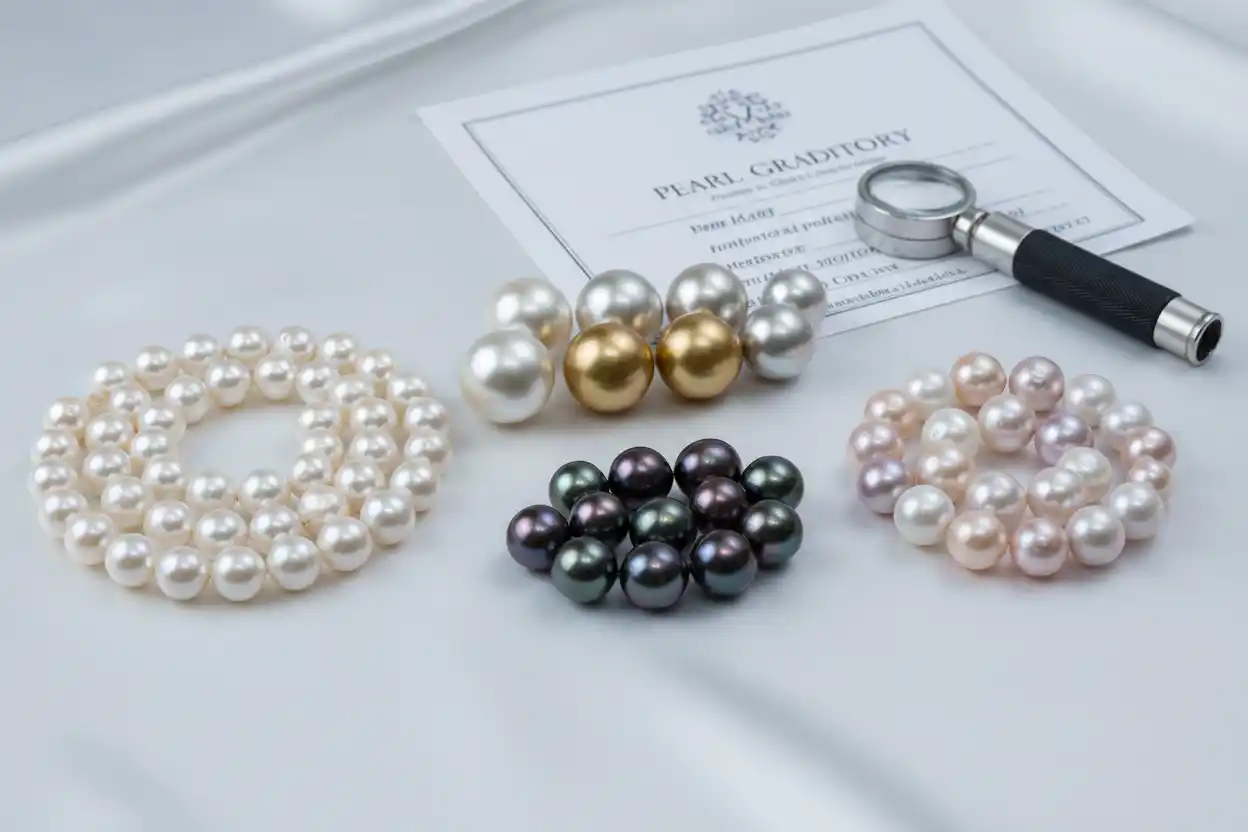
Pearl Price Guide: Value and Cost in 2026
Pearl prices in 2026 range from under $10 for an ordinary cultured Freshwater Pearl to more than $100,000 for an exceptional South Sea strand or important natural Pearl jewel. Most good cultured Pearl necklaces sell between approximately $200 and $10,000, depending on Pearl type, size, luster, surface quality and matching.
Pearls are rarely valued by carat weight. Dealers normally price them by millimeter size, individual Pearl, matched pair, strand or completed piece of jewelry.
Pearl Prices by Type in 2026
The first step in valuing Pearls is identifying their type. Freshwater, Akoya, Tahitian and South Sea Pearls come from different mollusks, grow in different size ranges and occupy different commercial markets.
| Pearl type | Typical loose Pearl price | Typical necklace price |
|---|---|---|
| Commercial Freshwater | $5–$50 per Pearl | $50–$500 |
| Fine Freshwater | $50–$300 per Pearl | $500–$5,000+ |
| Commercial Akoya | $20–$150 per Pearl | $300–$2,000 |
| Fine Akoya | $150–$800+ per Pearl | $2,000–$15,000+ |
| Commercial Tahitian | $50–$300 per Pearl | $800–$5,000 |
| Fine Tahitian | $300–$2,000+ per Pearl | $5,000–$30,000+ |
| Commercial South Sea | $100–$600 per Pearl | $2,000–$10,000 |
| Fine South Sea | $600–$5,000+ per Pearl | $10,000–$100,000+ |
| Natural Pearl | Individually evaluated | Hundreds to millions |
These ranges describe cultured-Pearl retail markets unless stated otherwise. A famous brand, rare natural origin, exceptional matching or historic provenance can push the total far above ordinary market levels.
The principles behind rarity, quality and demand appear in How Gemstone Prices Are Determined, although Pearls use their own specialized quality system.
Natural vs Cultured Pearls
A natural Pearl forms without deliberate human implantation. Such Pearls are exceptionally rare because most wild mollusks never produce a usable gem.
A cultured Pearl also forms inside a living mollusk, but a technician initiates the process by inserting tissue, a bead nucleus or both. The mollusk then deposits nacre around that material.
Cultured does not mean imitation. Freshwater, Akoya, Tahitian and South Sea cultured Pearls contain genuine biogenic Pearl material.
Most Pearls sold in modern jewelry are cultured. Natural Pearls belong to a much smaller auction and collector market where species, laboratory identification, provenance, size and historic importance can dominate value.
The completed Pearl guide owns the material’s biological formation, physical properties and traditional symbolism.
The Seven Pearl Value Factors
The Gemological Institute of America evaluates Pearl quality through seven factors:
- Size
- Shape
- Color
- Luster
- Surface quality
- Nacre quality
- Matching
No single factor establishes value. A large Pearl with dull luster and extensive surface damage can cost less than a smaller Pearl with sharp reflections and clean nacre.
Strands require all seven factors to align across numerous Pearls. Consequently, matching can make a necklace worth much more than the sum of its individual components.
Luster Is the Most Important Visual Factor
Luster describes the brightness and sharpness of reflections from a Pearl’s surface.
Fine Pearls show crisp reflections with strong contrast between bright and dark areas. The surface appears luminous, and the glow seems to come from within the nacre rather than sitting as a flat shine.
Weak-luster Pearls look chalky, dull or plastic-like. Even a large, round and clean Pearl loses substantial value when its reflections lack sharpness.
Luster should be judged in diffuse neutral light. Direct spotlights can make ordinary Pearls appear brighter than they look during normal wear.
When comparing necklaces, examine whether every Pearl shows similar luster. One dull section can weaken the appearance of the entire strand.
Nacre Quality and Durability
Nacre consists primarily of microscopic calcium-carbonate structures and organic material deposited by the mollusk.
Thick, continuous nacre generally supports stronger luster and better long-term durability. Thin or poorly formed nacre can reveal the bead nucleus, create a chalky surface or lead to premature wear.
Akoya Pearls deserve particular attention because their bead nuclei can occupy most of the interior. High-quality farming and sufficient cultivation time are necessary to build an attractive nacre layer.
Freshwater Pearls traditionally contained mostly nacre because many were tissue nucleated. Modern bead-nucleated Freshwater products vary, so buyers should not assume one construction from the Pearl type alone.
The newest GIA nacre classification uses a more detailed quality scale rather than treating nacre only as acceptable or unacceptable. Nevertheless, ordinary buyers should focus on luster, surface appearance and dependable seller disclosure.
Pearl Surface Quality
Most cultured Pearls contain some natural surface features. These may include pits, bumps, wrinkles, scratches, ridges or flattened areas.
A few small marks can be acceptable, especially when positioned near a drill hole or concealed by a setting.
Value declines when blemishes are numerous, deep or concentrated on the most visible area. Cracks, peeling nacre and extensive abrasion are more serious than small growth spots.
A smooth-looking Pearl should still be inspected closely. Coatings, heavy polishing or image editing can conceal an uneven surface.
For strands, surface quality should remain reasonably consistent from the center Pearls toward the clasp.
Shape and Pearl Value
Round Pearls receive the strongest traditional premium because perfect spherical growth is uncommon.
Near-round Pearls offer a similar appearance for less money. Oval, drop, button and circled shapes occupy different jewelry markets.
Baroque Pearls have irregular forms. Commercial baroque strands can be inexpensive, while exceptional flame, soufflé and artistically shaped Pearls may command premium designer prices.
A symmetrical drop can be particularly valuable for pendants and earrings. Matching two drops in shape, dimensions, color and luster increases the price sharply.
Shape should suit the design. An attractive baroque Pearl is not inherently lower quality when its irregularity creates the jewel’s intended character.
Pearl Color and Overtone
Pearl color includes body color, overtone and orient.
Body colors include white, cream, silver, gray, black, golden, yellow, pink, peach, lavender, green and blue.
Overtone is a translucent secondary color visible over the body. Common examples include rose, silver, cream, green and peacock.
Orient is the delicate rainbow-like iridescence seen in some Pearls, particularly fine thin-skinned or baroque material.
Color value depends on Pearl type and market preference. Rose overtone can strengthen white Akoya demand, peacock green can enhance Tahitian Pearls, and deep natural gold can command a major South Sea premium.
An unusual color is valuable only when luster and surface quality are also strong. Dyed or irradiated color should be disclosed and priced below comparable natural-color material.
Pearl Size and Price Thresholds
Pearls are measured in millimeters rather than carats.
Price rises as diameter increases, but the rate differs by Pearl type. A 9 mm Akoya is large for its category, while a 9 mm South Sea Pearl is relatively small.
| Pearl diameter | General market interpretation |
|---|---|
| 4–6 mm | Small Freshwater or Akoya Pearl |
| 6–8 mm | Common Freshwater and classic Akoya range |
| 8–10 mm | Large Akoya, medium Tahitian or small South Sea |
| 10–12 mm | Premium Freshwater, Tahitian or South Sea range |
| 12–15 mm | Large Tahitian and South Sea Pearl |
| Above 15 mm | Rare large South Sea, Tahitian or specialty Pearl |
A one-millimeter increase becomes more significant at larger diameters because volume rises rapidly. Fine matching also becomes increasingly difficult as size increases.
Freshwater Pearl Prices
Freshwater Pearls provide the broadest affordable market. Most are cultivated in China, although freshwater mollusks exist in other regions.
Commercial strands can cost approximately $50 to $300. They may include off-round Pearls, moderate surface features and softer luster.
Good round or near-round strands commonly range from $300 to $1,500. Fine high-luster necklaces can cost $1,500 to $5,000 or more.
Modern bead-nucleated Freshwater Pearls, sometimes marketed under names such as Edison, can reach 10 to 15 mm with strong luster and rich pink, peach or lavender colors. Exceptional examples may approach Akoya or South Sea prices.
The name Freshwater does not automatically mean inexpensive. Roundness, sharp luster, size and matching determine whether a strand belongs to an entry or premium tier.
Akoya Pearl Prices
Akoya Pearls are associated with the classic round white Pearl necklace. Japanese production has the strongest brand recognition, although Akoya cultivation also occurs elsewhere.
Entry necklaces commonly cost approximately $300 to $1,000. These strands may contain smaller Pearls, moderate blemishes or softer luster.
Good 7 to 8 mm necklaces often range from $1,000 to $4,000. Fine 8 to 9 mm strands with sharp reflections can cost $3,000 to $10,000.
Premium Hanadama-quality or branded Akoya strands may exceed $10,000, especially at large diameters.
The term Hanadama should be supported by the relevant laboratory documentation rather than used as a generic synonym for good Akoya.
Recent production challenges and reduced supply of fine Japanese material have strengthened prices, particularly for larger high-luster Pearls.
Tahitian Pearl Prices
Tahitian Pearls form in black-lipped oysters and are cultivated primarily in French Polynesia.
Their body colors range from light silver and gray to charcoal and nearly black. Overtones can include green, peacock, aubergine, blue, rose and gold.
Commercial strands commonly cost approximately $800 to $3,000. Good necklaces generally range from $3,000 to $10,000.
Fine large, round and well-matched strands can reach $10,000 to $30,000 or more. Exceptional loose Pearls with vivid peacock overtone and excellent surfaces may cost several thousand dollars each.
Naturally dark body color is part of Tahitian identity. Dyed black Freshwater Pearls should not be priced as Tahitian material.
Strong green or peacock color can add value, but flat gray Pearls with weak luster remain commercial even at large sizes.
White South Sea Pearl Prices
White South Sea Pearls form in silver-lipped varieties of the large Pinctada maxima oyster. Major production regions include Australia, Indonesia and surrounding areas.
They commonly range from approximately 9 to 18 mm, making them larger than most Akoya and Freshwater Pearls.
Commercial strands may begin near $2,000 to $5,000. Good necklaces often range from $5,000 to $20,000.
Fine round strands with strong luster and clean surfaces can cost $20,000 to $100,000 or more.
Silver, white and subtle rose overtones affect appearance. Australian-origin branding can add a premium, although visible quality remains central.
South Sea luster often appears softer and more satin-like than the mirror-sharp reflection of top Akoya Pearls. That difference reflects nacre structure rather than automatically indicating lower quality.
Golden South Sea Pearl Prices
Golden South Sea Pearls also form in Pinctada maxima, particularly gold-lipped oyster varieties cultivated in the Philippines and Indonesia.
Light champagne or pale yellow Pearls generally cost less than rich natural gold.
Commercial strands may range from approximately $3,000 to $10,000. Fine deep-golden necklaces commonly reach $10,000 to $50,000.
Large, round and strongly saturated strands can exceed $50,000 or $100,000.
Golden color must be evaluated for natural origin. Dyeing can create or intensify yellow and gold tones in lower-value Pearls.
A richly colored Pearl with dull luster should not receive the same premium as one combining deep gold, clean nacre and sharp reflections.
Natural Pearl Prices
Natural Pearls occupy a separate market from ordinary cultured jewelry.
A small, unattractive natural Pearl may cost hundreds of dollars. Fine round or drop-shaped examples can reach thousands or tens of thousands per Pearl.
Historic natural-Pearl necklaces and jewels can sell for hundreds of thousands or millions, especially when they have royal, aristocratic or designer provenance.
Species identification is also important. Natural saltwater Pearls from certain oysters and conchs can occupy different collector categories.
An independent laboratory report is essential. Age, provenance and jewelry authorship require additional expertise beyond gemological identification.
Natural rarity should never be inferred merely because a Pearl looks irregular or old.
Pearl Matching and Strand Value
A fine strand requires dozens of Pearls that match in size, shape, body color, overtone, luster, surface and nacre.
Matching becomes more difficult as quality and size rise. This explains why a strand can cost far more than the total price of similar-looking loose Pearls.
Graduated necklaces allow a controlled size change from the center toward the clasp. Uniform strands require Pearls of nearly identical diameter throughout.
The clasp also affects the finished price. Gold, platinum, Diamonds, brand and craftsmanship can add hundreds or thousands of dollars.
A necklace should be evaluated laid straight and worn around the neck. Subtle mismatching may become more apparent once the Pearls reflect the same lighting.
The dedicated Pearl Necklace Guide owns strand length, clasp and styling choices.
Pearl Earrings and Matched Pairs
Pearl studs require a closely matched pair. Differences in size, shape or overtone become obvious because the Pearls sit at equal positions on opposite sides of the face.
Commercial Freshwater studs may cost below $100. Fine Akoya pairs commonly range from $200 to $2,000.
Large Tahitian and South Sea earrings can cost $500 to $5,000 or more. Exceptional matched pairs with rare size and clean surfaces may rise considerably higher.
Drop earrings require matching both overall outline and orientation. The difficulty of finding two compatible natural forms creates an additional premium.
Style and setting choices belong to the Pearl Earrings Guide.
Pearl Treatments
Cultured Pearls may receive bleaching, polishing, pinking, dyeing, irradiation or coating.
Bleaching and mild processing are common in portions of the white cultured-Pearl market. More substantial color modification should be disclosed.
Dyeing can create black, blue, gold, pink and other colors. Dye may concentrate around drill holes, blemishes or porous areas.
Irradiation can darken certain Pearls, while coatings may add luster or unusual color.
Treatment does not necessarily make a Pearl unattractive, but it should affect price and care instructions.
The complete detection scope belongs to How to Spot Treated or Synthetic Pearl, while general enhancement principles appear in Gemstone Treatments Explained.
Real vs Imitation Pearls
Glass, shell and plastic beads can imitate cultured Pearls.
Some imitations use a coated bead made from glass or shell. Others contain crushed shell material bound with resin.
Surface feel, drill-hole inspection, magnification and X-radiography can help distinguish products, although simple home tests are not conclusive.
The familiar tooth test can scratch delicate nacre and should not be treated as a professional identification method.
The full comparison belongs to Real vs Fake Pearl.
Mother-of-Pearl is shell material rather than a spherical Pearl. Its separate identity appears in the completed Mother-of-Pearl guide.
Pearl Jewelry Prices in 2026
| Jewelry type | Broad U.S. retail range |
|---|---|
| Freshwater Pearl earrings or pendant | $30–$500 |
| Freshwater Pearl necklace | $50–$5,000+ |
| Akoya Pearl earrings | $150–$2,500+ |
| Akoya Pearl necklace | $300–$15,000+ |
| Tahitian Pearl pendant or earrings | $300–$5,000+ |
| Tahitian Pearl necklace | $800–$30,000+ |
| South Sea Pearl earrings | $500–$10,000+ |
| South Sea Pearl necklace | $2,000–$100,000+ |
| Natural-Pearl or signed antique jewelry | Individually evaluated |
Brand can create a significant premium. A signed Mikimoto, Tiffany, Cartier or comparable jewel may be worth more than an unsigned piece containing similar Pearls.
The metal, Diamonds and craftsmanship also contribute to the total.
Pearl is one of June’s traditional birthstones. That context belongs to the June Birthstone Guide, while gift and styling intent belongs to June Birthstone Jewelry.
Certification and Pearl Reports
A laboratory report becomes useful when natural origin, Pearl type, treatment or high value affects the purchase.
X-radiography can reveal internal growth structures that separate natural from cultured Pearls. Additional testing can identify mollusk type, treatment and whether a product consists of shell imitation.
A classification report may record measurements, color, shape, environment and quality factors. It does not determine a retail price.
The report number, number of Pearls and measurements should match the actual strand or jewel.
The broader laboratory framework appears in Gemstone Certification Labs Compared.
Detailed purchasing questions belong to the Pearl Buying Guide.
Pearl Care and Condition
Pearls are much softer than most faceted gemstones. Perfume, hairspray, cosmetics, sweat, acids and abrasive storage can damage the nacre.
Pearls should be put on after cosmetics and removed before bathing, exercising or household cleaning.
After wear, wipe them gently with a soft damp cloth. Strands should be restrung periodically when the silk stretches, frays or becomes dirty.
Store Pearls separately from Diamond, Sapphire and harder jewelry. Airtight long-term storage can also be unsuitable because organic components benefit from a stable environment rather than extreme dryness.
The complete maintenance process belongs to How to Clean Pearl Jewelry Safely. Shell-jewelry care remains separate in How to Clean Mother-of-Pearl Jewelry Safely.
Do Pearls Hold Their Value?
Ordinary cultured Pearls usually resell below retail. New Freshwater and commercial Akoya products remain widely available, while retailer markup and matching labor are difficult to recover.
Fine South Sea, Tahitian and top Japanese Akoya strands can retain stronger demand when quality, brand and documentation are exceptional.
Natural Pearls and important signed jewelry occupy a separate collector market. Provenance can become as important as Pearl quality.
Condition matters greatly. Worn nacre, peeling, damaged drill holes and stretched stringing reduce resale value.
The broader secondary-market framework appears in Do Gemstones Hold Their Value?.
Price Guide vs Buying and Identification Guides
This page owns Pearl price ranges by type and quality.
The buying guide owns seller questions and practical strand inspection, while the authenticity page owns real-versus-imitation tests. Treatment identification remains on its dedicated page.
Pearls also belong to the wider group of organic gems described in Types of Gemstones.
Online shoppers should verify measurements, Pearl type, treatment, clasp metal and return terms using How to Buy Gemstones Online Without Getting Scammed.
The Buying & Value hub connects Pearl pricing with certification, treatment and resale guidance.
Frequently Asked Questions
1. How much are real Pearls worth in 2026?
Real cultured Pearls can cost from under $10 per Pearl to several thousand dollars each. Fine strands range from hundreds to more than $100,000.
2. Are cultured Pearls real Pearls?
Yes. Cultured Pearls form inside living mollusks and consist of genuine Pearl material, although humans initiate their formation.
3. Which Pearl type is most expensive?
Fine white and golden South Sea Pearls generally occupy the highest cultured-Pearl market. Exceptional natural Pearls can cost far more.
4. How much is a Freshwater Pearl necklace?
Commercial strands may cost $50 to $500. Fine round, high-luster or bead-nucleated necklaces can reach $500 to $5,000 or more.
5. How much is an Akoya Pearl necklace?
Akoya strands commonly cost approximately $300 to $10,000. Large premium or branded necklaces can exceed $15,000.
6. How much are Tahitian Pearls?
Individual Tahitian Pearls may cost $50 to $2,000 or more. Strands commonly range from $800 to $30,000.
7. How much are South Sea Pearls?
Loose Pearls commonly cost $100 to $5,000 or more. Fine necklaces can range from $10,000 to above $100,000.
8. What makes one Pearl more valuable than another?
Size, shape, color, luster, surface quality, nacre and matching determine value.
9. Are perfectly round Pearls always best?
Roundness receives a traditional premium, but fine drop and baroque Pearls can be valuable when their luster, shape and design are exceptional.
10. Do dyed Pearls have value?
They can have fashion-jewelry value, but they should cost less than comparable natural-color Pearls and require clear disclosure.
11. Do Pearls need a laboratory report?
Commercial cultured Pearls usually do not. Reports are important for natural-Pearl claims, unusual treatments and high-value strands.
12. Are Pearls a good investment?
Ordinary cultured Pearls usually resell below retail. Fine natural Pearls, exceptional South Sea strands and signed historical jewels have stronger collector potential.
Pearl Value Is Built Across an Entire Surface
Pearls cannot be judged through size or roundness alone. The finest examples combine sharp luster, healthy nacre, restrained surface features and a color that remains attractive in ordinary light.
In 2026, buyers can find appealing cultured Pearl jewelry below $500, while matched Akoya, Tahitian and South Sea strands rise into four- and five-figure markets. The price becomes defensible only when Pearl type and all seven quality factors support it together.