March Birthstone Jewelry: 12 Spiritual Meanings of Aquamarine Magic
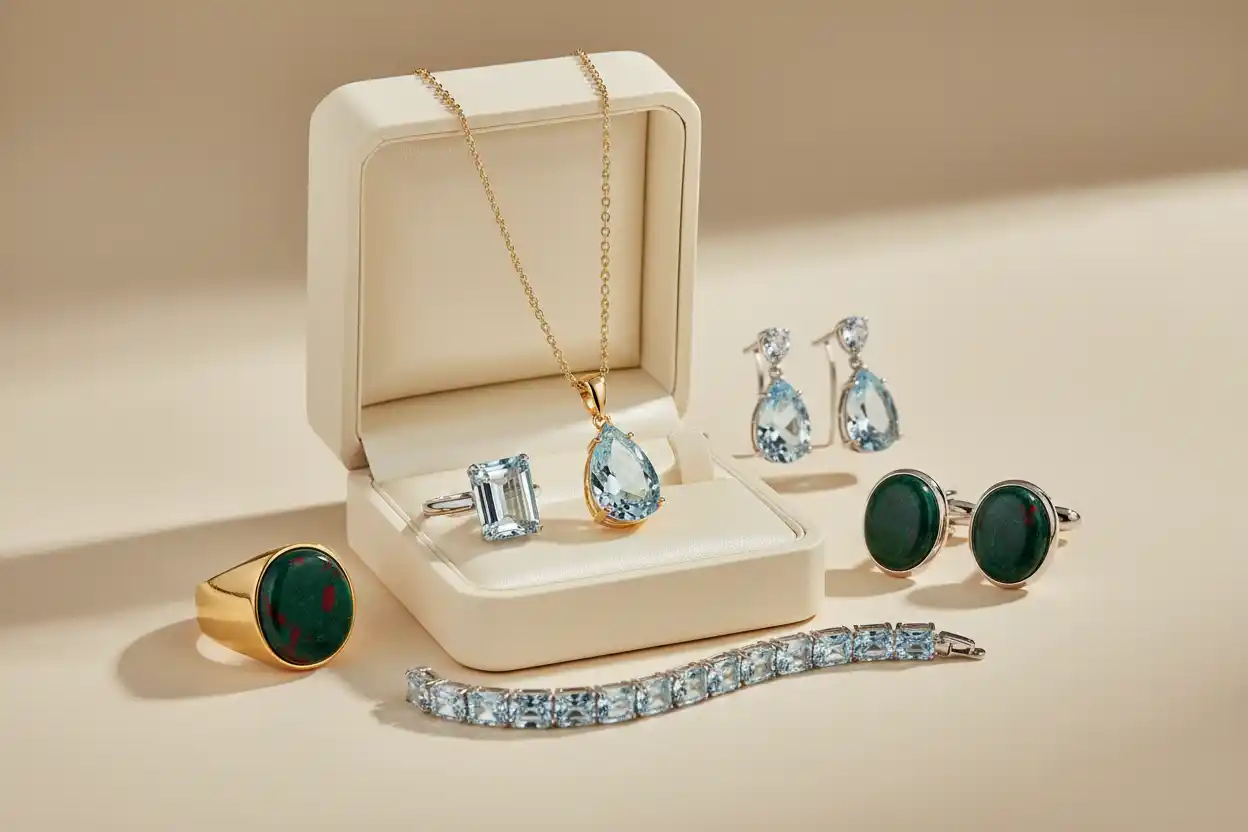
March birthstone jewelry is most closely associated with aquamarine, the blue to slightly greenish-blue variety of beryl whose clear watery appearance inspired a name derived from the Latin words for seawater. Aquamarine shares the beryl mineral species with emerald, but its visual character is usually much lighter, cleaner and more transparent. Fine stones combine strong clarity with an attractive blue or slightly greenish-blue color, and aquamarine ranks about 7.5 to 8 on the Mohs hardness scale, making it practical for rings, pendants, earrings and bracelets when normal jewelry care is used. Aquamarine is also associated with the nineteenth wedding anniversary.
March actually has two recognized birthstones: aquamarine and bloodstone. Bloodstone is a dark green chalcedony traditionally marked by red iron-oxide inclusions, while aquamarine provides the transparent blue appearance most often used in modern fine March birthstone jewelry. Both accumulated historical protection lore, but aquamarine became particularly connected with sailors, safe travel, marriage and the sea. GIA records old beliefs that aquamarine could calm waves, keep mariners safe and encourage happiness in marriage.
The “magic” in the title is therefore best understood as symbolism rather than supernatural force. Modern spiritual traditions often associate aquamarine with calm communication, emotional clarity, courage and renewal, but there is no established scientific evidence that wearing the gemstone alters anxiety, improves communication ability or generates a protective energy field. March birthstone jewelry can still carry powerful personal meaning through its color, history, durability and connection with the person wearing it.
12 Spiritual Meanings of March Birthstone Jewelry
- Blue aquamarine can symbolize calm and emotional steadiness.
- Its seawater name can represent movement and renewal.
- Ancient sailor lore can symbolize safe journeys.
- High transparency can represent honesty and clarity.
- Blue-green color can symbolize balanced communication.
- Marriage traditions can represent loyalty and partnership.
- Beryl durability can symbolize resilience.
- Springtime timing can represent new beginnings.
- Clear color can symbolize thoughtful decision-making.
- Aquamarine can represent courage during transition.
- March birthstone identity can express personal belonging.
- Spiritual “magic” remains symbolic rather than scientifically proven.
Aquamarine Gives March Jewelry Its Distinctive Watery Blue Character
Aquamarine’s name and color have shaped its identity for centuries. The gemstone belongs to beryl, with the chemical composition Be₃Al₂Si₆O₁₈, and typically appears blue, greenish blue or green-blue. GIA describes moderately strong dark blue to slightly greenish blue as the preferred market color, although much commercial aquamarine is lighter and more pastel.
That watery appearance naturally encourages symbolism involving calmness, flow and emotional openness. A March birthstone pendant may remind someone to approach a difficult situation more calmly, while a ring given during a major life transition might represent flexibility and forward movement.
The symbolism is personal rather than physical. Aquamarine does not make water safer, control emotions or cause a person to communicate better. Its usefulness as a symbol comes from the way color and history help people attach meaning to an object.
The themes described through aquamarine benefits can therefore be meaningful when they are treated as traditions and personal interpretations rather than therapeutic effects.
Ancient Sailor Lore Created Aquamarine’s Protection Symbolism
Aquamarine has one of the clearest maritime legends among major gemstones. Its name is associated directly with seawater, and historical traditions claimed that it could calm waves and protect sailors. GIA records these beliefs as part of the gemstone’s history, along with the idea that aquamarine encouraged happiness in marriage.
Those stories explain why aquamarine still appears in modern travel, protection and courage symbolism. Someone may give March birthstone jewelry before a long journey or major relocation as a wish for safety and confidence.
That emotional use is very different from claiming that the gemstone physically prevents accidents.
Historical protection lore should be preserved as history, not converted into a modern safety guarantee.
Transparency Makes Aquamarine a Natural Symbol of Honesty
Fine faceted aquamarine is commonly expected to be eye-clean. Unlike emerald, where visible inclusions are widely accepted, most high-quality aquamarines show strong transparency and few inclusions visible without magnification. GIA specifically notes that eye-clean clarity is expected in fine faceted stones.
That physical clarity makes aquamarine especially easy to associate with honesty, openness and direct communication.
A piece of March birthstone jewelry can therefore serve as a symbolic reminder to speak clearly or approach relationships without unnecessary concealment.
The gemstone itself does not improve speech or interpersonal ability. What it can do is carry a meaning the wearer intentionally gives it.
Aquamarine Is Durable Enough for Everyday Jewelry
At Mohs 7.5 to 8, aquamarine has sufficient hardness for most jewelry styles, including rings. GIA describes it as durable when protected from hard knocks and scratching, and warm soapy water is a consistently safe cleaning method.
That makes aquamarine easier to wear regularly than many softer birthstones.
Rings still deserve sensible care because hardness measures scratch resistance rather than complete resistance to fracture. A vulnerable edge can chip from a sufficiently strong impact, and the metal setting itself may wear or bend long before the gemstone shows significant surface damage.
For someone who works frequently with their hands, a lower setting or protective bezel can make March birthstone jewelry more practical over decades of wear.
Heat Treatment Is Common in Aquamarine
Aquamarine is often heated to reduce greenish components and create a purer blue appearance. GIA notes that much aquamarine in the market has undergone heat treatment for this purpose and that the treatment is generally stable.
A heated stone is not automatically inferior.
Some buyers prefer greener natural-looking aquamarine, while others want the cleaner blue typically favored in the commercial market. The important issue is accurate disclosure when treatment status matters to the purchase.
Fracture filling is far less common but can occur, and such stones require more cautious cleaning. GIA recommends warm soapy water rather than ultrasonic or steam cleaning when fracture filling is present.
Color Matters More Than Geographic Origin
Aquamarine is mined in several regions, including Brazil and high-elevation deposits in Pakistan’s Karakoram region. GIA notes that Pakistan is an important source, with aquamarine mined at elevations reaching roughly 15,000 feet.
Yet origin alone does not make an aquamarine valuable.
GIA’s buyer guidance specifically states that famous mine names do not automatically add value. Fine color and clarity matter more than a prestigious locality label.
When comparing the factors behind aquamarine price, buyers should therefore concentrate on color saturation, transparency, cutting and size rather than paying a premium solely because a seller uses a famous geographic term.
Large Aquamarines Are More Available Than Many Buyers Expect
Aquamarine can form unusually large crystals, and high-quality stones in substantial sizes are much more available than comparable large emeralds, rubies or sapphires. GIA notes that fine aquamarine above 25 carats can be readily available and that extremely large crystals have been documented.
Larger stones can also display stronger color because aquamarine’s pale bodycolor often becomes more visually concentrated with greater size.
This creates attractive opportunities for March birthstone pendants and statement rings.
A larger gemstone is not automatically a better one, however. Poor cutting can create windowing, while weak color can make even a very large stone look washed out.
When you buy aquamarine, beauty should be judged face-up rather than through carat weight alone.
Cut Can Make Pale Aquamarine Look Much Better or Much Worse
Aquamarine’s naturally light color makes cutting especially important. Well-positioned facets can strengthen brightness and help the visible blue appear more concentrated, while a poorly proportioned stone can look watery or empty through the center.
GIA notes that aquamarine can be fashioned into many shapes, including emerald cuts, rounds and ovals, and that the gemstone’s transparency makes it particularly suitable for creative cutting.
Its pleochroism means different crystal directions can display nearly colorless and stronger blue appearances. Skilled orientation helps preserve the most attractive face-up color.
This is another reason why buying only from a photograph can be difficult. Video, neutral lighting and several viewing angles reveal far more about a finished aquamarine.
March Birthstone Jewelry Can Symbolize Courage Without Claiming Supernatural Protection
Courage is one of the more meaningful modern aquamarine interpretations because it fits both maritime folklore and the practical idea of navigating uncertainty.
Someone starting a new job, leaving home or recovering from a difficult period may choose a March birthstone necklace as a reminder to move forward deliberately.
The gemstone cannot create bravery biologically.
Its role is closer to that of a meaningful photograph, inscription or wedding ring. The object becomes associated with a decision or value, and seeing it can remind the wearer of that meaning.
This type of symbolism is psychologically understandable without claiming supernatural power.
Aquamarine and Emerald Are Mineral Relatives
Aquamarine and emerald are both varieties of beryl, but their appearance and clarity expectations differ dramatically.
Aquamarine tends to be blue to slightly greenish blue and often exceptionally transparent. Emerald is green to bluish green and commonly contains obvious inclusions and fractures.
This relationship makes aquamarine especially interesting in birthstone jewelry because two of the year’s major birthstones, March aquamarine and May emerald, belong to the same mineral species while looking remarkably different.
The comparison also illustrates why gemstone quality cannot be evaluated through one universal clarity rule. Eye-visible inclusions that might seriously reduce the value of fine aquamarine can be normal and accepted in emerald.
Bloodstone Is Also a Genuine March Birthstone
Because aquamarine dominates modern March fine jewelry, bloodstone is sometimes forgotten.
GIA recognizes both aquamarine and bloodstone as March birthstones. Bloodstone is traditionally dark green chalcedony with red iron-oxide markings and has its own long history of protective, strength and health-related folklore.
Someone who prefers opaque gemstones, dark colors or historically styled jewelry may therefore choose bloodstone without departing from the recognized March birthstone tradition.
Aquamarine simply offers a more transparent, faceted and conventionally fine-jewelry appearance.
Aquamarine Magic Should Stay Separate From Medical Claims
Modern crystal traditions sometimes describe aquamarine as calming anxiety, soothing the nervous system, improving throat health or encouraging communication.
There is no established clinical evidence for those claims.
The discussions around aquamarine healing properties are most responsibly understood as spiritual traditions and symbolic practices rather than healthcare.
Someone can still find meditation with aquamarine meaningful, particularly if its sea-blue color helps create a calm atmosphere. That subjective experience does not prove that the mineral produces a therapeutic field.
Keeping the distinction clear allows March birthstone jewelry to retain its history and symbolism without overstating its physical effects.
Conclusion
March birthstone jewelry is most strongly associated with aquamarine, a blue to slightly greenish-blue beryl valued for exceptional transparency, attractive color and useful durability at Mohs 7.5 to 8. Its maritime history created enduring symbolism involving safe travel, calmness, loyalty and courage, while its clear appearance makes honesty and emotional openness natural modern interpretations. Heat treatment is common and usually stable, and fine aquamarine is judged primarily through color, clarity, cutting and overall beauty rather than geographic origin. Bloodstone remains a second recognized March birthstone, but aquamarine provides the month’s most familiar faceted-jewelry identity. Its “magic” can be meaningful as symbolism without being treated as medical or supernatural fact.
FAQs About March Birthstone Jewelry
What are the March birthstones?
Aquamarine and bloodstone are both recognized March birthstones. Aquamarine is the transparent blue to greenish-blue variety of beryl, while bloodstone is a dark green chalcedony commonly marked by red iron-oxide inclusions.
Is aquamarine suitable for everyday jewelry?
Yes. Aquamarine ranks about 7.5 to 8 on the Mohs hardness scale and is durable enough for regular wear when protected from strong impacts and harder gemstones.
What aquamarine color is considered best?
The market generally favors moderately strong dark blue to slightly greenish blue. Fine stones should also show attractive transparency and even color.
Is aquamarine usually heat treated?
Yes. Much commercial aquamarine is heated to reduce greenish color and produce a purer blue appearance. The treatment is generally stable.
How should March aquamarine jewelry be cleaned?
Warm soapy water is consistently safe. Ultrasonic and steam cleaning are usually acceptable for sound untreated or heated aquamarine, but they should be avoided when the stone contains significant fractures, liquid inclusions or fracture filling.
Does aquamarine protect travelers?
Historical traditions associated aquamarine with sailor protection and calm seas, but there is no scientific evidence that the gemstone prevents accidents or physical danger.
Does aquamarine have healing magic?
There is no established scientific evidence that aquamarine treats anxiety, throat problems, emotional disorders or other health conditions. Healing and energetic interpretations belong to folklore and modern spiritual practice.
Disclaimer:
Spiritual, magical, healing, calming and protective meanings associated with aquamarine reflect historical lore, cultural symbolism and personal practice rather than established medical or psychological effects. March birthstone jewelry does not replace professional healthcare, and perceived aquamarine energy cannot determine gemstone authenticity, treatment or quality.