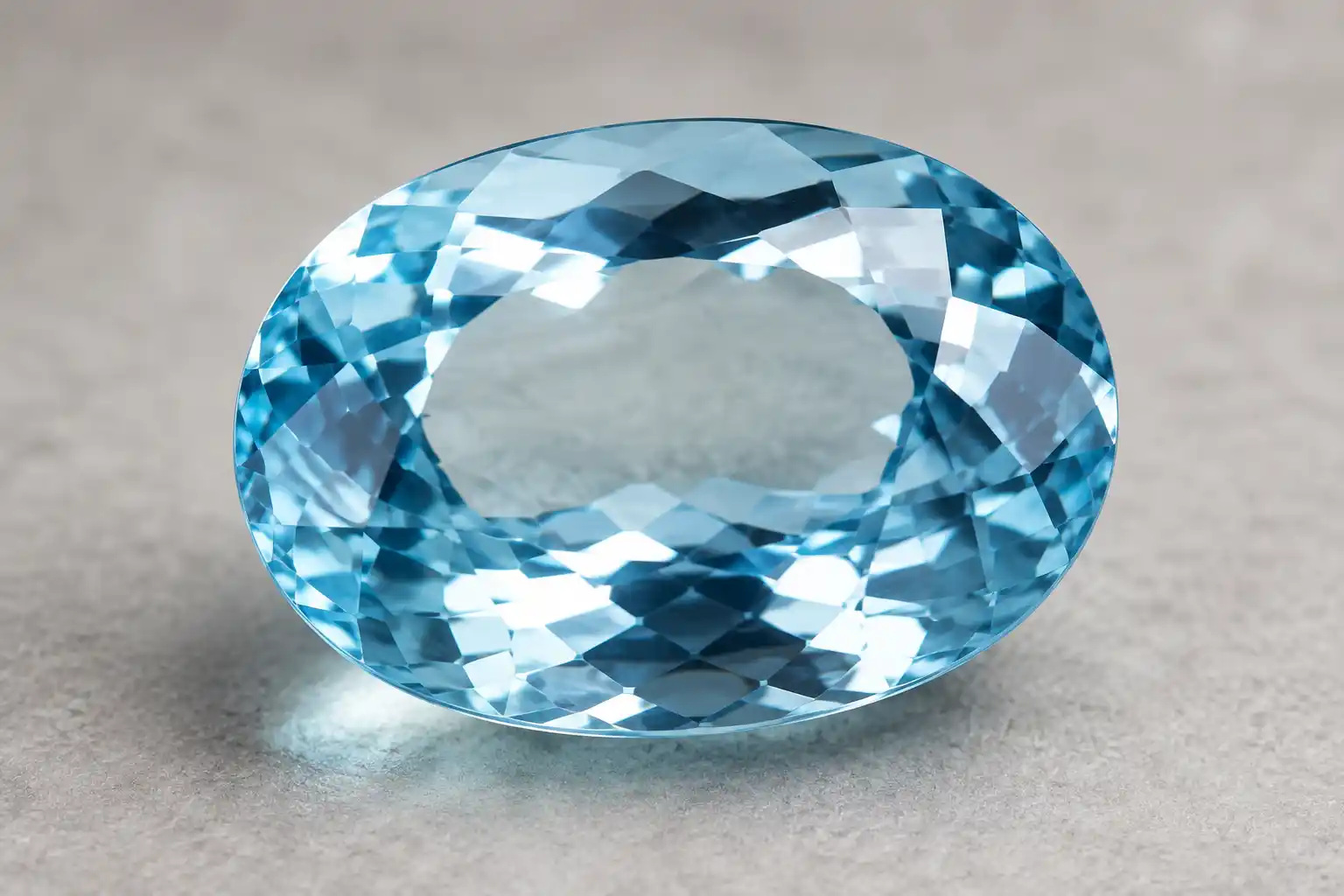
Buy Aquamarine: Purchase Checklist, Treatments, Grading & Cost
To buy aquamarine confidently, evaluate the actual gemstone rather than relying on size, an intense blue photograph, a prestigious locality name, or a seller-created quality grade. Fine aquamarine combines attractive blue to slightly greenish-blue color, strong transparency, competent cutting, suitable proportions, good condition, and clear disclosure of treatments and identity. Because aquamarine commonly forms as large, relatively clean crystals, impressive carat weight alone does not establish exceptional quality or rarity. GIA identifies color, clarity, cut, and carat weight as its principal quality factors and notes that fine stones typically display desirable blue to slightly greenish-blue color with good transparency.
Anyone planning to buy aquamarine should also understand what commercial terminology does and does not prove. Labels such as AAA, AAAA, premium, royal, vivid, or collector grade can be useful within an individual seller’s inventory, but they are not a universal aquamarine grading system. GIA specifically states that no standardized AAA-style quality scale exists for aquamarine and that GIA evaluates aquamarine through colored-stone identification reports rather than assigning the stone an overall quality grade. The practical buying approach is therefore straightforward: translate every attractive sales term into observable gemstone characteristics and documented claims.
Aquamarine Buying at a Glance
| Buying Factor | What to Look For | What Deserves Caution |
|---|---|---|
| Identity | Natural aquamarine supported by credible seller information or laboratory testing when warranted | Vague descriptions such as “aqua stone” without mineral identity |
| Color | Attractive blue to slightly greenish blue that remains appealing in ordinary lighting | Artificially intensified photographs or unexplained extreme saturation |
| Clarity | Good transparency and usually eye-clean appearance in faceted material | Prominent fractures, distracting inclusions, cloudiness, or undisclosed filling |
| Cut | Good symmetry, brightness, useful face-up size, minimal windowing | Excessive depth, large window, poor polish, weak symmetry |
| Carat weight | Weight considered together with dimensions and cut | Buying primarily because the stone is large |
| Treatment | Clear written disclosure of known treatment | Seller refuses to discuss heating or other enhancements |
| Grading terms | Seller explains exactly what its grade means | AAA or similar label presented as a universal laboratory grade |
| Origin | Documented when important to you | Paying heavily for a locality name without supporting evidence |
| Condition | Clean facet junctions, sound girdle, no serious chips | Damage concealed by a setting or photography |
| Documentation | Accurate invoice, return policy, treatment statement, report where appropriate | Generic certificate with unclear issuing laboratory |
| Cost | Compared using quality, dimensions, treatment, and seller terms | Simple price-per-carat comparison without considering quality |
| Jewelry | Secure setting and practical construction | Choosing the stone while ignoring mounting quality |
What Aquamarine Actually Is
Aquamarine is the green-blue to blue variety of the mineral beryl, the same mineral species that includes emerald in its green to bluish-green variety. Its chemical composition is Be₃Al₂Si₆O₁₈, and GIA lists a Mohs hardness of approximately 7.5 to 8. Aquamarine commonly forms transparent, well-developed crystals that can become unusually large, which helps explain why substantial clean gemstones occur more readily than they do in many other valuable colored-stone varieties.
That identity matters when you buy aquamarine because color by itself proves very little. Blue topaz, glass, synthetic spinel, synthetic blue beryl, and other transparent materials can occupy a similar visual range. Natural aquamarine and laboratory-grown blue beryl can also share closely related gemological properties, making professional testing important when a high-value stone lacks trustworthy documentation. GIA research has shown that hydrothermal synthetic blue beryl can be separated from natural aquamarine through microscopic, chemical, and spectroscopic evidence rather than casual visual inspection. For a focused explanation of common substitutes and testing limitations, see the real vs fake aquamarine guide.
Color Should Lead Your Aquamarine Purchase
Color generally deserves the greatest attention when selecting transparent faceted aquamarine. GIA describes aquamarine as ranging through blue, slightly greenish blue, greenish blue, strongly greenish blue, and green-blue, while particularly desirable material tends toward moderately strong darker blue to slightly greenish blue. Greater blue intensity normally supports stronger value when other quality factors remain comparable, although personal preference still matters and some buyers deliberately choose greener natural-looking material.
When you buy aquamarine online, evaluate color across multiple photographs or videos rather than trusting one optimized hero image. Pale aquamarine can shift noticeably with lighting, white balance, background color, camera exposure, and display settings. Ask for imagery in neutral daylight or neutral white lighting whenever a purchase is significant enough to justify extra verification. A gemstone that appears deep ocean blue against a black background may look much lighter on the hand, while excessive image saturation can make ordinary material appear exceptional. The seller should be willing to describe the stone’s appearance without depending entirely on edited imagery.
Color distribution also matters. An attractive aquamarine should present its color effectively when viewed face-up rather than hiding most of its saturation in the side profile. Very pale stones may still be beautiful, particularly when a bright cut and substantial size create an elegant icy appearance, but they should be valued and described as pale aquamarine rather than marketed as equivalent to highly saturated material.
Greenish Blue Is Not Automatically Inferior
Natural aquamarine commonly possesses a greenish component, and a slightly greenish-blue stone can be entirely authentic and attractive. GIA describes the material itself as green-blue to blue beryl and notes that heat treatment is commonly used to produce a more bluish appearance. A greener aquamarine therefore should not automatically be treated as defective, particularly when its color is even, attractive, transparent, and consistent with the buyer’s preference.
Commercial demand often favors purer blue material, so two aquamarines with similar clarity, size, and cutting may carry different asking prices because one displays a stronger blue. The better decision is to compare actual appearance with actual price rather than treating one color category as universally correct. Someone who prefers an ocean-green tint may obtain a particularly attractive gemstone without paying the premium associated with stronger blue.
Understand Heat Treatment Before You Buy Aquamarine
Heating is one of the most important treatment topics for aquamarine buyers. Aquamarine naturally can contain greenish or yellowish components, and controlled heating may reduce those components and create a purer blue appearance. GIA notes that much aquamarine in the market has been heat treated to produce a more purely blue color and describes the resulting treatment as stable.
Heat-treated aquamarine is not automatically low quality, fake, or undesirable. Treatment becomes a purchasing problem when disclosure is inaccurate, absent where required, or deliberately replaced with language suggesting untreated status without evidence. If unheated material matters to you, request that claim in writing and understand what evidence supports it. Conversely, if your priority is appearance rather than treatment status, a properly disclosed heated aquamarine may offer exactly the color you want.
Laboratory detection can also have limits depending on the material and treatment evidence. Buyers should therefore avoid paying a large premium for an asserted untreated stone merely because the seller says it looks natural. Documentation quality should rise with the financial significance of the claim.
Fracture Filling Requires Extra Attention
Fracture filling is far less central to the ordinary aquamarine market than heating, but buyers should still ask about clarity enhancement when visible fractures or unusually low-priced included stones are involved. GIA notes that fracture-filled aquamarine exists and recommends restricting cleaning of such gems to warm soapy water. A filled fracture can affect both treatment disclosure and long-term care, so it should not be treated as a minor technical detail.
When you buy aquamarine jewelry containing a heavily included stone, ask whether any clarity enhancement has been detected or represented by the supplier. A seller who cannot answer should not invent certainty. For a significant purchase, an independent colored-stone identification report can be more useful than a generic retailer certificate because the laboratory can evaluate identity and detectable treatments.
Aquamarine Clarity Is Usually Expected to Be Good
Aquamarine differs from emerald even though both belong to beryl. Fine faceted aquamarine is frequently eye-clean, and GIA states that most cut gems have no inclusions visible to the unaided eye. Material with obvious inclusions often moves into cabochons, beads, carvings, or intentionally included jewelry rather than competing directly with fine transparent faceted stones.
That expectation changes the way clarity should be judged when you buy aquamarine. A tiny internal feature visible only under magnification is not necessarily important, but a large fracture, cloud, reflective fissure, or dark inclusion that interrupts transparency can have a meaningful effect on beauty and value. Surface-reaching fractures deserve additional attention because they may affect durability, polishing, cleaning, or treatment history.
Included aquamarine can still make attractive jewelry, especially when the inclusions create deliberate texture or a softer translucent appearance. The key is not to compare such material with transparent faceted aquamarine as though they were identical quality categories. Price, description, and photographs should reflect what the gemstone actually is.
Inspect the Cut, Not Just the Shape
Oval, emerald, cushion, round, pear, rectangular, and specialty cuts all work well for aquamarine, so no single outline represents the universally best choice. GIA notes that aquamarine can be fashioned into many shapes and that emerald cuts, rounds, and ovals are common. Because aquamarine is often light in tone, skilled cutting plays an important role in creating brightness and an appealing face-up appearance.
The more useful question is whether the individual cut serves the gemstone. Look through the center for a large transparent region that allows you to see directly through the stone with little return of light. This effect, commonly called windowing, can make an otherwise attractive aquamarine look washed out. At the opposite extreme, excessive depth may preserve weight while producing a smaller face-up appearance than another gemstone of the same carat weight.
When buying remotely, request dimensions in millimeters in addition to carat weight. Length, width, and depth show how the weight is distributed and make comparisons between stones considerably more meaningful.
Carat Weight Does Not Work Like It Does for Every Gemstone
Aquamarine can grow in exceptionally large crystals. GIA reports that aquamarine rough ranges from small material to crystals weighing many pounds and notes that large gems are relatively available. Its discussion of quality factors even observes that very large fashioned stones can encounter weaker jewelry demand because they become impractical to wear.
That availability means the instruction to “buy the biggest aquamarine you can afford” is poor purchasing advice. A large pale stone with weak cutting and a prominent window may be less compelling than a smaller aquamarine with richer color, excellent transparency, and a lively face-up presentation. Size should be considered after the buyer understands color, cut, transparency, condition, and intended use.
Dimensions become particularly important for jewelry. Two five-carat gemstones can face up quite differently if one has excessive pavilion depth, while a well-proportioned stone may create greater visual presence without carrying the higher total weight.
Do Not Treat AAA or AAAA as Universal Aquamarine Grades
One of the easiest ways to make a weak aquamarine purchase is to assume that an impressive letter grade has the same meaning everywhere. It does not. GIA explicitly states that companies may create proprietary quality descriptions such as AAA, AA, and A, but no standardized aquamarine quality-grading scale exists.
If a seller describes a stone as AAA aquamarine, ask what criteria produced that grade. A useful answer might explain specific thresholds for color, clarity, cut, or treatment within that seller’s own inventory. An unhelpful answer simply repeats that AAA means “top quality” without defining how the conclusion was reached.
This distinction also prevents confusion about laboratory documentation. GIA can issue a colored-stone identification report containing observations such as weight, measurements, cutting style, color, natural versus laboratory-grown identity, and detectable treatment information, but it does not assign aquamarine an overall quality grade.
Be Careful With “Santa Maria” and Famous-Origin Claims
Aquamarine marketing frequently uses locality-associated terminology, particularly names connected with highly regarded blue material. A famous source can be historically interesting and may produce exceptional gems, but the locality name does not make every stone from that source exceptional. GIA states that geographic origin itself is not an important aquamarine value factor and that gems are valuable because of their quality rather than simply because they came from a famous mine.
Therefore, when you buy aquamarine sold with a famous-origin label, first judge the gemstone itself. Examine color, transparency, cut, condition, size, treatment disclosure, and documentation. If the seller charges a meaningful premium specifically for geographic origin, ask what evidence supports that claim.
This principle becomes even more important with natural mineral specimens. GIA has documented artificially assembled and repaired gem specimens in which aquamarine crystals and matrix material were altered or joined in ways that could mislead buyers. A collector buying an expensive crystal specimen should examine matrix relationships, repairs, adhesive evidence, restoration, labels, and provenance rather than assuming that an attractive specimen remains exactly as it formed underground.
Compare Aquamarine With Blue Topaz Carefully
Blue topaz is one of the most common visual comparisons for aquamarine, but the two are different minerals with different physical and commercial characteristics. Aquamarine is blue to greenish-blue beryl, while topaz is a separate mineral species. A photograph is not a reliable identification test because both can appear transparent, pale blue, and exceptionally clean.
If you are choosing between them rather than trying to identify an unknown stone, concentrate on the qualities and price structure of each material rather than assuming the more saturated gem must be aquamarine. For the mineralogical differences, identification methods, and jewelry implications, see aquamarine vs blue topaz.
For an expensive aquamarine, laboratory evidence is more meaningful than internet tricks involving scratching, condensation, temperature, or visual sparkle. Some of those methods can damage jewelry and none provides the combination of evidence available through proper gemological testing.
How Much Should You Spend to Buy Aquamarine?
There is no single responsible price-per-carat figure that describes every aquamarine. Cost changes with color strength, transparency, cut quality, carat weight, treatment, condition, seller positioning, jewelry craftsmanship, documentation, and the commercial market in which the stone is offered. GIA’s quality guidance makes clear that stronger desirable color can have a major effect on value, while eye-clean clarity and competent cutting are generally expected in fine faceted material.
The most useful comparison method is to place genuinely comparable stones side by side. Compare aquamarines with similar face-up color, clarity, treatment disclosure, weight, dimensions, cut quality, and documentation. A bargain-looking pale stone should not be compared directly with a saturated fine-color aquamarine merely because both weigh three carats.
Jewelry prices require another distinction. The price of an aquamarine ring includes metal, manufacturing, side stones, design, retail service, and brand positioning in addition to the center gemstone. A finished-jewelry price therefore cannot be treated as the loose aquamarine’s standalone market value.
Retail Price Is Not the Same as Resale Value
Buying aquamarine primarily because someone promises investment appreciation is risky. Consumer gemstone retail pricing incorporates costs that a future secondary-market buyer may not reimburse, including presentation, retail overhead, craftsmanship, warranties, inventory risk, and service. A dealer buying secondhand aquamarine must also leave room for testing, recutting or repair, marketing, and eventual resale.
That does not make fine aquamarine undesirable to own. It simply means enjoyment, jewelry use, collecting interest, craftsmanship, and documented quality are stronger purchase foundations than an assumption of guaranteed appreciation. The gemstone resale value guide explains why retail prices and secondary-market offers can diverge substantially.
When an Independent Gem Report Makes Sense
Not every small aquamarine requires laboratory documentation. A modestly priced stone purchased from an established seller with a clear return policy may not justify the cost or inconvenience of independent testing. The case for a reputable laboratory report becomes stronger as the price increases, the gemstone becomes unusually saturated or important, the seller makes valuable natural-origin or treatment claims, or the buyer simply requires greater certainty.
GIA states that its colored-stone identification reporting for aquamarine can document characteristics including weight, measurements, shape, cutting style, and color while indicating whether the material is natural or laboratory-grown and identifying detectable treatments. Such a report should not be confused with an appraisal or a guarantee of future value. Identification, quality assessment, and monetary valuation are separate questions.
Before paying a premium for any certificate, investigate who issued it. A document produced by the seller under an impressive-sounding laboratory name may provide far less independent assurance than a report from an established gemological laboratory.
Buying Aquamarine Online
Online shopping increases selection but removes the ability to rotate the gemstone in your hand before paying. A careful seller should therefore provide enough evidence to compensate for that limitation. Ask for photographs of the exact gemstone, not a representative image, and verify whether video, dimensions, carat weight, treatment disclosure, and return terms correspond to the same item.
Color deserves special scrutiny because screens and photography can change pale blues substantially. Request neutral-light footage when the listed color appears unusually saturated, and examine side views to understand depth. Magnified photographs can reveal facet wear, chips, fractures, abrasions, and setting condition, but remember that extreme macro photography also exaggerates harmless microscopic features that cannot be seen during normal wear.
A practical return window is particularly valuable when you buy aquamarine online because it allows you to inspect the gemstone in ordinary indoor and daylight conditions rather than making the entire decision from the seller’s imaging environment.
Loose Aquamarine Versus Aquamarine Jewelry
A loose stone is easier to inspect thoroughly because the girdle, pavilion, facet junctions, and complete outline remain visible. Mountings can conceal chips, extra depth, fractures, repairs, or a portion of the gemstone’s true color. Loose aquamarine also gives buyers more control over setting style and metal choice.
Finished jewelry offers a different advantage: you can judge the completed visual effect, proportions, comfort, and security immediately. The mounting, however, needs evaluation just as carefully as the stone. For rings, setting height, exposed corners, prongs, and daily-wear protection deserve particular attention; the dedicated aquamarine ring guide covers those construction decisions in detail.
Aquamarine also works especially well in lower-impact jewelry forms. Buyers comparing pendants can review the aquamarine necklace guide, while those selecting matched stones should consider the matching, hardware, and comfort issues described in the aquamarine earrings guide.
Durability and Care Matter Before the Purchase
Aquamarine’s Mohs hardness of approximately 7.5 to 8 gives it useful resistance to scratching, and GIA considers it durable enough for jewelry when treated sensibly. Hardness does not mean indestructibility, however. Sharp impacts can still damage a faceted gemstone, particularly around exposed girdles or pointed corners.
Care requirements should influence setting choice when the jewelry will receive frequent wear. GIA identifies warm soapy water as a safe cleaning method and states that ultrasonic and steam cleaning are usually safe unless the aquamarine contains liquid inclusions or fractures. Fracture-filled stones should be cleaned only with warm soapy water. GIA also advises against exposing aquamarine to high heat, although its color is stable under ordinary light exposure.
These limitations are another reason to obtain treatment and condition information before purchase rather than waiting until the jewelry needs repair or cleaning.
Aquamarine Purchase Checklist
Before completing a meaningful aquamarine purchase, confirm the following points:
Verify that the listing clearly identifies the material as aquamarine rather than using an ambiguous blue-gemstone description.
Compare color in more than one image or lighting condition, especially for online purchases.
Check whether the gemstone is eye-clean at normal viewing distance and whether any visible fractures affect appearance or durability.
Review carat weight together with millimeter dimensions so excessive depth does not masquerade as useful size.
Examine the face-up cut for brightness, symmetry, windowing, extinction, and overall visual balance.
Obtain written disclosure of known heating, filling, or other treatment.
Treat AAA, AAAA, and similar labels as seller terminology unless their criteria are explicitly defined.
Request evidence before paying a meaningful premium for geographic-origin claims.
Confirm whether a laboratory document is an identification report, appraisal, seller certificate, or independent report.
Inspect chips, abrasions, fractures, girdle condition, and setting security.
Read the return policy before payment, including any exclusions for altered or custom-set stones.
Compare genuinely similar aquamarines rather than comparing by carat weight alone.
Keep the invoice, report, treatment disclosure, photographs, and seller correspondence with the gemstone’s records.
Common Mistakes When You Buy Aquamarine
One common mistake is equating darker photography with better aquamarine. Another is prioritizing carat weight while ignoring millimeter spread and cut depth. Buyers can also overpay when seller-created grades such as AAA are mistaken for standardized laboratory rankings, or when locality names are treated as proof of exceptional quality.
Treatment misunderstandings create another unnecessary problem. Properly disclosed heat treatment is common and stable, so automatically rejecting every heated aquamarine can narrow the market without necessarily improving the stone you receive. The more meaningful distinction is between transparent disclosure and unsupported claims.
Finally, avoid assuming that every extremely clean blue stone must be aquamarine. Aquamarine itself commonly is very clean, but several substitutes can also appear flawless. When identity materially affects the purchase price, proper gemological evidence is preferable to appearance-based guesses.
Conclusion
To buy aquamarine well, focus on the gemstone’s observable quality and the credibility of the transaction. Attractive color, good transparency, competent cutting, useful face-up dimensions, sound condition, treatment disclosure, and suitable documentation matter more than oversized carat weight or impressive marketing terminology. Aquamarine’s ability to form large, clean crystals creates excellent opportunities for buyers, but it also means size alone should never be confused with rarity.
A strong purchase does not require chasing the bluest stone in the market or insisting on an arbitrary letter grade. It requires understanding what you are paying for. Compare equivalent stones, verify important claims, choose a seller with clear policies, and match the gemstone to the jewelry or collecting purpose you actually have in mind.
Frequently Asked Questions About Buying Aquamarine
What should I look for when I buy aquamarine?
Start with color, transparency, cut, dimensions, condition, and treatment disclosure. Fine faceted aquamarine is generally expected to be transparent and eye-clean, while stronger blue to slightly greenish-blue color can support higher value. Carat weight should be considered together with millimeter dimensions and cut quality rather than used as the main quality measure.
Is darker blue aquamarine always better?
Not automatically. Stronger desirable blue color generally carries greater commercial value, but tone, saturation, transparency, cut, evenness, and personal preference all matter. A dark stone that loses brightness or has poor cutting can be less visually successful than a somewhat lighter aquamarine with excellent brilliance.
Is greenish aquamarine real?
Yes. Aquamarine naturally ranges from green-blue through greenish blue to blue. Heating is commonly used to reduce greenish or yellowish components and create a purer blue appearance, so some untreated stones naturally display more green than treated commercial material.
Is heat-treated aquamarine worth buying?
Properly disclosed heat-treated aquamarine can be an entirely reasonable purchase. Heating is commonly used to make the gemstone appear more blue, and GIA describes the treatment as stable. What matters is that material claims and pricing are transparent rather than presenting a treated gemstone as demonstrably untreated without evidence.
Does AAA mean the best aquamarine?
There is no universal standardized AAA grading system for aquamarine. A seller may use AAA as an internal quality category, but buyers should ask exactly what criteria the label represents. GIA specifically confirms that standardized AAA-style quality grades do not exist for aquamarine.
Does GIA grade aquamarine?
GIA evaluates aquamarine but does not assign it an overall quality grade. Its colored-stone identification report can record characteristics and indicate natural versus laboratory-grown identity and detectable treatments.
Is a large aquamarine automatically expensive?
No. Aquamarine can form very large crystals, so large clean gems are more available than comparable sizes in some rarer gemstones. Color, transparency, cut quality, treatment, condition, and market demand still strongly influence value, and extremely large sizes can become less practical for jewelry.
Should I pay more for Santa Maria aquamarine?
Do not pay a large premium for a locality-associated name without examining actual quality and supporting evidence. GIA notes that origin itself is not an important aquamarine value factor and that a gemstone does not become fine merely because it came from a famous mine.
Can aquamarine be synthetic?
Laboratory-grown blue beryl exists and can closely reproduce the properties of natural aquamarine. GIA research documents hydrothermal synthetic blue beryl and shows that laboratory examination using microscopy, chemistry, and spectroscopy can distinguish it from natural material.
Can aquamarine be mistaken for blue topaz?
Yes. Both can be transparent, blue, clean, and bright, making visual identification unreliable. They are different mineral species with distinct optical and physical properties, so professional gemological testing provides far stronger identification than color alone. See aquamarine vs blue topaz for the detailed comparison.
Is aquamarine suitable for an everyday ring?
Aquamarine has a Mohs hardness of about 7.5 to 8 and is considered durable for jewelry, including rings, when protected from hard knocks and inappropriate treatment. Setting design, exposed corners, stone condition, and the wearer’s activities remain important because hardness does not make the gemstone immune to chipping or impact damage.
What is the safest way to clean aquamarine?
Warm soapy water is the safest general method. GIA states that ultrasonic and steam cleaning are usually suitable for aquamarine unless the stone contains liquid inclusions or fractures, while fracture-filled aquamarine should only be cleaned with warm soapy water.
Should I buy aquamarine with a certificate?
A small, modestly priced aquamarine does not always justify independent laboratory testing. Documentation becomes more useful as financial value rises or when identity, treatment, natural origin, or other important claims materially affect the purchase. Confirm who issued the report and what it actually establishes rather than assuming every document called a certificate has equal authority.