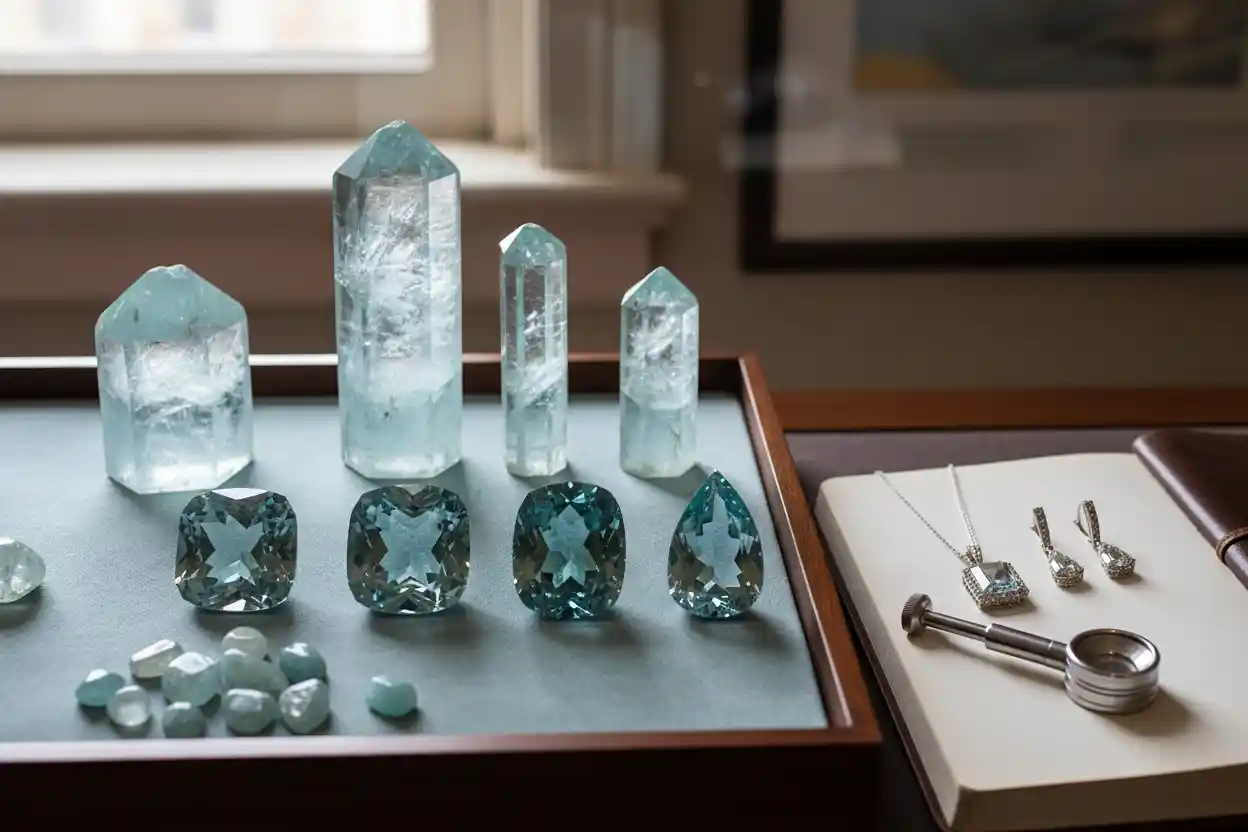
Aquamarine Healing Properties: 11 Popular Claims, Positive Traditions & Safe Limits
Aquamarine healing properties are traditionally associated with calm communication, courage, emotional balance, confidence, clarity, travel protection symbolism, relationship harmony, reflective thinking, creativity, hope, and adapting to change. These meanings draw strongly from aquamarine’s sea-like blue to greenish-blue color and its long association with water and journeys, but they are symbolic rather than medically established. Aquamarine does not treat anxiety, respiratory illness, thyroid problems, inflammation, pain, allergies, hormone conditions, or other physical or mental health concerns through ordinary contact with the body.
Aquamarine is the greenish-blue to blue variety of beryl, the same mineral species that includes emerald. Its chemical structure is beryllium aluminum silicate, and gem-quality stones commonly show excellent transparency with a Mohs hardness of about 7.5 to 8. This combination makes aquamarine considerably more durable for jewelry than many soft collector stones. Heat treatment is also common and can reduce greenish tones to create a purer blue appearance. These measurable physical characteristics explain how aquamarine behaves as a gemstone, while its traditional healing meanings belong to personal and cultural practice.
Aquamarine Communication Claims Support Clear Speech Without Changing the Voice or Nervous System
Communication is one of the strongest themes attached to aquamarine because its blue color has long encouraged associations with calm speech, truthfulness, and clear self-expression. Crystal traditions sometimes describe the gem as opening communication pathways or removing fear from the voice, but there is no established evidence that wearing aquamarine alters speech production, social confidence, or neurological function. A more useful interpretation is to connect the stone with preparation before an important conversation, particularly when someone tends to speak too quickly, become defensive, or avoid stating what they actually need.
An aquamarine ring or pendant can serve as a cue to organize thoughts before a meeting, relationship discussion, interview, or presentation. Someone might decide on the central point they need to communicate, identify the evidence supporting it, and consider what they need to hear from the other person. The crystals for communication tradition becomes more practical when the stone represents listening as well as speaking, because effective communication involves understanding the other person’s position rather than simply expressing your own more forcefully.
Traditional aquamarine benefits also include gentleness and diplomacy, but those qualities should not be confused with avoiding necessary disagreement. Calm communication can include saying no, correcting a misunderstanding, asking for clearer expectations, or ending an interaction that has become unsafe. Aquamarine symbolism works best when it supports direct language without hostility rather than silence for the sake of appearing peaceful.
Aquamarine Calm, Courage, and Emotional-Balance Claims Work Best as Deliberate Response Cues
Aquamarine is frequently described as calming because its pale blue and greenish-blue colors evoke water, open sky, and visual spaciousness. Those associations can make the gem personally soothing, but there is no established evidence that aquamarine lowers stress hormones or directly treats anxiety. Its most responsible role is as a cue to create a pause between emotional activation and response. Someone might touch an aquamarine pendant before answering a difficult question or use a polished stone during journaling when thoughts feel scattered.
Courage symbolism fits naturally alongside calm because courage does not require the absence of fear. A person may still feel nervous before a difficult conversation, journey, examination, or major change while choosing to prepare and proceed. The crystals for courage tradition is most useful when bravery means reasonable action despite uncertainty rather than reckless confidence. Aquamarine can symbolize that distinction because its traditional calm themes complement deliberate action instead of dramatic risk-taking.
Emotional balance should also be interpreted carefully. The gem cannot regulate mood biologically, remove anger, or prevent sadness. It can instead represent examining what an emotion is responding to before deciding what to do. Fear may signal uncertainty, anger may reveal a crossed boundary, and disappointment may show that an expectation mattered. Aquamarine symbolism becomes constructive when emotions are treated as information rather than problems that a crystal must erase.
Aquamarine Travel Protection Traditions Come From Maritime Lore, Not Physical Safety
Aquamarine has one of the strongest travel associations among gemstones because its name, color, and historical symbolism are connected with the sea. Modern crystal traditions often describe it as a protective travel stone, especially for ocean journeys, flights, or long-distance movement. These associations can be meaningful, but the gem cannot prevent accidents, seasickness, theft, lost luggage, mechanical problems, or unsafe weather.
The crystals for travel approach becomes more responsible when protection symbolism is connected with actual preparation. Aquamarine might represent checking identification, reviewing transport arrangements, protecting valuables, carrying necessary medicines, or confirming emergency contacts before departure. The stone can make those actions part of a personal ritual, while the safeguards themselves provide the real protection.
Water-related symbolism deserves the same limit. An aquamarine necklace cannot prevent drowning or make unsafe swimming conditions acceptable. Travelers on boats, beaches, or water-based activities still need appropriate equipment, local guidance, and situational awareness. Aquamarine can celebrate the beauty and emotional meaning of a journey without becoming a substitute for judgment.
Aquamarine Relationship Harmony and Confidence Claims Depend on Reciprocal Human Behavior
Aquamarine is sometimes associated with loyalty, harmonious relationships, honesty, and renewed understanding between partners. Its calm communication symbolism makes this connection intuitive, yet no gemstone can make another person become faithful, loving, cooperative, or emotionally available. Relationship outcomes still depend on what the people involved actually do.
A couple might use aquamarine as a shared symbol for speaking directly when something matters rather than allowing resentment to accumulate. The stone could also represent asking questions before making assumptions, acknowledging a mistake, or agreeing to revisit a difficult subject after both people have had time to think. These behaviors can genuinely improve communication, while the crystal remains a reminder rather than the cause.
Confidence in relationships also requires boundaries. A person does not need to tolerate repeated dishonesty, coercion, intimidation, or disrespect simply because aquamarine is traditionally associated with harmony. Personal safety, dignity, and informed choice always matter more than preserving a spiritual interpretation of a relationship.
Aquamarine Clarity, Creativity, and Hope Claims Reflect Perspective Rather Than Cognitive Enhancement
Aquamarine’s transparent appearance and cool color encourage traditional associations with mental clarity, insight, and fresh perspective. These themes are useful symbolically, but the gemstone does not increase memory, intelligence, concentration, or decision-making ability. A practical clarity routine can instead involve using aquamarine beside a notebook while separating facts from assumptions and identifying what information is still missing before a decision is made.
This interpretation connects well with crystals for clarity because clearer thinking usually comes from defining the problem precisely. Someone choosing between two options might write down realistic advantages, risks, costs, and uncertainties rather than asking the stone which path is spiritually correct. Aquamarine can accompany reflection without being treated as an oracle.
Creativity and hope claims should remain equally grounded. The stone can symbolize changing perspective, experimenting with another approach, or beginning again after a disappointing result. It does not generate ideas or guarantee favorable outcomes. Hope is strongest when it identifies possibilities that can still be acted upon rather than insisting that every situation will resolve exactly as desired.
Aquamarine Beryl Chemistry, Hardness, Heat Treatment, and Color Explain Its Real Gem Properties
Aquamarine belongs to the beryl mineral species and typically ranges from pale greenish blue through stronger blue. Iron within the crystal structure contributes to its characteristic color, and many natural stones are relatively pale compared with highly saturated blue gems. Aquamarine crystals can grow quite large and may show impressive transparency, which helps explain why sizable clean faceted stones are more available than similarly clean examples of some other colored gemstones.
Its Mohs hardness of approximately 7.5 to 8 gives aquamarine useful resistance to scratching and makes it suitable for rings, pendants, earrings, and other jewelry when worn sensibly. Hardness does not make it indestructible, however. Strong blows can still cause damage, especially in stones with fractures or vulnerable facet edges.
Heat treatment is common in aquamarine and is generally used to reduce greenish coloration and emphasize blue. Treatment does not automatically make an aquamarine inferior or fake, but disclosure remains important because buyers deserve to know what they are purchasing. When someone wants to buy aquamarine, color, clarity, cutting, treatment disclosure, size, and overall appearance provide more useful information than claims about healing intensity.
The aquamarine price reflects gem quality and market demand rather than spiritual potency. A deeper attractive blue, good transparency, effective cutting, and larger size can increase value, while no measurable pricing system exists for supposedly stronger calming or protective energy.
Aquamarine Jewelry Care Supports Long-Term Wear Without Crystal-Cleansing Risks
Aquamarine’s useful hardness makes it suitable for regular jewelry use, but sensible care still matters. Warm water, mild soap, and a soft brush are generally appropriate for routine cleaning. Steam and ultrasonic cleaning may be suitable for many aquamarines, but stones with significant fractures, liquid inclusions, or fracture filling require greater caution. When the treatment history is uncertain, simple warm soapy water is the safer choice.
Strong heat should be avoided during home care because unnecessary heating can affect a gemstone or its setting. Aquamarine’s color is generally stable in ordinary light, so there is no practical need to expose it to prolonged intense sunlight as part of a cleansing ritual. The stone also does not need salt, chemical solutions, or repeated soaking to maintain symbolic meaning.
Crystal water is unnecessary. Aquamarine’s personal significance can be expressed through jewelry, display, journaling, or meditation without putting a gem into drinking water. A responsible crystal routine should protect both the person and the gemstone.
Aquamarine Healing Claims Cannot Replace Medical or Mental Health Care
Aquamarine is sometimes credited with improving breathing, treating allergies, supporting the thyroid, balancing hormones, reducing inflammation, easing anxiety, or relieving pain. These claims are not established medical effects of beryl. Wearing the stone does not provide a therapeutic dose of beryllium, iron, or another substance, and the mineral should never be treated as medicine because of its chemistry.
The same evidence limits apply to mental health. Aquamarine may become a comforting object because of its appearance, personal history, or symbolic meaning, but it does not treat anxiety disorders, depression, trauma, panic, or chronic sleep problems. Someone can wear aquamarine during counseling or medical treatment if the stone feels meaningful while still relying on appropriate care for the condition itself.
Aquamarine does not need medical power to be valuable. Its sea-blue color, transparency, beryl crystal structure, jewelry durability, and long history of human appreciation already give the gemstone substantial appeal.
Conclusion: Aquamarine Healing Properties Are Symbolic While Beryl Durability and Blue Color Are Measurable
Aquamarine healing properties are best understood as traditional themes of communication, calm, courage, emotional balance, confidence, clarity, travel protection symbolism, relationship harmony, creativity, hope, and adaptability. Aquamarine itself is a greenish-blue to blue variety of beryl with a Mohs hardness around 7.5 to 8, good transparency, and commonly accepted heat treatment. It can support meaningful rituals and reflective habits, but it does not treat disease, control emotions, protect travelers from physical danger, or determine relationship outcomes.
FAQs About Aquamarine Healing Properties, Uses, and Safety
What are the main traditional aquamarine healing properties?
Aquamarine is commonly associated with communication, calm, courage, confidence, emotional balance, clarity, travel symbolism, relationship harmony, creativity, and hope.
Is aquamarine scientifically proven to heal?
No. There is no established evidence that aquamarine treats physical or mental health conditions through ordinary contact.
What mineral is aquamarine?
Aquamarine is the greenish-blue to blue variety of beryl.
How hard is aquamarine?
Aquamarine is about 7.5 to 8 on the Mohs scale, making it suitable for many types of jewelry.
Can aquamarine improve communication?
It can serve as a symbolic reminder to prepare and communicate clearly, but it does not directly change speech ability.
Does aquamarine reduce anxiety?
Aquamarine may feel personally calming, but it is not an established treatment for anxiety disorders.
Can aquamarine protect travelers?
No. Travel protection claims are symbolic and cannot replace practical safety measures.
Is aquamarine commonly heat treated?
Yes. Heat treatment is commonly used to reduce greenish tones and produce a purer blue appearance.
Can aquamarine be worn every day?
Its hardness makes it suitable for frequent wear, although hard impacts and inappropriate cleaning should still be avoided.
Can aquamarine go in drinking water?
There is no need to put aquamarine into drinking water for wellness purposes. External symbolic use is sufficient.
Does deeper blue aquamarine have stronger healing properties?
No. Color can affect gem quality and market value, but it does not establish stronger healing effects.
Aquamarine healing meanings are traditional or personal practices, not established treatments for physical or mental health conditions.