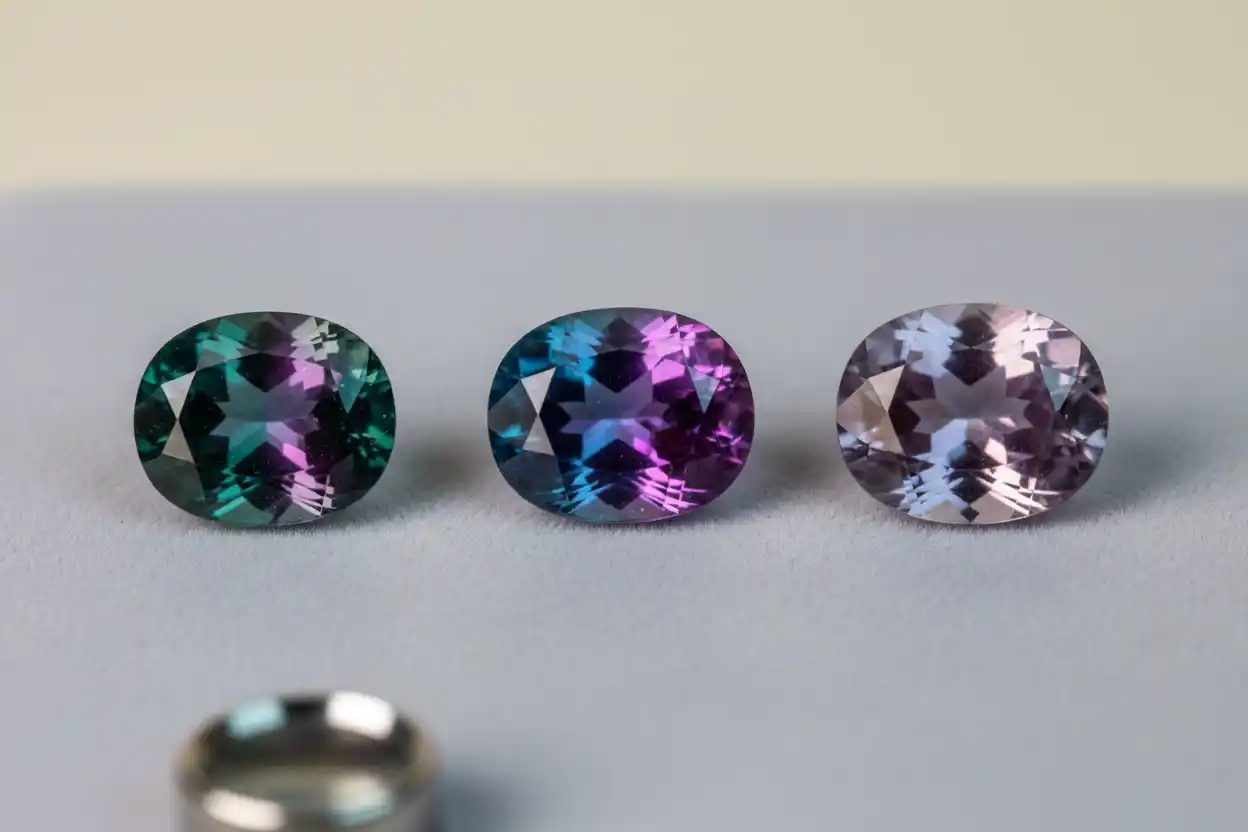
Real vs Fake Alexandrite: Natural, Synthetic and Imitation Tests
Real natural alexandrite is the chromium-bearing color-change variety of chrysoberyl. Fine stones appear green to bluish green in daylight-equivalent illumination and red to purplish red under warm incandescent light, although many natural examples show weaker, browner or grayer transitions.
The market contains several distinct alternatives. True laboratory-grown alexandrite has essentially the same mineral identity as natural alexandrite but formed through a manufactured process. Color-change synthetic sapphire, synthetic spinel, glass, garnet and diaspore can imitate part of the appearance without being alexandrite.
The word “fake” therefore needs precision. A disclosed laboratory-grown alexandrite is synthetic alexandrite, not natural alexandrite and not merely glass. A color-change synthetic sapphire sold as natural alexandrite is an imitation combined with misrepresentation.
Natural Alexandrite vs Synthetic and Imitation Materials
| Feature | Natural alexandrite | Synthetic alexandrite | Color-change synthetic corundum | Glass or other imitation |
|---|---|---|---|---|
| Material | Natural chrysoberyl | Laboratory-grown chrysoberyl | Laboratory-grown corundum | Unrelated material |
| Composition | BeAl₂O₄ with chromium | Essentially the same composition | Al₂O₃ with color-producing dopants | Variable |
| Mohs hardness | 8.5 | 8.5 | 9 | Often lower |
| Refractive index | About 1.746–1.755 | Alexandrite range | Corundum range, about 1.76–1.77 | Variable, often lower |
| Specific gravity | About 3.73 | Similar to natural alexandrite | Around 4.00 | Variable |
| Color change | Often green/bluish green to red/purplish red; quality varies | Can be strong and attractive | Commonly blue-violet to purple-red | May imitate a broad shift |
| Inclusions | Natural crystals, needles, fingerprints, growth features | Growth-method-related features | Curved growth structures or synthetic features | Bubbles and flow lines may occur |
| Rarity | Very rare in fine quality | Manufactured availability | Widely used as an imitation | Generally accessible |
| Correct disclosure | Natural alexandrite | Laboratory-grown or synthetic alexandrite | Color-change synthetic sapphire | Exact imitation material |
The table describes general tendencies. Laboratories rely on measured properties, microscopic evidence and spectroscopy because individual stones do not follow every visual stereotype.
What Is Natural Alexandrite?
Alexandrite belongs to the chrysoberyl family. Ordinary chrysoberyl is commonly yellow, greenish yellow or brownish, while alexandrite contains enough chromium to produce a distinctive light-source-dependent color change.
The alexandrite meaning guide owns the complete geology, history and symbolism. The types-of-alexandrite guide covers transparent, cat’s-eye, locality-associated and color-quality categories.
Natural alexandrite forms under unusual geological conditions that bring beryllium-bearing rocks or fluids into contact with chromium-bearing environments. This combination is uncommon because beryllium and chromium normally concentrate in different geological settings.
Fine natural gems are therefore scarce, particularly when strong color change, attractive daylight color, transparency and size occur together.
Color Change Is Necessary but Not Sufficient
The alexandrite effect is a change in perceived color under light sources with different spectral compositions.
Daylight and daylight-equivalent fluorescent illumination contain comparatively more blue and green wavelengths. Warm incandescent or candle-like light contains proportionally more red wavelengths.
Chromium-related absorption allows alexandrite to transmit different dominant colors under those conditions.
Other materials can produce a similar effect. Color-change garnet, sapphire, spinel, diaspore, glass and synthetic products may shift between green, blue, purple, brown, red or pink.
A stone that changes color is therefore not automatically alexandrite.
How to Test the Color Change Correctly
Use two distinctly different light sources.
First, observe the clean stone in indirect daylight or beneath a daylight-equivalent lamp with a high color-rendering quality. Record its dominant hue without relying on a photograph.
Next, move to a genuinely warm incandescent or halogen source. Many modern LEDs remain too cool or have discontinuous spectra that produce confusing results.
Allow your eyes to adapt and view the stone against a neutral white or gray background.
A fine natural alexandrite may change from green or bluish green to red or purplish red. Many genuine stones show olive, gray, brown or purple modifiers.
The strength of change affects quality and price, not identity by itself.
Color Change Versus Pleochroism
Alexandrite is strongly pleochroic. Different crystal directions can display different colors even under one light source.
Color change occurs when the light source changes. Pleochroism occurs when the crystal orientation changes relative to the viewer and polarized light.
Rotating a gemstone under one lamp may reveal green, orange and red-purple directional colors. That observation does not replace a daylight-versus-incandescent test.
Cut orientation influences the face-up result because the cutter chooses which directional colors dominate through the table.
The detailed relationship between cut and appearance remains within the alexandrite buying guide.
Natural Alexandrite Inclusions
Natural inclusions may include mineral crystals, liquid-related fingerprints, healed fractures, growth tubes and fine needles.
Parallel needles can create chatoyancy when the stone is cut as a cabochon, producing cat’s-eye alexandrite.
Inclusions can support natural origin, but no one inclusion appears in every genuine stone. A clean natural alexandrite is possible, particularly in a small gem.
Dust, polishing marks and scratches can also be mistaken for inclusions. Examination should use proper magnification and lighting.
A single “natural-looking” inclusion does not exclude laboratory growth because flux-grown synthetics can contain complex internal features.
Synthetic Alexandrite
True synthetic alexandrite is laboratory-grown chrysoberyl with chromium-related color change.
Growth methods have included flux, Czochralski pulling, floating-zone and other processes. The finished material can closely match natural alexandrite’s hardness, refractive index, density and color-change behavior.
Synthetic does not mean plastic or glass. It identifies a manufactured counterpart with essentially the same core crystal identity.
The laboratory-grown versus natural gemstones guide explains this terminology.
A disclosed synthetic alexandrite may be attractive and durable. The problem arises when it is sold as natural or accompanied by a false origin story.
Synthetic Alexandrite Inclusions
Flux-grown material may contain wispy flux residues, fingerprints, metallic platelets or other growth-related features.
Pulled crystals can show curved growth striations, color zoning or elongated bubbles, depending on production conditions.
Some synthetic inclusions look sufficiently natural that inexperienced visual inspection fails.
Laboratories compare inclusion structure with infrared, visible-light and other spectroscopic data. GIA’s alexandrite workflow uses FTIR as part of natural-versus-synthetic determination.
Color-Change Synthetic Sapphire
Color-change synthetic corundum is one of the most common alexandrite imitations.
The material may appear blue, violet or greenish under daylight-equivalent light and become purple, pink or red under incandescent illumination.
Because corundum is hard and brilliant, these stones can survive for decades in vintage rings and appear convincingly gem-like.
They may be sold as alexandrite, synthetic alexandrite, lab alexandrite or Alexandrium. Only the exact phrase color-change synthetic sapphire accurately describes a corundum imitation.
Refractive index, density and optic character separate it from chrysoberyl.
The broader sapphire guide covers corundum’s mineral identity without transferring alexandrite’s name to it.
Synthetic Spinel and Glass
Synthetic color-change spinel is less common but can imitate alexandrite-like shifts.
Glass may be manufactured with rare-earth elements that produce dramatic changes between blue-green, violet and red-purple.
Glass often has lower hardness and different refractive properties. Round bubbles and curved flow lines may be visible, though clean glass can lack obvious bubbles.
A large flawless stone with a theatrical color change and a very low price is more likely to be synthetic or imitation than fine natural alexandrite.
Price remains a warning sign, not a laboratory result.
Color-Change Garnet
Natural color-change garnet can resemble alexandrite under selected lighting.
Its daylight color may be greenish, brownish, gray, blue-green or purple, changing toward red, reddish purple or pink under incandescent light.
Garnet is singly refractive, while alexandrite is doubly refractive. Density, refractive index and spectra also differ.
A natural color-change garnet is not fake as a gemstone. It becomes an alexandrite imitation only when marketed under the wrong identity.
The general garnet family should be evaluated through its own mineral and variety criteria.
Color-Change Diaspore
Diaspore may change from greenish, yellowish or champagne tones to pink, orange or reddish colors.
Commercial names such as Zultanite or Csarite may accompany specific Turkish material, but diaspore remains a different mineral from chrysoberyl.
Diaspore has strong cleavage and different optical properties. Its color change is often less green-to-red than top alexandrite.
The diaspore buying guide owns the complete diaspore-specific evaluation.
Hardness and Scratch Tests
Alexandrite’s hardness of 8.5 places it between topaz and corundum on the Mohs scale.
Color-change synthetic sapphire is slightly harder at 9. Glass and many other imitations are softer.
That difference does not justify scratch testing. A hidden inclusion, thin girdle or incorrect test point can chip a valuable stone.
Metal tools also have inconsistent hardness and can leave streaks that resemble scratches.
Professional instruments provide safer evidence.
Refractive Index
Natural and synthetic alexandrite generally measure around 1.746–1.755.
Synthetic corundum typically measures higher, around 1.76–1.77. Glass and other imitations often fall below the chrysoberyl range, although high-index glass can overlap partially.
A refractometer can therefore eliminate many imitations quickly. It may not separate natural from synthetic alexandrite because both share chrysoberyl properties.
Accurate testing requires a polished facet, contact fluid and trained interpretation.
Specific Gravity
Alexandrite’s specific gravity is approximately 3.73.
Corundum is denser at roughly 4.00, while many glasses are lighter. Garnet and diaspore occupy their own ranges.
Hydrostatic weighing can support identification on a loose stone. Mounted gems cannot be measured accurately because metal contributes to weight and volume.
Small gemstones require precise equipment because a minor weighing error can produce a misleading result.
Fluorescence
Alexandrite fluorescence varies with chromium content, iron content and source.
Some stones show red fluorescence under long-wave ultraviolet light, while iron-rich examples may respond weakly.
Synthetic and imitation materials may also fluoresce. A strong reaction is not proof of natural origin, and an inert reaction does not disprove alexandrite.
UV examination contributes to a professional dataset rather than functioning as a standalone home test.
Treatments
Natural alexandrite is commonly valued without routine color enhancement. However, fracture filling, surface coating and other alterations have been documented.
A filler may reduce the visibility of surface-reaching breaks. Coating may change face-up color or intensify the apparent color change.
The dedicated treated-alexandrite guide owns microscopic treatment clues, stability and disclosure.
“Untreated” should not be accepted solely because alexandrite is not famous for routine heating.
Origin Claims
Alexandrite has been produced in Russia, Brazil, Sri Lanka, East Africa and other regions.
Historic Russian material carries strong market prestige, particularly when it displays attractive green-to-red change. However, color alone cannot establish Russian origin.
GIA origin determination considers trace-element chemistry, inclusions and other data. Even laboratories may issue cautious or inconclusive results.
A seller’s phrase “Russian-style color” is not the same as documented Russian origin.
Vintage Alexandrite Jewelry
Many vintage rings labeled alexandrite contain color-change synthetic corundum.
This does not necessarily mean the original jeweler intended fraud. Synthetic sapphire was widely used in affordable birthstone and color-change jewelry, and family descriptions may have simplified over generations.
An old mounting proves the age of the ring, not the natural origin of the gemstone.
Vintage hallmarks can identify metal and maker but do not authenticate the center stone.
Buying Red Flags
Be cautious when a listing offers a large, flawless, vivid green-to-red “natural Russian alexandrite” for a modest price.
Other warning signs include stock photographs used for multiple stones, no videos under two light sources, unexplained “lab alexandrite” wording and certificates created by the seller.
The alexandrite price guide explains why fine natural color change and size carry major premiums.
The alexandrite buying guide owns the complete purchase sequence.
Laboratory Reports
A valuable alexandrite should have an independent report identifying the material as natural chrysoberyl, synthetic chrysoberyl or an imitation.
The document should address treatment where detectable. A geographic-origin opinion is separate and may not be available for every stone.
The gemstone-certification guide explains report scope. Use how to read a gem lab report to compare measurements and wording with the stone offered.
Verify the report number through the laboratory’s own system where possible.
A Safe At-Home Screening Process
Clean the gemstone gently according to its setting.
Observe it in genuine daylight-equivalent illumination and warm incandescent light against a neutral background.
Record the actual colors. A change from violet-blue to purple-red may suggest synthetic corundum, although natural alexandrite can also show modifiers.
Use a loupe to look for inclusions, curved growth features, bubbles and obvious filler. Do not assume a clean stone is fake or an included stone is natural.
Review the carat weight, dimensions and price. A large fine natural alexandrite should not be casually inexpensive.
Stop before scratch, heat, chemical or impact testing. Seek professional identification when value matters.
Alexandrite Jewelry and Care
Natural and synthetic alexandrite share excellent hardness and generally good durability.
The alexandrite ring guide covers high-exposure settings. Alexandrite bracelets need secure links, while alexandrite earrings and alexandrite necklaces provide safer wear.
The complete cleaning procedure appears in how to clean alexandrite jewelry safely.
Alexandrite is one of June’s recognized birthstones, discussed in the June birthstone guide and June birthstone jewelry guide.
Frequently Asked Questions
1. What is real alexandrite?
Real natural alexandrite is chromium-bearing natural chrysoberyl that displays an alexandrite color-change effect.
2. Does every genuine alexandrite change from emerald green to ruby red?
No. Many natural stones show olive, gray, brown, purple or incomplete changes. Ideal green-to-red color is rare.
3. Is laboratory-grown alexandrite fake?
It is genuine synthetic chrysoberyl if accurately disclosed, but it is not natural alexandrite.
4. What is commonly sold as fake alexandrite?
Color-change synthetic sapphire is the most familiar imitation, while synthetic spinel, glass, garnet and diaspore can also resemble it.
5. How do I test alexandrite’s color change?
Compare the clean stone under daylight-equivalent light and a genuinely warm incandescent or halogen source.
6. Can an LED flashlight authenticate alexandrite?
No. LED spectra vary and may exaggerate or suppress colors. Light testing reveals behavior but not mineral identity.
7. Are natural alexandrites always included?
No. Natural stones can be relatively clean, particularly in small sizes. Inclusion absence does not prove synthetic origin.
8. Do curved growth lines mean synthetic alexandrite?
They can support a laboratory-grown conclusion in suitable material, but the full inclusion scene and measured properties must agree.
9. Can a refractometer separate synthetic sapphire from alexandrite?
Usually, because corundum and chrysoberyl have different refractive-index ranges.
10. Are most antique alexandrite rings natural?
No. Many vintage pieces contain color-change synthetic corundum, even when family tradition calls the stone alexandrite.
11. Is natural alexandrite commonly treated?
Routine heating is not standard, but fracture filling, coatings and other alterations have been documented.
12. When should I obtain a laboratory report?
Obtain one when the stone is represented as natural, valuable, Russian-origin, untreated or large enough for identity to affect the purchase materially.
Alexandrite authentication requires more than witnessing a dramatic color change. Natural chrysoberyl, laboratory-grown alexandrite and color-change synthetic sapphire can all perform convincingly beneath two lamps. The reliable conclusion comes from matching optical measurements, density, inclusions, spectra and treatment evidence with the seller’s disclosure.
Alexandrite appears in Crystals That Start With A and Gemstones That Start With A.