
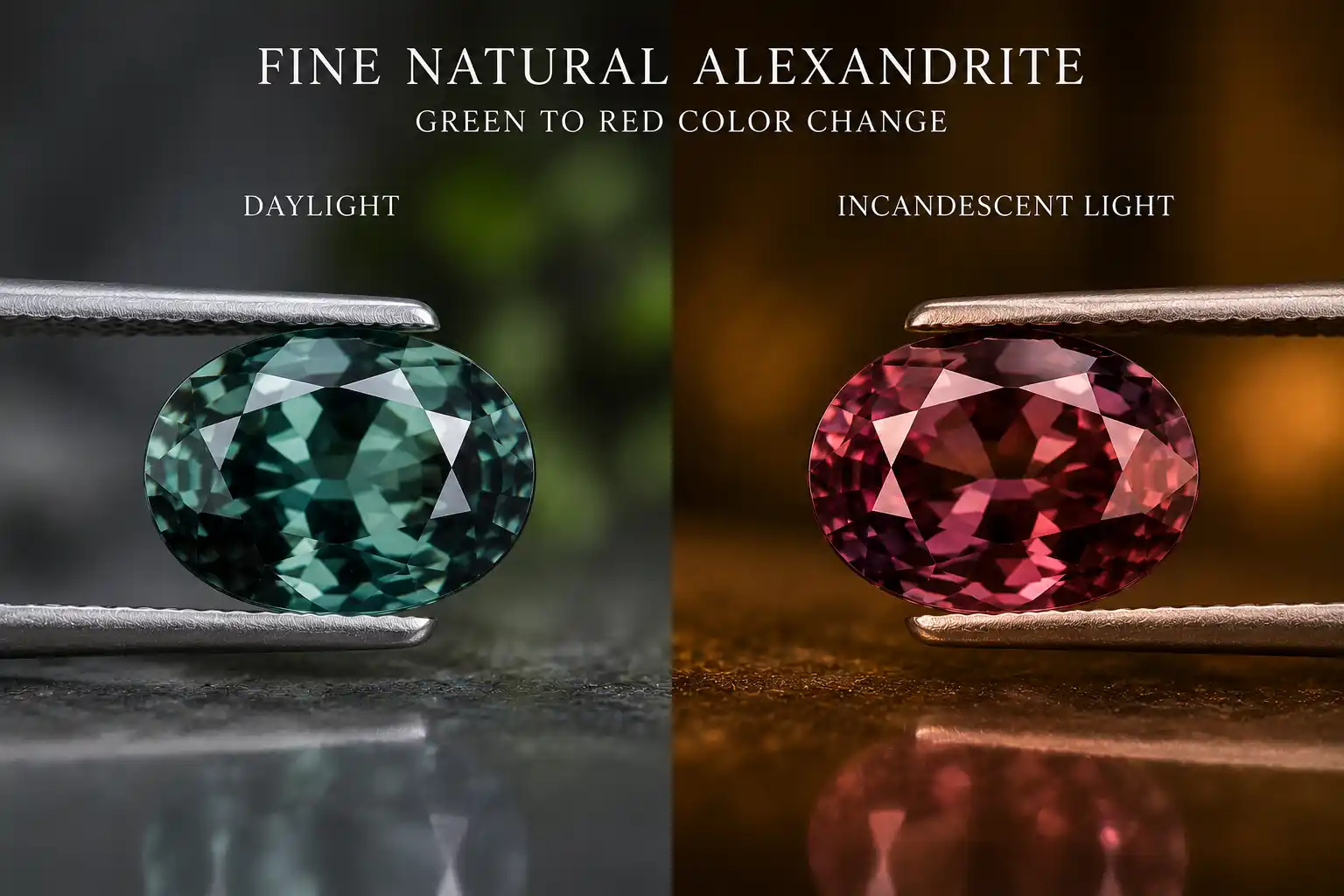

Alexandrite price varies more dramatically than the price of many familiar colored gemstones because natural material ranges from tiny commercial stones with weak or brownish color change to exceptionally rare transparent gems that shift between attractive green and red hues while maintaining strong saturation at sizes above one or two carats. Two stones with almost identical weights can therefore occupy completely different price levels when their color-change quality, transparency, cutting, treatment status and documentation are compared.
For buyers, the most important lesson is that alexandrite price cannot be reduced to a single number per carat, because the market rewards combinations of desirable qualities rather than weight alone. A 0.70-carat stone with vivid bluish-green to purplish-red change may command considerably more per carat than a 1.20-carat alexandrite whose daylight appearance is olive and whose warm-light color becomes muddy brown.
The ranges below are broad retail-planning estimates rather than fixed quotations, appraisals or guaranteed transaction values. Current market checks included publicly listed asking prices from specialist gemstone dealers, while the quality framework was cross-checked against established gemological descriptions of alexandrite color, rarity and geographic origin; asking prices were deliberately treated separately from completed sales because a seller’s listed figure does not prove what a buyer ultimately pays. Recent public inventories demonstrate the enormous spread clearly, with weak or commercial natural material sometimes listed below $1,000 per carat while stronger sub-carat examples and better one-carat stones can rise into several thousand dollars per carat or much more.
Alexandrite Price at a Glance
The following alexandrite price ranges are best used as planning bands for loose natural gemstones rather than as a substitute for evaluating an individual stone.
| Natural Alexandrite Quality | Typical Size | Broad Retail Planning Range |
|---|---|---|
| Weak color change, pale, dark or commercial material | Under 0.50 ct | About $300–$1,500 per carat |
| Commercial quality with visible change | Under 1 ct | About $800–$3,000 per carat |
| Good quality with attractive change | 0.25–1 ct | About $2,000–$7,500 per carat |
| Fine quality with strong attractive change | Under 1 ct | About $5,000–$15,000+ per carat |
| Fine natural alexandrite | 1–2 ct | About $10,000–$30,000+ per carat |
| Exceptional natural alexandrite | 2 ct and above | About $20,000–$50,000+ per carat |
| Important collector or provenance stones | Large or exceptional | Can exceed ordinary retail bands substantially |
These bands overlap because alexandrite price does not increase through neat size categories, and a gemstone near a weight boundary does not become more valuable merely because the scale crosses 1.00 or 2.00 carats. Quality must remain strong as size increases before the familiar alexandrite size premium becomes meaningful.
The broader Buying & Value section explains how these kinds of quality and transaction differences affect gemstone markets more generally.
Why Alexandrite Price Has Such a Wide Range
Alexandrite is the color-change variety of chrysoberyl, and fine natural material requires an unusual combination of mineral chemistry, attractive color response, transparency and usable crystal size that is difficult to find together. The best-known stones appear green to bluish green under daylight-type illumination and shift toward red or purplish red under warmer light, although genuine natural alexandrite can display much less ideal combinations.
That distinction creates several markets under the same gemstone name.
A pale yellow-green stone that becomes brownish orange may be genuine natural alexandrite, yet it does not offer the visual experience buyers associate with elite material. A vivid blue-green stone that becomes saturated raspberry red belongs to a much more competitive category, particularly when it is transparent, well cut and large enough to show the effect clearly.
The underlying mineral history and color-change mechanism are covered in the alexandrite meaning and properties guide, while alexandrite price should remain focused on what buyers actually pay for those quality differences.
Color Change Usually Has the Greatest Effect on Alexandrite Price
The most important alexandrite price factor is normally the quality of the color change, although it should be evaluated as several related characteristics rather than as one marketing percentage. A stone needs attractive appearance under both lighting environments if it is going to command a fine-quality premium.
Consider the daylight side first, where green, bluish green and attractive teal-green colors are generally more desirable than weak gray-green, yellow-green or muddy olive. Then examine the warm-light side, where red, purplish red and raspberry shades normally attract stronger demand than dull brown, orange-brown or gray-purple.
The transition itself also matters because a stone whose color changes only slightly will generally receive less market enthusiasm than one whose appearance changes distinctly. However, dramatic change between two unattractive colors does not automatically create high alexandrite price.
A useful valuation sequence is therefore:
daylight color → warm-light color → strength of change → saturation in both conditions.
This order keeps the buyer focused on the complete optical performance rather than a seller’s claim of “90%” or “100%” color change.
Strong Change Is Not Enough When the Colors Are Weak
An alexandrite may shift dramatically from yellowish green to brownish red, producing a genuine and easily visible color change while still remaining commercial rather than fine quality. Another gemstone may show a somewhat less complete transformation but move between beautiful bluish green and clean raspberry purple, creating stronger visual appeal and potentially a higher alexandrite price.
This distinction becomes particularly important when comparing online photographs, because sellers can select one cool-light image and one warm-light image that maximize the apparent contrast. The most useful comparison uses the same gemstone, neutral backgrounds and clearly different light sources while allowing the buyer to see transitional appearances as well.
For an important purchase, the complete selection process belongs in the alexandrite buying guide, where color performance can be considered alongside identity, cut and documentation.
What Current Dealer Listings Actually Show
A current asking-price sample illustrates why one alexandrite price figure is misleading, because natural stones around similar weights are publicly offered at radically different totals when their color quality and color-change strength differ.
One current 0.49-carat Sri Lankan natural alexandrite described as very light green and SI clarity was listed at about $412, which works out to roughly $840 per carat. A different 0.72-carat eye-clean alexandrite in current specialist inventory was offered around $6,600, or approximately $9,167 per carat, while natural stones slightly above one carat with moderate or weak change have also appeared at asking prices below $2,000 total. At the stronger end of another current specialist inventory, a 1.051-carat green-to-crimson alexandrite classified by that seller as good color quality was listed at €9,700.
Those examples should not be averaged into a universal alexandrite price because they are not equivalent stones, they come from different dealers using different grading language, and the figures represent asking prices rather than verified completed transactions. Their value is methodological: they demonstrate that weight alone cannot explain the market.
Asking Price, Sale Price and Appraisal Value Are Different
A dealer’s alexandrite price is the amount being requested for a particular stone at a particular time, whereas a completed sale records what a buyer actually agreed to pay after any negotiation, discount or auction competition. An appraisal answers a different question again because insurance replacement value, fair-market value and liquidation value can all produce different numbers for the same gemstone.
These distinctions matter particularly with alexandrite because the market is relatively thin compared with standardized commodities, while the quality differences between individual stones are substantial. A gemstone offered at $15,000 does not prove that comparable stones routinely sell for $15,000, and an insurance appraisal of $20,000 does not establish that the owner could sell it immediately for that amount.
The broader principles behind transaction type, rarity, size premiums and quality are explained in how gemstone prices are determined.
For this reason, every alexandrite price range on this page should be interpreted as a purchasing reference rather than a promised resale figure.
Alexandrite Price Under 0.25 Carat
Tiny natural alexandrites provide the most accessible entry into the market because small crystals are more common than large fine ones, while the total price can remain manageable even when the per-carat figure is relatively high. These stones are commonly used as accents in rings, earrings, anniversary pieces and multi-stone jewelry where individual dimensions matter more than a large center-stone appearance.
Commercial stones below 0.25 carat may sometimes cost well under $200 each when their color change is modest, their tone is pale or their warm-light color becomes brownish. Better small stones with strong green-to-red or green-to-purple performance can cost substantially more because fine color remains rare even at tiny sizes.
The important point is that a small alexandrite price should be judged on the total stone as well as the per-carat figure. A 0.10-carat natural gem costing $100 equals $1,000 per carat, yet the actual financial commitment is still $100.
Alexandrite Price From 0.25 to 0.50 Carat
The 0.25-to-0.50-carat range often gives buyers enough face-up area to appreciate color change more easily while remaining below the sharp premiums encountered in fine stones approaching or exceeding one carat. Commercial material may remain in the hundreds of dollars per stone, while attractive natural gems can move into the low thousands.
At this size, alexandrite price becomes increasingly sensitive to whether the gemstone offers two attractive colors rather than merely a technical change. A clean 0.40-carat stone that moves distinctly between blue-green and raspberry can cost considerably more than a larger example that appears pale green and becomes brown-orange.
Face-up dimensions should also be compared because a deep stone may retain carat weight below the girdle while looking smaller than another gem of slightly lower weight.
Alexandrite Price From 0.50 to 1 Carat
Between half a carat and one carat, quality differences become financially significant because natural stones are large enough for color, clarity and cutting deficiencies to become easier to see while fine material remains scarce. Commercial stones may still appear below several thousand dollars, whereas fine examples with strong change can rise into much higher per-carat territory.
This is also the range where vague online claims become increasingly costly.
A seller describing a 0.80-carat gemstone as “premium Russian alexandrite” may be asking a substantial premium based on origin, yet the buyer should first determine whether the stone is natural alexandrite, whether its color change is genuinely attractive and whether the origin claim has independent support. The real vs. fake alexandrite resource addresses that identity problem directly.
A high alexandrite price should purchase evidence as well as appearance.
Alexandrite Price Around 1 Carat
One carat is psychologically important in the gemstone market, but natural alexandrite makes the threshold particularly significant because fine material becomes increasingly difficult to obtain as size rises. A one-carat commercial stone with weak change can still be relatively modestly priced, while a one-carat fine alexandrite showing attractive green and red colors can enter five-figure territory.
This difference is why statements such as “one-carat alexandrite costs $10,000” are not sufficiently precise.
A one-carat stone can be:
dark;
brownish;
weakly changing;
strongly included;
poorly cut;
or unusually deep.
Another can be transparent, lively and strongly changing with attractive colors under both lighting conditions.
Their weights may be nearly identical while their alexandrite price differs by multiples.
Alexandrite Price From 1 to 2 Carats
Fine natural alexandrite between one and two carats belongs to a much more selective market because large transparent crystals with excellent color-change behavior are genuinely scarce. When quality remains high, alexandrite price per carat can rise sharply rather than remaining proportional to the sub-carat market.
Broad planning ranges of roughly $10,000–$30,000 or more per carat may be appropriate for fine stones in this category, although weaker one-to-two-carat material can sell far below those figures. The size premium only works when the quality deserves it.
A 1.50-carat alexandrite that is dark and brownish does not become fine merely because it is large.
A 1.20-carat stone with exceptional color change may be much more valuable.
Alexandrite Price Above 2 Carats
Fine natural alexandrite above two carats enters serious collector territory because maintaining attractive color, transparency and color-change strength at larger sizes becomes increasingly difficult. Exceptional gems can reach tens of thousands of dollars per carat, while unusual historic or museum-quality stones may move beyond ordinary retail comparisons altogether.
At this level, simple price tables become progressively less reliable.
Documentation, provenance, laboratory origin opinions, cutting history and individual buyer demand can materially affect alexandrite price. A truly exceptional large stone may also have so few close comparables that valuation becomes a specialist exercise rather than a spreadsheet calculation.
Buyers at this level should compare individual stones rather than asking for an average alexandrite price.
Why Price per Carat Rises With Size
Colored gemstones rarely scale linearly when large fine crystals are scarce, and alexandrite is an especially clear example because finding a larger crystal is only valuable if it retains the optical qualities that make alexandrite desirable. As size rises, the probability of maintaining strong color change, good transparency, attractive saturation and a usable cut becomes progressively lower.
Suppose a fine 0.50-carat alexandrite is worth $5,000 per carat.
A comparable one-carat stone does not necessarily cost $5,000 total.
Its per-carat rate may itself increase because the larger high-quality gem is rarer.
This nonlinear relationship means:
Total price = carat weight × quality-adjusted price per carat
The difficult part is determining the quality-adjusted rate.
That is why alexandrite price charts should never be used without examining the individual gemstone.
Color Tone and Saturation
Tone describes how light or dark the alexandrite appears, while saturation describes the strength or purity of the color. Both sides of the color change should retain enough brightness that the stone remains attractive in ordinary viewing conditions.
An excessively dark gemstone can look almost black except beneath strong lighting, which reduces the practical value of an otherwise desirable hue. An overly pale alexandrite may show technically attractive green and red directions while lacking the saturation expected in a fine stone.
Brown and gray modifiers commonly reduce broad market demand when they dominate the appearance.
A fine alexandrite price therefore reflects more than the labels “green” and “red.”
The quality of those colors matters.
Clarity and Alexandrite Price
Transparent alexandrite generally commands stronger prices when inclusions do not interfere significantly with color, brilliance or structural integrity, yet clarity should be considered alongside rarity rather than evaluated through a diamond-style standard. Minor inclusions can be entirely acceptable in a beautiful natural stone, particularly when color change is exceptional.
The most damaging clarity features include prominent fractures, dense cloudiness, large centrally located inclusions and surface-reaching breaks that reduce durability or transparency. A clean-looking stone with weak color may still be worth less than a moderately included gem whose color-change performance is outstanding.
Cat’s-eye alexandrite creates a different valuation problem because oriented inclusions are responsible for chatoyancy.
In that material, the inclusions create value when they produce a sharp, mobile eye while the gemstone retains meaningful color change.
Cut Can Raise or Lower Alexandrite Price
Alexandrite rough is expensive enough that cutters often face a difficult compromise between retaining weight and producing the best face-up appearance, particularly when crystal orientation affects pleochroism and the visible color-change combination. A beautifully oriented 0.80-carat stone can therefore be more valuable than a poorly oriented one-carat gem cut mainly to preserve weight.
Look for obvious windowing through the center, large dark extinction areas, excessive depth and poor symmetry.
A deep stone can hide substantial carat weight beneath the setting while presenting a relatively small surface area from above. Conversely, an excessively shallow stone may develop a large window that weakens saturation and brilliance.
Alexandrite price should reward the color and visual size the buyer actually sees, not merely weight hidden beneath the girdle.
Origin and Alexandrite Price
Geographic origin can affect alexandrite price when the stone is already high quality and the market values material from a particular source. Historic Russian alexandrite from the Ural Mountains carries the strongest prestige because those nineteenth-century deposits established the classic reputation for vivid green-to-red color change.
Brazil has also produced exceptional alexandrite, while Sri Lanka, Tanzania and other sources contribute material across wide quality ranges.
Origin should remain secondary to the gemstone itself.
A mediocre Russian alexandrite is not automatically worth more than an outstanding Brazilian or East African stone merely because the locality has greater historical prestige. GIA research confirms that geographic origin can influence market value and that origin determination relies on trace-element chemistry, inclusions and reference data rather than color alone.
If a seller asks a substantial Russian-origin premium, independent support becomes increasingly important.
Russian Alexandrite Price
A documented Russian alexandrite can command a premium when the stone also displays strong color change, attractive saturation and fine overall quality. The premium reflects a combination of historical reputation, limited supply and collector demand rather than a universal rule applied to every stone from the Urals.
Be cautious with phrases such as:
“Russian color,” “Russian style,” “old Russian alexandrite” or “Ural-type.”
Those descriptions may refer only to appearance unless a credible laboratory or documented provenance supports geographic origin.
Alexandrite price should not absorb a geographic premium based purely on marketing language.
Brazilian Alexandrite Price
Brazilian alexandrite can show excellent blue-green to reddish-purple color change and has produced some important modern material. Fine Brazilian stones can therefore command prices comparable with other elite alexandrite when color, clarity, size and documentation are strong.
There is no fixed Brazilian alexandrite price.
One Brazilian stone can be exceptional.
Another can be commercial.
The country name provides context, while the individual gemstone determines most of the value.
Sri Lankan Alexandrite Price
Sri Lanka produces alexandrite across a broad range of sizes and qualities, including material with yellowish-green daylight color and brownish or orangy warm-light components. Fine exceptions can show much more attractive changes.
This variability explains why current listings for Sri Lankan natural alexandrite can appear surprisingly affordable in smaller or weaker-quality stones. A low alexandrite price is not automatically evidence that the material is synthetic when the natural stone itself has pale color, modest change or commercial characteristics.
Quality must be examined before rarity assumptions are made.
African Alexandrite Price
Tanzania and other East African sources have contributed important modern alexandrite production, with stones ranging from heavily included or weakly changing material to much finer transparent gems. Current dealer inventories demonstrate especially broad alexandrite price differences within Tanzanian material because quality varies so strongly.
One current 1.03-carat Tanzanian stone with weak-to-moderate change was listed around $278 total, while another 0.72-carat eye-clean stone from a specialist inventory was listed around $6,600, illustrating the enormous effect of optical quality even before historical-origin premiums enter the comparison.
Country alone cannot explain that difference.
The stones themselves must be compared.
Natural vs. Lab-Grown Alexandrite Price
Natural and laboratory-grown alexandrite occupy fundamentally different price categories because laboratory production removes much of the geological scarcity supporting natural alexandrite price. Genuine synthetic alexandrite can still be chrysoberyl with essentially the same fundamental composition and very similar physical and optical properties, including dramatic color change.
Laboratory-grown material can therefore provide:
larger sizes;
high clarity;
strong color change;
and closely matched stones
for a fraction of the cost of equivalent-looking fine natural gemstones.
That does not make laboratory-grown alexandrite inferior for every purpose.
A buyer seeking beautiful color-change jewelry may consider it excellent value.
A collector paying for geological rarity will evaluate it very differently.
The seller must disclose laboratory-grown origin clearly because natural alexandrite price should never be applied to synthetic material.
Lab-Grown Alexandrite Price
Laboratory-grown alexandrite is generally much more affordable than natural material, although finished jewelry prices can still vary significantly with stone size, cutting, metal, design and brand. Because synthetic crystals can be produced in larger sizes, the sharp natural size premium is usually much weaker.
A large clean laboratory-grown alexandrite displaying dramatic green-to-red change can therefore cost less than a much smaller commercial natural stone.
That apparent contradiction disappears once rarity is understood.
The laboratory-grown stone may offer stronger visual performance.
The natural stone offers geological scarcity.
They are different markets.
Simulants Can Distort Alexandrite Price Comparisons
A color-changing stone is not automatically alexandrite.
Color-change synthetic sapphire, glass and other materials can imitate the appearance while belonging to entirely different mineral and price categories. Vintage jewelry creates particular confusion because synthetic color-change corundum has historically been described casually as alexandrite.
When a supposedly natural alexandrite price seems implausibly low, identify the material before searching for an explanation based on discounts or seller generosity.
Material identity comes before valuation.
Treatment and Alexandrite Price
Routine heat treatment is not central to the natural alexandrite market in the way heating is for sapphire or ruby, but other modifications can occur and should be disclosed. Fracture filling or surface coating can alter appearance or clarity, while the effect on price depends on the extent, stability and significance of the treatment.
The detailed distinctions belong in the treated alexandrite guide.
For valuation, the important principle is straightforward: alexandrite price should reflect what the stone actually is and how much of its visible quality depends on alteration. A seller’s generic claim of “natural” does not answer whether a natural gemstone has been modified.
Laboratory Reports and Alexandrite Price
Independent gemological documentation becomes increasingly important as alexandrite price rises because natural and laboratory-grown chrysoberyl can share many basic physical properties, while convincing simulants can reproduce dramatic color shifts. A credible report reduces uncertainty about identity, detectable treatments and, when the service is available and the evidence supports a conclusion, geographic origin.
A laboratory report does not establish fair selling price.
It does not guarantee resale value.
It does not make an unattractive stone beautiful.
The role and limitations of major reporting services are explained in the gemstone certification guide.
For an expensive alexandrite, documentation supports valuation by establishing facts that would otherwise remain uncertain.
Does Certification Increase Alexandrite Price?
A laboratory report does not magically add a fixed percentage to alexandrite price, but reliable documentation can make a valuable natural stone easier to compare and transact because important uncertainty has been reduced. The benefit becomes greater when the report confirms natural origin, absence of significant detectable treatment or a commercially relevant geographic origin.
For inexpensive commercial material, laboratory fees can represent a substantial portion of the stone’s total value.
For a five-figure alexandrite, the economics are different.
The more financially important the claim, the more reasonable independent verification becomes.
Jewelry Price Is Not the Same as Loose-Stone Price
An alexandrite ring, necklace, pair of earrings or bracelet contains more value components than the gemstone alone, because the retail price may include gold or platinum, diamonds, labor, design, sizing, manufacturing, brand premium and seller overhead. Comparing a finished jewelry price directly with a loose-stone per-carat table can therefore produce misleading conclusions.
An alexandrite ring may devote much of its cost to a secure custom setting, while an alexandrite necklace adds chain, bail and clasp construction. Matched alexandrite earrings can command additional value because two compatible natural stones are required, while an alexandrite bracelet may require many matched gems plus substantial mechanical construction.
When comparing finished pieces, separate gemstone value from jewelry value as far as the available information allows.
Why Matched Alexandrites Can Cost More
Matching adds scarcity because two or more natural stones must coordinate across several characteristics simultaneously, including dimensions, shape, daylight color, warm-light color, tone, clarity and strength of color change. A parcel containing ten natural alexandrites may contain only two that look convincing together.
This problem becomes especially important in earrings, three-stone rings and tennis bracelets.
The total alexandrite price of a well-matched suite may therefore exceed what you would expect from adding unrelated loose-stone prices.
The premium is for compatibility.
Cat’s-Eye Alexandrite Price
Cat’s-eye alexandrite is valued through a different combination of qualities because the cabochon must show both chatoyancy and meaningful color change. The eye should ideally be sharp, reasonably centered and mobile as the stone or light moves, while the body color should remain attractive under different illumination.
Transparency is not evaluated in the same way as faceted alexandrite because the inclusions producing the eye are part of the optical phenomenon.
A large cabochon with a weak diffuse eye and little color change may remain comparatively affordable.
A fine stone showing a sharp eye and strong color change can occupy a much rarer market.
Cat’s-eye alexandrite price should therefore not be compared directly with ordinary faceted material using one shared clarity standard.
Does Shape Affect Alexandrite Price?
Shape usually affects alexandrite price indirectly through cutting yield, visual performance and buyer demand rather than through a universal premium for one outline. Ovals, cushions and mixed cuts are common because cutters often adapt to the natural crystal in order to preserve valuable weight.
Round stones can require greater weight loss from rough and may command premiums in some situations, particularly when calibrated dimensions are needed.
Unusual shapes can be attractive but may have smaller resale audiences.
The strongest criterion remains face-up performance.
A beautifully oriented oval is worth more than a poorly performing round simply because round sounds more standardized.
How Cut Depth Can Hide Expensive Weight
Carat is weight rather than visible diameter, which means two one-carat alexandrites can look dramatically different once set. A deep pavilion can preserve costly rough below the girdle while producing a smaller face-up appearance.
Compare length, width and depth.
Do not compare alexandrite price by weight alone.
For rare gems, a stone that faces up well can provide greater visual value even when another candidate has a slightly higher carat number.
Does Alexandrite Hold Its Value?
Fine natural alexandrite has genuine rarity and collector demand, but that does not make every alexandrite a reliable financial investment. Retail markups, dealer spreads, laboratory fees, transaction costs, liquidity and buyer specialization all affect what an owner may recover later.
A gemstone purchased at retail for $10,000 cannot be assumed to have an immediate resale value of $10,000.
Laboratory-grown material normally has an even weaker scarcity argument because future production can continue.
The broader discussion of whether gemstones hold their value explains why retail replacement value and realistic resale value should not be confused.
Buy alexandrite primarily because the gemstone itself justifies the price to you.
How to Compare Two Alexandrites Fairly
The easiest way to make a poor alexandrite price comparison is to compare stones that are not actually equivalent. Instead, place the two candidates under the same lighting conditions and compare the characteristics that materially influence value.
Begin with natural or laboratory-grown origin, because the comparison is meaningless if the stones belong to different market categories. Then compare daylight color, warm-light color, strength of change, tone, saturation, clarity, face-up dimensions, cutting, treatment disclosure and laboratory documentation.
Only after those factors are reasonably similar should price per carat become the deciding metric.
If one stone is clearly better, the higher alexandrite price may be completely justified.
A Practical Price Comparison Example
Suppose Stone A weighs 0.82 carat and costs $3,500, while Stone B weighs 1.08 carats and costs $3,800.
Stone B initially looks like the obvious bargain because it offers more weight for only $300 more.
Now suppose Stone A changes from attractive bluish green to raspberry red, remains bright in ordinary light and has an independent report confirming natural alexandrite. Stone B appears yellowish olive in daylight, becomes brownish orange under warm light and has a deep cut that makes its face-up dimensions only slightly larger than Stone A.
The lower per-carat figure for Stone B does not automatically make it better value.
Stone A may justify its higher alexandrite price per carat because it delivers substantially more of the optical quality buyers actually seek.
Common Alexandrite Price Red Flags
An unusually low alexandrite price is not proof of fraud because natural commercial stones can genuinely be inexpensive relative to fine examples, but the combination of exceptional claims and a low price deserves much closer examination. A listing becomes particularly questionable when it claims a large, flawless, untreated, natural Russian alexandrite with vivid emerald-green to ruby-red change while charging a price similar to ordinary commercial colored gemstones.
Also investigate vague terminology such as “created alexandrite,” “alexandrite sapphire,” “Russian-style alexandrite” or “natural color-changing gem.”
These descriptions may conceal important differences.
The seller should state what the material actually is.
How Much Should You Spend on Alexandrite?
The right budget depends on whether you value geological rarity, optical performance, size or finished jewelry.
If your priority is natural origin at the lowest possible total cost, a small commercial stone may be appropriate.
If you want the characteristic alexandrite experience, allocating more of the budget to strong color change rather than additional carat weight usually makes sense.
If you want a large dramatic gemstone but do not care strongly about geological rarity, laboratory-grown alexandrite can provide much greater size and cleaner appearance per dollar.
If you are buying a serious collector stone, documentation and comparable quality become more important than finding the lowest alexandrite price.
Define the goal first.
Then judge the market appropriate to that goal.
Frequently Asked Questions
How much is alexandrite worth per carat?
Alexandrite price can range from a few hundred dollars per carat for weak commercial natural stones to tens of thousands of dollars per carat for exceptional material. One universal per-carat figure is not meaningful because color change, size, clarity, cut and documentation vary dramatically.
Why is alexandrite so expensive?
Fine natural alexandrite is exceptionally scarce, particularly when a larger transparent stone combines attractive green or bluish-green daylight color with strong red or purplish-red warm-light color.
How much does a one-carat alexandrite cost?
A one-carat alexandrite price can range from well below fine-gem levels for weak commercial material to five figures for attractive natural stones with strong color change. Quality is more important than the one-carat threshold by itself.
Can natural alexandrite be inexpensive?
Yes. Small, pale, included, brownish or weakly changing natural stones can be relatively affordable, which is why a low price alone cannot prove synthetic origin.
How much does fine natural alexandrite cost?
Fine natural stones under one carat can reach several thousand dollars per carat, while fine gems above one carat may enter approximately $10,000–$30,000+ per carat territory. Exceptional large material can go higher.
What affects alexandrite price the most?
Color-change quality usually has the strongest effect, followed by the attractiveness and saturation of both colors, size, transparency, cutting, natural origin, treatment status and documentation.
Does alexandrite price increase with size?
Yes, when quality remains comparable. Fine large alexandrite is much scarcer than fine small material, so the price per carat can rise as individual stone size increases.
Is Russian alexandrite more expensive?
Documented Russian origin can command a premium because of historic reputation and scarcity, particularly when the gemstone itself is high quality. A mediocre Russian stone is not automatically more valuable than an exceptional stone from another source.
Is Brazilian alexandrite valuable?
Fine Brazilian alexandrite can be extremely valuable when it combines attractive color change, transparency and useful size. There is no fixed price based on Brazilian origin alone.
Is Sri Lankan alexandrite cheaper?
Some Sri Lankan material can be more affordable because weaker stones may show yellowish, brownish or less dramatic color transitions, although Sri Lanka also produces fine alexandrite.
Is African alexandrite valuable?
Yes. African material spans commercial through fine quality, and alexandrite price depends far more on the individual stone’s optical performance than the country name alone.
Is lab-grown alexandrite expensive?
Laboratory-grown alexandrite is normally much less expensive than comparable-looking natural material because synthetic production removes much of the geological scarcity supporting natural alexandrite price.
Does synthetic alexandrite have resale value?
It can have resale value as jewelry or a laboratory-grown gemstone, but it does not carry the same rarity-driven market as fine natural alexandrite.
Does color change determine alexandrite value?
It is usually the dominant factor, but both resulting colors must also be attractive. Strong change between muddy colors does not automatically create a fine alexandrite price.
Is a 100% color-change alexandrite always valuable?
No. Percentage descriptions are not sufficient because color quality, saturation, darkness, clarity, size and cutting also matter.
Does clarity affect alexandrite price?
Yes. Transparency and the location of inclusions matter, although a beautifully colored moderately included stone may be worth more than a clean stone with weak color change.
Does cut affect alexandrite value?
Yes. Poor orientation, windowing, excessive depth and extinction can reduce visible color and brightness, while a strong cut can make better use of rare rough.
Does treatment reduce alexandrite price?
Potentially. The effect depends on the treatment type and extent, while untreated natural material with comparable beauty and documented identity generally has stronger collector appeal.
Does a lab report increase alexandrite value?
A report can support value by reducing uncertainty about identity, natural versus laboratory-grown origin, treatment and sometimes geographic source, but it does not set the selling price.
Is a gemstone appraisal the same as alexandrite market price?
No. An appraisal estimates value for a stated purpose, while an asking price is what a seller requests and a completed sale is what a buyer actually paid.
Is an online asking price reliable?
It is useful as one market observation but should not be treated as proof of actual transaction value. Compare multiple genuinely similar stones rather than relying on one listing.
Are alexandrite rings more expensive than loose stones?
Finished rings can cost more because the total includes the gemstone, metal, setting, accent stones, manufacturing, labor and retail margin.
Why are matched alexandrites expensive?
Natural matching requires several stones to coordinate in dimensions, color, tone and color-change behavior, which reduces the available pool of suitable gems.
Is cat’s-eye alexandrite expensive?
Fine cat’s-eye alexandrite can be valuable when it combines a sharp mobile eye with attractive color change and useful size. Weak chatoyancy or poor color reduces value.
Does alexandrite hold its value?
Fine natural alexandrite can have collector demand, but no gemstone has guaranteed appreciation or immediate resale at its original retail price.
Is alexandrite a good investment?
Alexandrite should not be purchased as a guaranteed investment. The market lacks the liquidity and standardized pricing of publicly traded financial assets, while quality assessment and resale channels strongly affect realized prices.
What is the cheapest way to buy natural alexandrite?
Small natural stones with modest color change generally provide the lowest total purchase price. Buyers should still verify identity when the seller’s claims materially affect value.
Should I buy a larger weak alexandrite or a smaller fine stone?
If you want the distinctive alexandrite experience, a smaller gem with attractive colors and strong change is often more satisfying than a larger stone whose main advantage is weight.
How often should alexandrite prices be checked?
Price pages should be treated as time-sensitive because dealer inventories, supply and market demand change. The market observations used for this guide were checked on August 24, 2026.
How to Judge Whether an Alexandrite Price Is Fair
A fair alexandrite price cannot be identified from carat weight alone because the gemstone’s most important qualities are visual, rarity-driven and difficult to standardize across unrelated inventory. The buyer needs to establish the correct market category first, then compare genuinely similar stones rather than searching for the lowest number attached to the word alexandrite.
Start by confirming whether the gemstone is natural alexandrite, laboratory-grown chrysoberyl or an imitation, because those categories can have dramatically different values even when their photographs appear similar. Examine the stone under meaningfully different light sources, compare the daylight and warm-light colors separately, assess the strength of the transition, and decide whether both sides of the change are attractive enough to justify the asking price.
Then look at size, but evaluate millimeter dimensions alongside carat weight so that deeply cut hidden weight does not receive an undeserved premium. Examine clarity, cutting, treatment disclosure and any geographic-origin claim, while using independent laboratory documentation when the financial importance of those claims justifies testing.
Finally, distinguish the seller’s asking price from completed-sale evidence and from any appraisal figure.
That distinction is essential.
Alexandrite price can legitimately range from hundreds of dollars per carat to tens of thousands because the stones occupying those two ends of the market may share little beyond their mineral identity. A pale, weakly changing commercial alexandrite and a large transparent gem with vivid blue-green to purplish-red change are not comparable products simply because both are natural chrysoberyl.
The most useful buying question is therefore not:
“What is the alexandrite price per carat?”
It is:
“What should this specific alexandrite cost given its identity, two colors, strength of change, size, clarity, cut, treatment, documentation and the type of transaction in which it is being sold?”
Once those variables are compared properly, alexandrite price becomes much easier to understand—and unusually cheap or unusually expensive listings become much easier to evaluate.