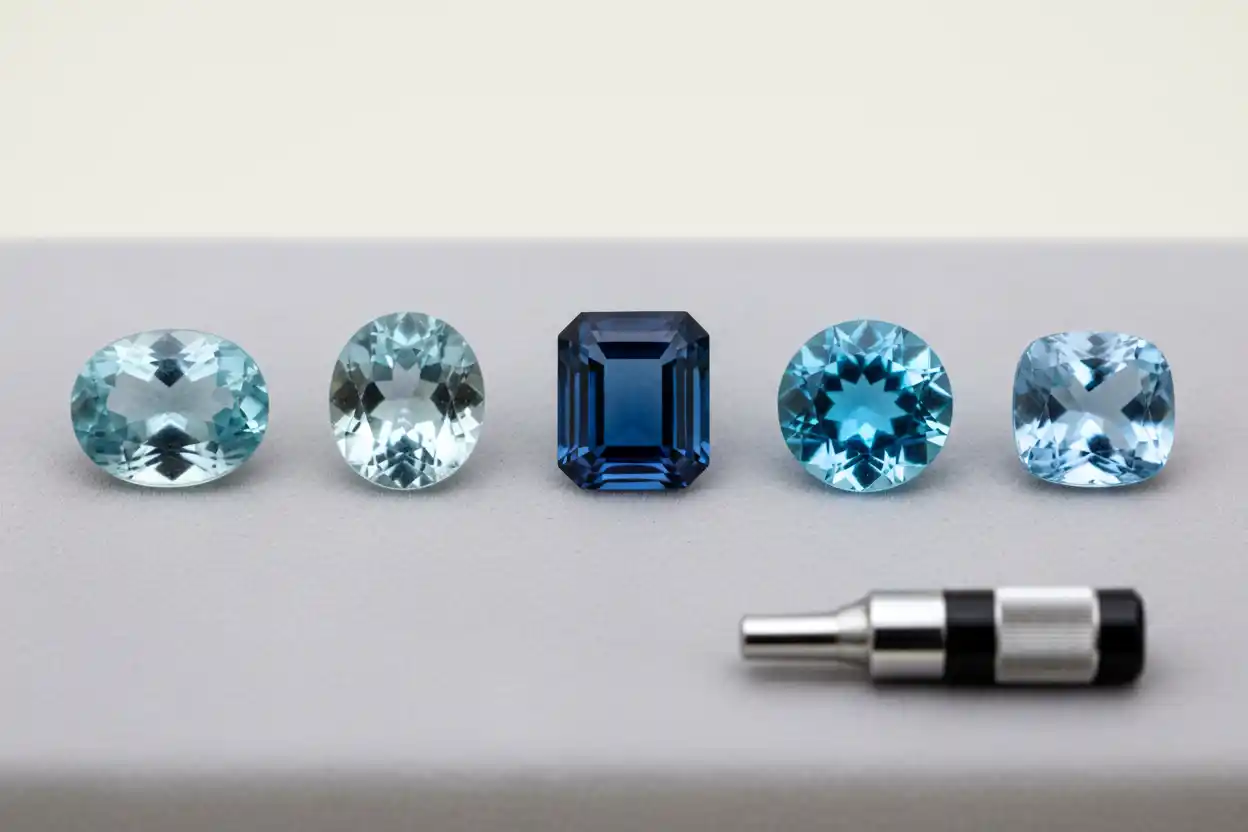
Real vs Fake Aquamarine: 9 Ways to Identify Genuine Beryl
Real vs fake aquamarine identification begins with mineral identity, not simply with finding a pale blue transparent gemstone. Genuine aquamarine is the greenish-blue to blue variety of beryl, Be₃Al₂Si₆O₁₈. Glass, synthetic spinel, blue topaz, synthetic quartz, other blue beryls, and laboratory-grown aquamarine can all create confusion, while heat treatment can change the appearance of perfectly natural aquamarine without making it fake.
GIA lists aquamarine refractive indices around 1.577 to 1.583, birefringence of approximately 0.005 to 0.009, specific gravity near 2.72, and Mohs hardness from 7.5 to 8. These properties make aquamarine relatively straightforward to separate from many simulants with proper gemological instruments, although separating natural aquamarine from laboratory-grown beryl may require microscopy, chemical analysis, and spectroscopy.
Color alone is a weak test because natural aquamarine can range from nearly colorless pale green-blue to considerably stronger blue. Large natural crystals can also be unusually clean, so the common internet rule that “a flawless aquamarine must be fake” is unreliable.
9 Real vs Fake Aquamarine Tests at a Glance
- Confirm the color is plausible for aquamarine.
- Check refractive index against beryl values.
- Examine inclusions with magnification.
- Look for natural pleochroism.
- Compare specific gravity when practical.
- Inspect rough crystal form carefully.
- Do not assume perfect clarity means synthetic.
- Separate heat treatment from imitation.
- Use laboratory testing for valuable stones.
Genuine Aquamarine Is Blue Beryl
Aquamarine belongs to the same mineral species as emerald, morganite, heliodor, and goshenite. What separates these varieties commercially is primarily color and the trace-element chemistry that produces it.
GIA describes aquamarine as the green-blue to blue variety of beryl and notes that its typical color is light pastel greenish blue. Heat treatment commonly removes a yellowish component, giving many stones a purer blue appearance.
| Gemological Feature | Genuine Aquamarine |
|---|---|
| Mineral species | Beryl |
| Formula | Be₃Al₂Si₆O₁₈ |
| Crystal system | Hexagonal |
| Refractive index | About 1.577 to 1.583 |
| Birefringence | About 0.005 to 0.009 |
| Specific gravity | Around 2.72 |
| Mohs hardness | 7.5 to 8 |
| Typical color | Light greenish blue to blue |
| Common treatment | Heat |
| Typical transparency | Transparent, often very clean |
Natural stones from individual deposits can fall slightly outside simplified textbook ranges. GIA studies of Pakistani aquamarine, for example, measured refractive indices and specific gravities that varied somewhat between specimens while remaining consistent with natural beryl.
1. Start With Color, but Never Stop There
Aquamarine gets its commercial identity from blue to greenish-blue color.
Natural rough may show a noticeable green component, while heating commonly shifts the appearance toward purer blue. The most valued stones generally have stronger blue or slightly greenish-blue color without becoming excessively dark.
Color is not an authenticity test by itself.
Glass can be manufactured in nearly any shade.
Synthetic blue spinel has historically been sold under misleading terminology resembling “synthetic aquamarine,” even though spinel and beryl are completely different minerals. Gem-A records this historical problem and notes that flame-fusion blue spinel was once marketed in ways that confused buyers about its true identity.
A pale blue stone should therefore be considered a candidate for testing, not assumed to be aquamarine.
2. Refractive Index Is One of the Best Gemological Checks
Refractive index is far more useful than color.
Genuine aquamarine typically falls around RI 1.577 to 1.583, with modest variation related to chemistry and locality.
A refractometer can quickly eliminate many common substitutes.
Blue topaz, synthetic spinel, glass, and quartz have different optical properties. A stone testing well outside the beryl range cannot be aquamarine regardless of how convincing its color appears.
Refractive index still cannot always separate natural aquamarine from synthetic aquamarine because laboratory-grown beryl can reproduce the principal properties of natural beryl.
That question requires more advanced evidence.
3. Natural Inclusions Can Support Identification
A 10x loupe or microscope can reveal internal features that support natural origin.
GIA’s study of aquamarine from Pakistan documented two-phase and three-phase inclusions containing fluids, gases, and solids, along with fingerprint-like healed fissures and elongated inclusions related to the crystal’s c-axis.
These features are valuable because they record geological growth and later changes inside the crystal.
However, natural aquamarine can also be remarkably clean.
GIA notes that aquamarine crystals are often large, well formed, and relatively inclusion-free.
A clean stone therefore does not prove laboratory origin.
Likewise, synthetic gems can contain their own growth-related inclusions.
The important question is what kind of inclusion is present, not merely whether an inclusion exists.
4. Pleochroism Provides Another Useful Clue
Aquamarine is dichroic, meaning its color can differ with crystallographic viewing direction.
GIA studies have observed blue or greenish-blue in one direction and very pale blue, greenish blue, or nearly colorless appearance in another.
An experienced gemologist can examine this behavior with a dichroscope.
Pleochroism helps separate aquamarine from some imitations, particularly substances whose optical character differs from beryl.
It is not a natural-versus-synthetic test because synthetic beryl can reproduce the same crystal symmetry.
Still, when pleochroism, refractive index, birefringence, and other properties all agree, the identification becomes much stronger.
5. Specific Gravity Can Separate Some Lookalikes
Aquamarine specific gravity is usually around 2.72.
This makes it considerably lighter than some blue gemstones with similar appearance.
A hydrostatic weighing setup can measure specific gravity on loose stones with reasonable accuracy when performed correctly.
GIA’s Pakistani samples ranged approximately from 2.60 to 2.72, while Mexican aquamarine samples measured around 2.70 to 2.71.
Natural variation means a single exact number should not be required.
Specific gravity is most useful when combined with refractive index.
If both measurements conflict strongly with beryl, the gem is probably another substance.
6. Rough Crystal Shape Can Be Useful, but It Can Also Be Faked
Natural aquamarine commonly forms attractive six-sided prismatic beryl crystals.
Collectors often use crystal form as an initial identification clue.
The problem is that rough-looking imitations can be manufactured deliberately.
Gem-A documented synthetic blue quartz that had been fashioned into an artificial six-sided crystal intended to imitate aquamarine rough. Examination of the crystal geometry, seed-plate features, optic figure, and infrared spectrum revealed that it was actually synthetic quartz.
This example is important because it shows why “rough” does not automatically mean natural.
An imitation can be cut to resemble a crystal.
True crystallography involves consistent interfacial relationships and growth features that are harder to reproduce convincingly.
7. Do Not Assume Large and Clean Means Fake
This rule is especially important for aquamarine.
Some gemstones become dramatically rarer when they are both large and clean. Aquamarine behaves differently because beryl crystals can grow to substantial sizes while retaining excellent transparency.
GIA specifically notes that aquamarine crystals are known for being large, clean, and well formed.
A 20-carat transparent aquamarine is therefore not automatically suspicious simply because it is large.
Color quality often matters more.
GIA’s buyer guidance explains that stronger color can become easier to see in larger aquamarines, while small stones below one carat are often comparatively pale.
Size and clarity must therefore be interpreted differently from alexandrite, ruby, or other gems where large clean natural examples may be extraordinarily scarce.
8. Heat-Treated Aquamarine Is Still Natural Aquamarine
Heat treatment is extremely important to understand in real vs fake aquamarine discussions.
Most aquamarine forms with some combination of blue and green. Heating can reduce the yellow component and produce a cleaner blue.
GIA describes heat treatment as common and generally stable.
A heated aquamarine is not fake.
It is natural beryl whose color has been modified.
Buyers interested specifically in untreated gems may value disclosure, but routine heating has long been accepted within the market.
This distinction prevents a common mistake: treating every enhanced gemstone as an imitation.
Treatment, laboratory growth, and imitation are three different categories.
9. Laboratory Testing Is the Best Way to Separate Natural From Synthetic
Laboratory-grown aquamarine is a genuine synthetic counterpart to natural aquamarine.
Hydrothermal processes can produce blue beryl with chemical, physical, and optical properties close enough to natural material that basic home tests may not establish origin.
GIA research has shown that natural aquamarine, irradiated Maxixe-type beryl, and hydrothermal synthetic blue beryl can be distinguished through combinations of microscopy, chemical analysis, UV-Vis-NIR spectroscopy, and infrared spectroscopy.
A GIA Colored Stone Identification Report can determine whether an aquamarine is natural or laboratory-grown and disclose detectable treatments.
For an expensive stone, that conclusion is more reliable than any home test.
Natural Aquamarine Versus Synthetic Aquamarine
Synthetic aquamarine should be described precisely.
If laboratory-grown blue beryl has the correct crystal structure and composition, it is not simply blue glass.
It is synthetic beryl.
Its commercial difference from natural aquamarine lies principally in origin, rarity, growth environment, inclusion characteristics, trace-element chemistry, and market value.
GIA’s studies of hydrothermally grown synthetic blue beryl demonstrate that advanced microscopy and spectroscopy can distinguish synthetic products from natural aquamarine.
A seller who clearly discloses synthetic aquamarine is offering a legitimate manufactured gemstone.
Misrepresentation occurs when it is sold as naturally mined aquamarine.
Aquamarine Versus Blue Topaz
Blue topaz is one of the most commercially common gems that buyers may confuse with aquamarine.
The two can overlap strongly in color, but their properties differ.
Aquamarine is beryl with hardness 7.5 to 8, specific gravity around 2.72, and relatively low refractive index.
Topaz is considerably denser, has different refractive properties, perfect cleavage, and a different chemical composition.
Most commercial blue topaz also obtains its blue color through irradiation followed by heating.
A trained gemologist can separate these stones easily using standard instruments.
Visual color alone is much less reliable.
Aquamarine Versus Glass and Synthetic Spinel
Glass can imitate pale blue aquamarine inexpensively.
Under magnification, gas bubbles, swirl marks, flow lines, or manufactured surface features may suggest glass, although high-quality imitation glass can be visually convincing.
Synthetic blue spinel presents another historical lookalike. It can resemble aquamarine in color but differs substantially in refractive index, optical character, density, and crystal structure.
This reinforces a core principle of identification.
Two stones can look almost identical while being easy to separate once their measurable properties are tested.
Maxixe-Type Beryl Is Not Ordinary Aquamarine
Another complication involves Maxixe-type blue beryl.
Irradiation can produce deep blue coloration in certain beryls whose absorption behavior differs from ordinary iron-colored aquamarine. Some of these colors may fade with exposure to light.
GIA research has distinguished Maxixe-type beryl from normal aquamarine using dichroism, fluorescence, chemistry, and spectroscopy.
The distinction is important because a strong blue color should not automatically be described as high-quality aquamarine.
The mechanism creating that color matters.
Laboratory testing may be required when unusual blue beryl is involved.
Fracture Filling and Resin Treatment
Aquamarine is often naturally clean, but fractured stones can sometimes be clarity enhanced.
Gem-A has reported aquamarine cabochons containing substantial artificial resin within fissures, with Raman spectroscopy confirming beryl together with resin.
A resin-filled aquamarine remains beryl, but significant filling should be disclosed because it can influence durability, care, appearance, and value.
GIA similarly recommends warm soapy water as the safest cleaning method for fracture-filled aquamarine.
This again illustrates why “real or fake” can be too simplistic.
A stone can be natural, treated, synthetic, or imitated, and those categories have different meanings.
Buying Aquamarine With Better Evidence
When preparing to buy aquamarine, prioritize identity, color quality, treatment disclosure, cutting, transparency, durability, and seller reliability.
Do not pay extra merely because a seller describes a stone as “AAA.” GIA specifically notes that there is no universal standardized AAA grading scale for aquamarine.
Likewise, famous locality names do not automatically make a gem superior.
The factors behind aquamarine price depend mainly on the quality of the individual gemstone rather than marketing language.
A report becomes increasingly worthwhile as value rises.
Spiritual Claims Do Not Prove Aquamarine Is Natural
Aquamarine is associated symbolically with calmness, communication, courage, water, emotional reflection, and protection.
Those beliefs cannot authenticate a gemstone.
The ideas discussed under aquamarine benefits may be meaningful to someone personally, but a synthetic blue beryl or glass imitation can be marketed using the same spiritual terminology.
Authenticity depends on crystallography, optical properties, chemistry, inclusions, and laboratory evidence.
Perceived energy is not an identification method.
Aquamarine Care Can Preserve Identification Features and Value
Aquamarine is relatively durable at 7.5 to 8 on the Mohs scale and is suitable for many types of daily jewelry.
It should still be protected from hard impacts and unnecessary heat.
Warm soapy water is the safest general cleaning method. Steam and ultrasonic cleaning may be suitable for uncomplicated stones but are not advisable when significant fractures, liquid inclusions, or fracture filling are present.
Avoid scratch testing a polished gem.
A proper refractive-index reading provides more useful information without damaging a valuable surface.
Conclusion
Real vs fake aquamarine identification depends on proving that a blue gemstone is beryl and then, when necessary, determining whether that beryl formed naturally or in a laboratory. Color alone is inadequate because glass, blue topaz, synthetic spinel, synthetic quartz, Maxixe-type beryl, and laboratory-grown aquamarine can overlap visually.
Refractive index, specific gravity, pleochroism, microscopy, crystal form, and treatment awareness provide strong screening evidence. Large size and high clarity should not automatically trigger suspicion because natural aquamarine can form as unusually large, transparent crystals. For valuable stones, professional spectroscopy and an independent colored-stone report remain the strongest way to confirm natural origin and detectable treatments.
FAQs
What is the easiest way to check whether aquamarine is real?
The best practical screening method is to confirm whether its optical properties match beryl. Refractive index around 1.577 to 1.583 is much more useful than judging blue color alone.
Is a very clear aquamarine fake?
Not necessarily. Natural aquamarine is often unusually clean and can grow in large transparent crystals. High clarity alone is not evidence of synthetic origin.
Can fake aquamarine be glass?
Yes. Pale blue glass can imitate aquamarine, while synthetic spinel, quartz, blue topaz, and other substances may also resemble it. Standard gemological testing can separate most of these readily.
Is synthetic aquamarine real aquamarine?
Laboratory-grown aquamarine is synthetic beryl with properties comparable to natural beryl. It should be disclosed as laboratory-grown rather than sold as naturally mined aquamarine.
Is heat-treated aquamarine fake?
No. Heating is commonly used to reduce greenish or yellowish components and produce a cleaner blue. The underlying stone remains natural aquamarine.
What hardness should real aquamarine have?
Aquamarine has Mohs hardness of approximately 7.5 to 8. Destructive scratch testing on finished jewelry is not recommended.
Can aquamarine be confused with blue topaz?
Yes. They can overlap visually, but topaz has different density, refractive properties, cleavage, and chemistry. A gemologist can usually separate them quickly using instruments.
Can a jeweler confirm natural aquamarine?
An experienced gemologist can identify beryl and many common substitutes. Determining whether sophisticated blue beryl is natural or laboratory-grown may require advanced laboratory testing.
Does GIA identify natural aquamarine?
Yes. GIA states that its Colored Stone Identification Report can indicate whether aquamarine is natural or laboratory-grown and disclose detectable treatments.
Disclaimer: Spiritual, emotional, protective, communication, energetic, and healing interpretations associated with aquamarine reflect beliefs and personal practices rather than established medical or psychological effects. Such claims cannot establish gemstone identity and should not replace professional gemological testing.