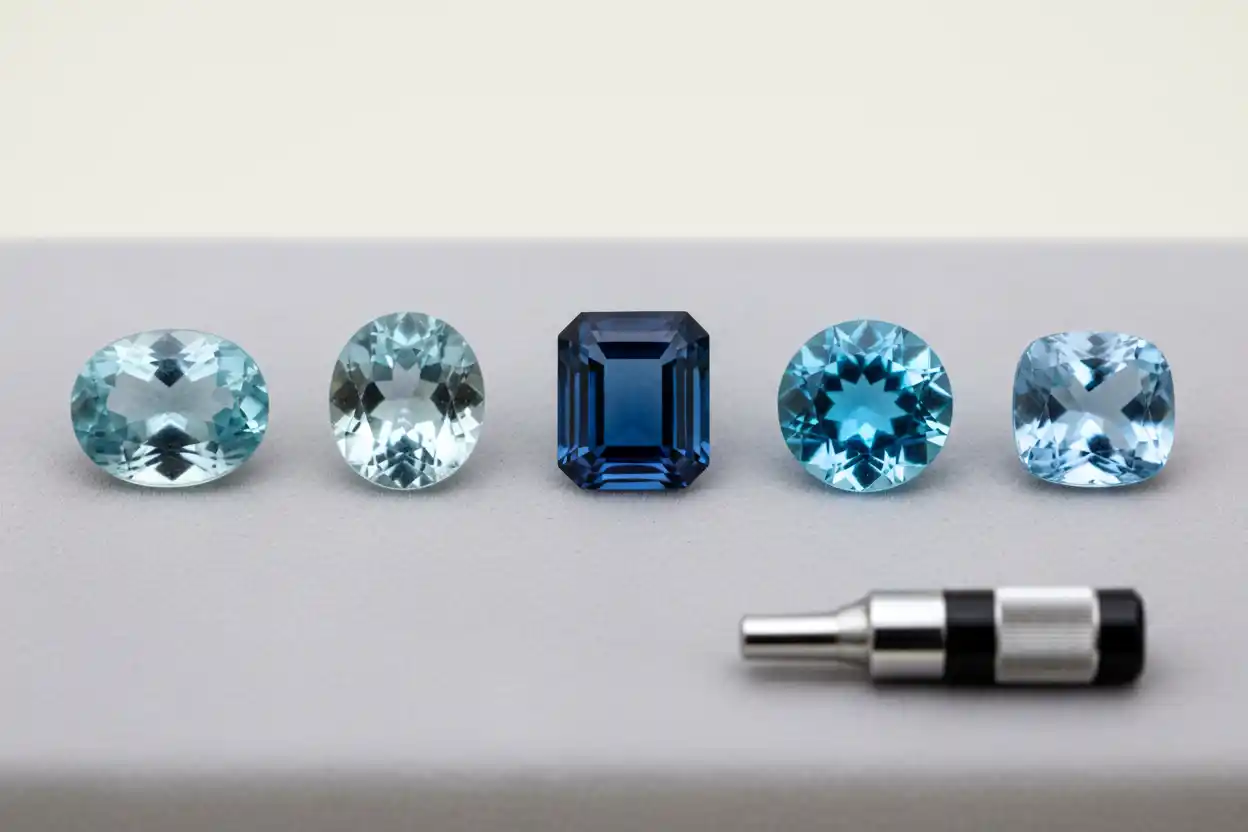
Real vs Fake Aquamarine: Natural, Synthetic and Glass Tests
Real natural aquamarine is the greenish-blue to blue variety of beryl. Iron within the crystal structure produces its color, which is commonly pale and may become stronger in larger stones.
Aquamarine imitations include treated blue topaz, glass, synthetic spinel, cubic zirconia, dyed quartz and other blue gems. Hydrothermal synthetic blue beryl is a closer challenge because it has essentially the same beryl structure and can reproduce aquamarine’s optical properties.
Deep-blue irradiated Maxixe-type beryl creates another identification boundary. It is beryl, but its color mechanism, pleochroism and light stability differ from ordinary iron-colored aquamarine.
A clean, pale stone is not automatically glass. Natural aquamarine frequently occurs in large, transparent crystals and is commonly eye-clean. Reliable identification combines optical measurements, dichroism, inclusions, density and treatment evidence.
This page owns the direct real-versus-fake workflow. The treated-aquamarine guide retains heat, irradiation, synthetic-growth, filling and coating boundaries.
Natural Aquamarine vs Common Alternatives
| Feature | Natural aquamarine | Hydrothermal synthetic blue beryl | Maxixe-type beryl | Blue topaz | Glass imitation |
|---|---|---|---|---|---|
| Material | Natural beryl | Laboratory-grown beryl | Natural or treated beryl with radiation-induced color center | Topaz, commonly irradiated and heated | Manufactured glass |
| Typical color | Pale greenish blue to moderately strong blue | Light to deep blue | Often deep blue to blue-green | Sky, Swiss or London blue | Any blue |
| Mohs hardness | 7.5–8 | 7.5–8 | 7.5–8 | 8 | Commonly about 5–6 |
| Refractive index | About 1.577–1.583 | Similar beryl range | Beryl range | Higher, commonly around 1.61–1.62 | Variable |
| Specific gravity | About 2.72 | Similar | Similar | Around 3.53 | Variable, often higher or lower depending on glass |
| Pleochroism | Near-colorless and stronger blue directions | Growth-dependent blue directions | Unusual deep-blue dichroism | Different optical character | None in ordinary glass |
| Inclusions | Tubes, liquid inclusions, crystals and growth features; often eye-clean | Hydrothermal growth features and seed-related structures | Treatment-related spectral features | Liquid cavities, cleavage-related features and inclusions | Round bubbles and curved flow |
| Color stability | Generally stable; heat-treated blue usually stable | Generally stable according to product | May fade with light | Treated blue generally stable after processing | Usually stable |
| Best confirmation | Refractive index, dichroism, microscopy and spectroscopy | Microscopy, chemistry and spectroscopy | UV-Vis-NIR spectroscopy | RI, density and optic testing | RI, density and microscopy |
What Is Genuine Aquamarine?
Aquamarine belongs to the beryl family, which also includes emerald, morganite, heliodor, goshenite and red beryl.
The aquamarine meaning guide owns formation, localities, symbolism and general properties. The types-of-aquamarine guide covers pale, deep-blue, cat’s-eye and trade-name categories.
Its composition is beryllium aluminum silicate. Beryl’s channel-like crystal structure can host water, alkalis and color-producing trace elements.
Aquamarine forms commonly in granitic pegmatites and some hydrothermal environments. Crystals can become exceptionally large, transparent and well formed.
Aquamarine Color
Natural aquamarine ranges from pale green-blue through greenish blue to blue.
The market generally prefers moderately strong blue or slightly greenish blue. However, many natural stones are light in tone.
Iron produces the color. Different oxidation states and interactions create blue and green components.
A very pale gem is not automatically inferior if its cutting is bright and its transparency attractive. Nevertheless, color becomes difficult to see in small stones, which is why larger aquamarines often appear more saturated.
Digital photographs can exaggerate blue. Compare the stone under neutral daylight, warm indoor light and against both white and skin-toned backgrounds.
Dichroism
Aquamarine is dichroic, meaning it can show two different colors along different crystal directions.
A dichroscope commonly reveals a nearly colorless or weakly colored direction and a stronger blue direction.
Cutters orient rough to emphasize desirable blue. Poor orientation may leave a stone almost colorless.
Glass is ordinarily singly refractive and lacks true beryl dichroism. Some other crystalline imitations are pleochroic, so the observation supports identification without completing it.
Maxixe-type beryl may show an unusual combination of deep-blue directional colors that differs from ordinary aquamarine.
Natural Aquamarine Inclusions
Most faceted aquamarine is expected to be eye-clean.
Internal features can include long hollow or liquid-filled tubes, two-phase inclusions, mineral crystals, healed fractures and growth zoning.
Parallel tubes may produce a cat’s-eye effect when the rough is cut as a cabochon.
The absence of inclusions does not indicate glass or synthetic material. Natural beryl can be exceptionally clean.
Conversely, one inclusion does not prove natural origin because hydrothermal synthetic beryl may contain complex growth-related features.
Hydrothermal Synthetic Aquamarine
Synthetic blue beryl can be grown through hydrothermal methods that imitate the hot aqueous conditions of natural crystal growth.
The product shares beryl’s composition, hardness, refractive index and density closely enough that ordinary physical tests may not separate it.
Microscopy may reveal seed plates, chevron growth, nail-head spicules, unusual zoning, metallic particles or fluid features associated with the manufacturing process. The exact scene varies by producer.
Chemical composition and visible or infrared spectra provide additional evidence.
A disclosed synthetic aquamarine can be a durable and attractive jewelry material. It must not be sold as mined natural aquamarine.
Maxixe and Maxixe-Type Beryl
Maxixe is a deep-blue beryl color variety whose color comes from radiation-induced centers rather than the ordinary iron mechanism of aquamarine.
Natural-color Maxixe has been found, while Maxixe-type color can be produced artificially by irradiating suitable beryl.
The deep blue may fade with exposure to light, distinguishing it practically from ordinary heat-treated aquamarine.
Maxixe-type beryl can show unusual dichroism, sometimes with two deep-blue or blue-green directions rather than aquamarine’s near-colorless and blue pair.
Standard refractive index and density still identify it as beryl. Spectroscopy is needed to characterize the color mechanism reliably.
A listing using deep aquamarine, electric aquamarine or ocean-blue beryl should not conceal Maxixe-type treatment.
Heat-Treated Aquamarine
Heating is the most common aquamarine treatment.
Many natural stones begin greenish blue because both ferrous and ferric iron influence color. Controlled heating can reduce the green component and leave a cleaner blue appearance.
The treatment is generally stable and widely accepted when disclosed according to trade standards.
Detection can be difficult. Some altered inclusions may indicate heating, but an absence of evidence does not prove untreated status.
A heated aquamarine remains natural beryl. Treatment changes the color history, not the mineral identity.
Irradiated and Coated Material
Irradiation can create Maxixe-type color in suitable beryl. The resulting deep blue may be unstable under light.
Coatings may place blue color on a pale aquamarine, colorless beryl or unrelated stone. Edge wear, scratches and colorless chips can reveal the surface layer.
Filled fractures may reduce the visibility of cracks, while oil or resin can affect cleaning requirements.
These processes belong in the dedicated treatment article rather than being collapsed into the word fake.
Blue Topaz Imitation
Blue topaz is one of aquamarine’s most common visual alternatives.
Most blue topaz begins as colorless topaz that receives irradiation and heat treatment. The material is genuine topaz but becomes an aquamarine imitation when sold under the wrong identity.
Topaz is considerably denser, so an equal-sized stone weighs more. Its refractive index is higher, and it has perfect cleavage.
The aquamarine-versus-blue-topaz guide owns the direct comparison. The related aquamarine-versus-topaz guide covers the wider topaz color family.
Color provides a clue but no conclusion. Sky blue topaz may resemble pale aquamarine, while Swiss blue is often more intense and London blue usually darker or grayer.
Apatite Imitation
Blue-green apatite can resemble vivid aquamarine.
Apatite is much softer at approximately Mohs 5 and is less suitable for daily rings.
Its color may appear more neon, teal or strongly green-blue. However, photographs can hide those distinctions.
The apatite-versus-aquamarine guide owns the complete comparison.
Do not scratch-test either stone. Optical properties and professional measurement separate them safely.
Glass Imitations
Glass can reproduce pale blue aquamarine convincingly.
Round bubbles, curved flow lines, mold seams and homogeneous color are common clues when present.
Glass may have a lower refractive index and different density, though specialty glass can overlap selected values.
A clean glass stone may lack bubbles, and a natural aquamarine may contain rounded cavities. The overall internal pattern matters more than one feature.
Glass does not show aquamarine’s true dichroism.
The glass-versus-crystal guide provides the wider identification framework.
Synthetic Spinel, Cubic Zirconia and Other Simulants
Synthetic spinel can be manufactured in pale aqua-blue colors and may appear in vintage jewelry.
Cubic zirconia can also be colored blue. Its strong brilliance and much greater density commonly distinguish it from beryl.
YAG, synthetic sapphire and other manufactured materials can imitate selected aquamarine colors.
A simulant is not necessarily fraudulent when disclosed. Exact material naming matters because durability, value and care differ.
Dyed Quartz and Chalcedony
Quartz, quartzite and chalcedony may be dyed blue or blue-green.
Dye often collects in fractures, grain boundaries and drill holes.
Transparent dyed quartz can share aquamarine’s pale appearance but has lower refractive index and density.
A purple or colorless quartz origin cannot be established from the finished blue color alone.
The real-versus-fake clear-quartz guide owns the quartz authenticity boundary.
Aquamarine Versus Goshenite
Goshenite is colorless beryl.
Because both materials share the same mineral family, their physical properties overlap substantially. A pale aquamarine may approach colorless goshenite visually.
A coating or irradiation can add color to colorless beryl. The question then concerns treatment rather than basic species identity.
The goshenite buying guide retains that variety’s purchase boundaries.
Aquamarine Versus Emerald
Aquamarine and emerald are both beryl, but their color causes, clarity expectations and common treatments differ.
Aquamarine is usually pale, iron-colored and eye-clean. Emerald is chromium- or vanadium-colored and commonly contains visible fractures and inclusions.
A saturated green beryl should not automatically be called aquamarine. The qualifying boundaries among green beryl, aquamarine and emerald require color and laboratory context.
The emerald meaning guide owns emerald identity, while the planned real-versus-fake emerald page retains authenticity.
“Santa Maria” Aquamarine
Santa Maria originally referred to fine deep-blue material from Brazil’s Santa Maria de Itabira region.
The name is now often used as a color description for strongly saturated aquamarine from other sources.
A stone described as Santa Maria color does not automatically originate from the Brazilian locality.
Origin generally has less influence on aquamarine value than color, clarity, cut and size. Unsupported geographical premiums should be treated cautiously.
Hardness and Scratch Testing
Aquamarine ranks approximately 7.5–8 on the gemstone-hardness chart.
It is harder than common glass, apatite and quartz but slightly softer than sapphire.
Deliberate scratch testing is destructive and cannot separate natural aquamarine from synthetic beryl.
The gemstone-toughness-versus-hardness guide explains why inclusions, cleavage and impact remain separate concerns.
Refractive Index
Aquamarine’s refractive index generally falls around 1.577–1.583, with birefringence of approximately 0.005–0.009.
This range separates it from many glass, quartz, apatite and topaz imitations.
Natural and hydrothermal synthetic beryl can share the same range.
A refractometer requires a polished facet and appropriate contact. Small mounted stones may be difficult to measure.
Specific Gravity
Aquamarine’s specific gravity is approximately 2.72.
Blue topaz is much denser, while quartz is slightly lighter. Cubic zirconia is dramatically heavier.
Hydrostatic weighing can support identification on a loose stone. Mountings invalidate the result.
Judging weight in the hand is unreliable unless two stones have almost identical dimensions and cutting.
Ultraviolet Fluorescence
Aquamarine is commonly inert or weak under ultraviolet light, though responses vary.
Maxixe-type beryl can show green fluorescence in some cases.
Synthetic and imitation products may also fluoresce or remain inert.
UV is therefore a supporting observation rather than a universal authenticity test.
Microscopy and Spectroscopy
Microscopy can reveal natural inclusions, hydrothermal growth structures, glass bubbles, coatings and fillers.
UV-Vis-NIR spectroscopy separates ordinary iron-colored aquamarine from radiation-colored Maxixe-type beryl by their absorption patterns.
Infrared spectroscopy and chemical analysis help distinguish hydrothermal synthetic blue beryl from natural material.
No home flashlight reproduces this laboratory evidence.
Buying Real Aquamarine
Use the aquamarine buying guide for color, clarity, cut and seller evaluation.
The aquamarine price guide explains why strong natural-looking blue, larger size and good cutting create premiums.
A listing should disclose natural or laboratory-grown origin, heating and any unusual irradiation or filling.
Request the exact stone’s dimensions and video. Pale aquamarine can look more saturated in deep cuts or dark backgrounds.
Follow how to buy gemstones online and retain enough time for inspection.
Laboratory Reports
A significant aquamarine report should identify natural or laboratory-grown beryl and disclose detectable treatment.
Deep-blue material, unstable color, extraordinary origin claims and high prices justify closer analysis.
The gemstone-certification guide explains laboratories and report scope.
Use how to read a gem lab report to compare weight, dimensions, treatment wording and identification with the actual stone.
Aquamarine Jewelry and Care
An aquamarine engagement ring can perform well with a protective setting and sensible wear.
The dedicated aquamarine ring guide covers styles, while aquamarine bracelets, aquamarine earrings and aquamarine necklaces have different exposure levels.
Warm soapy water is appropriate for many stones. Fractured, filled or coated material needs additional caution. The complete procedure appears in how to clean aquamarine jewelry safely.
Aquamarine’s calendar tradition is covered in the March birthstone guide and March jewelry guide.
A Safe At-Home Screening Sequence
Clean the stone gently and examine it in neutral daylight.
Look for aquamarine’s pale green-blue to blue color and compare it with the stronger artificial-looking blues common in some simulants.
Use a dichroscope if available. A near-colorless and stronger-blue pair supports ordinary aquamarine.
Inspect with a loupe for tubes, natural growth features, glass bubbles, coating wear or synthetic structures.
Compare dimensions and weight. An unexpectedly heavy blue stone may be topaz or cubic zirconia.
Review treatment and origin disclosure before considering price.
Stop before scratching, heating, exposing the stone to chemicals or placing it in prolonged sunlight to test fading. Seek laboratory analysis when value matters.
Frequently Asked Questions
1. What is real aquamarine?
Real natural aquamarine is naturally formed greenish-blue to blue beryl colored principally by iron.
2. Is natural aquamarine usually pale?
Yes. Much natural material is light in tone, and stronger color is generally easier to see in larger stones.
3. Can natural aquamarine be flawless?
Yes. Aquamarine frequently forms in large clean crystals, so eye-clean clarity is normal.
4. Is synthetic aquamarine real?
Hydrothermal synthetic aquamarine is laboratory-grown beryl with similar physical properties. It is legitimate when disclosed but is not naturally mined.
5. What is Maxixe-type beryl?
It is deep-blue beryl whose color comes from a radiation-induced center and may fade with light exposure.
6. Is heated aquamarine fake?
No. Heated aquamarine remains natural beryl; heat commonly removes greenish color and produces a purer blue.
7. How can I distinguish aquamarine from blue topaz?
Aquamarine is lighter in density, has lower refractive index and shows beryl dichroism. Blue topaz is heavier and has perfect cleavage.
8. Do bubbles prove aquamarine is glass?
Round bubbles strongly suggest glass, but the complete internal structure should be evaluated because natural cavities can occur.
9. Can a scratch test identify aquamarine?
Do not scratch a finished stone. The test damages gems and cannot separate natural from synthetic beryl.
10. Does deep blue prove high-quality aquamarine?
No. Deep blue may represent fine aquamarine, Maxixe-type beryl, coating, another gemstone or edited photography.
11. What tests distinguish synthetic aquamarine?
Laboratories combine microscopy, chemical analysis and visible and infrared spectroscopy.
12. When should aquamarine have a laboratory report?
A report is useful for expensive stones, deep-blue material, natural-origin claims, suspected synthetics or unusual treatment concerns.
Aquamarine authentication begins with beryl properties, not with a preferred shade of ocean blue. Natural aquamarine may be pale and exceptionally clean, while glass can contain bubbles and blue topaz feels markedly heavier. Hydrothermal synthetic beryl and Maxixe-type color require more advanced evidence. When the stone’s value is significant, microscopy, refractive measurements and spectroscopy provide a stronger conclusion than any destructive home test.
Aquamarine appears in Crystals That Start With A and Gemstones That Start With A.