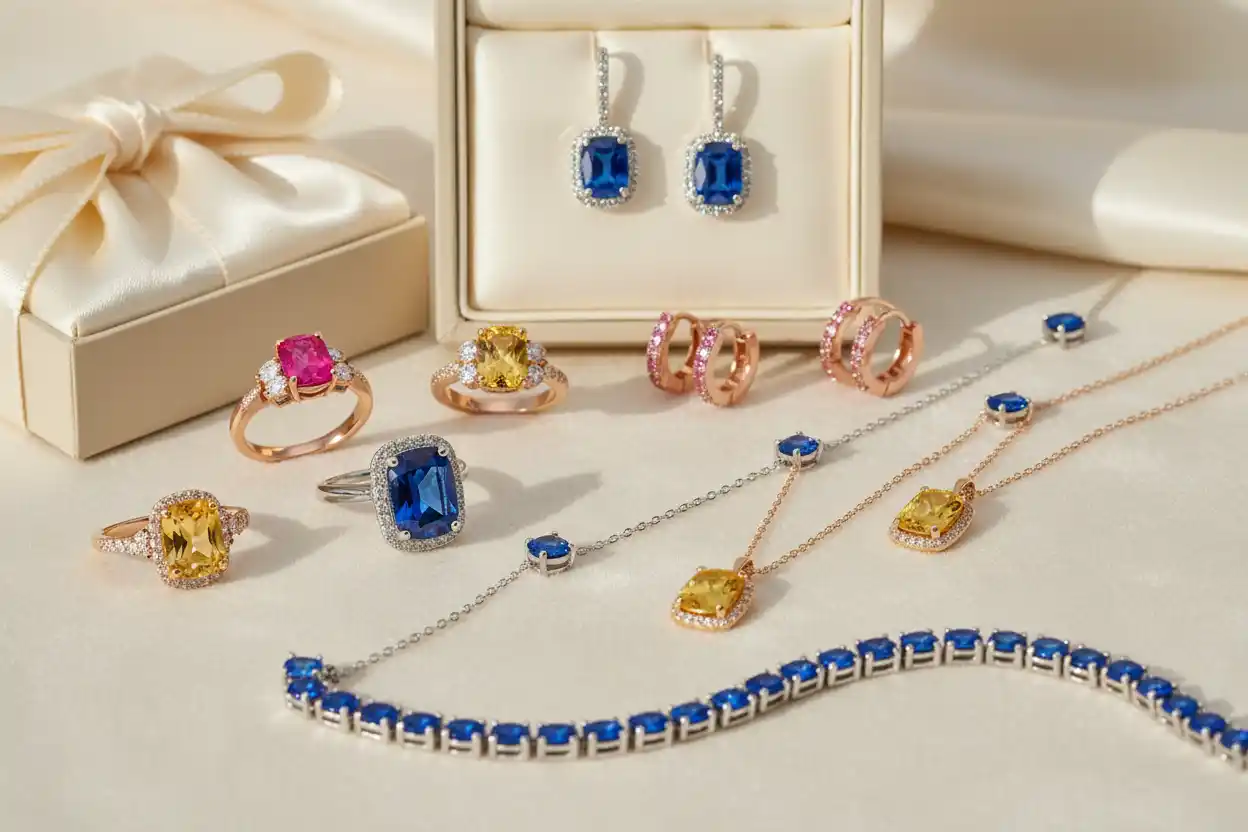
September Birthstone Jewelry: 15 Sacred Symbols of Sapphire Wisdom
September birthstone jewelry centers on sapphire, one of the most durable and historically important colored gemstones used in fine jewelry. Sapphire is corundum, the same mineral species as ruby, and it ranks 9 on the Mohs hardness scale with excellent toughness and no cleavage. Although deep blue is its best-known appearance, sapphire also occurs naturally in pink, yellow, orange, green, purple, violet, colorless and color-changing varieties. Red corundum is classified separately as ruby. This combination of exceptional durability and remarkable color variety makes sapphire practical for rings, earrings, pendants and bracelets intended to last for decades.
The September birthstone has also accumulated centuries of symbolism. GIA records traditional associations with sincerity, truth, faithfulness and nobility, while sapphire has appeared extensively in royal and religious jewelry. These historical meanings help explain why the gemstone became associated with wisdom, loyalty and disciplined judgment rather than merely luxury. Sapphire is also traditionally linked with the fifth and forty-fifth wedding anniversaries, giving September birthstone jewelry an additional relationship and milestone connection.
The “wisdom” associated with sapphire should nevertheless remain symbolic. Modern spiritual traditions may describe sapphire as improving mental clarity, intuition or spiritual perception, but there is no established scientific evidence that wearing the gemstone changes intelligence, treats emotional conditions or produces a measurable field of spiritual energy. Its strongest meanings come from history, color, durability and the values a wearer chooses to attach to the jewelry.
15 Sacred Symbols of September Birthstone Jewelry
- Blue sapphire can symbolize wisdom and thoughtful judgment.
- Historic traditions connect sapphire with truth and sincerity.
- Faithfulness symbolism makes it meaningful for relationships.
- Royal associations can represent dignity and self-respect.
- Religious history can symbolize contemplation and devotion.
- Mohs hardness 9 can represent lasting resilience.
- Deep blue can symbolize calm confidence.
- September identity can express personal belonging.
- Sapphire can symbolize disciplined communication.
- Natural inclusions can represent individuality.
- Vivid color can symbolize clarity of purpose.
- Anniversary traditions can represent enduring partnership.
- Fancy sapphires can symbolize individuality beyond tradition.
- A family sapphire can represent continuity across generations.
- Sacred wisdom remains symbolic rather than scientifically measurable.
Sapphire Wisdom Has Deep Historical Roots
The association between sapphire and wisdom did not begin with modern crystal shops. For centuries, blue sapphire appeared in royal regalia and religious jewelry, where its color became connected with nobility, sincerity, truth and spiritual contemplation. GIA records that ancient Greek and Roman elites believed blue sapphire offered protection from envy and harm, while clergy and rulers later used the stone as a symbol of moral seriousness and elevated status.
Modern September birthstone jewelry naturally inherits some of these ideas. A sapphire pendant may represent thoughtful decision-making, while a ring could symbolize remaining truthful during difficult situations. These meanings work best when understood as intentional symbolism rather than evidence that the gemstone changes cognition.
The traditions explored through sapphire meaning can therefore add personal depth to September jewelry, while gemological facts remain separate from spiritual interpretation.
Sapphire Is One of the Strongest Natural Choices for Daily Jewelry
Sapphire’s practical durability is one of the strongest reasons it works so well as a birthstone. Corundum ranks 9 on the Mohs hardness scale, has excellent toughness and lacks cleavage, meaning there is no single crystallographic plane along which it tends to split easily. GIA specifically identifies sapphire as an excellent gemstone for rings and other settings exposed to regular wear.
This makes September birthstone jewelry far easier to wear daily than softer stones such as opal, pearl, turquoise or moonstone.
A sapphire can still chip after a severe impact, particularly where an inclusion or damaged edge creates a point of weakness, but ordinary wear presents relatively little difficulty for a sound stone in a secure setting.
Its physical resilience also gives symbolic language about endurance a genuine visual foundation. Sapphire does not create psychological strength, but jewelry capable of remaining wearable for generations naturally lends itself to ideas of permanence and consistency.
Blue Color Is the Most Important Sapphire Quality Factor
For blue sapphire, color has the strongest influence on market value. GIA identifies velvety blue to violetish blue with medium to medium-dark tone and strong to vivid saturation as the most highly valued range. The color should remain intense without becoming so dark that brightness is lost.
This means darker is not automatically better.
A sapphire that appears almost black indoors may have strong saturation but weak visual life. At the other extreme, very pale or grayish-blue stones may lack the richness associated with fine blue sapphire.
When selecting September birthstone jewelry, look at the stone in ordinary room lighting as well as brighter illumination. The most satisfying sapphire generally remains recognizably blue and lively in several environments rather than looking impressive only under concentrated showroom lights.
Natural Inclusions Are Normal in Sapphire
Blue sapphires commonly contain inclusions, including small crystals, partially healed fractures, color zoning and rutile needles. Fine intersecting rutile needles are often referred to as silk. GIA notes that extremely high-clarity blue sapphire is rare, while some exceptionally valuable Kashmir sapphires actually owe part of their desirable velvety appearance to tiny inclusions that scatter light attractively.
This is an important distinction for buyers accustomed to diamond clarity.
A natural sapphire does not need to be internally flawless to be beautiful or valuable. The practical concern is whether inclusions noticeably reduce transparency, disrupt color or threaten durability.
Sapphire’s internal features can also support personal symbolism involving individuality. Two natural stones may share similar color while containing completely different microscopic features, giving each gemstone its own internal pattern.
Cutting Determines Whether Sapphire Looks Lively or Heavy
Sapphire rough commonly contains color zoning and noticeable pleochroism, so cutting involves more than selecting a fashionable shape. GIA explains that cutters must consider where color is concentrated, how dark the crystal is in different directions and how much weight can be retained while still producing attractive face-up color.
Poor cutting can make a fine piece of rough look dull, overly dark or uneven.
A well-cut sapphire should distribute light attractively across most of its face. Large dead areas, excessive extinction or obvious windowing can reduce the beauty even when the gemstone has a desirable laboratory description.
When you buy sapphire, viewing the stone in motion is particularly useful because brightness, color zoning and dark areas become easier to judge than they are in a still photograph.
Heat Treatment Is Common and Widely Accepted
A significant percentage of natural sapphires have been heated to improve color or clarity. GIA describes conventional heating as an accepted treatment, while fine stones with independent laboratory confirmation showing no evidence of heat can command additional premiums because comparable untreated gems are rarer.
A heated sapphire is therefore not automatically a poor or undesirable stone.
Treatment becomes more important when distinguishing conventional heat from lattice diffusion, fracture filling or dyeing. Lattice diffusion uses heat together with chemical elements to alter color and generally places the stone in a different value category from comparable conventionally heated or unheated sapphire.
For important September birthstone jewelry, treatment should be disclosed clearly rather than hidden behind vague language such as “enhanced.”
Fancy Sapphires Give September Jewelry Far More Color Freedom
Blue dominates September birthstone imagery, but sapphire occurs naturally in almost every major color except red. Pink, yellow, orange, green, purple and violet sapphires belong to the same corundum mineral species, while rare stones can also exhibit color change.
One of the most famous fancy varieties is padparadscha, valued for a delicate combination of pink and orange. The exact boundaries of the term remain debated, which is why respected gemological laboratories apply carefully defined criteria when deciding whether a stone qualifies.
This color diversity allows someone born in September to choose birthstone jewelry that reflects personal taste rather than feeling obligated to wear dark blue.
The birthstone identity comes from sapphire as a gemstone family, not from one specific hue.
Sapphire Price Reflects More Than Carat Weight
Color, transparency, cutting, treatment, size and sometimes geographic origin all influence sapphire value. The factors behind sapphire price become especially important because sapphires of similar weight can differ dramatically in appearance and rarity.
A vivid one-carat sapphire with excellent color can be much more desirable than a larger stone that appears overly dark or gray.
Geographic origin can add a premium to exceptional gems when determined by an independent laboratory, with Kashmir receiving particularly strong market recognition. Yet GIA emphasizes that every deposit produces a range of quality, so a famous locality does not automatically make an ordinary stone exceptional.
Quality should therefore be evaluated before provenance.
Sapphire’s Royal Identity Strengthens Its Symbolism of Dignity
Sapphire has remained closely connected with royalty for centuries. That association became especially visible in modern popular culture through the famous blue sapphire engagement ring worn first by Diana, Princess of Wales, and later by Catherine, Princess of Wales. GIA identifies the ring as one of the best-known modern examples of sapphire’s continuing royal identity.
For September birthstone jewelry, dignity can therefore be interpreted less as social status and more as self-respect and composure.
A sapphire ring given for graduation, professional achievement or a major birthday might symbolize taking one’s responsibilities seriously while remaining confident in personal values.
That meaning belongs to the wearer rather than to any supernatural force in the corundum.
Sapphire Can Symbolize Faithfulness Without Guaranteeing Relationships
Traditional sapphire symbolism strongly includes fidelity and faithfulness, which explains its long popularity in engagement and anniversary jewelry.
A gemstone cannot guarantee loyalty, preserve a marriage or prevent betrayal.
What it can do is represent a commitment that two people have consciously made.
This distinction is especially important in spiritual writing because a symbolic object can be emotionally powerful without having control over another person’s actions. September birthstone jewelry can represent honesty and partnership, but the quality of a relationship still depends on human choices.
Sapphire Healing Claims Should Remain Clearly Separated From Gemology
Modern crystal traditions may connect sapphire with mental clarity, concentration, spiritual insight, calming emotions or the throat and third-eye chakras.
These interpretations appear in discussions of sapphire benefits, but there is no established clinical evidence that sapphire treats anxiety, improves memory, changes neurological function or enhances intelligence.
The sapphire’s measurable properties are its mineral structure, hardness, optical behavior, inclusions, chemistry and durability.
Spiritual use can remain part of meditation, prayer or personal ritual, but it should not be confused with medical treatment.
Caring for September Birthstone Jewelry Is Relatively Simple
Warm soapy water is consistently safe for sapphire. GIA notes that ultrasonic and steam cleaning are usually appropriate for untreated, conventionally heated and lattice-diffusion-treated stones, while fracture-filled, cavity-filled or dyed sapphires require more cautious treatment and may be limited to cleaning with a damp cloth.
Because sapphire is so hard, it should also be stored separately from softer jewelry. A loose sapphire can scratch emerald, aquamarine, quartz, opal, pearl and many precious-metal surfaces.
For rings worn frequently, periodic inspection of prongs remains important. The sapphire may be highly durable, but the gold or platinum securing it can gradually wear.
Conclusion
September birthstone jewelry combines exceptional physical durability with one of the richest symbolic histories in the gemstone world. Sapphire is Mohs 9 corundum with excellent toughness and no cleavage, making it highly suitable for rings and other jewelry intended for frequent wear. Fine blue sapphire is valued primarily for vivid velvety blue to violetish-blue color, while clarity, cutting, treatment and provenance also influence quality. Historical associations with truth, sincerity, faithfulness, nobility and wisdom make sapphire particularly meaningful for September jewelry, but spiritual interpretations should remain separate from medical or psychological claims.
FAQs About September Birthstone Jewelry
What is the September birthstone?
Sapphire is the recognized September birthstone and is also traditionally associated with the fifth and forty-fifth wedding anniversaries. Although blue is its most familiar color, sapphire occurs in many other hues.
Is sapphire good for everyday jewelry?
Yes. Sapphire ranks 9 on the Mohs hardness scale, has excellent toughness and no cleavage, making it one of the strongest natural colored gemstones for frequent wear.
What sapphire color is most valuable?
Fine blue sapphires generally show velvety blue to violetish blue with medium to medium-dark tone and strong to vivid saturation without becoming excessively dark.
Are natural sapphires usually included?
Yes. Natural blue sapphires commonly contain crystals, healed fractures, color zoning or rutile silk. Extremely high-clarity blue sapphire is unusual and can be very valuable.
Are most sapphires heated?
Heat treatment is common and accepted. Fine stones showing no evidence of heat may command greater premiums because of their rarity.
Does sapphire symbolize wisdom?
Wisdom is a long-standing symbolic association rather than a measurable gemstone effect. Historical traditions also connect sapphire with truth, sincerity, fidelity and nobility.
Does sapphire improve mental clarity or intuition?
There is no established scientific evidence that wearing sapphire improves intelligence, concentration, memory or intuition. Such ideas belong to spiritual and symbolic traditions.
How should sapphire birthstone jewelry be cleaned?
Warm soapy water is always safe. More aggressive cleaning methods may be suitable for many untreated and heated sapphires, but fracture-filled or dyed stones need gentler treatment.
Disclaimer:
Sacred, wisdom, healing, protective, intuitive and energetic meanings associated with sapphire reflect historical traditions, cultural symbolism and personal spiritual practice rather than established medical or psychological effects. September birthstone jewelry does not replace professional healthcare, and perceived sapphire energy cannot determine authenticity, treatment, origin or quality.