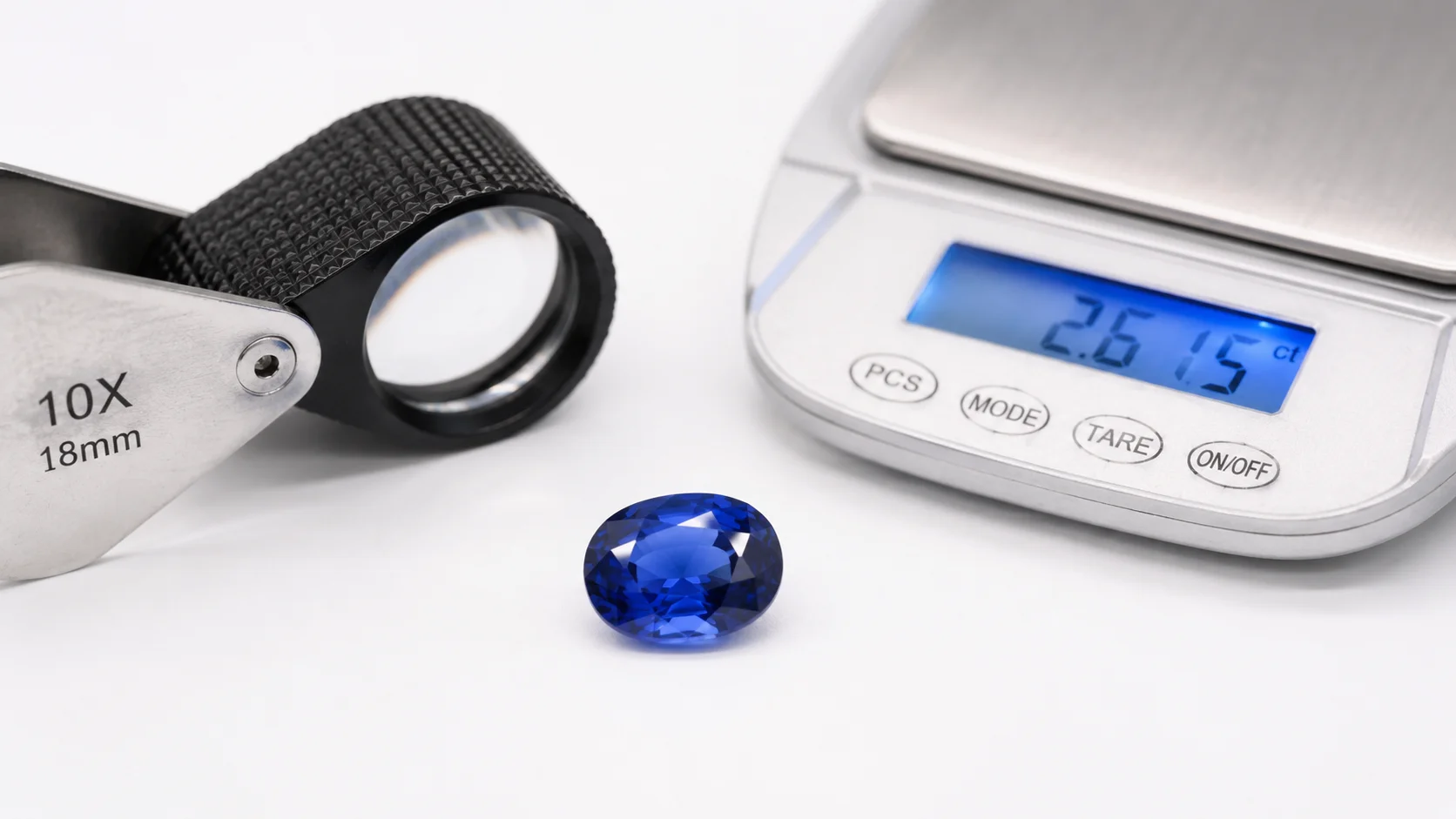
Sapphire Price Guide: Value and Cost in 2026
Natural Sapphire prices in 2026 range from below $50 per carat for low-grade or heavily treated material to more than $100,000 per carat for exceptional Kashmir gems. Most attractive blue jewelry Sapphires cost approximately $500 to $8,000 per carat.
The word Sapphire also covers pink, yellow, white, green, purple, color-change and star corundum. Each variety follows a different market, so the stone’s color category must be established before comparing prices.
Sapphire Price per Carat in 2026
The following table summarizes broad U.S. retail expectations for loose natural blue Sapphire.
| Blue Sapphire category | Typical characteristics | Approximate 2026 retail price |
|---|---|---|
| Entry commercial | Very dark, pale, heavily included, diffusion treated or poorly cut | $50–$300 per carat |
| Good heated Sapphire | Attractive blue, eye-clean appearance and competent cutting | $300–$1,500 per carat |
| Fine heated Sapphire | Strong blue, good transparency and balanced proportions | $1,500–$6,000 per carat |
| Fine unheated Sapphire | Vivid blue, natural inclusions, rare size and major report | $4,000–$15,000 per carat |
| Premium origin Sapphire | Fine unheated Kashmir, Burmese or Sri Lankan material | $10,000–$50,000 per carat |
| Exceptional collector gem | Kashmir origin, rare size, top color and prestigious provenance | $50,000–$250,000+ per carat equivalent |
Fancy Sapphire prices differ substantially. A commercial yellow or white Sapphire may cost below $100 per carat, while fine Pink, Padparadscha or Color-Change Sapphire can reach thousands per carat.
The universal interaction among color, clarity, size and demand appears in How Gemstone Prices Are Determined.
What Is Sapphire?
Sapphire is gem-quality corundum in every color except the red range classified as Ruby.
Its basic composition is aluminum oxide. Trace elements and color centers produce blue, pink, yellow, orange, green, purple, white and color-changing varieties.
Iron and titanium create most blue Sapphire. Chromium contributes to pink, while iron-related processes produce many yellow and green colors.
Sapphire has a Mohs hardness of 9, making it one of the most practical natural gemstones for rings and frequently worn jewelry.
The completed Sapphire guide owns the mineral’s formation, properties, history and symbolic traditions.
The completed Types of Sapphire page owns the full color and variety classification.
Blue Sapphire Color and Value
Blue Sapphire receives its strongest prices when the hue remains clearly blue, the saturation is strong and the tone does not become excessively dark.
Fine stones can range from medium cornflower blue to deeper royal blue. Both descriptions are used inconsistently, so the buyer should evaluate the actual gem rather than the label.
Gray and green modifiers normally reduce value. Excessive violet may also lower demand when the stone loses the familiar blue appearance.
Dark stones frequently look attractive beneath intense dealer lighting but almost black indoors. Conversely, overly pale Sapphire can appear washed out even when it has good clarity.
The ideal stone remains blue and lively across several ordinary lighting conditions.
Cornflower and Royal Blue Sapphire
Cornflower blue generally describes a medium, slightly violetish blue associated with an open and luminous appearance.
Royal blue usually refers to a deeper, strongly saturated blue that should remain vivid rather than dark or inky.
Major laboratories may offer these color descriptions under their own criteria. Their decisions can differ near the boundaries.
A laboratory phrase should support an already attractive stone rather than replace visual judgment.
Fine royal-blue Sapphire can command significant premiums, particularly when unheated and tied to Kashmir, Myanmar or Sri Lanka. However, a dark stone should not become valuable merely because a seller calls it royal blue.
Color Zoning
Natural Sapphire commonly contains color zoning created during crystal growth.
Subtle zoning may be invisible face-up and have little effect on value. Obvious pale bands, colorless centers or sharply divided dark areas reduce price.
Cutters orient the rough to blend zoning and concentrate the best blue through the face.
Poor orientation can cause a stone to look rich from the side but uneven through the table. A rotating video and neutral background reveal zoning more effectively than a single photograph.
Some zoning provides useful evidence of natural growth. Nevertheless, natural origin does not excuse an unattractive face-up pattern.
Clarity and Inclusions
Sapphire is generally expected to be more transparent than Ruby, although natural inclusions remain common.
Possible features include rutile silk, crystals, fingerprints, healed fissures, zoning and mineral needles.
Eye-clean stones receive premiums, especially above two or three carats. However, fine color can outweigh minor inclusions.
Dense silk may soften transparency, while evenly distributed fine silk can create a velvety appearance. Properly oriented silk can also produce a star when the stone is cut as a cabochon.
Open fractures, dark crystals beneath the table and large surface cavities reduce both durability and value.
Laboratory interpretation of inclusions also helps establish natural origin, heat treatment and geographic provenance.
Heat-Treated Sapphire Prices
Heating is accepted and widespread in the Sapphire market.
Conventional heat can improve color, dissolve silk, reduce cloudiness and heal some fissures. Heated Sapphire remains natural corundum.
Commercial heated stones commonly cost $100 to $1,500 per carat. Fine blue examples can reach $2,000 to $8,000 per carat, particularly in large sizes.
An unheated report creates a premium only when the underlying color and clarity are desirable. A dark or poorly cut unheated stone can cost less than a beautiful heated Sapphire.
The dedicated How to Spot Treated or Synthetic Sapphire page owns treatment detection and laboratory evidence.
Unheated Sapphire Prices
Fine unheated Sapphire receives a strong premium because the stone’s color and clarity developed without conventional thermal improvement.
One- to three-carat unheated blue stones commonly range from $3,000 to $15,000 per carat. Premium origin and larger size can push prices far higher.
Kashmir, Burmese and fine Sri Lankan stones occupy the most established collector tiers. Madagascar and other modern sources can also produce exceptional unheated gems.
No-heat status must appear on an independent report. A seller’s statement or untouched appearance is not enough.
Color still leads value. An attractive heated stone may outperform a pale, gray or heavily included unheated gem.
Lattice-Diffused Sapphire
Diffusion treatment introduces coloring elements into the Sapphire surface or lattice.
Titanium diffusion can create a blue layer near the surface. Beryllium diffusion can produce or modify yellow, orange, pink-orange and other colors.
Surface-diffused stones may lose part of their color if deeply repolished or recut. Lattice diffusion can penetrate more deeply but still represents substantial human modification.
Diffusion-treated Sapphire should cost less than conventionally heated material with comparable appearance.
Advanced laboratory testing is necessary because modern treatments may not be obvious to the unaided eye.
The general distinction among heat, diffusion, filling and coating appears in Gemstone Treatments Explained.
Fracture Filling and Coating
Sapphires may contain glass-filled or flux-healed fissures. The treatment improves apparent clarity but creates a discount and may alter cleaning requirements.
Cobalt-bearing coatings or surface treatments can modify color. Such products should not be priced as naturally colored blue Sapphire.
Dyed, filled and coated material belongs to a lower commercial tier, even when the face-up appearance is attractive.
A report should describe detected treatment and, where relevant, the degree of residue or filling.
The Real vs Fake Sapphire guide owns the broader distinction among natural, synthetic, treated and imitation products.
Kashmir Sapphire Prices
Kashmir Sapphire occupies the highest blue-Sapphire market.
The most famous material combines vivid blue color with microscopic inclusions that scatter light and create a velvety appearance.
Historic production was limited, and the classic mines have not supplied a meaningful modern commercial volume. Provenance and laboratory origin are therefore crucial.
Fine Kashmir stones commonly cost tens of thousands of dollars per carat. Exceptional gems can exceed $100,000 per carat, particularly in significant sizes.
Not every stone labeled Kashmir deserves this premium. The origin opinion must come from a respected laboratory, and the visual quality must support collector demand.
Burmese Sapphire Prices
Myanmar produces fine blue Sapphire, particularly from the Mogok region.
Top stones may show rich royal blue, good transparency and large crystal size. Fine unheated Burmese material can reach $10,000 to $50,000 per carat.
Commercial Burmese Sapphire also exists. Dark tone, zoning, inclusions and treatment can place it in much lower tiers.
Compared with Kashmir, Burmese Sapphire may look more saturated and crystalline rather than softly velvety.
Origin creates a premium only after color, cut and clarity meet a high standard.
Sri Lankan Sapphire Prices
Sri Lanka has supplied Sapphire for centuries and produces a broad range of blue and fancy colors.
Fine blue material often shows an open medium-to-medium-dark tone with strong brightness. The market may describe such gems as Ceylon Sapphire.
Commercial heated stones can cost hundreds per carat. Fine unheated Sri Lankan gems commonly reach $3,000 to $15,000 per carat, with exceptional large stones rising higher.
Sri Lanka also produces Pink, Yellow, White, Padparadscha, Star and Color-Change Sapphire.
The word Ceylon should indicate geographic origin rather than function as an automatic quality grade.
Madagascar Sapphire Prices
Madagascar is one of the most important modern Sapphire sources.
Deposits produce blue, pink, yellow, colorless, Padparadscha-like and color-changing material.
Commercial heated stones can be affordable, while fine unheated blues may reach several thousand dollars per carat.
Exceptional Madagascar Sapphire can compete visually with classic-source stones. However, Kashmir, Burmese and Sri Lankan origins often retain stronger historical premiums.
Color stability can matter in some pink-orange material. That issue belongs to the dedicated Padparadscha Sapphire Price Guide and Padparadscha Sapphire Buying Guide.
Montana and Australian Sapphire
Montana Sapphire commonly shows blue-green, gray-blue, teal and pale blue colors. Heat treatment is common and can improve saturation.
Small calibrated Montana stones may cost a few hundred dollars per carat, while fine untreated or precision-cut gems can reach $1,000 to $5,000 per carat.
Australian Sapphire frequently appears dark blue, blue-green or green. Commercial material can be inexpensive, although fine bright stones and carefully cut teal gems receive higher prices.
Local origin, traceability and precision cutting can create premiums independent of traditional royal-blue preferences.
These markets appeal to buyers seeking distinctive natural color rather than a Kashmir-like appearance.
Pink Sapphire Prices
Pink Sapphire commonly ranges from approximately $100 to $5,000 per carat.
Pale heated commercial stones occupy the lower market. Vivid pink, high transparency, rare size and unheated status create the strongest premiums.
The boundary with Ruby can vary. A laboratory may classify a borderline reddish-pink stone differently from a seller.
Strongly saturated Pink Sapphire above three or five carats can be expensive, although most examples remain below fine Ruby pricing.
Pink-Sapphire symbolism and variety context belong to the Sapphire Color Meaning and Symbolism and types pages rather than this market summary.
Yellow Sapphire Prices
Yellow Sapphire commonly costs approximately $50 to $2,000 per carat.
Commercial heated or diffusion-treated stones may fall below $300 per carat. Fine natural-color or conventionally heated gems with bright golden-yellow color can reach $500 to $2,000 per carat.
Brown, green or gray modifiers reduce value. Excessively pale stones can resemble colorless Sapphire.
Diffusion treatment is particularly important because it can produce vivid yellow and orange color at a low cost.
The completed Yellow Sapphire guide owns material context. The identification comparison appears in Citrine vs Yellow Sapphire.
White Sapphire Prices
White Sapphire generally ranges from approximately $20 to $300 per carat.
Colorless stones are not rare enough to support the price levels of fine blue or pink Sapphire. Their value depends mainly on transparency, cut and size.
A well-cut White Sapphire can provide a durable natural Diamond alternative, but it has less dispersion and often looks softer.
Clouds, color tint and windowing reduce value. Large clean stones may still remain affordable relative to Diamond.
The completed White Sapphire guide owns its mineral and jewelry context.
Laboratory-grown white corundum belongs to the Lab Sapphire Price Guide.
Color-Change Sapphire Prices
Color-Change Sapphire shifts between different appearances under daylight-equivalent and incandescent illumination.
Common changes include blue to purple, green to reddish purple and violet-blue to reddish violet.
Commercial stones may cost $200 to $1,000 per carat. Fine examples with a strong, attractive and balanced change can reach $1,000 to $5,000 per carat or more.
Weak changes that require highly controlled light receive less value.
Both colors should remain attractive. A stone that shifts from pleasant blue to muddy brown does not deserve a premium merely because a change occurs.
Star Sapphire Prices
Star Sapphire shows asterism caused by oriented inclusions.
Commercial gray, black or weak-blue stars may cost $20 to $300 per carat. Fine blue stones with a sharp centered star can reach $500 to $5,000 per carat.
Exceptional unheated Burmese or Sri Lankan stars may cost more than $10,000 per carat, particularly when the body remains translucent and the rays are complete.
A good star should move smoothly across the cabochon and remain centered at the crown.
The completed Star Sapphire guide owns phenomenon-specific material context.
Sapphire Size Premiums
Fine Sapphire becomes substantially more expensive when top color and clarity continue into larger sizes.
| Sapphire weight | Commercial heated | Fine heated | Fine unheated |
|---|---|---|---|
| Under 1 ct | $50–$800 per carat | $500–$2,500 per carat | $1,000–$5,000 per carat |
| 1–2 ct | $200–$1,500 per carat | $1,500–$5,000 per carat | $3,000–$12,000 per carat |
| 2–3 ct | $300–$2,000 per carat | $2,500–$8,000 per carat | $5,000–$20,000 per carat |
| 3–5 ct | $500–$3,000 per carat | $4,000–$12,000 per carat | $8,000–$30,000 per carat |
| Above 5 ct | Individually evaluated | $7,500–$25,000+ per carat | $15,000–$100,000+ per carat |
These bands exclude ordinary low-grade dark material and the exceptional Kashmir auction tier.
Dimensions should be evaluated with weight because overly deep stones can conceal expensive carats.
Cut Quality
Sapphire rough can be expensive, zoned and irregular, encouraging cutters to preserve weight.
Ovals and cushions dominate the market. Rounds require more cutting loss, while emerald cuts reveal color zoning and inclusions clearly.
A shallow stone can window and appear pale. Excessive depth can create extinction and reduce face-up size.
Fine cutting should display even color, balanced brilliance and useful dimensions. Minor asymmetry may be accepted when it preserves a rare color zone, but severe bulges and poor polish reduce value.
Detailed inspection and seller questions belong to the Sapphire Buying Guide.
Sapphire Comparisons
Sapphire can be confused with Tanzanite, Kyanite, Spinel, glass and synthetic corundum.
The Tanzanite vs Sapphire guide owns the distinction between violet-blue Zoisite and corundum.
The Kyanite vs Sapphire page covers a softer blue silicate that can overlap in color.
Ruby, Emerald and Sapphire purchasing priorities are compared in Sapphire vs Emerald vs Ruby.
Identity should be established before applying origin or treatment premiums.
Sapphire Jewelry Prices in 2026
| Jewelry type | Broad U.S. retail range |
|---|---|
| Silver jewelry with commercial Sapphire | $50–$500 |
| Gold earrings or pendant | $500–$5,000 |
| One-carat heated blue-Sapphire ring | $1,500–$10,000 |
| One- to two-carat fine unheated ring | $8,000–$50,000+ |
| Premium five-carat Sapphire jewel | $50,000–$500,000+ |
| Exceptional Kashmir or signed jewel | Hundreds of thousands to millions |
The center gem commonly dominates fine-jewelry pricing, though Diamonds, platinum, design and maker add substantial value.
Style-specific selection belongs to the Sapphire Ring Guide, Sapphire Engagement Ring Guide, Sapphire Earrings Guide, Sapphire Necklace Guide and Sapphire Bracelet Guide.
Sapphire’s birthstone role belongs to the September Birthstone Guide.
Certification and Origin Reports
A laboratory report becomes essential when treatment, origin or rare color materially affects the price.
A useful report may include natural origin, color, heat status, diffusion, filling, geographic origin and relevant trade-color descriptions.
Origin is an expert opinion based on inclusions, spectroscopy and trace-element chemistry. Some stones remain inconclusive.
The report does not determine retail value. Two unheated Sri Lankan Sapphires can differ dramatically because one has vivid blue color and the other appears gray or dark.
The Gemstone Certification Labs comparison explains laboratory scope.
Durability and Care
Sapphire’s hardness and toughness make it suitable for daily-wear rings.
The stone can still chip at exposed corners or existing fractures. Filled and coated stones require more caution than untreated or conventionally heated material.
Warm soapy water is generally safe. Steam and ultrasonic cleaning may be appropriate for intact untreated or heat-treated Sapphire, but not for filled, dyed or heavily fractured stones.
Complete maintenance guidance belongs to How to Clean Sapphire Jewelry Safely.
Does Sapphire Hold Its Value?
Fine unheated Sapphire has an established international collector market.
The strongest resale prospects belong to Kashmir, Burmese and top Sri Lankan gems with respected reports, rare size and excellent color.
Commercial heated, dark and diffusion-treated stones generally resell below retail.
Fancy colors can also retain demand, but each follows a smaller specialist market. Padparadscha, vivid Pink and strong Color-Change Sapphire have better prospects than ordinary pale material.
The general framework appears in Do Gemstones Hold Their Value?.
Price Guide vs Buying Guide
This page owns Sapphire’s 2026 family-level prices and value factors. It summarizes fancy colors without replacing dedicated Padparadscha pricing.
Practical report review, stone inspection and seller comparison belong to the buying guide.
Online shoppers should verify report numbers, treatment, origin, dimensions and return terms using How to Buy Gemstones Online Without Getting Scammed.
The Buying & Value hub connects Sapphire pricing with certification, treatments, comparisons and resale guidance.
Frequently Asked Questions
1. How much is Sapphire worth per carat in 2026?
Natural Sapphire ranges from below $50 per carat for low-grade material to more than $100,000 per carat for exceptional Kashmir gems. Most attractive blue stones cost $500 to $8,000 per carat.
2. What Sapphire color is most valuable?
Fine blue Sapphire and Padparadscha generally command the strongest broad prices, although exceptional Pink and Color-Change stones can also be expensive.
3. How much is a one-carat blue Sapphire?
A commercial heated one-carat stone may cost $300 to $2,000. Fine unheated material commonly costs $3,000 to $15,000 or more.
4. How much is a three-carat Sapphire?
A three-carat blue Sapphire may cost several thousand dollars when commercial or more than $50,000 in total when fine, unheated and well documented.
5. Is heated Sapphire valuable?
Yes. Fine heated Sapphire can cost thousands of dollars per carat, although comparable unheated material receives a premium.
6. Why is Kashmir Sapphire so expensive?
Historic supply is extremely limited, while fine stones can show an admired velvety blue appearance and strong collector provenance.
7. Is Sri Lankan Sapphire valuable?
Yes. Fine unheated Sri Lankan Sapphire can reach thousands or tens of thousands of dollars per carat.
8. How much is Yellow Sapphire worth?
Most Yellow Sapphire costs approximately $50 to $2,000 per carat, depending on treatment, saturation, clarity and size.
9. How much is White Sapphire worth?
Most natural White Sapphire costs approximately $20 to $300 per carat.
10. Does Sapphire need a laboratory report?
A report is advisable when heat status, diffusion, natural origin, geographic origin or a premium color category affects price.
11. Does Sapphire hold its value?
Fine unheated and prestigious-origin Sapphire can retain strong collector demand. Commercial treated stones usually resell below retail.
12. Is Sapphire a good investment?
Exceptional documented Sapphire may appreciate, but resale timing, commissions and future demand are uncertain.
Sapphire Pricing Starts With the Variety
A blue Kashmir Sapphire, a heated yellow stone, a white Sapphire and a diffusion-treated star cabochon share the same mineral family but not the same market.
In 2026, good blue jewelry Sapphire generally falls between $500 and $8,000 per carat. Higher prices become defensible when vivid color, no heat, rare size, prestigious origin and independent laboratory evidence align in one stone.