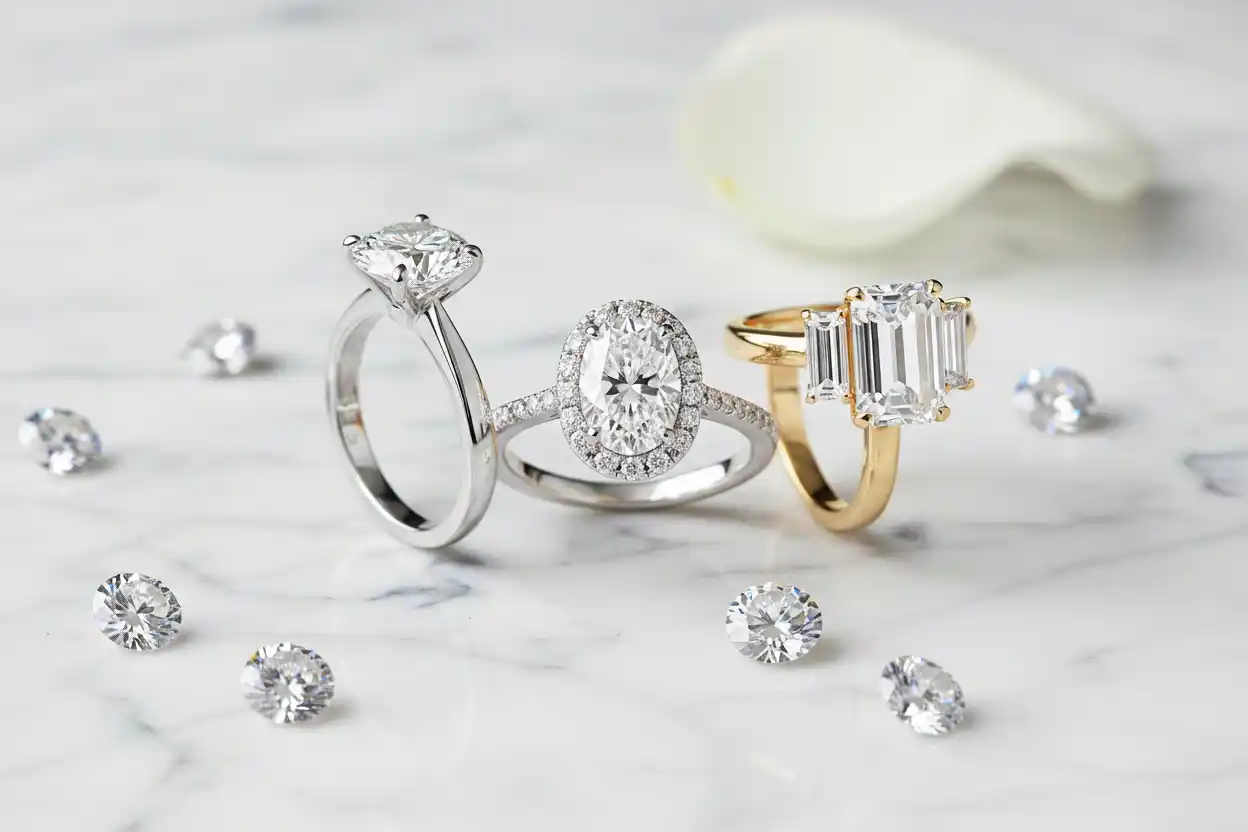
Diamond Engagement Rings: Complete Buyer’s Guide
A diamond engagement ring combines a gemstone purchase with decisions about style, durability, budget, setting and long-term wear. The strongest choice is not automatically the largest or highest-graded diamond; it is the ring whose diamond quality, proportions, construction and appearance fit the wearer’s priorities.
Start with cut and overall visual performance, then decide how much color, clarity and carat weight matter for the chosen shape. After that, evaluate the setting, metal, ring size and documentation as carefully as the diamond itself.
Diamond Engagement Rings at a Glance
| Factor | What matters most |
|---|---|
| Diamond identity | Natural or laboratory-grown, clearly disclosed |
| Cut | Brightness, fire, scintillation and balanced proportions |
| Color | Appearance in the chosen shape and metal |
| Clarity | Eye-clean appearance and absence of durability-threatening inclusions |
| Carat weight | Weight rather than face-up diameter |
| Shape | Style, finger coverage and practical durability |
| Setting | Security, protection, maintenance and visual effect |
| Metal | Color, durability, maintenance and allergy considerations |
| Ring size | Accurate fit with allowance for design width |
| Report | Independent grading for a significant center diamond |
| Budget | Total ring cost rather than diamond price alone |
| Long-term care | Prong inspection, cleaning, insurance and safe wear |
Start with the Wearer, Not the Diamond
The diamond is important, but an engagement ring is worn as a complete piece of jewelry.
Before comparing grades, consider the wearer’s preferences. Do they favor minimal jewelry, vintage design, geometric shapes or strong visual sparkle? Do they work with their hands? Do they wear yellow, white or rose-colored metals?
A person who wants a low-profile ring may prefer a bezel or compact halo even if a high prong solitaire displays more of the center stone.
Likewise, someone who rarely wears jewelry may find a modest well-proportioned diamond more comfortable than a large stone selected primarily for impact.
Style and lifestyle should establish the buying framework before a carat target does.
Understanding the 4Cs
The four standard diamond evaluation factors are cut, color, clarity and carat weight.
The completed diamond buying guide covers the 4Cs across loose stones in greater depth. For engagement rings, the important question is how the four factors interact within the chosen design.
A diamond does not need the highest grade in every category to look exceptional.
For many buyers, prioritizing cut and visible beauty while accepting a modest compromise in color or clarity creates a stronger ring than maximizing a paper specification that cannot be appreciated without magnification.
Cut: Usually the Strongest Visual Priority
Cut describes how effectively a faceted diamond interacts with light.
A well-cut diamond can display strong brightness, spectral fire and scintillation. Poor proportions may make a diamond appear dark or visually smaller despite a high color and clarity grade.
For standard round brilliant diamonds, independent laboratories may provide an overall cut grade. Fancy shapes such as oval, pear, emerald, radiant and cushion require more direct visual evaluation because their appearance varies substantially.
Compare diamonds under diffuse room light as well as jewelry-store spotlights.
Cut should never be confused with shape. Round, oval and pear describe outline; cut quality describes how well the facets and proportions work.
Diamond Shape
Shape determines much of an engagement ring’s personality.
| Diamond shape | Visual character | Practical consideration |
|---|---|---|
| Round brilliant | Classic and highly brilliant | Usually carries strong market demand |
| Oval | Elongated and bright | Check bow-tie darkness and symmetry |
| Cushion | Soft square or rectangular outline | Facet patterns vary widely |
| Emerald cut | Elegant step-cut appearance | Clarity and color are easier to see |
| Radiant | Rectangular or square with strong sparkle | Corner protection matters |
| Pear | Elongated teardrop | Point needs secure protection |
| Marquise | Long and dramatic | Both points require protection |
| Princess | Square and brilliant | Corners are vulnerable |
| Asscher | Geometric step cut | Clarity becomes more visually important |
| Heart | Symbolic and distinctive | Symmetry is especially important |
There is no universally superior engagement-ring shape. The best choice balances appearance, finger coverage and durability.
Round Brilliant Diamonds
Round brilliant diamonds remain a benchmark for sparkle and standardized cut evaluation.
Their circular outline also distributes impact more evenly than shapes with sharp points. This makes the round brilliant a practical choice for frequent wear.
Because the shape is highly popular and cutting round rough involves particular yield tradeoffs, comparable rounds may cost more than some fancy shapes.
A slightly smaller well-cut round can appear brighter than a larger stone with weaker proportions.
Oval Diamonds
Ovals offer an elongated appearance and may provide generous face-up coverage for their weight.
Most ovals show some degree of bow-tie effect, a darker region through the center caused by the interaction between cut and observation angle. A subtle bow tie is not automatically a defect, but a broad black band can reduce visual appeal.
Check outline symmetry carefully. One shoulder should not look fuller than the other.
A six-prong or well-designed four-prong setting can protect the stone while maintaining its elongated appearance.
Emerald-Cut Diamonds
Emerald cuts use broad step facets that create a hall-of-mirrors effect rather than the intense scintillation of a round brilliant.
Because the large facets reveal the interior clearly, inclusions and body color may be easier to notice.
Therefore, buyers may prioritize clarity and color somewhat differently than they would in a brilliant cut.
Length-to-width ratio changes the character substantially. A squarer emerald cut feels more geometric, while an elongated stone creates stronger vertical finger coverage.
A bezel or secure four-prong setting works well when the corners receive adequate protection.
Color
For diamonds in the traditional colorless-to-light range, less visible yellow or brown generally corresponds with higher color grades.
However, the setting changes how color appears.
Yellow or rose gold may visually harmonize with a slightly warmer diamond. Platinum and white gold create greater contrast, which can make warmth more obvious.
Shape matters as well. Step cuts and elongated pointed shapes may reveal body color differently from round brilliants.
Rather than buying a grade in isolation, inspect the diamond in a setting similar to the final ring.
The completed diamond color meaning and symbolism guide explores natural color varieties separately.
Clarity
Clarity evaluates internal inclusions and external blemishes.
For an engagement ring, the practical goal is often a diamond that appears clean without magnification and does not contain inclusions that create durability concerns.
Paying a large premium for a grade whose difference cannot be seen during normal wear may provide little visual benefit.
Step cuts can reveal inclusions more readily than brilliant cuts, so emerald and Asscher shapes may justify stronger clarity.
Location matters alongside grade. An inclusion near a vulnerable edge may deserve more attention than a small inclusion hidden within a brilliant facet pattern.
Carat Weight vs Visible Size
Carat measures weight, not diameter.
Two diamonds with identical carat weights may appear different in size from above because of their shape and proportions.
A deep diamond can hide substantial weight below the girdle. Conversely, an extremely shallow diamond may face up large but lose brightness through poor light return.
Compare millimeter dimensions alongside carat weight.
A well-cut 0.90-carat diamond may provide more attractive visible presence than a poorly proportioned 1.00-carat stone purchased primarily to reach a numerical milestone.
Fluorescence
Some diamonds emit visible light when exposed to ultraviolet radiation, most commonly blue.
Fluorescence is recorded on many diamond grading reports. It is not automatically a defect, and most fluorescent diamonds do not show an undesirable appearance in normal lighting.
Rare stones with very strong fluorescence may appear hazy or oily, so evaluate the actual diamond rather than rejecting fluorescence as a category.
Fluorescence does not inherently weaken the diamond.
Its influence on price can vary with color, strength and market preference.
Natural vs Laboratory-Grown Diamond Engagement Rings
Natural and laboratory-grown diamonds share the crystal structure and fundamental physical properties of diamond, but their origins and market dynamics differ.
A natural diamond formed through geological processes. A laboratory-grown diamond was created through controlled technological growth.
The completed lab diamond meaning and properties guide explains the material distinction, while the lab diamond engagement-ring guide owns the detailed buying intent for laboratory-grown center stones.
Neither origin should be hidden. Written disclosure matters because visual inspection alone cannot reliably establish natural versus laboratory-grown origin.
Diamond vs Moissanite
Moissanite is a different gemstone material, not a laboratory-grown diamond.
It is durable and highly brilliant but has different optical behavior, including stronger dispersion and double refraction under suitable observation.
The completed lab diamond versus moissanite guide explains their identification differences.
Buyers primarily concerned with sparkle and budget may consider both, but pricing should reflect accurate identity.
The completed list of diamond alternatives compares additional durable engagement-ring options.
Treated Diamonds
Some natural diamonds receive treatments intended to change color or apparent clarity.
Treatments can affect value and care, and they should be disclosed.
The completed guide to treated and synthetic diamonds explains methods such as color treatment, fracture filling and the distinction between treated natural diamonds and laboratory-grown material.
For a significant center stone, an independent grading report provides considerably more confidence than seller terminology alone.
Solitaire Engagement Rings
A solitaire centers one principal gemstone without major side stones.
It gives the diamond complete visual emphasis and can be relatively easy to clean and maintain.
Four prongs expose more of a round diamond, while six prongs provide additional security and create a rounder visual outline.
A bezel solitaire offers stronger edge protection and a lower profile.
Solitaire does not mean plain. Basket shape, gallery detail, band width and metal finish can change the design substantially.
Halo Engagement Rings
A halo surrounds the center diamond with smaller stones.
The design can increase apparent visual size and create additional sparkle. It also provides some protection around the edge of the center stone.
However, numerous small settings increase maintenance requirements.
Evaluate the central diamond independently before considering the halo. A large halo should not compensate for weak cutting or a center stone whose appearance the wearer does not like.
Hidden halos place small diamonds beneath the center rather than around its face-up outline.
Three-Stone Engagement Rings
Three-stone rings combine a center diamond with two side stones.
The design may symbolize past, present and future, although buyers do not need to adopt that meaning.
Side stones can be diamonds or colored gemstones. Their shape and height should complement the center without crowding it.
Matching color matters when all three stones are white diamonds.
Check the complete ring from the side because overly tall individual settings can create snagging and instability.
Pavé and Diamond Bands
Pavé places small diamonds closely across the band.
It adds substantial sparkle without increasing the center stone’s size. Micro-pavé creates an especially fine appearance but requires careful workmanship.
Very thin pavé bands may not suit repeated resizing, heavy impact or someone who routinely grips tools.
Small stones can loosen when the band bends.
A slightly sturdier shank often provides better long-term service than selecting the thinnest possible design for visual delicacy.
Bezel Settings
A bezel wraps metal around the diamond’s girdle.
It is one of the most protective settings and works particularly well for active lifestyles or diamonds with vulnerable points.
Full bezels create a smooth outline, while partial bezels leave more diamond exposed.
A bezel may make the stone appear visually different from an open prong setting, but it does not necessarily reduce beauty.
Good craftsmanship is critical because an uneven bezel can obscure the diamond or create an asymmetrical appearance.
Choosing the Metal
Platinum
Platinum is naturally white, dense and durable. It develops a patina with wear rather than requiring rhodium plating.
Its higher density makes a ring feel heavier.
White Gold
White gold provides a bright appearance and generally costs less than platinum. Many pieces receive rhodium plating, which may need renewal over time.
Ask about alloy composition when nickel sensitivity is a concern.
Yellow Gold
Yellow gold creates a warm traditional look and may harmonize with slightly warmer diamonds.
Rose Gold
Rose gold contains copper that creates its pinkish tone. It can provide strong contrast with white diamonds and suits vintage-inspired designs.
Metal selection should consider appearance, maintenance, skin sensitivity and setting construction.
Ring Size and Fit
Accurate ring size matters because an engagement ring is intended for repeated wear.
Finger size changes with temperature, time of day and swelling. Measure under normal conditions rather than immediately after strenuous activity or extreme cold.
Wide bands may feel tighter than thin ones and sometimes require a slightly different fit.
Eternity-style settings and intricate pavé can be difficult to resize. Ask about future sizing limitations before purchasing.
A ring should pass the knuckle with gentle resistance and remain secure without restricting circulation.
Setting Height and Lifestyle
High settings create visual drama and may allow a wedding band to sit flush beneath the engagement ring.
However, a tall diamond catches more easily on clothing, gloves and furniture.
Low settings provide greater protection and may feel more comfortable for hands-on work.
The best profile depends on how the ring will actually be used.
Someone who wears gloves professionally or cares for young children may prefer a low basket, bezel or compact halo.
Wedding Band Compatibility
Consider the future wedding band before finalizing the engagement ring.
A straight band may not sit flush against a low or unusually shaped center setting. Curved, contoured or open bands can solve that problem.
Trying both rings together also reveals whether their settings rub.
Diamonds can scratch metal and other gemstones, so direct friction between two rings may damage the settings even when the center diamond remains intact.
Planning the pair early can prevent expensive redesign later.
Setting a Budget
There is no responsible universal formula based on monthly salary.
Set a budget that does not compromise essential expenses, emergency savings or high-priority financial responsibilities.
Then divide that budget between the center diamond, setting, taxes, insurance and potential future maintenance.
A smaller high-performing diamond in a strong setting is often preferable to stretching finances for a carat milestone.
The completed diamond price guide explains the relationship between size, quality and market value without requiring an arbitrary spending rule.
Buying the Diamond and Setting Separately
Purchasing a loose diamond first can provide greater control over quality and documentation.
The setting can then be selected or custom-made around the exact dimensions of the stone.
However, coordinate responsibility between the diamond seller, jeweler and setter. Clarify who carries risk if the stone is damaged during setting.
For custom work, review drawings, dimensions, metal and completion terms before production begins.
Keep copies of all reports and receipts.
Grading Reports
A significant center diamond should generally have an independent grading report from a recognized gemological laboratory.
The report documents characteristics such as measurements, carat weight, color and clarity, and may record cut information, fluorescence and treatments depending on the diamond and report type.
Verify that the report number and measurements correspond with the stone supplied.
A grading report is not an appraisal. It describes gemological characteristics rather than assigning a retail replacement value.
Appraisals and Insurance
An appraisal may be useful for insurance, particularly when the complete ring has substantial replacement cost.
Review what an insurance policy actually covers. Theft, accidental damage, mysterious disappearance and international travel may be treated differently.
Photograph the ring and keep invoices, grading reports and appraisals securely.
Do not store the only copy of valuable documentation with the ring itself.
Update the appraisal when major changes in the ring, setting or replacement market make the existing document outdated.
Ethical and Sourcing Questions
Responsible sourcing involves more than a vague ethical label.
Ask what the seller can document about diamond origin, supply-chain controls and manufacturing. For recycled metals or traceable stones, request specific information about what the claim means.
Laboratory-grown diamonds remove geological mining from the production process but still have energy, manufacturing and supply-chain considerations.
No single label answers every environmental or social question.
Choose sellers who provide concrete disclosure rather than relying solely on broad marketing language.
Buying Online
When buying an engagement ring online, confirm:
- Exact diamond grading report
- Diamond measurements
- Natural or laboratory-grown origin
- Treatment disclosure
- Setting metal and dimensions
- Ring size
- Return period
- Resizing terms
- Warranty limitations
- Shipping insurance
- Independent inspection options
High-resolution video can reveal shape outline and light behavior that a still photograph may hide.
Return rights are particularly important for fancy shapes because personal visual preference cannot be reduced to grading numbers.
How to Inspect the Finished Ring
When the complete ring arrives, check that the center diamond sits level and does not move.
Inspect prongs for symmetry and smoothness. The shank should be evenly finished without sharp interior edges.
Confirm ring size and comfort.
Compare the grading-report measurements with the center stone and verify any identifying inscription when present.
If the ring differs materially from the agreed specifications, resolve the issue before wearing it extensively or altering it.
Caring for a Diamond Engagement Ring
Diamond is exceptionally scratch-resistant but not indestructible.
Hard blows can chip diamonds, and metal prongs can bend or wear. Remove the ring before exercise, gardening, heavy cleaning, machinery use and similar activities.
Warm water, mild soap and a soft brush suit many secure untreated diamond rings.
The completed guide to cleaning diamond jewelry safely explains settings, treatments and home-cleaning precautions.
Have the ring professionally inspected periodically and whenever a prong catches or the diamond moves.
Conclusion
A strong diamond engagement-ring purchase starts with the wearer’s lifestyle and aesthetic preferences rather than a carat target. Prioritize cut and visible beauty, then balance color, clarity and size according to shape and setting.
Choose protective construction, accurate sizing and a metal suitable for long-term wear. Confirm natural or laboratory-grown origin and obtain independent grading when the center diamond justifies it.
Most importantly, set a financially sustainable budget. A well-proportioned diamond in a secure setting carries more practical value than an impressive specification purchased at the expense of financial stability.
Frequently Asked Questions
1. What is the most important C for a diamond engagement ring?
Cut is often the strongest visual priority because it controls brightness, fire and scintillation. The other Cs still affect appearance and price.
2. What is the best diamond shape for an engagement ring?
There is no universal best shape. Round is classic and durable, while oval, cushion, emerald, radiant and other shapes suit different styles.
3. How much should I spend on a diamond engagement ring?
Use a budget that fits your actual finances. There is no responsible universal salary-based spending rule.
4. Is a laboratory-grown diamond suitable for an engagement ring?
Yes. Laboratory-grown diamonds have the fundamental properties of diamond, but their origin and market dynamics differ from natural diamonds and should be disclosed.
5. What clarity grade should an engagement diamond have?
Choose a stone that appears clean at normal viewing distance and lacks inclusions that threaten durability rather than automatically paying for the highest grade.
6. What color grade is best?
The ideal color depends on shape, metal and personal sensitivity to warmth. A slightly warmer diamond can look excellent in yellow or rose gold.
7. Is fluorescence bad in a diamond?
No. Fluorescence is not automatically negative, and most fluorescent diamonds show no undesirable appearance in ordinary lighting.
8. Is a bezel safer than prongs?
A bezel provides excellent edge protection. Well-made prongs can also be secure when they are maintained properly.
9. Should an engagement diamond have a grading report?
Independent grading is strongly advisable when the center diamond’s specifications materially affect the purchase price.
10. Can diamonds chip?
Yes. Diamond is extremely hard and resists scratching, but certain sharp impacts can chip it.
11. Can an engagement ring be worn all the time?
Continuous wear increases setting wear and impact risk. Remove the ring for exercise, cleaning, gardening and other rough activities.
12. Should I choose the engagement ring alone or with my partner?
Either approach can work. When style, sizing or budget preferences are uncertain, involving the wearer directly often reduces costly mistakes.