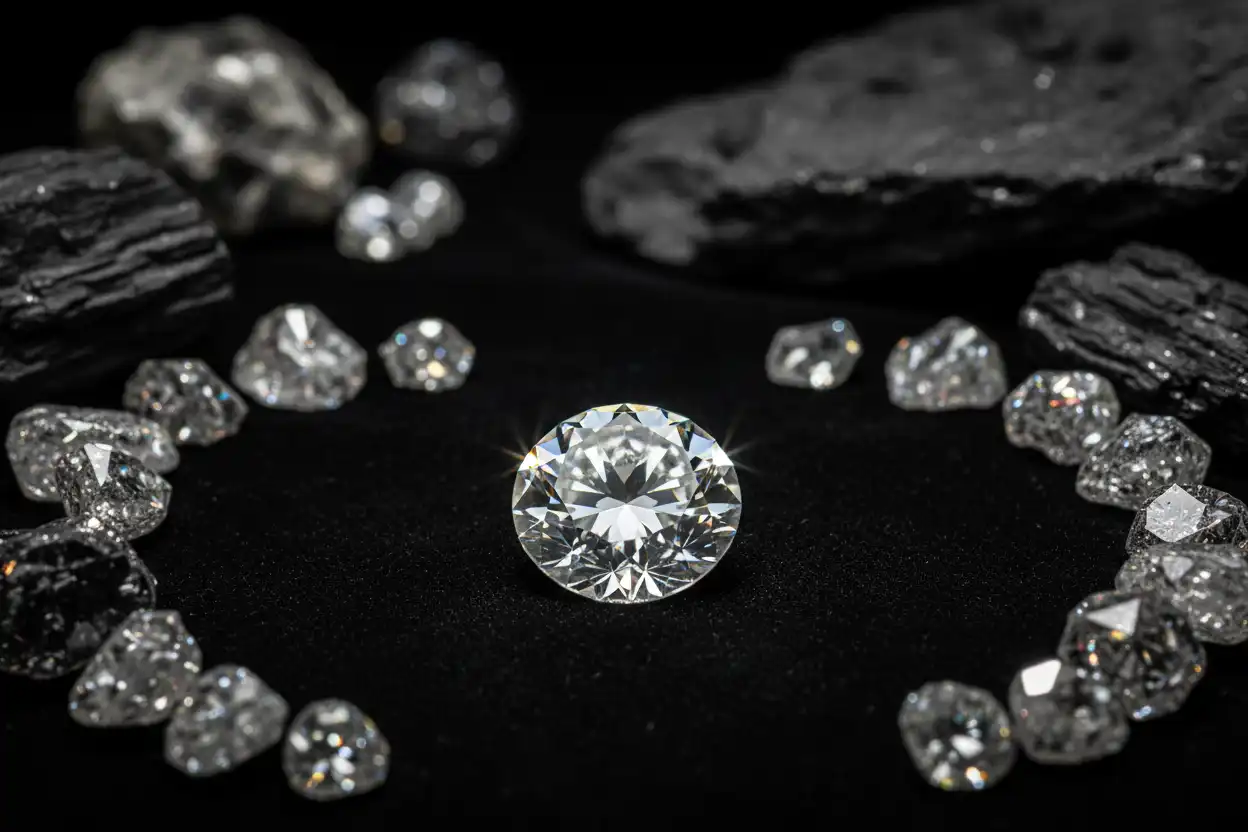
Diamond Meaning: Facts, Formation, Uses & Symbolism
Diamond meaning is often buried beneath centuries of symbolism, luxury marketing, engagement traditions, rarity claims, and metaphysical language, yet the material itself is unusually straightforward at the chemical level. Diamond is crystalline carbon, composed primarily of carbon atoms arranged in a strongly bonded three-dimensional structure. That atomic arrangement gives diamond its exceptional hardness, high refractive index, strong dispersion, distinctive thermal conductivity, and many of the physical properties that separate it from graphite even though both materials are made from carbon. Natural diamonds form under specific geological conditions, while laboratory-grown diamonds reproduce the essential crystal structure and composition through controlled technological processes.
That physical identity should come before any symbolic interpretation. Diamond meaning in culture has included durability, commitment, status, purity, power, wealth, victory, permanence, and romantic attachment, but none of those meanings is embedded in carbon atoms as an objectively measurable emotional property. Likewise, modern metaphysical descriptions may associate diamond with clarity, manifestation, energetic amplification, courage, or spiritual illumination, yet those ideas belong to cultural or personal interpretation rather than established mineral physics.
Within Gems Lore’s Gemstone Guides collection, the useful approach is to define diamond as a material first, then separate formation, color, identification, documented history, and symbolism into distinct evidence layers. That prevents three common errors at once: treating every clear faceted stone as diamond, confusing natural and laboratory-grown origin with material identity, and presenting symbolic language as though it were a measurable property of crystalline carbon.
Diamond at a Glance
| Property | Practical reference |
|---|---|
| Material identity | Crystalline carbon |
| Formula | C |
| Mineral class | Native element |
| Crystal system | Isometric/cubic |
| Mohs hardness | 10 |
| Relative toughness | Good but not indestructible; cleavage and impact remain important |
| Specific gravity | Approximately 3.52 |
| Typical luster | Adamantine |
| Refractive index | Approximately 2.42 |
| Dispersion | Strong, producing spectral fire in suitable cuts |
| Common natural colors | Colorless, yellow, brown, gray, with rarer blue, green, pink, red, orange, violet, and other hues |
| Common rough forms | Octahedra, cubes, dodecahedral forms, aggregates, irregular crystals |
| Natural or laboratory-grown? | Both exist |
| Common simulants | Cubic zirconia, moissanite, glass, synthetic sapphire, zircon, and others |
| Main identification caution | Visual appearance alone cannot establish natural origin or exclude simulants |
| Symbolic associations | Commitment, endurance, clarity, strength, status, permanence |
| Evidence boundary | Symbolism is cultural or personal interpretation, not a scientifically demonstrated healing effect |
The table immediately reveals why diamond meaning cannot be reduced to “the hardest stone.” Hardness describes resistance to scratching, not immunity to breaking. Diamond can cleave along crystallographic directions, chip at exposed edges, abrade other materials, and suffer damage in poorly protected jewelry despite occupying the top of the Mohs hardness scale.
What Diamond Actually Is
Diamond is a crystalline allotrope of carbon. Each carbon atom is strongly bonded within a three-dimensional network, producing a rigid structure very different from graphite, another form of carbon whose atoms are arranged in sheets. The chemistry may be simple, but the structural arrangement creates dramatically different physical properties.
This distinction is useful because “made of carbon” does not predict behavior by itself. Graphite is soft enough to leave marks on paper, while diamond is the hardest naturally occurring material on the Mohs scale. The difference comes from bonding and structure rather than from the element name alone.
Natural diamonds may contain trace elements, lattice defects, inclusions, strain, growth zones, and internal features that affect color, fluorescence, transparency, and identification. A gem described as carbon is therefore still much more structurally complex than a perfectly pure textbook formula suggests.
Diamond meaning should begin at that level: a material whose properties arise from crystal structure before human culture assigns value or symbolism.
Natural Diamond, Laboratory-Grown Diamond, and Simulants
Three categories are frequently confused.
A natural diamond formed through geological processes and was later transported toward Earth’s surface.
A laboratory-grown diamond is produced technologically but has the essential carbon composition and diamond crystal structure expected of diamond.
A diamond simulant is a different substance selected because it resembles diamond visually.
This distinction is crucial. Cubic zirconia is not synthetic diamond; it is stabilized zirconium dioxide. Moissanite is silicon carbide. Glass is amorphous silicate-rich material. Colorless sapphire is corundum. Each can imitate aspects of diamond appearance while remaining chemically and structurally distinct.
Laboratory-grown diamond, by contrast, is diamond material. Its growth origin differs, but its identity is not equivalent to an imitation.
Anyone evaluating a purchase should therefore separate material identity, growth origin, treatment, and quality. The detailed purchasing framework belongs in buy diamond, while this page keeps diamond meaning focused on what the material is and what has been associated with it culturally.
How Natural Diamond Forms
Natural diamond formation requires conditions that allow carbon to crystallize into the diamond structure rather than another carbon form. Many gem diamonds originate deep within Earth’s mantle, where high pressures and suitable temperatures exist over geological timescales.
Carbon-bearing fluids or melts interact with mantle rocks and can precipitate diamond when local chemistry and physical conditions become favorable. The resulting crystals may remain deep underground for long periods before rapid volcanic events transport them upward in mantle-derived magmas.
Those carrier rocks are important because diamonds do not usually crystallize inside the volcanic pipe at shallow depth. The eruption acts more like an elevator, carrying pre-existing mantle diamonds toward the surface fast enough that much of the material survives.
Weathering can later release diamonds from primary host rocks. Because diamond is durable and dense, crystals can become concentrated in river gravels, coastal sediments, or other secondary deposits.
The detailed geological distinction between mantle formation, host rocks, volcanic transport, and secondary deposits belongs in diamond formation and deposit geology. For diamond meaning, the important point is that natural formation is a geological process governed by carbon chemistry, pressure, temperature, fluids, and mantle conditions—not by the later symbolism of endurance or transformation.
Why Diamond Is So Hard
Diamond’s exceptional hardness comes from its strongly bonded three-dimensional carbon framework. Breaking or scratching the surface requires disrupting strong bonds rather than sliding weakly bonded layers past one another.
That property explains diamond’s historical and technological importance, but hardness is often misunderstood. The Mohs scale measures relative resistance to scratching. It does not measure toughness, impact resistance, cleavage, elasticity, or resistance to every kind of damage.
A diamond can scratch many materials while still chipping when struck in an unfavorable direction.
This distinction matters in jewelry because “hardest” is often incorrectly translated into “unbreakable.” A diamond ring can survive decades of ordinary wear and still suffer a chipped girdle or damaged point after one unlucky impact.
Diamond Cleavage and the Myth of Indestructibility
Diamond has well-developed cleavage along specific crystallographic planes. Under sufficient force applied in the right direction, a crystal can split along those structural weaknesses.
Historically, cutters exploited cleavage deliberately when dividing rough. In modern processing, sawing, laser cutting, and other technologies provide additional options, but crystallographic orientation still matters.
This is why durability needs a multi-property approach. Hardness protects polish and facet surfaces from many scratches, while toughness and cleavage influence resistance to impact.
The specialist guide to diamond cutting, orientation, and polish addresses how crystallographic direction influences cutting decisions. Diamond meaning may symbolize permanence, but the physical stone remains subject to mechanical limits.
What Causes Diamond Color?
Colorless diamond is only one part of the diamond family. Natural diamonds can appear yellow, brown, blue, green, pink, red, orange, gray, black, violet, or combinations of those impressions depending on impurities, lattice defects, deformation, inclusions, irradiation effects, and other structural causes.
Nitrogen is particularly important in many yellow diamonds because its presence in particular atomic arrangements can absorb portions of visible light. Boron can contribute blue coloration in suitable diamonds. Pink and red colors can be associated with plastic deformation and resulting changes in the crystal lattice rather than one simple coloring impurity.
Green coloration can involve radiation-related defects near or within the crystal, although origin-of-color interpretation can become technically difficult. Brown diamonds can involve deformation-related defects and other structural factors.
The detailed relationship among hue, saturation, tone, defect structures, fluorescence, and optical behavior belongs in diamond color meaning. On this page, the essential lesson is that color is a physical consequence of the material’s structure and chemistry before it becomes a cultural symbol.
Colorless Does Not Mean Chemically Perfect
A diamond that looks colorless to the eye does not necessarily represent perfectly pure carbon without defects or inclusions. Very small concentrations of impurities or structural imperfections can exist without creating obvious body color.
Likewise, laboratory grading language about color should not be interpreted as a complete chemical analysis.
Two diamonds with similar visible color can differ internally in nitrogen aggregation, fluorescence, inclusions, growth history, strain, or treatment status.
This is another example of why appearance and identity must remain separate. The human eye provides valuable information, but it does not reveal every aspect of crystal chemistry.
Why Diamond Sparkles
Diamond’s visual appearance depends on several optical properties working together. Its high refractive index allows light to bend strongly as it enters and exits the gem. Proper faceting can redirect substantial light back toward the observer, contributing to brightness.
Dispersion separates white light into spectral colors, producing the flashes commonly called fire.
Scintillation refers to the pattern of light and dark flashes seen as the stone, observer, or light source moves.
Cut quality determines how effectively these inherent optical properties are used. A diamond with strong material potential can look dull if proportions allow excessive light leakage, while a well-designed cut can create lively brightness from relatively modest size.
The specialist diamond optical properties and color behavior reference explores those effects more precisely. Their importance to diamond meaning is simple: brilliance and fire have physical optical explanations and do not require claims that the stone emits spiritual light.
Crystal Habit in Rough Diamond
Natural diamond commonly develops octahedral, cubic, dodecahedral, or modified crystal forms, although real rough can be distorted, twinned, resorbed, fractured, coated, or irregular.
Octahedral crystals are especially recognizable because eight triangular faces form a geometric shape strongly associated with textbook diamond morphology. Cubic crystals can occur as well, while resorption may modify sharper forms into more rounded dodecahedral-looking surfaces.
Natural growth surfaces can preserve microscopic features that help reconstruct crystal history. Once a diamond is faceted, most of those external geological clues disappear.
This difference is important for collectors. A fine natural crystal can have specimen value independent of whether it would produce the largest polished gem.
Diagnostic Traits of Diamond
Diamond identification relies on several properties rather than one visual shortcut. High hardness, distinctive refractive behavior, strong thermal conductivity, specific gravity, dispersion, crystallographic form, fluorescence responses, inclusions, spectroscopy, electrical properties in certain types, and advanced growth-structure analysis can all contribute.
Traditional visual clues have limitations.
A sharp-looking facet edge does not prove diamond. Strong rainbow fire does not prove diamond. A stone that scratches glass does not prove diamond because many materials can scratch ordinary glass. A handheld thermal tester can be useful but must be used correctly, particularly because some diamond simulants complicate simplistic readings.
Natural-versus-laboratory-grown separation is more demanding still. Both materials are diamond, so the question becomes growth origin rather than species identification.
High-value decisions should therefore rely on appropriate gemological evidence rather than social-media home tests.
What Magnification Can Reveal
Magnification can expose mineral inclusions, fractures, feathers, crystals, clouds, needles, cavities, polishing marks, abrasion, extra facets, girdle characteristics, laser features, and internal growth structures.
These observations can help assess quality and sometimes contribute to origin or treatment interpretation, but they need context.
A crystal inclusion does not automatically prove natural origin unless its identity and relationship to growth are understood. A clean stone is not automatically laboratory-grown. Certain laboratory-grown diamonds contain metallic or other growth-related inclusions, while natural diamonds can be exceptionally clean.
The dedicated diamond microscope and inclusion notebook covers those inclusion patterns in more detail.
For diamond meaning, magnification provides a useful reminder that internal imperfection is not the opposite of authenticity. Natural and laboratory-grown diamonds both record growth histories, and inclusions can become evidence rather than simply defects.
An Original Diamond Specimen and Photo Checklist
Begin by identifying the object’s form. Is it rough, faceted, mounted, loose, melee-sized, a crystal on matrix, or an industrial fragment? Different formats preserve different evidence.
For rough material, photograph the crystal from several orientations. Record natural faces, trigons or other surface features when visible, broken areas, coatings, attached minerals, resorption, and unusual crystal shape. Do not polish or clean aggressively simply to make a suspected diamond look brighter.
For faceted material, photograph under diffuse neutral light before using point illumination. Diffuse light helps document body color, transparency, facet symmetry, chips, abrasions, and inclusions. Point light emphasizes brightness, fire, and scintillation but can obscure subtle body color.
Record dimensions and weight together whenever the stone is loose. Those measurements can reveal whether density and proportions are broadly plausible, although they cannot prove identity.
Use magnification to inspect facet junctions, girdle, culet, inclusions, polish, cavities, chips, and internal reflections. Describe what is visible before assigning an origin explanation.
If natural-versus-laboratory-grown origin matters, stop treating photography as decisive. Growth-origin separation can require spectroscopy, luminescence imaging, fluorescence patterns, trace chemistry, or specialized instruments beyond ordinary consumer inspection.
Finally, keep five questions separate: Is the material diamond? Is it natural or laboratory-grown? Has it been treated? What quality does it have? Does any stated geographic or historical provenance have documentary support?
One answer cannot safely stand in for the other four.
A Source-Comparison Table for Common Diamond Claims
| Common claim | What can reasonably be retained | What needs correction or stronger evidence |
|---|---|---|
| “Diamond is the hardest natural material.” | Diamond has Mohs hardness 10 | Hardness does not mean unbreakable |
| “Diamond cannot chip.” | Diamond resists scratching exceptionally well | Cleavage and impact can cause damage |
| “Every natural diamond is rare.” | Fine gem-quality combinations can be scarce | Many industrial or small diamonds are comparatively abundant |
| “Laboratory-grown diamond is fake diamond.” | Laboratory origin differs from geological origin | Lab-grown material has diamond composition and structure |
| “Cubic zirconia is synthetic diamond.” | CZ is a diamond simulant | CZ is zirconium dioxide, not carbon |
| “The clearest diamond is chemically pure.” | Low visible color and inclusions can indicate high gem quality | Invisible defects and trace impurities can remain |
| “Every blue diamond contains boron.” | Boron is important in many natural blue diamonds | Color origin requires actual gemological evidence |
| “Black diamond is one uniform material type.” | Black appearance occurs in the diamond market | Causes can include inclusions, defects, treatments, or aggregate structures |
| “Diamond represents eternal love.” | This is a strong modern cultural association | It is not a physical property of carbon |
| “Diamond heals every chakra because it amplifies energy.” | Amplification is a modern metaphysical theme | No established mineralogical evidence demonstrates chakra activation |
| “Diamond improves strength because it is hard.” | Hardness makes it a powerful symbol of strength | Mineral hardness does not transfer mechanically or medically to the wearer |
| “A diamond certificate guarantees value.” | A grading report can document important gemological characteristics | It does not guarantee resale price or investment performance |
The central pattern is consistent: many unsupported statements begin with a real diamond property and then extend it into a claim the property cannot establish. Hardness can symbolize strength, but it does not make a person physically stronger. Geological age can symbolize endurance, but it does not make a relationship permanent.
Natural Versus Laboratory-Grown Diamond
Natural and laboratory-grown diamonds share the defining crystal structure of diamond, but their growth environments differ dramatically.
Natural diamonds record mantle processes and geological transport. Laboratory-grown diamonds form under engineered conditions designed to reproduce the physical environment necessary for diamond crystallization.
Modern production commonly uses high-pressure, high-temperature methods or chemical vapor deposition. Each approach can leave characteristic growth patterns, impurities, fluorescence behavior, or spectroscopic features that specialist laboratories use to determine origin.
This distinction should remain separate from moral or symbolic value. A naturally formed diamond can be important because of geological rarity and provenance. A laboratory-grown diamond can be important because of technological achievement, affordability, design possibilities, or personal choice.
Diamond meaning belongs partly to the story people attach to the object, and origin is one part of that story rather than a universal measure of emotional significance.
Treated Diamond Is Still a Material Question
Diamonds may undergo treatments intended to modify color, clarity appearance, or other market characteristics. Treatment should be disclosed because it can affect value, care expectations, testing, and comparison.
A treated diamond is not automatically synthetic, and a laboratory-grown diamond is not automatically treated. These are different classification questions.
Color modification, fracture-related interventions, coatings, irradiation-related processes, and other techniques each require their own terminology and evidence.
The specialist treated diamond guide owns those distinctions. Diamond meaning should not turn untreated status into a spiritual hierarchy in which natural untreated stones are described as energetically pure while treated or laboratory-grown diamonds are presented as spiritually inferior.
Those are belief claims, not gemological conclusions.
Diamond Compared With Cubic Zirconia
Cubic zirconia can resemble colorless diamond strongly, particularly in clean well-cut stones, but it is a different crystalline material with different density, hardness, thermal conductivity, refractive index, dispersion, and wear behavior.
CZ can display very strong spectral fire and can be manufactured in large clean sizes economically. Diamond is significantly harder and belongs to an entirely different chemical and economic category.
The comparison matters because “looks like diamond” is not the same as “is diamond.”
Identity should be established from material evidence rather than price, brilliance, seller language, or visual prestige.
Diamond Compared With Moissanite
Moissanite is silicon carbide and is another widely used diamond simulant. It can be extremely brilliant, highly dispersive, and durable enough for frequent jewelry wear.
Its optical behavior differs from diamond, including properties related to double refraction in most gem moissanite orientations, and trained observers may notice distinctive facet doubling or visual character under suitable conditions.
Modern testing instruments can distinguish diamond from moissanite more reliably than old thermal-only assumptions in many situations.
The comparison reinforces the same principle: a simulant is not inferior merely because it is different, but it should be sold under its correct material identity.
Diamond Price Is Not Diamond Meaning
Diamond’s symbolic reputation has become strongly entangled with price, creating the impression that a more expensive stone carries greater emotional significance.
Gemological value and personal meaning should be separated.
The market evaluates weight, color, clarity, cut, shape, natural or laboratory-grown origin, treatment, documentation, provenance, demand, and seller context. Those factors belong in diamond price rather than being used to rank the sincerity of relationships or the strength of symbolism.
A modest diamond can hold substantial personal meaning. A very expensive diamond can have none beyond its financial or collector value.
Money measures a market transaction, not emotional depth.
Diamond in Rings
Diamond became deeply connected with rings because durability, brilliance, marketing history, cultural convention, and the circular symbolism of the ring all reinforced one another.
That association is culturally powerful but historically contingent rather than a natural law. People expressed commitment through many materials before diamond engagement rings became dominant in modern markets.
Practical ring design must also respect real mechanics. An exposed point, thin girdle, shallow setting, damaged prong, or pre-existing fracture can make even diamond vulnerable.
Readers evaluating construction rather than symbolism can use the dedicated diamond ring reference, while the underlying mechanical principles are addressed in diamond setting and wear engineering.
Diamond Earrings and Necklaces
Earrings generally expose diamonds to less impact than rings, making them practical settings for matched stones and high-brilliance presentation. Matching becomes important because two diamonds viewed simultaneously can reveal differences in dimensions, color, cut, or brightness more readily than isolated stones.
The dedicated diamond earrings guide deals with those pair-specific choices.
Necklaces introduce different considerations: chain strength, pendant balance, articulation, stone orientation, clasp security, and the way the setting positions the diamond against clothing or skin. Those issues are addressed separately in diamond necklace.
Neither jewelry format changes diamond meaning scientifically. A stone does not acquire stronger emotional properties because it is worn closer to the heart or nearer the face.
Diamond Bracelets and Repeated Wear
Bracelets expose diamonds and settings to repeated movement, desk contact, clothing friction, and accidental impact. Multiple stones also multiply the number of prongs or setting points that can require inspection.
A line bracelet may contain individually small diamonds whose collective brilliance depends on matching and consistent setting rather than on one dominant center stone.
The diamond bracelet guide covers those design and buying considerations without turning the meaning page into a jewelry catalogue.
The practical lesson is that symbolic permanence requires ordinary maintenance if the physical jewelry is expected to last.
Cleaning Does Not Restore “Energy”
Diamond readily attracts oils because of its surface chemistry, which is one reason a worn diamond can appear dull even when its facets remain undamaged. Skin oils, cosmetics, soap residue, dust, and lotions can reduce the light reaching and leaving the stone.
Cleaning may therefore restore apparent brilliance dramatically.
That effect is optical, not metaphysical.
A diamond looking dull does not prove that it has absorbed negative energy or become spiritually depleted. Surface contamination is a simpler and testable explanation.
The correct maintenance method depends on treatments, fractures, surrounding stones, metal, and setting condition, which is why detailed care belongs in how to clean diamond jewelry rather than in a symbolism discussion.
Documented History of Diamond
Diamonds have been known and valued for a very long time, with early trade and use associated particularly with South Asia before additional sources expanded global supply. Their exceptional hardness, transparency, rarity in desirable sizes, and distinctive brilliance contributed to fascination long before modern optical cutting maximized their appearance.
Historical diamonds functioned as symbols of power, status, protection, wealth, rulership, rarity, and prestige in different societies. The meanings were not static. Access was limited, cutting technologies changed, major deposits shifted the market, and cultural interpretation evolved alongside trade.
The modern association with romantic commitment is particularly powerful but should not be projected unchanged across all historical periods. Diamond did not always mean engagement, and engagement did not always require diamond.
This distinction is central to responsible diamond meaning: documented cultural history is more interesting when it is allowed to change rather than being rewritten as one timeless universal symbolism.
Why Diamond Became a Symbol of Commitment
The physical durability of diamond provides an obvious metaphor for endurance. A transparent gem that resists scratching and can remain visually brilliant across generations lends itself naturally to ideas such as permanence and constancy.
Jewelry tradition then amplified that metaphor.
Rings already carried circular symbolism in many cultural contexts, and placing a durable, bright, expensive stone at the center of a ring created an effective material representation of commitment. Commercial promotion later strengthened the association dramatically.
The symbolism can be emotionally meaningful without being physically causal.
A diamond does not guarantee loyalty, compatibility, communication, or longevity in a relationship. It represents a promise because people collectively and personally decide that it does.
Purity and Clarity Symbolism
Colorless transparent diamonds are frequently associated with purity, truth, honesty, or clarity.
Again, the metaphor comes from appearance.
Transparency allows a person to see through the material, while high brilliance can produce a visual impression of cleanliness or light. Those characteristics become easy metaphors for sincerity or clear intention.
Yet a visually clean diamond can contain microscopic inclusions, trace impurities, and structural defects. In mineralogical terms, visual purity is not absolute chemical purity.
That contrast makes the symbolism more interesting rather than less: human ideas of clarity can be inspired by a material that is internally complex.
Strength Symbolism and the Hardness Shortcut
Diamond meaning commonly includes strength because diamond is exceptionally hard. The symbolic connection is understandable but often extended too far.
Hardness is a material-specific resistance to scratching.
Wearing diamond does not transfer Mohs hardness to the wearer, increase bone strength, improve immunity, create emotional resilience automatically, or make someone physically tougher.
A more grounded symbolic use would treat diamond as a reminder of deliberate resilience: maintaining boundaries, completing difficult work, protecting important commitments, or choosing consistency under pressure.
The symbol can support behavior without pretending that crystal hardness becomes human physiology.
Wealth, Status, and Social Meaning
Diamond has also become one of the strongest global symbols of wealth and status.
Part of that meaning comes from natural scarcity in desirable gem qualities, but social systems contribute just as strongly. Ownership, jewelry scale, famous stones, luxury brands, ceremonial use, and high-profile auctions have all reinforced the link between diamond and economic prestige.
That symbolism can be celebrated, criticized, rejected, or reinterpreted depending on personal values.
A laboratory-grown diamond complicates the story further because it can provide the same basic material identity and visual appearance without reproducing the same rarity economics.
Diamond meaning therefore changes with context. To one wearer it may represent luxury; to another, technological innovation; to another, family inheritance; and to another, a private promise independent of market price.
Diamond in Modern Metaphysical Symbolism
Modern crystal traditions sometimes describe diamond as an amplifier, manifestation stone, clarity crystal, spiritual purifier, crown-chakra stone, confidence stone, or energetic enhancer.
These descriptions belong to metaphysical belief systems.
No established scientific evidence shows that diamond amplifies another crystal’s healing energy, activates chakras, manifests external events, improves cognition, removes toxins, treats disease, or alters consciousness through a mineral-generated field.
A grounded symbolic practice can still use the same vocabulary metaphorically. “Amplification” might mean choosing one priority and giving it greater attention. “Clarity” might mean checking facts before making a decision. “Strength” might mean remaining consistent with a commitment.
The meaning becomes actionable because the person defines the behavior.
Diamond and the Crown Chakra
Clear diamonds are sometimes associated with the crown chakra in modern crystal systems because transparency and brilliance are linked symbolically with higher awareness, illumination, or spiritual clarity.
This association is interpretive rather than anatomical.
No validated medical or gemological instrument demonstrates that diamond opens or balances a crown chakra. Likewise, one diamond cannot be scientifically ranked as having stronger spiritual vibration because of carat weight, clarity grade, natural origin, or retail price.
Anyone using diamond in meditation can do so as a symbolic focus without turning the practice into a physiological claim.
Carbon Is Not Medicine
Diamond is carbon, and carbon is fundamental to life. That true statement sometimes becomes the basis for unsupported claims that diamond synchronizes with the human body because people are carbon-based organisms.
The reasoning is invalid.
Chemical element identity alone does not establish biological compatibility, therapeutic action, or energy transfer. Carbon occurs in countless compounds and structures with completely different properties.
Graphite, methane, proteins, carbon dioxide, diamond, and organic tissue all involve carbon but behave differently because bonding and molecular structure determine function.
A diamond worn on the skin is not a carbon supplement and does not medically strengthen cells.
Safe Ownership
An intact diamond in normal jewelry use does not require unusual chemical safety precautions. The principal everyday risks involve the jewelry itself: loose settings, sharp damaged edges, metal allergies, accidental swallowing of small loose stones, or mechanical injury during inappropriate handling.
Lapidary and industrial processing are different environments. Cutting, grinding, laser processing, polishing compounds, metal tools, cooling systems, and workplace dust can create occupational hazards that have little to do with ordinary jewelry wear.
Diamonds should not be ingested or intentionally ground for wellness practices.
Direct-contact crystal elixirs are unnecessary, particularly because finished jewelry may include metals, solder, coatings, cleaning residues, or treatments beyond the diamond itself.
Provenance and Ethics Are Separate From Crystal Identity
A diamond can be mineralogically genuine while its documented chain of custody remains incomplete.
Origin, mining practices, labor conditions, environmental impacts, sanctions, recycling history, laboratory growth, and supply-chain disclosure belong to provenance and ethics rather than to the definition of diamond itself.
This distinction matters because symbolic claims about purity or love can feel uncomfortable when the material’s sourcing story is uncertain. Buyers who care about those issues should request documentation proportionate to the purchase instead of assuming that a luxury presentation guarantees traceability.
Ethical meaning is created partly through decisions about sourcing, not solely through the material’s crystal structure.
What Diamond Meaning Should Not Duplicate
Diamond meaning owns the foundational material definition, formation overview, causes of color, diagnostic framework, historical development, symbolism boundaries, and safe ownership.
It should not duplicate the full buyer workflow, current valuation model, detailed color grading, specialized treatment identification, complete jewelry engineering, cleaning protocols, or advanced inclusion analysis.
Those topics require their own evidence and deserve separate treatment.
Keeping the boundaries clear makes this page more useful because readers searching diamond meaning receive an answer about diamond itself rather than a compressed version of every other diamond article.
Frequently Asked Questions About Diamond Meaning
What is diamond?
Diamond is crystalline carbon. Its carbon atoms are arranged in a strongly bonded three-dimensional structure that gives the material exceptional hardness and distinctive optical properties.
What does diamond meaning symbolize?
Diamond meaning commonly includes commitment, endurance, strength, clarity, purity, status, permanence, and resilience. These are cultural or personal interpretations rather than scientifically demonstrated emotional effects.
Is diamond the hardest mineral?
Diamond has Mohs hardness 10 and is exceptionally resistant to scratching. That does not mean it cannot chip, cleave, fracture, or suffer impact damage.
Is laboratory-grown diamond real diamond?
Yes. Laboratory-grown diamond has the essential carbon composition and crystal structure of diamond. Its origin is technological rather than geological.
Is cubic zirconia diamond?
No. Cubic zirconia is stabilized zirconium dioxide and is used as a diamond simulant. It is a different material.
Is moissanite diamond?
No. Moissanite is silicon carbide. It can resemble diamond and has excellent brilliance and durability, but its composition and optical behavior differ.
Why are some diamonds yellow?
Nitrogen-related defects and atomic arrangements can absorb portions of visible light and contribute yellow coloration. Exact color origin depends on the diamond’s structure and impurity configuration.
Why are some diamonds blue?
Boron is an important contributor in many natural blue diamonds, although professional testing is necessary when determining the origin of color in an individual stone.
Why do diamonds sparkle?
High refractive index, strong dispersion, polished facets, and effective cut geometry create brightness, spectral fire, and scintillation.
Are diamonds indestructible?
No. Diamond is extremely hard but can cleave or chip under sufficient impact, particularly along vulnerable crystallographic directions or exposed jewelry edges.
Does diamond have healing properties?
There is no established scientific evidence that diamond prevents, treats, or cures medical or psychological conditions through ordinary wear or handling.
Does diamond open the crown chakra?
Crown-chakra association belongs to modern metaphysical practice. No established scientific test demonstrates chakra activation by diamond.
Does a more expensive diamond have stronger meaning?
No. Market price reflects gemological and commercial variables, while personal meaning depends on relationships, history, intention, and individual values.
Can diamond be treated?
Yes. Some diamonds undergo treatments intended to alter color or improve the appearance of clarity. Treatment should be disclosed because it can affect value and care.
How can I tell whether a diamond is natural?
Natural-versus-laboratory-grown separation may require specialized gemological instruments, spectroscopy, fluorescence or luminescence analysis, growth-pattern examination, and laboratory expertise. Appearance alone is not reliable for high-value decisions.
Diamond Meaning Beyond the Marketing
Diamond meaning becomes more useful when the gemstone is allowed to be both physically remarkable and culturally constructed. As a material, diamond is crystalline carbon with exceptional hardness, high refractive power, strong dispersion, distinctive thermal behavior, and a geological history that can begin deep within Earth’s mantle. Those properties are measurable and remain true whether the stone is used in an engagement ring, industrial tool, mineral collection, laboratory experiment, or heirloom.
Its history adds a separate human layer. Diamonds have represented prestige, authority, wealth, endurance, rarity, romantic commitment, and social status in different contexts, while modern markets have made some of those associations far more dominant than others. Laboratory-grown diamonds now add another layer by separating diamond material identity from natural geological origin, forcing buyers to think more carefully about what they personally value.
Symbolism can remain meaningful without becoming pseudoscience. Diamond’s hardness can represent resilience without strengthening the body. Its transparency can represent clarity without altering cognition. Its durability can symbolize commitment without guaranteeing a relationship. Its brilliance can stand for insight without emitting a proven spiritual field.
That is the strongest diamond meaning: first understand what the material actually is, then decide what its history, appearance, provenance, and personal context make it represent. When the scientific and symbolic layers remain distinct, diamond does not lose its cultural power; the meaning becomes more precise.