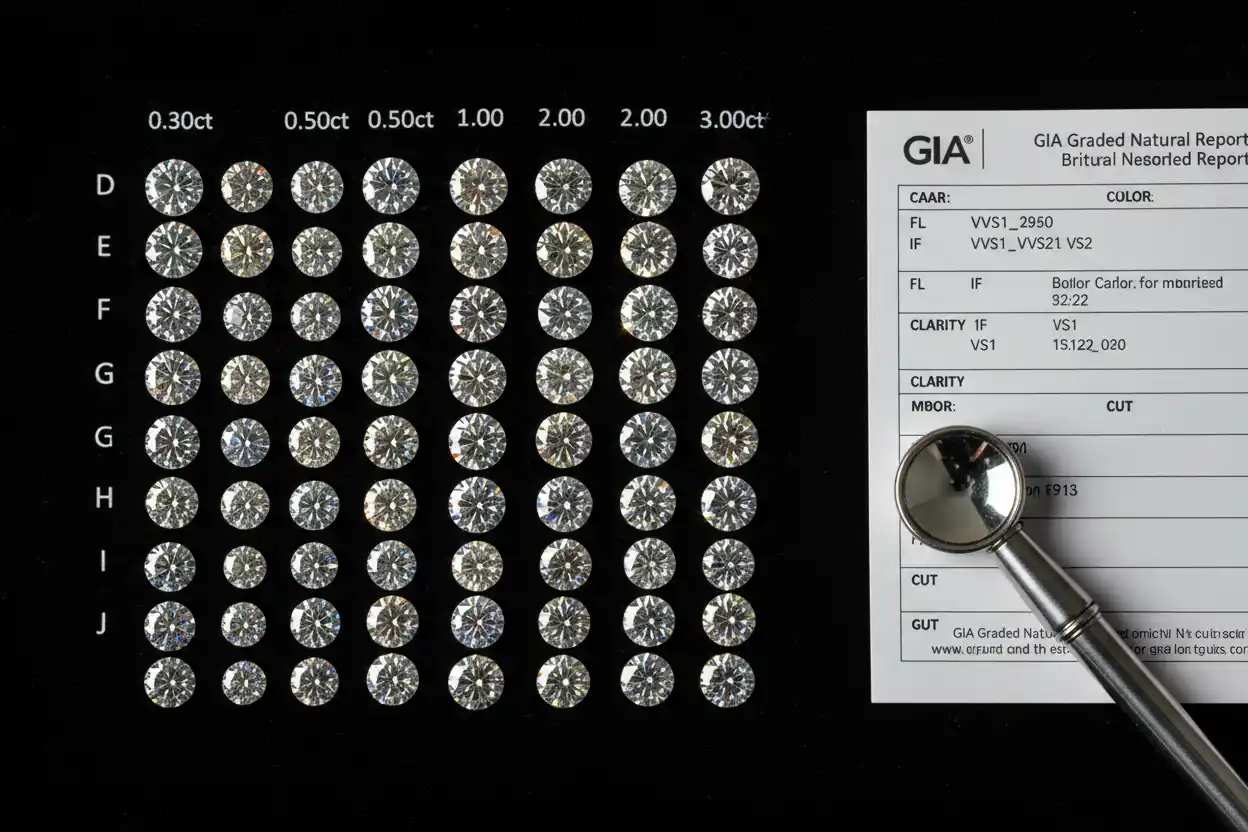
Diamond Price: Value Drivers, Grade, Supply & Demand
Diamond prices span an unusually wide range because carat weight alone does not determine value. In the current natural-diamond retail market, mainstream G-H color, VS2-SI1 clarity diamonds with Very Good cut or better have median asking prices around $770 at 0.50 carat, $3,860 at 1 carat, $9,300 at 1.50 carats, and $19,700 at 2 carats. At 3 carats, the current median rises to roughly $46,220. The increase is therefore far from linear.
A one-carat natural diamond can also vary substantially within a much narrower specification. Current 1.00-carat G/VS2 Excellent round listings include examples around $3,474, $3,648, $3,969, $4,140, and $4,256. Differences in proportions, fluorescence, exact dimensions, grading details, inventory position, and seller pricing create variation even when the headline grades look almost identical.
The main value drivers remain carat weight, cut, color, clarity, shape, treatment, grading documentation, and market demand. Natural and laboratory-grown diamonds should also be treated as separate markets because their current price structures are dramatically different.
Diamond Price At a Glance
| Natural diamond size | Current middle-market asking range | Current median asking price | Approx. median price per carat |
|---|---|---|---|
| 0.50 ct | $720-$850 | $770 | $1,540/ct |
| 0.70 ct | $1,290-$1,700 | $1,500 | $2,143/ct |
| 0.90 ct | $2,280-$3,060 | $2,610 | $2,900/ct |
| 1.00 ct | $3,420-$4,380 | $3,860 | $3,860/ct |
| 1.50 ct | $8,040-$10,950 | $9,300 | $6,200/ct |
| 2.00 ct | $17,520-$22,590 | $19,700 | $9,850/ct |
| 3.00 ct | $41,790-$53,860 | $46,220 | $15,407/ct |
These figures reflect current live asking prices for natural diamonds in a mainstream G-H color, VS2-SI1 clarity, Very Good-or-better quality band. They are useful market benchmarks, not fixed values for every diamond. D color, very high clarity, superior cutting, unusual shapes, fancy color, treatment, fluorescence, branding, and other characteristics can move an individual stone far outside these ranges.
Why Diamond Prices Rise Faster Than Carat Weight
A two-carat diamond does not normally cost twice as much as a comparable one-carat diamond. Current median figures put a one-carat natural diamond near $3,860 and a two-carat example near $19,700 within the same general quality band. That is more than five times the total price.
The reason is scarcity. Larger rough crystals capable of yielding an attractive polished diamond become progressively less common, especially when good color and clarity must be preserved at the same time. The market therefore places a higher price per carat on larger stones.
This effect becomes even clearer at three carats. A current median around $46,220 works out to approximately $15,407 per carat, compared with about $3,860 per carat at the one-carat level.
The detailed diamond price per carat is therefore more useful than assuming that price rises evenly with weight.
Carat Thresholds Create Noticeable Price Jumps
Diamond pricing is influenced by psychologically important weights such as 0.50, 0.70, 1.00, 1.50, 2.00, and 3.00 carats. Demand often concentrates around these familiar sizes, and sellers know that buyers actively search for them.
Current figures illustrate the effect. A 0.90-carat natural diamond in the mainstream benchmark band has a median asking price around $2,610, while the 1.00-carat median is approximately $3,860. The extra tenth of a carat increases total weight by about 11%, yet the median price rises by roughly 48%.
That difference is why a well-cut 0.90 to 0.99-carat diamond can sometimes offer attractive value. Face-up dimensions may remain close to those of a full one-carat stone, particularly when proportions are efficient.
The same principle applies around 1.50 and 2.00 carats. Buyers focused on visible size rather than a round-number weight can compare stones just below these thresholds.
Cut Can Change Both Beauty and Price
Cut has a direct effect on how a diamond interacts with light. In standard round brilliants, proportions, polish, symmetry, brightness, fire, and scintillation contribute to the overall cut assessment.
A diamond that retains excess weight in a deep pavilion may reach an attractive carat number without looking as large from the top as a better-proportioned stone of similar weight. This makes price-per-carat comparisons incomplete unless dimensions and cut quality are also considered.
Excellent-cut diamonds usually attract stronger demand, but not every stone within the same grade has identical proportions or face-up appearance. Two 1.00-carat G/VS2 Excellent rounds can therefore carry different asking prices even before retailer margins are considered.
Understanding diamond quality grading helps separate the numerical grade from the actual combination of proportions, finish, clarity, color, and appearance that buyers are paying for.
Color Creates Stepped Price Differences
For natural diamonds within the standard D-to-Z range, less visible bodycolor generally supports a higher price when other characteristics remain similar. D, E, and F diamonds sit in the colorless range, while G through J are near-colorless.
The financial difference can be much easier to notice than the visual difference. A G-color and H-color diamond may appear extremely similar after setting, yet the higher color grade can carry a meaningful premium.
Size and shape affect how easily warmth is seen. Larger diamonds can make subtle color more noticeable, while elongated shapes and step cuts may display bodycolor differently from round brilliants. The color of the setting also changes perception.
For value-focused buying, moving one or two grades lower can free a substantial part of the budget for better cutting or larger visible size without necessarily creating an obvious face-up compromise.
Clarity Premiums Are Not Always Visible
Clarity prices can rise sharply as inclusions become smaller and less numerous, but many of those differences are visible mainly under magnification. A VS2 diamond can look completely clean to the unaided eye while costing less than a VVS1 or VVS2 stone of otherwise similar quality.
SI1 diamonds create a wider range because some appear clean face up while others have obvious inclusions. Inclusion position also matters. A feature near the girdle may be easier to hide beneath a prong, while a dark crystal directly under the table can be more distracting.
Very high clarity can carry rarity and collector appeal, but buyers seeking visual beauty alone do not always gain a proportional improvement by moving from VS to VVS or Flawless.
The strongest price comparison therefore considers what the clarity characteristics actually look like rather than paying only for the grade abbreviation.
Shape Changes Price Even at the Same Weight
Round brilliant diamonds generally command strong pricing because demand is high and cutting a round often sacrifices more rough weight. Fancy shapes such as oval, pear, cushion, emerald, radiant, marquise, and princess cuts can offer different price relationships.
A one-carat oval may provide more visible surface area than a one-carat round, while an emerald cut emphasizes transparency and clarity rather than intense scintillation. Cushions can retain more weight below the surface, so two cushions with identical carat weights may have noticeably different face-up dimensions.
Shape trends also affect demand. A fashionable elongated oval or specific cushion outline can receive strong retail attention even when its price structure differs from a round.
Anyone comparing stones for an actual purchase should combine current pricing with the practical checks involved when they buy diamond, particularly measurements, proportions, video appearance, and return terms.
Natural and Laboratory-Grown Diamond Prices Are Separate Markets
Laboratory-grown diamonds have the same essential diamond crystal identity but a very different supply structure. Production can expand much faster than natural mining supply, and current retail prices reflect that difference.
Recent one-carat laboratory-grown diamonds can be listed for only a few hundred dollars, compared with several thousand dollars for similarly sized mainstream natural diamonds. Larger lab-grown stones can also remain dramatically less expensive than equivalent natural diamonds.
This gap means a general diamond price discussion becomes misleading unless origin is specified. Buyers considering laboratory-created stones should compare current lab diamond price independently rather than applying natural-diamond benchmarks.
The same separation matters when deciding to buy lab diamond. A lower acquisition price can deliver larger visible size or higher apparent specifications, but natural and lab-grown resale behavior is also different.
Supply and Demand Influence the Market Beyond the 4Cs
The 4Cs describe the individual diamond, but market pricing also reflects how many comparable stones are available and how strongly buyers want them. A popular combination such as a one-carat round near-colorless diamond with eye-clean clarity occupies a highly competitive retail segment because both supply and demand are substantial.
Scarcer combinations behave differently. Large natural diamonds with strong color and clarity grades are harder to replace, so sellers can ask much higher per-carat prices. At the opposite end, a heavily included small diamond with noticeable color competes in a much larger pool of lower-priced inventory.
Consumer preferences also shift demand between shapes, sizes, natural diamonds, and laboratory-grown diamonds. Retailers adjust inventory and pricing accordingly.
Supply and demand therefore influence the market price around the 4Cs rather than replacing them as grading criteria.
Fluorescence Can Affect Asking Price
Fluorescence describes a diamond’s reaction to ultraviolet radiation. Blue fluorescence is the most common response, and market preferences can affect how strongly fluorescent diamonds are priced.
Strong or very strong fluorescence can reduce asking prices for some high-color diamonds even when the stone looks attractive in ordinary lighting. This creates potential value for a buyer who examines the specific gemstone and finds no unwanted haziness.
Fluorescence should not be treated as an automatic defect. The important question is whether it affects transparency or appearance in normal viewing conditions.
Two diamonds with identical carat, color, clarity, and cut grades may therefore have noticeably different prices when fluorescence differs.
Treatments Usually Lower the Comparable Natural-Diamond Price
Natural diamonds can undergo treatments intended to alter color or clarity. High-pressure, high-temperature processing, irradiation, laser drilling, fracture filling, and coatings are examples buyers may encounter.
A treated diamond can still be attractive, but it should be disclosed and compared with other treated stones rather than priced automatically against untreated diamonds of similar apparent grade.
Treatment stability also matters. Some procedures are permanent under normal use, while fracture filling and surface coatings require additional care and can affect long-term desirability.
Independent grading or identification becomes particularly important when the asking price depends on natural color, untreated clarity, or another claim that treatment could change.
Grading Reports Affect Buyer Confidence, Not Monetary Value by Themselves
A respected grading report records characteristics such as carat weight, color, clarity, proportions, finish, fluorescence, and detectable treatments. It gives buyers a standardized basis for comparison.
It does not state what a diamond must sell for.
Two stones carrying comparable reports can still have different retail prices because exact proportions, inclusion visibility, face-up size, seller margin, fluorescence, and inventory conditions differ.
A report should therefore be treated as evidence about the gemstone, not as a guarantee of financial value. Verify the report number and make sure the weight and measurements correspond to the diamond being sold.
Engagement-Ring Pricing Includes More Than the Diamond
The center stone may represent most of the cost of a simple solitaire, but finished jewelry pricing also includes metal, side stones, setting work, design, brand, manufacturing, warranty, and retail service.
A platinum ring normally costs more to produce than a lightweight gold setting. Pavé, halos, side diamonds, custom galleries, and intricate hand finishing increase labor and total gemstone weight.
For that reason, a $10,000 ring should not automatically be interpreted as containing a $10,000 center diamond. The diamond engagement ring needs to be evaluated as a complete jewel, while loose-stone pricing should be compared separately.
This separation becomes especially useful when deciding whether to buy a diamond loose first and select a setting afterward.
Retail Asking Price Is Not the Same as Resale Value
A diamond purchased from a retailer includes costs that do not transfer automatically into the secondary market. Dealer margin, inventory expense, grading, photography, customer service, returns, advertising, and financing all contribute to the retail price.
A jeweler or resale buyer purchasing the stone from an individual needs room to authenticate, hold, and resell it. Their offer can therefore be significantly below the original purchase amount.
Exceptional large diamonds, unusual natural fancy colors, important provenance, or collectible signed jewelry can behave differently, but an ordinary commercial diamond should not be assumed to retain its full retail asking price.
Insurance appraisals can create additional confusion because replacement-value figures may be higher than realistic cash resale offers. Retail, appraisal, auction, and dealer-buying values describe different markets.
How to Judge Whether a Diamond Price Is Reasonable
Compare diamonds as closely as possible on origin, shape, carat weight, cut, color, clarity, fluorescence, treatment, and grading laboratory. A one-carat G/VS2 Excellent natural round around the current $3,500 to $4,300 mainstream range can be reasonable, but one listing should never define the entire market.
Next, check measurements and face-up appearance. A cheaper one-carat diamond that faces up noticeably small may provide weaker value than a slightly lighter stone with superior proportions.
For larger stones, pay particular attention to the steep increase in price per carat. The current mainstream median rises from about $3,860 per carat at one carat to $6,200 per carat at 1.5 carats, $9,850 per carat at two carats, and more than $15,000 per carat at three carats.
That progression explains why small adjustments to carat weight can change a diamond budget dramatically.
Conclusion
Natural diamond prices rise according to a combination of carat weight, cut, color, clarity, shape, treatment, grading, supply, and demand. Current mainstream medians range from about $770 for a 0.50-carat diamond to roughly $3,860 at one carat, $19,700 at two carats, and more than $46,000 at three carats. Compare closely matched stones, judge visible quality alongside the report, and keep natural and laboratory-grown diamond pricing separate.
FAQs
How much does a 1-carat natural diamond cost?
Current mainstream G-H, VS2-SI1 natural diamonds with Very Good cut or better have a median asking price around $3,860. Individual one-carat diamonds can cost considerably less or more depending on their full specifications.
How much does a 2-carat natural diamond cost?
The current median for a mainstream two-carat natural diamond in the same general quality band is about $19,700, with the middle portion of listings roughly between $17,500 and $22,600.
Why does a 2-carat diamond cost more than twice a 1-carat diamond?
Large natural diamonds are progressively scarcer. As carat weight rises while attractive color and clarity are maintained, the price per carat also increases.
Is a 0.90-carat diamond much cheaper than a 1-carat diamond?
It can be. Current median pricing is about $2,610 at 0.90 carat versus roughly $3,860 at one carat within the mainstream comparison band, despite only a 0.10-carat difference.
Which diamond characteristic affects price the most?
There is no single universal answer because the characteristics interact. Carat weight creates major price jumps, while cut, color, and clarity can also substantially change the price within the same weight.
Are round diamonds more expensive than other shapes?
Round brilliants often command strong prices because of demand and the amount of rough lost during cutting. Fancy shapes can offer different face-up sizes and price relationships at the same carat weight.
Why are lab-grown diamonds so much cheaper?
Laboratory production can expand supply much faster than natural geological supply. Current lab-grown retail prices are therefore far below natural diamond prices for many comparable sizes and apparent quality levels.
Does fluorescence reduce diamond value?
It can influence asking prices, particularly in high-color diamonds, but fluorescence is not automatically negative. The effect should be judged on the individual stone’s appearance.
Does a GIA grading report tell me the diamond’s price?
No. A grading report documents gemological characteristics. Retail, resale, appraisal, and auction values are determined separately by the market.
Do treated diamonds cost less?
Treated diamonds generally trade differently from comparable untreated natural diamonds. The size of the discount depends on the treatment, quality, stability, disclosure, and current demand.
Do diamonds hold their retail value?
Ordinary commercial diamonds often resell below their original retail purchase price because secondary-market buyers do not reimburse all retail margins and selling costs.
Is diamond price per carat constant?
No. Price per carat generally rises as diamonds become larger and scarcer. Current mainstream medians move from about $1,540 per carat at 0.50 ct to about $3,860 at 1 ct, $9,850 at 2 ct, and more than $15,000 at 3 ct.
Price disclaimer: Diamond prices vary with natural or laboratory-grown origin, carat weight, cut, color, clarity, shape, fluorescence, treatment, grading documentation, seller margins, supply, demand, and market conditions, so current retail ranges should be treated as comparison benchmarks rather than guaranteed resale values.