Emerald Meaning: Mineral Facts, History & Symbolism
Emerald meaning begins with a precise mineral identity. Emerald is the green gem variety of beryl, a beryllium aluminum silicate with the idealized formula Be₃Al₂Si₆O₁₈. Beryl crystallizes in the hexagonal system, commonly forming six-sided prisms, and occurs in several colors depending on trace chemistry. What distinguishes emerald is a sufficiently characteristic green produced principally by chromium and/or vanadium, with iron often modifying the final hue. That definition matters because not every green beryl specimen is automatically called emerald under every gemological or commercial convention, and green color alone cannot distinguish a natural emerald from synthetic emerald, other green gemstones, or glass.
The mineral facts also explain why emerald meaning should not be reduced to a list of mystical benefits. Emerald can genuinely display strong green coloration, distinctive inclusions, pleochroism, natural growth features, and geological relationships that reveal how it formed. Those properties are measurable. Modern associations with renewal, love, insight, prosperity, loyalty, patience, and emotional balance belong to cultural or personal interpretation. They can be meaningful without being presented as scientific evidence that emerald changes hormones, cures illness, attracts wealth, or alters another person’s feelings.
Within Gems Lore’s Healing Crystal collection, emerald meaning is most useful when mineral identity, documented history, and symbolism remain separate enough that each can be understood on its own terms.
Emerald at a Glance
| Property | Practical reference |
|---|---|
| Material identity | Green gem variety of beryl |
| Idealized formula | Be₃Al₂Si₆O₁₈ |
| Crystal system | Hexagonal |
| Main color causes | Chromium and/or vanadium, often modified by iron |
| Typical colors | Yellowish green, green, vivid green, blue-green |
| Transparency | Transparent to translucent |
| Luster | Vitreous |
| Mohs hardness | Approximately 7.5–8 |
| Specific gravity | Commonly around 2.7, with natural variation |
| Crystal habit | Hexagonal prisms, sometimes elongated or stout |
| Pleochroism | Commonly green to blue-green or yellow-green directional variation |
| Common inclusions | Crystals, fluid inclusions, healed fissures, growth features and complex “jardin” scenes |
| Treatment reality | Fracture filling with oils or resins is common in the trade |
| Natural versus synthetic | Both natural and laboratory-grown emerald exist |
| Main durability issue | Fractures and fillings can make an otherwise hard stone vulnerable |
| Symbolic associations | Renewal, love, wisdom, growth, loyalty, prosperity, perspective |
| Evidence boundary | Symbolism is interpretive rather than scientifically demonstrated therapy |
Emerald meaning becomes clearer once hardness is separated from toughness. Emerald is relatively hard and resists scratching better than many ornamental stones, but natural emerald frequently contains fractures and inclusions that reduce resistance to impact. A heavily included emerald can therefore require more careful wear than its Mohs number suggests.
Emerald Is Beryl Before It Is a Symbol
Beryl is a cyclosilicate mineral whose crystal structure contains rings of silicate tetrahedra together with beryllium and aluminum. The same structural framework produces several gem varieties when trace chemistry changes the color.
Emerald occupies the green part of that family.
That means emerald is not chemically related to every other green gemstone that may resemble it. Chrome diopside, green tourmaline, peridot, tsavorite garnet, jadeite, green sapphire, glass, and several other materials can overlap visually while belonging to completely different mineral groups.
Species identity should therefore come before symbolism.
An attractive green stone can inspire the same emotional response as emerald without being emerald mineralogically.
Why Emerald Is Green
The defining green color arises when trace elements alter how beryl absorbs visible light. Chromium is historically central to emerald coloration, while vanadium can also produce emerald-quality green in appropriate material. Iron can modify the hue, sometimes shifting the appearance toward blue-green, yellow-green, or darker tones depending on concentration and oxidation state.
The resulting color is not simply “chromium green.”
Natural emerald chemistry varies considerably between deposits.
Two stones of similar visual color can reach that appearance through somewhat different trace-element combinations, while stones from the same locality can vary noticeably in saturation and tone.
Crystal thickness matters as well. A thin edge can appear considerably lighter than the center of a thick rough crystal, and a deeply cut stone can look darker than a shallower gem with related chemistry.
The more detailed relationship among absorption, pleochroism, trace chemistry, transparency, and lighting belongs in emerald optical properties and color behavior.
For emerald meaning, the important fact is straightforward: green is produced by mineral chemistry and optics before humans assign symbolic meaning to it.
Emerald Green Is Not One Exact Shade
Commercial language often treats “emerald green” as though it were one standardized color.
Natural emerald spans a range.
Some stones lean slightly yellowish green. Others are balanced green. Some display a noticeable blue-green component. Tone can range from comparatively light to very dark, and saturation can move from subdued to exceptionally vivid.
The most attractive emerald is therefore not defined by one digital color code.
Lighting, stone thickness, cutting, inclusions, surrounding metal, camera white balance, and display settings all influence perceived color.
This is especially important when emerald meaning is discussed online because heavily edited photographs can create a green that the gemstone never shows in ordinary viewing.
The specimen should be allowed to look natural.
Pleochroism Adds Directional Color
Emerald, like other beryl, can show pleochroism: its apparent hue changes subtly with crystallographic viewing direction.
A stone may reveal more blue-green in one direction and more yellowish or pure green in another.
This directional behavior is one reason rough orientation matters during cutting. A cutter may sacrifice some weight to position the most attractive color toward the face-up direction.
Pleochroism is a physical optical property.
It should not be interpreted as emerald changing according to a person’s emotions, intentions, or energy.
If the same crystal appears slightly different after being rotated under one fixed light, crystallographic orientation offers a far stronger explanation.
How Emerald Forms
Emerald formation is geologically unusual because the elements needed for beryl and the trace elements responsible for green coloration do not always occur together naturally.
Beryllium is commonly associated with evolved granitic systems, pegmatites, and specialized fluids. Chromium and vanadium are more often associated with compositionally different rocks, including mafic, ultramafic, carbonaceous, or sedimentary environments.
Exceptional geological circumstances must bring these chemical ingredients together.
In some deposits, beryllium-bearing fluids interact with chromium- or vanadium-bearing host rocks during metamorphism and fluid-rock reaction. In others, hydrothermal fluids move through fractures, black shales, carbonate rocks, or other reactive units and produce emerald-bearing veins or replacement zones.
The result can be emerald associated with mica, quartz, carbonate minerals, pyrite, feldspar, talc, amphiboles, or other minerals depending on locality.
The detailed geological models belong in emerald formation and deposit geology. The key point for emerald meaning is that the gem’s rarity reflects an uncommon chemical meeting rather than simply the rarity of green minerals in general.
Why Emerald Deposits Can Look So Different
There is no single universal emerald host rock.
Some famous emeralds occur in dark carbonaceous or shale-related environments.
Others are linked with schists and altered ultramafic rocks.
Some develop in veins containing quartz or carbonate minerals.
Still others occur near granitic or pegmatitic systems.
These differences affect inclusions, trace chemistry, crystal habit, associated minerals, and sometimes the broad appearance of rough material.
They also explain why origin determination cannot rely on one feature.
A crystal containing pyrite is not automatically from one country.
A particular shade of green is not a geographic fingerprint.
A black host rock is not a complete provenance record.
Geographic origin must be treated as a separate analytical and documentary question.
The Emerald Crystal Habit
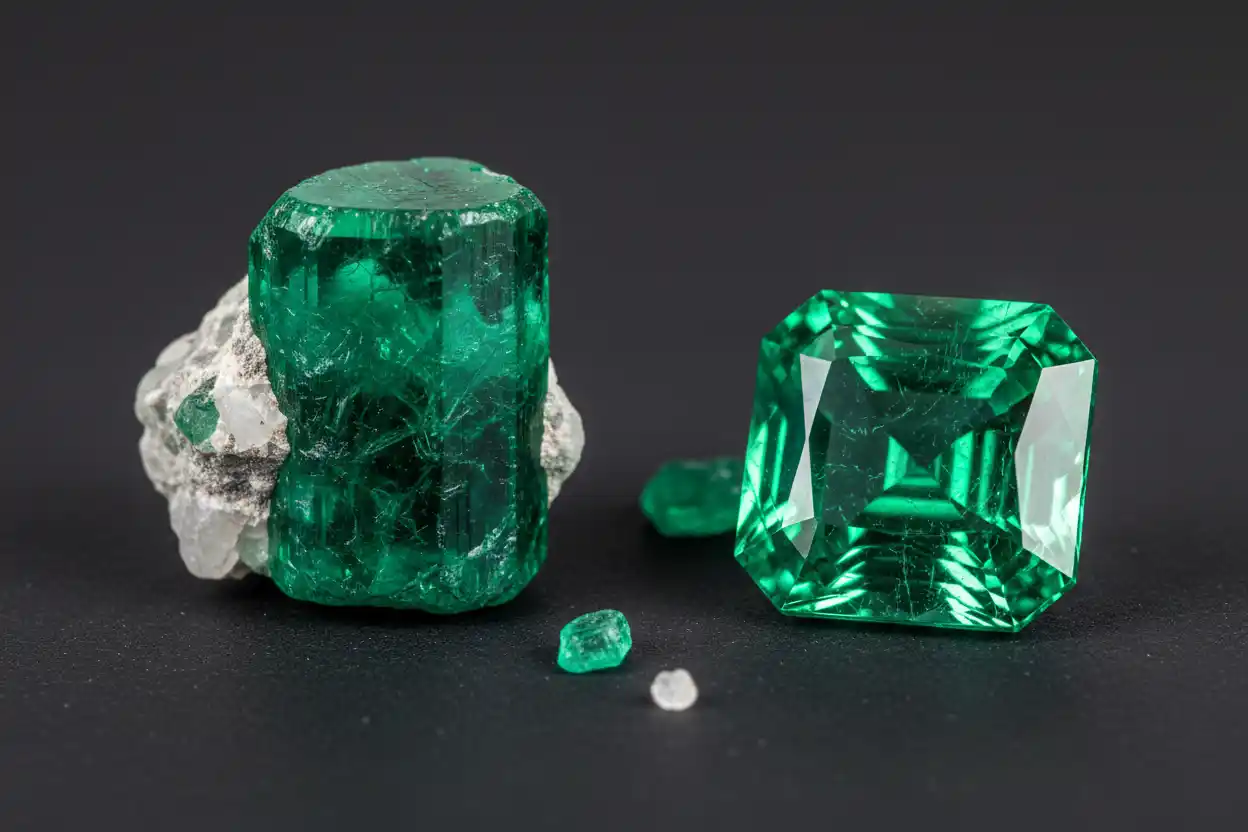
Well-formed emerald commonly develops as hexagonal prisms, sometimes with relatively flat terminations.
Crystals can be slender or stout.
Some are transparent enough for faceting.
Others are heavily fractured or included but visually impressive as mineral specimens.
Natural growth faces may contain striations, etching, attached matrix, secondary minerals, or partial overgrowths. These features can be scientifically useful and commercially important.
A polished emerald loses much of that external information.
That is why an intact crystal should not automatically be considered unfinished gemstone rough. In certain specimens, the natural crystal habit may preserve more geological and collector value than a faceted result would.
Why Emerald Inclusions Are So Famous
Emerald is well known for internal features collectively described in the gem trade by the French word jardin, meaning garden.
The term reflects the appearance of complex fractures, crystals, fluid inclusions, growth structures, and other features that can make a natural emerald’s interior resemble a miniature landscape.
Jardin is descriptive, not a specific inclusion type.
One stone may contain healed fissures.
Another may contain mineral crystals.
A third may contain multiphase fluid inclusions.
Many contain combinations.
The dedicated emerald microscope and inclusion notebook covers these internal features in greater depth.
For emerald meaning, the important point is that inclusion-rich does not automatically mean fake or poor quality. Natural emerald commonly carries internal evidence of the geological environment in which it formed.
Inclusions Do Not Automatically Prove Natural Origin
The presence of inclusions can support a natural-origin interpretation, but one should not assume that every included emerald must be natural.
Synthetic emeralds can contain characteristic growth structures, flux residues, synthetic inclusions, or other internal features of their own.
Glass imitations can contain bubbles.
Assembled stones can show bonding features.
Natural stones can also be unusually clean.
Identification should therefore rely on a combination of optical properties, spectroscopy, inclusions, growth structures, and laboratory testing when the stakes justify it.
One inclusion scene should not be allowed to answer every question.
An Original Emerald Specimen and Photo Checklist
A useful emerald assessment begins before the stone is placed under magnification.
First, record whether the object is a natural crystal, rough fragment, faceted gem, cabochon, bead, carving, or mounted jewel. Each form preserves different evidence.
For rough crystal, photograph the entire specimen under neutral diffuse light. Include the crystal termination, prism faces, attached matrix, fractures, weathered areas, and any secondary minerals rather than showing only the most attractive green face.
Next, photograph a thin edge with transmitted light. Record how color changes with thickness and whether transparency is uniform or strongly affected by fractures.
Rotate the stone under one fixed light source. Observe whether the hue shifts directionally. Keep this pleochroic observation separate from changes caused by switching lamps.
Under magnification, classify internal features before naming them. Record “three-phase-looking inclusion,” “healed fissure,” “colorless crystal,” “dark irregular crystal,” or “surface-reaching fracture” before attempting a precise species identification.
Inspect surface-reaching fractures carefully. Note whether they show flash effects, residues, differing luster, or other indications that filling may be present. Do not assume an oil or resin type without evidence.
For polished stones, record facet condition, windowing, extinction, girdle chips, abrasion, and obvious fracture intersections.
Then divide the conclusion into separate questions:
Species: Is the material beryl?
Variety: Is the color consistent with emerald?
Origin: Natural or laboratory-grown?
Treatment: Untreated, fracture-filled, or uncertain?
Geographic provenance: Documented, analytically supported, seller-stated, or unknown?
Symbolism: Historical, modern, personal, or unsupported?
This checklist prevents one beautiful green photograph from becoming evidence for everything else.
A Claim-Reconciliation Table for Emerald
| Common claim | What can reasonably be retained | What needs correction or stronger evidence |
|---|---|---|
| “Emerald is green beryl.” | Correct broad mineral identity | Exact variety designation still depends on color and gemological convention |
| “Chromium is what makes every emerald green.” | Chromium is a major emerald colorant | Vanadium can also contribute strongly, while iron modifies color |
| “A flawless emerald must be fake.” | Natural emerald is commonly included | Exceptional natural stones can still be comparatively clean |
| “Visible inclusions prove natural origin.” | Some natural inclusions are highly diagnostic | Synthetic emerald can also contain inclusions and growth features |
| “A dark green emerald is always more valuable.” | Strong saturation can be desirable | Excessive darkness can reduce beauty and value |
| “All emeralds are untreated.” | Natural untreated emerald exists | Fracture filling is common and must be considered separately |
| “Oil makes a fake emerald.” | Oils can fill natural fractures | A treated natural emerald remains natural, but treatment must be disclosed |
| “Color proves Colombian, Zambian, or another origin.” | Some deposits show characteristic tendencies | Geographic origin requires stronger evidence |
| “Emerald heals the heart because it is green.” | Green supports heart-centered symbolism | No established cardiovascular treatment is demonstrated |
| “Emerald guarantees loyalty in relationships.” | Loyalty has longstanding symbolic associations | A gemstone cannot control another person’s behavior |
| “Emerald attracts wealth.” | Prosperity is a common cultural symbol | No established mechanism guarantees financial gain |
| “Beryllium in emerald benefits the body.” | Beryllium is structurally essential to beryl | Wearing emerald does not create a therapeutic beryllium exposure |
| “Natural inclusions reduce emerald’s meaning.” | Inclusions can affect commercial quality | Symbolic value is not determined by gemological clarity grade |
| “Synthetic emerald has no real emerald properties.” | Laboratory-grown emerald has the same basic mineral species | Geological origin, inclusions, growth history, rarity, and market context differ |
The useful distinction is not natural versus meaningless or synthetic versus false. Natural and laboratory-grown emerald can share fundamental crystal chemistry while having very different formation histories. Symbolism remains a human interpretation in either case.
Natural Emerald and Synthetic Emerald
Laboratory-grown emerald can be produced through methods designed to crystallize beryl under controlled conditions, particularly hydrothermal and flux-based processes.
The resulting material is genuine emerald in the mineralogical sense when it has the appropriate beryl composition and green coloration.
It is not naturally mined emerald.
This distinction matters because “real” can mean several different things in consumer language.
A synthetic emerald is not green glass pretending to be beryl.
It is laboratory-grown beryl.
Its growth environment, rarity, inclusions, commercial value, and geological story differ from those of natural emerald.
The correct labels are therefore natural emerald, laboratory-grown or synthetic emerald, and imitation where appropriate.
Fracture Filling Is Common Enough to Matter
Natural emerald often contains surface-reaching fractures. Filling those fractures with oil, resin, or another substance can reduce their visibility and improve apparent transparency.
This practice is common enough that treatment status belongs in any serious emerald evaluation.
A fracture-filled emerald is still natural if the crystal itself formed naturally.
Treatment and natural origin answer different questions.
The exact filler, extent of enhancement, stability, and disclosure can affect value and care. Those details are covered separately in treated emerald.
For emerald meaning, the important principle is that treatment does not rewrite geological identity, but it can change how the stone looks and how it should be handled.
Hardness Does Not Make Emerald Indestructible
Emerald’s Mohs hardness of about 7.5–8 gives useful resistance to scratching.
That number is sometimes turned into the claim that emerald is automatically durable enough for any daily-wear situation.
The problem is toughness.
Natural inclusions and surface-reaching fractures can create mechanical weaknesses. A sharp impact can propagate an existing fracture even when the crystal surface itself resists scratching.
Filled fractures can introduce additional care considerations because extreme cleaning conditions may affect the filler.
This is why a fine emerald can be both hard and comparatively fragile.
Those concepts should not be collapsed into one “durability rating.”
Emerald Cutting Is a Compromise
The familiar rectangular step cut commonly called the emerald cut became strongly associated with emerald because the design can protect vulnerable corners, preserve useful rough, display color attractively, and accommodate the material’s inclusion-rich nature.
Not every emerald should receive that shape.
Rough geometry, color zoning, fractures, transparency, crystal orientation, and desired yield all influence cutting decisions.
A cutter may accept lower weight to remove a dangerous fracture.
Another crystal may need added depth to retain saturation.
An included specimen may become a cabochon instead of a faceted stone.
The specialist emerald cutting, orientation, and polish guide handles these tradeoffs in detail.
The finished gem is therefore both a natural mineral and a designed optical object.
Emerald in Rings, Bracelets, Earrings, and Necklaces
Emerald can be worn successfully in many forms, but construction changes the risks.
An emerald ring encounters frequent impact because hands routinely contact desks, handles, counters, and other hard surfaces.
An emerald bracelet also moves through a high-contact environment, particularly when multiple stones or beads can strike one another.
Emerald earrings generally experience less mechanical exposure, although matched color, weight, setting security, and backs become important.
An emerald necklace can reduce some impact risks while introducing chain balance, clasp security, drill-hole integrity, or pendant orientation as practical considerations.
The material remains emerald in every format.
The engineering conditions around it change.
Setting Design Should Respect Fractures
An emerald’s inclusions are visually interesting, but some also matter mechanically.
A prong pressing directly near a surface-reaching fissure can create a higher-risk situation than the same prong placed against sound material.
Thin corners are particularly vulnerable.
Protective settings can reduce accidental edge impact, but excessive metal pressure can create problems of its own.
The detailed construction issues belong in emerald setting and wear engineering.
Emerald meaning may include resilience, but the physical stone should not be expected to demonstrate that symbolism by surviving careless setting or impact.
Cleaning Requires Treatment Awareness
Emerald care should begin with the assumption that a stone may contain fractures and may have been filled unless treatment status is known confidently.
That makes aggressive cleaning inappropriate as a default.
Heat, ultrasonic energy, harsh chemicals, and unsuitable solvents can affect certain filled emeralds or the jewelry surrounding them.
The safest cleaning method depends on the individual stone, filler, setting, and condition.
The full care protocol belongs in how to clean emerald jewelry.
For emerald meaning, the practical lesson is simpler: a hard green stone can still require conservative care because internal structure and treatment matter as much as surface hardness.
Documented History of Emerald
Emerald has one of the longest documented cultural histories among colored gemstones.
Ancient Egyptian sources and archaeological contexts show that green beryl was mined and valued in Egypt, while Mediterranean writers discussed emerald-like green stones and their visual qualities. As with many ancient gem names, historical identification can be complicated because early terminology was based more heavily on appearance than modern chemistry.
Emerald later became deeply connected with South American deposits, particularly material from what is now Colombia. Indigenous societies had already valued green stones before European colonial extraction expanded emerald into international trade networks.
Emerald also became prominent in Islamic and South Asian courts, where large stones could be engraved, inscribed, or incorporated into elaborate jewelry and ceremonial objects. Mughal-associated emerald carvings are especially important examples of gemstones serving simultaneously as luxury objects, inscriptions, artistic surfaces, and symbols of status.
These histories are documented cultural contexts.
They should not be converted automatically into proof of modern healing claims.
Historical Emerald Names Require Caution
The deeper the historical record, the more careful mineral identification becomes.
An ancient writer’s “emerald” may not always correspond perfectly to what a modern gemologist would classify as emerald.
Green glass, malachite, green beryl, and other stones could sometimes be grouped or confused depending on the language and context.
Surviving objects can occasionally be tested.
Texts alone may remain ambiguous.
This matters for emerald meaning because statements such as “every ancient civilization used emerald for the same healing purpose” flatten different languages, materials, religious systems, and historical periods into one modern narrative.
History should remain specific enough to be meaningful.
Renewal Is the Most Natural Symbolic Theme
Among modern interpretations, renewal is especially well connected to emerald’s appearance.
Green is deeply associated with vegetation, spring growth, leaves, and living landscapes in many cultural contexts.
Emerald’s unusually saturated green can therefore become a strong symbol of renewal, restoration, or beginning again.
A person might use emerald meaning as a reminder to identify what should be cultivated rather than merely what should be avoided.
That could mean restarting a neglected habit, rebuilding a skill, repairing a relationship where repair is appropriate, or directing attention toward long-term development.
The stone does not create renewal biologically.
It represents an idea that the wearer chooses to act on.
Love and Loyalty Without Relationship Guarantees
Emerald has accumulated strong associations with love, fidelity, partnership, and loyalty.
Those themes appear naturally in jewelry traditions because emerald has long been used in high-value personal ornaments and gifts.
Modern metaphysical descriptions sometimes take the symbolism further and claim that emerald ensures fidelity, reveals betrayal, attracts a partner, repairs relationships, or causes unconditional love.
Those are not mineralogical properties.
An emerald cannot control another person’s choices.
It can, however, serve as a personal symbol of commitments such as honesty, loyalty, patience, or respectful communication.
That distinction preserves the meaning without assigning agency to the gemstone.
Emerald and Heart Symbolism
Green gemstones are frequently linked with the heart chakra in modern spiritual systems, and emerald is one of the most prominent examples.
The association commonly includes compassion, forgiveness, emotional openness, grief, love, and relational balance.
These are spiritual or reflective interpretations.
They are not cardiovascular claims.
There is no established scientific evidence that wearing emerald treats heart disease, corrects circulation, regulates blood pressure, repairs cardiac tissue, or changes heart rhythm.
The separate emerald healing properties guide can examine healing traditions and reflective practices while maintaining that evidence boundary.
A heart symbol does not become heart medicine.
Wisdom, Perception, and Clear Judgment
Emerald has also been associated with wisdom, insight, foresight, memory, and clear judgment across different historical and modern traditions.
The themes may reflect the stone’s prestige, its intense green, its transparency in fine material, and the tendency for valuable gems to acquire intellectual and moral symbolism over time.
A practical modern use could be to associate an emerald with a decision-making rule:
What evidence is available?
Which assumption is weakest?
What consequence matters most?
What information would change the decision?
The gemstone can cue the questions.
It does not answer them.
There is no established evidence that emerald physically raises intelligence or improves cognition through ordinary contact.
Prosperity Without Financial Promises
Emerald’s rarity, historical prestige, and connection with elite jewelry have made prosperity and abundance recurring parts of emerald meaning.
That symbolism should not become a financial prediction.
Owning emerald does not guarantee increased income, business success, profitable investing, inheritance, or favorable economic events.
Even the stone’s own market value varies dramatically according to color, clarity, treatment, origin evidence, size, cut, laboratory reports, and retail context.
Readers considering monetary value rather than symbolism should use the separate emerald price reference.
Prosperity can remain a cultural symbol without becoming an investment guarantee.
Buying an Emerald Is an Evidence Question
A commercial emerald purchase can involve several independent claims: natural origin, treatment level, geographic provenance, synthetic status, carat weight, color, clarity, and laboratory documentation.
The visual appeal may be obvious while some of those claims remain uncertain.
For that reason, the dedicated buy emerald guide focuses on purchase evaluation rather than repeating those commercial decisions here.
For emerald meaning, the relevant principle is that a symbolic story should never substitute for disclosure.
A stone does not become more natural because it is described as spiritually powerful.
A famous origin should not be inferred from color.
A high price does not prove untreated status.
Each claim deserves its own evidence.
Beryllium Chemistry Is Not a Wellness Benefit
Emerald is a beryllium-bearing mineral.
That fact is essential to beryl chemistry and irrelevant as a reason to ingest the stone or use it as a medical source of an element.
Beryllium in the crystal structure does not provide a wellness benefit through ordinary handling.
The same principle applies to chromium, vanadium, aluminum, and silicon.
An element can be responsible for mineral identity or color without being therapeutically useful in the form, amount, or exposure route present in a gemstone.
Chemistry explains emerald.
It should not be rewritten as medicine.
Safe Ownership
Ordinary handling of an intact emerald or finished piece of emerald jewelry is very different from dust-generating lapidary work.
For normal ownership, the main concerns are physical damage, fracture filling, setting condition, and appropriate cleaning.
Cutting, grinding, drilling, or sanding creates fine mineral dust and should be handled with professional controls such as wet processing, suitable extraction, eye protection, and respiratory protection.
Ingestion and direct-contact crystal elixirs are unnecessary.
A natural emerald can contain multiple inclusions, fracture-filling substances, polishing residues, and associated minerals that are not represented by the simplified beryl formula.
Safe ownership is best based on the actual object rather than generalized claims about “crystal purity.”
An Emerald’s Inclusions Can Be Part of Its Identity Without Defining Its Worth
The garden-like interior of emerald has become so culturally recognizable that inclusions are sometimes romanticized as proof that every imperfection is desirable.
That goes too far in the opposite direction.
Inclusions can document natural growth.
They can help identification.
They can reveal geological processes.
They can also reduce transparency, weaken the stone, or affect value.
An inclusion is neither automatically a defect nor automatically an advantage.
Its importance depends on what question is being asked.
For a mineralogist, an inclusion may be evidence.
For a cutter, it may be a structural constraint.
For a buyer, it may influence beauty or durability.
For personal symbolism, it may represent complexity.
Those meanings should not be confused.
Frequently Asked Questions About Emerald Meaning
What is emerald?
Emerald is the green gem variety of the mineral beryl, with the idealized formula Be₃Al₂Si₆O₁₈. Its characteristic green color is principally associated with chromium and/or vanadium.
What does emerald meaning symbolize?
Modern emerald meaning commonly includes renewal, love, loyalty, wisdom, growth, prosperity, compassion, patience, and perspective. These are cultural and personal interpretations rather than scientifically demonstrated effects.
What makes emerald green?
Chromium and vanadium are the principal trace elements associated with emerald green, while iron can modify the final hue and saturation.
Is emerald the same as green beryl?
Emerald is green beryl, but gemological naming can distinguish emerald-quality chromium- or vanadium-related green from lighter or differently colored green beryl. The exact boundary can depend on convention and laboratory criteria.
Is emerald a crystal?
Yes. Emerald is crystalline beryl and belongs to the hexagonal crystal system. Natural rough commonly forms prismatic six-sided crystals.
How hard is emerald?
Emerald is approximately 7.5–8 on the Mohs scale. Despite that hardness, fractures and inclusions can reduce toughness.
Why are emeralds so included?
Emerald often forms in geologically reactive environments involving fluids and multiple mineral phases. Fractures, crystals, healed fissures, and fluid inclusions commonly become incorporated during or after growth.
What does jardin mean in emerald?
Jardin is a descriptive gem-trade term for the garden-like scene created by emerald’s internal inclusions and fractures. It is not one specific inclusion species.
Are all emeralds treated?
No. Untreated natural emeralds exist, but fracture filling with oils, resins, or other substances is common enough that treatment should be considered explicitly.
Is an oiled emerald still natural?
Yes. A naturally formed emerald remains natural even if fractures have been filled. Natural origin and treatment status are separate characteristics.
Are synthetic emeralds real emerald?
Laboratory-grown emerald has the beryl structure and appropriate green coloration, so it is synthetic emerald rather than an imitation. Its growth origin and market context differ from natural emerald.
Does emerald have healing properties?
There is no established scientific evidence that emerald treats medical or psychological conditions, changes hormones, repairs organs, or causes therapeutic effects through ordinary wear.
Does emerald heal the heart?
Heart-related emerald meaning is symbolic and spiritual. It should not be interpreted as treatment for cardiovascular disease or other medical conditions.
Does emerald attract money?
Prosperity is a longstanding symbolic association, but there is no established mechanism by which emerald guarantees financial gain or investment returns.
Is emerald safe to wear every day?
Emerald can be worn regularly when its inclusions, setting, treatment, and lifestyle exposure are considered realistically. Fracture-rich stones need more protection from sharp impact and unsuitable cleaning conditions.
Emerald Meaning Is Strongest When Green Is Allowed to Mean More Than One Thing
Emerald meaning has survived so strongly because the gemstone works on several levels at once. Mineralogically, it is beryl colored by an unusual meeting of trace chemistry and geological conditions. Historically, it has moved through mining regions, courts, trade routes, jewelry traditions, carved objects, and collections. Visually, its green evokes living landscapes strongly enough that renewal, growth, love, prosperity, and hope became natural symbolic extensions.
Those layers do not need to be collapsed into one explanation.
Chromium and vanadium can explain color without explaining love. Inclusions can record geological history without proving geographic origin. A famous historical tradition can demonstrate cultural importance without validating modern medical claims. An emerald can symbolize prosperity without guaranteeing financial success.
That separation gives emerald meaning more depth than a generic list of benefits.
The stone’s real story is already extraordinary: beryllium-bearing systems and chromium- or vanadium-bearing environments must interact under unusual geological circumstances; crystals grow while trapping mineral and fluid evidence; later fractures may be filled naturally or commercially; cutters orient the rough around color and structural weakness; and generations of people interpret the resulting green gem through their own cultural values.
Emerald can therefore represent renewal, loyalty, wisdom, or growth because humans have repeatedly found those ideas compelling in its color and history. The symbolism becomes more credible when the mineral is allowed to remain exactly what it is—a remarkable green variety of beryl rather than a medical device, financial guarantee, or mechanism for controlling another person’s emotions.