Emerald Meaning: 9 Important Insights, Deep Symbolism & Real History
Emerald meaning has developed through thousands of years of jewelry, trade, royal ownership, religious interpretation, mythology, medicine, and personal ornament. Its intense green color has encouraged associations with renewal, vegetation, fertility, hope, love, prosperity, wisdom, status, and continuity in different cultural settings. These meanings were not identical across every civilization, but emerald has genuine historical depth that distinguishes it from gemstones whose spiritual reputations developed mainly in modern crystal culture.
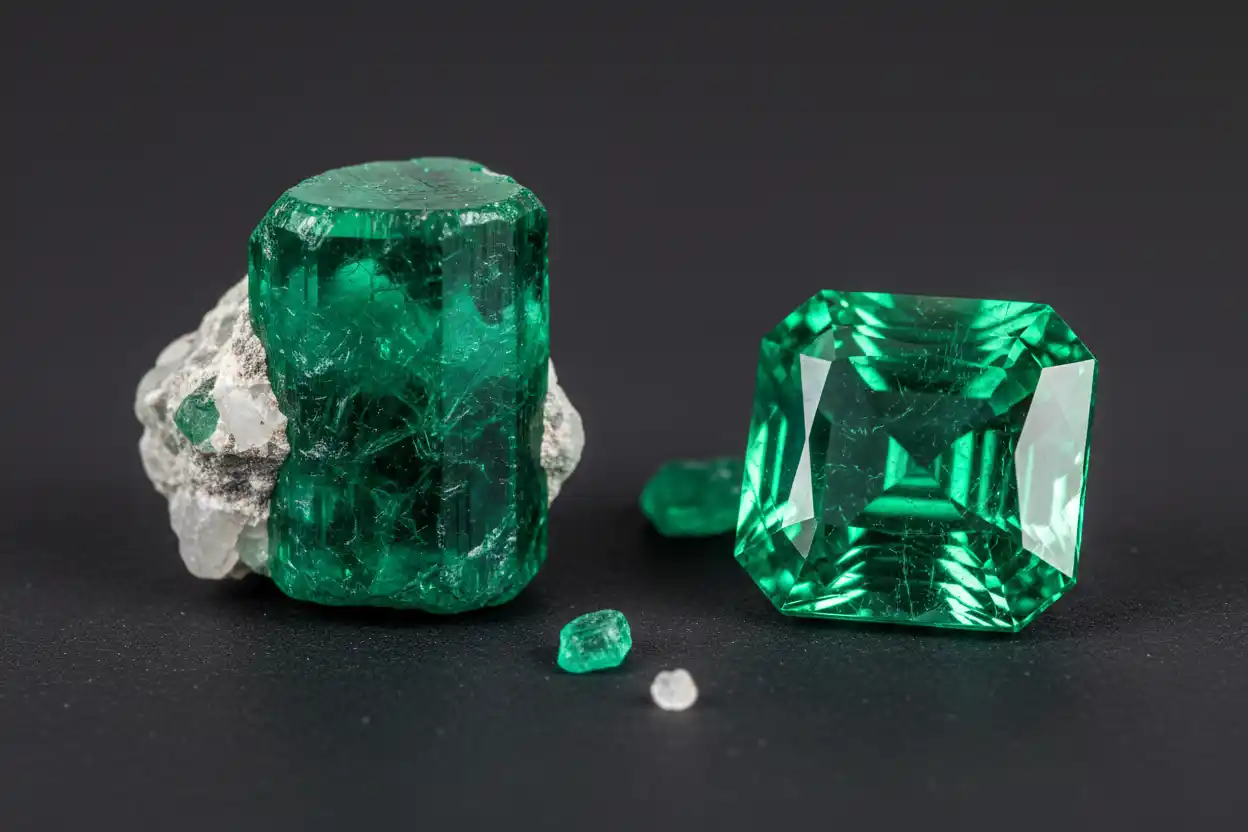
The physical gemstone also supports several of these themes naturally. Emerald is green beryl, colored mainly by chromium and/or vanadium, and forms only when geological conditions bring together elements that are not commonly concentrated in the same environment. Natural stones frequently contain inclusions and fractures, yet fine emerald can remain exceptionally valuable despite these internal features. That combination of rarity, vivid color, imperfect clarity, and enduring beauty gives emerald meaning a particularly rich foundation for themes involving growth, wisdom, resilience, and appreciation beyond perfection.
Historical medicinal beliefs should still be separated from modern evidence. Emerald was once credited in different traditions with effects involving sight, fertility, poisoning, prediction, and physical health. Those beliefs are valuable for understanding cultural history, but they do not prove that wearing emerald treats disease. Emerald meaning is strongest when documented traditions, natural properties, modern symbolism, and personal experience remain clearly distinguished.
9 Emerald Meaning Insights at a Glance
- Renewal reflects emerald’s vivid green color and its long association with vegetation and new growth.
- Love represents commitment, affection, fidelity, and relationship symbolism that developed across different historical and modern settings.
- Wisdom reflects traditions connecting emerald with insight, judgment, learning, or truthful perception.
- Hope draws from green symbolism and the human tendency to connect new growth with future possibility.
- Prosperity reflects emerald’s rarity, trade value, royal ownership, and long association with wealth and status.
- Fertility symbolism arose historically from associations between green, vegetation, life, and reproduction, not from proven medical effects.
- Status reflects the gem’s use in royal, aristocratic, ceremonial, and luxury jewelry.
- Resilience symbolizes valuable beauty existing alongside natural inclusions and fractures rather than perfect internal clarity.
- Legacy reflects emerald jewelry that can survive across generations and accumulate family history and personal meaning.
Renewal Is the Most Natural Emerald Meaning
Green is strongly associated with vegetation, leaves, spring growth, and renewal in many cultures, which gives renewal an intuitive place within emerald meaning. The connection is visual before it becomes spiritual. A fine emerald’s saturated green can resemble living foliage more closely than many other transparent gemstones, and that resemblance has encouraged people to connect it with nature, fertility, restoration, and beginning again.
Renewal can be interpreted practically without claiming that emerald changes human biology. Someone may wear an emerald ring after starting a new chapter in life, completing a difficult transition, rebuilding a career, or returning to a goal that had been neglected.
The gemstone does not make renewal happen. Instead, the owner can use it as a symbol of a decision already being made.
The real emerald benefits support this symbolism through genuine green color, durability, geological rarity, and a history long enough for the gemstone to carry both cultural and personal associations.
Love and Commitment Have Deep but Changing Emerald Traditions
Love is an important emerald meaning, but its history is more varied than the familiar modern association between diamond and engagement. Emerald has been connected with affection, fidelity, fertility, passion, and relationships in different historical traditions, while its rich green color has often reinforced themes of life and continuation.
Modern jewelry allows these ideas to take many forms. An emerald engagement ring may symbolize a deliberate departure from conventional diamond-centered design, while an inherited emerald can represent a relationship that has already lasted across generations.
The meaning comes from cultural association and personal commitment rather than from a biological effect of beryl. Emerald does not make a partner loyal, repair a relationship automatically, or create romantic attraction.
This distinction allows love symbolism to remain meaningful because responsibility stays with the people involved. The gem marks the commitment rather than creating it.
Wisdom and Insight Have Historical Roots but Need Careful Interpretation
Emerald has been associated in historical and legendary traditions with sight, foresight, truth, learning, and wisdom. Some older accounts attributed extraordinary powers to the gem, including the ability to reveal deception, improve vision, or provide supernatural insight.
Those traditions are culturally important but should not be read as scientific evidence.
A modern interpretation of wisdom within emerald meaning can focus instead on careful judgment. Emerald itself provides a fitting metaphor because evaluating one properly requires considering several interacting features. Strong color may matter more than perfect clarity, attractive inclusions may coexist with high value, and origin claims require evidence beyond simple appearance.
Wisdom similarly involves understanding context rather than applying one rule mechanically to every situation.
Emerald cannot improve intelligence or cognition through ordinary contact, but its history makes it a meaningful symbol for learning, discernment, and thoughtful decision-making.
Hope Comes from the Symbolism of Living Green
Hope is closely related to renewal but carries a different emotional emphasis. Renewal involves beginning again, while hope concerns the possibility that future conditions can improve.
Green naturally supports this emerald meaning because plants return after difficult seasons and new growth can appear where a landscape previously looked dormant. Human societies have repeatedly turned such natural cycles into symbols of future possibility.
A person may associate an emerald with hope during a difficult transition, but responsible symbolism does not require pretending that every outcome will become positive. Hope can coexist with uncertainty, practical planning, and realistic risk.
The stone itself cannot change probability. An emerald does not guarantee recovery, financial success, reconciliation, or any specific future result.
Its value as a symbol lies in representing the decision to keep moving toward a worthwhile possibility.
Prosperity Symbolism Reflects Real Rarity, Trade, and Status
Emerald’s association with prosperity has a historical foundation in scarcity, trade value, royal ownership, and luxury rather than in evidence that the gemstone attracts money. Fine emerald has traveled through major trade networks and appeared in royal treasuries, aristocratic jewelry, ceremonial objects, and valuable personal collections.
These uses made emerald a visible sign of access to wealth in many contexts.
Prosperity therefore became an understandable emerald meaning, but financial symbolism should not be confused with financial causation. Wearing a green gemstone cannot guarantee profit, attract customers, improve an investment, or change market conditions.
Anyone preparing to buy emerald should evaluate actual quality, treatment, documentation, price, and personal budget rather than treating prosperity symbolism as a reason to overspend.
Emerald can represent achievement or abundance while still leaving financial outcomes where they belong: with decisions, resources, circumstances, and risk.
Fertility Symbolism Is Historical, Not a Medical Treatment
Green color, vegetation, springtime, life, and reproduction have often overlapped symbolically, so fertility became part of emerald meaning in several traditions. Historical cultures sometimes credited emerald and other green stones with powers connected to childbirth, reproductive health, love, or physical vitality.
These traditions reveal how people understood color and nature, but they do not establish medical effectiveness.
An emerald should not be used as treatment for infertility, pregnancy complications, hormonal disorders, sexual health conditions, or reproductive disease. The gemstone’s chromium- or vanadium-related color has no demonstrated mechanism for regulating reproductive biology through skin contact.
Historical fertility symbolism can still be discussed responsibly as part of cultural history. The important distinction is between what an object represented to people and what medicine can establish about health outcomes.
Royal and Ceremonial Use Made Status Part of Emerald Meaning
Emerald has long carried status symbolism because exceptional stones were rare, expensive to obtain, difficult to transport, and visually distinctive. Royal families, political elites, religious institutions, and wealthy collectors acquired emerald jewelry and objects partly because the gem communicated access to rare resources and skilled craftsmanship.
Status within emerald meaning therefore reflects social history rather than an invisible property inside the crystal.
A large emerald mounted in elaborate goldwork could communicate wealth because obtaining and commissioning the jewel required resources. The same object might simultaneously have religious, political, family, or diplomatic significance.
Modern status symbolism continues, although access to natural, laboratory-grown, vintage, and lower-cost emerald jewelry has made the market far more varied.
A person’s worth should not be confused with the price of a gemstone. Status is a social interpretation attached to objects, while human value is not determined by carat weight or rarity.
Natural Inclusions Make Resilience a More Nuanced Emerald Symbol
Emerald often contains more visible internal features than many transparent gemstones, yet fine examples remain highly prized. This gives resilience a particularly interesting place within emerald meaning.
The symbolism is not that every fracture is beneficial. Some inclusions reduce transparency, threaten durability, or lower value. The deeper point is that beauty and worth do not require absolute internal perfection.
Emerald quality has long been evaluated with an understanding that natural stones frequently contain a visible internal world. Cutters, jewelers, and buyers work with those features rather than expecting every gem to resemble perfectly clean laboratory-grown crystal.
Resilience can therefore represent continuing to function despite complexity or vulnerability. The gemstone does not make a person emotionally resilient, but its natural structure offers a meaningful metaphor for value that survives visible imperfections.
Modern beliefs involving emerald healing properties sometimes extend this idea into claims about emotional or physical healing. Those claims should remain separate from the symbolic interpretation.
Legacy Develops When Emerald Jewelry Carries History Forward
Emerald can survive for generations when properly protected and maintained, making legacy one of the strongest personal forms of emerald meaning. A stone may begin as a newly purchased ring, later become an inherited pendant, and eventually be reset into a design suited to another generation.
The physical gemstone remains recognizable while its emotional meaning accumulates.
Family legacy can include stories about who originally owned the piece, where it was purchased, why it was given, or which events it accompanied. A relatively modest emerald can therefore become emotionally irreplaceable even if another stone has greater market value.
Historic emerald jewelry works similarly on a larger scale. Provenance may connect an object with a region, workshop, ruler, family, period, or artistic tradition.
Legacy in this sense depends on human memory and documentation rather than gemstone energy. The stone becomes a durable carrier for stories.
Emerald Has Genuine Ancient History Without One Universal Meaning
Emerald possesses authentic historical depth, but that history should not be reduced to a single universal spiritual definition. Ancient Egyptian mining and ornament, classical Mediterranean references, South American emerald traditions, Mughal carving and collecting, European royal jewelry, religious use, and global trade all belong to different cultural contexts.
The same gemstone could symbolize fertility in one setting, status in another, religious devotion elsewhere, or simply wealth and beauty.
This diversity is more historically interesting than claiming that emerald always meant love, truth, healing, or prosperity to everyone.
Modern emerald meaning can inherit parts of this long history while also developing new interpretations through engagement jewelry, birthstone traditions, collecting, fashion, and personal experience.
The important principle is attribution. A cultural belief should remain connected to the culture and period in which it actually appeared.
Personal Emerald Meaning Can Become Stronger Than Traditional Definitions
A particular emerald may eventually symbolize something completely individual. Someone may buy one after completing a degree, receive an emerald ring from a grandparent, choose the stone for an engagement, or purchase a crystal during travel to a mining region.
These experiences can become more meaningful than any standardized symbolism.
Personal meaning also changes over time. A ring first chosen for its color may later become connected with a marriage, child, career milestone, inheritance, or memory of someone who wore it previously.
This ability to accumulate meaning explains why gemstones often become emotionally important even when their physical composition never changes.
Emerald meaning is therefore not something the crystal dictates. History provides context, culture provides shared symbols, and individual experience adds another layer.
Conclusion
Emerald meaning commonly includes renewal, love, wisdom, hope, prosperity, fertility symbolism, status, resilience, and legacy. Some of these themes have genuine historical roots, while others developed or changed as emerald moved between cultures, trade systems, royal courts, jewelry traditions, and modern spiritual practice.
The strongest interpretation respects those differences. Green color can symbolize renewal without medically regenerating the body, royal history can support status symbolism without determining human worth, and inherited jewelry can carry powerful emotional meaning without requiring supernatural energy. Emerald’s real geology, cultural history, inclusions, craftsmanship, and personal associations already provide exceptional symbolic depth.
FAQs
What is the main emerald meaning?
Emerald meaning commonly centers on renewal, love, wisdom, hope, prosperity, fertility symbolism, status, resilience, and legacy.
Why does emerald symbolize renewal?
Its vivid green color resembles vegetation and new growth, making renewal one of the most natural symbolic themes associated with emerald.
Does emerald symbolize love?
Yes. Emerald has been connected with love, fidelity, relationships, and commitment in various historical and modern settings.
Why is emerald associated with wisdom?
Historical traditions sometimes linked emerald with sight, foresight, truth, and knowledge. Modern symbolism often interprets these ideas as discernment or thoughtful judgment.
Does emerald symbolize prosperity?
Emerald has long been associated with wealth and status because fine stones were rare and valuable. There is no evidence that wearing emerald itself attracts money.
Is emerald associated with fertility?
Fertility appears in some historical emerald traditions because green, vegetation, life, and reproduction were symbolically connected. Emerald is not a medical treatment for fertility or reproductive health.
Why can emerald symbolize resilience?
Natural emeralds frequently contain inclusions and fractures while remaining beautiful and valuable, making resilience and worth beyond perfection understandable modern metaphors.
Does emerald have ancient meaning?
Yes, emerald has genuine ancient and historic cultural significance, but its meanings varied between societies and should not be reduced to one universal tradition.
Does emerald have healing powers?
There is no established clinical evidence that wearing emerald treats eyesight, heart conditions, fertility problems, anxiety, infection, or other illnesses.
Emerald meaning in healing, fertility, heart-related, prosperity, protective, or energetic practice reflects historical, cultural, spiritual, and personal belief and should not replace qualified medical, mental-health, or financial advice.