Aragonite Meaning: Mineral Identity, History & Symbolism
Aragonite meaning begins with calcium carbonate mineralogy. Aragonite is a naturally occurring calcium carbonate mineral with the formula CaCO₃. It shares that chemistry with calcite but has a different crystal structure: aragonite crystallizes in the orthorhombic system, whereas calcite is trigonal. This makes the two minerals polymorphs—materials with the same overall chemical formula but different atomic arrangements. That structural distinction changes their crystal forms, density, cleavage behavior, optical properties, geological stability, and the environments in which they commonly develop.
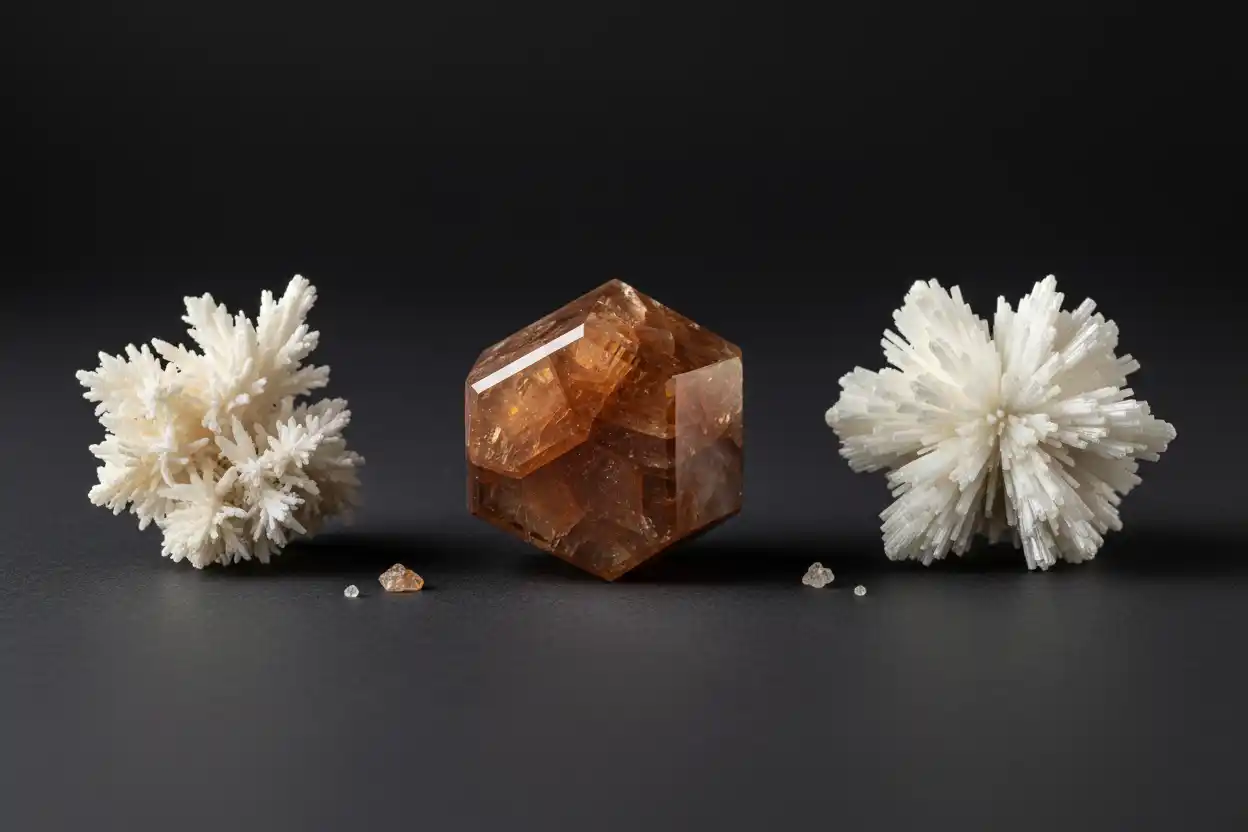
Natural aragonite appears in far more forms than the polished brown or orange stones often shown in crystal shops. It can be colorless, white, gray, yellow, brown, reddish, orange, greenish, bluish, violet, or combinations of these colors. Crystals may be slender and prismatic, needle-like, columnar, radiating, fibrous, coral-like, stalactitic, massive, or grouped into striking cyclic twins that create a six-sided appearance even though the mineral itself is not hexagonal. Aragonite also forms naturally within shells, pearls, coral skeletons, cave deposits, hot-spring precipitates, sedimentary environments, and low-temperature mineral veins.
Those physical facts provide the strongest foundation for understanding aragonite meaning. Modern crystal traditions often associate the stone with grounding, patience, stability, emotional balance, concentration, responsibility, or connection with the Earth. Such themes can function as personal symbolism, but they are not measurable properties of CaCO₃. Aragonite has not been demonstrated to heal disease, alter metabolism, remove toxins, change emotional states through mineral energy, or influence external events.
Readers exploring other evidence-led mineral references can browse the broader Gemstone Guides.
Aragonite Identity at a Glance
| Property | Aragonite |
|---|---|
| Mineral species | Aragonite |
| Chemical formula | CaCO₃ |
| Mineral class | Carbonate |
| Relationship to calcite | Polymorph with the same chemical formula but different crystal structure |
| Crystal system | Orthorhombic |
| Common habits | Prismatic, acicular, fibrous, radiating, columnar, stalactitic, massive, cyclically twinned |
| Common colors | Colorless, white, gray, yellow, brown, reddish, orange, greenish, blue, violet |
| Transparency | Transparent to translucent; massive material may appear opaque |
| Luster | Vitreous to resinous; some fibrous material may appear silky |
| Mohs hardness | Approximately 3.5–4 |
| Specific gravity | Approximately 2.94–2.95 |
| Cleavage | Distinct but less dominant visually than calcite’s characteristic rhombohedral cleavage |
| Fracture | Uneven to subconchoidal |
| Tenacity | Brittle |
| Optical character | Biaxial |
| Important chemical behavior | Reacts with acids as a calcium carbonate |
| Stability note | Metastable relative to calcite under ordinary surface conditions |
| Main identification limit | Color, shape, and trade name alone cannot prove aragonite |
Aragonite’s moderate hardness and brittle nature make it significantly more delicate than quartz, feldspar, beryl, or corundum. Its calcium carbonate chemistry also means chemical care matters: acidic cleaners can attack the surface, while aggressive mechanical cleaning can damage fibrous, radiating, or highly twinned specimens.
Aragonite and Calcite: Same Formula, Different Structure
The relationship between aragonite and calcite is central to understanding the mineral. Both are CaCO₃, yet calcium and carbonate ions are organized differently within their crystal lattices. That difference produces distinct symmetry, density, cleavage, optical behavior, and typical crystal forms.
Aragonite’s structure is more densely packed, which helps explain why its specific gravity is slightly higher than calcite’s. It commonly forms under conditions where pressure, solution chemistry, biological control, temperature, or rapid precipitation favor the orthorhombic arrangement. Calcite is more stable under many ordinary surface conditions, so aragonite can eventually recrystallize or transform into calcite over sufficiently long geological intervals.
That transformation should not be exaggerated. An aragonite specimen does not automatically convert into calcite during ordinary handling, nor does brief contact with room air destroy it. Transformation depends on environmental conditions and time. Collector specimens can remain recognizable and stable for very long periods when stored appropriately.
The distinction also matters in fossils, shells, and cave deposits. A structure that originally formed as aragonite may later be partially or completely replaced by calcite while preserving some of its original external form. Identifying the present mineral therefore requires evidence rather than assuming that preserved morphology proves original chemistry.
How Aragonite Forms
Aragonite develops in a wide range of low-temperature geological and biological environments. Calcium-rich waters containing dissolved carbonate can become supersaturated and precipitate CaCO₃. Which polymorph forms depends on multiple factors, including temperature, pressure, magnesium content, fluid chemistry, biological processes, evaporation, carbon dioxide behavior, and precipitation rate.
In caves, aragonite can grow as delicate needles, radiating sprays, frost-like aggregates, and branching forms where local chemistry favors it over calcite. In hot springs and mineral-rich waters, rapid precipitation can produce banded, fibrous, or crust-like aragonite. Sedimentary environments can preserve aragonitic shells and skeletal material, while hydrothermal and oxidation-zone environments can produce distinctive crystals alongside other minerals.
Marine organisms provide another important pathway. Many mollusks, corals, and other organisms construct hard tissues from aragonite under biological control. Nacre, the layered material commonly associated with mother-of-pearl and many pearls, can contain aragonitic tablets arranged in highly organized microstructures. This biological role does not make every aragonite specimen organic; it shows that the same mineral species can form through both inorganic precipitation and biological mineralization.
The deeper relationships among fluids, host rocks, caves, sediments, biological systems, and mineral sequences are covered in Aragonite formation and deposit geology.
Why Aragonite Forms Pseudohexagonal Twins
Some of the most recognizable aragonite specimens look like six-sided prisms. This can create the mistaken impression that aragonite crystallizes in the hexagonal system.
It does not.
The apparent sixfold shape commonly results from cyclic twinning. Several orthorhombic crystal individuals grow together in repeated orientations, producing an aggregate whose external outline resembles a hexagonal crystal. The apparent symmetry belongs to the twinned group rather than to a single sixfold crystal lattice.
This is a useful identification lesson because external shape can imitate a higher symmetry than the underlying mineral possesses. A visually convincing “hexagon” therefore cannot determine crystal system without closer crystallographic evidence.
Well-developed cyclic twins can be attractive collector specimens precisely because their geometry records this repeated structural relationship.
Aragonite Can Be Needle-Like, Radiating, or Coral-Like
Aragonite is highly variable in habit. Fine acicular crystals may grow as sprays or radiating clusters, while fibrous forms can build botryoidal, stalactitic, branching, or coral-like aggregates. Some specimens form compact pseudohexagonal twins; others appear almost sculptural because thousands of narrow crystals grow outward from common centers.
These shapes reflect growth environment rather than separate species.
Trade names based on appearance can therefore cause unnecessary confusion. A branching piece, a radiating cluster, a brown twin, and a pale cave specimen may all be aragonite despite looking dramatically different.
Microscopic examination becomes especially useful when morphology is complex. Growth boundaries, inclusions, alteration, coatings, secondary minerals, fractures, and surface modifications can be documented more closely in the Aragonite microscope inclusion notebook.
What Causes Aragonite’s Colors?
Ideal aragonite can be colorless, so stronger coloration generally reflects impurities, inclusions, structural defects, staining, associated minerals, or combinations of these factors. Iron-bearing material can contribute yellow, brown, orange, or reddish appearances in some specimens, while copper-bearing environments can produce greenish or bluish aragonite. Organic material and fine inclusions can also modify color in biogenic or sedimentary material.
A visible color should not be converted automatically into one specific chemical explanation. Two blue-green aragonites from different deposits can look similar while obtaining their color through different combinations of trace chemistry and inclusions. Brown surface staining may also differ from color distributed through the crystal interior.
The safest description begins with what can actually be seen: honey-yellow aragonite, reddish-brown aragonite, blue-green aragonite, or colorless prismatic aragonite. Identifying the exact chromophore requires chemical or spectroscopic evidence appropriate to the individual specimen.
Refractive behavior, birefringence, transmitted-light characteristics, directional effects, and detailed color mechanisms belong in Aragonite optical properties and color behavior.
Aragonite’s Diagnostic Traits
Aragonite combines several properties that become useful when considered together. It is softer than quartz, with a Mohs hardness around 3.5–4, and denser than calcite. It is brittle, reacts with acids because it is a carbonate, commonly displays orthorhombic or pseudohexagonally twinned crystal forms, and has strong birefringent optical behavior.
None of these properties should be used recklessly. Acid testing can permanently damage a specimen, particularly when applied directly to a valuable crystal. Scratch testing can also leave visible marks. Destructive testing is unnecessary when microscopy, density, refractive data, Raman spectroscopy, X-ray diffraction, or other nondestructive methods can answer the question more responsibly.
The most convincing identification comes from converging evidence. Crystal habit may suggest aragonite; density and optics can strengthen the hypothesis; spectroscopy or diffraction can confirm the mineral where certainty matters.
Original Aragonite Specimen and Photo Checklist
A photograph can reveal considerable information when observations are separated from assumptions.
| Observation | What it may support | What it cannot prove alone |
|---|---|---|
| Pseudohexagonal six-sided cluster | Compatible with cyclically twinned aragonite | Hexagonal crystal system |
| Needle-like radiating spray | Common aragonite habit | Species identity |
| Honey-brown or reddish crystals | Common natural appearance | Exact color-causing element |
| Blue-green aggregate | Compatible with aragonite from some deposits | Copper as the color mechanism |
| White branching cave material | Plausible aragonite morphology | Exact cave locality |
| Fibrous or stalactitic texture | Compatible with precipitated aragonite | Whether material is untreated |
| Shell-like layered material | Potential biogenic carbonate context | Aragonite without mineralogical confirmation |
| Vitreous transparent crystal | Compatible with aragonite | Geographic provenance |
| Seller label naming a mine | Useful provenance claim | Independent locality proof |
| Old handwritten specimen label | Potential historical documentation | Chemical identity |
| Raman or XRD result matching aragonite | Strong mineral identification | Treatment or locality |
| Chemical data showing trace elements | Useful composition evidence | Complete explanation of visible color without additional context |
This checklist is intentionally conservative. It allows morphology and color to guide investigation without asking a photograph to prove chemistry, provenance, or treatment history.
Specific questions about labels, collection history, mine claims, repairs, and disclosure belong in the Aragonite provenance and disclosure checklist.
Aragonite Claims That Need Qualification
| Claim | Better interpretation |
|---|---|
| “Aragonite is calcite” | Both are CaCO₃ polymorphs, but they are distinct mineral species |
| “Six-sided aragonite is hexagonal” | Many six-sided forms are cyclic twins of orthorhombic crystals |
| “All blue aragonite contains copper” | Some blue-green material may involve copper, but color cause must be established specimen by specimen |
| “Aragonite instantly turns into calcite” | Transformation is possible, but it is condition- and time-dependent |
| “Coral-shaped aragonite is fossil coral” | Branching mineral habit does not prove biological origin |
| “Aragonite from shells is chemically different from mineral aragonite” | Biogenic and inorganic aragonite share the same mineral structure, though trace chemistry and microstructure can differ |
| “Acid is the best way to identify aragonite” | Acid confirms carbonate behavior but is destructive and does not reliably separate every carbonate species |
| “Aragonite detoxifies the body” | No established medical mechanism supports this claim |
| “Aragonite supplies calcium when worn” | Calcium in the mineral structure is not delivered nutritionally through skin |
| “Aragonite scientifically grounds energy” | Grounding is a symbolic or metaphysical interpretation, not a measured mineral property |
| “Every aragonite has ancient spiritual meaning” | Symbolic traditions vary and many modern claims lack documented historical continuity |
The most useful distinction is between an observation and an explanation. Seeing a six-sided aggregate is an observation. Calling the mineral hexagonal is an explanation—and in aragonite’s case, often the wrong one.
The Documented Origin of the Name Aragonite
Aragonite takes its name from a Spanish locality associated with early described specimens. The name refers to geographic mineral history rather than symbolic properties.
The locality connection is often simplified to “Aragon,” but historical mineral naming is more specific than the broad regional label suggests. The important point for a meaning reference is that aragonite entered mineralogical language through specimen description and locality, not through an ancient metaphysical system centered on grounding or energy.
That documented history is already substantial. Aragonite became important in crystallography because its forms differ so dramatically from calcite despite identical chemistry. It became important in geology through carbonate precipitation and transformation. It became important in biology because many organisms build shells and skeletal structures from it.
There is no need to invent an ancient healing tradition to make the mineral historically interesting.
Aragonite in Shells, Pearls, and Marine Skeletons
Aragonite plays a major role in biomineralization. Many mollusk shells contain aragonitic layers, and nacre can consist of microscopic aragonite tablets combined with organic material. Some corals also build aragonitic skeletons.
The biological setting changes texture and organization rather than turning aragonite into another mineral species. An aragonitic shell layer and an inorganic cave crystal can both contain orthorhombic CaCO₃ while displaying completely different structures at the visible and microscopic scales.
This is one reason aragonite is useful for understanding the difference between mineral identity and material architecture. Chemical formula alone does not determine appearance. Growth process matters.
Biogenic aragonite also should not be generalized into wellness claims. The fact that organisms can produce calcium carbonate does not mean wearing an aragonite pendant improves bones, teeth, or calcium metabolism.
Aragonite Is Metastable, Not Automatically Unstable
Aragonite is often described as metastable relative to calcite under ordinary near-surface conditions. The word can sound more alarming than the practical reality.
Metastable means that another structural arrangement may be thermodynamically favored under particular conditions even though the existing mineral can persist for a long time because transformation requires a pathway. Many natural aragonite specimens, shells, cave deposits, and crystals remain preserved despite this relationship.
Collectors therefore do not need to expect an aragonite specimen to spontaneously collapse into calcite. Preservation depends more on avoiding damaging chemicals, mechanical shock, excessive handling of delicate habits, and poor environmental conditions.
Long-term specimen storage, repair records, original labels, and matrix preservation are covered in the Aragonite specimen conservation record.
Aragonite and Acid Sensitivity
Aragonite is calcium carbonate, so acidic substances can attack it. Even mild household acids can dull polished surfaces or damage natural crystal faces when exposure is sufficient.
This chemistry makes vinegar-based cleaning inappropriate. Acid testing is also a poor choice for valuable specimens because the test intentionally creates a chemical reaction on the material being examined.
Normal handling is not hazardous because of this acid response. It is simply a property that affects cleaning and identification choices.
Owners should be especially cautious with delicate radiating clusters, cave specimens, and matrix pieces containing several minerals, because a method that leaves one component untouched may damage another.
Safe Ownership of Aragonite
Aragonite’s main ownership concerns are softness, brittleness, delicate crystal habit, and carbonate chemistry. Store specimens away from quartz and harder materials that could scratch them. Support large clusters from the matrix rather than lifting them by projecting crystals, and avoid placing fragile radiating sprays where vibration or repeated handling can break individual needles.
Polished pieces deserve similar protection from abrasive contact. Hardness around 3.5–4 means ordinary environmental grit can scratch the surface more readily than many mainstream gemstones. Rings therefore demand far more caution than pendants or display pieces.
Detailed symbolic and physical cleaning choices are addressed separately in how to cleanse aragonite. For general ownership, the safest principle is conservative handling: avoid acids, harsh cleaners, high heat, aggressive scrubbing, unnecessary immersion of delicate matrix specimens, and impact.
Is Aragonite Suitable for Jewelry?
Aragonite can be fashioned into cabochons, beads, carvings, polished freeforms, and occasional faceted collector stones, but it is not an ideal material for hard daily wear. Its modest hardness means surfaces can abrade, while brittle or fibrous material may chip or break.
Protected pendants, earrings, brooches, beads, and ornamental objects are generally more forgiving than exposed rings. A jewelry designer should also consider whether a particular piece is compact massive material or a fragile aggregate, because both may be sold as aragonite while behaving differently under pressure.
Technical decisions involving rough orientation, abrasive sequence, polish, fracture control, and preservation of delicate structures belong in Aragonite cutting, orientation and polish. Mounting pressure, protected edges, ring suitability, drill holes, and impact exposure are addressed in Aragonite setting and wear engineering.
Cutting and Grinding Require Sensible Dust Control
Ordinary handling of an intact aragonite specimen is different from sawing or grinding it. Lapidary work creates fine particulate material from the stone and any associated matrix.
Wet-working methods where appropriate, local extraction, eye protection, suitable respiratory controls, and careful cleanup reduce unnecessary exposure. This is standard workshop practice rather than evidence that an intact aragonite crystal is dangerous to own.
The surrounding matrix also matters. A specimen sold as aragonite can contain other minerals, and the safety characteristics of generated dust should never be inferred from the headline mineral name alone.
Aragonite Symbolism and Grounding
Modern aragonite symbolism frequently emphasizes grounding, stability, patience, discipline, responsibility, and connection with the physical world. Dense radiating clusters and earthy brown-orange material make those associations visually intuitive, particularly within contemporary crystal traditions.
A person may use aragonite as a physical reminder to slow down, complete practical tasks, organize a workspace, maintain routines, or focus attention on responsibilities. In that setting, the stone functions as an intentional cue.
The mineral has not been scientifically demonstrated to create a grounding field, discharge unwanted energy into the Earth, stabilize another person’s emotions, or alter neurological function through contact.
The distinction does not invalidate symbolic use. It clarifies where the effect occurs: meaning is assigned by the person rather than emitted as a measurable therapeutic property of the calcium carbonate.
Aragonite and Emotional Balance Claims
Aragonite is sometimes described as a crystal for stress, anger, anxiety, or emotional instability. A tactile mineral can certainly become part of a calming routine—someone may hold it while breathing slowly, journaling, reflecting, or taking time away from a stressful situation.
Those behaviors can exist without claiming that the mineral itself treats a psychological condition.
There is no established evidence that aragonite modifies neurotransmitters, lowers stress hormones, cures anxiety disorders, treats depression, or regulates emotional responses through an energetic mechanism. Persistent or severe mental-health symptoms require appropriate human support rather than reliance on gemstone claims.
The broader boundary between personal symbolism and medical assertions is explained in the Gems Lore disclaimer.
Aragonite and Calcium Claims
Because aragonite is CaCO₃, some descriptions leap from mineral chemistry to claims about bones, teeth, calcium deficiency, or skeletal health.
That inference is not justified.
Calcium contained within a mineral crystal does not become a therapeutic dose simply because the stone touches skin. Wearing aragonite does not establish absorption, dosage, bioavailability, efficacy, or safety.
Likewise, raw mineral specimens should not be ground into supplements or added to drinking water because their purity, associated minerals, contamination, and biological safety have not been established for ingestion.
Mineral composition is a statement about geology, not a medical prescription.
Aragonite and Earth-Connection Symbolism
Earth symbolism is another common theme, particularly for brown, orange, cream, and radiating aragonite clusters. The mineral’s geological formation, natural textures, and warm colors make it easy to associate with physical landscapes, caves, sediments, and mineral-rich waters.
As metaphor, this can be useful. Someone may keep an aragonite specimen on a desk as a reminder to focus on tangible tasks or spend more time outdoors.
The mineral does not need to be described as transmitting measurable “Earth frequencies” for that symbolism to work.
A physical geological object can represent the Earth simply because it is a product of geological processes.
Color-Specific Meanings Are Interpretations
Different aragonite colors are sometimes assigned separate metaphysical roles: blue for communication, brown for grounding, orange for creativity, white for clarity, and green for emotional healing.
These associations follow broader human color symbolism more closely than mineralogical distinctions.
A blue aragonite’s physical coloration concerns trace chemistry, inclusions, defects, and geological context. Its association with communication comes from symbolic interpretation. Those are separate questions.
The same stone does not acquire a different measured biological function because one part is blue and another part is white.
Color can influence personal meaning without becoming medical evidence.
Aragonite Is Not a Substitute for Calcite
Because aragonite and calcite share CaCO₃ chemistry, the two are sometimes treated as interchangeable in crystal descriptions.
Their scientific relationship is close, but they remain distinct mineral species with different structures and physical behavior. Their symbolism can also differ culturally because appearance, habit, commercial naming, and use histories differ.
One should therefore not copy an entire list of calcite properties and label it aragonite merely because both contain calcium carbonate.
This is especially important for identification and care, where structural differences have practical consequences.
Aragonite Versus Nearby Mineral References
Aragonite’s calcium carbonate identity contrasts strongly with Apophyllite meaning, where hydrated calcium silicate chemistry produces very different cleavage, hardness, crystal structure, and geological behavior. Similar pale crystal colors do not create mineralogical similarity.
Arfvedsonite meaning provides an even sharper contrast: arfvedsonite is a dark amphibole with complex sodium-iron silicate chemistry rather than a carbonate. Comparing the materials makes clear why metaphysical categories such as “grounding stones” are not useful scientific classification systems.
Minerals that share a symbolic label can be structurally unrelated, while minerals with the same chemical formula can have distinct structures and identities.
Provenance Matters for Collector Specimens
Aragonite occurs in many localities and geological environments, making appearance an unreliable geographic indicator. Pseudohexagonal brown twins, delicate cave sprays, blue-green aggregates, fibrous crusts, and stalactitic material can each occur in more than one region.
A seller’s specific mine or cave claim should therefore be supported by labels, collection records, geological documentation, or a credible chain of custody rather than color or crystal habit alone.
This matters most for specimens where locality contributes heavily to collector interest. A beautiful unlabeled aragonite remains a valid mineral specimen, but an unknown locality should be described as unknown rather than reconstructed from visual similarity.
Buying Aragonite Requires Different Questions
An accurate identification does not automatically answer whether a particular specimen is worth purchasing. Buying decisions can involve repairs, stabilization, artificial assembly, coatings, locality documentation, shipping fragility, condition, and whether the asking price reflects specimen quality.
Those commercial questions are addressed in where to buy aragonite.
A meaning reference only needs to establish the qualities that make those questions relevant: aragonite is relatively soft, can occur in extremely fragile habits, may be associated with multiple minerals, and can carry significant locality or specimen-form interest.
Original Evidence Ladder for Aragonite Claims
Aragonite claims become more reliable when the evidence level matches the conclusion.
Visual observation can establish color, transparency, habit, matrix, visible damage, twinning pattern, and surface condition. A photograph may strongly suggest aragonite but cannot determine exact chemistry or locality.
Basic physical examination can add density, hardness context, carbonate behavior, fracture, and optical observations. Destructive acid or scratch tests should be avoided when better options exist.
Microscopy can reveal growth relationships, twinning boundaries, inclusions, alteration fronts, repairs, coatings, surface deposits, and intergrowths.
Mineral identification can be confirmed with methods such as Raman spectroscopy or X-ray diffraction when exact species matters.
Color-mechanism claims require chemistry or spectroscopy capable of establishing the elements, inclusions, or structural effects responsible in the actual specimen rather than assigning a cause from appearance.
Geological interpretation requires matrix relationships, associated minerals, field context, host rock, fluid history, or sedimentary and biological evidence appropriate to the occurrence.
Provenance claims require labels, collection records, supplier history, or other traceable documentation.
Symbolic and historical claims require their own evidence. A documented text can show that people associated a stone with a belief; it cannot establish that the claimed supernatural effect physically occurs.
This hierarchy prevents a visually appealing specimen from being asked to prove far more than its appearance can support.
What Aragonite Meaning Can Responsibly Represent
Aragonite offers unusually rich material for symbolism because its real mineral behavior already provides strong metaphors. Its cyclic twinning can represent cooperation among distinct parts. Its radiating growth can represent expansion from a center. Its occurrence in shells and cave deposits can represent gradual construction. Its polymorphic relationship with calcite can symbolize how the same ingredients can form different structures under different conditions.
These interpretations are meaningful precisely because they are metaphors rather than claims of invisible physical power.
A person can associate aragonite with patience because cave crystals grow incrementally. They can associate it with structure because twinned crystals organize into repeated forms. They can use it as a reminder of adaptation because calcium carbonate can exist in more than one crystal structure.
None of those meanings requires the stone to cure illness, control emotions, attract money, or alter another person’s behavior.
The evidence-first approach used throughout Gems Lore is described on About Gems Lore. Questions involving a particular aragonite specimen can be submitted through Contact Gems Lore.
Frequently Asked Questions
What is aragonite?
Aragonite is an orthorhombic calcium carbonate mineral with the chemical formula CaCO₃.
Is aragonite the same as calcite?
No. Aragonite and calcite have the same chemical formula but different crystal structures, making them distinct polymorphs of calcium carbonate.
Why does some aragonite look hexagonal?
Cyclic twinning can combine several orthorhombic crystal individuals into an aggregate with a pseudohexagonal external shape.
What colors can aragonite be?
Aragonite may be colorless, white, gray, yellow, brown, reddish, orange, greenish, blue, violet, or mixed in appearance.
What causes blue or green aragonite?
Trace chemistry, inclusions, structural effects, and associated minerals can influence color. Copper may contribute to some blue-green material, but color cause should not be assumed from appearance alone.
How hard is aragonite?
Aragonite has a Mohs hardness of approximately 3.5–4, making it significantly softer than quartz and many mainstream jewelry gemstones.
Is aragonite fragile?
It can be. The mineral is brittle, and radiating, fibrous, needle-like, or highly twinned specimens may be particularly vulnerable to breakage.
Does aragonite react with acid?
Yes. Aragonite is calcium carbonate and can be attacked by acids. Acidic household cleaners are inappropriate for routine care.
Does aragonite turn into calcite?
Aragonite is metastable relative to calcite under many surface conditions and can transform over geological time or under suitable environmental conditions. Ordinary specimens do not instantly change during normal ownership.
Where does aragonite form?
It forms in caves, hot springs, sedimentary environments, low-temperature veins, biological hard tissues, marine settings, and several other calcium-rich systems.
Is aragonite found in shells?
Yes. Many mollusks and other organisms produce aragonitic structures, and aragonite is an important component of many shells and nacreous materials.
Is aragonite found in coral?
Many modern reef-building corals construct aragonitic skeletons. This biological occurrence is distinct from inorganic mineral specimens even though the mineral structure is the same.
Is aragonite suitable for jewelry?
It can be used in beads, cabochons, carvings, pendants, earrings, and protected pieces, but its modest hardness and brittleness make it less suitable for exposed everyday rings.
Can aragonite be faceted?
Transparent crystals can be faceted for collector purposes, but softness and brittleness make faceted aragonite much less practical than harder mainstream gemstones.
How can aragonite be identified?
Useful evidence includes crystal habit, cyclic twinning, density, optical properties, carbonate chemistry, microscopy, Raman spectroscopy, and X-ray diffraction.
Should I use acid to test aragonite?
Acid will react with calcium carbonate, but direct acid testing can damage specimens and is unnecessary when nondestructive methods are available.
Can a photograph prove a specimen is aragonite?
No. A photograph can document color, habit, matrix, and visible twinning but cannot conclusively establish mineral species, treatment, or geographic origin.
What does aragonite symbolize?
Modern symbolism commonly associates aragonite with grounding, patience, stability, discipline, responsibility, emotional balance, and connection with the Earth.
Does aragonite have healing properties?
There is no established scientific evidence that aragonite treats disease or produces medical healing.
Does aragonite provide calcium to the body?
Wearing or holding aragonite does not provide a demonstrated nutritional calcium dose. Mineral chemistry should not be confused with biological delivery.
Does aragonite help with stress?
Someone can use aragonite as a personal reminder during calming or reflective practices, but the mineral has not been demonstrated to treat anxiety, stress disorders, or other psychological conditions.
Is aragonite a grounding stone?
It is widely described as a grounding stone in modern metaphysical traditions. Grounding in this context is symbolic or spiritual language rather than a measured mineralogical property.
Can aragonite be placed in drinking water?
Aragonite specimens should not be used to prepare ingestible crystal remedies. Purity, associated minerals, contamination, and medical safety are not established by a specimen’s mineral name.
How should aragonite be stored?
Keep it away from harder minerals, protect fragile crystal projections, avoid acidic substances, support specimens from their matrix, and preserve original labels and provenance information.
Can aragonite be cleaned with vinegar?
No. Vinegar is acidic and can attack calcium carbonate surfaces.
Why is provenance important for aragonite?
The mineral occurs in many regions and habits, so appearance alone cannot prove locality. Original labels and collection documentation preserve information that may otherwise be impossible to recover.
Can aragonite symbolism be meaningful without being scientifically proven?
Yes. A mineral can serve as a personal symbol of patience, structure, adaptation, or stability without those meanings being presented as physical effects of calcium carbonate.
Aragonite meaning becomes more precise when mineral identity, geological history, and human interpretation remain distinct. The material is an orthorhombic calcium carbonate polymorph whose varied crystal habits, cyclic twinning, biological occurrence, cave growth, color diversity, and relationship with calcite make it scientifically significant before symbolism is considered.
Its physical characteristics also impose practical limits: aragonite is relatively soft, brittle, acid-sensitive, and sometimes extremely delicate. Those facts explain how it should be identified, handled, stored, fashioned, and documented.
Modern associations with grounding, patience, stability, and personal structure can remain meaningful as intentional metaphors. Aragonite does not need unsupported healing powers or invented ancient traditions to carry significance; its real mineral structure, formation pathways, and natural forms already provide a substantial story.