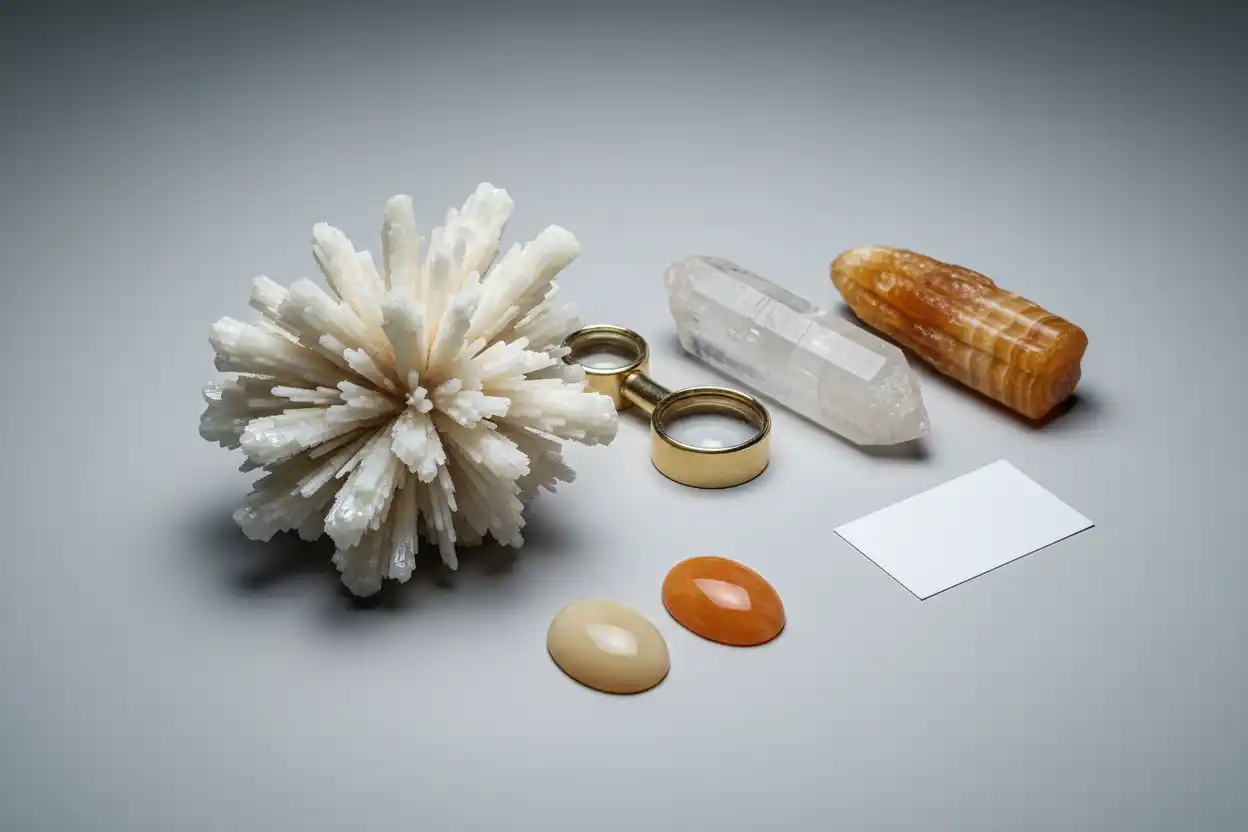
Where to Buy Real Aragonite: Trusted Sellers and Fake-Spotting Tips
Real aragonite is not especially difficult to find, yet buying a well-identified, undamaged piece requires more care than choosing the most colorful listing. The mineral occurs in delicate sprays, twinned “sputnik” clusters, compact masses, stalactitic forms, polished objects, beads and occasional jewelry. Each format presents different authenticity, repair and durability questions.
A dependable purchase starts with mineral identity. Aragonite is calcium carbonate, the same chemical composition as calcite but a different crystal structure. Its orthorhombic growth, frequent twinning, brittle nature and Mohs hardness of about 3.5 to 4 shape both its appearance and its care requirements. For a broader mineral profile, read the aragonite meaning and properties guide before comparing listings.
Decide What Kind of Aragonite You Want
The safest seller and the right evaluation method depend on the form you intend to buy. A collector seeking a complete crystal cluster should shop differently from someone choosing a polished palm stone or necklace.
| Aragonite format | Best buying source | Main risk to check |
|---|---|---|
| Fine crystal specimen | Established mineral dealer, specialist show or reputable auction house | Repaired crystals, glued matrix, undisclosed restoration and weak locality data |
| Common cluster or “sputnik” form | Mineral shop, gem show or experienced online dealer | Broken points, reconstructed clusters, resin repair and misleading color |
| Polished tower, sphere or carving | Lapidary supplier or crystal retailer with treatment disclosure | Dyed carbonate, mixed material, filled fractures and incorrect trade names |
| Cabochon, bead or pendant | Lapidary or jewelry seller who names the material and construction | Softness, surface coatings, drilled-hole fractures and confusion with calcite |
| Study sample | Mineralogical supplier or educational dealer | Incomplete labeling, mixed carbonate material and poor specimen documentation |
For rare or expensive pieces, prioritize a mineral dealer who provides a specimen label, exact dimensions, condition notes and a clear return policy. General marketplaces can still yield genuine material, but the buyer must verify more details independently.
Where to Buy Real Aragonite
Specialist mineral dealers
A specialist dealer is usually the strongest choice for terminated crystals, twinned specimens and documented locality material. Good dealers describe the mineral species, locality, associated minerals, specimen dimensions, repairs and collection history. They also understand that an aragonite cluster can lose value when a major crystal has been reattached or when the display face has been heavily stabilized.
Ask whether the dealer belongs to a recognized mineralogical community, regularly exhibits at mineral shows or maintains archived labels from older collections. Membership alone does not prove a specimen is correct, although a visible professional history makes accountability easier.
Gem and mineral shows
In-person shows let you inspect luster, crystal terminations, matrix contacts and hidden damage under several lighting angles. Bring a small flashlight and a 10× loupe, but do not perform scratch or acid tests on a seller’s specimen. Instead, compare multiple pieces and ask the dealer to explain why the item is aragonite rather than calcite or another carbonate.
Shows are also useful for judging scale. Wide-angle listing photographs can make a small cluster appear large, whereas dimensions and hand inspection reveal its actual presence. Before attending, review the general guide to identifying crystals so you know which observations are useful and which home tests are unreliable.
Reputable online mineral shops
A trustworthy online listing should show the exact specimen from several directions, including the base, matrix contact and any repaired area. It should not rely on a single heavily edited photograph. Videos are particularly helpful because moving light reveals crystal luster, chipped terminations and glossy adhesive.
The seller should state whether the buyer receives the pictured item or a randomly selected piece from a batch. For one-of-a-kind clusters, insist on exact-item photography. The broader online gemstone buying guide explains how to evaluate seller identity, payment protection and return terms.
Lapidary and jewelry sellers
Polished aragonite is best purchased from a seller who understands its softness and brittle tenacity. A competent lapidary should disclose resin filling, surface coating, dye, backing material and repairs. Jewelry sellers should also explain whether the stone sits in a protective bezel and whether the item is suitable for frequent wear.
Aragonite pendants and earrings are generally more practical than rings or bracelets because they receive fewer knocks. Even so, drill holes, thin points and exposed edges deserve close inspection.
What Genuine Aragonite Usually Looks Like
Natural aragonite varies widely, so authenticity cannot be reduced to one color or shape. Colorless, white, cream, honey, brown and iron-stained orange material is common, while blue, green, pink, red or violet examples require closer attention to mineral identity and possible treatment. Natural specimens may be transparent, translucent or opaque.
Crystal habits include slender prisms, needles, radiating sprays, columnar crystals, pseudohexagonal twins, fibrous aggregates and botryoidal or stalactitic masses. Moroccan “sputnik” clusters are popular because repeated twinning produces radiating forms. However, a star shape alone does not prove authenticity; sellers can assemble broken crystals or cast lookalikes.
Under magnification, genuine crystals commonly show small growth irregularities, minute edge chips, natural contacts between crystals and matrix, uneven iron staining or internal features that continue beneath the surface. Perfectly repeated points, mold seams, round gas bubbles, pooling color and uniformly glossy joins suggest resin, glass or reconstruction.
The fake-crystal buyer’s guide provides a wider framework for recognizing molded pieces, dyed material and misleading listings without damaging the stone.
Aragonite Versus Calcite: The Most Important Buying Distinction
Aragonite and calcite share the formula CaCO3, yet they are different minerals. Calcite crystallizes in the trigonal system and has Mohs hardness 3, while aragonite is orthorhombic and slightly harder. In well-formed crystals, habit and cleavage can help an experienced mineralogist, but compact, polished or fibrous pieces can be difficult to separate by sight.
Retailers sometimes use the names loosely, especially for banded carbonate carvings, blue polished material and cave deposits. Some products may contain both minerals, while others are calcite sold under an aragonite trade label. Review the calcite mineral guide and the types of calcite overview before paying a premium for a color or locality claim.
Do not use vinegar, stronger acids or destructive scratch tests to settle the question. Both carbonates can react with acid, and a scratch test can permanently damage a polished surface or collectible crystal. When the distinction materially affects value, X-ray diffraction or Raman spectroscopy is more appropriate than a home experiment.
Common Fake, Altered and Misrepresented Aragonite
Dyed carbonate sold as naturally colored aragonite
Bright blue, teal, purple, hot pink or intensely green pieces may be dyed. Dye can concentrate in fractures, pores, drill holes and low areas around crystal contacts. Nevertheless, some natural aragonite is genuinely colorful, so color intensity is only a reason to ask questions, not proof of treatment.
Request a written answer to: “Has this material been dyed, coated, stabilized, filled or otherwise treated?” A vague reply such as “all natural stone” does not address treatment.
Calcite or mixed carbonate sold as aragonite
This is more common than a sophisticated synthetic fake. The seller may repeat a wholesaler’s label without testing the material. Compact stones, banded carvings and pale-blue pieces are especially vulnerable to loose naming. A seller who cannot explain the identification should not charge a premium based on species.
Resin casts and molded clusters
Resin imitations may copy a radiating cluster while showing identical points, rounded details, mold lines or bubbles. They often feel unusually light or warm, although hand feel is not conclusive. Painted surfaces may collect pigment in recesses and show a plastic gloss.
Reconstructed or repaired specimens
A genuine aragonite cluster can still be materially altered. Broken crystals may be reattached, clusters may be built from separate pieces, or a specimen may be glued to an artificial base. Professional repairs are not automatically unacceptable, but they must be disclosed because they affect value and handling.
Inspect for glossy menisci, adhesive strings, mismatched crystal orientation, excess matrix filler and color differences around joins. Long-wave ultraviolet light can sometimes reveal adhesive, but fluorescence varies and should not be treated as a definitive test.
Coatings and surface enhancement
Wax, oil, resin or clear coating can deepen color and conceal a dull or porous surface. On polished material, the finish may be legitimate stabilization; on a collectible crystal, undisclosed coating can significantly change the specimen. The general gemstone treatment guide explains why treatment type, durability and disclosure matter.
How to Judge an Aragonite Specimen
A high-quality specimen is not simply the largest one. Evaluate the complete display.
First, examine crystal completeness. A few minor contacts may be normal, but major broken terminations, crushed edges and repaired central crystals should reduce the price. Next, consider luster. Fresh aragonite may show vitreous to resinous surfaces, while weathering or chemical cleaning can make it dull or etched.
Composition matters as well. A specimen with balanced radiating crystals, a stable base and an attractive display direction can be more desirable than a larger but chaotic piece. Matrix should support the crystals without obscuring them, and the underside should reveal natural attachment rather than a resin platform.
Locality can add scientific and collector interest. Molina de Aragón in Spain is historically associated with the mineral’s name, while Morocco is widely known in the retail market for radiating clusters. Other localities can produce excellent material, but appearance rarely proves origin. A valuable locality claim should come with an original label, collection history or dealer documentation.
Finally, check stability. Very thin needles may shed during shipping, while dense clusters can hide fractures. Ask whether any points are loose and whether the specimen has been stabilized.
Buying Polished Aragonite, Beads and Carvings
Polishing changes what you can observe. Crystal habit disappears, and mixed carbonate material can look uniform. Therefore, insist on treatment and species disclosure rather than relying on appearance alone.
For spheres and towers, inspect the entire piece for filled pits, deep fractures and unstable cavities. Natural veining is acceptable when structurally sound, but open fractures can spread after a minor impact. A polished object should sit securely without rocking, and edges should not crumble under gentle handling.
Beads need clean drill holes with no radiating cracks. Because aragonite is much softer than quartz, it scratches relatively easily and may abrade against harder beads or metal spacers. For necklaces, knotting or small spacers can reduce bead-to-bead impact.
Carvings should have rounded vulnerable points and an even polish. Fine projections, thin wings or sharp decorative tips are unsuitable for a brittle carbonate unless the piece is strictly for display.
Buying Aragonite Jewelry
Aragonite jewelry is attractive but not ideal for rough daily wear. The Mohs hardness chart helps explain scratch resistance, while the guide to gemstone toughness versus hardness explains why a stone can be relatively hard yet still fracture.
Choose pendants, brooches and earrings over exposed rings. A bezel or partial protective frame is preferable to high prongs around a brittle cabochon. Examine the back of the setting for glue, foil, resin or a backing plate, and ask whether the stone is solid aragonite or a composite.
For vintage jewelry, request photographs of edge wear, scratches and any whitening around adhesive. Repairs should be documented, especially when the stone cannot be removed safely for testing.
Seller Questions That Reveal Listing Quality
Before purchasing, ask concise, specific questions:
- Is the specimen confirmed as aragonite, and how was it identified?
- What is the exact locality, and is a locality label included?
- Has any crystal been repaired, reattached or stabilized?
- Has the piece been dyed, coated, filled, waxed, oiled or treated with resin?
- Are the photographs of the exact item?
- Are any crystals loose, chipped or concealed by the display angle?
- What are the dimensions and weight?
- How will the specimen be packed?
- What is the inspection and return period?
- Will treatment, repair and locality statements appear on the invoice?
A knowledgeable seller may say that identification is based on provenance and morphology rather than laboratory testing. That can be reasonable for inexpensive material, provided the claim is appropriately cautious.
Price and Value Without Hype
Aragonite value depends on specimen aesthetics, crystal quality, locality, rarity of form, color, size, condition, repair history and documentation. Polished objects also reflect cutting labor, yield and finish. Generic claims that a piece is “museum grade,” “investment grade” or “extremely rare” are meaningless without evidence.
Compare like with like. A common small Moroccan cluster should not be evaluated against a historic labeled European specimen or an unusually transparent crystal. Likewise, a large sphere should be judged for polish, fractures and material quality rather than weight alone.
The gemstone pricing guide explains why color, condition, provenance, treatment and market demand interact. For aragonite, condition and disclosure often matter more than a seller’s spiritual marketing language.
When Professional Testing Is Worthwhile
Laboratory testing makes sense when the item is expensive, the exact species matters, the stone is polished and visually ambiguous, or the seller makes a premium locality claim. Raman spectroscopy can identify many mineral phases non-destructively, while X-ray diffraction is especially useful for distinguishing calcium-carbonate polymorphs. A qualified mineralogist may also combine microscopy, specific gravity and crystallographic observations.
A general jewelry appraisal is not automatically a mineral identification. Ask whether the professional has access to suitable instrumentation and whether the report will name treatments, repairs and composite construction.
Shipping, Returns and Documentation
Aragonite clusters require careful immobilization. Each specimen should be wrapped so pressure does not bear directly on crystal tips, placed in a rigid inner box and cushioned inside a larger shipping box. Loose packing chips alone are not enough for fragile sprays.
Request insured, tracked shipping for valuable pieces. Photograph the unopened parcel, packing layers and specimen as you unpack it. If damage occurs, those images help establish whether the break happened in transit.
A fair return policy should allow enough time to inspect the item under normal light and magnification. Return conditions should not require destructive testing. For online purchases, keep screenshots of the listing and written seller statements about repairs, treatment and locality.
Ethical and Responsible Buying
Aragonite is widespread, yet responsible sourcing still matters. Ask whether the seller can name the country or mine, whether collection was legal, and whether the material came through established dealers. Be cautious with claims from protected caves, reserves or heritage sites. A polished crystal without any origin information may still be genuine, but it should not carry a provenance premium.
The guide to ethically sourced crystals offers a practical way to assess traceability, labor claims and environmental language without expecting perfect mine-to-retail documentation for every low-cost specimen.
Caring for Aragonite After Purchase
Keep aragonite away from acids, household cleaners, salt solutions, steam and ultrasonic cleaning. For a dusty specimen, start with a hand air blower or very soft dry brush. A polished piece can usually be wiped with a barely damp soft cloth and dried immediately, but avoid soaking porous, fractured, coated or glued material.
Store aragonite separately from harder minerals so they do not scratch it. Support heavy specimens from the base rather than lifting them by crystal points. The dedicated guide on cleansing and charging aragonite separates symbolic practices from physically safe care. Before using water with any crystal, consult the planned water-safety guide, and do not place aragonite in an ultrasonic machine merely because another carbonate survived one; the ultrasonic-cleaner guide addresses those risks in detail.
Build a Small Reference Set, Not a Random Collection
A useful aragonite collection can show how one mineral changes across crystal habit, color, matrix and locality. Start with a well-labeled common cluster, then add a contrasting prismatic or compact specimen. As your eye improves, the A crystal directory, A gemstone directory and visual gemstone-type guide can help place aragonite among related collector materials.
The best purchase is not the most dramatic listing. It is the piece whose identity, condition, treatment, locality and return terms are described clearly enough that you know exactly what you are paying for.
Frequently Asked Questions
1. Is aragonite commonly faked?
Sophisticated synthetic aragonite is not a major retail problem because common material is inexpensive. Mislabeling, dyeing, resin casting, glued reconstruction and calcite sold as aragonite are more realistic concerns.
2. How can I tell aragonite from calcite at home?
Well-formed crystal habits can provide clues, but compact or polished pieces may be impossible to separate reliably by sight. Avoid acid and scratch tests; use professional Raman or X-ray diffraction when the distinction affects value.
3. Are Moroccan aragonite “sputnik” clusters real?
Many are genuine natural twinned aragonite clusters. Even so, inspect for reattached points, assembled clusters, artificial bases and undisclosed repairs, because genuine crystals can be reconstructed.
4. Is blue aragonite always dyed?
No. Naturally blue aragonite exists, but vivid uniform color, dye concentration in cracks and vague seller disclosure justify caution. Species and treatment should be confirmed before paying a premium.
5. Can aragonite be used in an everyday ring?
It is a poor choice for an exposed everyday ring because it is soft, brittle and vulnerable to household acids. A protected pendant or occasional-wear piece is more practical.
6. What should a locality label include?
A useful label names the mineral, mine or occurrence when known, district or region, country and any collection history. “Morocco” or “Spain” is better than no origin, although a more precise locality is preferable for collector value.
7. Do repairs make an aragonite specimen worthless?
No. A well-executed, disclosed repair can preserve an important specimen. However, repair extent, location and visibility should influence the price, and reconstructed clusters need especially clear disclosure.
8. Is polished aragonite usually pure aragonite?
Not necessarily. Polished objects may be aragonite, calcite, mixed carbonate rock or material sold under a trade name. Ask how the species was identified and whether the object contains resin or filler.
9. Should I buy aragonite with a certificate?
A laboratory report is rarely necessary for an inexpensive common cluster. It becomes more useful for costly polished material, disputed species, premium locality claims or historically important specimens.
10. What lighting is best for inspecting aragonite online?
Neutral daylight or high-quality white light is most useful. Request unfiltered photographs, a rotating video and close-ups of the base, crystal contacts, repaired areas and any unusually saturated color.
11. How should an aragonite cluster be shipped?
The seller should immobilize it in a rigid inner container, protect points from direct pressure and place that container inside a cushioned outer box. Valuable pieces should travel with tracking and insurance.
12. What is the biggest red flag in an aragonite listing?
The strongest warning is a premium claim—rare color, famous locality, “museum grade” quality or untreated status—paired with no exact-item photographs, no condition disclosure and no return policy.