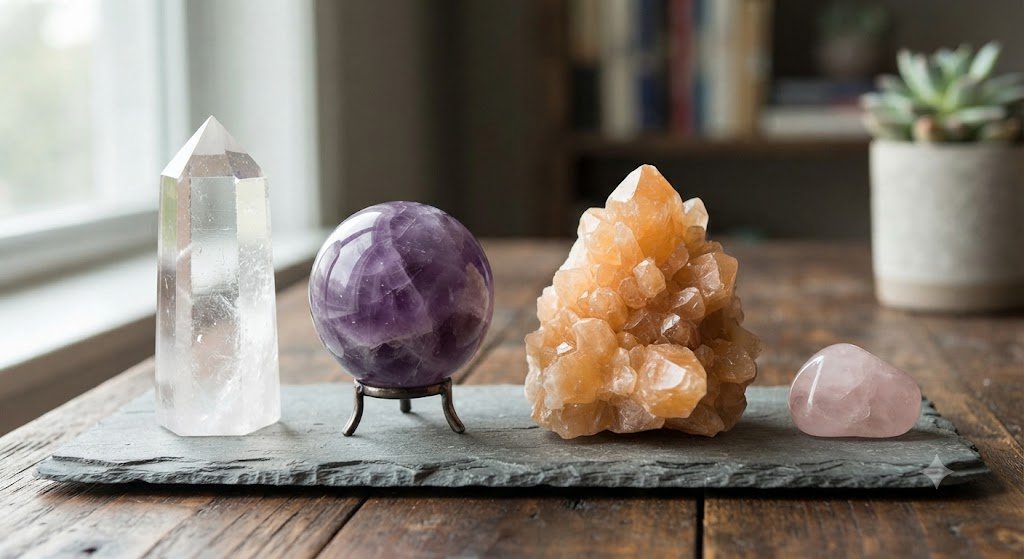
Crystal Shapes Meaning: 7 Facts About Natural Forms, Carved Shapes & Symbolism
Crystal shapes meaning can refer to two very different things: the natural form a mineral develops while growing and the symbolic meaning people later assign to polished or carved shapes. Quartz prisms, pyrite cubes, fluorite crystals, mica sheets, and needle-like rutile develop their characteristic habits because of crystal structure and growth conditions. A polished sphere, heart, pyramid, palm stone, or most commercial towers, however, gets its shape from cutting and lapidary work.
That distinction matters because crystal shapes meaning is often presented as though every modern carved form carries an ancient or scientifically measurable energy pattern. Mineralogy does not support that interpretation. Shape can influence how an object feels in the hand, how it stands on a desk, how light moves across polished surfaces, and how easily someone associates it with a personal intention. Those are real differences without proving that a pyramid concentrates energy or that a sphere emits a therapeutic force in every direction.
The most useful approach is therefore to recognize natural crystal geometry, appreciate lapidary craftsmanship, and treat metaphysical interpretations as personal or modern spiritual symbolism rather than physical properties of the mineral.
7 Crystal Shapes Meaning Facts That Separate Geology From Symbolism
- Natural crystal shapes develop from crystal structure and growth conditions rather than human intention.
- Many commercial towers and points are cut and polished rather than naturally terminated crystals.
- Spheres are shaped by lapidary work and commonly symbolize wholeness or continuity in modern practice.
- Pyramids are carved forms whose energy-focusing interpretations are spiritual beliefs rather than measured mineral effects.
- Hearts, moons, stars, skulls, and similar shapes gain meaning mainly from familiar human symbols.
- Tumbled stones and palm stones emphasize touch, portability, and smoothness rather than natural crystal habit.
- Natural clusters, geodes, and terminated crystals preserve growth features that can reveal genuine mineralogical information.
Natural Crystal Shapes Meaning Begins With Crystal Structure
The scientific side of crystal shapes meaning starts inside the mineral. Atoms or ions arrange in repeating three-dimensional structures, and minerals growing with enough room can develop external forms related to that internal order. Mineralogists describe the characteristic appearance of crystals as crystal habit.
Seven crystal systems are commonly recognized: cubic, tetragonal, orthorhombic, hexagonal, trigonal, monoclinic, and triclinic. These systems describe symmetry relationships, not spiritual functions. Quartz belongs to the trigonal system and commonly develops six-sided prismatic forms terminated by rhombohedral faces. Pyrite belongs to the cubic system and can form striking cubes, while fluorite commonly forms cubes or octahedral forms. Gypsum can develop tabular, prismatic, or bladed crystals.
Growth conditions complicate these ideal forms. Temperature, pressure, fluid chemistry, available space, impurities, twinning, and contact with neighboring crystals can change external appearance. Two specimens of the same mineral can therefore look very different while sharing the same underlying crystal structure.
In mineralogy, crystal shapes meaning is primarily diagnostic. Shape can provide clues to identity and growth history rather than evidence for a healing effect.
Crystal Points and Towers: Natural Terminations vs Cut Shapes
Points and towers dominate modern discussions of crystal shapes meaning, yet they need careful identification. A natural quartz crystal often grows as an elongated prism with a naturally formed termination. Its faces developed during crystallization. A commercial tower may instead begin as a rough chunk that a lapidary cuts and polishes into a symmetrical six-sided or multi-sided point.
Both can be attractive, but they tell different stories. Natural terminations preserve crystal-growth surfaces, striations, contact marks, inclusions, and other geological evidence. Cut towers emphasize color, pattern, polish, and human craftsmanship.
Modern spiritual practice commonly associates upward-pointing towers with focus, direction, intention, or concentration. Those meanings can make the object memorable during journaling or meditation, but the pointed geometry has not been shown to concentrate medically effective energy.
People who program crystals often connect a chosen stone with a specific reminder or intention. A tower can serve that purpose because its orientation is visually obvious, not because cutting the stone into a point creates a newly verified physical healing field.
Crystal Shapes Meaning for Spheres and Polished Balls
Spheres offer one of the clearest examples of how crystal shapes meaning differs from natural mineral formation. Large quartz, obsidian, fluorite, calcite, jasper, and other stone spheres are shaped and polished by people. Minerals do not normally grow from rock cavities as perfectly polished balls.
Modern symbolism frequently connects spheres with unity, wholeness, cycles, completeness, equality, or an idea of energy extending in every direction. These associations are intuitive because every point on an ideal sphere’s surface lies the same distance from its center. They remain symbolic rather than evidence that a crystal sphere physically radiates healing energy evenly around a room.
Spheres do have practical qualities. Their polished surfaces can display color zoning, banding, inclusions, aventurescence, chatoyancy, or other visual features without corners interrupting the view. They also feel smooth in the hand, although larger spheres need secure stands because they can roll and become damaged.
When discussing crystal shapes meaning, a sphere’s psychological appeal and lapidary beauty are enough to explain its popularity without assigning it unmeasured physical powers.
Pyramids and the Modern Idea of Focused Crystal Energy
Pyramids receive some of the strongest energy-based claims in crystal culture. Crystal shapes meaning descriptions often state that a pyramid draws energy through its base and concentrates or releases it through the apex. No established mineralogical or medical evidence demonstrates this effect.
Most crystal pyramids are cut from larger pieces of quartz, fluorite, sodalite, jasper, calcite, obsidian, or other stones. The pyramid therefore reflects lapidary design rather than the mineral’s natural crystal habit. Cutting quartz into a pyramid does not change its chemical formula from SiO₂, nor does it establish a new therapeutic property.
A pyramid can still be a useful symbolic object. Its broad base and narrowing upper form can represent moving from many possibilities toward one priority, building a goal from a stable foundation, or concentrating attention on a specific task. These interpretations make crystal shapes meaning personally useful while keeping the mechanism honest.
A crystal grid may use a pyramid or point as part of a deliberate geometric arrangement, but the significance of that placement belongs to the spiritual or personal framework chosen by the user.
Hearts, Moons, Stars, Skulls, and Other Carved Crystal Shapes
Human symbolism has a much stronger influence on carved forms than mineral science does. Heart-shaped rose quartz may represent affection because people already understand the heart as a symbol of love. A moon-shaped labradorite may suggest cycles, nighttime, or change because of the cultural symbolism of the Moon. Skulls can evoke mortality, memory, ancestry, knowledge, or transformation depending on personal and cultural context.
This is an important part of crystal shapes meaning because it shows how symbolism travels from familiar imagery into gemstone practice. The mineral does not need to create the meaning independently. A carved rose quartz heart can feel emotionally significant because of its color, gift history, tactile shape, and human associations.
Craft quality also matters. Curves should be polished smoothly, thin points should not contain unstable fractures, and carvings with undercut details need protection from impacts. Softer minerals scratch more quickly than quartz-family stones, so a crystal hardness chart helps explain why an intricate fluorite carving requires gentler storage than a similarly shaped quartz carving.
Crystal shapes meaning therefore includes craftsmanship, visual language, and personal interpretation as well as geology.
Tumbled Stones and Palm Stones Emphasize Touch and Portability
Tumbled stones are rough pieces rounded and polished through repeated abrasion, while palm stones are usually shaped into smooth, flattened forms intended to sit comfortably in the hand. Neither preserves the original crystal habit particularly well, but both reveal color, pattern, inclusions, and texture.
Modern crystal shapes meaning often assigns tumbled stones an approachable or gentle quality because they lack sharp points. Palm stones are commonly used during meditation simply because their rounded profile is comfortable to hold. That ergonomic advantage is real even though no evidence shows that smoothing a mineral changes its therapeutic energy.
The shaping process can also make some rocks easier to appreciate. Agate banding, jasper patterns, tiger’s eye chatoyancy, labradorite flashes, and unakite’s mixed coloration may become more obvious after polishing.
A tumbled stone is therefore not a lesser version of a natural crystal. It serves a different purpose. Collectors interested in crystallography may prefer natural faces and terminations, while someone interested in tactile use, pocket carrying, or pattern may prefer a polished stone.
Natural Clusters, Geodes, and Double-Terminated Crystals
Natural clusters preserve several crystals growing together on a common base or matrix. Their geometry can reveal competition for space, changing growth conditions, multiple generations of crystallization, and relationships between different minerals. Unlike carved objects, these forms can contain direct geological evidence.
Crystal shapes meaning in spiritual practice often interprets clusters as community, cooperation, amplification, or shared intention. Those themes can arise naturally from seeing many crystals together, but a cluster has not been scientifically shown to amplify another stone’s healing effects.
Geodes tell another geological story. A cavity in rock gradually receives mineral-rich fluids, allowing crystals to grow inward along its walls. Quartz and calcite are common geode minerals, although the exact mineralogy varies by locality. Breaking or cutting a geode reveals an interior that could not be seen from the outside.
Double-terminated crystals have terminations at both ends when they grow without attachment restricting either end. Their natural form differs fundamentally from a commercial wand polished to points at both ends. Crystal shapes meaning may treat both similarly in spiritual practice, but mineralogical description should preserve the distinction.
Does Crystal Shapes Meaning Change a Stone’s Physical Properties?
Cutting a stone changes its external geometry, weight, surface area, and sometimes the way light interacts with it. Faceting can increase brilliance in transparent gems, a polished cabochon can reveal chatoyancy, and a sphere can display patterns from many viewing angles. Those are genuine physical consequences of shape.
The chemical identity does not become stronger because a quartz crystal becomes a tower or sphere. Quartz remains quartz. Fluorite remains fluorite. Obsidian remains volcanic glass regardless of whether it is carved into a heart, skull, moon, or pyramid.
This distinction helps keep crystal shapes meaning clear. Shape may change how an object is used, displayed, held, stored, or interpreted. It does not establish a medicinal property or a universally measurable spiritual function.
Two people can therefore assign different meanings to the same carved form without either changing the stone itself.
How to Choose a Crystal Shape Without Overthinking Symbolism
Choose natural specimens when crystal growth, locality, terminations, matrix relationships, and geological history interest you. Choose spheres or polished freeforms when color and internal patterns matter most. A palm stone works well when comfort in the hand is important, while towers and points create a strong vertical display.
Symbolism can then follow the purpose you want the object to represent. A heart can remind you to communicate kindly, a tower can represent one priority, and a sphere can represent looking at an issue from several directions. The strongest crystal shapes meaning is often the interpretation you can translate into an actual behavior.
Physical care should remain separate from symbolism. A fluorite sphere is still soft and cleavable. A topaz carving remains vulnerable to cleavage. A quartz point can chip if dropped. Shape never cancels the mineral’s real durability limits.
Conclusion
Crystal shapes meaning combines genuine mineral geometry with human craftsmanship and modern symbolism. Natural habits such as quartz prisms or pyrite cubes develop during crystal growth, while spheres, pyramids, hearts, palm stones, and most commercial towers receive their shape through cutting and polishing.
Symbolic meanings such as wholeness, focus, affection, or transformation can make a shape personally useful, but they are not scientifically measured healing properties. Understanding where geology ends and interpretation begins makes crystal shapes more interesting, not less.
FAQs
What Does Crystal Shapes Meaning Refer To?
Crystal shapes meaning can describe natural mineral habits or the symbolic meanings assigned to carved and polished forms such as towers, spheres, hearts, and pyramids.
Do Natural Crystal Shapes Have Meaning?
Scientifically, natural shapes reflect crystal structure and growth conditions. Spiritual meanings assigned to those shapes are personal or cultural interpretations rather than measured mineral properties.
What Is the Meaning of a Crystal Tower?
Modern crystal shapes meaning often associates towers with focus, direction, or intention. Most commercial towers are cut and polished, so the symbolic meaning comes from their designed form rather than natural crystallization.
What Does a Crystal Sphere Symbolize?
Spheres commonly symbolize wholeness, continuity, balance, or completeness. There is no established evidence that they distribute healing energy uniformly through a room.
Do Crystal Pyramids Concentrate Energy?
There is no scientific evidence that a carved crystal pyramid concentrates therapeutic energy. Its pointed geometry can still serve as a personal symbol for focus or structured goals.
Are Tumbled Crystals Less Powerful Than Raw Crystals?
No scientific evidence shows that polishing reduces or increases a crystal’s healing power. Tumbled stones simply have a different surface, shape, and tactile character.
Are Crystal Hearts Naturally Formed?
Polished crystal hearts are carved by people. Their symbolism comes mainly from the familiar human association between the heart shape and affection or emotional connection.
What Is a Natural Crystal Habit?
Crystal habit describes the typical external form a mineral develops during growth, influenced by its internal structure and environmental conditions.
Does Cutting a Crystal Change Its Meaning?
Cutting can change how someone interprets or uses a stone, but it does not create a scientifically demonstrated healing property. Crystal shapes meaning remains partly personal when dealing with carved forms.