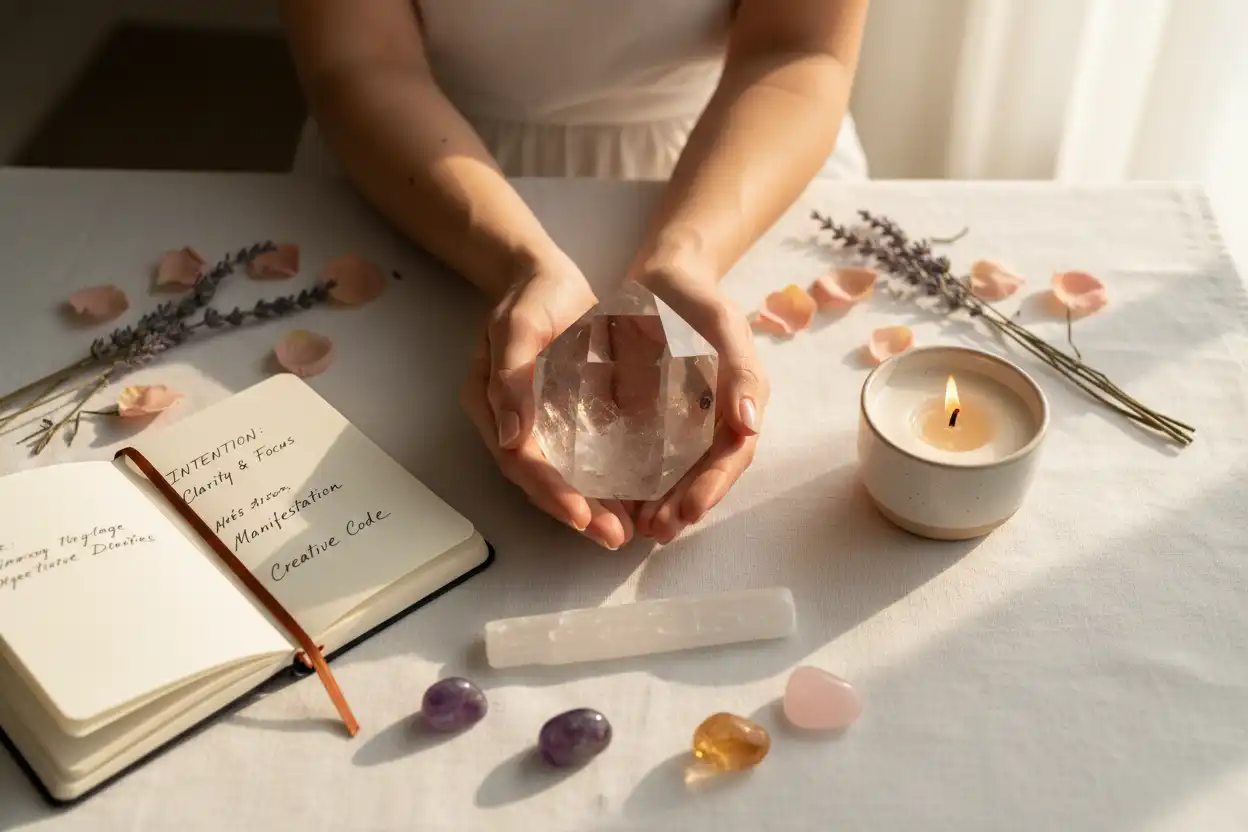
How to Program Crystals: 7 Practical Steps for Clear Intentions & Meaningful Use
Learning how to program crystals is best understood as creating a deliberate association between a stone and an intention you want to remember. In modern crystal practice, people may hold a quartz point, polished stone, pendant, or other specimen while choosing a goal, repeating a phrase, meditating, or deciding how the crystal will fit into a routine. There is no established scientific evidence that this process writes information into a crystal lattice or gives the gemstone a new therapeutic power.
That distinction does not make the practice meaningless. Objects can become effective reminders because people repeatedly connect them with particular actions, memories, places, or goals. A crystal beside a notebook can remind someone to begin writing. A stone kept near a desk can signal the start of a focused work period. A pendant can prompt someone to pause before an important conversation.
The most useful method for how to program crystals therefore keeps the intention specific, realistic, and connected to behavior. The stone becomes a cue. The person remains responsible for the action.
How to Program Crystals in 7 Practical Steps
- Identify the crystal correctly and make sure it is safe to handle.
- Clean it physically using a method appropriate for the mineral.
- Choose one clear intention that describes something you can influence.
- Hold, view, or place the crystal somewhere comfortable and distraction-free.
- State the intention briefly in words you actually understand and believe.
- Connect the stone with one repeatable action or routine.
- Review the intention later and change or end the practice when it no longer fits.
Step 1: Identify the Stone Before You Program It
The first step in how to program crystals is knowing what you actually have. A clear stone might be quartz, glass, calcite, synthetic material, or another mineral. A metallic specimen might be pyrite, hematite, galena, or something else with very different care requirements.
Identification matters because spiritual practices sometimes involve holding, washing, carrying, placing stones against the skin, or exposing them to sunlight. Those activities are not suitable for every specimen. Some minerals are soft, soluble, brittle, chemically sensitive, coated, stabilized, or potentially hazardous if they produce dust or fragments.
A stone does not need perfect laboratory identification before it can be appreciated, but uncertain specimens deserve conservative handling. Avoid licking, grinding, placing unknown minerals in drinking water, or using aggressive cleaning rituals.
Learning how to tell if a crystal is real also helps distinguish natural stones from glass, resin, synthetic gems, dyed products, and altered crystals before attaching elaborate claims to them.
Step 2: Clean the Crystal Physically Without Damaging It
Many instructions for how to program crystals begin with cleansing, but physical cleaning and spiritual cleansing are different. Physical cleaning removes dust, skin oils, residue, or dirt. The safest method depends on mineral identity.
Quartz usually tolerates brief cleaning with warm water and mild soap. Fluorite is softer and cleavable. Gypsum varieties such as selenite deserve protection from prolonged water exposure. Turquoise can be porous or stabilized, while coated gems may require protection from abrasion. Steam, ultrasonic cleaning, strong chemicals, salt, and prolonged soaking are not universal crystal-care methods.
A clean soft cloth is often enough when you simply want the stone to feel prepared for a ritual. If the crystal is already clean, there is no mineralogical requirement to wash it again.
The goal at this stage of how to program crystals is simply to begin with a specimen that is safe and comfortable to use.
Step 3: Choose One Intention You Can Influence
The quality of the intention matters more than the number of crystals. When learning how to program crystals, choose wording that focuses on your own behavior rather than attempting to control external events.
“I will prepare thoroughly for tomorrow’s presentation” is actionable. “This crystal will make everyone approve of me” is not. “I will pause before replying when I feel angry” describes a behavior. “This stone will stop other people from upsetting me” gives responsibility to the object.
The same principle applies to money, relationships, study, creativity, and wellness. A crystal can remind someone to follow a budget, send an application, write for thirty minutes, communicate a boundary, or begin a calming routine. It cannot guarantee wealth, attraction, examination results, reconciliation, or medical recovery.
Effective intentions are usually short enough to remember and specific enough to act on. That keeps how to program crystals grounded in a real routine instead of vague wishes.
Step 4: Create a Quiet Moment Around the Intention
The next step in how to program crystals does not require elaborate ceremony. Sit somewhere comfortable, place the stone in front of you or hold it if the mineral is safe for ordinary contact, and remove unnecessary distractions for a few minutes.
Look at its actual features. Notice color, transparency, inclusions, crystal faces, polish, weight, or texture. This anchors the practice in a real object rather than requiring you to imagine that something physically invisible must happen.
Some people prefer slow breathing or brief meditation at this stage. Others simply read the intention from a notebook. Either approach can work as a personal ritual.
The point is focused attention. A deliberate moment makes the association between the crystal and the intended behavior easier to remember later.
Step 5: State the Intention Clearly and Briefly
When people describe how to program crystals, they often recommend repeating an affirmation or speaking directly to the stone. There is no evidence that the crystal understands language or stores sentences as information. The words are useful because they clarify the intention for the person using them.
A simple statement works better than an elaborate promise. Examples include “I will work on one priority before checking messages,” “I will communicate this boundary calmly,” or “I will follow my evening wind-down routine.”
Avoid statements that disguise unsupported health claims. A crystal should not be programmed to “cure” pain, depression, infection, infertility, insomnia, or another medical condition. A behavior-centered intention such as remembering a medical appointment or following a clinician-approved routine is very different.
This is where how to program crystals becomes practical: the words define what the stone will remind you to do.
Step 6: Link the Crystal to One Repeatable Action
An intention becomes more useful when it has a context. If the stone represents focused work, place it where focused work happens. If it represents deliberate communication, wear or carry a suitable durable stone when preparing for an important meeting. If it represents journaling, keep it beside the journal.
A crystal grid can organize several stones around one intention, although a grid is not required and has not been shown to create a measurable energy circuit. One crystal in a consistent location is often easier to use.
The key question in how to program crystals is what should happen when you notice the stone. If the answer is clear, the object has a practical role. Seeing it might mean “start the task,” “check the plan,” “pause before replying,” or “write down the next step.”
Without a corresponding action, the ritual can remain pleasant but vague.
Step 7: Review, Change, or End the Crystal Program
A programmed crystal does not need to carry the same intention forever. When circumstances change, how to program crystals can include deliberately changing the association.
Review the intention after a reasonable period. Did the stone still remind you of the intended action? Is the goal complete? Does another behavior now matter more? If the answer has changed, state a new intention or return the stone to ordinary display or storage.
There is no evidence that the previous intention remains trapped inside the mineral and must be removed through moonlight, smoke, salt, or another ritual. Someone who enjoys symbolic closure can still use sound, meditation, journaling, or a simple spoken statement.
Questions about do crystals run out of energy also become simpler from this perspective. The mineral does not need to be refueled because personal meaning and attention, rather than a finite store of healing power, drive the practice.
Do You Need to Cleanse Before Learning How to Program Crystals?
Spiritual cleansing is optional. Modern crystal traditions use moonlight, smoke, sound, visualization, water, salt, and other rituals, but there is no scientific evidence that these methods remove accumulated emotional energy from a mineral.
If a cleansing ritual helps mark the beginning of the process, choose one that does not damage the stone. Sound, quiet reflection, or a clean cloth are low-risk options for many specimens. Water, sunlight, salt, smoke, and heat require more care because minerals respond differently.
How to program crystals does not become more effective because the cleansing ritual is longer or more elaborate. A deliberate intention stated once can be just as meaningful as a complex ceremony.
Does Crystal Shape Change Programming?
Modern crystal practice sometimes assigns different functions to spheres, points, towers, hearts, pyramids, and palm stones. A point may symbolize direction, a sphere may represent completeness, and a heart may reinforce an intention involving compassion.
Most commercial forms are shaped through cutting and polishing rather than growing naturally in those exact forms. Ideas surrounding crystal shapes meaning can still make a ritual more memorable, but shape does not scientifically increase a crystal’s ability to store intentions.
Choose the form that fits the activity. A palm stone is comfortable to hold, a tower is easy to see on a desk, and a small polished stone is convenient to carry. Practical suitability matters more than claims that one geometry programs more strongly than another.
How Often Should You Program a Crystal?
There is no required schedule. How to program crystals depends on when the chosen intention changes or when the ritual stops feeling useful. Some people set an intention once and keep the stone in the same place for months. Others revise the association for a new project or life situation.
Repeated programming does not damage the mineral, but aggressive physical cleansing between intentions can. Avoid repeatedly soaking, heating, salting, scrubbing, or sunbathing delicate stones merely because a ritual schedule says they must be reset.
A simple verbal reset is enough for symbolic purposes. Physical care should follow gemology rather than ritual frequency.
Common Mistakes When Programming Crystals
The most common mistake is giving the crystal responsibility for an outcome the user must pursue. A stone cannot study for an examination, communicate a boundary, apply for a job, follow a budget, or make a difficult decision.
Another mistake is unsafe cleansing. Water, salt, heat, sunlight, chemicals, and rough handling can damage particular stones. Unknown specimens deserve conservative care.
Finally, avoid treating every uncomfortable feeling as evidence that a crystal has absorbed negativity or been programmed incorrectly. Sometimes the intention no longer fits, the ritual has become repetitive, or the problem requires action beyond symbolic practice.
Understanding how to program crystals should increase clarity and agency rather than make the user dependent on the object.
Conclusion
How to program crystals can be a simple seven-step intention-setting practice: identify the stone, clean it safely, choose an actionable goal, focus attention, state the intention, connect it with a behavior, and review it later.
No evidence shows that programming writes instructions into a crystal lattice or creates new healing powers. The strongest use is symbolic: the stone becomes a consistent reminder of something you have chosen to do.
FAQs
How to Program Crystals for the First Time?
Identify and safely clean the stone, choose one realistic intention, spend a quiet moment focusing on it, state the intention clearly, and connect the crystal with a repeatable action.
Do You Need to Cleanse a Crystal Before Programming It?
No scientific requirement exists. Physical cleaning may be useful, while spiritual cleansing is optional and should use a method that will not damage the mineral.
Can You Program More Than One Crystal?
Yes. There is no established limit, although one or two stones can make an intention easier to remember than a large group with many different meanings.
Can You Program a Crystal for Someone Else?
You can assign personal symbolism to a gift, but you cannot guarantee another person’s feelings, health, choices, or outcomes through a crystal.
How Long Does It Take to Program Crystals?
There is no required duration. A focused minute or two can establish a personal intention just as well as a longer ritual.
Can a Programmed Crystal Lose Its Intention?
There is no evidence that intentions are physically stored in crystals. Your personal association may fade or change, and you can simply restate or replace the intention.
Can You Reprogram the Same Crystal?
Yes. You can assign a new personal meaning whenever the old intention is complete or no longer useful.
Does Programming Make Crystals More Powerful?
No established evidence shows that programming increases measurable healing or energetic power. It can make the stone more meaningful as a reminder.
Can Programming Crystals Treat Health Problems?
No. Programming a crystal is an intention-setting practice, not a treatment for physical or mental health conditions.