Angelite Healing Properties: 10 Popular Claims, Positive Traditions & Safe Limits
Angelite healing properties are traditionally associated with calm communication, emotional softness, patience, inner peace, compassion, spiritual reflection, grief support, self-expression, hope, and adapting gently to change. These meanings come from modern crystal traditions rather than established medical evidence. Angelite does not treat anxiety, depression, sleep disorders, thyroid problems, inflammation, pain, respiratory illness, hormonal conditions, or other physical or mental health concerns through ordinary handling or jewelry use.
Angelite is the trade name commonly used for pale blue anhydrite, a calcium sulfate mineral related chemically to gypsum but lacking water in its crystal structure. Its soft blue color, matte to slightly waxy appearance, and cloudy internal texture make it visually distinctive, yet the stone is comparatively soft and should be handled carefully. Angelite generally sits around 3 to 3.5 on the Mohs hardness scale, has pronounced cleavage, and can be damaged by rough wear or prolonged contact with water. These mineral facts matter because angelite’s real properties determine how it should be used and cared for, while its healing associations remain symbolic.
Angelite Communication Claims Center on Calm Speech, Listening, and Clear Boundaries
Communication is one of the most recognizable themes attached to angelite. Its pale blue color has encouraged comparisons with other blue stones traditionally linked with voice, honesty, and peaceful expression. In crystal practice, angelite is often described as helping people speak gently, listen more openly, or communicate difficult emotions without becoming overwhelmed. There is no evidence that the mineral changes language processing or directly reduces social anxiety, but it can work well as a reminder to prepare a conversation carefully and communicate with less unnecessary tension.
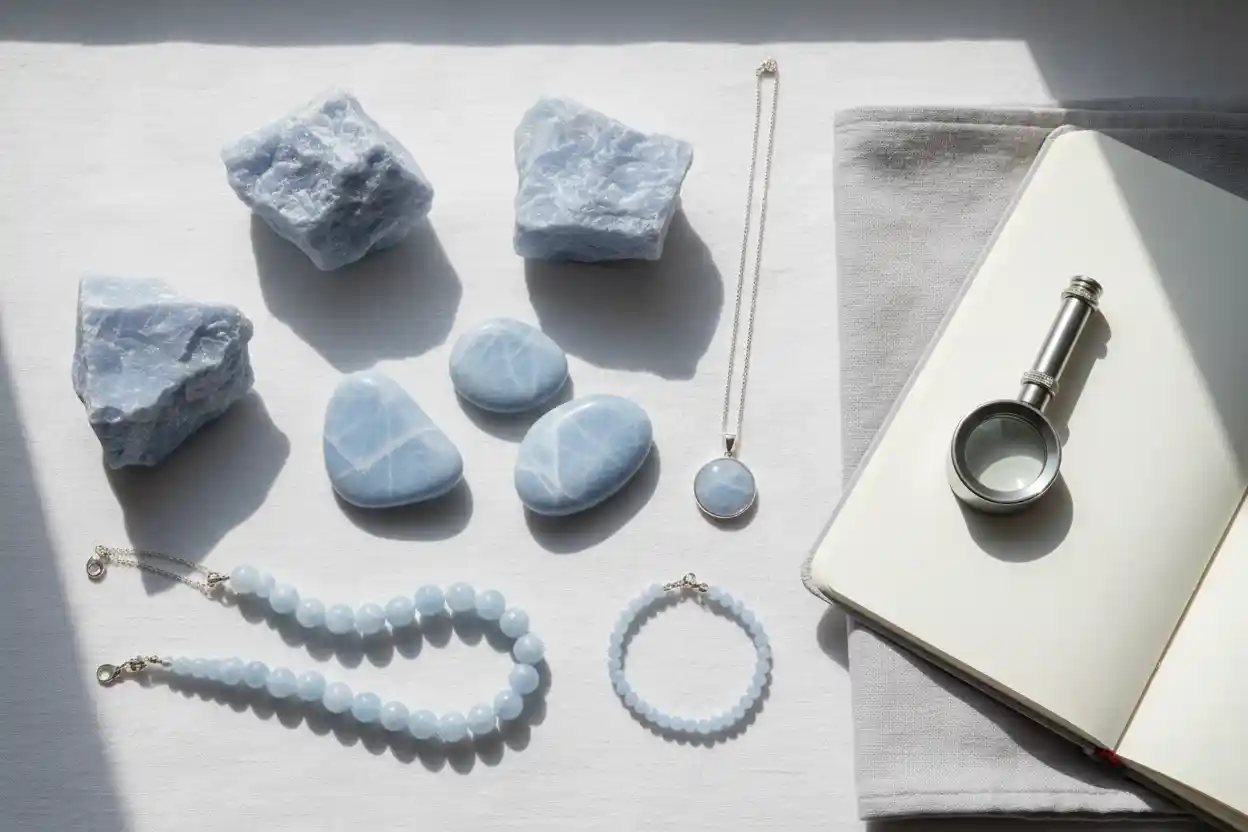
A polished stone beside a notebook can symbolize writing down the real point before speaking. Instead of beginning a difficult conversation with a vague accusation, a person can identify the specific behavior, explain why it matters, and state what change would help. This approach connects naturally with crystals for communication because clearer communication depends on timing, listening, word choice, and appropriate boundaries rather than on an invisible force from the stone.
Angelite’s calm symbolism should not be confused with passivity. Gentle communication can still be direct. Saying no, asking for clarification, correcting misinformation, or leaving an unsafe interaction can all be consistent with calm expression. The stone is most useful symbolically when it represents clarity without hostility rather than silence for the sake of keeping peace.
Angelite Calm and Inner-Peace Claims Work Best as Low-Stimulation Rituals
Angelite is often marketed as a calming or peaceful stone, and its muted blue color contributes strongly to that reputation. There is no established evidence that it lowers stress hormones, regulates the nervous system, or treats anxiety. A more practical interpretation is to connect angelite with reducing unnecessary stimulation when the mind feels overloaded. The stone can mark the beginning of a quiet period, a screen-free break, reflective journaling, or another routine that creates space between stress and response.
The symbolism around crystals for inner peace fits angelite especially well when peace means creating conditions that make reflection easier rather than trying to eliminate every difficult emotion. A person might keep angelite beside a chair used for reading or meditation, place it near a journal, or carry a small piece during a demanding day as a tactile reminder to slow down before reacting.
Calm should not become pressure to appear serene when something genuinely requires action. Anger, fear, grief, and frustration can all contain useful information. Angelite symbolism is most constructive when it supports a measured response to those emotions instead of suggesting that unpleasant feelings are failures that must be spiritually removed.
Angelite Compassion and Emotional-Softness Traditions Support Reflection, Not Treatment
Angelite is frequently associated with compassion, forgiveness, tenderness, and emotional openness. These themes can be personally meaningful during relationship changes, family conflict, grief, or periods when self-criticism becomes excessive. A stone can symbolize treating yourself or another person with more care, but it cannot repair trauma, erase grief, or produce forgiveness automatically.
Traditional angelite benefits often emphasize comfort and emotional support, yet the useful part of such a practice lies in what happens around the stone. Someone may use angelite while writing a letter they never send, recording what they wish had happened differently, or deciding what boundary is necessary after a difficult experience. These actions can support reflection because they create language around the experience.
Forgiveness also needs careful limits. It should not be treated as an obligation, especially after betrayal, abuse, coercion, or serious harm. A crystal should never be used to pressure someone into reconciliation before trust has been rebuilt or safety has been established. Compassion and self-protection can exist together.
Angelite Grief Support Claims Should Respect the Reality and Duration of Loss
Angelite is commonly recommended in modern crystal practice for grief because its name and soft color create associations with comfort, remembrance, and spiritual connection. There is no evidence that the stone changes the grief process biologically, but a personally meaningful object can become part of remembrance rituals. Someone might keep angelite near a photograph, hold it during quiet reflection, or use it as a marker for writing memories about someone who died.
The crystals for grief tradition is most responsible when it acknowledges that grief does not follow a fixed schedule. A stone cannot shorten mourning, prevent painful memories, or guarantee a sense of closure. Some days may feel manageable while others become difficult again without indicating that healing has failed.
Persistent grief that seriously disrupts ordinary functioning may benefit from counseling or other professional support. Angelite can remain part of a private remembrance practice while human support addresses the emotional reality of loss.
Angelite Hope and Adaptability Claims Reflect Gentle Adjustment to Change
Angelite is also associated with hope, acceptance, and moving through transition without losing emotional balance. Its symbolism suits situations where circumstances cannot simply be reversed, such as relocation, relationship changes, career transitions, family changes, or another major life adjustment. The stone does not make adaptation easier automatically, but it can represent the decision to work with current reality rather than spending all available energy wishing conditions had remained unchanged.
Hope is more useful when it remains specific. Instead of using angelite to symbolize that everything will work out, it can represent one realistic possibility that remains open. A person might identify what can still be changed, what must be accepted for now, and which support would make the transition easier. This approach prevents positive symbolism from becoming denial.
The idea also connects with crystals for letting go when letting go means releasing a strategy, expectation, or situation that can no longer be maintained. It does not mean forgetting what happened or pretending something never mattered.
Angelite Spiritual-Connection Claims Are Personal Beliefs, Not Evidence of Contact
The name “angelite” strongly shapes how the stone is marketed. Crystal traditions often describe it as a stone for angels, spirit guides, prayer, intuitive communication, or receiving messages. These beliefs can be meaningful within a person’s spiritual practice, but they should not be presented as objectively verified properties of anhydrite.
A person may choose angelite for meditation because its color and name support a particular spiritual mood. The experience can be personally significant without proving that an external being communicated through the gemstone. Dreams, impressions, coincidences, and intuitive feelings should therefore be interpreted carefully, especially when important health, financial, legal, or relationship decisions are involved.
The traditional angelite meaning can be appreciated as part of crystal culture while factual decisions remain grounded in evidence. Spiritual symbolism does not need scientific confirmation to have personal meaning, but it should not be used as proof of hidden information.
Angelite Is Blue Anhydrite With Softness, Cleavage, and Water Sensitivity
Angelite’s actual mineral identity explains why it needs more careful handling than quartz-based stones. It is blue anhydrite, a calcium sulfate mineral that crystallizes in the orthorhombic system. Its relatively low hardness means harder stones, metal edges, and abrasive surfaces can scratch it readily, while cleavage makes the stone vulnerable to chips or breaks under sharp impact.
Water deserves particular caution. Anhydrite is closely related to gypsum and can gradually alter when exposed to moisture over time. Brief incidental contact is not the same as immediate destruction, but repeated soaking, prolonged water exposure, or using angelite in crystal-water practices is unnecessary and can be hard on the stone’s surface and structure. Keeping it dry is the more sensible care choice.
Its pale blue color can range from powdery sky blue to gray-blue, sometimes with white areas or uneven texture. Polished pieces often have a soft, subdued appearance rather than the glassy transparency of aquamarine or topaz. Blue calcite healing properties may share similar calm symbolism because of color, but blue calcite and angelite are entirely different minerals with different structures and physical behavior.
Angelite and Celestite Look Similar but Are Different Minerals
Angelite is sometimes confused with celestite because both can appear pale blue and are commonly sold for calm or spiritual symbolism. The minerals are chemically and structurally different. Angelite is anhydrite, while celestite is strontium sulfate. Their appearance can overlap enough that casual visual identification is unreliable, particularly in polished pieces.
Traditional celestite healing properties often overlap with angelite themes such as quiet reflection, spiritual connection, and peaceful communication, which can add to buyer confusion. Metaphysical descriptions are not useful identification tools. Mineral identity should instead be based on reliable sourcing, physical characteristics, and gemological or mineralogical testing when the distinction matters.
This is especially relevant when a specimen is unusually expensive or represented as rare. A soothing blue color is not enough to establish what the stone actually is. Buying from sellers who use accurate mineral names is more useful than relying on spiritual labels.
Angelite Jewelry Is Best for Lower-Impact Wear Because of Its Softness
Angelite can be worn in jewelry, but its softness and cleavage make some designs more practical than others. Pendants and earrings usually expose the stone to fewer impacts than rings or bracelets. Smooth cabochons are common because they highlight the soft blue color without creating thin facet edges that could chip easily.
Routine cleaning should stay gentle. A dry or barely damp soft cloth is preferable to prolonged soaking, steam, ultrasonic cleaning, harsh chemicals, or abrasive cleaners. Perfume, hairspray, cosmetics, and household cleaners should be kept away from the stone when possible. Storage should also separate angelite from harder gems such as quartz, topaz, sapphire, and diamond that can scratch it.
Crystal rituals do not require exposing angelite to water, salt, or sunlight for long periods. If symbolic cleansing matters personally, dry methods such as quiet storage, intention-setting, or simply wiping the stone clean are less likely to damage it.
Angelite Healing Claims Do Not Replace Medical or Mental Health Care
Some descriptions attribute angelite with effects on the throat, thyroid, inflammation, pain, circulation, weight, sleep, anxiety, depression, or other health concerns. These claims are not established therapeutic effects of blue anhydrite. Wearing the stone does not deliver a medicine into the body, and placing it on a particular area does not treat the organs located there.
The same evidence limit applies to emotional conditions. Angelite may become a comforting object within a reflective routine, but persistent anxiety, depression, trauma symptoms, severe grief, or sleep disruption deserve appropriate support according to their severity. Personal crystal practice can coexist with professional care, but it should not delay it.
Angelite’s appeal does not depend on medical effectiveness. Its soft color, mineral identity, symbolism, and tactile qualities already make it interesting as a collectible and reflective object.
Conclusion
Angelite healing properties are best understood as traditional themes of calm communication, inner peace, compassion, grief support, patience, hope, adaptability, self-expression, emotional softness, and spiritual reflection. Angelite is actually blue anhydrite, a soft calcium sulfate mineral with pronounced cleavage and sensitivity to prolonged moisture. It can support meaningful personal rituals and reflective habits, but it does not treat illness, control emotions, provide verified spiritual messages, or replace professional care.
FAQs
What are the main traditional angelite healing properties?
Angelite is commonly associated with calm communication, inner peace, compassion, grief support, patience, hope, self-expression, adaptability, and spiritual reflection.
Is angelite scientifically proven to heal?
No. There is no established evidence that angelite treats physical or mental health conditions through ordinary contact.
What mineral is angelite?
Angelite is the trade name commonly used for pale blue anhydrite, a calcium sulfate mineral.
How hard is angelite?
Angelite is relatively soft, generally around 3 to 3.5 on the Mohs scale.
Can angelite go in water?
Prolonged soaking is best avoided because angelite is anhydrite and moisture can affect the stone over time.
Can angelite help communication?
It can serve as a symbolic reminder to speak clearly and listen carefully, but it does not directly change communication ability.
Is angelite good for grief?
Angelite can have personal meaning in remembrance and grief rituals, but it does not treat grief or shorten the grieving process.
Does angelite connect people with angels?
That is a spiritual belief rather than a scientifically established property of the mineral.
Is angelite the same as celestite?
No. Angelite is anhydrite, while celestite is strontium sulfate. Their pale blue colors can look similar.
Is angelite suitable for everyday rings?
Its softness and cleavage make lower-impact jewelry such as pendants and earrings more practical than frequently worn rings.
Angelite healing meanings are traditional or personal practices, not established treatments for physical or mental health conditions.