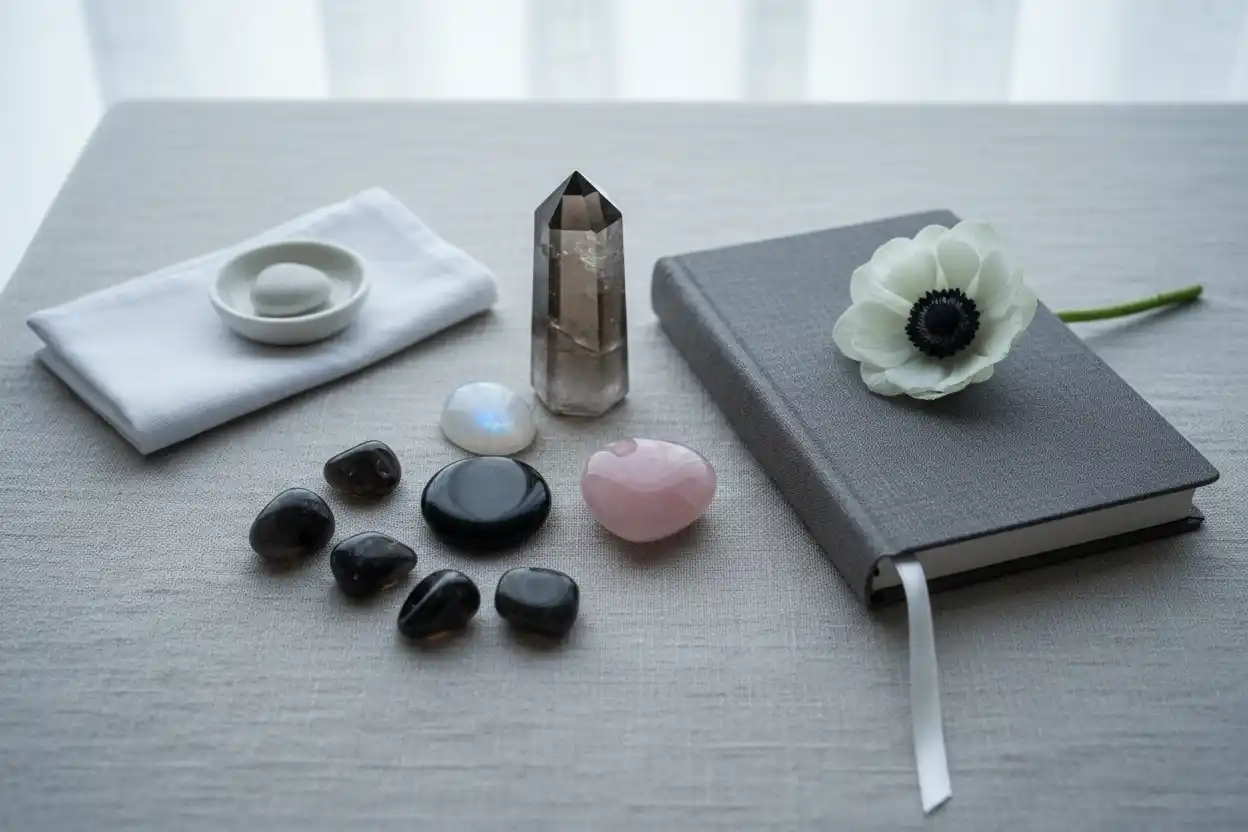
7 Popular Crystals for Grief: Calming Symbolism & Safe Use Limits
Crystals for grief can serve as personal objects of remembrance, reflection, comfort, and continuity, but they cannot shorten grief, remove loss, prevent painful memories, or treat depression and other mental health conditions. Grief is a human response to loss that can change in intensity and form over time. It may include sadness, anger, numbness, relief, guilt, confusion, longing, or periods that feel almost normal before difficult feelings return.
Apache tears, rose quartz, amethyst, smoky quartz, moonstone, lepidolite, and rhodonite are commonly connected with grief-related traditions because their symbolism includes remembrance, compassion, reflection, grounding, transition, patience, and emotional boundaries. A stone may become meaningful because it was carried at a memorial, associated with someone who died, placed beside a photograph, or used during a quiet journaling routine. Its value can be deeply personal without requiring claims that the crystal medically changes grief.
Apache Tears for Remembrance and Making Space for Loss
Apache tears are small rounded forms of obsidian, a natural volcanic glass. Their modern crystal symbolism is strongly associated with grief, remembrance, mourning, and emotional transition.
The traditions surrounding Apache tears healing properties can support a simple remembrance practice. A stone might sit beside a photograph, letter, or object connected with the person or experience being remembered.
The goal is not to use the stone to stop sadness. It can instead create a physical place for memory when emotions feel difficult to organize.
Some people find meaning in holding a familiar object during anniversaries, memorial dates, or moments when grief appears unexpectedly. The comfort comes from association, ritual, memory, and attention rather than an established therapeutic effect of obsidian.
Because obsidian is volcanic glass, broken pieces can develop very sharp edges. Smooth polished Apache tears are safer for frequent handling than chipped or fractured pieces.
Rose Quartz for Self-Compassion When Grief Includes Guilt or Regret
Rose quartz is pink quartz traditionally associated with affection, compassion, kindness, and emotional warmth. These themes can be useful when grief becomes mixed with thoughts about what should have been said or done differently.
The symbolism connected with rose quartz healing properties can represent treating yourself with enough compassion to recognize the limits of hindsight.
After a loss, people may replay conversations and imagine different outcomes. Some reflection can be meaningful, but endless self-criticism cannot change what happened.
A rose quartz stone beside a journal might accompany questions such as: What did I value about this relationship? What did I do with the information I had at the time? Is there something I genuinely need to make amends for, or am I demanding impossible perfection from my past self?
Self-compassion does not erase responsibility. It allows responsibility to remain proportionate rather than expanding into permanent self-punishment.
Amethyst for Quiet Reflection Without Forcing Emotional Closure
Amethyst is purple quartz and is traditionally associated with reflection, restraint, perspective, and calm routines. Its symbolism can fit grief because loss often produces questions that have no immediate answer.
The traditions around amethyst healing properties can support a quiet period where the objective is simply to notice what you are feeling without demanding that the emotion disappear.
A polished amethyst can sit beside a journal or be held during a brief breathing exercise. The structured pause can create a gentler setting for reflection, while the stone remains a physical focus point rather than a treatment.
Grief rarely follows a clean sequence. Someone may feel stable and then experience strong sadness after hearing a song, visiting a familiar place, or encountering an ordinary reminder.
That fluctuation does not automatically mean progress has been lost.
Smoky Quartz for Returning Attention to Immediate Needs
Smoky quartz ranges from pale gray-brown to deep nearly black and is traditionally associated with grounding, practical thinking, and returning attention to the present.
The symbolism around smoky quartz healing properties can be useful on days when grief makes ordinary responsibilities feel unusually difficult.
A smoky quartz stone can serve as a reminder to reduce the time horizon. Instead of trying to understand the entire future, identify what needs attention during the next hour. Eat something. Drink water. Answer one necessary message. Take prescribed medication correctly. Rest. Contact someone supportive.
These small actions do not resolve grief, but basic routines can become important when concentration and motivation are disrupted.
The stone can represent returning to the immediate task without implying that grief should be ignored.
Smoky quartz belongs to the quartz family and is durable enough for regular handling and many jewelry styles.
Moonstone and Lepidolite for Grief That Changes Shape Over Time
Moonstone is a feldspar gem known for its shifting glow, called adularescence. Traditional symbolism frequently connects it with cycles, transition, adaptation, and changing circumstances.
The themes within moonstone healing properties can represent the fact that grief itself changes. Early grief may feel constant, while later grief can appear in waves around anniversaries, places, conversations, or milestones.
Adapting does not mean forgetting. A person can build a meaningful life while continuing to remember someone important.
Lepidolite is a lithium-bearing mica commonly found in lilac or lavender shades. Traditional lepidolite healing properties often emphasize patience and gradual transition.
That symbolism can fit periods when other people appear ready for someone to “move on” before the grieving person feels ready. There is no crystal-based timetable for grief, and ordinary handling of lepidolite does not provide a therapeutic lithium dose.
Lepidolite is also relatively soft and splits easily along its mica layers, so protected palm stones and display pieces are more practical than rough carrying.
Rhodonite for Grief, Relationships, and Unfinished Conversations
Rhodonite commonly appears pink with black manganese-oxide markings and is traditionally associated with compassion, accountability, emotional balance, and boundaries.
The symbolism around rhodonite healing properties can be especially relevant when grief includes unresolved conflict.
Not every relationship ends with everything settled. Someone may die while disagreements remain, a friendship may end without a final conversation, or a family loss may bring old tensions back into focus.
A rhodonite stone can accompany an unsent letter in which you write what you wish had been said. The exercise cannot change the past, but it may help organize thoughts that have remained unfinished.
Rhodonite can also symbolize maintaining boundaries with living relatives or acquaintances when grief creates pressure, conflict, or unwanted demands. Mourning does not remove the right to privacy and safety.
Grief Does Not Follow a Fixed Sequence or Deadline
Popular descriptions sometimes make grief sound like a set of stages that everyone moves through in the same order. Real experiences are much less predictable.
Sadness may coexist with relief. Anger may appear months later. A person may enjoy an event and then feel guilty for enjoying it. Someone else may return to ordinary routines quickly while still carrying deep loss privately.
None of these patterns can be judged accurately by how often someone cries or how visibly emotional they appear.
The traditions around crystals for emotional healing are safest when emotional healing means learning to live alongside difficult experiences rather than deleting them.
A crystal can mark a moment of remembrance, but there is no correct number of days, rituals, or stones required before grief should end.
Memory Rituals Can Be Meaningful Without Claiming to Treat Grief
A stone can become part of a remembrance ritual because physical objects often carry associations. You might place one beside a photograph, carry it on an anniversary, or keep it with letters and keepsakes.
Some people may choose rose quartz to represent affection, Apache tears remembrance, or moonstone continued change. The meaning comes from the connection you assign to the object.
The traditions around crystals for gratitude can also support remembrance by focusing on something specific you valued about the person or experience that was lost.
Gratitude should not be used to suppress sadness. Saying that you are grateful for a relationship does not mean you must feel grateful for the loss itself.
Both appreciation and pain can exist together.
When Grief Deserves Additional Support
Grief can be intensely painful without automatically being a mental health disorder. Support may come from trusted family, friends, faith communities, cultural mourning practices, peer groups, counseling, or other sources that feel appropriate.
Professional support becomes particularly important when grief is persistently overwhelming, severely disrupting basic daily functioning, or occurring alongside major depression, trauma symptoms, substance misuse, or thoughts of self-harm.
A crystal should not delay seeking help because someone believes they need to complete another ritual, find a stronger stone, or wait for emotional energy to shift.
The traditions around crystals for inner peace can remain personally meaningful while real support addresses the emotional, social, and health needs surrounding the loss.
Avoid Harmful Claims About Grief and Crystals
Statements that one crystal “heals grief,” clears grief from the body, or guarantees emotional closure can create unrealistic expectations. Grief reflects attachment, memory, identity, circumstances, and the meaning of the loss, none of which can be reduced to a stone.
It is also unhelpful to suggest that continuing grief means someone used a crystal incorrectly or failed to maintain a positive mindset.
Avoid ingesting crystal powders or preparing homemade crystal drinks as grief remedies. Treatments, coatings, contaminants, and mineral chemistry may be uncertain, and ingestion adds risk without providing an established grief benefit.
External symbolic use through jewelry, palm stones, keepsakes, and display is simpler and safer.
Conclusion
Crystals for grief can serve as personal symbols of memory, compassion, reflection, grounding, change, patience, and unfinished emotion. Apache tears, rose quartz, amethyst, smoky quartz, moonstone, lepidolite, and rhodonite each offer a different traditional meaning that can be connected with remembrance or reflective routines. They cannot remove grief or determine how quickly it should change, so their role should remain supportive while human connection and professional care are used when needed.
FAQs
Which crystals are traditionally associated with grief?
Apache tears, rose quartz, amethyst, smoky quartz, moonstone, lepidolite, and rhodonite are commonly connected with grief, remembrance, transition, and compassion traditions.
Which crystal is most strongly linked with mourning?
Apache tears are particularly associated with grief, remembrance, and emotional transition in modern crystal traditions.
Can crystals heal grief?
No. Crystals cannot remove loss or medically treat grief. They can serve as personally meaningful objects during remembrance and reflection.
Is rose quartz useful after losing someone?
Rose quartz can symbolize affection and self-compassion, particularly when grief includes guilt, regret, or longing.
Which crystal symbolizes change after a loss?
Moonstone and lepidolite are commonly associated with transition, patience, and gradual adjustment.
Can smoky quartz stop grief-related sadness?
No. Smoky quartz cannot stop sadness, but it can serve as a reminder to return attention to immediate practical needs.
Is it normal for grief to return after feeling better?
Grief can fluctuate and may become stronger around reminders, anniversaries, milestones, or unexpected memories.
When should someone seek extra help for grief?
Additional support is important when grief remains overwhelmingly distressing, severely disrupts daily functioning, or occurs alongside serious depression, trauma symptoms, substance misuse, or self-harm thoughts.
Can crystal rituals replace grief counseling?
No. A ritual can be personally meaningful, but it does not replace professional support when counseling or other care is needed.
Crystal meanings and grief associations are traditional or personal practices, not established treatments for grief or mental health conditions.