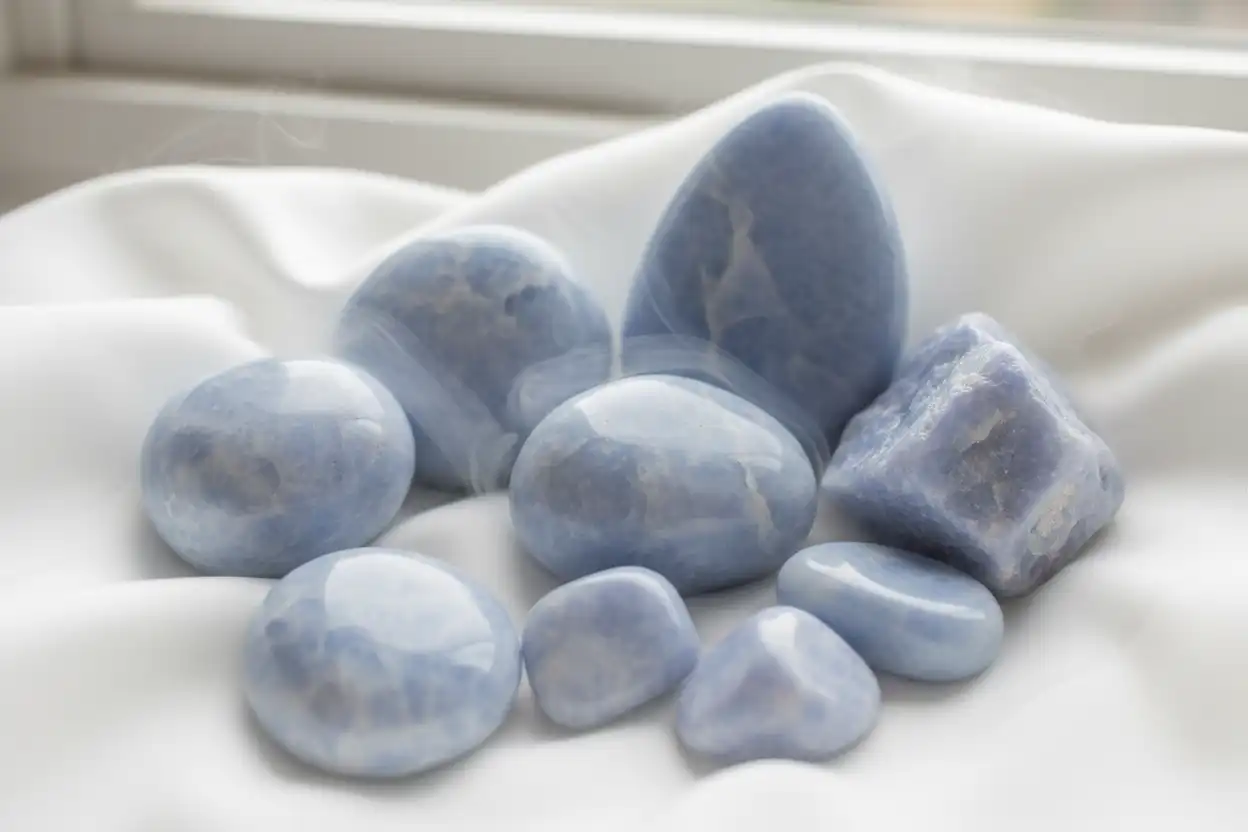
Angelite Meaning: Mineral Identity, History & Symbolism
Angelite meaning begins with a mineralogical distinction that is easy to lose in gemstone marketing: Angelite is not an independent mineral species. The name is used for pale blue to blue-gray, commonly fine-grained or massive anhydrite, a calcium sulfate mineral with the formula CaSO₄. Mineral references specifically associate the Angelite trade name with semitransparent blue-gray anhydrite marketed as gem and ornamental material from Peru.
That makes Angelite materially different from stones that merely share its soft blue appearance. It is not blue calcite, celestite, aquamarine, gypsum, or a special crystalline substance created for metaphysical use. Its measurable properties are those of anhydrite: an orthorhombic sulfate mineral with moderate softness, strong cleavage, relatively high density for a pale ornamental stone, and no water molecules built into its ideal chemical formula.
The modern symbolic story came later. Angelite is commonly associated with calm, communication, compassion, spiritual reflection, or an imagined connection with angels. Those associations belong to contemporary crystal culture and personal symbolism. They are not properties established by mineralogical testing, and they should not be presented as medical, psychological, or supernatural facts.
Readers exploring other evidence-led mineral references can use the wider Gemstone Guides. This page stays focused on what Angelite is, how its blue material relates to anhydrite, what can and cannot be inferred from appearance, its documented naming context, responsible symbolism, and safe ownership.
Angelite Identity at a Glance
| Property | Angelite |
|---|---|
| Mineral identity | Anhydrite |
| Status of “Angelite” | Trade/lapidary name, not a separate mineral species |
| Ideal formula | CaSO₄ |
| Mineral class | Sulfate |
| Crystal system | Orthorhombic |
| Typical Angelite form | Fine-grained to massive ornamental material rather than well-formed crystals |
| Characteristic trade color | Pale blue to blue-gray |
| Other anhydrite colors | Colorless, white, gray, violet, pink, brownish, reddish, and related pale tones |
| Transparency | Commonly semitranslucent to opaque in Angelite material |
| Luster | Vitreous, pearly, or slightly greasy depending on surface and orientation |
| Mohs hardness | About 3–3.5 |
| Specific gravity | Around 3.0 |
| Cleavage | Strong in several directions |
| Tenacity | Brittle |
| Closely related material | Gypsum, CaSO₄·2H₂O |
| Major identification limit | Pale blue color alone cannot prove Angelite, Peruvian origin, or treatment status |
The distinction between Angelite and anhydrite is therefore similar to the distinction between a recognized commercial variety and its underlying mineral species. The detailed mineral identity of the parent species is covered separately in anhydrite meaning. Angelite does not require a new chemical formula simply because its color, texture, and lapidary use have acquired a separate trade name.
Angelite Is Anhydrite, Not Hydrated Gypsum
Anhydrite and gypsum are closely related calcium sulfate minerals, but they are not identical. Anhydrite has the ideal formula CaSO₄, whereas gypsum incorporates structural water as CaSO₄·2H₂O. That difference changes crystal structure, density, hardness, geological behavior, and the conditions under which each mineral is stable.
The name anhydrite itself reflects this absence of structural water. It was derived from a term meaning “without water,” emphasizing the contrast with hydrated calcium sulfate minerals.
The relationship between the two minerals is geologically important because anhydrite can hydrate to form gypsum when conditions allow water to enter and reorganize the material. Gypsum can also lose water under appropriate burial or thermal conditions and become anhydrite. These are genuine mineral transformations, not metaphors for emotional cleansing or spiritual change.
A polished Angelite object does not instantly transform into gypsum simply because a drop of water touches it. Geological hydration is controlled by fluid access, temperature, pressure, texture, time, and other conditions. Nevertheless, the mineral’s softness, cleavage, and calcium-sulfate chemistry make prolonged soaking unnecessary and undesirable for a polished collectible.
How Angelite Forms
Because Angelite is anhydrite, its geological story belongs to the broader formation of calcium sulfate minerals. Anhydrite commonly occurs in evaporite environments where saline water becomes sufficiently concentrated for sulfate minerals and associated salts to develop. Thick sedimentary sequences can contain anhydrite together with gypsum, halite, carbonate rocks, clay-rich layers, and other evaporite minerals.
Anhydrite also occurs in hydrothermal environments, veins, altered rocks, and other geological settings. In sedimentary deposits, subsequent burial, groundwater movement, dissolution, dehydration, and hydration can substantially modify the original calcium sulfate assemblage. A rock body that contains gypsum near the surface may contain more anhydrite at depth, while water moving through anhydrite-bearing material can encourage conversion toward gypsum.
Angelite sold as ornamental material is most strongly associated with fine-grained blue-gray Peruvian anhydrite. That description should not be expanded into a precise deposit model for every commercial piece without supporting locality documentation. The host rocks, mineral associations, deposit processes, and geological evidence for specific occurrences belong in Angelite formation and deposit geology.
For the purposes of Angelite meaning, the key point is that its soft blue appearance developed within a real calcium-sulfate geological system. It was not formed as a distinct “spiritual mineral.”
What Causes Angelite’s Blue Color?
Pure anhydrite does not need to be blue. Mineralogical descriptions include colorless, white, gray, pale blue, violet, pink, reddish, brownish, and other subdued colors. Fine-grained Angelite is distinguished commercially by its characteristic pale blue to blue-gray appearance, often accompanied by lighter mottling or variations in tone.
The exact cause of that blue appearance should not be reduced to one universally proven trace element. Natural mineral color can reflect trace impurities, microscopic inclusions, defects, scattering within fine-grained material, alteration, or combinations of these factors. Accessible mineralogical references describe blue and blue-gray anhydrite but do not justify assigning every piece of Angelite to a single chromophore based solely on visible color.
This matters because online descriptions sometimes claim that copper, a specific metal, or an undefined “energy frequency” creates Angelite’s blue color. A chemical cause requires chemical or spectroscopic evidence. A photograph showing powder-blue material does not provide that evidence.
Questions about transmitted light, refractive behavior, scattering, color variation, and how polished surfaces alter apparent saturation belong in Angelite optical properties and color behavior.
Why Angelite Usually Looks Massive Rather Than Crystalline
Well-formed anhydrite crystals exist, but Angelite encountered in lapidary markets is typically fine-grained, massive material. It may be fashioned into cabochons, beads, spheres, eggs, carvings, palm stones, or polished freeforms because a solid mass is easier to shape into ornamental objects than isolated brittle crystals.
A broken surface may show a fine granular texture, subtle cleavage-related planes, pale mottling, or areas that reflect light differently as the specimen is turned. Polishing smooths this texture and can deepen the apparent blue slightly, but the material usually retains a restrained, opaque-to-semitranslucent appearance.
This is an important photographic clue. A seller image showing intensely transparent, faceted, electric-blue material should not automatically be accepted as typical Angelite merely because the product name says so. Genuine Angelite’s common commercial appearance is much softer and more massive.
Diagnostic Traits of Angelite
Angelite identification should begin with the properties of anhydrite. Hardness is approximately 3–3.5, meaning it is substantially softer than quartz and can be scratched more easily than many conventional jewelry gems. Its specific gravity is close to 3.0, so a compact piece can feel somewhat heavier than similarly sized material with lower density.
Cleavage is especially significant. Anhydrite has strong cleavage in multiple crystallographic directions, and the mineral is brittle. In crystalline material, these planes can produce blocky or nearly rectangular fragments. Fine-grained Angelite may not display textbook cleavage as dramatically, but the underlying mineral property still contributes to its susceptibility to chipping and breakage.
Color provides only weak identification evidence. Pale blue calcite, celestite, dyed minerals, glass, and other ornamental materials can overlap with Angelite visually. Hardness, density, texture, cleavage behavior, refractive properties, microscopy, spectroscopy, and mineralogical analysis become progressively more useful as the need for certainty increases.
Detailed observation of grains, fractures, cleavage traces, inclusions, coatings, filled areas, and polishing features belongs in the Angelite microscope inclusion notebook.
Original Angelite Specimen and Photo Evaluation Checklist
A photo can help classify what is visible, but it cannot prove every claim made about the stone. The following checklist separates direct observations from conclusions requiring stronger evidence.
| Observation | What it may support | What it cannot prove by itself |
|---|---|---|
| Pale powder-blue to blue-gray color | Appearance compatible with Angelite | Mineral species |
| Fine-grained massive texture | Compatible with common lapidary Angelite | Peruvian origin |
| White or gray mottling | Normal-looking natural variation may be present | Absence of dye or coating |
| Moderate polish with subdued luster | Consistent with soft massive anhydrite | Treatment history |
| Blocky fracture or cleavage-related break | Compatible with anhydrite structure | Definitive identification |
| Semitranslucent thin edge | Compatible with Angelite material | Chemical purity |
| Seller label stating “Peru” | Provenance information worth retaining | Independently verified locality |
| Bright uniform blue throughout photographs | Color observation | Natural color |
| Extremely glossy surface | Surface finish or coating may require examination | Resin impregnation |
| Raman or diffraction match to anhydrite | Strong evidence for mineral identity | Commercial trade name or geographic provenance |
The practical rule is simple: describe first, conclude second. “Pale blue massive stone with white mottling” is a direct observation. “Natural untreated Angelite from a particular Peruvian mine” is a much larger claim involving species, treatment, and provenance.
For locality documents, old collection cards, invoices, mine statements, and seller disclosure, use the Angelite provenance and disclosure checklist.
Angelite Claims That Need Reconciliation
The commercial name has accumulated descriptions that range from technically sound to demonstrably unsupported. This table separates them.
| Name or claim | Evidence assessment | Better interpretation |
|---|---|---|
| “Angelite is a mineral species” | Incorrect | Angelite is a trade name applied to blue-gray anhydrite |
| “Angelite is anhydrite” | Supported | Its underlying mineral identity is CaSO₄ anhydrite |
| “Angelite is blue gypsum” | Incorrect | Gypsum and anhydrite are different calcium sulfate minerals |
| “Angelite is celestite” | Incorrect | Celestite is strontium sulfate, SrSO₄ |
| “Angelite is blue calcite” | Incorrect | Calcite is calcium carbonate, CaCO₃ |
| “Every blue anhydrite is automatically Angelite” | Too broad | Angelite is a commercial variety name with a particular historical trade usage |
| “All Angelite must come from Peru” | Requires documentary context | Mineral references link the trade name strongly with Peruvian material, but individual origin claims still require provenance |
| “Copper definitely causes Angelite’s blue color” | Unsupported as a universal statement | Specific color chemistry requires specimen-level evidence |
| “Angelite dissolves immediately in water” | Exaggerated | Calcium sulfate minerals warrant conservative moisture care, but brief contact is not instant destruction |
| “Angelite has scientifically proven healing energy” | Unsupported | Healing or energetic claims are modern metaphysical beliefs |
| “Angelite communicates with supernatural beings” | Not scientifically testable as a mineral property | This belongs to spiritual interpretation rather than gemology |
This source-reconciliation approach satisfies a more useful purpose than repeating a list of meanings. It clarifies which claims describe the material and which describe what people have chosen to believe about it.
The Documented History of the Name Angelite
The history of the underlying mineral begins with anhydrite, whose name refers to its lack of structural water compared with gypsum. The mineral itself was recognized within classical mineralogical classification long before the ornamental trade name Angelite became common.
“Angelite” emerged instead through the lapidary and metaphysical market for pale blue-gray, fine-grained anhydrite from Peru. Mineral databases describe the term specifically as a trade name rather than an accepted mineral species and note its association with carvings and other polished objects.
That origin matters because modern descriptions sometimes reverse the sequence. They portray Angelite as an ancient named crystal with a long independent spiritual tradition and mention anhydrite almost as an afterthought. Mineralogically, the opposite is more accurate: anhydrite is the mineral; Angelite is the later commercial identity applied to particular blue ornamental material.
A compelling story does not need an invented ancient lineage. The transition from geological calcium sulfate to Peruvian lapidary material and then to a modern metaphysical symbol is itself a useful documented history.
Angelite and the Meaning of Its Trade Name
The word “Angelite” strongly influences the symbolism attached to the stone. Once a pale blue mineral was marketed under a name referencing angels, associations with spiritual communication, guardianship, serenity, prayer, intuition, and higher consciousness followed naturally within contemporary crystal traditions.
This is a case where the commercial name and the symbolic narrative reinforce each other.
That does not establish a mineralogical relationship between anhydrite and angels. The formula CaSO₄, orthorhombic crystal structure, hardness, cleavage, and density remain unchanged whether a specimen is called Angelite, blue anhydrite, or simply an ornamental calcium sulfate stone.
Understanding this sequence allows a person to appreciate Angelite symbolism without mistaking naming history for physical evidence.
Responsible Angelite Symbolism
Modern Angelite symbolism commonly emphasizes calm communication, compassion, gentleness, reflection, peacefulness, and spiritual connection. Its pale blue color can understandably evoke open sky, quietness, or contemplative imagery, while the word “Angelite” directly encourages associations with angelic traditions.
A person may therefore keep Angelite as a reminder to communicate more carefully, approach conflict calmly, reflect before reacting, or maintain a personal spiritual practice. Those uses are symbolic and behavioral: the person chooses the meaning and acts on it.
The stone itself has not been scientifically demonstrated to improve communication ability, cure anxiety, heal the throat, regulate hormones, treat inflammation, repair organs, prevent illness, contact supernatural beings, or transmit a measurable healing field.
The broader distinction between personal symbolism and scientific or medical evidence is explained in the Gems Lore disclaimer.
Angelite Meaning and “Throat Chakra” Claims
Angelite is frequently connected with the throat chakra because of its blue color. Within modern chakra-based crystal practice, blue stones are often interpreted as symbols of communication, truthfulness, or self-expression.
That connection is a belief framework, not a diagnostic property.
A blue Angelite specimen does not affect a measurable anatomical chakra structure because mainstream anatomy has not established such a structure. Likewise, wearing the mineral near the throat does not establish treatment for voice problems, thyroid disorders, respiratory symptoms, or other health concerns.
Someone who finds the symbolism useful can instead treat the stone as a visual cue: speak carefully, listen completely, or write down difficult thoughts before a conversation. The effect then comes through deliberate behavior rather than an unsupported mineral mechanism.
Angelite Meaning and Claims About Angels
The stone’s trade name makes claims about angelic communication particularly common. Some spiritual practitioners use Angelite during prayer, meditation, remembrance, or personal rituals because the pale color and name fit their beliefs.
There is no laboratory test showing that anhydrite establishes communication with angels, spirits, guides, deceased people, or other supernatural entities.
That does not require dismissing personal religious or spiritual practice. It simply means mineralogical evidence should not be used to certify a supernatural claim. The appropriate statement is that Angelite has become a symbolic object within some modern spiritual practices.
Does Angelite Have Healing Properties?
There is no established scientific evidence that Angelite treats disease or produces medical healing. Statements that it heals specific organs, changes hormone function, corrects blood chemistry, treats infections, repairs tissue, or replaces professional care go beyond what the mineral can support.
The same distinction applies to emotional wellbeing. A familiar object can be incorporated into relaxation, meditation, journaling, or personal routines, but that is different from demonstrating that calcium sulfate emits a therapeutic energy.
Responsible gemstone writing should distinguish between “some people use Angelite as a calming symbol” and “Angelite scientifically calms the nervous system.” The first describes a practice. The second makes a physiological claim requiring evidence that does not exist.
Angelite Compared With Blue Look-Alikes
Pale blue ornamental stones are especially easy to misidentify from seller photographs because lighting, white balance, editing, surface polish, and camera exposure can make very different minerals appear similar.
Celestite is one important comparison. It is strontium sulfate rather than calcium sulfate and commonly occurs as delicate transparent-to-translucent crystals. Blue calcite is calcium carbonate and usually reacts differently in physical and chemical testing. Some gypsum varieties can also be pale blue or gray, but gypsum contains structural water and is softer.
Color therefore should be treated as the first observation, not the final identification.
A genuine Angelite specimen can be visually understated. Powder-blue, gray-blue, white mottling, granular texture, and subdued polish are often more believable than intensely saturated electric blue.
Angelite and Anhydrite Should Not Be Separated Artificially
Because Angelite is a trade variety of anhydrite, some overlap between the two topics is unavoidable. The useful editorial boundary is to let this page explain the blue ornamental material, its trade identity, symbolism, and practical ownership while the parent anhydrite meaning guide explains the broader mineral species and its full range of crystal habits, colors, occurrences, and mineralogical history.
This distinction prevents two pages from pretending they describe unrelated substances.
It also helps collectors interpret labels correctly. “Angelite — anhydrite” is a coherent description. “Angelite, mineral species” is not.
Can Angelite Be Faceted?
In principle, transparent anhydrite can be fashioned as a gem, but typical Angelite is fine-grained massive material and is more commonly carved, polished, or cut into cabochons and beads. Its hardness and cleavage make it substantially less forgiving than many mainstream jewelry gems.
Lapidary work must consider grain structure, cleavage, fractures, and the tendency of edges to chip. Polishing pressure and heat should be controlled rather than treating the material like quartz.
Those technical decisions are covered in Angelite cutting, orientation, and polish instead of being expanded here.
Angelite in Jewelry Requires Sensible Protection
Angelite can be worn, but it is not an ideal material for every jewelry format. Hardness around 3–3.5 means surfaces can accumulate scratches from common environmental materials, and brittle cleavage-related behavior means exposed edges can chip if struck.
Pendants, earrings, and protected beads generally impose less abrasion than an exposed everyday ring. Mounting architecture matters because a large unprotected surface or thin edge increases mechanical risk.
Detailed guidance on bezel protection, prong pressure, edge exposure, backing, and everyday wear belongs in Angelite setting and wear engineering.
For the meaning page, the practical conclusion is that symbolism should not override physical durability. A stone marketed as spiritually protective still needs mechanical protection.
Safe Ownership of Angelite
Angelite is best treated as a relatively soft, brittle ornamental mineral. Store polished pieces away from harder gemstones and minerals that could scratch them. Avoid dropping carvings onto hard surfaces, particularly pieces with narrow wings, points, thin edges, or pre-existing fractures.
Prolonged soaking is unnecessary. Steam and ultrasonic cleaning are also poor choices for a soft cleavable material whose exact treatment or repair history may be unknown. A lightly dampened soft cloth followed by careful drying is a more conservative approach for many polished objects, provided the piece has no coatings, adhesives, or composite construction that require different care.
The site’s dedicated how to cleanse Angelite page addresses cleaning and symbolic cleansing methods separately so they do not need to be duplicated here.
For valuable specimens, old collection material, repaired pieces, or unusual matrix specimens, use the more conservative documentation practices in the Angelite specimen conservation record.
Cutting Dust Is Different From Owning a Polished Stone
Routine handling of an intact Angelite carving is not the same exposure pathway as sawing, grinding, sanding, or crushing the material. Lapidary work can create fine calcium-sulfate and associated mineral dust that should not be deliberately inhaled.
Use appropriate wet-cutting practices, effective local dust collection, clean work procedures, and suitable respiratory protection for the operation. The same principle applies to many mineral materials: natural origin does not make airborne particulate desirable to breathe.
This proportionate precaution does not justify alarmist claims that touching Angelite is inherently dangerous.
Treatment and Disclosure
Angelite can be polished, repaired, coated, impregnated, dyed, or otherwise modified in commerce, just as many ornamental materials can. None of those possibilities should be assumed merely because a specimen looks unusually smooth or vividly colored.
Conversely, the word “natural” does not answer every treatment question. A natural anhydrite stone could still have been dyed or coated after mining, while a completely untreated stone can still have uncertain geographic provenance.
When purchasing, ask the seller to distinguish mineral identity, color origin, treatments, repairs, and locality rather than compressing all of them into one statement. Transaction-specific checks belong in where to buy Angelite rather than this meaning reference.
Provenance Matters More Than Color for Origin Claims
Peru is fundamental to the recognized Angelite trade description, but pale blue appearance does not prove Peruvian origin. A locality claim should be supported by supplier records, original labels, collection history, mine information, or other documentary evidence appropriate to the specimen.
This distinction becomes particularly important as a trade name spreads. Once buyers recognize a commercial label, sellers may use it more broadly than mineralogical references originally did. That does not automatically make every use fraudulent, but it makes precise disclosure more important.
“Blue anhydrite sold as Angelite” and “documented Peruvian Angelite” communicate different levels of provenance certainty.
What a Photograph Can and Cannot Establish
A clear photograph can document color, texture, polish, visible fractures, shape, grain size, obvious coatings, and perhaps some matrix relationships. Multiple images under neutral lighting can show whether the blue is uniform or mottled.
A photograph cannot measure chemical composition, specific gravity, refractive index, or crystal structure. It cannot establish whether a faint blue color comes from the same microscopic mechanism in every sample. It cannot prove a mine or country of origin, and it cannot demonstrate a metaphysical effect.
This boundary is part of the evidence-led approach described on About Gems Lore. When a claim matters, the method used to support it should actually be capable of answering that claim.
Angelite as a Collector and Ornamental Material
Angelite’s attraction is different from that of a highly transparent faceted gemstone. Its appeal lies in restrained powder-blue coloration, soft visual texture, substantial feel, smooth polish, and the contrast between a quiet ornamental appearance and an interesting calcium-sulfate mineral identity.
Carvings can display the material effectively because broad polished surfaces reveal subtle mottling better than tiny facets would. Natural rough, however, can preserve grain relationships, fracture patterns, and locality context that disappear after fashioning.
Neither format is inherently superior. A collector may value geological context, while another owner may prefer a polished object for tactile or symbolic reasons.
The distinction resembles the broader principle seen in andalusite meaning: how people use a mineral can change dramatically without changing the mineral’s underlying identity.
The Most Useful Way to Interpret Angelite Meaning
Angelite has several legitimate layers of meaning, provided they are not confused.
Mineralogically, it means pale blue-gray ornamental anhydrite, principally CaSO₄.
Geologically, it represents calcium-sulfate mineral formation and the close relationship between anhydrite, gypsum, evaporite systems, fluids, and changing environmental conditions.
Historically, Angelite is a commercial name tied to Peruvian ornamental material and later metaphysical use rather than a separate ancient mineral species.
Symbolically, it can represent calm communication, reflection, compassion, spirituality, or personal ideas associated with angels and the color blue.
Scientifically, those symbolic themes do not demonstrate healing energy, supernatural communication, or predictable effects on health or life events.
Keeping all five layers separate gives Angelite a richer story than treating every statement about it as equally factual.
Frequently Asked Questions
What is Angelite?
Angelite is a trade name for pale blue to blue-gray, generally fine-grained anhydrite used as an ornamental and metaphysical stone. Its underlying mineral formula is CaSO₄.
Is Angelite a real mineral?
The material is real, but “Angelite” is not a separate mineral species. Mineralogically, it is anhydrite.
Is Angelite the same as anhydrite?
Angelite is a particular commercial variety or trade description of anhydrite. Not every anhydrite specimen is normally called Angelite because anhydrite occurs in many colors, textures, crystal habits, and geological settings.
Is Angelite the same as gypsum?
No. Anhydrite has the formula CaSO₄, while gypsum is hydrated calcium sulfate, CaSO₄·2H₂O. They are closely related but distinct minerals.
Is Angelite the same as celestite?
No. Angelite is anhydrite, a calcium sulfate. Celestite is strontium sulfate. Their pale blue colors can sometimes create visual confusion.
Is Angelite blue calcite?
No. Calcite is calcium carbonate and belongs to a different mineral class. Similar color does not imply the same mineral identity.
Why is Angelite blue?
The pale blue-gray appearance is a recognized characteristic of the trade material, but a single universal trace-element explanation should not be assigned to every specimen without analytical evidence. Impurities, inclusions, defects, and fine-grained optical effects may contribute.
Where does Angelite come from?
The established Angelite trade name is strongly associated with fine-grained blue-gray anhydrite from Peru. A specific specimen’s geographic origin should still be supported by provenance rather than inferred solely from its color.
How hard is Angelite?
Because Angelite is anhydrite, its Mohs hardness is about 3–3.5. It can therefore scratch more easily than quartz, topaz, corundum, and many conventional jewelry stones.
Is Angelite fragile?
It can be. Anhydrite is brittle and has strong cleavage, while typical polished Angelite is also relatively soft. Impacts, abrasion, and exposed edges deserve sensible care.
Can Angelite get wet?
Brief incidental contact is different from prolonged soaking, but immersion is unnecessary for a soft calcium-sulfate ornamental stone. Conservative cleaning avoids soaking, steam, and aggressive methods, especially when treatment history is unknown.
Does Angelite turn into gypsum?
Anhydrite can hydrate to gypsum under suitable geological and chemical conditions. That genuine mineral reaction should not be exaggerated into the claim that a polished Angelite object immediately becomes gypsum whenever it touches water.
What does Angelite symbolize?
Modern symbolism commonly associates Angelite with calm communication, compassion, peaceful reflection, spirituality, and angelic imagery. These are cultural or personal interpretations rather than measurable mineral properties.
Does Angelite connect you with angels?
There is no scientific evidence that Angelite enables communication with angels or other supernatural beings. Some people use it symbolically within spiritual practices because of its name and pale blue appearance.
Does Angelite have healing properties?
There is no established scientific evidence that Angelite treats disease or produces physiological healing. It can be used as a symbolic or contemplative object without presenting those uses as medical facts.
Is Angelite associated with the throat chakra?
It is commonly associated with the throat chakra in modern crystal traditions because of its blue color and symbolism around communication. Chakra claims are spiritual interpretations rather than established anatomical or gemological properties.
Can Angelite be worn every day?
Its relatively low hardness and brittle cleavage make exposed everyday wear more demanding than for durable jewelry gems. Protected designs and lower-impact jewelry formats are generally more practical.
How can I identify real Angelite?
Begin with pale blue-gray color, fine-grained massive texture, hardness, density, cleavage behavior, and comparison with likely look-alikes. Reliable species identification may require gemological or mineralogical testing rather than photographs alone.
Can Angelite be dyed or treated?
Treatment is possible in ornamental materials, so unusually saturated color or an unexplained glossy surface should be evaluated rather than automatically labeled natural. Treatment status cannot usually be established from one photograph.
How should I preserve an Angelite specimen?
Protect it from harder minerals, impacts, unnecessary moisture exposure, aggressive cleaning, and loss of labels or provenance documentation. Preserve original matrix and collection information when they contribute geological context.
What should I do if an Angelite specimen has uncertain origin?
Keep every original label, receipt, supplier statement, and photograph with the specimen. Treat the origin as unverified until adequate documentation supports it. For questions requiring additional context, contact Gems Lore.
Angelite meaning becomes clearer once the commercial name is separated from the mineral beneath it. Angelite is pale blue-gray anhydrite: a relatively soft, brittle calcium sulfate whose trade identity grew around Peruvian ornamental material. Its formation, cleavage, density, relationship with gypsum, and physical durability belong to mineralogy and can be investigated with evidence.
The associations with peace, communication, compassion, angels, chakras, or spiritual awareness belong to another category. They can carry personal significance without becoming physical properties of CaSO₄. Keeping those boundaries clear preserves both sides of the material’s story: the actual mineral and the meanings people have chosen to place upon it.