12 Celestite Healing Properties: Popular Claims, Verified Facts & Safe Use
Celestite healing properties are commonly described through themes of calm, emotional balance, comfort during change, restful routines, mental clarity, communication, confidence, creativity, meditation, intuition, personal boundaries, and spiritual reflection. These ideas belong to crystal-healing practice and personal symbolism rather than established mineral therapy. Celestite has not been shown to treat anxiety, correct sleep disorders, change brain function, remove grief, or generate a measurable healing force in the body. Its verified identity is geological: celestite, known mineralogically as celestine, is strontium sulfate with the formula SrSO₄, while the celestite meaning used in spiritual practice comes largely from symbolism attached to its pale blue color, delicate crystals, and contemplative appearance.
Celestite Healing Properties: 12 Popular Claims
The twelve recurring claim themes can be separated without turning small variations of the same belief into extra benefits:
- Calm and relaxation
- Emotional balance
- Comfort during grief or transition
- Support for a restful bedtime routine
- Mental clarity
- Communication
- Confidence in self-expression
- Creativity and inspiration
- Meditation and sustained attention
- Intuition and decision reflection
- Symbolic protection and personal boundaries
- Chakra and spiritual reflection
These themes can have personal value when celestite is used as a reminder to pause, journal, prepare for a conversation, meditate, or create a consistent routine. The mineral itself does not need to produce a biological effect for the ritual to feel meaningful.
A Pale Blue Strontium Sulfate Mineral
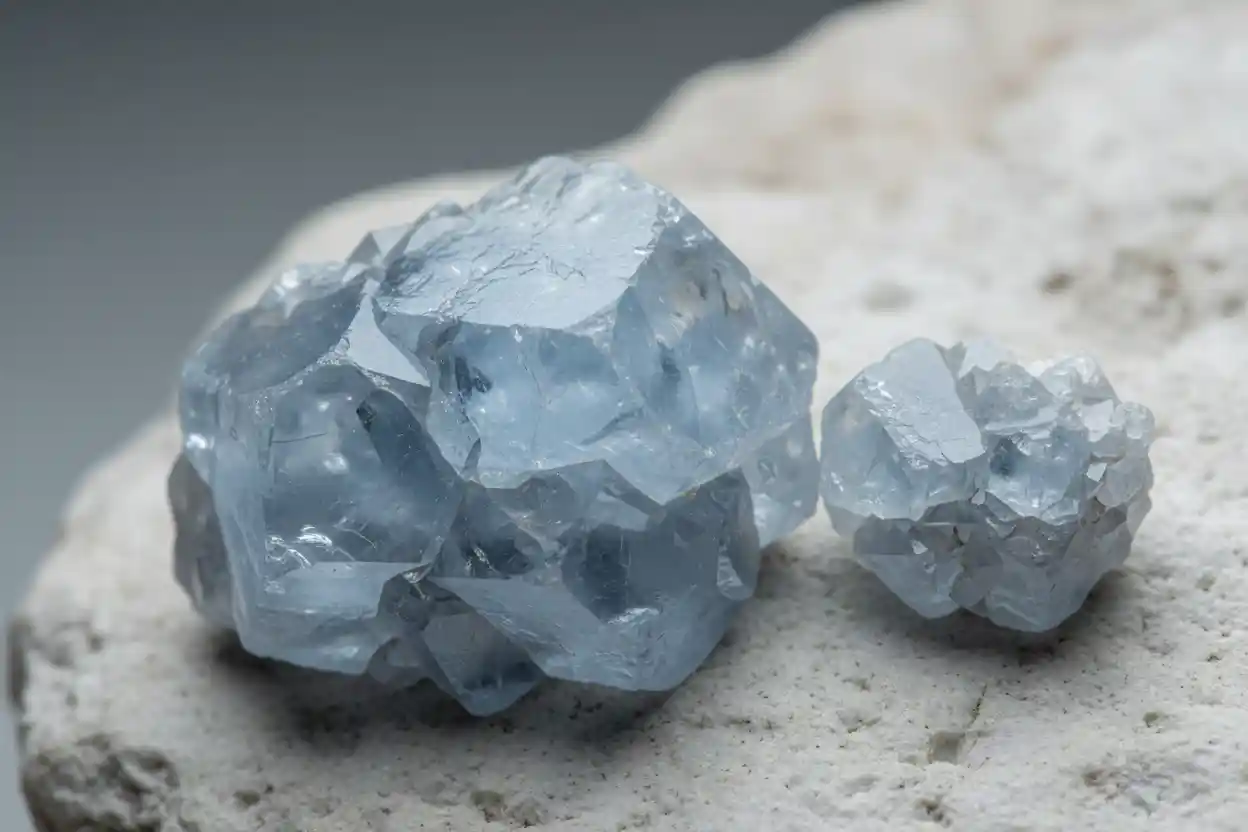
Celestite is the common crystal-market name for celestine, a valid mineral species composed of strontium sulfate, SrSO₄. It crystallizes in the orthorhombic system and belongs to the baryte group, alongside structurally related sulfate minerals. The mineral is often found as tabular, prismatic, blocky, fibrous, granular, or massive material, while collector specimens can develop beautifully transparent crystals with sharply defined faces.
Colorless and white celestite exist, but the pale sky-blue variety is the form most familiar in the crystal trade. Pink, pale green, brownish, grayish, and other faint colors can also occur. Its luster is usually vitreous, becoming pearly on some cleavage surfaces. The blue appearance has strongly influenced modern symbolic associations involving peace, communication, spaciousness, and contemplation, which are explored further through celestite color meaning. Color is a physical property of the specimen, while the meanings attached to it are interpretive.
Celestite is much softer than quartz. Its Mohs hardness is approximately 3 to 3.5, and it is brittle. It has perfect cleavage in one direction, good cleavage in another, and poorer cleavage along an additional plane. Those features make attractive crystals more vulnerable than their solid appearance suggests. A specimen may scratch, chip, or split if it is knocked against a hard surface or handled carelessly.
The most important lookalike is baryte because both minerals belong to the same structural group and can form similar tabular crystals. Baryte contains barium sulfate rather than strontium sulfate. Calcite can also resemble pale celestite in some specimens, although calcite differs chemically, crystallographically, and in its characteristic cleavage. Mineral identification should therefore rely on more than blue color alone.
Celestite is not a hydrated mineral. Water is not part of its ideal SrSO₄ formula. That fact is relevant to care, but it does not mean delicate crystal clusters benefit from prolonged soaking.
From Pennsylvania to Madagascar
Celestite has a well-documented mineralogical history. Material from Bell’s Mill near Bellwood in Blair County, Pennsylvania, was analyzed in the 1790s, and the locality is recognized as the mineral’s type locality. Abraham Gottlob Werner introduced the name in 1798, drawing on a word meaning celestial in reference to the faint blue color of the original material.
The current approved mineral name is celestine, although “celestite” remains extremely common in gemstone, collector, and crystal-healing contexts. Both names refer to the same strontium sulfate mineral rather than two different stones.
Celestite forms in several geological settings. It is particularly associated with sedimentary environments, evaporite sequences, limestone and dolostone cavities, and some hydrothermal or low-temperature mineral deposits. Crystals may line geodes and open cavities where mineral-bearing fluids deposited strontium sulfate over time.
Madagascar is especially famous for pale to medium-blue celestite geodes. At the Sakoany deposit, celestite occurs in a layer between limestone and sandy sedimentary rocks, with both geodes and well-developed crystal clusters documented from the locality. Other important occurrences are known from the United States, Italy, Spain, Mexico, Egypt, and numerous additional regions. The places where celestite is found reflect the mineral’s dependence on suitable strontium-rich geological conditions rather than one single type of deposit.
Calm, Emotional Balance, and Comfort
1. Calm and Relaxation
Celestite is widely presented as a calming crystal, with its pale blue color reinforcing associations with quiet, open skies and stillness. A practical way to use that symbolism is to place the stone somewhere associated with a short relaxation routine. Seeing it might become the cue to put down a device, release shoulder tension, slow breathing, or sit quietly for several minutes.
There is no established mechanism by which strontium sulfate directly lowers stress or changes nervous-system activity through proximity. The ritual actually provides the pause. A familiar object can make that pause easier to remember because the person has deliberately assigned it that role.
2. Emotional Balance
Emotional-balance claims usually describe celestite as helping people respond less reactively when feelings become intense. The idea becomes more concrete when the stone is paired with journaling or reflection. A person can name the emotion, identify what triggered it, separate facts from assumptions, and decide whether an immediate response is useful.
Celestite does not regulate mood. The celestite benefits described in contemporary crystal practice are more realistically treated as prompts for deliberate habits than as biochemical effects of the mineral.
3. Comfort During Grief or Transition
Celestite is also used symbolically during grief, endings, relocation, relationship changes, or other periods when familiar routines have been disrupted. A specimen placed beside a photograph, journal, or meaningful object can become part of a personal remembrance or transition ritual.
The stone cannot remove grief or accelerate a healthy grieving process. Its role is symbolic. Meaning can come from the memory, reflection, or quiet time associated with the object rather than from a therapeutic force produced by the crystal.
Sleep, Clarity, and Communication
4. Support for a Restful Bedtime Routine
Celestite’s calming reputation has led to frequent claims about sleep. Instead of treating the stone as a sedative, it can be used as a visible cue for beginning a consistent nighttime routine. Placing it away from the edge of a bedside table might signal that it is time to dim lights, stop work, put away the phone, write down unfinished thoughts, or begin quiet reading.
The mineral does not induce sleep or treat insomnia. The routine built around it may be useful because predictable evening habits help create a clear transition from daytime activity to rest.
5. Mental Clarity
Celestite is sometimes described as clearing confusion or helping the mind feel more spacious. A practical interpretation is to use the specimen while organizing a complicated problem. Write down what is known, what remains uncertain, what requires outside information, and what can be decided immediately.
This is best treated as a metaphor rather than a mechanism. Celestite does not clear neural pathways or directly improve cognitive processing. The structure imposed on the problem is what makes thinking more manageable.
6. Communication
Blue minerals are frequently connected with communication in modern crystal traditions, and celestite is no exception. Before an important conversation, someone can use the stone as a reminder to decide what actually needs to be said, what question needs an answer, and what tone will make the exchange more constructive.
There is no evidence that celestite changes speech function or influences another person’s reaction. Communication improves through preparation, listening, clarity, and restraint. The stone can represent those intentions without causing them.
Confidence, Creativity, and Meditation
7. Confidence in Self-Expression
Communication and confidence are related but not identical. Someone may know exactly what they want to say yet still hesitate to express it. Celestite is sometimes used as a symbol for overcoming that hesitation, particularly in meetings, presentations, creative critiques, or personal conversations.
The stone doesn’t produce confidence. Preparation, repeated experience, skill development, and taking action despite uncertainty do. Short celestite affirmations can complement the ritual when they focus on realistic behavior such as speaking slowly, asking directly, or stating a boundary respectfully.
8. Creativity and Inspiration
Celestite’s transparent blue crystals can be visually striking, so some people use it as a creative object or brainstorming cue. A writer, designer, artist, or musician might place it near a workspace and begin a brief period of idea generation whenever the stone is brought out.
There is no demonstrated pathway through which celestite generates artistic ideas. What the routine can do is reduce the delay between intending to create and actually beginning. The stone becomes a starting signal rather than the source of creativity.
9. Meditation and Sustained Attention
Celestite is well suited to visual meditation because a crystal cluster offers many surfaces, reflections, and subtle color variations to observe. A practitioner can keep the specimen safely positioned nearby, focus on its appearance for a short period, and return attention to breathing whenever the mind wanders.
The stone does not force the brain into a special meditative state. Meditation is the activity. A consistent focal object may simply make it easier to establish the ritual and return attention to the same point.
The ways to use celestite should also account for its fragility. A stable display position is often more appropriate than frequent handling of delicate crystals.
Intuition, Boundaries, and Spiritual Practice
10. Intuition and Decision Reflection
Celestite is sometimes described as encouraging intuition or helping a person recognize an inner answer. A more grounded approach is to treat an intuitive reaction as one piece of information rather than unquestionable guidance. Write down the immediate feeling, then compare it with evidence, previous experience, risks, and practical consequences.
Celestite does not reveal hidden facts or predict outcomes. An intuition ritual can still be valuable when it encourages someone to examine why a choice feels right or wrong before making a commitment.
11. Symbolic Protection and Personal Boundaries
Some crystal traditions describe celestite as spiritually protective or capable of creating a peaceful energetic environment. There is no verified mechanism by which the mineral forms an invisible barrier or prevents another person from causing harm or distress.
A practical version of protection is boundary-setting. The stone can represent a decision to stop answering messages after a certain hour, leave a hostile discussion, decline an unreasonable request, or protect uninterrupted time for rest. The boundary works because the person states and maintains it.
12. Chakra and Spiritual Reflection
Modern crystal practice commonly links blue celestite with the throat chakra through themes of communication and expression. It is also frequently connected with the third-eye and crown chakras through ideas of contemplation, intuition, prayer, and spiritual awareness. Individual systems differ in the exact correspondence.
Chakras are a spiritual framework, not anatomical structures demonstrated by modern medicine. A celestite chakra practice therefore belongs to meditation, spirituality, and personal symbolism rather than treatment of the brain, throat, nervous system, or endocrine organs.
The celestite spiritual meaning often centers on peace, reflection, openness, and a sense of connection to something larger than immediate daily concerns. Those ideas can have personal significance without requiring strontium sulfate to produce a supernatural force.
Safe Care for Soft Celestite Crystals
Celestite needs careful handling because its Mohs hardness is only about 3 to 3.5 and its crystals have pronounced cleavage. It can be scratched by quartz, agate, feldspar, and many common gemstones, while a hard impact can chip or split a crystal along cleavage planes. Delicate geodes and clusters are best lifted from a sturdy matrix or base rather than by gripping projecting crystals.
Store celestite separately from harder stones and away from shelf edges. A stable display surface is usually better than keeping a crystal cluster loose in a container with other minerals. Fine points and cleavage edges can be damaged simply by specimens knocking together.
Cleaning should be gentle. Avoid ultrasonic cleaners, steam, abrasive powders, stiff brushes, strong acids, harsh household chemicals, and sudden temperature changes. Loose dust can often be removed with a gentle air blower or a very soft clean brush used with minimal pressure.
Celestite is not a hydrated mineral, but prolonged soaking is still unnecessary. Its softness, brittleness, cleavage, possible fractures, matrix minerals, and specimen treatments all make repeated immersion a poor default care method. Brief contact with clean water is different from leaving a cluster submerged for hours, but many collector specimens can be maintained without soaking at all.
Do not prepare drinking water or crystal elixirs by soaking natural celestite specimens. Mineral specimens are not manufactured as food-contact products, and their impurities, associated minerals, coatings, and contaminants are not controlled for ingestion. The detailed answer to whether celestite is safe in water should therefore distinguish ordinary gem care from intentional soaking or consumption.
Cleansing Celestite Without Soaking
Ritual cleansing does not require physical washing. Celestite’s softness and cleavage make dry symbolic approaches particularly sensible. Sound, quiet reflection, intention-setting, or leaving the specimen in a stable dedicated location can all serve as personal cleansing practices without repeatedly handling fragile crystals.
A bell, singing bowl, short meditation, spoken intention, or simple pause to reconsider why the stone is being used can mark the end of one practice and the beginning of another. These actions do not remove a scientifically established harmful energy from celestite. Their meaning comes from the ritual itself.
The gentlest ways to cleanse celestite avoid salt burial, abrasive contact, prolonged soaking, steam, and strong heat. A symbolic practice should preserve the crystal rather than create preventable damage.
Conclusion
Celestite is a soft orthorhombic strontium sulfate mineral whose real character comes from its chemistry, cleavage, pale colors, and distinctive geological formation. Its twelve popular healing themes can support personally meaningful routines around calm, communication, creativity, reflection, boundaries, and meditation, but those themes remain traditional or personal interpretations rather than proven therapeutic effects. Used carefully, the stone can serve as a quiet visual reminder while the meaningful change comes from the actions chosen around it.
Frequently Asked Questions
What are the main celestite healing properties?
Popular claims include calm, emotional balance, grief support, restful routines, mental clarity, communication, confidence, creativity, meditation, intuition, personal boundaries, and spiritual reflection. These are traditional or personal beliefs rather than established medical effects.
Are celestite and celestine the same mineral?
Yes. Celestine is the current mineralogical name for SrSO₄, while celestite remains a widely used alternative name in gemstone and crystal-healing contexts.
What is celestite made of?
Celestite is strontium sulfate with the chemical formula SrSO₄. It belongs to the baryte group and crystallizes in the orthorhombic system.
How hard is celestite?
Celestite has a Mohs hardness of approximately 3 to 3.5. It is brittle and has strong cleavage, so crystal clusters should be protected from scratches and impacts.
Can celestite reduce anxiety or stress?
Celestite has not been shown to directly treat anxiety or produce a mineral-specific calming effect. It can be used as a reminder to begin breathing, journaling, meditation, or another deliberate calming routine.
Can celestite help with sleep?
The stone does not act as a sedative or treat sleep disorders. Some people use it as part of a consistent bedtime ritual that includes reducing stimulation and creating a quieter evening routine.
What chakra is celestite associated with?
Modern crystal practice commonly associates blue celestite with the throat chakra and may also connect it with the third-eye or crown chakra. These associations belong to spiritual frameworks rather than anatomy.
Is celestite suitable for jewelry?
It can be used in carefully protected jewelry, but its low hardness, brittleness, and cleavage make it much less durable than quartz or corundum. Pendants and occasional-wear pieces are generally less exposed than rings.
Can celestite go in water?
Brief contact with clean water is different from prolonged soaking, but routine immersion is unnecessary for a soft, cleavable crystal. Delicate clusters, specimens on matrix, repaired pieces, and unknown treatments are better kept as dry as practical.
How should celestite be cleansed?
For ritual cleansing, sound, meditation, intention-setting, or dry placement are gentle choices. Physical dirt should be handled separately with careful methods that protect the mineral’s soft surfaces and fragile cleavage.
Crystal healing claims are traditional or personal beliefs and should not replace qualified medical or mental health care.