9 Hidden Celestite Benefits: Gentle Uses, Hidden Facts & Responsible Use
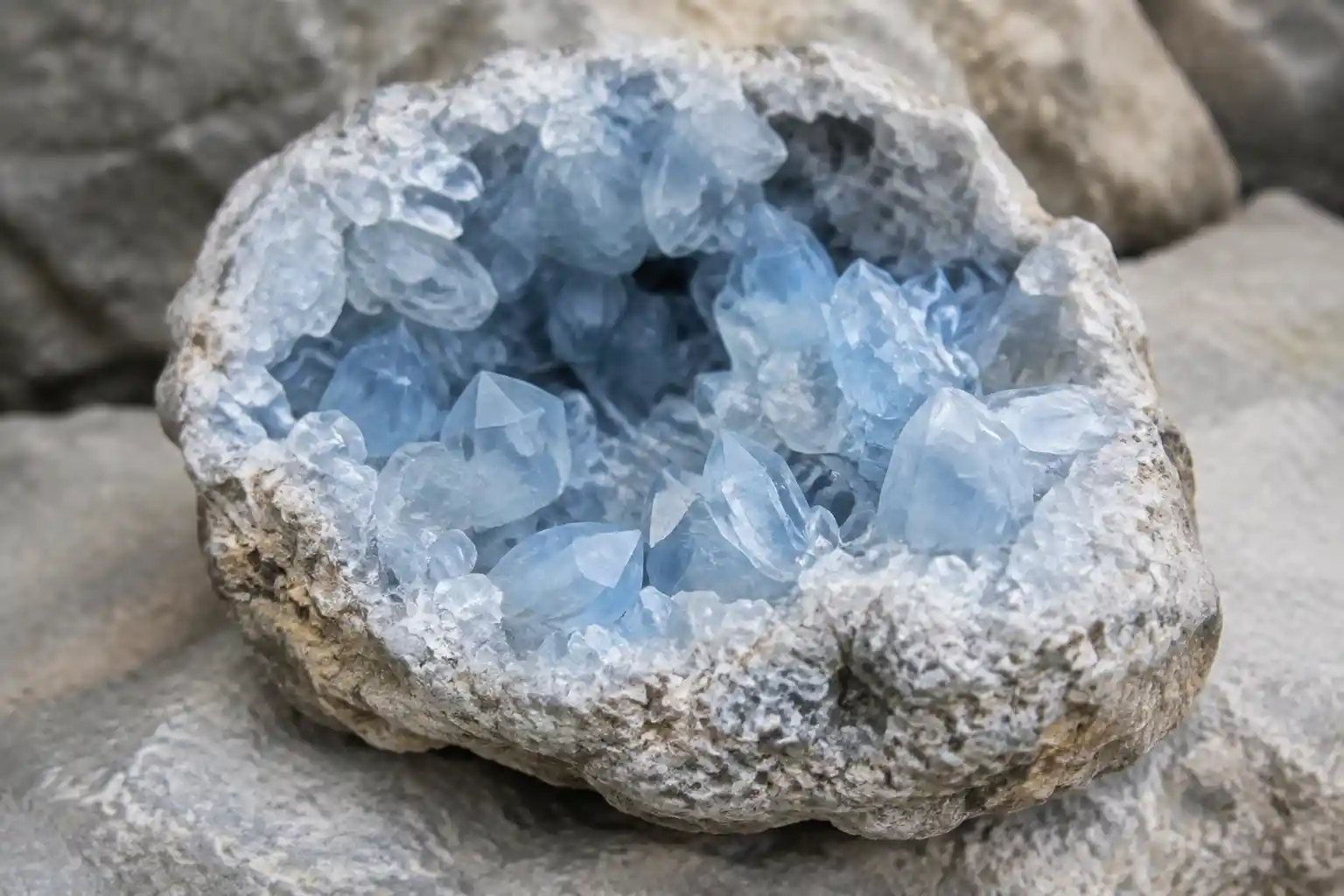
Celestite benefits begin with mineral collecting, geological education, crystal form, and delicate blue beauty. Celestite, also called celestine, is strontium sulfate, SrSO₄, and commonly forms colorless, white, pale blue, gray, yellowish, or reddish crystals. The soft sky-blue specimens that dominate the collector market are especially recognizable when transparent to translucent crystals line cavities or geodes.
Unlike quartz or chalcedony, celestite is relatively soft and has pronounced cleavage, so its strongest uses are generally display, study, and collecting rather than hard everyday jewelry. Fine specimens can show sharp tabular or prismatic crystals, glassy luster, attractive transparency, and dramatic contrast between pale blue crystal interiors and the darker outer rock of a geode. These qualities create real celestite benefits without requiring any healing claim.
Modern spiritual traditions often associate celestite benefits with calmness, meditation, peaceful communication, sleep, spiritual awareness, or angelic symbolism. Those ideas may have personal or religious meaning, but they are not medically established effects of strontium sulfate. Celestite does not treat anxiety disorders, insomnia, neurological conditions, throat disease, inflammation, or other health problems through ordinary handling.
9 Celestite Benefits at a Glance
- Pale blue crystals make celestite an attractive mineral for natural display specimens.
- Strontium sulfate chemistry gives the species genuine scientific and educational interest.
- Crystal habits provide useful examples for learning mineral form, luster, cleavage, and symmetry.
- Geodes and cavity specimens reveal how crystals grow into open spaces within rock.
- Collectors can study locality, color variation, matrix, transparency, and crystal quality.
- Celestite provides an identification exercise that goes beyond simply recognizing blue color.
- Mineral displays benefit from its combination of delicate color, transparency, and natural crystal form.
- Modern symbolism can represent peaceful attention or reflection without making medical claims.
- Careful handling teaches why softness, cleavage, crystal fragility, and specimen preservation matter.
Pale Blue Crystal Form Is the Most Visible Celestite Benefit
The soft blue color of many celestite specimens is the reason most collectors recognize the mineral immediately. Good crystals can range from almost colorless with a faint blue tint to a clearer sky-blue, sometimes becoming darker where crystals are thicker.
Color alone, however, is not what makes a specimen attractive. Crystal shape, transparency, luster, arrangement, matrix balance, damage, and overall composition can matter just as much. A smaller specimen with sharp intact crystals may be more aesthetically successful than a large geode containing heavily damaged points.
Natural celestite can also occur in colors other than blue. Colorless, white, gray, yellowish, and reddish examples remind collectors that a mineral species is defined by chemistry and crystal structure rather than one familiar commercial color.
This is one of the most useful celestite benefits for beginners. A popular appearance can introduce the mineral, but identification eventually requires understanding what exists beneath the color.
Strontium Sulfate Gives Celestite Genuine Mineralogical Importance
Celestite has the chemical composition SrSO₄ and represents an important natural source of strontium. It belongs to the sulfate mineral family and is structurally related to barite, BaSO₄, with chemical similarities that help students understand mineral groups and elemental substitution.
This chemistry creates substantial celestite benefits for mineral education. A specimen can introduce sulfate minerals, strontium geochemistry, crystal structure, industrial mineral resources, and the difference between a decorative crystal and the element contained within it.
The strontium inside celestite should not be interpreted as a health ingredient available through skin contact. A crystal’s chemical formula describes its mineral structure, not a nutritional or therapeutic delivery system.
That distinction is particularly important because scientific terminology can sound medical when removed from context. Celestite is interesting because it is strontium sulfate. That fact does not mean wearing or holding it produces a biological strontium effect.
Understanding the chemistry gives the mineral more value, not less, because it connects an attractive specimen with genuine Earth science.
Celestite Geodes Show How Crystals Grow into Open Cavities
One of the most appealing celestite benefits is the ability to observe natural crystal growth within cavities. Geodes and cavity specimens preserve spaces where mineral-rich fluids deposited crystals along interior walls, allowing individual points to project inward as they developed.
These specimens are effectively natural cross-sections of mineral growth. The exterior may look rough and ordinary, while the interior contains a field of pale blue crystals.
Crystal size, spacing, orientation, and clarity depend on the conditions present while growth occurred. Some cavities contain many small points packed closely together, while others allow fewer crystals to grow larger.
This contrast between exterior rock and internal crystal formation gives celestite substantial educational value. A specimen can introduce cavity formation, fluid movement, precipitation, nucleation, and crystal growth without requiring complicated laboratory equipment.
Large geodes also make impressive displays because their geological structure remains obvious rather than being reduced to a single loose crystal.
Collecting Celestite Rewards Crystal Quality and Reliable Locality
Collectors can approach celestite through crystal form, color, locality, matrix, fluorescence in certain specimens, associated minerals, or geode structure. Famous occurrences have produced everything from pale blue geodes to transparent individual crystals and massive forms.
Locality documentation adds scientific interest because celestite forms in several geological environments, including sedimentary deposits, evaporite-related settings, cavities, and hydrothermal occurrences. Knowing where a specimen originated helps connect its appearance with geological context.
This makes provenance one of the practical celestite benefits for serious collectors. A specimen with reliable old labels or precise locality information may retain educational importance even if another piece has slightly stronger color.
Condition also deserves attention. Because celestite is soft and has good cleavage, crystal points can chip during mining, transport, cleaning, or display. Repairs and glued crystals should be disclosed when present.
Someone deciding where to buy celestite should therefore examine crystal damage, repair history, dimensions, locality, photographs, matrix stability, and seller disclosure instead of choosing solely by blue saturation.
Celestite Is Better Suited to Display Than Everyday Jewelry
Durability is an important limit on celestite benefits. The mineral has a relatively low Mohs hardness, around 3 to 3.5, and has pronounced cleavage. That combination leaves polished or faceted pieces much more vulnerable to scratches and breakage than quartz, spinel, sapphire, or many conventional jewelry gems.
Celestite can occasionally be faceted for collectors, particularly when transparent rough is available, but such stones are best treated as collector gems rather than durable everyday jewelry.
Natural crystal specimens are even more vulnerable because projecting points can chip easily. Repeated handling should therefore be minimized, particularly with fine geodes or sprays.
This does not reduce celestite’s value. It simply means the mineral is best appreciated in a role suited to its physical properties.
One of the most responsible celestite benefits is learning that rarity or beauty does not automatically make a mineral appropriate for constant wear. Preserving a delicate specimen can be more valuable than forcing it into jewelry.
Celestite Helps Develop Better Mineral Identification Skills
A pale blue crystal is not necessarily celestite. Calcite, barite, fluorite, gypsum, blue aragonite, and other minerals can overlap in color, particularly in photographs.
Identification requires attention to hardness, cleavage, density, crystal habit, luster, optical behavior, associated minerals, locality, and professional testing when necessary.
Celestite has a higher density than many people expect from its delicate appearance because strontium is relatively heavy. This can provide an additional clue when compared with lighter blue minerals of similar size.
Crystal habit can also help, although natural specimens are varied enough that no single shape should be treated as absolute proof.
These characteristics make mineral identification one of the most useful celestite benefits. Collectors learn quickly that color is an introduction, not a conclusion.
That lesson improves judgment across the entire mineral market.
Display Value Comes from Natural Structure Rather Than Polishing Alone
Many gemstones depend heavily on cutting to reveal their beauty. Celestite often needs very little alteration because natural crystal groups can already be visually striking.
A geode lined with pale blue crystals preserves geological context, crystal habit, matrix, and three-dimensional structure simultaneously. Polishing those crystals away would remove much of what collectors value.
This creates distinctive celestite benefits for mineral displays. Large specimens can serve as focal pieces, while smaller clusters fit easily into cabinets or educational collections.
Lighting should be chosen carefully. Soft directional illumination can reveal transparency and crystal faces without washing out the pale blue color. Excessive handling or frequent repositioning should be avoided because crystal points may be fragile.
Stable stands and shelves are more important than elaborate cleaning. A specimen that remains physically intact will generally retain more value and scientific interest than one repeatedly handled for presentation.
Modern Celestite Symbolism Commonly Emphasizes Calmness and Reflection
Contemporary crystal culture frequently associates celestite benefits with peace, meditation, gentle communication, sleep, spiritual awareness, and angelic imagery. Pale blue color and delicate transparent crystals make those themes visually understandable.
Someone may place a celestite specimen in a quiet room because they enjoy its appearance and associate the color with relaxation. Another person may use it during journaling or meditation as a symbol of slowing down.
These experiences do not demonstrate that strontium sulfate changes the nervous system or produces sleep biologically.
Beliefs involving celestite healing properties may discuss anxiety relief, throat health, sleep, headaches, emotional healing, or energetic effects. Those ideas belong to spiritual practice rather than established clinical evidence.
Celestite benefits remain meaningful when calmness describes symbolism, atmosphere, or personal routine rather than a medical promise.
Gentle Cleaning and Stable Display Are Essential
Celestite’s softness means aggressive cleaning can do more harm than good. Fine crystals should not be scrubbed forcefully, and abrasive brushes can scratch or chip delicate surfaces.
Water exposure should be approached cautiously, particularly with matrix specimens whose associated minerals or structural stability may be uncertain. Harsh chemicals, ultrasonic cleaners, steam, acids, and household cleaning products are poor default choices.
Dust can often be reduced with a gentle air blower or extremely soft dry brush if the crystals are stable. Supporting the specimen by its matrix rather than touching the crystal points also lowers the risk of accidental breakage.
Direct impact is the biggest practical danger. Large geodes should sit on stable shelves, and smaller specimens can benefit from boxes or display cases that reduce handling.
These simple precautions preserve the celestite benefits collectors value most: color, crystal form, geological context, and natural surface quality.
Responsible Use Means Respecting Chemistry Without Turning It into Medicine
Celestite contains strontium, but an intact mineral specimen is not a medical preparation. It should not be treated as a nutritional source, dissolved for consumption, or used to create ingestible crystal preparations.
The mineral’s composition also does not provide evidence for claims involving bones, nervous-system function, sleep, inflammation, anxiety, or cellular health through ordinary handling.
Modern spiritual practice may still give the stone symbolic significance. A familiar crystal can become associated with quiet time, reflection, or a personal ritual.
The distinction is simple: symbolism belongs to human interpretation, while health claims require clinical evidence.
Keeping those categories separate allows celestite benefits to remain grounded in what the mineral genuinely offers.
Conclusion
Celestite benefits include attractive pale blue crystals, strontium sulfate mineralogy, geode formation, collecting value, identification practice, geological education, natural display appeal, and personal symbolism. Its delicate crystals make it particularly suited to specimen collecting rather than frequent jewelry wear.
Modern themes of calmness, meditation, peaceful communication, or spiritual reflection can remain personally meaningful when they are treated as symbolism rather than medicine. The strongest celestite benefits come from understanding its chemistry, crystal growth, softness, cleavage, locality, and preservation needs.
FAQs
What are the main celestite benefits?
The most verifiable celestite benefits include mineral collecting, geological education, crystal-form study, strontium mineralogy, geode appreciation, identification practice, display value, and personal symbolism.
What is celestite made of?
Celestite, also called celestine, is strontium sulfate with the chemical formula SrSO₄.
Why is celestite blue?
Many celestite specimens naturally show pale blue coloration, although the mineral can also be colorless, white, gray, yellowish, or reddish. Color alone should not be used for identification.
Is celestite rare?
Celestite is less common than major minerals such as quartz or calcite, although it occurs in multiple regions and geological environments. Fine blue crystal specimens can be particularly collectible.
Is celestite suitable for jewelry?
It is generally better suited to collecting because its low hardness and cleavage make it vulnerable to scratching, chipping, and breakage.
Are celestite geodes natural?
Yes. Natural cavities can become lined with celestite crystals when mineral-bearing fluids deposit strontium sulfate under suitable geological conditions.
What does celestite symbolize?
Modern symbolism commonly connects celestite with calmness, meditation, peaceful communication, spiritual awareness, and reflection.
Does celestite help with sleep or anxiety?
There is no established clinical evidence that celestite treats insomnia, anxiety disorders, neurological conditions, or other medical concerns.
How should celestite be cleaned?
Minimal gentle cleaning is best. Avoid aggressive brushing, harsh chemicals, ultrasonic cleaning, steam, and unnecessary handling of delicate crystal points.
Celestite benefits described as healing, emotional, angelic, chakra, sleep-related, or energetic effects remain spiritual and personal beliefs and should not replace qualified medical or mental-health care.