Celestite Meaning: Mineral Facts, History & Symbolism
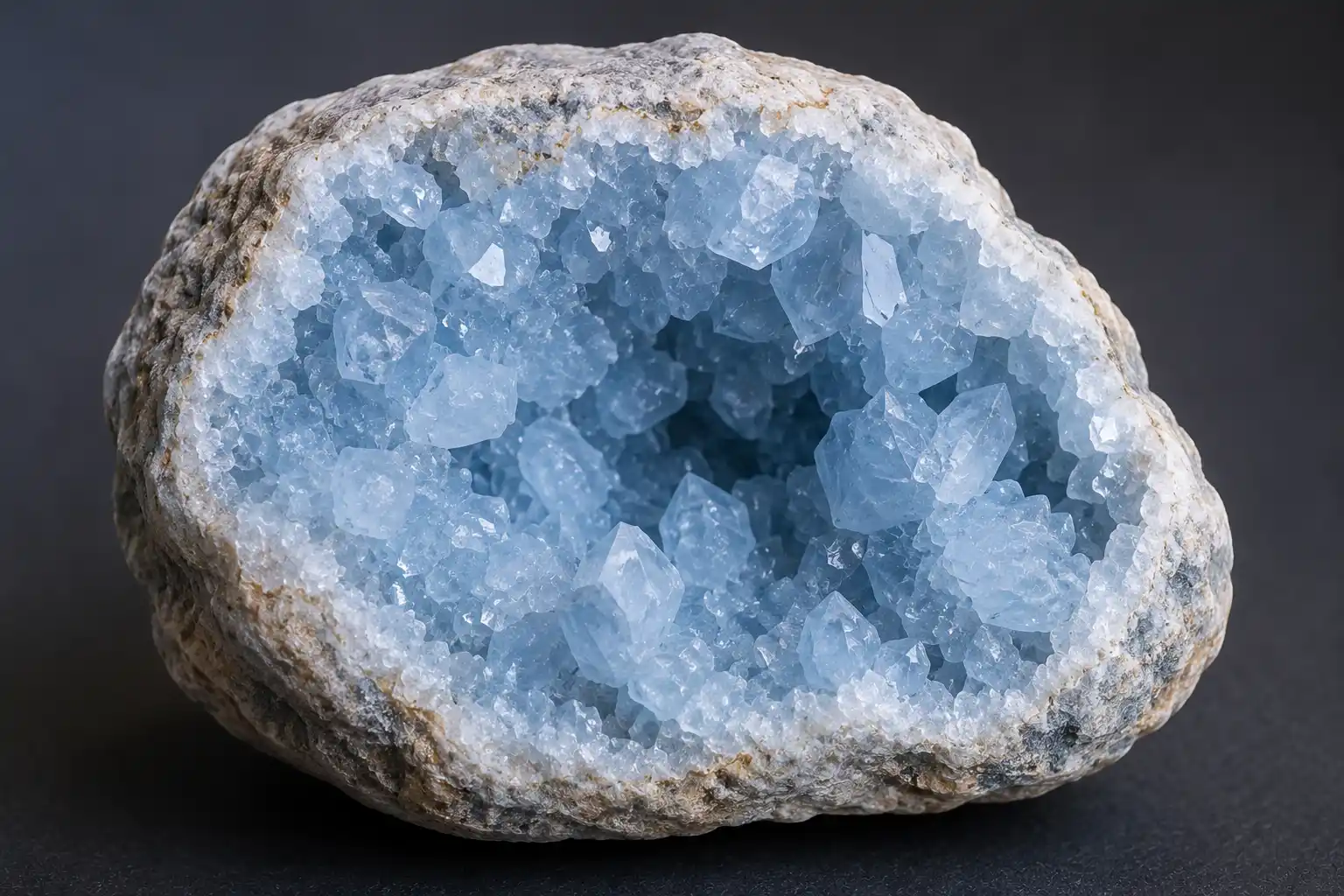
Celestite meaning is commonly associated in modern crystal practice with calm reflection, communication, perspective, peace, spiritual contemplation, and creating mental space before responding. Those themes belong to symbolism rather than to measurable effects produced by the mineral. Materially, celestite—more formally called celestine in many mineralogical references—is strontium sulfate, SrSO₄, an orthorhombic sulfate mineral in the baryte group. It is naturally colorless in pure form but is especially familiar to collectors as pale sky-blue crystals, often arranged in tabular or prismatic groups inside cavities and geodes.
The material’s physical properties are distinctive. Celestine has Mohs hardness about 3–3.5, measured specific gravity around 3.96–3.98, brittle tenacity, perfect basal cleavage, additional good and poor cleavage directions, and vitreous-to-pearly luster. Its density is unusually high for a pale transparent-to-translucent mineral, reflecting the presence of strontium in the crystal structure. It is also biaxial positive, with refractive indices in approximately the 1.619–1.632 range.
These properties make celestite scientifically more interesting than the simplified description “blue calming crystal” suggests. Its blue color involves radiation-related defects in the sulfate lattice rather than a straightforward blue pigment, its crystal structure places it close to baryte, and its geological occurrence connects sedimentary evaporites, carbonate rocks, groundwater, hydrothermal fluids, geodes, and secondary mineralization.
For other crystal references that separate measurable material facts from symbolic interpretation, browse the Healing Crystal section.
What Is Celestite?
Celestite is a strontium sulfate mineral with the ideal chemical formula:
SrSO₄
The mineral is commonly called celestine in formal mineralogical databases, while celestite remains a widely recognized synonym in gem, crystal, and collector usage. The two names do not describe different minerals.
Celestine belongs to the baryte group and forms a compositional relationship with baryte, BaSO₄. In simplified terms, strontium dominates the large-cation site in celestine, while barium dominates it in baryte. Some natural specimens can contain partial substitution between these elements, creating intermediate compositions rather than perfectly pure end members.
| Property | Typical celestite characteristics |
|---|---|
| Mineralogical name | Celestine |
| Common synonym | Celestite |
| Chemical formula | SrSO₄ |
| Mineral class | Sulfate |
| Mineral group | Baryte group |
| Crystal system | Orthorhombic |
| Typical colors | Colorless, pale blue, white, gray; also reddish, greenish, brownish and other pale tints |
| Transparency | Transparent to translucent |
| Mohs hardness | About 3–3.5 |
| Specific gravity | About 3.96–3.98 |
| Cleavage | Perfect basal cleavage; additional good and poorer directions |
| Fracture | Uneven |
| Tenacity | Brittle |
| Luster | Vitreous, pearly on cleavage surfaces |
| Streak | White |
| Optical character | Biaxial positive |
| RI range | Approximately 1.619–1.632 |
| Birefringence | Approximately 0.010–0.011 |
| Common habit | Tabular, prismatic, fibrous, granular, nodular or cavity-filling aggregates |
| Separate mineral species? | Yes |
The combination of relatively low hardness and relatively high density is especially useful diagnostically. A celestite crystal can feel surprisingly heavy for its size while remaining easy to scratch compared with quartz.
Celestite or Celestine: Which Name Is Correct?
Both names refer to the same mineral.
Celestine is the formal species name used by major mineralogical references, while celestite remains an established synonym and is especially common in commercial crystal terminology.
That distinction is nomenclatural rather than physical.
A specimen does not become chemically different because one seller calls it celestite and another mineralogist calls it celestine.
For clarity, this page uses celestite because that is the familiar search and trade term, while recognizing celestine as the formal mineral name.
Why Is Celestite Blue?
Pure SrSO₄ is colorless, so the famous blue color requires an explanation beyond the basic chemical formula.
Research on blue celestine indicates that the color is associated with radiation-induced defect centers in the sulfate crystal lattice. Ionizing radiation can generate sulfur-oxygen radical centers such as SO₃⁻, SO₂⁻, and O⁻ that absorb portions of visible light and contribute to the pale blue appearance. Trace components, particularly small amounts of potassium substituting into the structure, can help stabilize these color-producing centers.
This is more precise than saying that one blue trace element simply “colors the stone.”
The blue is therefore related to crystal defects, irradiation history, trace chemistry, and the way the lattice absorbs visible wavelengths.
That also helps explain why the color can be sensitive to environmental conditions.
Not Every Celestite Crystal Is Blue
Celestite can be colorless, white, gray, blue, reddish, greenish, brownish, or lightly tinted in other ways. Thin material can be nearly colorless even when a thicker portion of the same crystal appears blue.
The familiar sky-blue appearance is commercially important, but it is not a requirement for species identity.
A colorless SrSO₄ crystal can still be celestite.
A pale blue mineral is not automatically celestite.
Color must be interpreted together with crystal structure, cleavage, hardness, density, optical properties, and geological context.
Why Some Blue Celestite Can Fade
The defect-related blue color is not equally stable in every specimen.
Experimental mineralogical work has shown that heating can bleach blue celestine and that irradiation can restore or produce blue coloration under suitable conditions. Light exposure can also cause fading in some material. The exact stability depends on the nature of the crystal and its trace chemistry.
For collectors, the practical implication is conservative rather than alarming:
Do not display a valuable blue specimen indefinitely in strong direct sunlight or unnecessarily intense lighting.
This is a preservation issue.
Color fading does not indicate that the crystal is “using up energy,” releasing metaphysical power, or absorbing emotional negativity.
How Celestite Forms
Celestite occurs in several geological settings, but sedimentary and diagenetic environments are particularly important. It can form in evaporite sequences with gypsum and halite, in limestone and dolomite, as concretions and nodules, in fissures and cavities, and from strontium-bearing groundwater or basinal brines. It also occurs in hydrothermal veins and some volcanic-rock cavities.
The basic geological requirement is a source of strontium and sulfate under conditions where SrSO₄ becomes sufficiently supersaturated to crystallize.
That can happen when:
strontium-bearing fluids encounter sulfate-rich water;
evaporitic systems concentrate dissolved ions;
groundwater moves through carbonate rock;
earlier minerals dissolve or react;
basinal brines migrate through fractures;
or later fluids precipitate celestite inside open cavities.
The full deposit-scale treatment of fluid chemistry, evaporites, carbonate replacement, cavities, brines, and associated minerals is covered in celestite formation and deposit geology.
Celestite in Evaporite Deposits
Evaporite environments develop when water evaporates faster than dissolved salts can be removed from a basin.
As dissolved ions become concentrated, minerals such as gypsum, anhydrite, and halite can precipitate. Strontium can participate in the evolving chemistry and may later form celestite.
Celestite is consequently documented in sedimentary sequences containing gypsum, anhydrite, carbonate rocks, and related evaporitic material.
Some deposits involve primary precipitation.
Others involve later diagenetic replacement or fluid-driven redistribution.
A celestite layer therefore does not necessarily record one simple episode of crystal growth.
Celestite in Limestone and Dolomite
Carbonate rocks can host attractive celestite in cavities, fractures, concretions, or replacement zones.
Migrating groundwater or basinal brines can transport dissolved strontium and sulfate through porous or fractured limestone and dolomite. When local chemical conditions change, celestite can precipitate.
Common associated minerals in such environments include:
calcite;
dolomite;
gypsum;
anhydrite;
strontianite;
fluorite;
and other secondary minerals.
The association is geologically informative but not automatically diagnostic.
A blue crystal on calcite still needs to behave like celestite if the identification matters.
Why Celestite Forms Geodes
Some of the most recognizable celestite specimens consist of blue crystals lining hollow cavities.
A geode begins with an enclosed or partly enclosed cavity. Mineral-rich fluids enter the space, and crystals grow inward from the walls as dissolved material precipitates.
Because the cavity provides open space, crystal faces can develop much more freely than they can inside solid rock.
The result may be:
small drusy crystals;
broad tabular crystals;
thick prismatic crystals;
radiating groups;
or a combination of habits.
The hollow interior is therefore a growth environment.
It is not part of the chemical definition of celestite.
Why Celestite Feels Heavy
One of the more useful hand-specimen clues is its specific gravity near 4.
That is significantly denser than quartz, calcite, gypsum, and many common pale collector minerals.
The high density reflects strontium’s relatively high atomic mass.
A fist-sized celestite specimen can therefore feel unexpectedly heavy compared with a similarly sized quartz or gypsum crystal.
This sensation is only a clue.
Matrix material changes the apparent heft of a specimen, and baryte can be even denser.
For a clean loose crystal, a measured hydrostatic specific gravity is much more informative than subjective hand feel.
Celestite’s Perfect Cleavage
Celestite has perfect cleavage in one principal basal direction, good cleavage in another, and poorer cleavage in an additional direction.
That gives the mineral a tendency to split along structurally controlled planes.
Cleavage surfaces may appear smooth and somewhat pearly compared with ordinary broken surfaces.
This characteristic affects both identification and durability.
A crystal that looks thick and substantial can still split if struck along a vulnerable orientation.
Low hardness adds another limitation.
Celestite is therefore a collector mineral that deserves gentler handling than its dense feel might suggest.
Hardness: Why Celestite Scratches Easily
Celestite has Mohs hardness about 3–3.5.
It is much softer than quartz at Mohs 7 and significantly softer than feldspar, beryl, corundum, spinel, or most mainstream faceted jewelry stones.
That means:
dust containing harder mineral grains can scratch it;
metal tools may damage surfaces;
rough brushing can abrade crystal faces;
and loose storage with harder specimens can dull edges.
Hardness testing should not be performed casually on a good collector crystal.
The diagnostic value does not justify creating permanent damage when less destructive observations are available.
Celestite Versus Baryte
Baryte is one of the most important look-alikes because it belongs to the same structural group.
Baryte has the ideal formula:
BaSO₄
Celestite is:
SrSO₄
Both are orthorhombic sulfates, can form tabular crystals, possess similar cleavage geometry, and occur in pale colors.
Density is one of the more useful distinctions.
Baryte commonly has specific gravity around 4.5, while celestite is closer to 4.0. The difference is measurable and can sometimes be noticeable by hand when similar-sized clean crystals are compared.
Mixed or compositionally intermediate material can make the comparison less simple.
When exact identification matters, density, chemical analysis, Raman spectroscopy, or X-ray diffraction provide stronger evidence.
Celestite Versus Blue Calcite
Blue calcite can resemble pale blue celestite in photographs.
The physical differences are substantial.
Calcite is CaCO₃, has Mohs hardness 3, specific gravity near 2.71, perfect rhombohedral cleavage, and strong double refraction. Celestite is SrSO₄, has specific gravity near 4, orthorhombic crystallography, and different cleavage geometry.
A celestite specimen therefore feels dramatically heavier than an equivalent volume of calcite.
Crystal form and cleavage can also help.
Color by itself should not decide the comparison.
Celestite Versus Gypsum
Gypsum is another pale sulfate mineral and commonly occurs in the same broad evaporitic geological systems.
Its formula is:
CaSO₄·2H₂O
Gypsum is much softer, around Mohs 2, and much less dense than celestite.
Large transparent gypsum crystals can therefore look superficially similar to colorless celestite but behave very differently during physical testing.
Their chemistry also differs: gypsum incorporates structural water and calcium, whereas celestite is an anhydrous strontium sulfate.
Association does not imply identity.
Celestite Versus Strontianite
Strontianite is strontium carbonate:
SrCO₃
Celestite is strontium sulfate:
SrSO₄
The shared strontium makes the two minerals chemically related in a broad elemental sense, and both can occur in strontium-rich sedimentary systems.
Their carbonate-versus-sulfate chemistry creates different reaction behavior and crystallography.
A chemical analysis detecting strontium alone would therefore not be enough to establish celestite.
The anion matters.
Celestite Versus Chrysocolla
The neighboring chrysocolla meaning reference concerns a blue-to-green copper-bearing material whose mineralogical classification, hardness, density, texture, and formation differ sharply from celestite.
Both can photograph as attractive pale blue material.
Chrysocolla is commonly massive, botryoidal, crusty, or mixed with other copper minerals and silica. Celestite is a crystalline strontium sulfate that frequently produces transparent-to-translucent orthorhombic crystals.
The comparison reinforces a basic identification rule:
Blue is a color category, not a mineral species.
Celestite Versus Carnelian
The preceding carnelian meaning reference provides an even stronger contrast.
Carnelian is iron-colored chalcedony composed primarily of SiO₂, with hardness around the quartz-family range and no easy cleavage.
Celestite is SrSO₄, substantially softer, denser, and strongly cleavable.
The two stones differ in nearly every major diagnostic property despite both appearing widely in symbolic crystal collections.
This illustrates why metaphysical categories are not mineralogical categories.
Original Celestite Specimen and Photo Checklist
The following checklist provides a structured first-pass evaluation of a purported celestite specimen. It does not replace laboratory identification when the species, locality, or treatment claim materially affects value.
Check crystal habit
Look for tabular, bladed, prismatic, or thick plate-like crystals consistent with orthorhombic celestine.
Massive, fibrous, granular, and nodular forms can also occur, so one ideal habit should not be required.
Examine color under neutral light
Record whether the specimen is colorless, pale blue, gray-blue, white, greenish, reddish, or brownish without dramatic photo enhancement.
Inspect thin edges
Thin blue crystals may appear much paler or almost colorless in transmitted light.
Compare weight with size
Celestite should feel relatively heavy compared with quartz or calcite of similar volume.
Treat this only as a clue unless density is measured.
Look for cleavage
Existing chips may reveal smooth planar cleavage surfaces.
Do not deliberately break a specimen.
Compare luster
Crystal faces are typically vitreous, while cleavage surfaces can appear pearly.
Inspect crystal contacts
Natural crystals lining a geode should show plausible attachment to the cavity wall or earlier mineral generations.
Look for color zoning
Blue intensity may vary within one crystal or from crystal to crystal.
Natural zoning does not require perfectly uniform saturation.
Watch for digital enhancement
Commercial photography can make pale gray-blue crystals appear electric blue.
Ask for neutral-light images if color strongly affects price.
Inspect the matrix
Gypsum, anhydrite, calcite, dolomite, sulfur, strontianite, carbonate rock, or other plausible associated minerals can provide useful geological context.
Use magnification
A loupe can reveal cleavage, inclusions, fractures, color zoning, repairs, coatings, fluid inclusions, and matrix relationships. The celestite microscope inclusion notebook develops those observations more deeply.
Check for repairs
Large geode crystals can be damaged and reattached.
Look for glossy adhesive, bubbles, mismatched fracture surfaces, or glue bridging the crystal-to-matrix contact.
Preserve labels
Locality information can be scientifically and commercially significant.
An original specimen label should not be discarded merely because the mineral seems visually recognizable.
Do not infer locality from sky-blue color
Similar pale-blue celestite occurs in multiple geological regions.
Remove metaphysical language from identification
Terms such as angel stone, celestial vibration, communication crystal, high-frequency celestite, or crown-chakra stone provide no diagnostic evidence.
Claim Versus Evidence: Common Celestite Statements
Celestite meaning pages often mix well-established mineral facts with modern beliefs and incorrect explanations.
| Claim | Evidence status | More accurate interpretation |
|---|---|---|
| Celestite is strontium sulfate | Supported | Its ideal formula is SrSO₄ |
| Celestite and celestine are different minerals | Incorrect | Celestite is an established synonym of celestine |
| Celestite is orthorhombic | Supported | Its structure belongs to the baryte group |
| Celestite is always blue | Incorrect | Colorless, white and other pale colors also occur |
| Pure SrSO₄ is naturally blue | Incorrect | Pure material is colorless; blue involves lattice-related color centers |
| The blue comes from copper in every specimen | Incorrect | Blue coloration is associated primarily with radiation-related defect centers |
| Strong sunlight can affect some blue specimens | Supported | Blue color can fade in light-sensitive material |
| Celestite is as hard as quartz | Incorrect | Celestite is only about Mohs 3–3.5 |
| Celestite is light because its color looks delicate | Incorrect | Its specific gravity is close to 4 |
| Celestite is a variety of calcite | Incorrect | One is SrSO₄; the other is CaCO₃ |
| Every blue crystal geode is celestite | Incorrect | Other minerals can form blue cavity crystals |
| The name refers to its sky-like color | Supported historically | The name derives from a word meaning celestial |
| Celestite scientifically creates calm | Unsupported | Calmness is a symbolic or personal association |
| Celestite activates angelic communication | Metaphysical belief | No mineralogical measurement establishes this |
| Celestite treats anxiety or sleep disorders | Unsupported medical claim | Mineral identity does not establish therapeutic efficacy |
This framework allows the stone’s real optical, chemical, and geological properties to remain interesting without turning them into evidence for unrelated claims.
The Name Really Does Refer to the Sky
Celestine’s name ultimately derives from a word meaning celestial or heavenly, referring to the faint blue appearance associated with early named material.
That documented etymology explains why later spiritual symbolism feels intuitively compatible with the mineral.
The historical naming reason was color.
It was not evidence that early mineralogists demonstrated communication with angels, higher dimensions, chakras, or supernatural realms.
The distinction matters because an authentic celestial name can easily be expanded into invented ancient lore.
Documented History Versus Later Spiritual Interpretation
Celestite has a legitimate mineralogical and industrial history connected with strontium chemistry, sulfate deposits, mining, mineral collections, and the classification of the baryte-group minerals.
Strontium compounds derived from mineral resources have also had technological applications, including uses where their characteristic spectral behavior is important.
Those applications involve processed chemical compounds under controlled conditions.
They do not mean an intact celestite specimen produces the same effects merely by being held or placed in a room.
Likewise, the mineral’s sky-associated name provides genuine linguistic history without proving later metaphysical narratives.
Celestite Meaning in Modern Symbolism
Modern celestite meaning commonly emphasizes calmness, reflection, gentle communication, perspective, peace, meditation, and spiritual contemplation.
Its pale blue color is an obvious source of some of these themes. In contemporary visual culture, soft blue is often associated with open sky, quiet environments, spaciousness, distance, and reduced visual intensity.
Someone may therefore choose celestite as a physical reminder to slow down before responding, distinguish facts from assumptions, or create a quieter setting for reflection.
That use is symbolic.
The crystal does not have to alter brain chemistry for an object-based reminder to feel meaningful.
Calmness as a Practical Symbol
A grounded interpretation of celestite’s calming reputation focuses on actions that can actually be performed.
For example, a person might associate the stone with a short routine:
identify what happened;
separate observation from interpretation;
decide whether an immediate response is necessary;
choose one clear next action.
The celestite becomes a cue for the routine.
Its strontium sulfate chemistry is not acting as a sedative.
This distinction allows personal symbolism without converting it into a medical claim.
Communication Symbolism
Blue crystals are frequently connected with communication in modern metaphysical systems.
A practical interpretation might use celestite as a reminder to:
state uncertainty clearly;
ask one direct question;
listen before correcting;
avoid exaggerating what is known;
distinguish evidence from belief;
or delay an emotionally charged response until the facts are clearer.
These behaviors can improve communication through ordinary human practice.
There is no need to claim that a sulfate crystal physically activates speech centers or transfers communicative energy.
The “Celestial” Association
Because the name itself evokes the sky, celestite is frequently linked symbolically with angels, heavens, higher consciousness, spiritual guides, or celestial communication.
These interpretations are understandable as modern word and color symbolism.
They are not mineralogical consequences of SrSO₄.
A laboratory can establish the mineral’s structure, chemical composition, optical behavior, density, and color mechanism.
It cannot determine whether the specimen communicates with a non-physical entity.
That question belongs to belief rather than mineral science.
Celestite and the Throat Chakra
Some modern crystal traditions associate blue celestite with the throat chakra, emphasizing communication and truthful expression.
Other systems associate it with the third eye or crown chakra because of its celestial symbolism.
These assignments are spiritual interpretations.
Gemological testing cannot measure whether a chakra is blocked, open, activated, aligned, balanced, or cleansed.
A person can still include celestite in private chakra practice while keeping that framework separate from claims about mineral physics.
Celestite and Sleep
Celestite is frequently marketed as a bedtime or sleep crystal because of its calm visual appearance and symbolic reputation.
Someone may genuinely find that a familiar object contributes to a relaxing bedroom routine.
That experience does not establish that celestite treats insomnia, changes melatonin, alters neurological activity, reduces anxiety disorders, or produces a measurable sedative compound through ordinary proximity.
A useful ritual can remain a ritual.
Persistent sleep problems deserve appropriate evidence-based attention rather than reliance on a mineral specimen.
Does Celestite Have Healing Properties?
Celestite should not be presented as a medical treatment.
Claims that it treats anxiety, insomnia, throat illness, neurological problems, hearing conditions, chronic pain, inflammation, cellular dysfunction, hormone disorders, or other health concerns are not established by identifying the mineral as SrSO₄.
Its measurable properties describe:
composition;
crystal structure;
optical behavior;
hardness;
density;
cleavage;
color centers;
and geological formation.
Those facts do not demonstrate therapeutic effects through ordinary contact.
A celestite specimen can still be personally meaningful during meditation, journaling, or quiet reflection without replacing appropriate healthcare.
Strontium Does Not Become a Health Benefit Through Touch
Celestite contains strontium as an essential component.
That should not be converted into a health claim merely because strontium compounds have been studied or used in other contexts.
Chemical behavior depends on the compound, solubility, dose, exposure route, particle size, and biological conditions.
Strontium sulfate in an intact mineral crystal is not equivalent to a controlled pharmaceutical formulation.
Ordinary handling does not provide a defined medical dose through the skin.
The formula identifies the mineral.
It is not a treatment instruction.
Cutting Celestite
Transparent celestite can be faceted, but the material is challenging.
Its hardness of only 3–3.5 means facet edges abrade relatively easily. Perfect cleavage and brittle behavior create additional risk during preforming, faceting, polishing, handling, and setting.
Good transparent crystals may also be more valuable to mineral collectors in their natural form than as small cut stones.
Before cutting, consider:
crystal completeness;
cleavage direction;
fractures;
transparency;
color;
inclusion position;
provenance;
matrix relationships;
and whether the specimen has collector significance.
The technical decisions around orientation, cleavage, facet placement, polish, and specimen preservation are covered in celestite cutting, orientation and polish.
Celestite in Jewelry
Celestite is not an ideal everyday ring stone.
Low hardness makes it vulnerable to scratches, while cleavage increases the chance of chipping or splitting during impact.
A protected pendant, display jewel, or occasional-wear piece is more realistic than an exposed ring intended for constant use.
Setting pressure also matters.
A prong tightened directly against a cleavage-vulnerable edge can damage the stone before ordinary wear begins.
The detailed relationship among cleavage, mounting pressure, edge protection, and use frequency is addressed in celestite setting and wear engineering.
Cleaning and “Cleansing” Are Different Questions
Physical cleaning concerns dust, oils, coatings, matrix stability, crystal fragility, and chemical compatibility.
Metaphysical cleansing concerns ritual symbolism.
They should not be treated as the same process.
Celestite’s softness and cleavage make aggressive brushing, abrasive cleaning, rough handling, and poorly chosen cleaning methods unnecessary risks.
The dedicated guide on how to cleanse celestite separates specimen-safe handling from optional symbolic practices rather than assuming a spiritual ritual must physically alter the crystal.
Buying Celestite
A meaning page can define the mineral, but buying introduces separate questions:
Is the blue material actually celestite?
Is the specimen repaired?
Has color been represented accurately?
Is the matrix natural?
Is the locality documented?
Are broken crystals visible?
Has strong lighting exaggerated saturation?
Is the specimen stable enough for shipping?
Does the price reflect condition and provenance?
Those purchase-specific issues belong in the where to buy celestite guide.
Metaphysical phrases such as “angelic grade,” “high-frequency cluster,” or “master communication crystal” are not gemological quality grades.
Provenance Matters for Collector Specimens
Celestite occurs at many localities, and particular deposits can produce characteristic crystal habits, matrix associations, or colors.
Appearance alone does not prove origin.
A pale-blue crystal geode can look consistent with a famous producing region without actually coming from that locality.
Useful evidence includes:
original locality labels;
mine or district records;
dealer documentation;
collection cards;
acquisition history;
old photographs;
field notes;
or a traceable chain of custody.
The celestite provenance disclosure checklist provides a structured framework for distinguishing documented locality from an appearance-based assumption.
Conserving Celestite
Celestite specimens require protection from both mechanical damage and unnecessary light exposure.
Low hardness makes crystal surfaces vulnerable to abrasion.
Cleavage and brittleness make edges vulnerable to impact.
Some blue material can also lose color under unfavorable exposure conditions.
A collector should therefore document important specimens before changing storage or display.
Record:
color under neutral lighting;
crystal dimensions;
cleavage cracks;
broken tips;
matrix contacts;
repairs;
labels;
provenance;
and existing areas of surface wear.
The celestite specimen conservation record provides a structured method for maintaining that baseline.
Safe Ownership and Handling
Normal ownership of a stable celestite specimen is generally straightforward.
Its chemical formula should not be used to create alarmist assumptions about ordinary handling.
The main practical collector risks are mechanical fragility, accidental breakage, and dust generated during processing.
Cutting, drilling, sanding, or grinding can produce fine mineral particulate matter as well as dust from associated matrix minerals. Appropriate wet methods where suitable, local extraction, eye protection, and respiratory controls are preferable to uncontrolled dry grinding.
Do not intentionally crush celestite for inhalation or ingestion.
Do not prepare drinking-water crystal elixirs from geological specimens.
Natural specimens can contain matrix minerals, coatings, contaminants, polishing compounds, or associated phases that are not represented by the ideal SrSO₄ formula.
An Evidence Ladder for Celestite Claims
Different questions require different levels of evidence.
Direct observation can document color, habit, crystal shape, transparency, matrix, cleavage surfaces, fractures, and condition.
Measured physical properties can assess hardness and specific gravity when testing is appropriate.
Microscopy can reveal cleavage, inclusions, color zoning, repairs, coatings, internal fractures, and crystal-growth relationships.
Optical mineralogy can examine refractive indices, birefringence, biaxial character, and pleochroism.
Raman spectroscopy can provide strong species-level evidence for SrSO₄.
X-ray diffraction can confirm the orthorhombic celestine structure.
Chemical analysis can determine strontium, sulfur, barium, calcium, and other substitutions.
Spectroscopic and defect studies can investigate the radiation-related centers responsible for blue coloration.
Geological context can test whether a claimed occurrence is compatible with evaporitic, carbonate-hosted, hydrothermal, or cavity-filling mineralization.
Provenance documentation supports mine and locality claims.
Historical evidence supports the mineral’s celestial name and scientific use without proving modern metaphysical narratives.
Modern symbolism includes calmness, communication, spiritual reflection, angelic themes, and chakra associations. These remain human interpretations.
What Celestite Meaning Can Reliably Include
Celestite meaning becomes clearest when mineral facts, documented history, and modern symbolism remain separate.
Materially, celestite is SrSO₄, an orthorhombic strontium sulfate mineral in the baryte group. It has hardness around 3–3.5, specific gravity close to 4, brittle tenacity, strong directional cleavage, and vitreous-to-pearly luster. Its famous pale-blue color is associated with radiation-induced defect centers in the sulfate lattice rather than with one simple blue pigment.
Geologically, celestite occurs particularly in sedimentary and diagenetic systems, including evaporite sequences, carbonate rocks, concretions, fissures, cavities, and deposits formed from migrating strontium-bearing groundwater or brines. It can also occur in hydrothermal and volcanic-rock environments.
Historically, its formal name celestine refers to a celestial or sky-like quality associated with pale-blue material. That genuine etymology explains the later appeal of heavenly symbolism without proving that the mineral has an ancient tradition of angelic communication.
Modern users may interpret celestite as representing calm reflection, thoughtful speech, perspective, quiet contemplation, or pausing before reacting. Those meanings can be personally useful while remaining separate from claims that the mineral medically treats anxiety or insomnia, opens chakras, communicates with spiritual beings, or transfers therapeutic strontium through the skin.
The detailed color mechanisms remain on the celestite optical properties and color behavior reference rather than being expanded repeatedly here.
Gems Lore explains its material-first approach on the About page. Health, metaphysical, and informational limitations are set out in the Disclaimer, while factual corrections or supporting mineralogical evidence can be submitted through Contact.
Celestite does not need exaggerated claims to be distinctive. A dense strontium sulfate can grow as delicate sky-blue crystals inside sedimentary cavities, preserve radiation-related color centers in its lattice, split along pronounced cleavage planes, and connect evaporitic chemistry with some of the most visually recognizable blue mineral specimens in collections. Celestite meaning is strongest when that real material story comes first and symbolism remains the human interpretation inspired by it.