12 Real Chalcedony Healing Claims: Ancient Traditions, Verified Facts & Safe Use
Chalcedony healing properties are traditionally associated with calm, emotional balance, communication, confidence, clearer thinking, concentration, creativity, supportive relationships, grounding, protection, meditation, and spiritual reflection. Chalcedony also has genuine archaeological antiquity, with carved examples surviving from ancient Egypt, Mesopotamia, the Aegean world, and other early cultures, but ancient use does not prove modern healing claims. The stone has not been shown to treat anxiety or depression, change brain function, remove emotional distress, or transmit a measurable therapeutic force through the body. Its verified identity is geological: chalcedony is a fine-grained silica gemstone composed primarily of microscopic quartz, often with some moganite, while the chalcedony meaning used in spiritual practice reflects layers of historical symbolism, color interpretation, and personal belief.
Chalcedony Healing Properties: 12 Traditional Claims
The twelve recurring themes can be kept distinct without multiplying one general idea into several nearly identical “benefits”:
- Calm during stressful moments
- Emotional balance
- Clear communication
- Confidence in self-expression
- Mental clarity
- Concentration and patience
- Creativity and fresh perspective
- Compassion and social harmony
- Grounding during change
- Protective symbolism and boundaries
- Meditation and reflective attention
- Chakra and spiritual reflection
These are real in the sense that people genuinely use chalcedony within these traditions and rituals. That does not make the claimed effects proven properties of silica. A stone can carry cultural or personal meaning while the practical outcome still depends on attention, behavior, relationships, environment, and appropriate professional care.
Fine-Grained Silica With Many Faces
Chalcedony is a cryptocrystalline to microcrystalline form of silica, usually described as a variety of quartz. Its ideal chemical composition is SiO₂, although natural chalcedony commonly contains some moganite, another silica phase, as well as small amounts of molecular water and silanol groups within its microscopic structure. The intergrowth is so fine that individual crystals normally cannot be distinguished with the naked eye. Mineralogically, chalcedony is therefore quite different in appearance from large transparent quartz points even though both are dominated by silica.
Its structure is generally associated with the trigonal quartz system, while the gemstone itself develops as fibrous to granular microscopic aggregates. Natural surfaces can have a waxy or dull luster, whereas polished chalcedony often becomes smooth and brighter. It occurs in colorless, white, gray, blue, lavender, brown, yellow, orange, red, green, and many mixed tones depending on inclusions, impurities, structure, and variety. The symbolism attached to those shades is discussed through chalcedony color meaning, but the physical color originates in mineral structure and included substances rather than a healing mechanism.
Chalcedony usually measures about 6.5 to 7 on the Mohs hardness scale. It has no observed cleavage and commonly breaks with conchoidal or sub-conchoidal fracture. Although mineralogical descriptions classify its tenacity as brittle, its densely intergrown microscopic structure makes massive chalcedony comparatively tough in everyday gemstone use. This combination helps explain why people have carved it into seals, beads, cabochons, small vessels, amulets, and decorative objects for thousands of years.
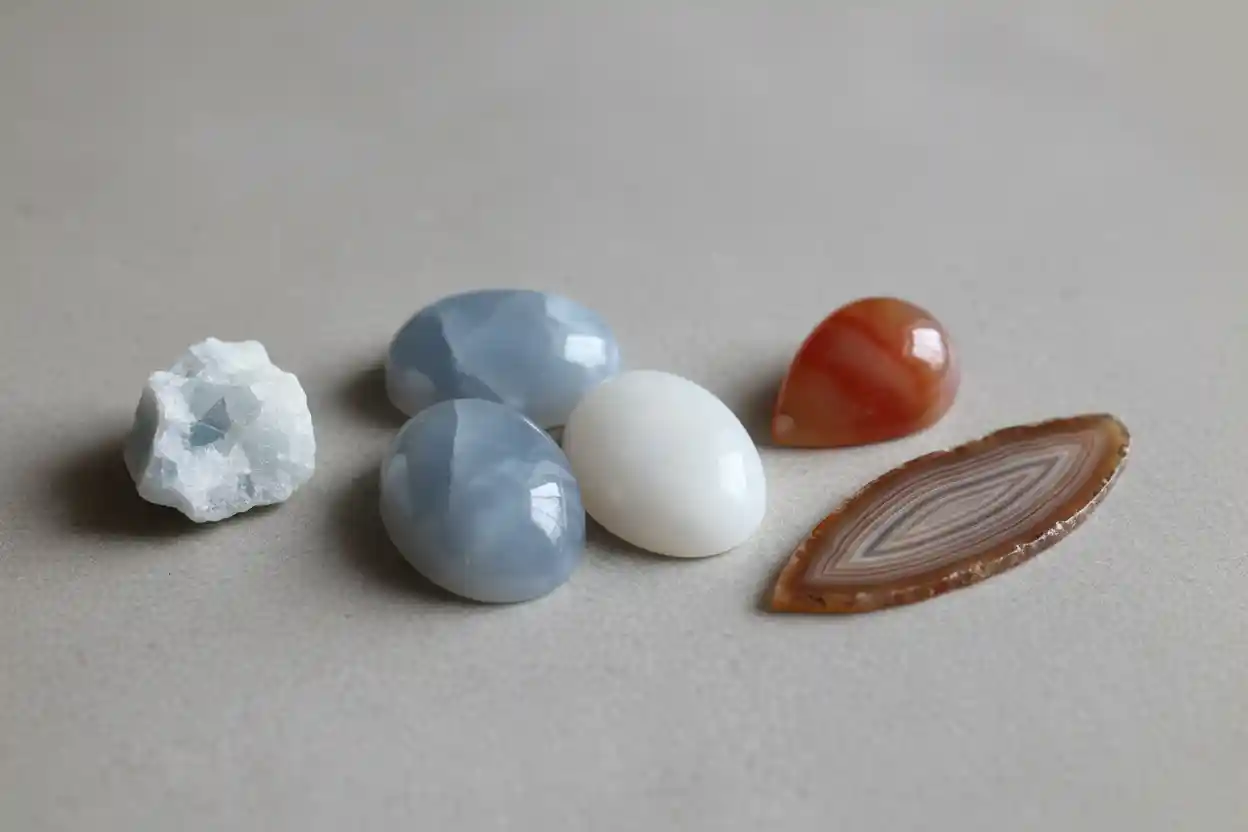
The term chalcedony also covers or relates closely to a large family of familiar gem varieties. Agate is banded chalcedony, carnelian occupies orange-to-red territory, sard is generally browner, chrysoprase is green, and onyx and sardonyx represent particular banded forms under traditional gem terminology. Jasper is closely related silica but is usually more opaque and compositionally more complex. The boundaries between commercial names can therefore depend on color, transparency, banding, inclusions, and historical naming conventions rather than a completely different basic chemistry.
Ancient Use and Geological Origins
Chalcedony has a legitimate ancient record. The Metropolitan Museum of Art holds an Egyptian chalcedony cylinder seal dated to roughly 2345–2181 BCE or later, Mesopotamian examples from the third millennium BCE onward, and Minoan chalcedony seals from the second millennium BCE. One museum record for a Kassite chalcedony cylinder seal also notes that protective properties could be attributed in the ancient Near East to both the stone and the imagery carved into seals. These objects establish long historical use and symbolism, although they should not be treated as proof that every modern chakra, emotional, or wellness claim existed in the same form in antiquity.
The name chalcedony has traditionally been linked with Chalcedon, an ancient settlement on the Bosporus, although the exact history of the gemstone term is less straightforward than simply identifying one discovery site. Chalcedony itself is not a separate modern mineral species requiring a formal type locality, so assigning it one mine as a species type locality would be misleading.
Geologically, chalcedony forms in many low-temperature silica-rich environments. It commonly lines cavities, fills fractures and veins, forms crusts, and develops as an alteration product in volcanic rocks, tuffs, breccias, and other host rocks. Silica-bearing fluids deposit microscopic quartz and related silica phases gradually, producing compact nodules, botryoidal surfaces, seams, geodes, and banded varieties. Brazil is one major commercial source, while important chalcedony of different types also comes from India, Madagascar, the United States, Turkey, Namibia, Botswana, Indonesia, and numerous other regions. The places where chalcedony is found vary because chalcedony describes a widespread mode of silica formation rather than a gemstone restricted to one deposit.
Calm, Emotional Balance, and Communication
1. Calm During Stress
Chalcedony has long acquired associations with gentleness and composure, particularly in modern crystal practice. A person can make that symbolism practical by using a stone as the cue to slow breathing, step away from an escalating conversation, or spend several minutes identifying what actually requires an immediate response.
There is no demonstrated mineral mechanism by which microscopic quartz reduces nervous-system arousal. The pause is doing the practical work. Repeatedly connecting one familiar object with a calming routine may help someone remember the routine, but the silica itself is not functioning as medication.
2. Emotional Balance
Emotional balance claims often describe chalcedony as smoothing extremes or encouraging a more even response to difficult situations. One useful ritual is to place the stone beside a journal and separate four things before reacting: what happened, what was felt, what interpretation followed, and what remains uncertain.
The stone does not regulate mood or remove distress. The chalcedony benefits described in traditional and contemporary practice are more responsibly understood as symbolic prompts when they involve behaviors that a person actually controls.
3. Clear Communication
Communication is one of the most persistent chalcedony themes, particularly around pale and blue varieties. Before a difficult discussion, someone might use the stone as a reminder to identify the main point, choose precise language, ask one necessary question, and listen fully before responding.
Chalcedony cannot alter speech centers, guarantee eloquence, or control how another person receives a message. Preparation can change a conversation. The stone can represent that preparation without being credited for the biological processes involved in speech and language.
Confidence, Clarity, and Concentration
4. Confidence in Self-Expression
Communication and confidence overlap, but they are not the same claim. A person may know what needs to be said yet hesitate to speak. Chalcedony can be used as a ritual cue before a presentation, meeting, boundary-setting conversation, creative critique, or unfamiliar social setting.
The mineral does not manufacture courage or self-esteem. Confidence develops through preparation, skill, repeated experience, and acting despite uncertainty. Short chalcedony affirmations may fit the ritual when they focus on realistic intentions such as speaking slowly, asking directly, or expressing a viewpoint without unnecessary hostility.
5. Mental Clarity
Another common claim presents chalcedony as supportive of clear thought. Instead of interpreting this as the stone changing brain activity, someone can associate it with an information-sorting habit. Write down what is known, what is assumed, what requires verification, and which decision can reasonably be postponed.
This is best treated as a metaphor rather than a mechanism. Chalcedony does not clear neural pathways. Organizing information can make a complicated situation easier to assess because the person has reduced some of the mental clutter around it.
6. Concentration and Patience
Chalcedony is also used as a focus stone during study, detailed work, or activities that require patience. A polished piece beside a notebook or computer can mark the beginning of a predetermined distraction-free work interval, with the same object used to redirect attention when the mind wanders.
No evidence shows that chalcedony directly lengthens attention span or improves memory. The ways to use chalcedony are more practical when the stone accompanies a real concentration strategy such as silencing notifications, choosing one task, and setting a clear working period.
Creativity, Compassion, and Grounding
7. Creativity and Fresh Perspective
Because chalcedony appears in so many colors, patterns, translucencies, and surface forms, it can be an engaging visual object during creative work. A writer, artist, designer, or maker might use one specimen as the beginning of a short brainstorming session, sketching exercise, color study, or free-writing period.
There is no established pathway through which chalcedony activates creativity. The ritual can still reduce the friction of beginning. A visually interesting object gives the person a concrete starting point rather than a promise that an idea will arrive automatically.
8. Compassion and Social Harmony
Traditional descriptions sometimes associate chalcedony with goodwill, fellowship, generosity, or peaceful social interaction. In contemporary practice, this can become a behavioral reminder to ask a question before assuming intent, acknowledge another person’s position accurately, or lower the temperature of an avoidable argument.
The stone does not alter another person’s feelings or make relationships harmonious. Cooperation comes from communication, boundaries, empathy, compromise where appropriate, and sometimes distance where cooperation is not healthy. Chalcedony can symbolize those intentions without controlling the people involved.
9. Grounding During Change
Some people use chalcedony when circumstances feel unsettled, even though grounding is more strongly associated with darker stones in many modern systems. A practical chalcedony ritual can focus on what remains stable: current responsibilities, available support, the next necessary action, and the parts of the situation that are genuinely controllable.
The stone does not anchor an invisible energy field. The routine works by directing attention toward immediate facts and practical choices.
Protection and Reflective Attention
10. Protective Symbolism and Boundaries
Protective meanings are not purely modern inventions around chalcedony. Ancient Near Eastern seal traditions sometimes attached protective significance to precious stone seals and their carved imagery. That historical fact shows that symbolic protection has deep cultural precedents, but it does not demonstrate a measurable shield around the wearer.
In present-day practice, protection is more useful when translated into boundaries. A chalcedony stone might represent the decision to leave a hostile conversation, refuse pressure for an immediate answer, protect personal time, or limit contact in a situation that repeatedly crosses an established boundary. The stone does not enforce the boundary. The person does.
11. Meditation and Reflective Attention
Translucent chalcedony, especially specimens with soft color gradients or botryoidal surfaces, can provide a stable visual focus during meditation. A practitioner can observe the stone for several minutes, notice when attention wanders, and deliberately return to breathing or another chosen focus.
There is no mineral mechanism that forces the brain into meditation. The practice itself develops attention. A repeated object can simply signal that it is time to enter the routine and can provide somewhere neutral to return the eyes when attention drifts.
Chakra and Spiritual Reflection
12. Chakra and Spiritual Meaning
Chalcedony does not have one universal chakra correspondence because it occurs in many colors. Blue chalcedony is most often linked with the throat chakra through communication and expression themes. Pink and some green varieties may be incorporated into heart-centered practice, while darker or earth-toned forms can appear in grounding-focused systems. Other traditions make different associations.
Chakras are a spiritual framework, not anatomical structures established by medical science. A chalcedony chakra practice therefore belongs to meditation, symbolism, religion, or personal spirituality rather than the physical treatment of glands, nerves, organs, or other body systems.
The chalcedony spiritual meaning has more historical depth than the symbolism of many recently discovered stones because chalcedony has been carved, worn, traded, and interpreted across ancient cultures. Even so, ancient seals, ornaments, and protective beliefs should not be used to claim scientific validation for modern crystal healing. Historical meaning and biological evidence answer different questions.
Safe Care for Chalcedony
Chalcedony’s hardness of about 6.5 to 7 and lack of obvious cleavage make it suitable for many forms of jewelry, beads, carvings, and handled stones. Its dense microcrystalline structure also gives massive chalcedony useful practical toughness. It can still chip after a hard impact, however, and harder gems such as topaz, sapphire, ruby, and diamond can scratch its polished surface.
Store polished pieces separately when possible, particularly if they have exposed edges or high-polish surfaces. Mild soap, lukewarm water, and a soft cloth are generally sufficient for ordinary cleaning of an untreated intact stone. Abrasive powders, aggressive scrubbing, strong acids, bleach, and sudden temperature changes are unnecessary.
Chalcedony is not classified as a hydrated mineral by its ideal SiO₂ formula, although natural chalcedony can contain small quantities of molecular water and silanol groups. Brief washing is therefore different from assuming every specimen should be soaked for hours. Dyed chalcedony, fracture-filled stones, glued pieces, jewelry settings, and unknown treatments can all make prolonged immersion less appropriate.
The practical answer to whether chalcedony is safe in water depends partly on the specific specimen. Plain water used briefly for cleaning an intact untreated stone is generally less concerning than repeated soaking, salt solutions, very hot water, acidic liquids, or immersion of treated jewelry.
Cleansing Without Unnecessary Wear
Ritual cleansing and physical cleaning are separate activities. Chalcedony does not need to be soaked in water, buried in salt, exposed to smoke, heated, or scrubbed simply because someone wants to reset its symbolic role. Sound, quiet reflection, intention-setting, or placing the stone in a clean dedicated space can all be used without creating unnecessary wear.
A bell, singing bowl, spoken intention, meditation period, or a few minutes spent reconsidering what the stone represents can mark a transition between uses. These actions do not remove a scientifically established harmful energy from chalcedony. Their meaning comes from the ritual and the attention given to it.
The gentlest ways to cleanse chalcedony are particularly useful for dyed, carved, antique, repaired, or jewelry-mounted pieces where avoiding unnecessary immersion and abrasion also protects the object itself.
Conclusion
Chalcedony is a fine-grained silica gemstone with genuine ancient use, a broad family of colors and varieties, and physical properties that made it suitable for seals, beads, carvings, jewelry, and symbolic objects across many cultures. Its twelve healing themes can still provide personally meaningful cues for calm, communication, focus, creativity, boundaries, and reflection, but those themes remain traditional or personal interpretations rather than demonstrated therapeutic properties of quartz. Its long history gives chalcedony cultural depth; responsible use keeps that history distinct from claims that require scientific evidence.
Frequently Asked Questions
What are the main chalcedony healing properties?
Popular claims include calm, emotional balance, communication, confidence, mental clarity, concentration, creativity, compassion, grounding, protection, meditation, and spiritual reflection. These are traditional or personal beliefs rather than established medical effects.
Is chalcedony really an ancient stone?
Yes. Archaeological and museum collections document chalcedony objects from ancient Egypt, Mesopotamia, the Minoan world, and other early cultures. That confirms ancient use of the gemstone but does not validate every modern healing claim.
What is chalcedony made of?
Chalcedony consists primarily of microscopic silica, SiO₂, dominated by quartz and commonly containing some moganite. Natural chalcedony can also contain small amounts of molecular water and silanol groups.
How hard is chalcedony?
Chalcedony is approximately 6.5 to 7 on the Mohs hardness scale. It has no observed cleavage and is comparatively tough in massive form, although it can still chip or fracture after a strong impact.
Is agate the same as chalcedony?
Agate is a banded form of chalcedony. Carnelian, chrysoprase, sard, onyx, and several other familiar gem names also belong within or closely alongside the chalcedony family.
Can chalcedony reduce anxiety or stress?
Chalcedony has not been shown to directly treat anxiety or produce a mineral-specific calming effect. It can be used as a reminder to begin breathing, reflection, journaling, or another deliberate calming routine.
Does chalcedony improve communication?
There is no evidence that the stone alters speech or language function. Someone may use it as a cue to prepare what they want to say, listen carefully, and pause before responding.
What chakra is chalcedony associated with?
The association usually depends on color. Blue chalcedony is most commonly linked with the throat chakra, while other colors may be assigned to different chakras in contemporary spiritual systems.
Can chalcedony go in water?
Brief cleaning with plain lukewarm water is generally reasonable for many intact untreated specimens. Long soaking, salt water, harsh chemicals, extreme heat, and immersion of dyed, glued, repaired, or mounted pieces are better avoided.
How should chalcedony be cleansed?
For ritual cleansing, sound, meditation, intention-setting, or dry placement are gentle options. Physical cleaning should be handled separately with methods appropriate to the individual specimen and any treatments it may have received.
Crystal healing claims are traditional or personal beliefs and should not replace qualified medical or mental health care.