Chalcedony Color Meaning: Symbolism, Uses & Color Guide
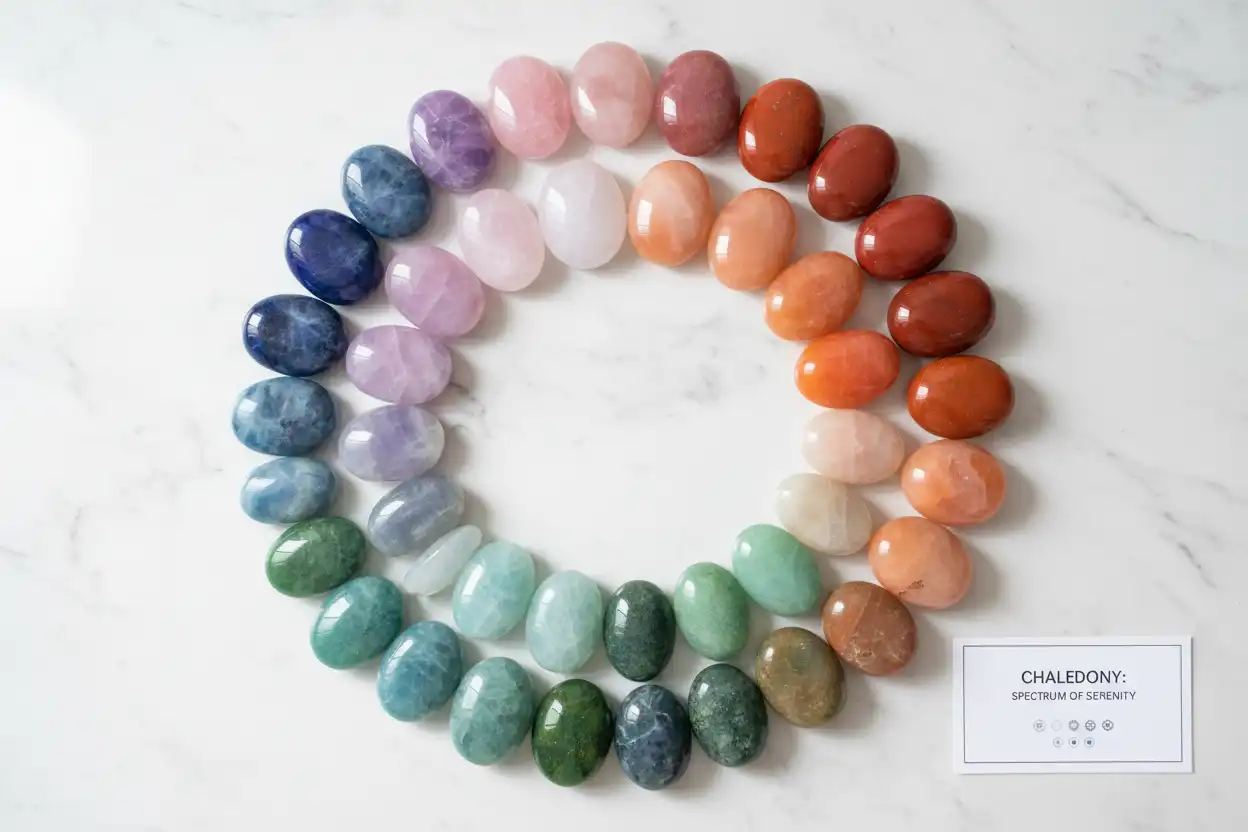
Chalcedony color meaning changes significantly from one shade to another because this fine-grained silica material occurs across an unusually broad palette, from translucent white and misty gray to blue, green, yellow, orange, red, pink, purple, brown, black, and multicolored forms. Modern crystal traditions often give each color a different symbolic emphasis, yet the physical reason a chalcedony looks blue, red, green, or black belongs to mineralogy rather than metaphysics. Trace components, microscopic inclusions, iron compounds, nickel-bearing phases, light scattering, mineral structure, and human treatment can all influence color.
That distinction is essential when interpreting chalcedony color meaning. A blue stone may symbolically represent measured communication, while green chalcedony may be associated with renewal and orange-red material with action or confidence, but none of those colors scientifically causes the emotional or spiritual quality assigned to it. Color symbolism can still be useful as a personal language for reflection, jewelry selection, gifts, meditation, or intention-setting when it is understood as interpretation rather than a measurable force.
The broader chalcedony meaning guide covers the material’s mineral identity, formation, physical properties, uses, and general symbolism. This guide concentrates specifically on chalcedony color meaning: what different colors can physically represent, how natural and treated colors differ, which recognized chalcedony varieties occupy each part of the palette, and how color symbolism can be used without confusing belief with gemology.
Chalcedony Colors at a Glance
| Chalcedony color | Common physical explanation | Familiar examples | Traditional or modern symbolism |
|---|---|---|---|
| White | Light scattering, low concentrations of coloring inclusions | Common chalcedony, pale agate | Clarity, simplicity, fresh perspective |
| Gray | Fine inclusions, scattering, dark trace material | Gray chalcedony, gray agate | Neutrality, patience, balanced judgment |
| Blue | Microscopic structural scattering and deposit-specific inclusions | Blue chalcedony, blue lace agate | Communication, listening, composure |
| Green | Nickel-, chromium-, or other mineral-related coloration | Chrysoprase, chrome chalcedony | Renewal, growth, openness |
| Yellow | Iron-bearing compounds and related inclusions | Yellow chalcedony, some agates | Optimism, discernment, confidence |
| Orange | Iron oxides and hydroxides | Carnelian, orange chalcedony | Creativity, motivation, initiative |
| Red | Concentrated iron compounds | Red chalcedony, carnelian, sard | Courage, persistence, vitality symbolism |
| Pink | Natural trace coloration or treatment | Pink chalcedony | Affection, gentleness, self-respect |
| Purple/Lavender | Natural trace/inclusion effects or treatment | Lavender chalcedony | Reflection, imagination, contemplation |
| Brown | Iron compounds, inclusions and concentrated coloration | Sard, brown agate | Stability, practicality, endurance |
| Black | Dark inclusions, concentrated coloration or dye | Black onyx, dark chalcedony | Boundaries, seriousness, protection symbolism |
| Multicolored | Layering, inclusions, banding and changing growth conditions | Agate, sardonyx, patterned chalcedony | Integration, complexity, gradual development |
This table provides a useful starting point, but chalcedony color meaning should never be used to identify a gemstone. Several different minerals can share the same color, and the same chalcedony specimen may contain more than one shade.
What Gives Chalcedony Its Color?
Chalcedony consists primarily of microscopic silica material dominated by quartz and commonly intergrown with varying amounts of moganite. Unlike transparent macrocrystalline quartz, whose individual crystals may be large enough to see easily, chalcedony is made from extremely fine interlocking structures that create its characteristic waxy appearance and diffuse translucency.
The complete types of chalcedony guide explains how those structures produce many recognized materials, including plain chalcedony, agate, carnelian, chrysoprase, onyx, sardonyx, bloodstone, and related varieties.
Color can develop in several ways. Iron compounds commonly produce yellow, orange, red, and brown. Nickel-bearing material is particularly important in chrysoprase. Chromium-bearing phases can contribute to some green chalcedony. Dark mineral matter can produce gray, brown, or black appearances, while microscopic structures and scattering effects can contribute to the soft blue seen in certain translucent material.
Color may also be modified intentionally. Chalcedony is sufficiently porous in some forms that dye can penetrate the material, making artificially intensified blue, green, pink, purple, red, or black colors commercially common.
For that reason, chalcedony color meaning and color origin are separate questions. Symbolism describes what people associate with the appearance; gemology asks why the stone physically has that appearance.
White Chalcedony Color Meaning
White chalcedony color meaning is commonly connected with clarity, simplicity, neutrality, openness, and creating a less cluttered starting point. Its pale appearance makes it particularly suited to symbolism involving a blank page or the removal of unnecessary complications.
Physically, white chalcedony may range from almost colorless and translucent to milky, cloudy, porcelain-like, or nearly opaque. Fine microscopic scattering and very low concentrations of strongly coloring inclusions can produce these pale appearances.
A practical interpretation of white chalcedony color meaning is to use the stone as a reminder to simplify a problem. When several issues have become mixed together, ask which decision actually needs to be made first and which details can wait.
This does not mean white chalcedony removes negative energy, clears toxins, or changes mental function. Its usefulness as a symbolic object comes from the behavior connected with it.
White chalcedony is especially versatile in jewelry because its neutral palette combines easily with metals, colored gemstones, pearls, and patterned materials. The color can also provide a useful background in cameos, layered carvings, or banded chalcedony.
Gray Chalcedony Color Meaning
Gray chalcedony color meaning usually emphasizes neutrality, patience, moderation, realistic judgment, and the ability to remain thoughtful when a situation is not clearly positive or negative.
Gray is visually positioned between extremes, so its symbolism naturally lends itself to questions involving ambiguity. Rather than forcing an immediate conclusion, gray chalcedony color meaning can represent gathering additional information and allowing uncertainty to exist.
Natural gray chalcedony ranges from pale silver-gray and smoky blue-gray to deeper charcoal tones. Differences in microscopic inclusions, mineral matter, translucency, thickness, and lighting can substantially change the apparent shade.
A polished cabochon may look nearly blue under cool daylight but distinctly gray under warmer indoor illumination. Color descriptions should therefore consider lighting rather than assuming that every photographed difference represents a different variety.
Gray chalcedony works particularly well in understated jewelry, signet-style pieces, minimalist cabochons, beads, and carvings where texture and polish are more important than strong saturation.
Blue Chalcedony Color Meaning
Blue chalcedony color meaning is most commonly associated with thoughtful communication, patient listening, composure, reflection, and choosing words deliberately. Among all chalcedony colors, blue has one of the strongest independent identities in both jewelry and modern crystal traditions.
The dedicated blue chalcedony meaning guide explores this variety in depth, including its mineral properties, symbolism, identification, treatment concerns, and practical uses.
Natural blue chalcedony can range from almost colorless bluish gray to sky blue, periwinkle, lavender-blue, and medium blue. Fine material often appears softly luminous rather than vividly transparent because light scatters through the microcrystalline structure.
Blue chalcedony color meaning works best when communication symbolism is connected with actual communication habits. A stone placed near a desk, journal, or meeting notes might represent listening completely before responding, verifying facts before making an accusation, or choosing language that communicates a boundary without unnecessary hostility.
Blue chalcedony does not scientifically improve speech, regulate the nervous system, or make another person communicate honestly. Its symbolism can serve as a cue, while communication skills still depend on attention, preparation, judgment, and behavior.
Readers comparing blue materials more broadly can use the blue gemstones guide to distinguish chalcedony from sapphire, aquamarine, turquoise, lapis lazuli, blue topaz, and other unrelated gems that share part of the same palette.
Green Chalcedony Color Meaning
Green chalcedony color meaning commonly focuses on renewal, growth, openness, adaptability, patience, and allowing something constructive to develop gradually.
The most famous natural green chalcedony variety is chrysoprase, whose attractive apple-green to deeper green color is associated primarily with nickel-bearing components. Other green chalcedony may have different coloring mechanisms and should not automatically be sold under the chrysoprase name.
This distinction matters because green chalcedony color meaning does not define gem identity. A stone may look green yet be dyed agate, chrome chalcedony, chrysoprase, prase, glass, jade imitation, or an entirely different mineral.
Symbolically, green can represent development without guaranteeing outcomes. A useful green chalcedony practice might involve selecting one area in which gradual improvement is realistic: learning a skill, strengthening a routine, repairing communication, organizing finances, or creating a healthier work process.
The gemstone does not make those improvements happen. Green chalcedony color meaning simply provides a visual language for intentional growth.
The wider green gemstones guide helps compare chalcedony with jade, emerald, peridot, tourmaline, garnet, aventurine, and other green materials whose durability, value, treatments, and mineral identities are very different.
Yellow Chalcedony Color Meaning
Yellow chalcedony color meaning is generally connected with optimism, practical confidence, discernment, curiosity, and bringing attention to possibilities that might otherwise be overlooked.
Natural yellow and yellow-brown colors in chalcedony commonly involve iron-bearing compounds. The shade can range from pale cream-yellow through honey, mustard, golden brown, and warmer orange-yellow transitions.
Because the boundaries between color names are subjective, one seller may describe a stone as yellow chalcedony while another calls a similar piece golden agate, yellow agate, honey chalcedony, or even pale carnelian. Mineral structure and pattern matter more than the marketing adjective.
A grounded use of yellow chalcedony color meaning is to associate the stone with constructive evaluation rather than unrealistic positivity. Optimism is most useful when it allows someone to recognize a possible solution without ignoring risk.
Yellow chalcedony cannot guarantee success, wealth, good luck, or confidence. It can represent the choice to examine both opportunities and limitations before deciding what to do.
Orange Chalcedony Color Meaning
Orange chalcedony color meaning centers on creativity, initiative, enthusiasm, confidence, warmth, and translating intention into action. This color range overlaps strongly with carnelian, one of the best-known members of the chalcedony family.
The carnelian meaning guide covers the orange-to-red variety separately because carnelian has its own established gem identity, long history of carving and jewelry use, treatment considerations, and symbolic traditions.
Orange colors commonly arise from iron compounds dispersed through the silica material. Natural stones may range from pale apricot and honey-orange to stronger red-orange, and heat can intensify the appearance of some iron-bearing chalcedony.
Orange chalcedony color meaning is particularly suited to starting behavior. Instead of interpreting the stone as a source of motivation, connect it with a small observable action: write the opening paragraph, prepare the tools, make the call, practice the first section, or complete the first defined task.
This keeps orange chalcedony color meaning practical. The color symbolizes momentum, but the person supplies the effort.
Red Chalcedony Color Meaning
Red chalcedony color meaning is commonly associated with courage, persistence, determination, commitment, and visible action. Redder carnelian and sard may occupy this part of the chalcedony palette, although trade boundaries between red, red-orange, and brown-red material are not perfectly fixed.
Iron compounds are again central to much of the natural coloration. Concentration, oxidation conditions, translucency, thickness, and treatment can all affect whether a piece appears orange, red, reddish brown, or almost dark brown.
Symbolically, red chalcedony color meaning can be used to represent courage without pretending that a gemstone removes danger or fear. Courage may mean preparing for a difficult conversation, making an informed decision despite uncertainty, admitting an error, or completing a necessary task that feels uncomfortable.
A stone cannot make an unsafe environment safe, guarantee physical strength, increase blood flow, or alter biological energy. Red chalcedony color meaning should remain a symbolic language rather than a physiological claim.
Pink Chalcedony Color Meaning
Pink chalcedony color meaning is generally associated with affection, gentleness, emotional openness, friendship, compassion, and self-respect.
Natural pink chalcedony exists, but dyed pink chalcedony is also common. Strongly saturated material therefore deserves careful examination, particularly when color appears concentrated around fractures, pits, drill holes, or more porous areas.
Pink chalcedony should not automatically be confused with rose quartz. Both are silica-rich quartz-family materials, but their structures, typical appearances, internal textures, and color mechanisms differ.
A useful interpretation of pink chalcedony color meaning focuses on affection expressed through behavior. Appreciation can mean telling someone specifically what you value. Self-respect can mean enforcing a reasonable boundary. Compassion can mean listening without automatically accepting every request.
These actions make pink chalcedony color meaning more substantive than a promise that the gemstone attracts love.
For a broader comparison of pink materials used in jewelry, the pink gemstones guide separates chalcedony from rose quartz, sapphire, spinel, morganite, tourmaline, and other pink gems.
Purple and Lavender Chalcedony Color Meaning
Purple and lavender chalcedony color meaning commonly revolves around contemplation, imagination, reflection, creativity, and approaching familiar problems from a different perspective.
Natural lavender and violet-tinged chalcedony occurs, although dyed material is also present in the market. The soft, translucent lavender-blue material seen in some deposits can overlap visually with blue chalcedony, making trade descriptions somewhat subjective.
Highly saturated purple chalcedony should not automatically be assumed natural. Dye can produce intense shades that are uncommon in untreated material, and photographs may further exaggerate saturation.
Symbolically, purple chalcedony color meaning works well as a reminder to explore alternatives before settling on the first solution. In creative work, that might mean generating several rough concepts before deciding which deserves refinement. In a personal decision, it may mean deliberately testing an assumption from another viewpoint.
The stone does not enhance imagination biologically or reveal hidden knowledge. Its color can simply represent the practice of giving thought enough room to develop.
Brown Chalcedony Color Meaning
Brown chalcedony color meaning emphasizes stability, practicality, patience, durability, realism, and attention to ordinary responsibilities.
Brown shades can develop through iron compounds, mineral inclusions, weathering products, darker structural material, or combinations of these factors. Sard occupies part of the reddish-brown chalcedony range, while many agates contain brown, tan, cream, and reddish layers.
Brown chalcedony color meaning is particularly useful when a goal depends on repetition rather than excitement. Creating a budget, maintaining equipment, organizing a workspace, practicing a skill, keeping records, or completing maintenance tasks rarely feels dramatic, yet these ordinary behaviors often create long-term stability.
The symbolism therefore favors consistency over instant transformation.
Brown material can also be visually appealing in men’s jewelry, carved objects, beads, cameos, signets, and pieces designed around earth-toned palettes.
Black Chalcedony Color Meaning
Black chalcedony color meaning is usually associated with boundaries, seriousness, restraint, protection symbolism, discipline, and knowing when to disengage from unnecessary conflict.
Black onyx is the most familiar commercial example, although perfectly uniform black chalcedony is frequently produced through dyeing. Traditional onyx refers to banded chalcedony, while much material sold as black onyx in modern jewelry is treated to create a consistent dark appearance.
The onyx meaning guide covers the material in greater detail, including the difference between mineral identity, trade naming, treatment, durability, symbolism, and jewelry use.
Black chalcedony color meaning becomes more grounded when “protection” is interpreted as boundary-setting rather than an invisible shield. Protection can mean refusing unsafe requests, protecting private information, leaving a harmful situation, using appropriate safety equipment, or limiting access to your time.
The gemstone does not scientifically block negative energy, prevent accidents, or guarantee safety. Practical precautions remain practical precautions.
For buyers choosing dark jewelry stones, the black gemstones guide compares onyx with black diamond, sapphire, spinel, tourmaline, obsidian, hematite, jet, and other materials.
Multicolored and Banded Chalcedony Color Meaning
Multicolored chalcedony color meaning differs from the symbolism of a single uniform shade because several colors, layers, or inclusions may coexist in one stone. Agate is the classic example, with bands that can record repeated episodes of silica deposition under changing chemical conditions.
The agate meaning guide explores the mineral’s layered appearance and its common symbolism involving patience, gradual development, stability, and resilience.
From a symbolic perspective, multicolored chalcedony color meaning can represent complexity without requiring every part of a situation to match. Different priorities, emotions, responsibilities, and viewpoints can coexist while still forming one larger structure.
Natural banding may contain white, gray, brown, red, orange, yellow, black, blue, or other colors. Dyeing is also widespread in agate, and treated bands can be deliberately intensified to create dramatic contrast.
Pattern should therefore be appreciated separately from claims about natural color.
How Chalcedony Color Relates to Different Varieties
Chalcedony color meaning becomes easier to understand when color and variety names are not treated as identical concepts.
Chalcedony is a broad microcrystalline silica material. Some variety names depend heavily on color, while others depend on pattern, inclusions, translucency, or a combination of characteristics.
Carnelian is defined largely by its orange-to-red appearance. Chrysoprase is green chalcedony associated with nickel-related coloration. Onyx traditionally depends on parallel banding rather than simply being black. Agate depends principally on banding, even though it can occur in many colors.
Jasper is commonly opaque microcrystalline silica rich in inclusions and can appear red, yellow, brown, green, black, or multicolored. The relationship between jasper and chalcedony is complex because gem-trade usage is broader than a strict microscopic mineralogical definition. The jasper meaning guide covers that material separately.
This is why chalcedony color meaning should not replace accurate variety identification. A color describes appearance; a gem name may describe structure, composition, texture, inclusions, or historical trade convention.
Natural Color vs Dyed Chalcedony
Treatment is one of the most important practical issues in any chalcedony color meaning guide because chalcedony has a long history of artificial color enhancement.
Dye can create or intensify blue, green, pink, purple, red, and black. The treatment may be stable enough for normal use, but it should still be disclosed because natural and treated color can occupy different market categories.
Possible visual clues include unusually intense color, concentrations around drill holes or fractures, stronger color in porous layers, pale interiors beneath damaged areas, or unnatural consistency across material that would normally show some variation. None of these observations proves treatment by itself.
Some chalcedony is also heated, particularly iron-bearing material where heat can shift or strengthen warm orange and red tones.
A treated gemstone is not automatically fake. Natural chalcedony that has been dyed remains natural chalcedony with treated color. Glass or resin made to imitate chalcedony is a different issue because the underlying material is not chalcedony.
Does Chalcedony Color Change Its Physical Properties?
Color alone usually does not create a completely different basic durability category within chalcedony. Most chalcedony varieties remain around 6.5–7 on the Mohs scale, lack conventional cleavage, and benefit from a fine-grained structure that works well for beads, cabochons, carvings, and many forms of jewelry.
However, individual stones can perform differently because color may be connected with inclusions, porosity, fractures, weathering, band boundaries, treatments, or associated minerals.
A heavily fractured dyed specimen may be less durable than a compact untreated piece even though both are chalcedony. A carving with thin projections may also break more easily than a thick cabochon.
Chalcedony color meaning therefore has almost no value for determining durability. Physical condition and structure matter much more.
How Color Affects Chalcedony Uses
Color strongly influences how chalcedony is used aesthetically.
Soft blue and gray chalcedony work naturally in understated cabochons and cool-toned jewelry. Chrysoprase and other green material can provide strong contrast against yellow or white metals. Carnelian produces warm orange and red accents, while black onyx is popular in signets, cuff links, beads, and graphic designs.
White and layered chalcedony have a particularly important history in cameos because contrasting layers allow a cutter to create a light figure against a darker background. Patterned agates may instead be cut so that bands, fortifications, plumes, moss-like inclusions, or landscape-like structures become the visual focus.
The use of the stone should follow its physical quality rather than chalcedony color meaning alone. An attractive color cannot compensate for major fractures, weak drill holes, poor polish, unstable dye, or unsuitable construction.
Choosing Chalcedony by Color
When selecting a stone primarily for appearance, begin with hue, tone, saturation, translucency, and evenness.
Hue is the basic color family: blue, green, orange, red, pink, and so on. Tone describes how light or dark the stone appears. Saturation refers to color intensity. Translucency determines how much light penetrates the material, which can have a major influence on chalcedony’s characteristic internal glow.
There is no single “best” chalcedony color. Fine blue chalcedony may be valued for even translucency and delicate color, while fine chrysoprase attracts attention through stronger green saturation. Carnelian may be preferred for a glowing orange-red appearance, whereas black onyx is often chosen for uniform dark contrast.
Color preference remains partly personal. Chalcedony color meaning can help someone choose a symbolic association, but beauty, condition, treatment disclosure, intended use, and price should remain separate considerations.
How to Buy Chalcedony Colors More Carefully
When color contributes significantly to price, ask whether it is natural, heated, dyed, coated, impregnated, reconstructed, or otherwise treated.
Request photographs in ordinary neutral lighting rather than relying only on highly saturated studio images. Examine both transmitted and reflected light when possible because translucent chalcedony can look dramatically different when illuminated from behind.
Look closely around drill holes, fractures, edges, and color boundaries. Ask whether the seller knows the geographic source and whether the locality claim is documented rather than assumed from appearance.
The dedicated guide on where to buy chalcedony focuses on authenticity, treatment disclosure, seller descriptions, condition, comparison shopping, and common red flags.
The key point is that chalcedony color meaning should never be used as evidence that a stone is natural, rare, untreated, or valuable.
Chalcedony Color Meaning and Chakra Associations
Modern chakra traditions frequently assign chalcedony colors according to the familiar color sequence used in contemporary crystal practice.
Red or dark reddish material may be linked with the root chakra, orange with the sacral chakra, yellow with the solar plexus, green and pink with the heart, blue with the throat, and purple or lavender with upper-chakra symbolism.
These associations are spiritual frameworks rather than anatomical facts. A blue chalcedony does not medically affect the throat, a green gemstone does not regulate the heart, and orange chalcedony does not influence reproductive organs or hormones.
Used responsibly, chakra symbolism can function like other reflective color systems. Someone might choose blue as a reminder to communicate clearly or green as a reminder to approach a relationship with openness.
The value lies in the intention and resulting behavior, not in a demonstrated physiological effect of the gemstone.
Chalcedony Color Meaning for Jewelry and Gifts
Color symbolism can add a personal layer to jewelry without making supernatural promises.
Blue chalcedony can be chosen for someone whose work depends on careful communication. Green may represent a new beginning or long-term growth. Orange and red can mark creativity or courage. Pink can express affection, friendship, or appreciation. Gray can symbolize calm judgment, while black can represent boundaries or commitment.
The message becomes more meaningful when it is specific.
Instead of saying, “This stone will give you confidence,” a gift might mean, “I chose this warm orange chalcedony because it reminds me of the courage you showed when you started again.”
That approach preserves chalcedony color meaning as genuine symbolism while keeping the claim grounded in the person and occasion.
Frequently Asked Questions
What is the main chalcedony color meaning?
Chalcedony color meaning varies by shade. Blue is commonly associated with communication, green with renewal, orange and red with action, pink with affection, white with clarity, gray with balance, brown with stability, black with boundaries, and purple with reflection. These are symbolic interpretations rather than scientifically proven effects.
What colors does natural chalcedony come in?
Natural chalcedony can appear colorless, white, gray, blue, green, yellow, orange, red, pink, lavender, brown, blackish, and multicolored. The exact color depends on microscopic structure, mineral inclusions, trace components, iron or nickel compounds, and other geological factors.
Is blue chalcedony naturally blue?
Natural blue chalcedony exists and may show pale blue, gray-blue, periwinkle, or lavender-blue tones. Dyed blue chalcedony also exists, so color alone cannot prove that a specimen is untreated.
What does green chalcedony symbolize?
Green chalcedony color meaning usually involves renewal, growth, openness, patience, and constructive change. These meanings belong to modern symbolism and do not mean the stone scientifically causes emotional or physical changes.
What does orange chalcedony mean?
Orange chalcedony color meaning commonly relates to creativity, initiative, motivation, confidence, and purposeful action. Carnelian occupies much of this warm orange-to-red chalcedony range.
What does pink chalcedony symbolize?
Pink chalcedony color meaning is commonly associated with affection, gentleness, compassion, friendship, and self-respect. It should not be interpreted as a guarantee that a gemstone can attract love or change another person’s emotions.
Is black chalcedony natural?
Naturally dark chalcedony exists, but uniform black onyx and other black chalcedony in commerce are often dyed. Treatment should be disclosed when known.
Does the color of chalcedony change its hardness?
Not significantly as a general rule. Most chalcedony remains around 6.5–7 on the Mohs scale, although fractures, porosity, inclusions, treatments, and individual structure can affect practical durability.
How can I tell if chalcedony has been dyed?
Possible clues include unnaturally intense color, dye concentrations around fractures or drill holes, strong color in more porous bands, or inconsistent coloration beneath damaged surfaces. These clues are not definitive, and professional gemological examination may be necessary when treatment materially affects value.
Which chalcedony color is best?
There is no universally best color. Blue chalcedony is valued for soft translucency, chrysoprase for vivid green, carnelian for warm orange-red color, agate for patterns, and onyx for dramatic contrast. The best choice depends on appearance, treatment status, condition, use, price, and personal preference.
Is chalcedony color meaning scientifically proven?
No. Chalcedony’s composition, microstructure, hardness, color mechanisms, treatments, and optical characteristics can be investigated scientifically. Chalcedony color meaning, spiritual symbolism, chakra associations, and metaphysical interpretations are cultural or personal frameworks rather than established physical effects.
Can two chalcedony colors have different meanings but the same chemistry?
Yes. Blue, gray, pink, orange, and many other chalcedony colors remain primarily silica materials even though their appearances and symbolic associations differ. Color often reflects inclusions, structural effects, trace components, or treatment rather than a completely different basic chemical composition.
Chalcedony Color Meaning in Practical Terms
Chalcedony color meaning is most useful when three separate questions remain distinct: what the stone physically is, what created its color, and what that color personally symbolizes.
Mineralogically, chalcedony is a fine-grained silica material whose colors can arise from structure, light scattering, iron, nickel-bearing components, other mineral inclusions, and treatment. Gemologically, those colors affect beauty, variety naming, market expectations, jewelry design, and sometimes price, but appearance alone cannot prove identity, origin, rarity, or untreated status.
Symbolically, chalcedony color meaning provides a flexible visual language. Blue can represent thoughtful communication, green can represent patient growth, orange can represent initiative, pink can represent affection, gray can represent balanced judgment, and black can represent deliberate boundaries. None of those meanings requires claiming that the gemstone changes biology or controls external events.
That separation makes chalcedony color meaning more useful rather than less. The real gemstone remains interesting for its chemistry, microscopic structure, colors, patterns, treatments, and long history as a carving and jewelry material, while its varied palette can still serve as a personal reminder of the qualities someone consciously chooses to practice.