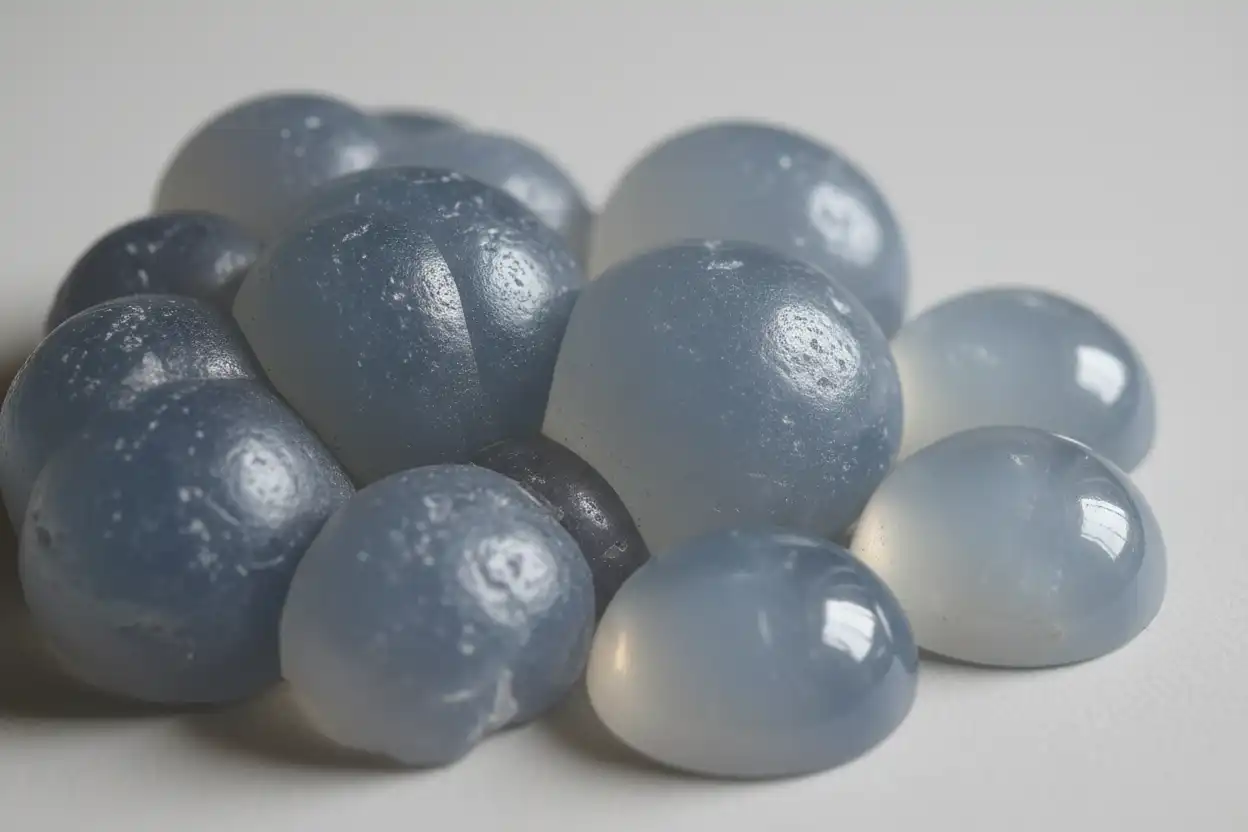
Chalcedony Meaning: Mineral Facts, History & Symbolism
Chalcedony meaning is commonly associated in modern crystal traditions with composure, communication, cooperation, emotional steadiness, reflection, and quiet confidence. Those ideas belong to symbolism rather than to measurable powers of the material. Gemologically, chalcedony is a fine-grained silica material composed predominantly of microscopic to submicroscopic quartz, commonly with variable amounts of the closely related silica phase moganite. Its nominal chemistry is SiO₂, but its texture is very different from the large visible crystals associated with rock crystal, amethyst, or smoky quartz.
That texture is central to understanding chalcedony. Instead of growing primarily as one transparent six-sided quartz crystal, chalcedony develops as tightly intergrown microscopic fibers or crystallites. The result can be translucent, cloudy, waxy-looking, banded, botryoidal, nodular, stalactitic, vein-filling, or massive. Many familiar ornamental materials—including agate, onyx in its mineralogical sense, carnelian, sard, chrysoprase, and several other trade varieties—belong within or overlap the broader chalcedony family.
A useful chalcedony meaning reference therefore needs to distinguish three things that are often blended together: the physical silica material, historical names and uses, and later symbolic interpretations. For other mineral-first references built around the same distinction, browse the Gemstone Guides.
What Is Chalcedony?
Chalcedony is a microcrystalline to cryptocrystalline silica material whose constituent crystals are too small to resolve easily with the unaided eye. It is conventionally treated as a variety or aggregate form of quartz rather than as a separate mineral species with a unique chemical formula.
Its simplified composition is:
SiO₂
That formula is useful but incomplete if interpreted too literally. Natural chalcedony can contain structural water, microscopic pores, iron compounds, clay minerals, other inclusions, and variable proportions of moganite alongside quartz.
| Property | Typical chalcedony characteristics |
|---|---|
| Material identity | Microcrystalline to cryptocrystalline silica |
| Nominal chemistry | SiO₂ |
| Principal crystalline component | Quartz |
| Common additional silica phase | Moganite |
| Common structure | Intergrown microscopic fibers or crystallites |
| Typical colors | Colorless, white, gray, blue-gray, brown, yellow, orange, red, green, black and multicolored |
| Transparency | Commonly translucent to opaque; some material is semitransparent |
| Mohs hardness | About 6.5–7 |
| Specific gravity | Commonly around 2.58–2.65 |
| Typical RI behavior | Around the mid-1.53 range in gemological testing |
| Cleavage | No prominent easy cleavage |
| Fracture | Conchoidal to uneven |
| Luster | Waxy on many natural surfaces; vitreous to waxy when polished |
| Common forms | Nodules, veins, cavity fillings, botryoidal masses, crusts and banded aggregates |
| Separate mineral species? | No; a silica variety/material |
The absence of visible quartz prisms does not make chalcedony noncrystalline. Its crystals are simply extremely small.
Chalcedony Is Not Just “Any Pale Blue Stone”
Commercial crystal markets often use the word chalcedony as though it means only softly colored blue-gray material.
Blue chalcedony is important and attractive, but the broader mineralogical term is much wider.
Chalcedony can be:
colorless;
white;
gray;
blue-gray;
brown;
yellow;
orange;
red;
green;
nearly black;
or patterned by several colors.
Some of those appearances receive more specific variety names when color, banding, inclusions, or structure meet familiar trade conventions.
The underlying silica texture remains the more fundamental identity.
Chalcedony, Agate, Jasper, and Other Names
The terminology surrounding microcrystalline silica can become confusing because some names emphasize structure while others emphasize color or opacity.
A practical hierarchy is:
Chalcedony is the broad microcrystalline silica material.
Agate generally refers to chalcedony showing characteristic banding, fortification structures, or other patterned growth.
Carnelian generally refers to translucent orange-to-red chalcedony.
Sard generally refers to darker reddish-brown chalcedony.
Chrysoprase refers to green chalcedony whose color is associated with nickel-bearing material.
Jasper is usually much more opaque and contains abundant finely dispersed mineral matter in addition to microcrystalline silica.
Natural specimens can sit between those categories.
A reddish translucent stone with obvious banding can legitimately be described as both carnelian-colored and agate-like. Trade names should communicate observable characteristics rather than pretend that nature always respects rigid commercial boundaries.
Quartz and Moganite in Chalcedony
One of the more important modern refinements to the simple “chalcedony equals quartz” definition is the recognition that chalcedony commonly contains both quartz and moganite.
Quartz and moganite share SiO₂ chemistry but differ structurally.
Their extremely fine intergrowth helps produce the distinctive microstructure of many chalcedonies.
The relative proportions can vary according to geological history, alteration, age of the material, and subsequent structural reorganization.
This does not require buyers to treat every cabochon as a two-mineral laboratory problem.
It does mean that chalcedony is structurally more interesting than simply “tiny ordinary quartz.”
Why Chalcedony Looks Waxy
Freshly broken or weathered chalcedony often has a waxy luster rather than the sharply vitreous brilliance of a large quartz crystal.
The difference arises largely from texture.
Light interacting with innumerable microscopic crystallites, pores, fibers, inclusions, and surface irregularities is scattered differently from light reflecting from one broad, smooth crystal face.
Polishing changes the interaction.
A well-polished chalcedony cabochon can develop a strong glossy surface while still preserving characteristic diffuse translucency beneath it.
Waxy rough luster and glossy polish are therefore not contradictory.
How Chalcedony Forms
Chalcedony forms when silica-bearing fluids precipitate extremely fine-grained silica within cavities, fractures, pores, veins, sediments, or other available spaces.
Silica can be transported in groundwater, hydrothermal fluids, weathering solutions, or fluids moving through volcanic rock. As temperature, pressure, pH, dissolved-ion concentration, evaporation, or host-rock interactions change, silica can become supersaturated and begin depositing.
Growth may occur in repeated stages.
A cavity can therefore preserve:
an outer layer of chalcedony;
later agate banding;
drusy macrocrystalline quartz;
iron-rich zones;
clay inclusions;
and additional mineral growth toward the center.
This layered history explains why chalcedony, agate, and crystalline quartz frequently occur together rather than representing completely unrelated geological events.
The full treatment of silica transport, volcanic cavities, hydrothermal fluids, sedimentary occurrences, replacement textures, and repeated growth stages is covered in chalcedony formation and deposit geology.
Chalcedony in Volcanic Cavities
Volcanic rocks provide some of the most familiar environments for chalcedony.
Gas bubbles trapped in cooling lava can leave cavities. Later groundwater or hydrothermal fluids carrying dissolved silica move through fractures and pores into those openings.
As silica precipitates, it can coat the cavity wall.
Repeated changes in fluid chemistry may build successive layers.
Eventually, the cavity may become:
completely filled;
partly filled;
banded as agate;
lined with botryoidal chalcedony;
or capped internally by larger quartz crystals.
The familiar hollow agate geode is therefore one possible outcome of a larger silica-deposition process.
Chalcedony Can Also Replace Earlier Material
Not all chalcedony simply fills empty space.
Silica-bearing fluids can replace earlier minerals, fossils, wood, or other materials while preserving parts of the original structure.
In petrified wood, for example, silica may replace or fill biological tissues while retaining recognizable wood texture.
The final object can contain chalcedony, quartz, opal, or combinations of silica phases depending on its geological history.
Preserved shape does not mean the original substance remains chemically unchanged.
Replacement is one of the more important ways minerals can preserve information about materials that are no longer present.
What Causes Chalcedony Color?
Pure silica is colorless.
Most chalcedony colors result from trace components, microscopic inclusions, dispersed mineral particles, structural effects, or combinations of those factors.
Iron-bearing material is responsible for many yellow, orange, red, and brown colors. Nickel-bearing phases are associated with the green appearance of chrysoprase. Dark colors can reflect iron or manganese compounds, carbonaceous matter, dense inclusions, or other causes depending on the specimen.
Blue-gray chalcedony requires particular care because its appearance can involve microscopic light scattering rather than one simple blue pigment.
A photograph cannot reliably determine the exact chromophore in every specimen.
The dedicated chalcedony color meaning guide addresses color varieties and symbolic associations, while the physical mechanisms of light scattering, absorption, refractive behavior, and translucency are developed in chalcedony optical properties and color behavior.
Why Blue Chalcedony Can Look Different Under Changing Light
Pale blue and blue-gray chalcedony can shift visually depending on:
background;
thickness;
transmitted versus reflected light;
color temperature;
surface polish;
cloudiness;
and camera processing.
A thin translucent edge may appear lighter and more luminous than the center of a thick cabochon.
Against a dark background, scattered blue light may become more obvious.
Warm indoor illumination can suppress the blue and make the stone appear gray.
This is why serious color comparison should use controlled lighting rather than screenshots from unrelated sellers.
Transparency Is Useful but Not Absolute
Chalcedony is commonly translucent, but opacity varies widely.
Fine clean material may transmit substantial light through a thin section.
Iron-rich, inclusion-rich, thick, or dark material can appear nearly opaque.
That means “translucent” supports chalcedony identification without defining every possible sample.
Jasper provides a useful comparison because it normally contains enough included mineral matter to be opaque or nearly opaque.
The boundary can become gradual in natural material.
Chalcedony Has No Prominent Easy Cleavage
Macrocrystalline quartz and chalcedony both lack prominent easy cleavage.
When chalcedony breaks, it typically produces conchoidal to uneven fracture surfaces.
This gives many rough pieces curved, shell-like breaks.
The absence of easy cleavage contributes to chalcedony’s practical durability for carving, beads, seals, cabochons, and everyday ornamental objects.
That does not make it unbreakable.
Sharp impacts can chip thin edges, fracture drill holes, or propagate pre-existing cracks.
Hardness and Everyday Durability
Chalcedony typically falls around Mohs 6.5–7.
That makes it considerably more scratch-resistant than calcite, fluorite, apatite, and many softer collector minerals.
Its fine-grained texture and lack of strong cleavage also make it comparatively forgiving in jewelry.
Durability still depends on the actual stone.
A heavily fractured chalcedony, thin carving, composite, dyed porous piece, or stone with a vulnerable mounting may perform differently from a solid untreated cabochon.
For wear-related design questions, use chalcedony setting and wear engineering rather than assuming hardness alone decides jewelry suitability.
Original Chalcedony Specimen and Photo Checklist
Use this checklist to evaluate rough chalcedony, polished cabochons, carvings, beads, and online photographs without relying on color names alone.
Look for microcrystalline texture
The body should appear dense and fine-grained rather than composed of visible large quartz crystals.
A drusy quartz coating can occur on chalcedony, but it is a later visible crystal layer rather than the chalcedony texture itself.
Examine translucency at a thin edge
Use neutral white backlighting.
Many chalcedonies transmit soft diffuse light rather than remaining completely opaque.
Compare the center with the edge
Greater thickness can make the center appear darker or more opaque.
Do not use only the thickest section to judge transparency.
Inspect the natural surface
Rough chalcedony commonly has a waxy, botryoidal, weathered, nodular, or irregular exterior.
A polished surface may look substantially more vitreous.
Look for banding
Distinct bands suggest agate structure within the broader chalcedony family.
Faint zoning does not automatically make every specimen agate.
Examine color distribution
Natural color may vary gradually rather than remain perfectly uniform.
Look for clouds, zones, spots, veins, or variations in translucency.
Inspect fractures and drill holes
Color concentrated strongly in porous areas, drill holes, or fractures can be a treatment clue.
It is not automatically proof of dye because natural staining can behave similarly.
Search for coatings
Surface-applied color, resin, wax, or other treatments may alter luster and apparent saturation.
Look for mold features in suspected glass
Bubbles, flow lines, mold seams, and unusually uniform material can suggest imitation.
The absence of obvious bubbles does not prove chalcedony.
Examine unusual inclusions under magnification
The chalcedony microscope inclusion notebook addresses fibrous texture, mineral inclusions, fractures, staining, banding, treatments, and microscopic diagnostic limits in greater detail.
Avoid destructive scratch tests
A finished object should not be damaged merely to confirm that it falls somewhere near quartz hardness.
Record dimensions and weight
Unexpected density can reveal that a supposed chalcedony object deserves additional investigation.
Preserve original labels
Locality, collector, and treatment information can be more difficult to reconstruct than the material identity itself.
Treat extraordinary provenance separately
Appearance cannot prove that a blue chalcedony came from a particular famous deposit.
Exclude metaphysical terms from identification
Descriptions such as communication stone, nurturing crystal, peace stone, healer’s chalcedony, or high-vibration silica provide no gemological evidence.
A Claim-versus-Evidence Guide to Chalcedony
| Claim | Evidence status | More accurate interpretation |
|---|---|---|
| Chalcedony is silica | Supported | Its nominal chemistry is SiO₂ |
| Chalcedony is microcrystalline | Supported | It consists of extremely fine silica crystallites |
| Chalcedony is simply one large quartz crystal | Incorrect | Its texture is an aggregate of microscopic crystallites |
| Chalcedony commonly includes quartz and moganite | Supported | Both silica structures may occur in the microcrystalline aggregate |
| Chalcedony is always blue | Incorrect | It occurs in many colors |
| Blue chalcedony gets its color from one universal blue element | Too absolute | Scattering, impurities and specimen-specific factors can contribute |
| Agate is unrelated to chalcedony | Incorrect | Agate is a patterned form within the chalcedony family |
| Carnelian is unrelated to chalcedony | Incorrect | Carnelian is orange-to-red chalcedony |
| Jasper and chalcedony have a perfectly sharp natural boundary | Too absolute | Opacity and impurity content create transitional material |
| Chalcedony cannot be dyed | Incorrect | Dye treatment is possible in sufficiently receptive material |
| Every vivid-colored chalcedony is dyed | Incorrect | Strong natural colors also occur |
| Chalcedony has good jewelry durability | Generally supported | Quartz-family hardness and lack of easy cleavage are useful, but fractures and treatments matter |
| Chalcedony scientifically improves communication | Unsupported | Communication is a symbolic association |
| Chalcedony cures emotional or physical illness | Unsupported medical claim | Silica identity does not establish therapeutic efficacy |
| Chalcedony balances chakras | Spiritual interpretation | Chakra assignments are not gemological properties |
The most useful chalcedony meaning discussion preserves this distinction between measurable material properties and interpretations applied by people.
Chalcedony Versus Macrocrystalline Quartz
Both materials are predominantly SiO₂.
The important difference is texture.
Macrocrystalline quartz forms crystals large enough to show familiar prisms and terminations. Chalcedony is composed of microscopic intergrowths that create dense masses, nodules, crusts, bands, and botryoidal surfaces.
Their hardness is broadly similar.
Their fracture behavior is broadly related.
Their appearance can be completely different.
A material can therefore share chemistry with another quartz variety without sharing its visible crystal form.
Chalcedony Versus Agate
Agate is best understood as chalcedony with characteristic patterned or banded growth.
A uniform pale blue cabochon may be called blue chalcedony.
A piece with repeated curved or angular bands may be called agate.
The distinction describes structure rather than a completely different chemistry.
Some commercial names blur the boundary, particularly when banding is faint.
The most informative listing describes both:
Translucent chalcedony with subtle agate banding.
That wording conveys more information than treating the categories as mutually exclusive species.
Chalcedony Versus Jasper
Jasper is generally more opaque and inclusion-rich.
Both are silica-rich microcrystalline materials, but jasper commonly contains enough finely dispersed hematite, iron oxides, clay, other silicates, or mineral fragments to block light and create denser visible texture.
Chalcedony is usually more translucent and internally smoother.
Natural transitions exist.
A dark red silica material can move visually between translucent carnelian, sard, and opaque jasper depending on thickness and impurity content.
When a trade boundary is gradual, transparent descriptive language is better than false precision.
Chalcedony Versus Glass
Glass can imitate chalcedony’s smooth polish, translucency, and nearly uniform color.
Possible glass clues include:
rounded gas bubbles;
flow structures;
mold seams;
highly uniform coloration;
different refractive behavior;
and lower scratch resistance in some formulations.
Natural chalcedony can still appear surprisingly uniform, and good glass may contain few obvious bubbles.
A high-value object should therefore be evaluated with gemological evidence rather than one visual shortcut.
Chalcedony Versus Chalcopyrite
The neighboring chalcopyrite meaning reference concerns a completely different material: a copper-iron sulfide mineral with metallic luster and brass-yellow color.
The similarity lies mainly in the names.
Chalcedony is silica.
Chalcopyrite is CuFeS₂.
One is typically waxy-to-vitreous and nonmetallic; the other is metallic and opaque.
This is a useful reminder that similar mineral names do not imply chemical relationship.
Treatments and Enhancement
Chalcedony has a long history as a workable ornamental material, and its microscopic porosity means some varieties can respond well to treatment.
Commercial enhancement can include:
dyeing;
heating;
impregnation;
coating;
bleaching;
sugar-acid processing in some agate-related material;
and combinations of techniques.
Not every chalcedony is treated.
Not every treatment makes a stone unsuitable.
The essential issue is disclosure when treatment materially affects color, value, identification, or care.
A natural pale chalcedony and a brightly dyed product may both be silica, yet their commercial descriptions should not pretend the appearance developed in the same way.
How to Look for Dye
Dye can sometimes concentrate in:
fractures;
porous bands;
drill holes;
surface pits;
rind material;
and zones with greater permeability.
Magnification can therefore reveal uneven penetration.
Highly saturated colors rarely encountered in natural chalcedony deserve additional attention, but unusual color is not itself proof of artificial treatment.
Spectroscopy and other laboratory methods may be required where treatment status strongly affects value.
Heating Can Change Iron-Bearing Chalcedony
Heat treatment is especially relevant to iron-colored chalcedonies such as carnelian and some agates.
Heating can alter iron-bearing phases and intensify orange or red coloration.
The silica remains natural chalcedony.
Its appearance has been modified.
That distinction matters because “natural material” and “untreated appearance” are not identical claims.
A seller should disclose treatment according to the standards appropriate to the market and stone.
Gemological Identification
A polished chalcedony can be evaluated through a combination of observations rather than one decisive property.
Useful evidence includes:
aggregate optical reaction;
refractive index around the chalcedony range;
specific gravity near the quartz-family range;
hardness;
absence of easy cleavage;
microcrystalline texture;
spectroscopy;
and microscopy.
Raman spectroscopy or X-ray diffraction can provide stronger structural evidence when a specimen is unusual or scientifically important.
Microscopic and instrumental findings should still be interpreted according to the actual question.
Confirming silica does not necessarily determine the precise trade variety, color cause, treatment history, or geographic origin.
Trade Variety Is Not the Same as Mineral Identity
A laboratory may confidently establish that a cabochon is natural chalcedony.
The commercial question might then be whether the material should be called:
blue chalcedony;
agate;
carnelian;
sard;
chrysoprase;
onyx;
or another variety.
That second question can depend on color, pattern, inclusions, opacity, and trade convention.
Material identity and variety naming therefore occur at different classification levels.
A strong description makes both levels clear.
Chalcedony’s Documented Human History
Chalcedony and related microcrystalline quartz materials have been valued for carving, beads, seals, engraved gems, tools, decorative objects, inlays, religious artifacts, and jewelry across many cultural contexts.
Their usefulness is easy to understand materially.
Chalcedony combines:
adequate hardness;
good polishability;
lack of strong cleavage;
fine uniform texture;
availability in attractive colors;
and the ability to preserve detailed carving.
These physical advantages made it suitable for small objects that needed to withstand repeated handling.
The existence of historical chalcedony objects is well established.
The meanings attached to those objects, however, must be interpreted according to their specific cultural and archaeological contexts.
Historical Use Does Not Create One Universal Meaning
A seal made from chalcedony can carry administrative, personal, religious, political, or decorative significance.
A bead may indicate ornament, trade, status, ritual use, or simply material preference.
Those meanings should not be collapsed into one claim that “ancient people believed chalcedony always represented peace and communication.”
Different societies used similar materials differently.
Likewise, older mineral names do not always correspond perfectly to modern gemological definitions.
Specific historical symbolism requires specific evidence.
Chalcedony Meaning in Modern Symbolism
Modern chalcedony meaning commonly emphasizes communication, calmness, cooperation, emotional steadiness, receptivity, and thoughtful speech.
Blue-gray varieties are especially likely to receive communication symbolism because blue is widely associated in modern crystal practice with the throat chakra and verbal expression.
A material-first interpretation can translate those themes into behavior.
A chalcedony stone might serve as a reminder to:
speak accurately rather than dramatically;
listen fully before responding;
ask for clarification;
separate observation from assumption;
reduce unnecessary conflict;
or leave space for another person’s explanation.
Those behaviors can improve communication through ordinary practice.
The silica does not need to transmit a communication frequency.
Calmness as a Symbol
Chalcedony’s smooth polish, muted colors, diffuse translucency, and rounded nodular forms often create a visually quiet appearance.
That aesthetic can make calmness an intuitive symbolic theme.
Someone might use a small chalcedony object as a cue to pause before sending an angry message, structure a difficult conversation, or return attention to one manageable task.
The symbolic association can be useful.
It should not be reframed as evidence that SiO₂ functions as a sedative or treats an anxiety disorder.
Cooperation and Group Symbolism
Because chalcedony consists of innumerable microscopic crystallites functioning together as one coherent material, it provides an interesting metaphor for cooperation.
No individual crystallite needs to dominate visually for the aggregate to be durable and recognizable.
Someone might interpret that structure as representing:
distributed contribution;
shared responsibility;
coordination;
or strength created by many small parts.
That metaphor comes from material structure.
It does not mean the mineral causes cooperation biologically or socially.
Chalcedony and the Throat Chakra
Modern crystal practices frequently connect blue chalcedony with the throat chakra.
The association is usually based on color symbolism and contemporary metaphysical frameworks rather than on mineral physics.
Gemological measurements can determine:
refractive behavior;
silica structure;
density;
optical character;
color-related absorption;
and inclusions.
They cannot measure whether a chakra is blocked, open, balanced, cleansed, or activated.
A person may still use chalcedony in a private chakra practice while identifying the practice accurately as spiritual symbolism.
Does Chalcedony Have Healing Properties?
Chalcedony should not be presented as a medical treatment.
Claims that it treats anxiety, throat disorders, inflammation, blood conditions, hormone problems, neurological disease, sleep disorders, pain, or other medical conditions are not established by identifying the stone as microcrystalline silica.
Its measurable properties describe:
SiO₂-rich composition;
microscopic texture;
hardness;
refractive behavior;
inclusions;
formation;
and color.
Those characteristics do not demonstrate therapeutic effects through ordinary contact.
A personally meaningful stone can still be used during reflection, journaling, or meditation without replacing appropriate healthcare.
Silicon and Oxygen Are Not a Treatment Through Touch
The elemental composition of chalcedony does not create a medical dose.
Silicon and oxygen are bound within a stable silica structure.
Their biological relevance in other chemical forms does not mean that holding polished chalcedony transfers useful nutrients through the skin.
Chemical form, dose, exposure route, solubility, and metabolism determine biological effects.
A gemstone formula describes identity.
It is not a medical ingredient list.
Buying Chalcedony
Purchase decisions introduce questions that should remain separate from the meaning reference:
Is the material actually chalcedony?
Is the color natural?
Has it been dyed?
Is the piece assembled?
Does the photograph represent translucency accurately?
Are cracks hidden?
Is the locality documented?
Is a specialized trade name justified?
Those questions are developed in where to buy chalcedony.
For this page, the essential buying boundary is simpler: metaphysical phrases such as “healer grade,” “communication quality,” or “high-vibration chalcedony” are not gemological quality grades.
Cutting and Polishing Chalcedony
Chalcedony is highly suitable for cabochons, beads, carving, engraving, and polished decorative surfaces.
Its fine texture generally takes a smooth polish, while the lack of prominent easy cleavage gives cutters considerable freedom compared with strongly cleavable minerals.
Orientation can still matter because of:
banding;
translucency;
pattern;
color zoning;
fractures;
rind;
inclusions;
and desired final thickness.
A cabochon cut too thick can become visually dull or dark.
A thin section may reveal more transmitted color.
A banded specimen may require careful orientation to expose its strongest pattern.
Those lapidary choices are developed in chalcedony cutting, orientation and polish.
Chalcedony in Jewelry
Chalcedony is generally practical for jewelry because quartz-family hardness and the absence of easy cleavage provide good everyday durability.
Cabochons are particularly common.
Rounded domes eliminate vulnerable facet junctions and highlight diffuse color and translucency.
Rings still experience more abrasion and impact than pendants or earrings, so protective settings and sufficient stone thickness matter.
Beads should be checked for chipping around drill holes, especially where internal fractures intersect the opening.
The broader mechanical relationship between stone geometry, exposure, mounting pressure, and wear is addressed in the mapped setting guide rather than repeated here.
Provenance Is Separate From Appearance
Chalcedony occurs widely.
Some localities develop commercially recognizable colors or textures, but visual resemblance does not prove source.
A blue chalcedony can look similar to material associated with a famous district while having formed elsewhere.
Useful provenance evidence can include:
original mine labels;
collection records;
parcel documentation;
dealer invoices;
field photographs;
specimen numbers;
and traceable ownership history.
The chalcedony provenance disclosure checklist provides a structured framework for distinguishing documented locality from inferred locality.
The stronger the premium attached to origin, the stronger the documentation should be.
Conserving Chalcedony Specimens and Objects
Chalcedony is durable enough that it is sometimes treated too casually.
A modern tumbled stone and an important antique carving do not deserve the same intervention.
Historic chalcedony objects may preserve:
carving marks;
engravings;
patina;
old polish;
wear patterns;
drill technology;
repairs;
residues;
inscriptions;
and provenance information.
Aggressive repolishing can destroy those features.
Likewise, chemical cleaning can affect dyes, coatings, adhesives, metal settings, or associated matrix.
Before altering a significant object, document its present condition.
The chalcedony specimen conservation record provides a repeatable structure for recording condition, repairs, labels, surfaces, dimensions, and subsequent changes.
Safe Ownership and Handling
Normal handling of intact chalcedony is generally straightforward.
The main safety distinction appears when quartz-rich material is cut, drilled, sanded, or ground.
Mechanical processing can create respirable crystalline-silica dust. Lapidary work should therefore control dust with appropriate wet methods where suitable, local extraction, eye protection, and suitable respiratory controls rather than uncontrolled dry grinding.
Natural material can also contain inclusions, dyes, matrix minerals, coatings, or residues not represented by the simplified SiO₂ formula.
Do not deliberately pulverize chalcedony for inhalation or ingestion.
There is also no mineralogical need to place geological specimens into drinking water to obtain symbolic benefit.
An Evidence Ladder for Chalcedony Claims
Different questions require different evidence.
Direct observation can document color, translucency, banding, surface texture, fractures, rind, pattern, and condition.
Basic gemological testing can determine whether hardness, density, refractive behavior, fracture, and aggregate optical response are compatible with chalcedony.
Microscopy can reveal fine texture, inclusions, staining, fractures, dye concentration, coatings, band boundaries, and treatment clues.
Spectroscopy can investigate color-related absorption and some treatment questions.
Raman spectroscopy can confirm silica phases and help characterize unusual material.
X-ray diffraction can investigate quartz, moganite, and other crystalline components.
Chemical analysis can identify iron, nickel, manganese, chromium, or other constituents relevant to color and inclusions.
Geological evidence can determine whether the specimen’s structure fits volcanic-cavity, hydrothermal, sedimentary, replacement, or other chalcedony-forming environments.
Provenance documentation supports mine, district, archaeological, collection, and ownership claims.
Historical evidence can demonstrate genuine use of chalcedony and related silica materials without automatically supporting modern metaphysical narratives.
Modern symbolism includes communication, calmness, cooperation, emotional balance, chakra associations, and spiritual interpretation. These are human meanings rather than intrinsic physical properties.
What Chalcedony Meaning Can Reliably Include
Chalcedony meaning becomes clearer when material identity, documented history, and modern symbolism remain separate.
Materially, chalcedony is microcrystalline to cryptocrystalline silica composed predominantly of quartz with variable moganite and minor impurities. Its nominal chemistry is SiO₂, while its extremely fine texture gives it the familiar waxy rough luster, diffuse translucency, good polishability, quartz-family hardness, and absence of prominent easy cleavage.
Geologically, chalcedony develops when silica-bearing fluids precipitate inside cavities, fractures, veins, sediments, pores, or replacement environments. Repeated episodes of deposition can create nodules, botryoidal masses, agate bands, transitional textures, and later macrocrystalline quartz growth. These real processes explain why the chalcedony family contains such extraordinary variety without requiring every color or pattern to become a separate mineral species.
Historically, chalcedony and related microcrystalline quartz materials have been used extensively for beads, seals, engraving, jewelry, carvings, decorative objects, and tools. Their durability and fine texture explain much of that practical appeal. Specific cultural symbolism, however, should be attributed only where evidence supports it rather than projected universally across every historical use.
Modern symbolism commonly connects chalcedony meaning with calm communication, cooperation, receptivity, and thoughtful expression. Its cohesive microcrystalline structure offers a useful metaphor for many small contributions creating one durable whole, while its smooth appearance can serve as a personal reminder to communicate with less unnecessary friction.
Those meanings can remain personally useful without claiming that chalcedony treats disease, alters hormones or neurological function, transmits therapeutic silica through the skin, or scientifically activates chakras.
Gems Lore explains its material-first approach on the About page. Health, metaphysical, identification, and informational limitations are set out in the Disclaimer, factual corrections or supporting mineralogical evidence can be submitted through Contact, and site data practices are described in the Privacy Policy.
Chalcedony does not need exaggerated claims to be remarkable. Microscopic silica crystallites can build durable nodules, fill volcanic cavities, preserve delicate replacement structures, produce extraordinary colors and patterns, accept detailed carving, and bridge familiar materials from agate to carnelian and chrysoprase. Chalcedony meaning is strongest when that real material story comes first and symbolism remains the human interpretation inspired by it.