12 Real Citrine Healing Claims: Deep Traditions, Verified Facts & Safe Use
Citrine healing properties are commonly described through optimism, motivation, confidence, focus, creativity, purposeful action, emotional perspective, abundance symbolism, resilience, communication, meditation, and spiritual reflection. These are real claims in the sense that people genuinely use citrine within these traditions, not proof that the claimed effects are produced by quartz itself. Citrine has not been shown to treat depression or anxiety, alter brain chemistry, create financial success, or transmit a measurable healing force through the body. Its verified identity is much simpler: citrine is the transparent yellow-to-orange variety of quartz, while the citrine meaning used in crystal practice comes from historical associations, warm color symbolism, and modern personal ritual.
Citrine Healing Properties: 12 Popular Claims
The twelve recurring themes can be kept distinct without stretching one general idea into several nearly identical benefits:
- Optimism and positive perspective
- Motivation and purposeful action
- Confidence and self-belief
- Focus and concentration
- Creativity and idea generation
- Clearer decision-making
- Emotional perspective during setbacks
- Abundance and goal-setting symbolism
- Resilience during change
- Communication and social confidence
- Meditation and reflective attention
- Chakra and spiritual reflection
These themes can be personally meaningful when citrine acts as a cue for planning, journaling, beginning a task, reviewing a decision, or setting a realistic goal. The action remains under the person’s control.
Yellow Quartz With Iron-Related Color
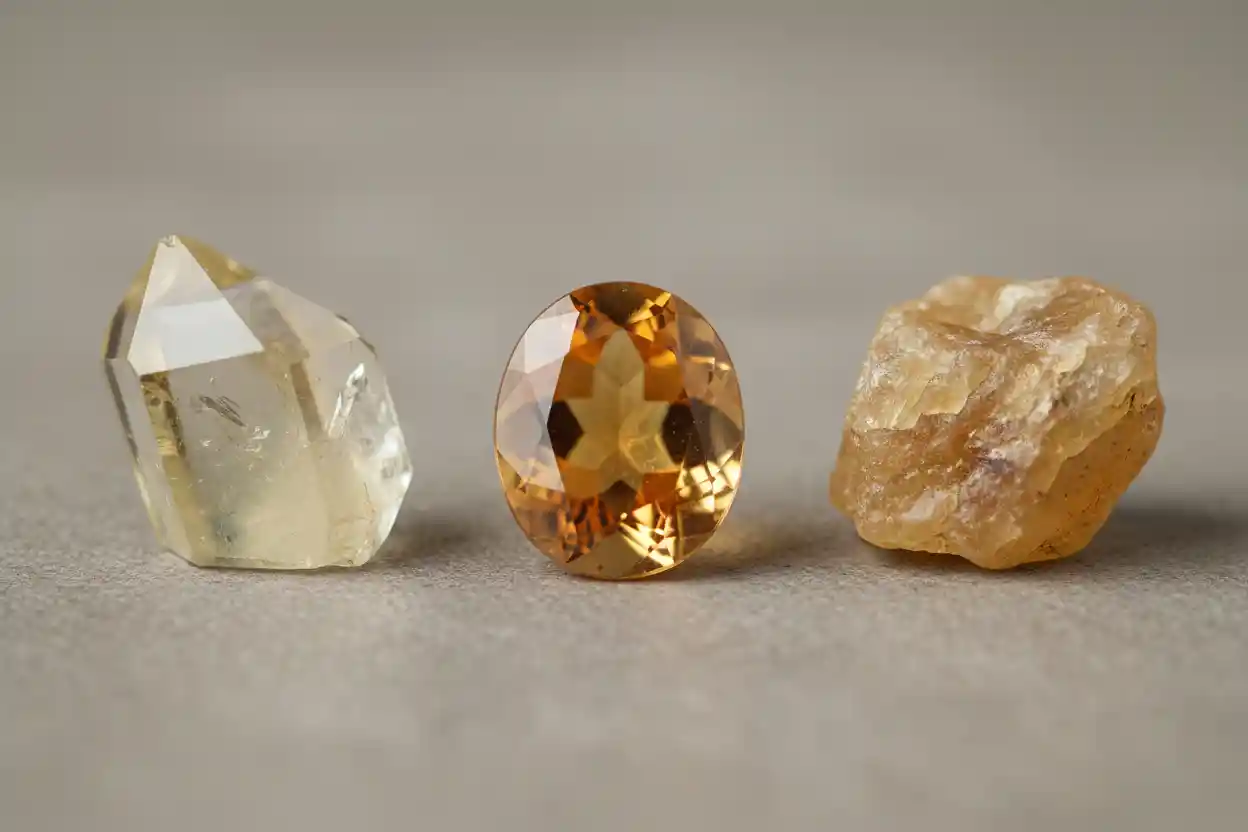
Citrine is a variety of quartz with the chemical formula SiO₂. Quartz crystallizes in the trigonal system, and gem-quality citrine ranges from pale yellow through golden yellow, brownish orange, reddish orange, and orangy red. GIA identifies trace iron as central to citrine’s yellow-to-orange coloration and places its Mohs hardness at 7.
The stone normally has a vitreous luster and can form the familiar six-sided prismatic crystals associated with quartz. Transparent faceting rough is commonly cut into oval, round, emerald, cushion, and customized shapes, while larger crystals can become carvings or display specimens. Citrine has no true cleavage, which gives it an advantage over gems such as topaz or calcite when exposed to everyday knocks, although quartz is still brittle and can chip or fracture after a sufficiently hard impact.
Natural citrine is comparatively rare. GIA notes that much of the citrine sold in today’s market began as amethyst and acquired yellow, orange, or reddish tones through controlled heating. That treatment changes color rather than turning the gem into a different mineral: the finished stone remains quartz.
This distinction matters because bright orange crystal clusters sold as citrine may sometimes be heated amethyst, while natural citrine often shows subtler yellow, smoky-yellow, or golden tones. Treatment does not automatically make a gem unsuitable, but it should not be confused with an entirely different geological origin. The citrine color meaning used in symbolic practice develops from the visible yellow and orange palette, whereas the physical colors themselves arise from quartz chemistry, trace elements, irradiation history, and sometimes heat treatment.
Citrine can be confused with yellow topaz, yellow sapphire, heliodor, glass, and other yellow gems. Before modern gemology, its warm color was indeed sometimes mistaken for topaz. Hardness, refractive properties, crystal structure, inclusions, and professional testing are more reliable than color alone when identification matters.
Historical Use Without Exaggerating the Record
Quartz has been used in jewelry for thousands of years, but the historical record for citrine specifically is more limited than the general history of quartz, agate, or amethyst. GIA reports citrine in Roman jewelry and documents its later popularity in Victorian-era ornaments, while also emphasizing that naturally yellow citrine is uncommon.
That history supports describing citrine as a gem with established traditions, but it does not prove that today’s full set of manifestation, chakra, emotional, and wellness claims existed in exactly the same form in antiquity. Modern crystal practice combines older gemstone symbolism with newer ideas about intention, meditation, prosperity, personal development, and color.
The name citrine is linked to words associated with lemon or citrus color, reflecting the gem’s yellow appearance. Because citrine is a color variety of quartz rather than an independent mineral species, it does not have a separate formal species type locality.
Natural citrine occurs in several quartz-producing regions. GIA identifies Bolivia, Spain, Madagascar, Mexico, and Uruguay among notable sources, while Brazil is particularly important for amethyst that is commonly heated to produce commercial citrine. Natural geological heating can also transform amethyst-bearing quartz toward citrine colors under suitable conditions, showing that yellow quartz can form through natural thermal processes as well as treatment. The places where citrine is found therefore include both genuine natural citrine occurrences and regions important to the wider commercial quartz trade.
Optimism, Motivation, and Confidence
1. Optimism and Positive Perspective
Citrine’s sunny yellow and orange tones have made optimism one of its most persistent modern symbolic themes. A practical use is to keep the stone near a journal and use it as a cue to record what went reasonably well, what remains possible, and which problem actually deserves attention next.
There is no mineral mechanism by which quartz creates happiness or treats low mood. The routine may still change what a person deliberately notices. That is an attention habit, not a biological effect generated by the stone.
2. Motivation and Purposeful Action
Citrine is often presented as an energizing or motivational crystal. Rather than waiting for the stone to produce drive, someone can connect it with the first concrete action in a task. Picking up the stone might mean opening a document, beginning a workout, sending one necessary message, or spending ten uninterrupted minutes on something that has been repeatedly postponed.
The stone doesn’t generate motivation. The routine built around it might reduce hesitation by making the starting point explicit. The citrine benefits described in crystal practice become more useful when they lead toward an action the user can actually take.
3. Confidence and Self-Belief
Confidence claims often connect citrine with personal power, visibility, and willingness to act. A person could use the stone before a presentation, interview, meeting, examination, or unfamiliar situation as a reminder to review their preparation rather than repeatedly seek reassurance.
Citrine does not increase self-esteem through skin contact or proximity. Confidence grows through preparation, competence, experience, support, and taking action despite uncertainty. A symbolic object can help mark that intention without causing it.
Focus, Creativity, and Decisions
4. Focus and Concentration
Citrine is sometimes kept on desks or work surfaces as a focus stone. A practical version is to associate it with one predetermined working interval. When the stone is placed beside the notebook or computer, notifications are silenced, one task is selected, and distractions are recorded rather than immediately followed.
There is no evidence that citrine directly improves memory, attention span, or cognitive processing. A consistent visual cue can still support a work routine because it reminds the user what they intended to do.
5. Creativity and Idea Generation
Warm yellow and orange stones are frequently associated with creativity, and citrine is often included in this symbolism. A writer, artist, designer, or entrepreneur might place a polished stone beside a notebook and use it to begin a timed brainstorming session in which ideas are generated before they are evaluated.
The stone does not activate creative centers in the brain. Its useful role is simpler: it marks the beginning of the exercise. The ways to use citrine are most defensible when they support real creative habits instead of promising inspiration on demand.
6. Clearer Decision-Making
Citrine is also described as promoting decisiveness and mental clarity. Someone facing a difficult choice can turn that claim into a structured review by writing down the available options, likely consequences, missing information, and decisions that do not need to be made immediately.
This is best treated as a metaphor rather than a mechanism. Quartz cannot reveal which choice is objectively correct. Slowing the process and organizing information can still reduce impulsive decision-making.
Emotional Perspective and Abundance Symbolism
7. Emotional Perspective During Setbacks
Citrine is often associated with maintaining hope after disappointment. A practical ritual might involve separating a setback into three parts: what actually happened, what can still be changed, and what conclusion would be premature to draw.
The stone does not erase disappointment or regulate mood. It can serve as a reminder that one difficult event and the interpretation placed on that event are not always the same thing. That distinction can be useful without turning a gemstone into therapy.
8. Abundance and Goal-Setting
Few citrine claims are as recognizable as abundance, prosperity, and manifestation. These ideas are usually symbolic rather than mineralogical. Citrine cannot attract money, produce customers, guarantee a promotion, change investment outcomes, or make financial opportunities appear.
The symbolism becomes more practical when abundance is translated into goal-setting. Someone might keep citrine beside a written savings goal, business plan, application schedule, or project checklist and use it as the cue to complete the next realistic step. The stone doesn’t produce the outcome. Planning and action do.
This distinction matters because hopeful ritual should not become a reason to take financial risks, ignore evidence, or expect guaranteed results. Citrine can symbolize a goal without promising that the goal will happen.
Resilience and Communication
9. Resilience During Change
Citrine is sometimes used during career changes, relocation, relationship transitions, uncertain projects, or periods when previous plans no longer apply. A useful ritual is to identify what has changed, what remains under personal control, and which immediate action would make the situation more manageable.
There is no force in citrine that creates psychological resilience. Resilience develops through coping skills, problem-solving, support, rest, experience, and professional help when needed. The stone can simply mark the decision to work with what remains controllable.
10. Communication and Social Confidence
Although citrine is not as strongly associated with communication as many blue stones, modern crystal practice sometimes connects it with confident expression, sociability, and speaking without excessive self-doubt. Before a conversation or presentation, someone can use the stone as a reminder to identify the central message and decide what actually needs to be communicated.
The mineral does not change speech centers or influence another person’s response. Preparation remains the active factor. Short citrine affirmations can fit this ritual when they describe realistic intentions such as speaking clearly, asking directly, or following through on a prepared point.
Meditation and Spiritual Reflection
11. Meditation and Reflective Attention
A transparent or richly colored citrine can provide a stable visual object during meditation. A practitioner might observe the crystal’s color, internal reflections, or natural faces for several minutes and gently return attention to the same object whenever the mind wanders.
Citrine does not force the brain into a meditative state. Meditation is the practice. A familiar stone can simply help define the beginning of the routine and provide a neutral visual point to return to.
12. Solar Plexus and Sacral Chakra Symbolism
Modern crystal practice most commonly links yellow citrine with the solar plexus chakra through themes of confidence, agency, motivation, and purposeful action. More orange specimens are sometimes associated with the sacral chakra through creativity, pleasure, and expressive energy. Different systems may place emphasis differently.
Chakras are a spiritual framework, not anatomical structures established by medical science. A citrine chakra practice therefore belongs to meditation, symbolism, religion, or personal spirituality rather than treatment of the digestive system, endocrine organs, nervous system, or other physical structures.
The citrine spiritual meaning often emphasizes optimism, generosity, prosperity, personal agency, and the willingness to act on an intention. Those interpretations can be meaningful as personal symbols without requiring quartz to alter external events or emit a measurable supernatural force.
Safe Care for Citrine
Citrine’s Mohs hardness of 7 makes it durable enough for rings, pendants, earrings, bracelets, carvings, and many everyday jewelry uses. Its lack of true cleavage also reduces the risk of clean splitting along one crystallographic plane. Even so, quartz remains brittle. A hard strike against stone, tile, or metal can chip a facet edge or fracture a gem, and harder gemstones can scratch it.
GIA recommends warm, soapy water for ordinary citrine cleaning and notes that abrupt temperature changes can cause fracture. Ultrasonic cleaning is usually acceptable for suitable untreated stones, but should be avoided when a gem is fracture-filled, dyed, heavily included, glued into a setting, or otherwise of uncertain condition.
Heat deserves particular attention because so much commercial citrine owes its color to deliberate treatment. The fact that professional heating can transform amethyst does not mean finished jewelry should be exposed casually to high temperatures. Strong heat or rapid temperature change may alter color or create fractures.
Citrine is not a hydrated mineral. Its ideal formula is SiO₂, so structural water is not required for the quartz crystal lattice. Brief contact with fresh water during normal cleaning is therefore generally reasonable for an intact untreated stone. Prolonged soaking is still unnecessary, especially for mounted, repaired, dyed, filled, or glued pieces.
The detailed answer to whether citrine is safe in water should distinguish ordinary cleaning from long ritual immersion. Salt water, boiling water, harsh cleaners, and repeated soaking offer no care advantage and may create problems for settings or treatments.
Cleansing Without Heat or Long Soaking
Ritual cleansing does not need to involve physical washing. Sound, meditation, reflection, intention-setting, or placing citrine in a clean dedicated location can all serve as symbolic reset practices without exposing the stone to unnecessary temperature changes or prolonged moisture.
A bell, singing bowl, spoken intention, or short period of quiet reflection can mark the transition between one use and another. These practices do not remove a scientifically demonstrated harmful energy from citrine. Their significance comes from the ritual itself.
The gentlest ways to cleanse citrine avoid salt burial, boiling, strong heat, chemical exposure, and unnecessary long soaking. Keeping ritual care simple also protects jewelry settings and stones whose treatment history may not be known.
Conclusion
Citrine is a yellow-to-orange quartz gemstone whose real properties come from silica chemistry, iron-related coloration, Mohs hardness 7, and a geological history that may be natural or influenced by heat treatment. Its twelve popular healing themes can provide personally meaningful prompts for optimism, motivation, focus, creativity, goal-setting, resilience, and reflection, but they remain traditional or personal interpretations rather than demonstrated therapeutic effects. Citrine is most useful in this context when its warm symbolism points toward deliberate action instead of promising results that a gemstone cannot guarantee.
Frequently Asked Questions
What are the main citrine healing properties?
Popular claims include optimism, motivation, confidence, focus, creativity, decision-making, emotional perspective, abundance symbolism, resilience, communication, meditation, and spiritual reflection. These are traditional or personal beliefs rather than established medical effects.
What is citrine made of?
Citrine is the yellow-to-orange variety of quartz and has the chemical formula SiO₂. Trace iron and related color-center processes contribute to its characteristic color.
Is natural citrine rare?
Yes. Natural citrine is relatively uncommon, and much of the citrine in the modern gem market is produced by heat-treating amethyst. The treated stone remains quartz.
How hard is citrine?
Citrine has a Mohs hardness of 7. It has no true cleavage and is reasonably durable for jewelry, although strong impacts can still cause chips or fractures.
Can citrine improve mood or motivation?
Citrine has not been shown to directly change mood or create motivation through a mineral effect. It can be used as a personal cue for planning, starting a task, journaling, or another chosen routine.
Does citrine attract money or abundance?
There is no evidence that citrine attracts money, customers, promotions, or investment gains. Its abundance symbolism can instead be used as a reminder to set goals and take realistic financial or professional actions.
Is most citrine heat treated?
A large proportion of commercial citrine is heat-treated amethyst because naturally yellow citrine is comparatively rare. Heating changes the color while the stone remains quartz.
What chakra is citrine associated with?
Modern crystal practice most commonly connects yellow citrine with the solar plexus chakra and may associate more orange material with the sacral chakra. Chakras belong to spiritual frameworks rather than anatomy.
Can citrine go in water?
Brief cleaning with fresh lukewarm water is generally reasonable for an intact untreated stone. Prolonged soaking, salt water, extreme temperatures, and immersion of filled, dyed, repaired, or glued pieces are better avoided.
How should citrine be cleansed?
For ritual cleansing, sound, meditation, intention-setting, or dry placement are gentle options. Physical dirt should be handled separately with mild cleaning suitable for quartz.
Crystal healing claims are traditional or personal beliefs and should not replace qualified medical or mental health care.