
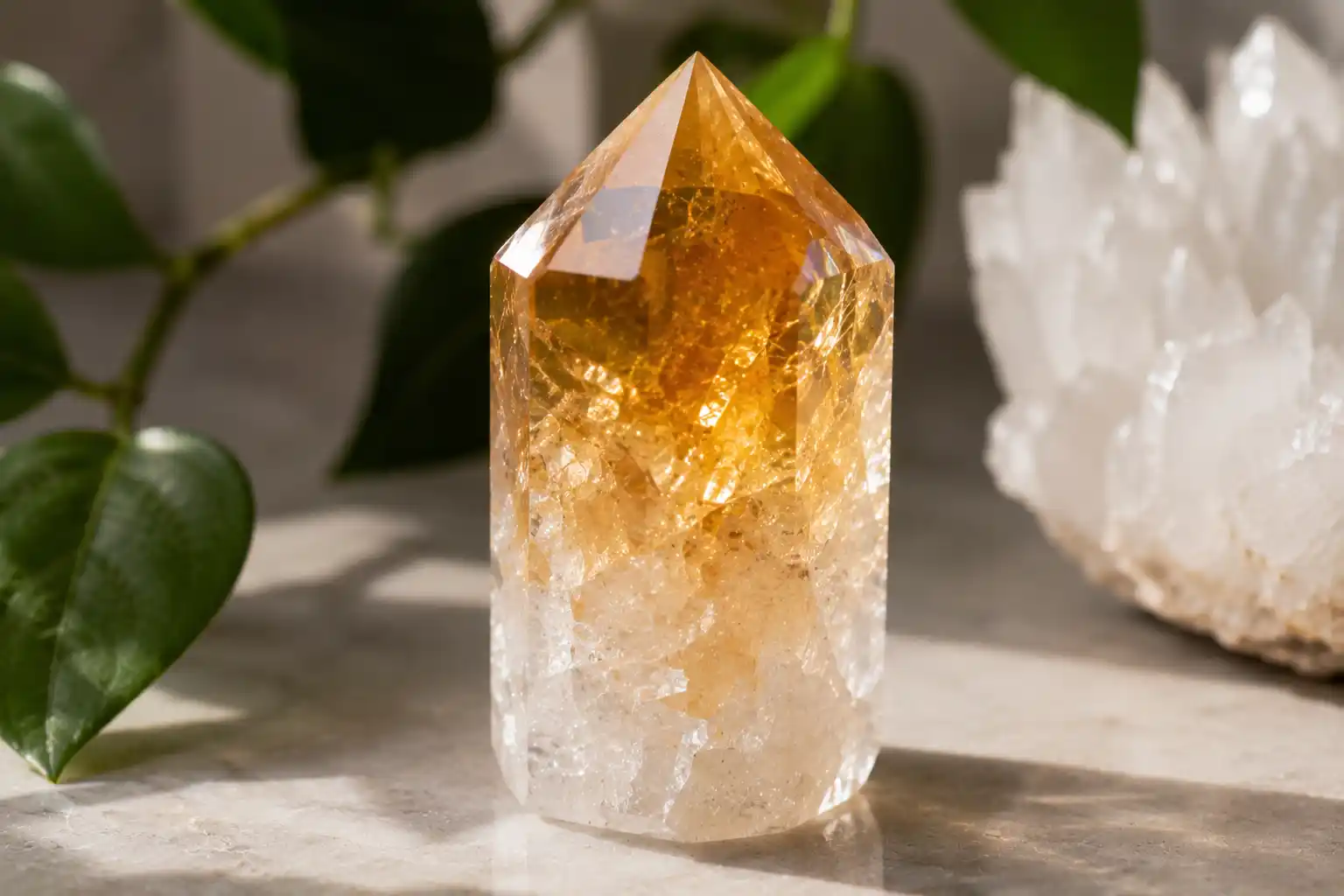

Citrine meaning centers on optimism, constructive confidence, generosity, opportunity, purposeful prosperity, creativity, and using available resources rather than waiting passively for good fortune. Its yellow-to-orange color naturally evokes sunlight, warmth, visibility, and abundance, which helps explain why citrine has become one of the best-known prosperity stones in contemporary crystal traditions.
Physically, citrine is yellow-to-orange quartz with the chemical formula SiO₂. Natural citrine exists, but it is significantly less common than the large quantity of commercial material created by heating suitable amethyst. Heat-treated amethyst remains genuine quartz; the important distinction is whether its finished color developed naturally or through human treatment.
That mineralogical distinction is essential to understanding citrine meaning. The stone can symbolize prosperity without literally attracting money. It can represent confidence without changing self-esteem biologically. It can be used during meditation, journaling, creative work, business planning, or goal setting without being presented as treatment for depression, diabetes, digestive problems, hormonal conditions, fatigue, or other health concerns.
At Gems Lore, citrine meaning is approached as constructive optimism grounded in evidence: recognize what is possible, identify the resources already available, choose an appropriate action, and remain willing to change the plan when reality provides better information.
Citrine Meaning at a Glance
| Aspect | Citrine |
|---|---|
| Main citrine meaning | Optimism, confidence, generosity, opportunity and purposeful prosperity |
| Mineral family | Quartz |
| Composition | Silicon dioxide, SiO₂ |
| Typical colors | Pale yellow, smoky yellow, honey, gold, orange and reddish brown |
| Crystal system | Trigonal |
| Transparency | Transparent to translucent |
| Mohs hardness | 7 |
| Cleavage | None in the conventional gemological sense |
| Fracture | Conchoidal |
| Toughness | Generally good |
| Common forms | Faceted gems, crystal points, clusters, beads and carvings |
| Natural color | Relatively uncommon |
| Most common commercial origin | Heat-treated amethyst |
| Other treatments | Irradiation, heating and surface coatings |
| Birthstone | November, alongside topaz |
| Traditional themes | Optimism, confidence, generosity and prosperity |
| Main chakra | Solar plexus |
| Secondary chakra | Sacral chakra for orange material |
| Main care concerns | Hard impact, treatment stability, prolonged intense heat or light |
| Medical status | No scientifically established healing effect |
| Financial status | Cannot guarantee money, sales, investments or business success |
The most useful citrine meaning treats abundance as a resource-management question rather than a promise that more money must arrive.
What Is Citrine?
Citrine is the yellow-to-orange variety of macrocrystalline quartz.
It shares its fundamental mineral identity with amethyst, smoky quartz, clear quartz, rose quartz, prasiolite, and ametrine. The wider quartz family explains how these materials can share the same basic chemistry while developing very different colors and appearances.
Its chemical formula is:
SiO₂
Quartz consists of silicon and oxygen arranged in a strong three-dimensional framework. That structure contributes to citrine’s Mohs hardness of 7, lack of prominent cleavage, good practical durability, and suitability for many jewelry designs.
Citrine meaning belongs to human culture and spiritual interpretation. The stone’s chemistry, crystal structure, treatment history, hardness, and optical properties belong to mineral science.
Keeping those categories distinct allows both to be appreciated accurately.
How Natural Citrine Forms
Natural citrine can develop when suitable iron-bearing quartz experiences geological conditions that create stable yellow, smoky-yellow, honey, or brownish-yellow coloration.
It may occur in pegmatites, hydrothermal veins, and other quartz-bearing environments.
Natural heating inside Earth can alter some iron-bearing quartz over long periods. Color centers related to iron, heat, and natural radiation can also contribute to yellow coloration.
Natural crystals are often much less dramatically orange than many commercial specimens.
They may appear pale lemon-yellow, smoky yellow, champagne, honey-colored, or brownish.
Natural material can also occur with purple amethyst zones. When recognizable purple and yellow areas occur in one crystal, the gem is known as ametrine.
The geological origin does not create citrine meaning, but it matters greatly when evaluating rarity and value.
Why Is Citrine Yellow?
Citrine’s color is associated mainly with iron-related defects and color centers within quartz.
Different combinations of iron, temperature, irradiation, and structural conditions can produce different yellow-to-orange results.
Natural citrine and heated amethyst do not necessarily owe their finished colors to identical microscopic processes.
Heating amethyst can transform purple into yellow, orange, reddish brown, or other colors depending on the starting material and treatment conditions.
Irradiation followed by heat can also modify suitable quartz.
Surface coatings create another possibility because they can produce yellow or golden appearance without changing the quartz interior itself.
That is why color alone cannot tell the entire history of a citrine.
Natural Citrine vs Heat-Treated Amethyst
This distinction is one of the most important parts of buying citrine.
Most citrine offered in crystal shops is heat-treated amethyst.
Heat-treated amethyst remains quartz. It is not automatically fake.
However, it should not be represented as naturally colored citrine when the yellow or orange color was produced through treatment.
Natural citrine commonly shows relatively pale yellow, smoky-yellow, honey, or brownish tones.
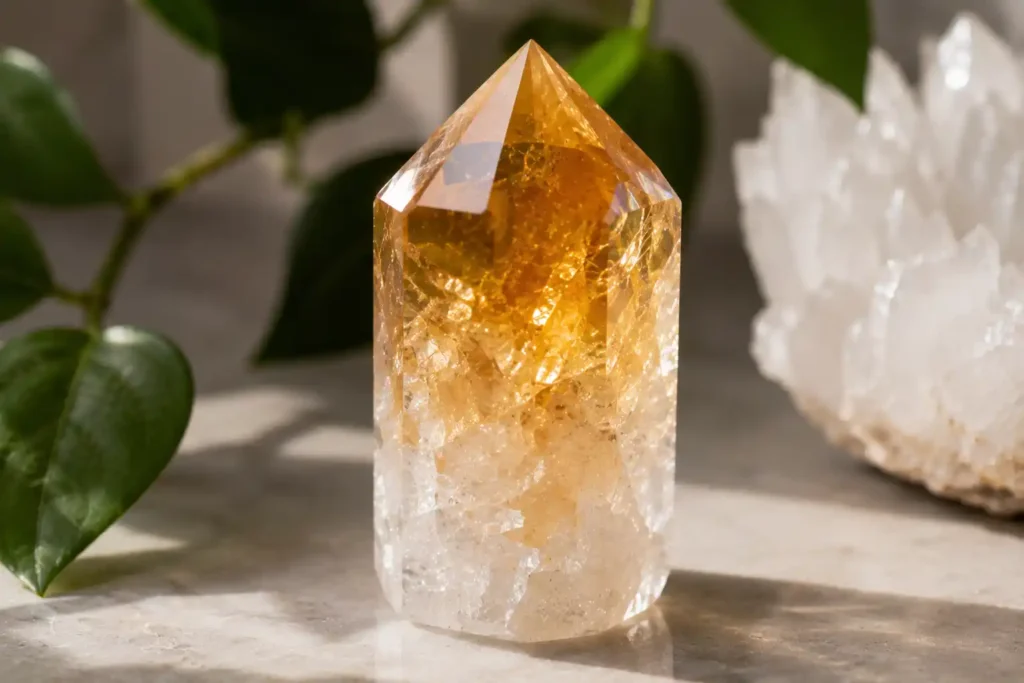
Heated amethyst clusters often develop concentrated orange or reddish-brown color near the crystal tips with pale or white quartz toward the base. Many also retain the shapes associated with amethyst geodes.
Faceted material is much harder to classify visually because cutting removes much of the original crystal habit.
The real vs fake citrine guide examines natural citrine, heated amethyst, synthetic quartz, glass, coatings, and other lookalikes in greater detail.
Treatment disclosure affects rarity and market expectations, but citrine meaning does not become invalid simply because a stone has been heated.
Is Heat-Treated Citrine Fake?
No, not when the underlying material is genuine quartz and the treatment is disclosed accurately.
Calling all heated citrine “fake” oversimplifies the market.
A better classification is:
Natural quartz + natural yellow color = natural-color citrine
Natural amethyst + human heating = heat-treated citrine
Laboratory-grown quartz = synthetic citrine or synthetic yellow quartz
Glass or another non-quartz material = imitation
These categories are materially different.
The treated citrine guide explains treatment evidence and disclosure in greater detail.
A buyer may personally prefer natural citrine because geological color origin matters to them. Another buyer may prefer an attractive heated stone at a more accessible price.
Both choices can be reasonable when the description is honest.
Citrine Meaning Through History
Yellow gemstones have long been associated with sunlight, warmth, status, prosperity, authority, and wealth.
However, historical gem names were not always used with modern mineralogical precision.
A yellow gem described as “topaz” in an older text might have been quartz, genuine topaz, beryl, or another material.
Modern gemology distinguishes citrine from other yellow gemstones through chemistry, crystal structure, optical properties, density, and other tests.
Citrine became increasingly available in jewelry as heat treatment of amethyst produced attractive yellow-to-orange quartz in substantial quantities.
Modern crystal culture later strengthened the connection between citrine meaning and prosperity, leading to names such as “merchant’s stone,” “success stone,” or “abundance stone.”
Those names reflect spiritual traditions and marketing history. They do not establish that citrine independently produces wealth.
What Does Citrine Symbolize?
The central citrine meaning is constructive optimism.
Optimism does not mean denying problems.
It means asking whether a useful option remains even when the preferred outcome is uncertain.
Suppose a business launch underperforms.
Unrealistic positivity says:
Everything will work out somehow.
A more grounded citrine meaning asks:
What did customers actually do, what resources remain, and what can be tested next?
The same principle applies to relationships, work, creativity, and finances.
Citrine meaning becomes valuable when hope encourages appropriate action rather than replacing evidence.
Citrine Meaning for Optimism
Optimism is probably the most recognizable citrine meaning.
Its bright yellow and golden color naturally reinforces the symbolism.
A simple reflection practice is to divide a page into three headings:
Problem
Resources
Next Action
Describe the difficulty accurately.
Then list resources that genuinely exist: knowledge, time, savings, tools, people, experience, information, or another practical asset.
Finally, choose one action.
This prevents citrine meaning from becoming forced positivity.
You do not have to pretend that a setback feels good.
Constructive optimism means refusing to assume that one setback eliminates every useful possibility.
Citrine Meaning for Confidence
Confidence is another major citrine meaning.
Useful confidence is evidence-based.
Before an interview, presentation, negotiation, examination, or important meeting, identify what supports your ability to participate.
What did you prepare?
Which relevant skill do you possess?
What experience applies?
Where do you still need help?
Then act using that information.
Citrine does not create confidence biologically.
Citrine meaning can instead remind you to evaluate yourself more accurately—without unnecessary self-criticism and without pretending you cannot fail.
Citrine Meaning for Self-Respect
Self-respect is an important but sometimes overlooked citrine meaning.
Prosperity symbolism should not focus only on acquiring more money.
It can also involve recognizing reasonable value.
In professional life, this might mean asking whether compensation reflects responsibility.
In relationships, it can mean declining repeated disrespect.
In creative work, it may involve acknowledging what you have actually accomplished instead of dismissing every achievement.
Self-respect is not superiority.
Citrine meaning works best when it represents standards applied consistently to yourself and others.
Citrine Meaning for Generosity
Citrine meaning also includes generosity.
This creates an important counterbalance to purely acquisitive ideas about abundance.
Prosperity is not only what you accumulate.
It can include what you are able to share responsibly.
You may share money, knowledge, introductions, time, encouragement, or practical help.
However, healthy generosity considers capacity.
Giving beyond your means can create financial pressure, resentment, exhaustion, or dependency.
Citrine meaning therefore connects generosity with sustainability rather than unlimited self-sacrifice.
Citrine Meaning for Emotional Warmth
Yellow and orange colors often carry cultural associations with warmth, sociability, visibility, and friendliness.
This contributes to citrine meaning around positive engagement.
A citrine can symbolize expressing appreciation rather than assuming another person already knows they matter.
It might remind you to participate in a conversation, acknowledge someone’s work, or initiate a reasonable social interaction.
That does not mean quietness or introversion needs to be “healed.”
The goal is authentic engagement.
Citrine meaning should not pressure someone to perform happiness or constant sociability.
Citrine Healing Properties
Citrine healing properties in contemporary crystal traditions commonly include optimism, confidence, motivation, generosity, emotional warmth, creativity, prosperity, focus, and self-respect.
Some sources extend those claims into physical health.
Citrine has been promoted for digestion, metabolism, blood sugar, diabetes, hormones, endocrine health, circulation, fatigue, immunity, and organ function.
Reliable clinical evidence does not show that wearing, holding, carrying, or displaying citrine treats those conditions.
Citrine meaning can still be used during meditation, journaling, goal setting, or another reflective practice.
The key distinction is that symbolism can influence what you choose to focus on, while the gemstone itself has not been established as a medical treatment.
What “Healing” Can Mean Without Medical Claims
The word healing is sometimes used more broadly than medicine.
Someone may describe rebuilding confidence after a failure as healing.
Another person may use the word for developing a healthier relationship with money or recovering emotionally from disappointment.
Citrine meaning can fit that symbolic use.
For example, a person rebuilding after a business setback might keep citrine beside a weekly review and ask what resources remain.
Another person might use it while practicing a boundary related to spending.
These activities have understandable behavioral mechanisms.
The stone provides a cue.
The reflection, planning, communication, and repeated behavior produce the practical result.
Citrine Meaning and Placebo Effects
A person may genuinely feel more optimistic or motivated after beginning a citrine ritual.
That subjective experience does not prove that quartz emits a prosperity or confidence energy.
Expectation, attention, sensory experience, ritual, learned association, and repeated behavior can all influence how an experience feels.
Imagine placing the same citrine beside your planner every Monday before reviewing goals and expenses.
Over time, the object itself may become associated with that routine.
That can be useful.
A responsible citrine meaning acknowledges the experience while avoiding unsupported claims about a mineral-specific medical mechanism.
Citrine Meaning for Depression and Anxiety
Citrine is sometimes marketed as a crystal that removes depression or anxiety because its bright color symbolizes optimism.
That language should be treated carefully.
Depression can involve persistent low mood, loss of pleasure, changes in sleep or appetite, impaired concentration, hopelessness, and other serious symptoms.
Anxiety can involve panic, avoidance, intrusive worry, physical symptoms, and difficulty functioning.
Citrine is not an evidence-based treatment for either condition.
If the stone feels comforting, it can remain a personal object within a wider routine.
Citrine meaning should not replace appropriate professional assessment, psychotherapy, medication, or other recommended care.
Citrine Meaning for Physical Health Claims
The yellow color of citrine has encouraged symbolic associations with the stomach, pancreas, metabolism, and solar plexus.
Color resemblance does not create a biological mechanism.
Citrine cannot regulate blood glucose.
It does not replace insulin.
It cannot treat digestive disease.
It does not correct hormonal disorders, nutritional deficiencies, or persistent fatigue.
If a physical symptom continues or becomes concerning, appropriate medical assessment matters.
Citrine meaning is safest when health symbolism becomes a reminder to take evidence-based care seriously rather than an alternative to it.
Citrine Meaning for Prosperity
Prosperity is the defining modern theme within citrine meaning.
The safest interpretation begins with resources.
Prosperity can include:
time, skills, savings, information, professional relationships, customers, equipment, housing, education, experience, or another useful asset.
Ask what already exists before focusing only on what is missing.
Then ask whether those resources are being managed effectively.
Someone may have a strong skill but never show their work.
A business may have customers but weak expense control.
A household may have sufficient income but no financial system.
Citrine meaning becomes more useful when abundance refers to responsible use of resources rather than supernatural acquisition.
Does Citrine Attract Money?
There is no reliable evidence that citrine attracts money independently.
Placing a crystal in a wallet, cash register, office, or business does not guarantee revenue.
However, a symbolic money ritual can be connected with real behavior.
Keep citrine near your financial records and use it as a cue to review expenses.
Place it beside an invoice list and follow up on overdue payments.
Keep it near your workspace and review business leads on a fixed schedule.
The citrine price guide concerns the gemstone’s actual market value, which should remain separate from prosperity claims.
Citrine meaning may symbolize abundance. Financial outcomes still depend on decisions, circumstances, risk, and other real-world factors.
Citrine Meaning for Money Management
A grounded financial interpretation of citrine meaning focuses on visibility.
Know what is coming in.
Know what is going out.
Know what obligations are due.
Know which resources are liquid and which are tied up elsewhere.
A citrine can become a reminder to conduct a regular financial review.
That is particularly useful because money anxiety often becomes worse when figures remain vague.
Seeing the numbers may reveal a problem.
It can also reveal that a feared problem is smaller than expected.
Either result is more useful than assuming a prosperity stone guarantees a favorable outcome.
Citrine Meaning for Scarcity Thinking
Citrine meaning is frequently used to counter “scarcity thinking.”
This idea needs nuance.
Sometimes people underestimate resources because attention is concentrated on what is missing.
In that case, listing available skills, contacts, tools, savings, knowledge, or options can provide perspective.
However, genuine scarcity exists.
A person may actually lack enough income, housing, food security, healthcare access, or financial flexibility.
Citrine meaning should never be used to blame someone for structural or material hardship.
Optimism does not manufacture resources that are objectively unavailable.
The responsible question is:
Which resources exist, which do not, and what support or action is realistically available?
Citrine Meaning for Business
Citrine is often called the merchant’s stone, making business one of the strongest contexts for citrine meaning.
A grounded business practice connects optimism with verification.
Before pursuing an opportunity, define:
the customer problem, the expected cost, the evidence of demand, the decision deadline, and what result would justify further investment.
Citrine may symbolize openness to opportunity.
It cannot validate an opportunity or protect against fraud.
The citrine buying guide applies that same evidence-first principle when the product being purchased is the gemstone itself.
For business decisions generally, verified data, contracts, financial records, and appropriate professional advice matter more than prosperity symbolism.
Citrine Meaning for Entrepreneurs
Entrepreneurship requires enough optimism to act under uncertainty but enough skepticism to test assumptions.
That balance fits citrine meaning particularly well.
A founder may believe strongly in a product.
Customers still decide whether they want it.
Instead of treating belief as proof, define an experiment.
Talk with potential customers.
Test pricing.
Measure conversion.
Track costs.
Review the result.
Citrine meaning can represent constructive ambition while the business process protects against wishful thinking.
Citrine Meaning for Career
In career symbolism, citrine meaning emphasizes confidence, visibility, opportunity, self-respect, and purposeful development.
A job seeker can use the stone as a cue to move from planning toward measurable action.
Update the application.
Contact the relevant person.
Prepare for the interview.
Ask for feedback.
If you are considering a promotion or salary discussion, document responsibilities and results first.
Citrine meaning should encourage prepared visibility rather than a belief that recognition is guaranteed.
Citrine Meaning for Goal Setting
Citrine is frequently used in goal-setting rituals.
The symbolism becomes much more useful when the goal has an observable endpoint.
“Become successful” is difficult to evaluate.
“Submit four suitable applications this week” is measurable.
“Make more money” is vague.
“Reduce a specific recurring expense and save a defined amount this month” creates a concrete action.
A practical citrine meaning question is:
What evidence would tell me that this goal has progressed?
If you cannot answer, the goal may need clarification before additional motivation matters.
Citrine Meaning for Decision-Making
Citrine meaning also includes purposeful choice.
Decision-making works best after enough information has been gathered.
List the realistic options.
Identify major costs and benefits.
Separate what is known from what is uncertain.
Ask which consequences are reversible and which are difficult to undo.
Then decide when additional research stops changing the picture.
Citrine cannot reveal the future.
It cannot tell you which choice is guaranteed to succeed.
The symbolism is useful at the point where endless uncertainty needs to become a reasonable commitment.
Citrine Meaning for Focus
Citrine can serve as a visual focus cue.
Choose one priority rather than displaying the stone beside a list of twenty unrelated tasks.
Use a timer if helpful.
When an unrelated thought appears, place it in a separate note and return to the selected task.
This approach gives citrine meaning a straightforward behavioral role.
The gemstone does not treat ADHD, cognitive impairment, neurological disease, or medical causes of concentration difficulty.
Its value lies in becoming part of an environment designed around the task you actually want to complete.
Citrine Meaning for Creativity
Citrine meaning also includes creativity, experimentation, and visibility.
Its prosperity reputation can sometimes create pressure to monetize every creative activity.
That is unnecessary.
Creativity can have value even when it produces no income.
Use citrine beside a rough-draft session, rehearsal, design exercise, or brainstorming period.
Delay evaluation temporarily.
Generate material first.
Then review the work using appropriate criteria.
Citrine does not create talent, but citrine meaning can mark a routine that protects enough time for practice.
Citrine Meaning for Confidence in Public Speaking
Citrine meaning fits public speaking through constructive confidence rather than guaranteed approval.
Before speaking, review what has already been prepared.
Can the audience understand the central point?
Are the examples relevant?
Have you practiced the opening?
Is the timing realistic?
Then accept that a minor mistake can happen without ruining the entire presentation.
The stone does not promise applause.
Its useful symbolism is entering the situation willing to communicate rather than trying to eliminate every possible uncertainty first.
Citrine Meaning and the Solar Plexus Chakra
Citrine is one of the stones most strongly associated with the solar plexus chakra in contemporary crystal traditions.
The yellow color matches the modern color system commonly assigned to this symbolic center.
Solar-plexus themes include agency, confidence, personal authority, boundaries, self-definition, and purposeful action.
A practical citrine meaning exercise is to identify one decision that actually belongs to you.
Then distinguish it from consequences outside your control.
You can decide whether to apply.
You cannot guarantee acceptance.
You can decide whether to ask for appropriate compensation.
You cannot force the employer’s answer.
Chakras are spiritual concepts rather than scientifically verified anatomical structures.
Citrine Meaning and the Sacral Chakra
Orange citrine is also sometimes associated with the sacral chakra.
Modern sacral symbolism includes creativity, desire, emotional movement, pleasure, preferences, and experimentation.
Citrine meaning in this context can represent allowing creativity to exist without demanding that every idea become profitable.
It can also symbolize recognizing your own preferences clearly.
The stone does not increase fertility, libido, artistic ability, or reproductive health.
Those claims should remain separate from spiritual symbolism.
Citrine Meaning in Meditation
Citrine works well as a meditation object because yellow, orange, smoky, and transparent zones provide clear visual features.
Hold a smooth stone or place it in front of you.
Notice its color, transparency, temperature, shape, and internal features.
Then choose one goal that needs action.
Ask:
What result am I actually seeking?
What evidence would show progress?
What resource is already available?
What is still missing?
What is the smallest useful action?
Finish the meditation by recording or scheduling that action.
Citrine meaning becomes stronger when reflection leads to behavior.
Citrine Meaning in Journaling
A useful citrine journaling exercise is titled:
Resources Before Results
List the skills, time, money, tools, relationships, information, and experience already available.
Then identify what the goal still requires.
Some missing resources may need to be learned.
Others can be borrowed, purchased, delegated, or replaced.
Some may reveal that the current plan is unrealistic.
Citrine meaning should allow that conclusion.
Constructive optimism is not the belief that every plan must succeed.
It is the willingness to work with reality while remaining open to better possibilities.
How to Program Citrine
Programming is a modern crystal practice in which a stone is assigned a specific intention.
It does not physically alter the quartz.
The wider guide to programming crystals explains the practice across different stones.
For citrine meaning, choose an intention that can be connected with action.
“Bring me money” places the result entirely outside direct control.
“Send three invoices by Thursday” creates a measurable behavior.
“Make my business successful” is broad.
“Review last month’s customer retention and identify one improvement” can be completed.
State the intention, write the first step, and decide when it will happen.
The association may help you remember the task. It cannot guarantee the outcome.
Citrine Meaning as a November Birthstone
Citrine shares November birthstone status with topaz.
The November birthstone tradition gives buyers two very different gemological options.
Citrine provides quartz-family durability, broad availability in larger sizes, and yellow-to-orange color at relatively accessible prices.
Topaz offers a different mineral identity, different optical properties, and perfect cleavage despite greater Mohs hardness.
Citrine meaning makes the stone especially appropriate for November gifts involving optimism, opportunity, confidence, or personal growth.
Birthstone status does not prove that a citrine is natural, untreated, or correctly identified.
Types of Citrine
The types of citrine guide separates natural colors, commercial color descriptions, treated material, and related quartz varieties.
Common descriptions include pale lemon, golden, honey, smoky yellow, orange, reddish brown, and Madeira-style color.
“Madeira citrine” is a color term referring to rich orange-to-reddish tones reminiscent of Madeira wine. It is not a separate mineral species and does not prove geographic origin.
“Lemon quartz” is another trade term often applied to bright yellow or yellow-green quartz, much of which has a treatment-related color history.
Names should describe appearance accurately rather than imply unsupported rarity.
Citrine vs Yellow Quartz
Not every yellow quartz is correctly described as natural citrine.
The yellow quartz guide separates citrine from lemon quartz, iron-stained quartz, coated material, and other yellow quartz categories.
Iron staining may occur on crystal surfaces or inside fractures rather than producing the body color expected of citrine.
Surface coatings can also create vivid or iridescent yellow effects.
Precise description matters because several materials can look broadly similar in photographs.
Citrine meaning cannot determine mineral identity.
Citrine vs Yellow Topaz
Yellow topaz is a completely different mineral.
Topaz is harder on the Mohs scale at 8, while citrine is 7.
However, topaz has perfect cleavage and may split from a sufficiently sharp impact. Citrine lacks that prominent cleavage and can therefore be more forgiving in some types of wear.
Both may occur in pale yellow, golden, or brownish colors.
Professional testing can distinguish them using optical properties, density, and other gemological measurements.
Color alone is not enough.
Citrine vs Yellow Sapphire
Yellow sapphire is yellow corundum.
It has Mohs hardness 9 and is generally more resistant to scratching than citrine.
Fine yellow sapphire can also command substantially higher prices.
Both markets include treated and synthetic material, but the treatments differ.
Citrine commonly involves heating amethyst or irradiation-related color modification, while sapphire may be heated, diffusion treated, fracture filled, or laboratory grown.
Citrine meaning and yellow-sapphire symbolism may overlap through confidence or prosperity themes, but the gemstones themselves are entirely different materials.
Citrine vs Heliodor
Heliodor is yellow-to-golden beryl.
Its chemistry, density, refractive properties, and crystal structure differ from quartz.
Pale heliodor and natural citrine can appear quite similar in photographs.
Home scratch testing is not a sensible way to distinguish valuable stones.
Reliable seller disclosure or professional gemological testing is safer.
Citrine meaning should never be used as an identification test simply because one yellow stone “feels” different from another.
Where Citrine Is Found
Natural citrine has been reported from Brazil, Madagascar, Bolivia, Zambia, Namibia, Russia, Spain, and other quartz-producing regions.
Brazil is particularly important to the commercial citrine market because it produces enormous quantities of quartz and amethyst, including material later heated to produce citrine-like color.
Bolivia is well known for ametrine combining purple amethyst and yellow citrine zones.
Geographic origin can be difficult to determine once rough has been cut.
A locality name should not be treated as proof that color is natural.
Documented provenance matters when origin substantially affects price or collecting interest.
Citrine Quality Factors
Citrine quality is usually evaluated through color, clarity, cut, size, treatment, and condition.
Color
Attractive citrine ranges from pale yellow through honey and gold to orange and reddish brown.
Natural color can be rarer, but rarity does not make every pale natural stone more attractive than every heated stone.
Judge beauty and origin separately.
Clarity
Faceted citrine is often eye-clean.
Internal veils, crystals, or zoning may be acceptable when they do not dominate the stone or threaten durability.
Cut
A well-cut citrine should distribute light effectively across its face.
A large transparent window through the center can make a stone look washed out.
Size
Large clean quartz is relatively available.
That means carat weight alone does not create exceptional rarity.
Treatment
Natural, heated, irradiated, coated, and synthetic categories should be described accurately.
Condition
Chips, facet-edge wear, fractures, scratches, or repaired carvings can reduce desirability.
These physical factors determine quality more directly than citrine meaning.
How to Tell if Citrine Is Real
Start by separating two different questions:
Is the material quartz?
Is its color natural, treated, or laboratory produced?
That distinction is important because heat-treated amethyst is real quartz even though the final yellow color was produced by treatment.
The real vs fake citrine guide covers the complete authenticity process.
Obvious glass may contain round bubbles, curved flow features, or molded characteristics.
Synthetic quartz can be much harder to identify without gemological testing.
Strong orange crystal tips over white bases commonly suggest heated amethyst, although appearance alone is not conclusive for every specimen.
Avoid destructive scratch, flame, or chemical tests.
Citrine Treatments
Heating is the dominant treatment in the citrine market.
Suitable amethyst can become yellow, orange, or reddish brown after controlled heating.
Irradiation followed by heating can also create yellow color in certain quartz.
Surface coatings may produce vivid yellow, orange, or iridescent effects.
Laboratory-grown yellow quartz also exists.
The treated citrine guide explains these categories in detail.
Treatment can be stable and commercially acceptable.
The issue is whether the seller describes it honestly.
Citrine meaning does not scientifically become stronger because the color is untreated, although geological naturalness may be personally important to some buyers.
Buying Citrine
The citrine buying guide is useful when choosing loose stones, clusters, carvings, or jewelry.
Ask whether the color is natural, heated, irradiated, coated, or uncertain.
Inspect the stone under neutral lighting rather than relying only on highly saturated photographs.
For faceted gems, request dimensions as well as carat weight.
Check for windowing, excessive depth, chips, and facet wear.
For crystal clusters, examine the base, color distribution, crystal habit, damage, and repairs.
When shopping remotely, the buying gemstones online guide explains seller descriptions, return policies, photographs, treatment disclosure, and common warning signs.
Citrine Value
Citrine is generally affordable because quartz is abundant and treated material is widely available.
Documented natural citrine with attractive color, transparency, provenance, and strong cutting can command a premium.
Designer workmanship, precious metal, historic significance, or exceptional lapidary cutting can also contribute significantly to the final price.
Large size alone does not guarantee high value.
The citrine price guide examines market factors more closely.
Citrine meaning should remain separate from market value.
A seller describing a stone as unusually powerful, abundant, or “high vibration” has not demonstrated a gemological reason for a higher price.
Citrine Jewelry
Citrine works in rings, pendants, earrings, bracelets, and statement jewelry.
Its Mohs hardness of 7 provides useful scratch resistance for many forms of wear.
The gemstone hardness chart provides comparisons with other jewelry stones.
Hardness is not the same as toughness. The distinction is explained in gemstone toughness vs hardness.
Quartz has no prominent cleavage but can still chip along facet edges, crystal points, or existing fractures.
Pendants and earrings usually encounter less impact than exposed rings and bracelets.
Citrine Bracelets
A citrine bracelet can keep citrine meaning visible during the day as a reminder of confidence, optimism, or financial awareness.
Bead size, drill-hole quality, stringing material, clasp construction, and fit all affect practical durability.
Bracelets frequently strike desks and other surfaces.
Inspect them periodically for chipped beads or stretched elastic.
There is no scientifically established need to wear citrine on a particular wrist to attract money or activate an energetic effect.
Choose the side that is comfortable and practical.
Citrine Earrings
Citrine earrings are a comparatively protected jewelry format.
Faceted citrine can show bright golden color in studs and drops, while larger stones remain relatively affordable because quartz is available in substantial sizes.
For pairs, judge visible color, dimensions, cut, and brightness together.
Perfect internal matching is not always necessary.
Earrings can represent citrine meaning personally, but wearing the gemstone near the head does not scientifically improve confidence, mood, or decision-making.
How to Clean Citrine
For most sound uncomplicated citrine, use warm water, mild soap, and a soft brush or cloth.
The detailed process appears in how to clean citrine jewelry.
Rinse briefly and dry thoroughly.
Avoid strong household chemicals, aggressive abrasives, rapid temperature changes, and unnecessary steam.
Use extra caution with fractures, coatings, glue, dyed components, plated metal, elastic, or assembled jewelry.
Citrine meaning has no effect on cleaning requirements.
The physical gemstone and jewelry construction determine safe care.
Can Citrine Go in Water?
Solid untreated citrine generally tolerates brief contact with clean water during normal cleaning.
That does not mean prolonged soaking is beneficial.
Jewelry may contain materials that react differently from quartz.
Coatings, glue, cord, plated metal, or fractures can make conservative cleaning preferable.
Do not place citrine directly in drinking water or prepare gemstone elixirs.
A stone being washable does not establish that it is suitable for ingestion.
Citrine and Sunlight
Some natural and treated quartz colors can fade or change after prolonged intense exposure to light or heat.
That does not mean ordinary daylight wear is automatically harmful.
The greater concern is long-term display on a bright hot windowsill or repeated exposure to high heat.
Store valuable specimens away from prolonged intense sunlight when possible.
Citrine meaning does not require solar charging.
A symbolic practice should not expose a gemstone unnecessarily to conditions that may alter its appearance.
How to Cleanse Citrine Spiritually
Spiritual cleansing is optional and different from physical cleaning.
The how to cleanse citrine guide covers material-conscious approaches.
Sound, visualization, intention, or another low-risk ritual can be used if it has personal meaning.
Citrine does not mineralogically require energetic cleansing.
There is no need to soak it in saltwater, expose it to prolonged intense sunlight, bury expensive jewelry, or use another physically risky method.
A simple reset of the intention can serve the same symbolic purpose.
Combining Citrine With Other Crystals
Citrine is frequently combined with clear quartz, smoky quartz, amethyst, pyrite, and carnelian.
The symbolism varies.
Carnelian can represent action and creativity, making it a natural companion to citrine meaning when optimism needs to become a first step.
Smoky quartz may represent perspective and grounding.
Clear quartz is often used for clarity or intention.
There is no reliable evidence that crystal combinations amplify wealth or healing energy.
Physical compatibility matters more than metaphysical pairing.
Rough edges and harder materials can scratch polished surfaces, while some minerals require much more conservative exposure to water or humidity.
Citrine Safety and Ingestion
Citrine should be used externally.
Do not swallow stones.
Do not grind citrine into powder for spiritual remedies.
Do not prepare drinking water by soaking the gemstone.
Quartz-family material can produce respirable crystalline-silica dust during cutting, grinding, or drilling, which creates a serious occupational hazard.
Commercial material may also contain coatings, polishing residues, metals, dyes, adhesives, or environmental contaminants.
Lapidary work should use appropriate wet processes, dust control, eye protection, and other suitable safety practices.
Historical or spiritual use does not establish ingestion safety.
What Citrine Meaning Can and Cannot Do
Citrine meaning can provide symbolic language for optimism, confidence, generosity, opportunity, self-respect, creativity, resource awareness, and purposeful prosperity.
It can remind you to review finances.
It can mark the beginning of a work session.
It can represent a decision to approach a situation constructively.
It can accompany journaling or meditation.
It can symbolize gratitude for resources already available.
Citrine meaning cannot guarantee money.
It cannot make a business profitable.
It cannot determine investment outcomes.
It cannot cure depression or anxiety.
It cannot regulate blood sugar, metabolism, hormones, digestion, circulation, fertility, or immunity.
It cannot make another person offer you a promotion, buy from you, or accept a proposal.
The strongest citrine meaning connects hope with a practical action while leaving the outcome open to evidence.
Frequently Asked Questions
What is citrine meaning?
Citrine meaning centers on optimism, confidence, generosity, creativity, opportunity, resource awareness, and purposeful prosperity.
What are citrine healing properties?
Traditional citrine healing properties include confidence, optimism, motivation, self-respect, creativity, generosity, focus, and abundance symbolism. These are spiritual associations rather than scientifically established medical treatments.
What does citrine mean spiritually?
Spiritually, citrine meaning emphasizes constructive optimism, personal agency, generosity, opportunity, confidence, and using available resources deliberately.
Is citrine scientifically proven to heal?
No. Citrine has not been scientifically established as a treatment for physical or mental-health conditions.
Does citrine attract money?
No reliable evidence shows that citrine independently attracts money. Citrine meaning can instead be connected with real financial behaviors such as budgeting, invoicing, saving, planning, or reviewing expenses.
Why is citrine called the merchant’s stone?
Modern crystal traditions associate citrine with commerce, prosperity, opportunity, and business success, leading to names such as merchant’s stone or success stone. These are symbolic titles rather than guarantees of profit.
Does citrine bring good luck?
Citrine meaning is often connected with favorable opportunity and optimism, but the gemstone does not alter probability or guarantee a favorable event.
Is citrine good for confidence?
Confidence is one of the main citrine meaning themes. A practical use is to let the stone remind you of preparation and evidence supporting your ability to participate.
Is citrine good for motivation?
Citrine meaning includes motivation, but the stone does not biologically supply mental or physical energy. It can serve as a cue to begin a planned task.
Is citrine good for creativity?
Creativity is commonly included in citrine meaning. It can be used symbolically during drafting, experimentation, rehearsal, or other creative routines.
What chakra is citrine associated with?
Citrine is most strongly associated with the solar plexus chakra. Orange stones are also sometimes linked with the sacral chakra in modern spiritual traditions.
Does citrine increase fertility?
No. Citrine does not increase fertility, alter hormones, or improve reproductive health through crystal use.
Does citrine treat depression or anxiety?
No. Citrine is not an evidence-based treatment for depression, anxiety, or another mental-health condition.
Is citrine a November birthstone?
Yes. Citrine shares November birthstone status with topaz.
Is citrine a type of quartz?
Yes. Citrine is the yellow-to-orange variety of macrocrystalline quartz.
Is natural citrine rare?
Natural citrine is much less common in the commercial market than heat-treated amethyst sold as citrine.
Is most citrine heat-treated amethyst?
A large proportion of commercial citrine consists of amethyst heated to produce yellow, orange, or reddish-brown color.
Is heat-treated amethyst fake citrine?
No. It remains genuine natural quartz, but its color is treated and should be described accordingly.
What is Madeira citrine?
Madeira citrine is a trade color description for rich orange-to-reddish citrine. It is not a separate mineral species or proof of geographic origin.
What is the difference between citrine and yellow topaz?
Citrine is quartz with Mohs hardness 7. Yellow topaz is a separate mineral with hardness 8 and perfect cleavage. Their density and optical properties also differ.
How can I tell if citrine is real?
Determine both whether the stone is quartz and whether its color is natural, treated, coated, or laboratory produced. Visual clues can help, but important stones may require professional gemological testing.
How much is citrine worth?
Value depends on natural versus treated color, attractiveness, transparency, cut, size, condition, provenance, craftsmanship, and the finished jewelry. Large size alone does not make citrine rare.
Can citrine go in water?
Most solid uncomplicated citrine tolerates brief washing with clean water. Avoid unnecessary soaking when treatments, fractures, glue, elastic, leather, or sensitive metals are present.
Can citrine go in drinking water?
No. Do not prepare direct crystal elixirs or ingest citrine particles.
Can sunlight fade citrine?
Prolonged intense light or heat can alter some natural or treated quartz colors. Normal daylight wear is different from continuous exposure on a bright windowsill.
Does citrine need spiritual cleansing?
No mineralogical process requires spiritual cleansing. Cleansing is an optional symbolic practice, and low-risk methods are preferable.
Is expensive citrine spiritually stronger?
No. Price reflects gemological quality, treatment status, natural rarity, craftsmanship, provenance, and market demand rather than scientifically measurable spiritual strength.
Citrine Meaning as Constructive Prosperity
Citrine meaning has become closely associated with abundance because yellow-to-orange quartz naturally evokes sunlight, warmth, confidence, visibility, and opportunity.
The symbolism becomes more useful when prosperity is treated as a practice rather than a promise.
Money has to be managed.
Opportunities need evaluation.
Confidence needs preparation.
Creativity needs time and repeated work.
Generosity needs limits.
A business needs customers, revenue, cost control, and sound decisions rather than a gemstone placed near the register.
At the same time, citrine is worth understanding beyond metaphysical symbolism. It is a durable quartz gemstone, a November birthstone, a popular jewelry material, and a market where natural color, heat-treated amethyst, irradiated quartz, coatings, synthetic material, and imitations can coexist.
Accurate identification and treatment disclosure allow each stone to be valued for what it actually is.
If citrine meaning matters personally, choose one theme and connect it with an action.
For optimism, identify one realistic possibility.
For abundance, list the resources already available.
For confidence, review your preparation.
For prosperity, strengthen one financial habit.
For creativity, make the first version.
The gemstone can mark the intention.
You still provide the judgment, effort, and follow-through that give the intention practical value.
Disclaimer: Citrine meaning, healing properties, chakra associations, prosperity symbolism, luck beliefs, and other metaphysical interpretations come from historical, cultural, and contemporary spiritual traditions rather than established medical or financial science. Citrine should not be used to diagnose or treat physical or mental-health conditions, regulate blood sugar or hormones, replace healthcare or financial advice, guarantee money, sales, investments, employment, or business success, or prepare drinking-water remedies.