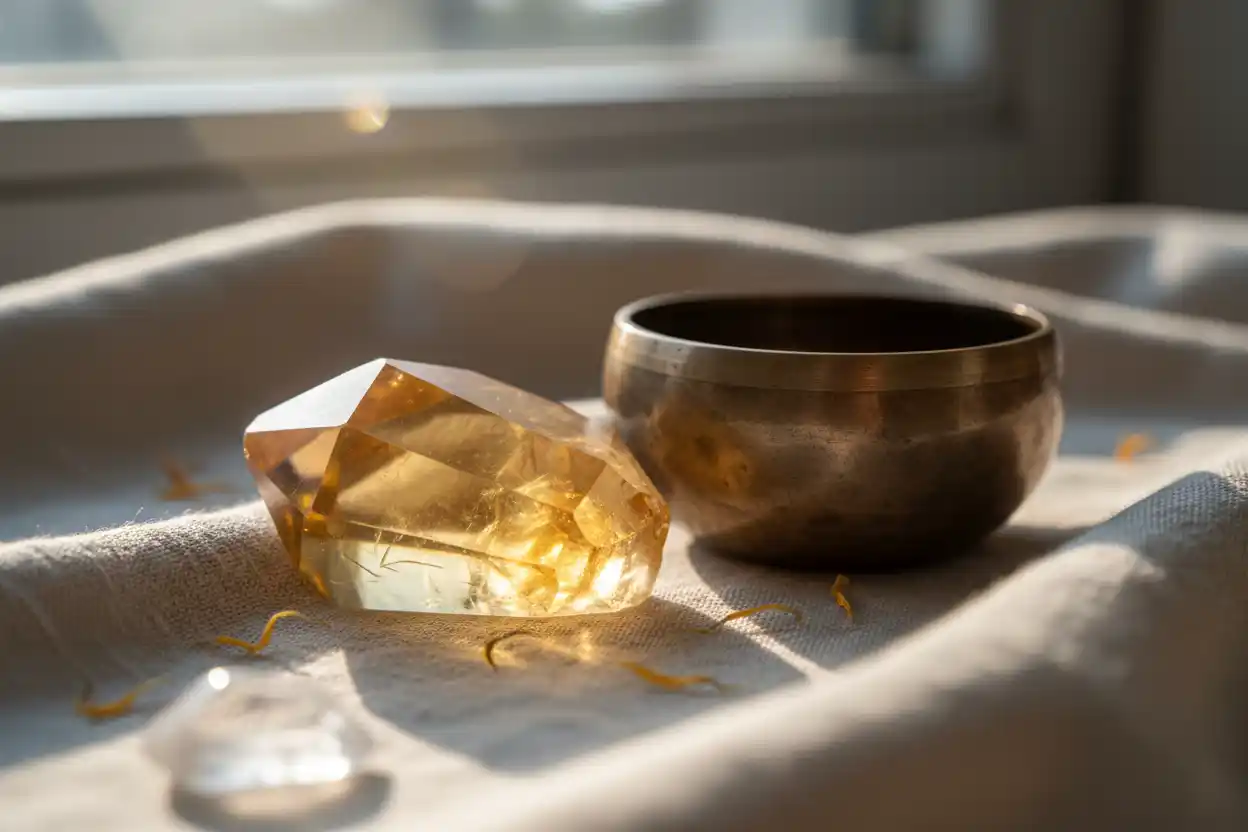
How to Cleanse and Charge Citrine
The safest ways to cleanse and charge Citrine are sound, intention, visualization, gentle breath, indirect moonlight, and a brief lukewarm-water rinse when the stone is physically sound. These methods avoid prolonged intense sunlight, steam, high heat, salt deposits, abrupt temperature changes, and unnecessary contact with harder objects.
Citrine does not require spiritual cleansing for gemological reasons. Cleansing and charging are personal rituals used to mark a transition, establish an intention, or prepare an object for meditation or mindful use.
What Cleansing and Charging Mean
Crystal cleansing generally refers to symbolically releasing previous associations or preparing a stone for a new purpose.
Charging usually means connecting it with an intention, routine, value, or personal reminder.
These practices do not change Citrine’s chemical formula, hardness, treatment history, or measurable physical energy. Their significance comes from the ritual and the intention assigned by the practitioner.
The gemstone’s mineralogy, yellow-to-orange color, localities, and cultural symbolism belong to the broader Citrine guide. Its position within the mineral family appears in the Quartz guide.
Why Citrine Still Needs Material-Specific Care
Citrine is transparent yellow-to-brownish-orange quartz. It ranks 7 on the Mohs scale, has good toughness, and lacks pronounced cleavage.
| Property | Ritual implication |
|---|---|
| Mineral species | Quartz |
| Typical color | Pale yellow to brownish orange or reddish orange |
| Mohs hardness | 7 |
| Toughness | Good |
| Cleavage | None |
| Safest ritual methods | Sound, intention, visualization, breath, and indirect moonlight |
| Water exposure | Brief contact is generally suitable for sound material |
| Sunlight exposure | Avoid prolonged intense exposure |
| Heat exposure | Avoid |
| Main risks | Color fading, thermal shock, filling, dye, coatings, glue, and setting damage |
The gemstone hardness chart explains why Citrine withstands many routine scratches but can still be marked by harder gemstones.
Scratch resistance does not prevent every fracture or chipped edge. The distinction appears in Gemstone Toughness vs Hardness and Gemstone Cleavage Explained.
Most Commercial Citrine Has Been Heated
Natural Citrine is uncommon. Much of the material in the commercial market began as Amethyst and was heated to create yellow, orange, or reddish-brown color.
Some Smoky Quartz may also produce Citrine-like color through controlled heat treatment.
Heating is normally stable during ordinary wear. However, the treatment history explains why Citrine should not be deliberately placed near flames, steam, radiators, heated ritual bowls, or intense lamps.
The treatment-identification workflow belongs to How to Spot Treated or Synthetic Citrine, while the wider enhancement framework appears in Gemstone Treatments Explained.
A cleansing ritual should never be used to test whether Citrine is natural or heated.
Inspect the Citrine Before Beginning
Examine the stone beneath bright, indirect light.
Look for surface-reaching fractures, chipped points, damaged facet junctions, cloudy glue, peeling coatings, loose prongs, worn drill holes, stretched elastic, and color concentrated inside fissures.
Natural color zoning and inclusions are not dirt. Do not scrape or press against them.
Large heated Amethyst clusters sold as Citrine cathedrals can contain fragile points, matrix, repairs, and color concentrated near the crystal tips. They should remain on a stable padded base during any ritual.
When treatment or construction is uncertain, choose sound, intention, or visualization rather than water or direct contact.
Physically Clean Dirt Separately
Symbolic cleansing does not remove skin oil, cosmetics, dust, or setting residue.
The complete physical-care method belongs to How to Clean Citrine Jewelry Safely.
A sound Citrine can normally be washed with warm water, mild liquid soap, and a soft brush. Dyed, coated, fracture-filled, glued, or damaged material requires more conservative care.
Dry the stone completely before beginning a symbolic ritual or returning it to storage.
Machine-cleaning boundaries appear in Which Gemstones Can Go in an Ultrasonic Cleaner?, although ultrasound is unnecessary for spiritual cleansing.
Method 1: Cleanse Citrine with Sound
Place the Citrine on a folded cloth or padded tray.
Ring a singing bowl, bell, chime, or tuning fork nearby. You may also hum, chant, clap gently, or play calm music.
Do not place a faceted gem or crystal cluster directly inside a hard metal bowl while striking it. Contact and concentrated vibration can chip points or damage a setting.
Several gentle sound cycles are sufficient. The ritual does not become more effective through greater volume.
Sound is especially useful for jewelry containing glue, filler, delicate metalwork, or companion stones with stricter care limits.
Method 2: Use Intention
Leave the Citrine on a padded surface or hold a smooth piece loosely above a cloth.
Choose one clear purpose. It might serve as a reminder to complete a financial task, begin a creative project, maintain confidence during a presentation, or approach work with consistency.
State the intention silently or aloud.
A concise behavioral intention is usually easier to connect with the object than a long list of abstract outcomes.
Return the Citrine to its storage place or wear it after the ritual.
Method 3: Use Visualization
Place the Citrine where it cannot roll or fall.
Imagine previous associations fading while its yellow-to-orange color becomes linked with the purpose you selected.
Some practitioners visualize golden, white, amber, or neutral light. The imagery is symbolic rather than a physical emission from the quartz.
Continue for several breaths or a few minutes.
Visualization is suitable for valuable, treated, fractured, glued, or mounted Citrine because it requires no direct contact.
Method 4: Use Breath Carefully
Keep the stone resting on a soft cloth.
Take several slow breaths and exhale gently toward it once or twice.
Avoid forceful blowing or visible condensation, particularly around open fractures, drill holes, and jewelry settings.
State the chosen intention after the breath ritual.
This method works well when no tools, outdoor exposure, or additional minerals are available.
Method 5: Use Indirect Moonlight Indoors
Place Citrine indoors near a window on a padded tray or inside an open lined jewelry box.
An hour, an evening, or overnight indoor placement may be used according to personal preference.
Outdoor placement is unnecessary. Dew, rain, animals, falling debris, theft, and abrupt temperature changes create practical risks.
The moon phase affects personal symbolism rather than the gemstone’s physical properties.
Indirect moonlight also avoids the concentrated light and heat discussed in Which Crystals Can and Can’t Go in the Sun.
Method 6: Use a Brief Water Ritual
A sound, untreated or stably heated Citrine can be rinsed briefly in clean lukewarm water.
Hold it securely over a bowl rather than an open drain. Dry it immediately with a soft lint-free cloth.
Do not soak the stone for hours or overnight.
Avoid water rituals for fracture-filled, dyed, coated, glued, strung, antique, or visibly damaged pieces. The complete jewel—not the quartz alone—determines whether immersion is appropriate.
The wider environmental distinction belongs to Which Crystals Can and Can’t Go in Water.
Method 7: Place Citrine Near Clear Quartz
Some practitioners use Clear Quartz as a symbolic companion for charging other quartz varieties.
The material profile belongs to the Clear Quartz guide.
Place the stones beside each other on a lined tray rather than stacking them directly.
Both minerals have Mohs hardness 7, so their points and polished edges can abrade one another when hard grit becomes trapped between them.
A soft cloth barrier protects the surfaces without changing the symbolic arrangement.
Method 8: Use a Written Intention
Write one concise statement and place it beside or beneath the padded Citrine.
The statement might describe a concrete action, such as finishing one overdue task, reviewing a budget weekly, or devoting uninterrupted time to a project.
Leave the arrangement in place for several minutes or an evening.
Keep pens, staples, clips, and rough decorative items away from the gemstone.
A written ritual can be repeated when the purpose changes without exposing the Citrine to light, water, salt, or smoke.
Citrine, Amethyst, and Ametrine
Citrine and Amethyst are both quartz varieties associated with iron-related color centers, although their colors and treatment histories differ.
The Amethyst-specific ritual workflow belongs to How to Cleanse and Charge Amethyst.
Ametrine contains purple and yellow-to-orange zones in one quartz crystal. Its dedicated ritual appears in How to Cleanse and Charge Ametrine.
All three can use sound, intention, visualization, indirect moonlight, and cautious water contact when the individual stone is suitable.
None should be deliberately heated as part of a cleansing or charging practice.
Avoid Prolonged Direct Sunlight
Some Citrine color can fade after prolonged exposure to intense light.
A sunny windowsill may also become significantly warmer than the surrounding room.
Brief daylight during normal wear differs from leaving a gemstone in concentrated sun for many hours.
Do not attempt to strengthen pale color through sunlight. Light exposure cannot convert low-saturation quartz into fine Citrine and may create fading instead.
Avoid Steam, Flame, and High Heat
Steam combines heat, pressure, and rapid temperature change.
Abrupt temperature changes can cause Citrine to fracture, while high heat may alter its color.
Keep the stone away from candles, fireplaces, incense flames, boiling water, saunas, heated bowls, radiators, and repair torches.
A brief sound or visualization ritual provides the intended symbolism without thermal risk.
Avoid Direct Salt Contact
Dry salt can become trapped around prongs, inside fissures, between cluster points, and within drill holes.
Saltwater adds prolonged moisture and can affect metal, glue, elastic, stringing, filler, and accompanying stones.
Do not bury faceted Citrine or a crystal cluster in coarse salt.
When salt has personal symbolism, keep it in a separate bowl while the Citrine remains on a lined dish nearby.
Avoid Soil Burial
Soil contains Quartz grains, mineral debris, moisture, fertilizers, microorganisms, and organic acids.
These materials can scratch polished surfaces, become lodged in a cluster, and affect metal settings.
Outdoor burial also creates risks of loss, weather exposure, and accidental impact.
A nature-based alternative places the Citrine near a plant without contact with soil or water.
Use Smoke Cautiously
A brief cool-smoke ritual may be used in traditions that include it.
Keep the Citrine away from flames, hot ash, incense coals, and heated containers. Move smoke around the object rather than carrying the gemstone close to a burner.
Smoke may leave soot, oil, or fragrance residue that requires physical cleaning.
Sound and intention offer cleaner alternatives for jewelry worn against the skin.
Buying, Value, and Authentication Context
The Citrine buying guide covers natural color, heated Amethyst, hue, tone, zoning, cut, clarity, size, and seller disclosure.
Market factors belong to the Citrine price guide.
The full range of natural, heated, smoky, lemon-colored, reddish, and trade-name material appears in Types of Citrine.
The complete authentication workflow belongs to Real vs. Fake Citrine.
Citrine shares November birthstone status with Topaz, covered in the November birthstone guide.
Whether a stone is natural, treated, synthetic, or imitation does not prevent it from holding personal meaning. Its ritual care should still follow its actual material and construction.
Frequently Asked Questions
1. What is the safest way to cleanse Citrine?
Sound, intention, visualization, breath, and indirect indoor moonlight are the lowest-risk methods.
2. Can Citrine be cleansed in water?
A sound stone can be rinsed briefly in lukewarm water. Avoid soaking filled, dyed, coated, glued, strung, or fractured pieces.
3. Can Citrine be charged in sunlight?
Prolonged intense sunlight is not recommended because some color can fade and the stone may become hot.
4. Can Citrine be left in moonlight overnight?
Yes, when kept indoors on a padded surface away from condensation and temperature changes.
5. Can Citrine be cleansed with salt?
Direct salt contact is best avoided because grains can lodge in fissures, settings, and cluster surfaces.
6. Can Citrine be cleansed with smoke?
A brief cool-smoke ritual is possible, but sound or intention avoids soot, heat, and fragrance residue.
7. Can Clear Quartz charge Citrine?
Some practitioners use it symbolically. Separate the stones with a soft cloth to prevent equal-hardness quartz surfaces from rubbing.
8. Can heat charge Citrine?
No. Heat may alter color and abrupt temperature changes can cause fractures.
9. Is heated Amethyst still Citrine?
Heated Amethyst is widely sold as Citrine in the gem trade, although natural Citrine has a different geological color history.
10. How long should Citrine charge?
A few minutes, an evening, or overnight indoors can serve the ritual. There is no objective minimum.
11. How often should Citrine be cleansed?
Use a schedule that fits your practice. Repeated exposure to water, sunlight, or smoke is not physically necessary.
12. Does cleansing change Citrine scientifically?
No established evidence shows that cleansing alters Citrine’s chemistry, health effects, or measurable physical energy.
Conclusion
Citrine does not need intense sunlight or elaborate exposure to support a meaningful personal ritual. Sound, intention, visualization, and protected moonlight preserve its yellow-to-orange color while avoiding heat, salt, and unnecessary soaking. A safe ritual gives the object a clear purpose without physically changing the quartz.
Crystal cleansing and charging are spiritual or personal practices, not scientifically established methods for changing health, energy, or the physical properties of Citrine.